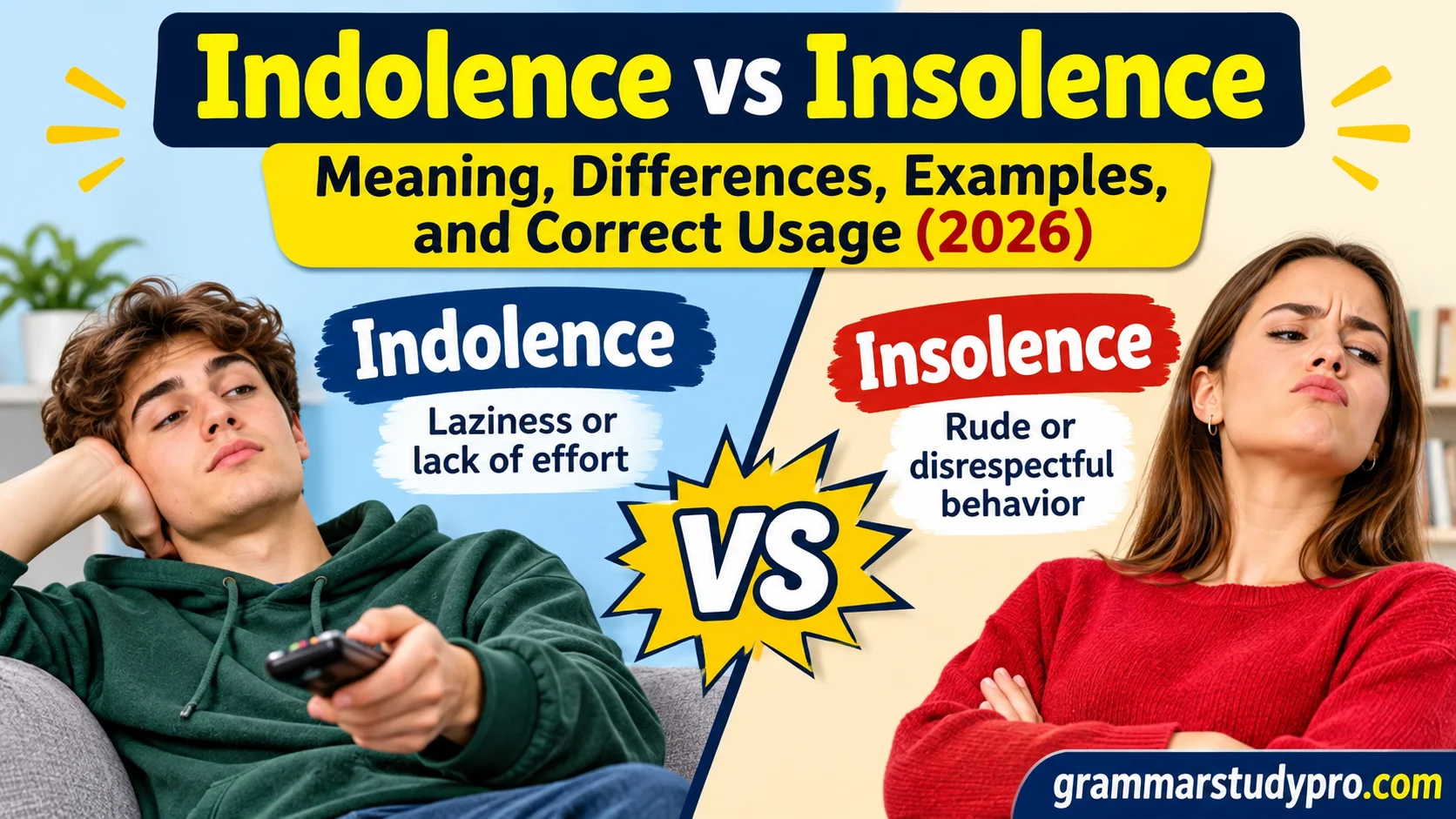
Indolence vs Insolence explains two different behaviors: one shows a lack of effort, while the other shows disrespect toward others.
Both words describe undesirable qualities, but their meanings and uses differ. Indolence means laziness or avoidance of effort, while insolence describes disrespect, rude behavior, and disrespectful behavior. Understanding this distinction helps you avoid confusion between these similar words. In English usage and modern English, the correct word depends on the situation. Learning their pronunciation, spelling, synonyms, and antonyms can improve your English vocabulary and vocabulary development. Good grammar, grammar usage, and grammar accuracy also support better writing, reading, and communication. Whether you are a student, one of many writers, or a working professional, clear language matters. It improves language clarity, language skills, and communication clarity in professional writing, formal writing, and academic writing. It also helps you prepare clear messages, understand conversations, and use practical examples in different situations. Careful word choice, precise expression, and clear expression help prevent writing mistakes and awkward mistakes. These habits build confident writing and make choosing the correct word easier.
The historical meaning of these ideas also connects with the experiences of free black people and free blacks in the Caribbean. Discussions of blackness, black identity, black experience, black freedom, and black liberation often appear in critical black thought and black thought. This history includes Haiti, present-day Haiti, the Dominican Republic, and present-day Dominican Republic, which share the island of Hispaniola. Its island history forms an important part of Caribbean history and the wider history of the Americas. Scholars also examine blackness in the Americas through the history of French Saint-Domingue, a French colony, and Spanish Santo Domingo, a Spanish colony. Under colonialism and European colonialism, the European colonizer often viewed independent behavior with suspicion.
Historical stories and films provide more examples of these attitudes. One historical case involves El Negro Incógnito, also called The Unknown Black Man, a serial killer connected with serial violence and terrorizing in the early 1790s. His story reflects the terror, colonial terror, horror, and suspicious behavior that influenced colonial thinking. Ideas about malevolence and hidden malevolence also appear in the character of Carrefour from the 1943 film I Walked With a Zombie. Researchers study these examples through historical texts, cultural texts, historical scholarship, anthropological scholarship, anthropological studies, and historical research. Their work also explores cultural history, historical context, cultural representation, and historical representation. Other theoretical works use critical theory, liberal humanism, liberal thought, and humanism to explain race, freedom, and power.
Quick Answer:
Indolence means laziness, idleness, or an unwillingness to make an effort. It describes someone who avoids work, responsibilities, or necessary activities.
Insolence means rudeness, disrespect, or offensively bold behavior. It describes someone who speaks or acts disrespectfully toward another person.
Here are two simple examples:
- Indolence: His indolence prevented him from finishing the important assignment on time.
- Insolence: The teacher reprimanded the student for his insolence during class.
The easiest way to remember the difference is:
- Indolence = Laziness or inactivity.
- Insolence = Rudeness or disrespect.
Both words are nouns, but they describe different character traits and behaviors. You cannot substitute one for the other without changing your sentence’s meaning.
Comparison Overview
Although indolence and insolence share several letters, their definitions, applications, and related words differ considerably. Looking at their characteristics side by side makes the distinction easier to understand.
| Feature | Indolence | Insolence |
| Meaning | Laziness or unwillingness to work | Rudeness or disrespect |
| Part of speech | Noun | Noun |
| Pronunciation | IN-duh-luhns | IN-suh-luhns |
| Describes | Lack of effort or activity | Disrespectful behavior |
| Common situations | Work, education, and responsibilities | Conversations, relationships, and authority |
| Synonyms | Idleness, laziness, sloth | Impudence, rudeness, disrespect |
| Antonyms | Diligence, industry, effort | Courtesy, respect, politeness |
| Adjective | Indolent | Insolent |
| Adverb | Indolently | Insolently |
The most important distinction concerns what each word describes.
Indolence focuses on someone’s willingness to make an effort. A person displaying indolence might avoid studying, ignore responsibilities, or repeatedly postpone necessary tasks.
Insolence focuses on someone’s lack of respect toward others. An insolent person might make insulting remarks, challenge someone rudely, or respond with disrespectful behavior.
For example, an employee who refuses to complete assigned work demonstrates indolence. However, an employee who insults a supervisor demonstrates insolence.
Main Differences Between Indolence and Insolence
The difference between these words becomes clearer when you examine their meanings, grammatical uses, and everyday applications. Let’s explore each distinction individually.
What Does Indolence Mean?
Indolence refers to a state or habit of laziness, inactivity, or unwillingness to exert effort. It describes someone who avoids work or responsibilities despite having opportunities to complete them.
The word often suggests more than temporary tiredness. Instead, it commonly describes a continuing tendency to avoid productive activity.
For instance, imagine a student who spends several weeks avoiding homework. Although the student has enough time and resources, they repeatedly choose entertainment instead of studying. This behavior could be described as indolence.
Indolence can appear in different areas of life, including:
- Education: Avoiding homework, studying, or academic responsibilities.
- Employment: Neglecting assignments and avoiding necessary tasks.
- Personal life: Ignoring important responsibilities and postponing everyday activities.
- Professional development: Refusing to improve skills or pursue opportunities.
- Daily routines: Consistently choosing inactivity when action is necessary.
However, indolence doesn’t mean someone is lazy every time they take a break. Resting after a demanding day is normal and healthy. The word generally describes an unwillingness to make an effort rather than a reasonable need for relaxation.
Examples of indolence in sentences:
- His indolence prevented him from completing the project before the deadline.
- The manager became frustrated with the team’s indolence.
- Years of indolence affected his ability to maintain productive habits.
- Her indolence stopped her from pursuing better career opportunities.
- The teacher noticed a growing pattern of indolence among several students.
In each example, the word describes a lack of effort or motivation. It doesn’t suggest that someone behaved rudely toward another person.
What Does Insolence Mean?
Insolence means rude, disrespectful, or offensively bold behavior. It describes actions or words that show little consideration for another person’s position, feelings, or authority.
Unlike indolence, insolence doesn’t involve laziness or avoiding work. Instead, it concerns how someone treats other people.
For example, imagine a student who disagrees with a teacher’s decision. Disagreement itself isn’t necessarily disrespectful. However, if the student responds with insults or deliberately humiliates the teacher, that behavior may demonstrate insolence.
Insolence commonly appears in situations involving:
- Authority figures: Disrespectful behavior toward teachers, parents, supervisors, or officials.
- Conversations: Rude replies, insulting comments, or contemptuous remarks.
- Workplaces: Disrespectful communication with managers or colleagues.
- Relationships: Speaking offensively or treating another person with contempt.
- Public interactions: Deliberately behaving rudely toward someone.
It’s important to distinguish insolence from confidence or honest disagreement. Someone can question a decision without being insolent. The problem arises when their words or actions become disrespectful.
Examples of insolence in sentences:
- The principal reprimanded the student for his insolence.
- Her insolence during the meeting offended several colleagues.
- The manager refused to tolerate such insolence from employees.
- His insolence toward his parents created unnecessary arguments.
- The customer complained about the employee’s insolence.
Notice how every example involves disrespectful behavior. None describes laziness or a refusal to complete work.
Indolence vs Insolence: Understanding the Difference
The easiest way to distinguish these words is to examine the behavior being described.
Indolence concerns someone’s attitude toward effort and responsibility. Insolence concerns someone’s attitude toward respect and appropriate behavior.
Consider these contrasting situations:
| Situation | Correct word | Explanation |
| An employee repeatedly avoids assignments. | Indolence | The employee refuses to make an effort. |
| An employee insults the manager. | Insolence | The employee behaves disrespectfully. |
| A student refuses to study for examinations. | Indolence | The student avoids academic effort. |
| A student mocks the teacher. | Insolence | The student shows disrespect. |
| Someone neglects household responsibilities. | Indolence | The person avoids necessary work. |
| Someone makes insulting comments during an argument. | Insolence | The person behaves rudely. |
Interestingly, one person can demonstrate both qualities.
Imagine an employee who regularly ignores assigned tasks and responds rudely whenever a supervisor asks about the unfinished work. Their unwillingness to complete assignments demonstrates indolence. Their disrespectful replies demonstrate insolence.
Therefore, context determines which word communicates the intended meaning.
Difference in Pronunciation and Spelling
The similar appearance of indolence and insolence can make them difficult to distinguish at first. Both contain eight letters and end with the same five-letter sequence, -olence.
However, their middle consonants differ.
| Word | American English pronunciation | Beginning sound |
| Indolence | /ˈɪndələns/ | IN-d… |
| Insolence | /ˈɪnsələns/ | IN-s… |
Both words begin with a similar sound and contain three syllables. However, indolence includes a d sound, while insolence includes an s sound.
A useful memory technique is to connect each spelling with a familiar word:
- Indolence: Think of idle or idleness. Both relate to inactivity.
- Insolence: Think of insult. Both connect with disrespectful behavior.
These simple associations can help you remember which word belongs in a particular sentence.
When to Use Indolence in a Sentence
Knowing the definition is useful, but recognizing the right context makes your writing more accurate. Indolence works best when you want to describe a lack of effort, habitual laziness, or unwillingness to remain productive.
It often appears in formal writing, workplace discussions, educational settings, and literary descriptions. The word carries a more formal tone than everyday expressions such as being lazy or doing nothing.
Let’s examine its common applications.
Indolence in the Workplace
In professional settings, indolence describes employees who consistently avoid their duties or show little interest in completing assigned work.
It can also describe a broader workplace culture where people lack initiative. However, a single missed deadline doesn’t automatically indicate indolence. The word usually suggests a recurring pattern.
Examples:
- The supervisor criticized the employee’s indolence during the quarterly review.
- Indolence among team members delayed the company’s important projects.
- His professional growth suffered because of his indolence.
- The department struggled with indolence and a lack of initiative.
Indolence in Education
In education, indolence often describes students who avoid studying, neglect assignments, or show little interest in academic responsibilities.
For example, a student might understand a subject perfectly but refuse to complete homework. Their problem isn’t necessarily a lack of ability. Instead, their unwillingness to make an effort demonstrates indolence.
Examples:
- The student’s indolence affected his examination results.
- Her teacher warned her about the consequences of academic indolence.
- Indolence prevented several students from reaching their academic goals.
- The professor encouraged his students to overcome indolence through consistent practice.
Indolence in Everyday Life
Indolence isn’t limited to schools and workplaces. You can also use it when discussing personal habits and everyday responsibilities.
Someone who repeatedly postpones household chores, ignores important errands, or avoids necessary activities might display indolence.
However, there’s an important distinction between laziness and taking time to recover. People need rest after physical or mental effort. Calling someone indolent simply because they enjoy a quiet afternoon would be unfair.
Examples:
- His indolence left the household chores unfinished.
- She recognized her indolence and started following a daily routine.
- The family’s financial problems worsened because of his indolence.
- A little discipline helped him overcome his indolence.
Indolence in Formal and Literary Writing
Writers often choose indolence when they want a more formal description of inactivity or habitual laziness.
The word can describe a character’s personality, a community’s lack of initiative, or someone’s unwillingness to pursue meaningful goals.
For example:
- The novel portrays the young man’s indolence as a major personal weakness.
- The author describes a life of comfort, indolence, and wasted opportunities.
- His indolence gradually damaged his relationships and professional reputation.
The word also has an interesting literary history. James Thomson published The Castle of Indolence in 1748, using the concept of indolence as a central literary theme.provides further background on the word’s development.
When to Use Insolence in a Sentence
While indolence concerns effort, insolence concerns respect. Use this word when someone behaves rudely, speaks disrespectfully, or shows offensive disregard for another person.
It frequently appears in formal conversations, literature, disciplinary discussions, and descriptions of interpersonal conflict.
Here are some common situations where insolence fits naturally.
Insolence in Conversations
A person’s words can reveal insolence even when their actions seem ordinary.
For instance, answering a reasonable question with an insulting remark may demonstrate insolence. Similarly, deliberately mocking someone during a serious conversation can show disrespect.
However, expressing a different opinion doesn’t automatically make someone insolent. People can disagree respectfully.
Examples:
- His insolence turned an ordinary discussion into an argument.
- She couldn’t believe the insolence in his response.
- The manager was surprised by the customer’s insolence.
- His sarcastic remarks revealed considerable insolence.
Insolence Toward Authority Figures
Insolence frequently describes disrespectful behavior toward people who hold positions of authority.
These situations might involve teachers, parents, supervisors, managers, or public officials. The word becomes especially relevant when someone deliberately uses insulting language or behaves contemptuously.
Examples:
- The principal punished the student for his insolence.
- His insolence toward his parents caused serious disagreements.
- The supervisor warned the employee against further insolence.
- The teacher refused to accept such insolence in the classroom.
Importantly, authority doesn’t make every disagreement insolent. A student can question a teacher’s decision respectfully. Insolence involves the disrespectful manner rather than disagreement itself.
Insolence in Professional Settings
Respectful communication helps workplaces function smoothly. Insolence can damage professional relationships and create unnecessary conflict.
An employee might demonstrate insolence by insulting a colleague, mocking a supervisor, or responding contemptuously to reasonable feedback.
Examples:
- The director addressed the employee’s insolence during the meeting.
- Her insolence toward colleagues damaged the team’s working relationship.
- The company introduced disciplinary measures after repeated incidents of insolence.
- His insolence made productive communication almost impossible.
In professional writing, disrespectful behavior may sometimes sound more neutral. Choose insolence when you specifically want to emphasize offensive or openly rude conduct.
Insolence in Literature and Formal Writing
In literature, insolence can help writers portray arrogance, defiance, contempt, and disrespect.
A character who repeatedly mocks others or speaks offensively might be described as insolent. The noun insolence identifies the behavior itself.
Examples:
- The king considered the servant’s insolence unforgivable.
- Her insolence revealed a complete disregard for social expectations.
- The novel explores the consequences of arrogance and insolence.
- His insolence toward the elderly man shocked the entire village.
The word also appears in discussions of authority and public institutions. Historical English dictionaries connect it with haughtiness, impudence, and contemptuous treatment. offers an example of this older usage.
Indolence vs Insolence: Examples in Sentences
Sometimes, the best way to understand two confusing words is to see them in realistic sentences. The following examples demonstrate how each word functions naturally.
Indolence Examples
Use these sentences to understand how indolence describes laziness, inactivity, and a lack of effort.
- His indolence prevented him from completing his professional training.
- The manager noticed the team’s growing indolence.
- She overcame her indolence by setting realistic daily goals.
- The student’s indolence became obvious during examination preparation.
- Their indolence delayed the construction project.
- Years of indolence had weakened his work habits.
- The author criticized the character’s indolence and lack of ambition.
- His indolence cost him an important career opportunity.
- Regular exercise helped her overcome physical inactivity and indolence.
- The organization struggled because of widespread indolence among its members.
What these examples have in common: Each sentence describes someone avoiding effort, neglecting responsibilities, or showing little interest in productive activity.
Insolence Examples
These sentences demonstrate how insolence describes disrespectful speech and offensive behavior.
- The teacher was disappointed by the student’s insolence.
- His insolence toward the manager resulted in a formal warning.
- She couldn’t tolerate his repeated insolence.
- The customer’s insolence upset the entire service team.
- The principal addressed the student’s insolence immediately.
- His insolence during the interview damaged his professional reputation.
- The officer refused to overlook such insolence.
- Her insolence toward her colleagues created unnecessary tension.
- The novel portrays insolence as a serious character flaw.
- Everyone noticed the insolence in his remarks.
What these examples have in common: Each sentence describes disrespect, offensive behavior, or an inappropriate attitude toward another person.
Indolence and Insolence in the Same Sentence
You can use both words together when describing two different negative qualities.
For example:
- His indolence delayed the project while his insolence frustrated the manager.
- The teacher disliked the student’s indolence and insolence for different reasons.
- The character displayed indolence toward his responsibilities and insolence toward his family.
- Their indolence affected productivity while their insolence damaged workplace relationships.
These sentences work because each word describes a separate problem.
Indolence vs Insolence: Synonyms and Antonyms
Synonyms and antonyms make vocabulary easier to understand. They also help you select more precise words when writing essays, articles, emails, and everyday messages.
However, remember that similar words don’t always carry identical meanings. Some are stronger, more informal, or more specific.
Synonyms of Indolence
The following words relate to laziness, inactivity, or avoiding effort.
| Synonym | Meaning |
| Laziness | Unwillingness to work or make an effort |
| Idleness | A state of not working or being active |
| Sloth | Extreme laziness or reluctance to act |
| Inactivity | Lack of physical or mental activity |
| Sluggishness | Slow movement or limited energy |
| Inertia | Resistance to activity or change |
| Shiftlessness | Lack of ambition, energy, or purpose |
For example, you might describe someone as lazy in casual conversation. In a formal essay, indolence may communicate the same general idea more precisely.
However, inertia can refer to resistance to change rather than simple laziness. Therefore, consider the context before substituting synonyms.
Antonyms of Indolence
Antonyms describe qualities opposite to laziness or inactivity.
| Antonym | Meaning |
| Diligence | Careful and persistent effort |
| Industry | Consistent hard work |
| Industriousness | A strong willingness to work |
| Productivity | The ability to produce useful results |
| Initiative | Readiness to take action independently |
| Effort | Physical or mental work toward a goal |
For example:
- Her diligence helped her complete every assignment.
- The manager appreciated his team’s industry.
- Personal initiative helped him overcome indolence.
Synonyms of Insolence
These words describe disrespectful, rude, or offensively bold behavior.
| Synonym | Meaning |
| Rudeness | Behavior that lacks politeness |
| Disrespect | Lack of proper consideration for others |
| Impudence | Bold or shameless disrespect |
| Impertinence | Inappropriate or disrespectful behavior |
| Arrogance | An exaggerated sense of personal importance |
| Cheekiness | Bold or disrespectful behavior |
| Audacity | Boldness that may seem offensive or improper |
Although these words overlap, they aren’t perfect replacements.
For instance, arrogance emphasizes an exaggerated sense of superiority. Meanwhile, insolence specifically highlights disrespectful behavior.
Antonyms of Insolence
The following words express qualities opposite to insolence.
| Antonym | Meaning |
| Respect | Showing consideration for others |
| Courtesy | Polite and considerate behavior |
| Politeness | Good manners and respectful communication |
| Civility | Courteous behavior in social interactions |
| Humility | A modest view of oneself |
| Deference | Respectful regard for another person’s position |
For example:
- Her courtesy impressed everyone at the meeting.
- The student showed respect toward the teacher.
- His humility made him pleasant to work with.
These qualities contrast with the disrespect and offensive behavior associated with insolence.
Indolence vs Insolence: Related Word Forms
Understanding related word forms helps you use both terms correctly in different grammatical situations. Although indolence and insolence are nouns, their adjective and adverb forms appear frequently in English.
Word Forms of Indolence
The word indolence has three commonly used forms.
| Word | Part of speech | Meaning |
| Indolence | Noun | Laziness or inactivity |
| Indolent | Adjective | Lazy or unwilling to work |
| Indolently | Adverb | In a lazy or inactive manner |
Examples:
- Indolence: His indolence affected his academic performance.
- Indolent: The indolent employee avoided taking responsibility.
- Indolently: He spent the afternoon sitting indolently in his chair.
Use indolence when naming the quality, indolent when describing someone, and indolently when explaining how someone acts.
One additional detail deserves attention: indolent also has a medical meaning. In medical terminology, an indolent condition or tumor generally progresses slowly or causes little pain. This specialized meaning differs from the everyday meaning of laziness.
Word Forms of Insolence
The word insolence also has three common grammatical forms.
| Word | Part of speech | Meaning |
| Insolence | Noun | Rudeness or disrespect |
| Insolent | Adjective | Rude, disrespectful, or offensively bold |
| Insolently | Adverb | In a rude or disrespectful manner |
Examples:
- Insolence: The teacher disliked the student’s insolence.
- Insolent: His insolent response offended the supervisor.
- Insolently: She spoke insolently to her colleague.
These forms help you describe different aspects of disrespectful behavior.
For example, you can describe someone’s insolence, call that person insolent, or explain that they responded insolently.
Common Mistakes When Using Indolence and Insolence
Even experienced English speakers sometimes confuse words with similar spellings. However, understanding their grammatical functions and meanings prevents most mistakes.
Here are some common errors worth avoiding.
Using Indolence to Describe Disrespectful Behavior
Indolence doesn’t mean rudeness or offensive behavior. It describes laziness or a lack of effort.
Incorrect: The teacher punished the student for his indolence after he insulted her.
Better: The teacher punished the student for his insolence after he insulted her.
The second sentence uses insolence because the student displayed disrespect.
Using Insolence to Describe Laziness
Insolence doesn’t describe someone who avoids work or responsibilities.
Incorrect: His insolence prevented him from completing the assignment.
Better: His indolence prevented him from completing the assignment.
The correct word is indolence because the sentence focuses on avoiding effort.
Confusing Indolent and Insolent
Both adjectives describe negative qualities, but they apply to different behaviors.
- Indolent: A person who avoids work or activity.
- Insolent: A person who behaves rudely or disrespectfully.
Consider these examples:
- The indolent student refused to complete his homework.
- The insolent student mocked his teacher during class.
The first student avoids academic responsibilities. The second student demonstrates disrespect.
Assuming Similar Spellings Mean Similar Definitions
Words sometimes look alike without sharing the same meaning. Indolence and insolence provide a perfect example.
Their similar endings don’t make them interchangeable. Always examine the sentence’s context before choosing either word.
Using Formal Vocabulary When Simpler Words Work Better
Both words have a relatively formal tone. Therefore, they might sound unnatural in casual conversations.
For example:
- Formal: His indolence affected the team’s productivity.
- Simple: His laziness affected the team’s productivity.
Similarly:
- Formal: The manager refused to tolerate her insolence.
- Simple: The manager refused to tolerate her rudeness.
Neither version is automatically better. Choose the wording that suits your audience and writing style.
Memory Tricks: How to Remember Indolence vs Insolence
Remembering the difference becomes much easier when you connect each word with a familiar expression.
Here are some simple techniques.
Associate Indolence With Idleness
Both indolence and idleness relate to inactivity or avoiding work.
Think about someone who regularly postpones assignments, ignores responsibilities, and avoids productive activities.
That person demonstrates indolence.
Memory trick: Indolence = Idleness = Laziness.
Associate Insolence With Insults
The words insolence and insult share a similar beginning.
An insult can demonstrate disrespect, particularly when someone deliberately uses offensive language toward another person.
Memory trick: Insolence = Insults = Disrespect.
Remember Their Different Behaviors
Another useful technique is to connect each word with a specific action.
| Word | Remember it through | Example |
| Indolence | Avoiding work | Refusing to complete assignments |
| Insolence | Showing disrespect | Insulting a supervisor |
These associations make the distinction easier to recall during conversations and writing.
Indolence vs Insolence: Which Word Should You Choose?
Choosing the correct word depends on what you want to describe. Before using either term, ask yourself whether the situation involves laziness or disrespect.
Use this simple guide:
- Choose indolence when describing someone who avoids work, neglects responsibilities, or shows little effort.
- Choose insolence when describing someone who behaves rudely, makes insulting remarks, or shows disrespect.
- Choose indolent when describing a lazy or inactive person.
- Choose insolent when describing someone who behaves disrespectfully.
- Choose indolently or insolently when describing how someone performs an action.
Consider these additional examples:
Example 1:
The employee’s indolence delayed the entire project.
Here, indolence works because the employee avoided responsibilities.
Example 2:
The employee’s insolence offended the department manager.
Here, insolence works because the employee behaved disrespectfully.
Example 3:
The indolent worker ignored his responsibilities and responded insolently when questioned.
This sentence uses both words correctly. The first describes laziness while the second describes disrespect.
The distinction is simple once you focus on the behavior rather than the spelling.
FAQs
What is the main difference between indolence and insolence?
Indolence means laziness or a lack of effort, while insolence means rude or disrespectful behavior. The two words describe different qualities and cannot be used interchangeably.
Is indolence a positive or negative quality?
Indolence generally has a negative meaning. It describes someone who avoids work, ignores responsibilities, or shows little interest in making an effort.
What is an example of insolence?
Speaking rudely to a teacher, ignoring a supervisor’s instructions disrespectfully, or making an insulting remark can demonstrate insolence.
Are indolence and insolence synonyms?
No, they are not synonyms. Indolence relates to laziness and inactivity, whereas insolence relates to disrespect, rudeness, and arrogance.
How can I remember the difference between indolence and insolence?
Remember that indolence starts with “I” for inactivity, while insolence starts with “Ins” and relates to insulting behavior. This simple trick can help you choose the correct word.
Conclusion
Understanding Indolence vs Insolence becomes easier when you focus on what each word describes. Indolence refers to laziness, inactivity, and avoiding effort. Insolence, on the other hand, describes disrespectful, rude, or insulting behavior.
Although their spelling and pronunciation look similar, their meanings are quite different. Choosing the correct word improves your grammar, vocabulary, and communication skills. Whether you’re writing an academic essay, preparing a professional message, or having an everyday conversation, using these words correctly helps you express your ideas clearly and confidently.