Elegy vs Eulogy explains two different ways of remembering someone who has passed away. Both words relate to death, remembrance, and mourning, but they serve different purposes. An elegy expresses grief through poetry, while a eulogy honors the deceased through praise and personal memories. When good-hearted people pass away, these forms of expression help us share feelings and celebrate their lives. You may encounter both terms in a funeral or memorial service, but knowing their meanings makes it easier to choose the right word. An elegy is usually a lamenting poem that expresses sorrow, sadness, loss, and reflection. It may appear as a song, couplet, or other form of poetry with a melancholy tone. A poet might write one after losing a close friend to express personal grief and emotional pain.
A eulogy, on the other hand, is a speech, essay, or short prose tribute that praises a deceased person. It often takes place during a funeral ceremony or memorial ceremony, when a family member shares meaningful memories about the person’s life. Its purpose is to highlight someone’s character, achievements, personality, and positive qualities. For example, a family member might deliver a eulogy to show respect, admiration, and appreciation for someone they loved. Unlike an elegy, which focuses on grief, a eulogy focuses on celebrating life and honoring the dead. These differences also help distinguish both terms from other literary forms, including odes, dirges, and epitaphs.
Understanding these two words can improve your English vocabulary, writing, and everyday conversations. Remember that an elegy is mainly a poetic expression of sorrow, whereas a eulogy is a tribute that celebrates someone’s life. Their origins, traditional forms, and purposes explain why they aren’t interchangeable.
Quick Answer:
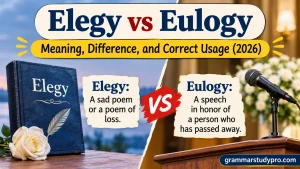
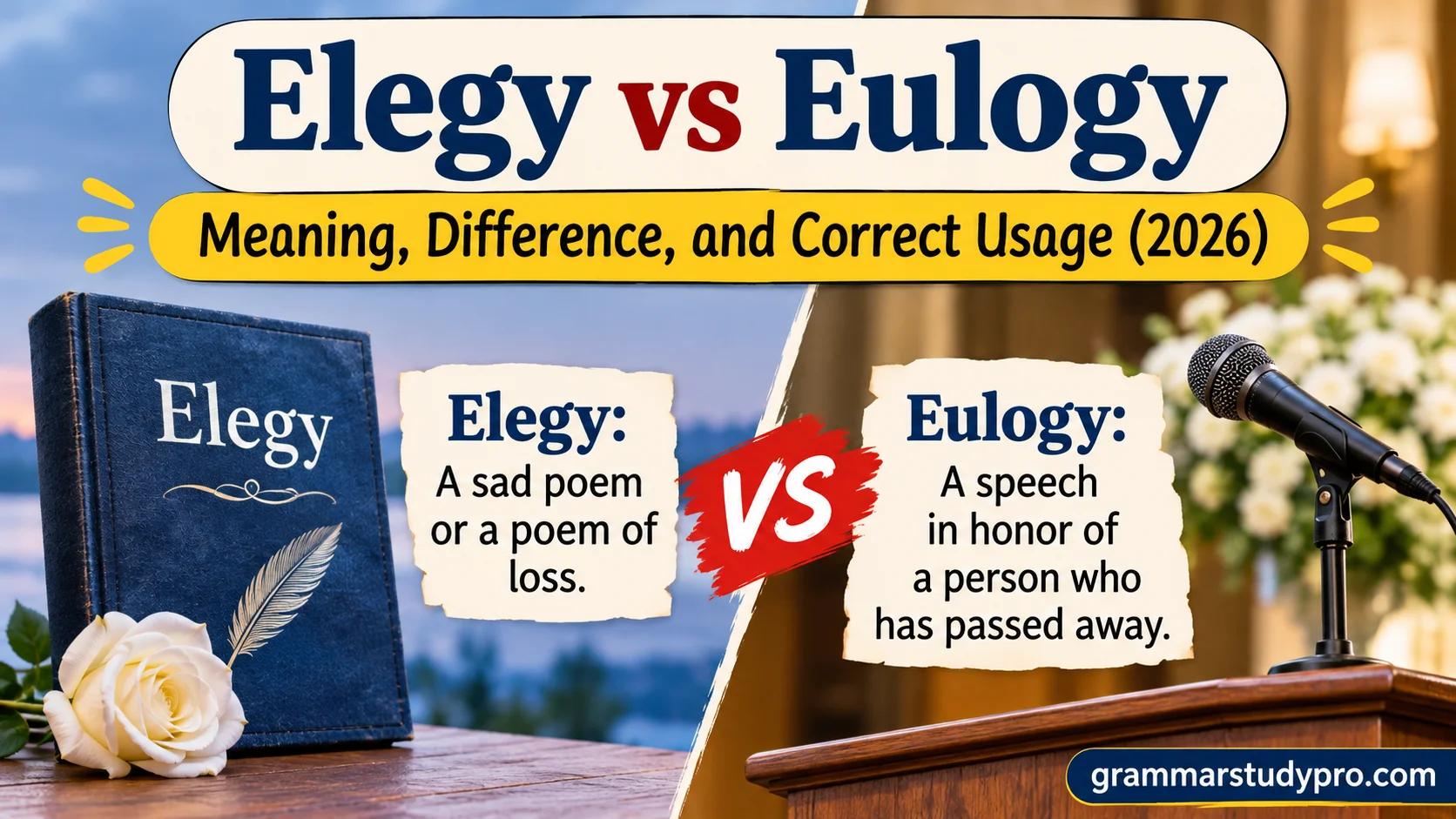
The main difference between elegy vs eulogy concerns their purpose and form. An elegy primarily expresses sorrow or mourns a loss, while a eulogy primarily praises and honors someone.
- Elegy: A poem, song, or literary composition expressing grief, sadness, or reflection, especially following someone’s death.
- Eulogy: A speech or written tribute praising someone’s character, achievements, contributions, or life, particularly during a funeral.
Consider these examples:
- Elegy: The poet wrote an elegy to express his sorrow after his friend’s death.
- Eulogy: Sarah delivered a heartfelt eulogy at her grandfather’s funeral.
Remember this simple distinction: An elegy mourns a loss, while a eulogy celebrates a life.
Both can contain sadness and admiration. However, an elegy emphasizes mourning, whereas a eulogy emphasizes praise.
Comparison Overview: Elegy vs Eulogy
Although elegy and eulogy share connections with death and remembrance, several characteristics distinguish them. Their meanings, formats, purposes, and common settings aren’t identical.
The following table provides a quick comparison.
| Comparison Point | Elegy | Eulogy |
| Meaning | A mournful poem or composition | A speech or written expression of praise |
| Part of speech | Noun | Noun |
| Main purpose | Express grief and reflect on loss | Honor and celebrate someone |
| Common form | Poem, song, or literary composition | Speech or written tribute |
| Main focus | Sorrow, remembrance, and mortality | Character, achievements, and memories |
| Emotional tone | Melancholic and reflective | Respectful, appreciative, and emotional |
| Common setting | Literature, poetry, and memorial works | Funerals and memorial services |
| Connection with death | Often mourns someone who died | Often honors someone who died |
| Broader meaning | Can express sorrow over other losses | Can praise living people or things |
| Plural form | Elegies | Eulogies |
The most important distinction involves what each expression tries to communicate. An elegy gives language to grief, while a eulogy gives recognition to someone’s life and qualities.
For instance, a writer might compose an elegy about a childhood friend who passed away. At the friend’s funeral, another person might deliver a eulogy describing their kindness, humor, and accomplishments.
What Does Elegy Mean?
An elegy is a poem or literary composition that expresses sadness, mourning, or reflection about loss. Traditionally, writers have used elegies to remember deceased individuals and explore the emotional experience of losing someone.
However, the word doesn’t always require a specific person’s death. An elegy can also express sorrow about lost relationships, fading traditions, vanished places, or the passing of time.
Think of an elegy as a literary expression of grief. It gives writers an opportunity to explore emotions that ordinary conversation sometimes struggles to communicate.
Definition of Elegy
According to literary usage, an elegy is a poem of mourning or loss that often remembers the dead and explores grief. Some elegies also move toward consolation, acceptance, or a deeper understanding of mortality.
Academy of American Poets+1
An elegy can explore several themes:
- Grief: The emotional pain of losing someone important.
- Remembrance: Memories of a person, relationship, or meaningful experience.
- Mortality: Reflections on human life and the certainty of death.
- Separation: The sadness associated with losing someone or something.
- Consolation: Finding comfort or understanding after experiencing loss.
Unlike a funeral speech, an elegy doesn’t need to follow a fixed structure. Writers can express their feelings through traditional poetry, free verse, songs, or other literary forms.
For example:
After her mother’s death, Emily wrote an elegy filled with memories of their childhood together.
Here, the word describes a literary expression of personal grief.
Origin and Etymology of Elegy
The word elegy comes from the Greek word elegos, associated with a lament or mournful song. Its history, however, is more complicated than its modern definition suggests.
In ancient Greek literature, an elegy originally referred to a particular poetic form or meter. Writers used this form for different subjects, including love, war, loss, and mourning.
The traditional Greek elegiac couplet combined two different metrical lines:
- A dactylic hexameter.
- A dactylic pentameter.
Over time, the term became more closely associated with poems expressing grief and remembering the dead. English writers eventually adopted this mournful meaning as the word’s familiar literary sense.
Cambridge University Press+2
This historical development explains why modern elegies don’t necessarily follow the original Greek meter.
Different Types of Elegy
Not every elegy expresses grief in the same way. Writers use different approaches depending on their subjects, emotions, and literary traditions.
Here are some important forms.
Pastoral Elegy
A pastoral elegy mourns someone’s death through images of nature and rural life. The deceased person often appears as a shepherd, while landscapes, flowers, rivers, and other natural elements reflect the sadness.
John Milton’s Lycidas is a famous example. Milton wrote it after the death of his fellow Cambridge student Edward King.
Personal Elegy
A personal elegy focuses on an individual’s experience of grief. The writer might remember a family member, friend, or loved one while exploring feelings of sadness and separation.
For example, someone might write a poem remembering a childhood friend who passed away unexpectedly.
Public Elegy
A public elegy commemorates someone whose death affects a wider community or society. Writers often use this form to recognize influential figures and express collective sorrow.
Walt Whitman’s When Lilacs Last in the Dooryard Bloom’d, written after Abraham Lincoln’s assassination, provides a notable example.
Meditative Elegy
A meditative elegy explores broader questions about mortality, human existence, time, and the temporary nature of life.
Rather than focusing entirely on one person’s death, it considers what loss means for humanity.
Thomas Gray’s Elegy Written in a Country Churchyard illustrates this reflective approach.
These categories can overlap. A single poem might combine personal grief, public remembrance, and philosophical reflection.
Examples of Elegy in Sentences
Seeing the word in context makes its meaning easier to understand. The following examples demonstrate how writers and speakers use elegy naturally.
- The poet composed an elegy to remember his beloved grandmother.
- Her final collection included an elegy about the loss of childhood innocence.
- The musician performed an elegy dedicated to his late friend.
- Thomas Gray’s famous elegy reflects on mortality and forgotten lives.
- The writer created an elegy for a village that disappeared after the war.
- His poem became an elegy for the friendship they once shared.
- The memorial included an elegy honoring the victims of the tragedy.
Usage tip: Elegy usually describes the creative work itself rather than the person delivering a funeral speech.
Famous Examples of Elegies in Literature
Literary history contains many important elegies. Studying these works helps explain how writers transform grief into poetry.
Elegy Written in a Country Churchyard — Thomas Gray
Thomas Gray published Elegy Written in a Country Churchyard in 1751. The poem reflects on death, forgotten individuals, and the shared fate of human beings.
Rather than mourning one specific person, Gray considers the lives of ordinary villagers buried in a country churchyard. He explores how death eventually comes to everyone regardless of wealth, status, or achievement.
This work demonstrates that an elegy can examine mortality without focusing on a particular deceased individual.
Lycidas — John Milton
Milton wrote Lycidas in memory of Edward King, a fellow student who drowned in 1637. The poem uses pastoral imagery to express sorrow over his death.
Nature, shepherds, and mythological references help Milton communicate his grief. The poem also explores religious faith, poetic ambition, and the meaning of death.
It remains one of the best-known examples of the English pastoral elegy.
Adonais — Percy Bysshe Shelley
Shelley published Adonais in 1821 after the death of fellow poet John Keats. The poem mourns Keats while examining the relationship between artistic achievement and mortality.
Shelley uses the pastoral elegy tradition to honor Keats’s memory and express his sorrow.
In Memoriam A.H.H. — Alfred, Lord Tennyson
Tennyson’s In Memoriam A.H.H. remembers his close friend Arthur Henry Hallam, who died in 1833.
Published in 1850, the collection explores grief, faith, doubt, friendship, and the struggle to accept death. Its emotional depth makes it an important example of personal elegiac poetry.
Together, these works show that an elegy can take many forms while maintaining its central connection with loss and remembrance.
What Does Eulogy Mean?
A eulogy is a speech or written tribute that expresses admiration, appreciation, or praise for someone. People commonly deliver eulogies during funerals and memorial services to honor someone who has passed away.
Unlike an elegy, a eulogy usually focuses on the person’s life rather than the sadness surrounding their death. Speakers often share personal memories, describe admirable qualities, and recognize meaningful accomplishments.
For example, a son might deliver a eulogy for his father by discussing his generosity, dedication to family, and influence on others.
A eulogy doesn’t have to sound entirely sad. It can include humor, uplifting memories, and stories that capture someone’s personality.
Definition of Eulogy
The Oxford Learner’s Dictionary defines a eulogy as a speech or piece of writing that praises someone or something highly. It also identifies the funeral speech as a common use of the word.
Oxford Learner’s Dictionaries
A eulogy typically highlights:
- Personal qualities: Kindness, honesty, generosity, courage, and compassion.
- Life achievements: Professional success, educational accomplishments, and personal milestones.
- Relationships: The person’s connections with family members, friends, and colleagues.
- Memorable experiences: Stories that reveal the person’s personality and values.
- Lasting influence: The positive difference the person made in other people’s lives.
For example:
During the memorial service, Michael delivered a heartfelt eulogy celebrating his mother’s kindness and dedication to her family.
Here, eulogy describes a speech that honors and praises someone who has died.
Although funerals provide the most familiar setting, the word has a broader meaning. You can also use eulogy for a speech or written statement praising a living person, an institution, or even an idea.
Origin and Etymology of Eulogy
The word eulogy comes from the Greek word eulogia, meaning praise or good words. It combines two Greek elements:
- Eu means good or well.
- Logia relates to speaking or words.
The expression essentially refers to speaking well of someone or something.
The word entered English through medieval Latin and Middle English. Its earlier meaning involved formal praise or commendation. Over time, its association with praising deceased individuals became especially familiar.
Etymology, Origin & Meaning+1
This origin provides a useful memory trick. The word eulogy contains the idea of saying something good about another person.
Purpose and Main Elements of a Eulogy
A meaningful eulogy does more than list someone’s accomplishments. It gives listeners a personal picture of the individual they have gathered to remember.
Although no universal structure exists, many effective eulogies include several important elements.
Introduction and Personal Connection
The speaker introduces the deceased and explains their relationship. This opening helps listeners understand why the speaker has chosen particular memories and experiences.
Personal Qualities
A eulogy often describes qualities that made someone special. These might include kindness, patience, humor, determination, generosity, or loyalty.
Achievements and Contributions
The speaker may recognize professional accomplishments, community involvement, personal milestones, or contributions to family life.
Memorable Stories
Specific stories make a eulogy more personal. A short account of someone’s generosity or unusual sense of humor can communicate more than a long list of adjectives.
Closing Tribute
The speaker concludes by expressing gratitude, sharing a final memory, or recognizing the person’s lasting influence.
Consider this example:
A father who volunteered at his local school might be remembered for helping children develop confidence. His eulogy could describe how he spent weekends supporting students and encouraging their dreams.
That small detail creates a clearer picture of his character than simply calling him generous.
Examples of Eulogy in Sentences
Here are several examples showing how to use eulogy correctly.
- Sarah delivered a beautiful eulogy honoring her grandfather’s life.
- His brother prepared a heartfelt eulogy for the funeral service.
- The mayor gave a eulogy celebrating the community leader’s contributions.
- Everyone appreciated the eulogy because it captured her mother’s wonderful personality.
- The written eulogy described his achievements and lifelong dedication to education.
- Her speech became a touching eulogy to the friendship they had shared.
- The speaker included humorous memories in his eulogy to celebrate his father’s personality.
Usage tip: Use eulogy when the main purpose involves praising or honoring someone. The speech may contain sadness, but appreciation remains central.
What Makes a Good Eulogy?
A good eulogy feels personal rather than rehearsed. It should reflect the person’s actual character instead of presenting an exaggerated picture.
Consider these practical qualities:
- Honesty: Describe the person sincerely without inventing achievements or experiences.
- Specific memories: Include meaningful stories instead of relying on general praise.
- Clear organization: Arrange thoughts so listeners can follow the tribute.
- Appropriate length: Keep the speech focused and respectful of the occasion.
- Emotional balance: Allow room for sadness, appreciation, and even gentle humor.
- Personal connection: Explain why the person’s life mattered to those around them.
For example, saying someone was a wonderful friend communicates a positive feeling. Explaining how they helped a neighbor during a difficult period makes that praise more meaningful.
A eulogy doesn’t need complicated language. Simple, sincere words often create the strongest tribute.
Main Differences Between Elegy and Eulogy
Now that both terms have clear definitions, let’s examine their differences more closely. Although they share connections with remembrance and death, their traditional purposes remain distinct.
Difference in Meaning: Elegy vs Eulogy
The primary difference between elegy and eulogy lies in their meanings.
An elegy expresses sorrow, mourning, or reflection about a loss. A eulogy expresses praise, admiration, and appreciation for someone.
For example:
- Elegy: The writer composed an elegy after losing his closest friend.
- Eulogy: The friend’s sister delivered a eulogy celebrating his generosity.
Both examples involve remembering the same person. However, the first emphasizes grief while the second emphasizes admiration.
Difference in Purpose
An elegy gives people a literary way to explore loss. Writers use it to communicate emotions, preserve memories, and reflect on mortality.
A eulogy serves a different purpose. It recognizes someone’s life, celebrates personal qualities, and allows others to remember meaningful contributions.
| Purpose | Elegy | Eulogy |
| Primary goal | Express grief | Express praise |
| Emotional focus | Sadness and remembrance | Appreciation and honor |
| Main activity | Literary reflection | Public or written tribute |
| Common result | A creative expression of loss | A celebration of someone’s life |
An elegy might help a poet process personal grief. Meanwhile, a eulogy helps family members and friends remember what made someone special.
Difference in Form and Structure
The two words also differ in their traditional forms.
An elegy generally appears as a poem, song, or other literary composition. It may follow a specific poetic structure or use free verse.
A eulogy usually takes the form of a speech delivered during a funeral or memorial service. It can also appear as a written tribute.
Here is a practical comparison:
An elegy might contain:
- Poetic language and imagery.
- Metaphors about death and nature.
- Emotional reflections on separation.
- Rhythmic or structured verses.
- Philosophical thoughts about mortality.
A eulogy might contain:
- An introduction about the deceased.
- Personal stories and memories.
- Descriptions of admirable qualities.
- Achievements and contributions.
- A closing message of appreciation.
However, these forms aren’t absolute rules. A eulogy can be poetic, and an elegy can use prose-like language.
Difference in Tone and Emotion
An elegy generally carries a mournful, reflective, or melancholic tone. Its language often communicates the emotional weight of losing someone or something important.
A eulogy usually adopts a respectful and appreciative tone. Speakers may express sadness, but they also emphasize positive memories and personal achievements.
For instance, an elegy might describe the emptiness someone feels after losing a close friend. A eulogy might remember how that friend made everyone laugh during difficult moments.
Both can make an audience emotional. The difference lies in the message each one emphasizes.
Difference in Context and Usage
People encounter elegies and eulogies in different settings.
An elegy commonly appears in poetry collections, literary discussions, music, and artistic memorials. Students may study elegies when examining poetic forms or themes involving mortality.
A eulogy commonly appears during funerals, memorial services, and public tributes. Families, friends, colleagues, and community members may deliver these speeches.
Consider these situations:
- A poet writes about the death of a childhood friend. The composition is an elegy.
- A daughter speaks about her father’s achievements during his funeral. Her speech is a eulogy.
- A musician creates a mournful composition remembering a historical tragedy. It may be an elegy.
- A community leader delivers a speech praising a respected public figure. The speech is a eulogy.
The setting can provide helpful clues, but the intended purpose matters most.
Can an Elegy Also Be a Eulogy?
Yes, an elegy can contain elements of a eulogy. However, that doesn’t make the two terms interchangeable.
Imagine a poet writing a mournful poem about a respected teacher who recently passed away. The poem expresses sadness while celebrating the teacher’s wisdom, kindness, and influence.
The composition has an elegiac purpose because it expresses grief. At the same time, its praise resembles a eulogy.
This overlap happens because mourning and admiration often appear together. People can miss someone deeply while appreciating everything that person contributed to their lives.
The same distinction applies to funeral speeches. A eulogy can include sadness and emotional reflections without becoming an elegy.
The easiest way to distinguish them is to identify the main purpose of the work. If it primarily mourns a loss, elegy is appropriate. If it primarily praises someone, eulogy is the better choice.
Elegy vs Eulogy: Examples in Different Contexts
Understanding these words becomes easier when you see how they work in everyday situations. The following examples cover literature, funerals, speeches, and artistic expression.
Elegy vs Eulogy at a Funeral
Funerals often involve both mourning and praise. However, an elegy and a eulogy serve different roles during the occasion.
Imagine a family organizing a memorial service for a beloved grandfather.
A family member writes a poem expressing the sadness of losing him. The poem describes childhood memories and the empty feeling left behind. That composition is an elegy.
Later, his daughter delivers a speech about his kindness, patience, and dedication to his family. That speech is a eulogy.
The two expressions complement each other. One gives voice to grief, while the other celebrates a meaningful life.
Elegy vs Eulogy in Literature and Poetry
Literature provides some of the clearest examples of elegy. Writers use poetry to explore death, memory, separation, and the passage of time.
For example, Thomas Gray’s Elegy Written in a Country Churchyard reflects on ordinary people and their forgotten lives.
By contrast, a written eulogy usually focuses more directly on praising a particular individual. It might describe someone’s achievements, character, and positive influence.
The distinction becomes especially useful when studying literary genres. Not every poem about a deceased person is automatically an elegy. Its emotional purpose and literary approach matter.
Elegy vs Eulogy in Speeches and Public Tributes
Public figures sometimes receive tributes after their deaths. These tributes can take different forms depending on the speaker’s intentions.
A politician might deliver a eulogy recognizing a former colleague’s public service and leadership.
A poet might write an elegy expressing collective grief over that same person’s death.
Both honor the deceased, but they communicate their messages differently.
Elegy vs Eulogy in Music and Artistic Expression
Music can also express mourning and remembrance. Composers sometimes create solemn works in memory of deceased individuals or following tragic events.
These compositions may have an elegiac character because they communicate sorrow and reflection.
A eulogy, however, generally takes the form of spoken or written praise. Someone might include a song during a funeral tribute, but the song doesn’t automatically become a eulogy.
The distinction depends on the nature and purpose of the expression.
Common Mistakes When Using Elegy and Eulogy
Because these words look similar, writers sometimes use them incorrectly. However, remembering their purposes makes it easier to avoid common mistakes.
Using Eulogy When You Mean Elegy
One common mistake involves calling every mournful poem a eulogy.
A poem expressing sadness after someone’s death is generally an elegy. A eulogy usually refers to a speech or written tribute that praises the deceased.
Incorrect: The poet wrote a eulogy expressing his sadness through several verses.
Better: The poet wrote an elegy expressing his sadness through several verses.
The second sentence identifies the literary expression more accurately.
Using Elegy When You Mean Eulogy
Another mistake happens when someone describes a funeral speech as an elegy.
Incorrect: Her brother delivered an elegy during their father’s funeral.
Better: Her brother delivered a eulogy during their father’s funeral.
The second example works because the brother delivers a speech honoring his father.
Assuming Both Words Mean a Funeral Speech
Although both words relate to remembrance and death, they don’t describe the same activity.
An elegy usually refers to a literary or artistic expression of mourning. A eulogy refers to praise, commonly delivered through a funeral speech.
Remember that a person can write an elegy without attending a funeral. Similarly, someone can deliver a eulogy without writing a single poem.
Thinking an Elegy Must Always Be About Death
This misunderstanding limits the meaning of elegy too much.
An elegy often mourns a deceased person, but it can also explore other forms of loss. Writers may use the term for compositions reflecting on disappearing traditions, lost relationships, forgotten places, or fading memories.
For example:
The documentary became an elegy for the small fishing community that disappeared after the harbor closed.
Here, the word describes a reflective expression of loss rather than a poem about someone’s death.
Elegy vs Eulogy: Synonyms and Related Words
Understanding related vocabulary can improve your writing. However, remember that synonyms rarely have completely identical meanings.
Some words emphasize mourning, while others communicate praise or remembrance.
Synonyms of Elegy
These words relate to mourning, sorrow, or expressions of loss.
| Synonym | Meaning |
| Lament | An expression of grief or sorrow |
| Dirge | A solemn song associated with mourning |
| Threnody | A poem or song expressing grief for someone who died |
| Requiem | A religious service or musical composition for the dead |
| Plaint | An expression of sorrow or complaint |
| Monody | A poem or song expressing personal grief, especially for someone deceased |
For example, a musician might compose a dirge for a funeral, while a poet might write a threnody remembering a deceased friend.
These words share connections with mourning, but their specific meanings and traditional uses differ.
Synonyms of Eulogy
The following words communicate praise, admiration, or respectful recognition.
| Synonym | Meaning |
| Tribute | An expression of respect or admiration |
| Praise | Words expressing approval or admiration |
| Commendation | Formal recognition of someone’s qualities or achievements |
| Panegyric | A formal speech or written expression of high praise |
| Homage | An expression of respect or admiration |
| Acclaim | Public recognition or enthusiastic praise |
For example, a speaker might deliver a tribute to honor a retired teacher. Another person might write a commendation recognizing the teacher’s contributions to education.
Although these words can sometimes replace eulogy, their meanings aren’t always interchangeable.
Elegy vs Dirge vs Requiem
Elegy, dirge, and requiem frequently appear in discussions about death and mourning. However, each word describes something slightly different.
| Word | Meaning | Typical Use |
| Elegy | A mournful poem or literary composition | Poetry expressing grief or loss |
| Dirge | A slow, solemn song associated with mourning | Funeral music |
| Requiem | A religious service or musical composition for the dead | Religious ceremonies and classical music |
A simple example helps clarify the differences.
- A poet writes an elegy remembering a deceased friend.
- A choir performs a dirge during a funeral procession.
- A composer creates a requiem honoring the dead through sacred music.
All three relate to death or mourning, but their traditional forms and uses differ.
How to Remember the Difference Between Elegy and Eulogy
Sometimes, understanding a definition isn’t enough. You also need a simple way to remember which word belongs in a particular sentence.
Fortunately, a few practical tricks make the distinction easier.
Simple Memory Trick for Elegy vs Eulogy
Associate each word with its central purpose.
Elegy = Emotional Loss
Think of an elegy as a literary expression of grief. It helps writers communicate sadness, remember the dead, and reflect on loss.
Eulogy = Expressing Praise
Think of a eulogy as saying good things about someone. It celebrates their qualities, achievements, and positive influence.
You can also remember the Greek origin of eulogy. Its element eu means good, which connects the word with praise and positive recognition.
Quick Decision-Making Guide
If you’re unsure which word to use, consider what you’re describing.
| Situation | Correct Word |
| Writing a poem about someone’s death | Elegy |
| Delivering a speech praising a deceased person | Eulogy |
| Creating a mournful song about loss | Elegy |
| Honoring someone’s achievements during a funeral | Eulogy |
| Writing about the passing of an old tradition | Elegy |
| Preparing a written tribute celebrating someone’s life | Eulogy |
| Reflecting poetically on mortality | Elegy |
Remember: Elegy focuses on the experience of losing something, while eulogy focuses on recognizing someone’s value.
FAQs
What is the main difference between an elegy and a eulogy?
An elegy is a poem or literary composition that expresses grief, sorrow, and sadness after someone’s death. A eulogy is a speech or written tribute that praises the deceased and celebrates their life.
Is an elegy always a poem?
An elegy is traditionally a poem that expresses mourning or loss. However, the term can also describe a musical composition with a sad or melancholy tone.
Is a eulogy always given at a funeral?
No. Although people commonly deliver eulogies at funerals and memorial services, they can also appear in written tributes, essays, and other memorial settings.
Can an elegy and a eulogy be about the same person?
Yes. Someone might write an elegy to express sadness over losing a loved one while another person delivers a eulogy to celebrate that individual’s life and achievements.
What are the differences between an elegy, an ode, a dirge, and an epitaph?
An elegy expresses sorrow over death or loss. An ode praises or celebrates someone or something. A dirge is a mournful song or poem performed for the dead. An epitaph is a short inscription written on a gravestone to remember someone.
Conclusion
Understanding Elegy vs Eulogy becomes easier when you remember their different purposes. An elegy expresses grief through poetry, while a eulogy honors someone through praise, memories, and appreciation.
Both forms help people remember those who have passed away, but they communicate different emotions. Choosing the correct word makes your writing clearer and helps you express feelings about death, remembrance, and celebration of life accurately.