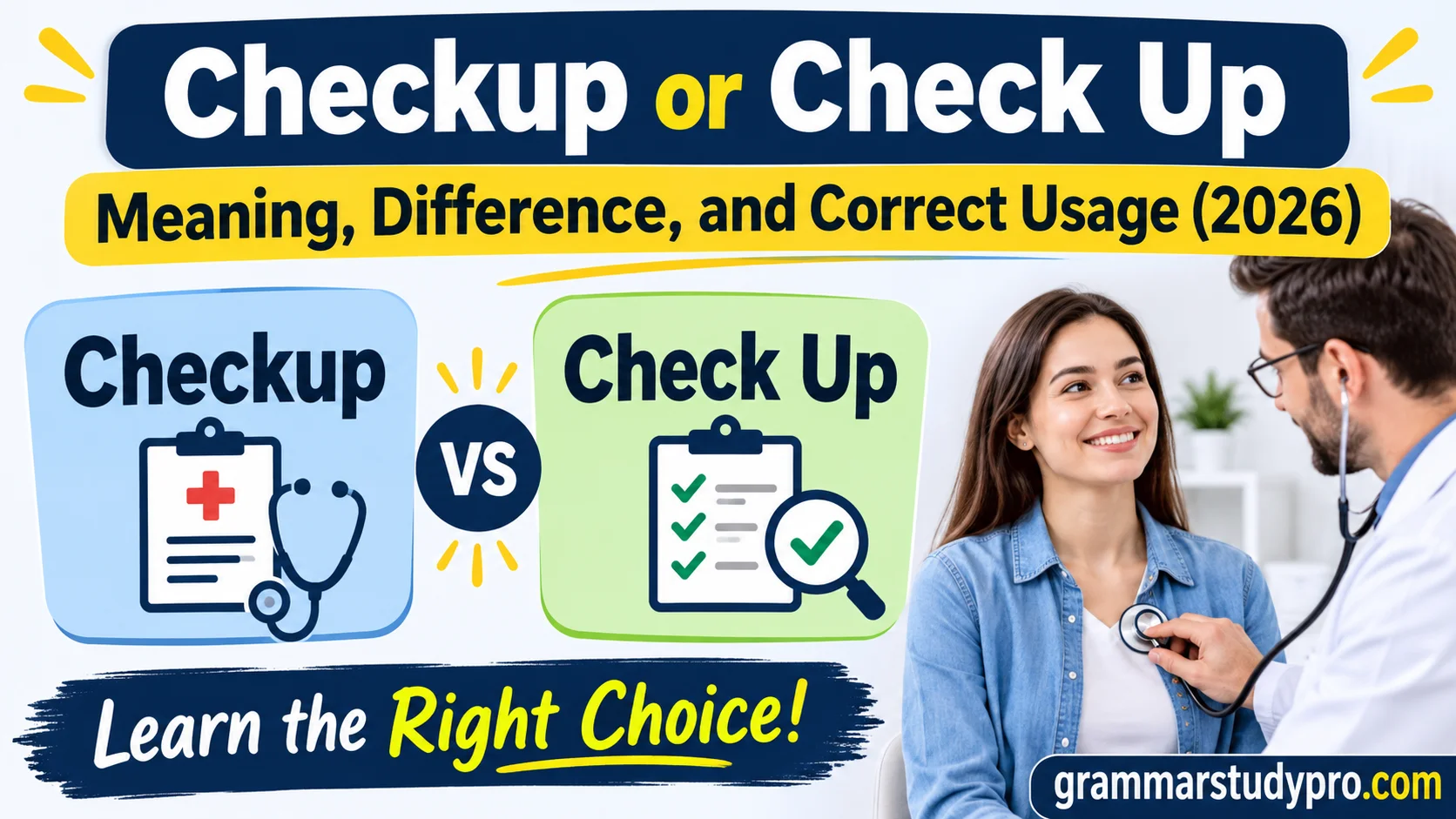
A medical examination and correct spelling are two different subjects, but both matter in everyday communication. Checkup or Check Up can describe different things:
A medical examination is a checkup, while check up means to examine or review something carefully. During a doctor’s appointment or medical visit, patients receive medical care through clinical tests, diagnostic tests, and laboratory tests. These may include a physical examination, clinical examination, or another medical inspection. Doctors use these examination procedures and test types for preventive medicine, preventive care, and preventive healthcare. Regular health screening and routine screening support health monitoring, health evaluation, and health assessment. They also help with medical evaluation, medical diagnosis, and reviewing medical results and test results.
A medical check-up also helps with disease detection, early detection, and disease identification. It supports disease prevention and may reduce the risk of further disease development. Doctors examine possible ailments, chronic diseases, and other medical conditions that affect a person’s health. Some health problems show initial symptoms, while others have unnoticed symptoms that appear later. Doctors may check risk factors, blood pressure, high blood pressure, high cholesterol, cholesterol, and uric acid levels. These examinations can also help identify diabetes and cancer. The required tests depend on the patient’s age, gender, and individual needs. For example, men and women may require different age-related tests or gender-specific tests. This explains why patients do not always receive the same medical care during every examination.
Understanding grammar is equally important when discussing medical examinations. Checkup, check up, and check-up have different word forms, grammatical purposes, and parts of speech. In English grammar, checkup is a noun, while check up is a verb that describes an action, such as checking, reviewing, or inspecting something. The hyphenated form, check-up, is another compound word and related term. Knowing the spelling, correct spelling, spelling differences, and spelling rules helps you understand their grammatical function. These grammatical distinctions, grammatical differences, and linguistic differences are useful parts of the English language. Learning these language rules improves your vocabulary, word formation, and understanding of common expressions and terms. Every writer should focus on usage, correct usage, and word choice to create clear sentences.
Quick Answer
Checkup is a noun that refers to a medical examination or routine assessment. Check up is a phrasal verb that means to investigate, verify, or monitor someone or something.
Here’s the easiest way to remember the difference:
- Checkup: Use one word when you’re talking about an examination.
- Check up: Use two words when you’re describing the action of investigating or monitoring something.
Examples:
- Correct: I have a doctor’s checkup tomorrow.
- Correct: I need to check up on my grandmother.
- Correct: The manager will check up on the project’s progress.
- Incorrect for standard American English: I have a doctor’s check up tomorrow.
In American English, checkup is the standard spelling for the noun. British English commonly uses the hyphenated form check-up.
English meaning – Cambridge Dictionary+1
Comparison Overview
Although checkup and check up share the same pronunciation, their grammatical roles differ. One functions as a noun while the other works as a phrasal verb.
| Feature | Checkup | Check Up |
| Spelling | One word | Two words |
| Part of speech | Noun | Phrasal verb |
| Meaning | An examination or assessment | To investigate, verify, or monitor |
| Main purpose | Names an examination | Describes an action |
| Common context | Medical appointments and inspections | Monitoring people or checking information |
| Example | I scheduled a checkup. | I checked up on him. |
| American English usage | Standard noun spelling | Standard verb spelling |
The easiest way to distinguish them is to examine their position in a sentence.
For example, you can schedule a checkup, attend a checkup, or receive a checkup. However, you can check up on someone, check up on information, or check up on a situation.
The meaning determines the spelling.
English meaning – Cambridge Dictionary+1
What Does Checkup Mean?
The word checkup refers to an examination that helps determine whether someone or something is in good condition. It most commonly appears in healthcare conversations, especially when people discuss routine medical visits.
In American English, checkup is a closed compound noun. It combines check and up into one word with its own established meaning.
Merriam-Webster defines checkup as an examination, especially a general physical examination. The word can also describe other types of routine assessments.
checkup+1
Definition of Checkup
A checkup is a planned examination that evaluates someone’s health or assesses the condition of something. It can help identify problems, confirm that everything works properly, or determine whether further attention is necessary.
In healthcare, a checkup usually involves a doctor or another medical professional reviewing a person’s general condition. Depending on the appointment, the examination might include questions about symptoms, a physical assessment, or recommended screening tests.
The word also appears in other situations where people inspect something regularly.
Consider these examples:
- I scheduled a routine checkup with my doctor.
- The mechanic performed a complete vehicle checkup.
- My dentist recommended another dental checkup.
- The technician completed a safety checkup before opening the facility.
Notice that checkup names the examination in every sentence. That’s why you write it as one word in standard American English.
Checkup in Medical Contexts
Medical appointments provide the most familiar examples of the word checkup. People visit healthcare professionals to review their health, discuss concerns, and receive appropriate examinations.
A routine medical checkup may involve several activities, depending on the patient’s age, health history, symptoms, and medical needs.
For example, a healthcare professional might:
- Ask about recent symptoms and existing health concerns.
- Review medications and relevant medical history.
- Measure blood pressure and other basic health indicators.
- Perform a physical examination when appropriate.
- Discuss recommended screenings and preventive care.
- Suggest follow-up appointments or additional testing when necessary.
However, not every checkup includes all these steps. A routine appointment differs from a specialized examination or diagnostic procedure.
The term also appears in several common healthcare expressions:
| Expression | Meaning | Example |
| Medical checkup | General health examination | I need a medical checkup. |
| Annual checkup | Examination arranged yearly | She attends an annual checkup. |
| Dental checkup | Examination of teeth and gums | My dental checkup is next week. |
| Eye checkup | Examination of vision and eye health | He scheduled an eye checkup. |
| Routine checkup | Regular health assessment | Children need routine checkups. |
| Physical checkup | General physical examination | The doctor recommended a physical checkup. |
Important: A checkup doesn’t automatically mean that someone has a health problem. Many people schedule routine examinations even when they feel perfectly healthy.
Checkup in General and Nonmedical Contexts
Although people often associate checkup with healthcare, the word can also describe other examinations.
For instance, mechanics inspect vehicles to identify maintenance needs. Technicians examine equipment to confirm that it operates properly. Businesses may also review systems and processes to identify potential problems.
Here are some practical examples:
- Vehicle checkup: The mechanic recommended a complete vehicle checkup before our road trip.
- Equipment checkup: The technician performed an equipment checkup before restarting production.
- Safety checkup: The supervisor arranged a safety checkup for the warehouse.
- System checkup: The IT department completed a system checkup after the software update.
- Routine checkup: The company arranged a routine checkup of its office equipment.
In each example, checkup identifies an examination or assessment.
One useful distinction matters here: not every inspection-related expression requires the word checkup. Terms such as inspection, maintenance check, and system audit may sound more precise in particular professional settings.
Choose the word that best describes the actual examination.
What Does Check Up Mean?
Unlike checkup, the expression check up contains two separate words and functions as a verb phrase.
It generally means to investigate, verify, or monitor someone or something. Writers most commonly use it in the construction check up on.
For example:
- I called to check up on my grandmother.
- The manager will check up on the employees.
- We need to check up on those figures.
- The nurse checked up on the patient.
The expression describes an action rather than naming an examination.
According to Oxford Learner’s Dictionaries, check up on somebody can mean making sure someone behaves as expected. Check up on something means finding out whether information is true or correct.
Oxford Learner’s Dictionaries+1
Definition of Check Up
Check up is a phrasal verb formed from the verb check and the particle up.
The expression usually appears with the preposition on when someone investigates or monitors a person, situation, or piece of information.
For example:
- I should check up on the delivery.
- She regularly checks up on her elderly parents.
- The supervisor checked up on the new employee.
- We need to check up on the information before publishing it.
The phrase can also change tense according to the sentence.
| Tense | Example |
| Present | I check up on my parents regularly. |
| Present continuous | She is checking up on the report. |
| Simple past | He checked up on the delivery yesterday. |
| Present perfect | They have checked up on the details. |
| Future | I’ll check up on the application tomorrow. |
Notice that the two words remain separate even when the verb changes tense.
You write checked up, not checkuped. That’s an important grammatical clue.
Check Up On Someone
One common use of check up on involves looking after someone or making sure they’re doing well.
People often use this expression when discussing family members, friends, employees, children, or patients.
For example, imagine that your grandmother lives alone. You might call her every evening to see how she’s feeling.
You could say:
“I call my grandmother every evening to check up on her.”
Here, the expression communicates concern and attention. You’re making sure she’s okay rather than scheduling a medical examination.
However, check up on someone can also suggest supervision or monitoring. The exact meaning depends on the situation.
Consider these examples:
- My parents check up on me whenever I travel.
- The nurse checked up on the patient after surgery.
- The teacher checks up on students who miss several classes.
- I called my brother to check up on him.
- The manager checks up on employees during important projects.
The expression doesn’t always carry a negative meaning. Sometimes it simply shows concern. In other situations, it can suggest that someone wants to monitor another person’s behavior.
Check Up On Something
You can also use check up on when investigating information, verifying details, or reviewing a situation.
This construction often appears in workplaces, research, customer service, and everyday communication.
For example, suppose a customer hasn’t received an order. You might contact the delivery company and check up on its status.
Other examples include:
- Please check up on the payment before closing the account.
- I need to check up on those statistics.
- The editor checked up on the facts before publishing the article.
- We should check up on the application status.
- She checked up on the company’s background before accepting the offer.
In these sentences, the phrase describes an investigation or verification process.
It’s worth remembering that check up on and look up aren’t interchangeable in every situation.
For example:
- I checked up on the company. (I investigated its background.)
- I looked up the company’s address. (I searched for its address.)
Both expressions involve finding information, but their meanings differ.
Main Differences Between Checkup and Check Up
Understanding the grammatical difference makes this spelling choice much easier. Although both expressions sound alike, they perform separate jobs within sentences.
Difference in Part of Speech
The most important distinction involves their grammatical functions.
Checkup is a noun. It identifies an examination, appointment, or assessment.
Check up is a phrasal verb. It describes the action of investigating, monitoring, or verifying something.
Compare these examples:
- I need a checkup before my vacation.
- I need to check up on my travel insurance.
In the first sentence, checkup names an examination. In the second, check up on describes an action.
You can also identify the noun through its surrounding words.
For example:
- A routine checkup
- My annual checkup
- The doctor’s checkup
- Several medical checkups
By contrast, the verb phrase works with a subject and an appropriate complement.
- She checks up on her patients.
- They checked up on the information.
- He is checking up on the results.
Difference in Meaning
The second difference concerns what each expression communicates.
A checkup is the examination itself. It refers to something a person schedules, receives, or attends.
Check up describes the process of investigating or monitoring something.
Look at this comparison:
| Checkup | Check Up |
| I booked a checkup. | I checked up on the booking. |
| She needs a dental checkup. | She checked up on her dental records. |
| He attended his annual checkup. | He checked up on his medical results. |
| The technician completed a checkup. | The technician checked up on the equipment. |
The first column identifies examinations. The second describes actions involving investigation or monitoring.
This difference remains consistent even when the surrounding subject changes.
Difference in Sentence Structure
Sentence structure provides another reliable way to identify the correct form.
Because checkup functions as a noun, it commonly follows articles, adjectives, and possessive words.
Examples:
- A checkup
- The checkup
- My checkup
- An annual checkup
- A thorough checkup
You can also use the plural form checkups.
For example:
“Regular checkups help patients discuss health concerns with their doctors.”
Meanwhile, check up behaves like a verb phrase. It changes according to the subject and tense.
Examples:
- I check up on my family.
- She checks up on her children.
- They checked up on the results.
- We are checking up on the delivery.
One helpful test is to replace the expression with another noun or verb.
If examination fits naturally, you probably need checkup. If investigate or verify fits, you probably need check up.
Difference in Everyday Usage
People use checkup when discussing appointments and examinations. The term appears frequently in healthcare conversations and routine inspection contexts.
On the other hand, check up usually appears when someone wants to investigate a situation or monitor another person.
Consider two everyday situations.
Situation one: Scheduling a doctor’s appointment
You want to visit your doctor for a routine examination.
You would say:
“I scheduled a checkup for Monday.”
Situation two: Making sure someone feels better
Your friend recently became sick. You want to find out how they’re feeling.
You would say:
“I’ll call tonight to check up on my friend.”
Both expressions are correct. The difference comes from what you’re trying to communicate.
Checkup vs. Check Up: Sentence Examples
Examples make spelling rules easier to remember. The following sentences show how each form works in everyday American English.
Examples of Checkup in Sentences
Use checkup when the sentence identifies an examination or assessment.
- I have a routine checkup scheduled for Friday.
- My annual checkup went well.
- The dentist recommended a regular checkup.
- She booked a medical checkup after noticing unusual symptoms.
- The mechanic performed a complete vehicle checkup.
- Children should receive appropriate routine health checkups.
- My doctor suggested another checkup in six months.
- The technician completed an equipment checkup.
- His last physical checkup took place in January.
- We arranged a safety checkup before reopening the building.
Notice how checkup functions as a noun in all these examples.
Examples of Check Up in Sentences
Use check up when describing an investigation or monitoring action.
- I need to check up on my elderly neighbor.
- The doctor will check up on the patient later.
- Please check up on the application status.
- The supervisor checked up on the team’s progress.
- We should check up on those figures before submitting the report.
- She regularly checks up on her younger brother.
- I’ll check up on the delivery tomorrow.
- The manager is checking up on the latest developments.
- They checked up on the information before making a decision.
- My parents always check up on me when I travel.
Here, the expression describes an action. The words remain separate regardless of tense.
Checkup or Check Up: Common Sentence Corrections
Sometimes, seeing an incorrect sentence beside its corrected version helps you recognize the difference immediately.
| Incorrect sentence | Correct sentence | Explanation |
| I have a check up tomorrow. | I have a checkup tomorrow. | The noun uses one word in American English. |
| She scheduled a check up. | She scheduled a checkup. | The sentence refers to an appointment. |
| I need to checkup on him. | I need to check up on him. | The verb phrase uses two words. |
| He checkedup on the report. | He checked up on the report. | The verb remains open. |
| My annual check up is next week. | My annual checkup is next week. | The standard American noun is closed. |
Remember: These corrections follow standard American English spelling. British English commonly uses check-up for the noun.
Common Expressions and Related Forms
Several expressions use checkup or check up in slightly different contexts. Learning these combinations can help you write more naturally.
Checkup Appointment
A checkup appointment refers to a scheduled examination, usually with a healthcare professional.
The expression combines two nouns. Checkup identifies the type of appointment while appointment emphasizes the scheduled visit.
Examples:
- I have a checkup appointment with my dentist.
- Her checkup appointment starts at 10 a.m.
- He rescheduled his annual checkup appointment.
In everyday conversation, you can also simply say checkup. The additional word appointment isn’t always necessary.
Regular Checkup
A regular checkup refers to an examination that someone receives at appropriate intervals.
The timing depends on the type of examination and individual circumstances.
For example, someone might arrange regular dental checkups while following a different schedule for general medical visits.
Examples:
- My doctor recommended a regular checkup.
- Regular checkups help patients discuss changing health concerns.
- She attends regular dental checkups.
Remember that the phrase uses checkup as a noun.
Check Up On
Check up on is the most common construction involving the phrasal verb.
It means investigating, monitoring, or making sure someone or something is doing well.
Examples:
- I called to check up on my mother.
- The supervisor checked up on the new employee.
- We need to check up on the latest information.
The preposition on introduces the person or thing being monitored.
Check-Up With a Hyphen
Although this article focuses on American English, you may encounter check-up in British publications, dictionaries, and international writing.
The Cambridge Dictionary distinguishes between the two regional noun spellings:
- American English: checkup
- British English: check-up
Both forms refer to a medical examination. The difference reflects regional spelling conventions rather than a change in meaning.
English meaning – Cambridge Dictionary+1
For American audiences, use checkup when writing the noun.
For example:
- American: I have an annual checkup.
- British: I have an annual check-up.
However, the verb phrase remains two words: check up on.
Common Mistakes to Avoid
Even experienced writers sometimes confuse these expressions because they sound identical. Fortunately, a few simple corrections can prevent most mistakes.
Using Check Up as a Noun
One frequent mistake involves writing check up when referring to a medical appointment.
Incorrect: “I need to schedule a check up.”
Correct: “I need to schedule a checkup.”
The sentence identifies an examination rather than an action. Therefore, the noun form works.
Writing Checkup as a Verb
Another common mistake involves joining the words when describing an action.
Incorrect: “I will checkup on the delivery.”
Correct: “I will check up on the delivery.”
The expression functions as a phrasal verb, so you must keep both words separate.
Forgetting the Preposition On
Writers sometimes leave out on when they mean to investigate or monitor someone.
Awkward: “I’ll check up my brother tonight.”
Natural: “I’ll check up on my brother tonight.”
The usual construction takes on before the person or thing being monitored.
Confusing Checkup With Follow-Up
Although checkup and follow-up can appear in healthcare conversations, they don’t mean exactly the same thing.
A checkup is an examination. A follow-up is an additional appointment, action, or communication that happens after an earlier event.
For example:
- The doctor scheduled a checkup for next month.
- The doctor scheduled a follow-up after reviewing the test results.
A follow-up may include another examination, but the expressions aren’t interchangeable in every situation.
Assuming Check-Up Is Wrong Everywhere
Another mistake involves treating the hyphenated form as universally incorrect.
In American English, checkup is the standard closed noun. However, British English commonly uses check-up.
Therefore, regional conventions matter. If you’re writing for an American audience, choose the closed spelling.
How to Remember the Difference Between Checkup and Check Up
You don’t need to memorize complicated grammar rules to choose the correct spelling. A simple noun-versus-verb test can help you make the right decision.
Use these memory tricks:
- Checkup = Examination: You schedule, attend, or receive a checkup.
- Check up = Action: You check up on someone or something.
- Checkups = Plural noun: You can have several checkups throughout the year.
- Checked up = Past-tense verb: You checked up on someone yesterday.
Here’s another easy way to remember:
| If you want to say… | Use… |
| I have a medical examination. | Checkup |
| I scheduled an examination. | Checkup |
| I want to see how someone is doing. | Check up on |
| I want to verify some information. | Check up on |
| I monitored someone’s progress. | Checked up on |
A Practical Case Study
Consider two coworkers discussing their schedules.
Sarah says, “I have a medical checkup tomorrow morning.”
James replies, “I’ll check up on you afterward to see how everything went.”
Both sentences use the correct expression, but each communicates something different.
Sarah uses checkup because she’s referring to a medical examination. James uses check up on because he wants to find out how Sarah is doing.
This small conversation demonstrates the entire spelling rule.
As a final memory trick, remember this sentence:
You schedule a checkup, but you check up on someone.
FAQs
1. Is it checkup or check up?
Both forms are correct, but they have different meanings. Checkup is a noun referring to an examination, while check up is a verb meaning to examine or investigate something.
2. Is check-up also correct?
Yes, check-up is a hyphenated form commonly used as a noun. It has the same meaning as checkup and refers to a medical examination or routine health assessment.
3. How do you use checkup in a sentence?
You can use checkup when talking about a medical examination. For example: “I have a doctor’s appointment tomorrow for my annual checkup.”
4. What does check up mean as a verb?
Check up means to investigate, examine, or make sure something is correct. For example: “The manager will check up on the team’s progress tomorrow.”
5. Is a medical checkup necessary?
A regular medical checkup helps doctors monitor your health and identify potential problems. It may include blood pressure measurements, laboratory tests, and other examinations based on your age and health needs.
Conclusion
Choosing between checkup or check up becomes easier when you understand their grammatical functions. Use checkup as a noun for a medical examination, and use check up as a verb when describing an action.
You can also use check-up as a hyphenated noun. Remembering these simple differences will improve your spelling, sentence structure, and everyday communication.