Unalienable vs. Inalienable becomes easier to understand when you explore American history and the original Declaration of Independence.
The United States Declaration of Independence is an important historical document and founding document that discusses fundamental rights, natural rights, and personal freedoms. Its Preamble mentions the Creator and the rights of people, including Life, Liberty, and the Pursuit of Happiness. These human rights, individual rights, and inherent rights cannot be taken away, transferred, or surrendered. The original Declaration text uses Unalienable Rights, making it the correct choice when quoting this historical source. This famous expression also connects with human freedom, personal liberty, and American independence. Its exact wording matters because historical spelling helps preserve the original meaning.
The confusion between these spellings mainly comes from modern usage and contemporary writing. Modern dictionaries recognize both Unalienable and Inalienable as accepted English adjectives with almost the same meaning. Their word meaning is similar, although their historical background and spelling differences create an interesting distinction. Inalienable appears frequently in modern English vocabulary, while Unalienable remains closely connected to the Declaration of Independence. Writers can use either form in similar contexts, but the right choice depends on the situation. For an academic paper, academic writing, or formal discussion about American history, the original spelling improves accuracy. Understanding these linguistic differences, historical connections, and language usage can improve your vocabulary and writing skills. It also helps prevent misquotations when discussing important historical sources.
A familiar phrase can sometimes create a small mistake in our memory. For example, readers may remember Inalienable because they encounter it more often in contemporary language. Bentham, also known as Jeremy Bentham, offered a famous critique of natural rights and contributed to discussions about political philosophy. Historical discussions, including blog posts, can attract attention and increase readership, even if the interest is fleeting. Tools like Google Ngram provide search data about word frequency, language trends, and historical usage. These patterns help explain how English spelling and terminology change over time. When you feel curious about a word, checking reliable dictionary definitions and original texts is better than relying on an assumption or impression. Whether you encounter these words in a university advertisement, a college discussion, or everyday writing, understanding their correct usage helps you choose the right form.
Quick Answer:
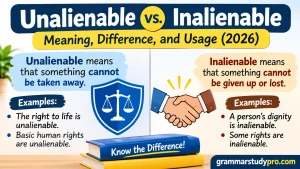
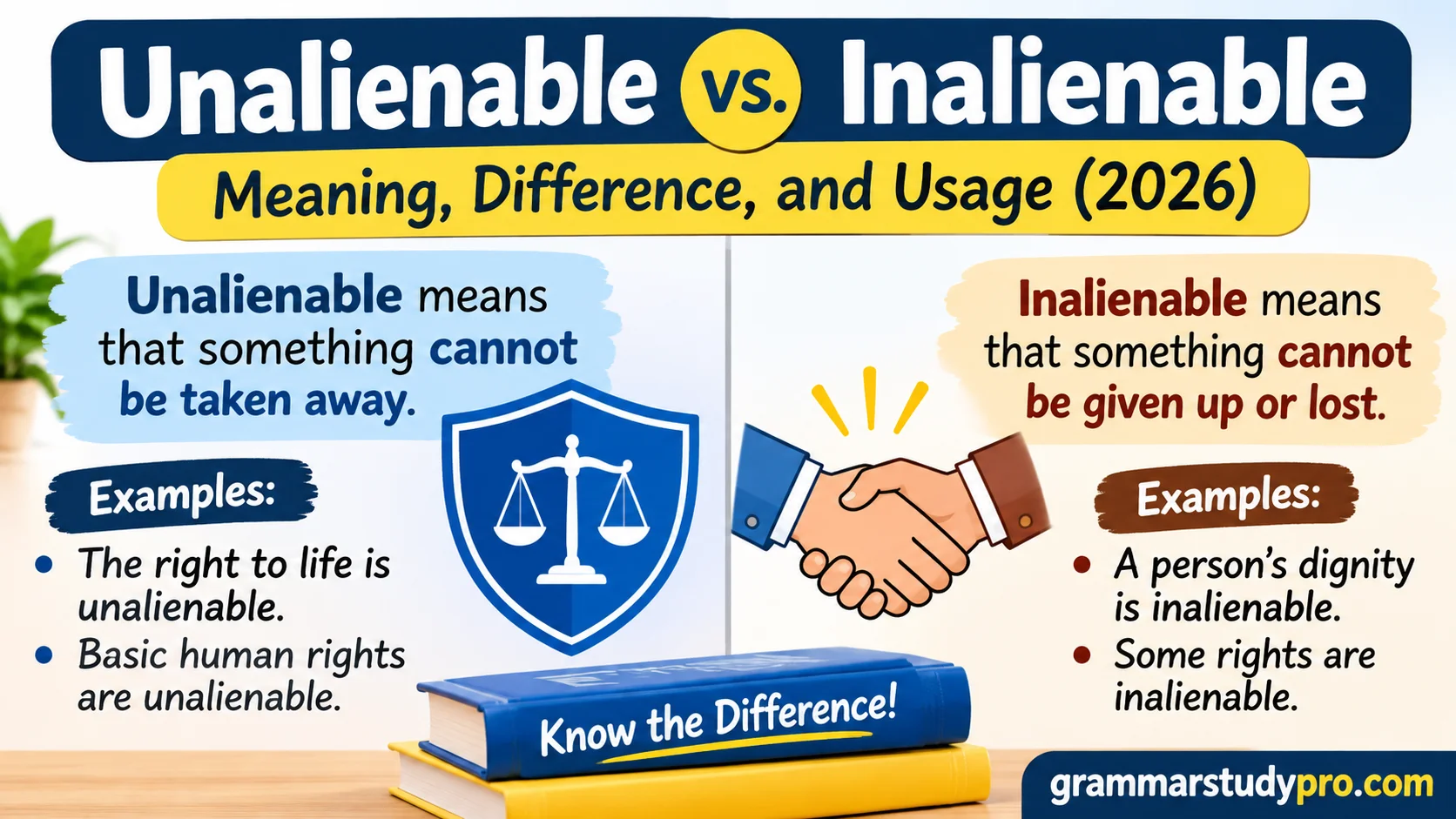
Unalienable and inalienable are both correct spellings. They share essentially the same meaning: something that cannot be taken away, transferred, or given up.
The main difference involves their spelling history and modern usage rather than their definitions.
- Unalienable: A traditional spelling strongly associated with the Declaration of Independence and American history.
- Inalienable: A widely used modern spelling that frequently appears in formal writing, legal discussions, and human rights contexts.
For example:
- Every person deserves certain unalienable rights regardless of their background.
- Freedom and personal dignity are considered inalienable rights.
Both sentences are grammatically correct. However, inalienable is generally the more familiar choice in contemporary writing. When quoting the Declaration of Independence, preserve its original spelling: unalienable.
Comparison Overview: Unalienable vs. Inalienable
Although these words look slightly different, they communicate the same essential idea. Both describe rights, qualities, or freedoms that cannot legitimately be transferred or surrendered.
| Feature | Unalienable | Inalienable |
| Part of speech | Adjective | Adjective |
| Meaning | Impossible to take away or transfer | Impossible to take away or transfer |
| Spelling | Correct | Correct |
| Prefix | Un- | In- |
| Modern usage | Less common | More common |
| Historical association | Declaration of Independence | Formal and modern writing |
| Common expression | Unalienable rights | Inalienable rights |
| Interchangeable | Yes | Yes |
| Example | Unalienable freedom | Inalienable freedom |
The most important point is that neither spelling is incorrect. You can use either word when discussing fundamental rights, personal liberty, and human dignity.
However, context matters. Historical documents may preserve unalienable, while contemporary writers often choose inalienable.
What Does Unalienable Mean?
The word unalienable describes something that cannot be surrendered, transferred, or taken away. It commonly appears in discussions about fundamental rights, individual freedoms, and human dignity.
When someone describes a right as unalienable, they mean that the right belongs to a person inherently. It doesn’t depend on another person’s permission or approval.
For example, the idea of unalienable rights suggests that certain basic freedoms belong to people simply because they’re human. A government may recognize and protect those rights, but the underlying principle doesn’t treat them as ordinary privileges.
Definition of Unalienable
According to its dictionary meaning, unalienable refers to something that cannot be transferred to another person or taken away.
The word is an adjective. It describes a quality or condition that makes something impossible to surrender or alienate.
Consider these simple explanations:
- Cannot be taken away: A fundamental right that someone should not lose.
- Cannot be transferred: Something that cannot simply become another person’s possession.
- Cannot be surrendered: A right that isn’t treated as an ordinary possession someone can freely give up.
- Inherent: Something that belongs to a person naturally rather than through a special grant.
For example, consider this sentence:
Every individual deserves unalienable rights that protect personal freedom and human dignity.
Here, unalienable describes rights that belong inherently to individuals. The sentence emphasizes that these rights shouldn’t depend on someone else’s willingness to recognize them.
However, the word doesn’t automatically mean that governments can never violate those rights. It expresses a principle about their fundamental status rather than a guarantee that violations never happen.
Origin and History of Unalienable
The history of unalienable helps explain why the word remains familiar today. Its roots connect to the English word alienable, which describes something that can be transferred or surrendered.
The prefix un- expresses negation. When attached to alienable, it reverses the original meaning.
The word dates back to the early seventeenth century. Etymological records trace unalienable to the 1610s.
Etymology, Origin & Meaning+1
Here’s how its parts work:
- Un-: A prefix meaning not or the opposite of something.
- Alienable: Something that can be transferred, surrendered, or given away.
- Unalienable: Something that cannot be transferred or surrendered.
The word gained particular recognition through American political history. The Declaration of Independence used unalienable Rights to describe the fundamental rights discussed in its famous opening statement.
That historical connection explains why many Americans recognize this spelling even when contemporary writing uses inalienable more frequently.
Examples of Unalienable in Sentences
Understanding a definition becomes easier when you see the word working in everyday sentences. The following examples demonstrate how unalienable fits different situations.
- Every person should enjoy unalienable rights regardless of their nationality or social background.
- The founding document described life and liberty as unalienable freedoms.
- Human dignity is often discussed as an unalienable quality of every individual.
- The speaker argued that personal freedom represents an unalienable principle of a fair society.
- Citizens should understand the historical importance of unalienable rights in American political thought.
- The organization promotes the protection of unalienable human rights across different communities.
- No individual should have to surrender their basic dignity to gain social acceptance.
- The Declaration of Independence famously refers to certain unalienable Rights.
Notice that the word usually appears before a noun. It describes the nature of a right, freedom, or principle.
In most contemporary contexts, you can replace it with inalienable without changing the sentence’s essential meaning.
What Does Inalienable Mean?
The word inalienable describes something that cannot be transferred, surrendered, or taken away. It commonly appears in conversations about human rights, personal liberty, legal principles, and individual dignity.
For instance, when someone calls freedom an inalienable right, they mean that freedom belongs inherently to individuals. It shouldn’t depend entirely on the decisions of governments, institutions, or other people.
You’ll frequently encounter this spelling in formal writing. Lawyers, researchers, educators, and human rights organizations often use it when discussing fundamental freedoms.
Definition of Inalienable
Inalienable is an adjective describing something that cannot be given away, transferred, or taken away.
Its meaning closely matches unalienable. Both words emphasize that certain rights or qualities aren’t ordinary possessions that someone can freely exchange.
Here are several ways to understand the word:
- Nontransferable: Something that cannot be passed to another person.
- Inherent: A quality or right that belongs naturally to someone.
- Non-surrenderable: Something that cannot simply be given up.
- Fundamental: A basic principle or freedom that deserves recognition and protection.
Consider this example:
Every individual has an inalienable right to personal dignity and respect.
The adjective inalienable describes the nature of the right. It suggests that dignity isn’t something another person can legitimately grant or remove at will.
However, context matters when discussing actual laws. A right described as inalienable may still face violations or restrictions in practice. The word expresses its fundamental character rather than claiming that every society always protects it perfectly.
Origin and History of Inalienable
The word inalienable developed from the prefix in- and the adjective alienable.
In this construction, in- means not or opposite of. It changes the meaning of alienable into its negative form.
Historical etymological records trace inalienable to the 1640s. The word may also have developed under the influence of the French term inaliénable.
Etymology, Origin & Meaning+1
Let’s examine its structure:
- In-: A prefix that expresses negation.
- Alienable: Something capable of being transferred or surrendered.
- Inalienable: Something that cannot be transferred or surrendered.
Although the two spellings use different prefixes, they express essentially the same idea.
The word became particularly important in discussions about natural rights, political philosophy, and individual freedom. Writers used it to describe rights that people possess inherently rather than receive as temporary privileges.
Today, inalienable remains a common choice in formal discussions about human rights and fundamental freedoms.
Examples of Inalienable in Sentences
The following examples show how inalienable works in different situations:
- Every human being deserves inalienable rights regardless of their circumstances.
- Personal dignity is an inalienable part of human identity.
- Freedom of thought is often considered an inalienable human right.
- The constitution recognizes certain principles that protect individual liberty.
- Every person should have an inalienable right to make important personal decisions.
- The organization works to defend the inalienable freedoms of vulnerable communities.
- Education can help people understand their fundamental rights and responsibilities.
- The lawyer explained why certain basic rights should remain protected.
These examples show that inalienable works naturally in both formal and general writing.
You can also use it in academic essays, historical discussions, and articles about individual freedoms.
Main Differences Between Unalienable and Inalienable
At first glance, unalienable and inalienable seem like two different words with separate meanings. However, their definitions overlap almost completely.
The real distinction comes from their prefixes, historical development, and frequency in modern writing.
Let’s examine their differences more closely.
Meaning and Definition: Unalienable vs. Inalienable
The biggest similarity between these words is their meaning. Both describe something that cannot be surrendered, transferred, or taken away.
For example:
- Unalienable: Freedom is an unalienable right.
- Inalienable: Freedom is an inalienable right.
Both sentences communicate the same fundamental idea. Neither spelling suggests a different level of protection or a separate category of rights.
You don’t need to learn two different definitions. Understanding one will help you use the other correctly.
Spelling and Prefix Differences
The visible difference between these words appears at the beginning.
Unalienable uses the prefix un-, while inalienable uses in-.
Both prefixes can express negation in English. However, they come from different linguistic traditions.
| Word | Prefix | Meaning of Prefix | Result |
| Unalienable | Un- | Not | Not transferable |
| Inalienable | In- | Not | Not transferable |
The difference becomes easier to understand when you separate each word into its parts.
For example, consider unhappy and incomplete. Both prefixes create negative meanings, although English doesn’t allow you to exchange them freely in every word.
The same principle applies here. Both forms have become established English adjectives through their historical development.
Remember: Different prefixes don’t necessarily produce different meanings. In this particular comparison, both spellings communicate essentially the same idea.
Frequency and Modern Usage
Although both words remain correct, they don’t appear equally often in contemporary English.
Inalienable is generally the more common spelling in modern usage. You’ll frequently encounter it in discussions about fundamental rights, personal liberty, legal principles, and human dignity.
Meanwhile, unalienable appears less frequently outside historical references and discussions of the Declaration of Independence.
Dictionary.com also identifies inalienable as the more common modern form while recognizing unalienable as an accepted alternative.
Dictionary.com
Here’s a practical comparison:
| Writing Situation | Suggested Spelling |
| Modern academic essay | Inalienable |
| General informational article | Inalienable |
| Human rights discussion | Inalienable |
| Historical quotation | Unalienable, if that’s the original wording |
| Discussion of the Declaration | Unalienable |
| Personal vocabulary practice | Either spelling |
These are practical usage recommendations rather than strict grammatical rules.
If you’re writing for a modern audience, inalienable will usually feel more familiar. However, choosing unalienable doesn’t make your sentence incorrect.
Historical and Cultural Context
History gives unalienable a special place in American English. Its connection to the Declaration of Independence makes it recognizable to readers who have studied American history.
The famous document describes certain rights as unalienable Rights. This wording appears in the final adopted text.
By contrast, earlier drafts of the document used inalienable. The change illustrates how both forms existed during the same historical period.
USHistorical+2
This distinction matters when discussing historical documents. You should preserve the original spelling when quoting an important source.
For ordinary modern writing, however, you can choose either spelling without changing the intended meaning.
Why Does the Declaration of Independence Use Unalienable Rights?
One of the biggest reasons people search for unalienable vs. inalienable is the Declaration of Independence. The famous American document uses unalienable rather than the modern spelling many readers expect.
This wording isn’t a spelling mistake. It reflects the language used in the final version of the document adopted in 1776.
The Famous Phrase: Life, Liberty, and the Pursuit of Happiness
The Declaration of Independence contains one of the most recognizable statements in American history:
“We hold these truths to be self-evident, that all men are created equal, that they are endowed by their Creator with certain unalienable Rights, that among these are Life, Liberty and the pursuit of Happiness.”
— The Declaration of Independence, 1776.
National Archives
This passage identifies three important rights:
- Life: The fundamental interest in living and preserving one’s existence.
- Liberty: The freedom to make choices and live without unjust restrictions.
- The pursuit of happiness: The freedom to seek personal fulfillment and build a meaningful life.
The document presents these rights as inherent rather than privileges granted by a government.
Its wording also explains why unalienable remains familiar in American education, political discussions, and historical writing.
The phrase has influenced generations of discussions about individual freedom and equality.
Why Not Inalienable Rights?
Interestingly, Thomas Jefferson’s early draft used inalienable rather than unalienable.
His original rough draft described certain rights as “inherent & inalienable rights.” The committee draft also retained inalienable in its wording. However, the final adopted text uses unalienable.
The Papers of Thomas Jefferson+1
This historical development explains why both spellings appear in discussions about the Declaration.
The important details are:
- Jefferson initially wrote inalienable in his rough draft.
- The committee’s draft retained that spelling.
- The final version adopted by Congress used unalienable.
- Both words expressed the same essential meaning.
The National Archives identifies July 4, 1776, as the date Congress adopted the Declaration. Delegates began signing the engrossed parchment copy on August 2, 1776.
National Archives+1
Therefore, the spelling in the final document reflects its historical wording rather than a difference in meaning.
How the Two Spellings Became Popular
Both forms existed long before the Declaration of Independence.
Etymological records trace unalienable to the 1610s and inalienable to the 1640s. This means neither word originated with the Declaration.
Etymology, Origin & Meaning+1
However, the Declaration gave unalienable lasting cultural recognition.
Meanwhile, inalienable continued to appear in formal discussions and eventually became the more common modern spelling.
Their development can be summarized through these historical points:
| Historical Detail | Explanation |
| Early 1600s | Unalienable entered English usage. |
| 1640s | Inalienable appeared in English. |
| June 1776 | Jefferson’s rough draft used inalienable. |
| 1776 committee draft | Inalienable remained in the draft wording. |
| July 4, 1776 | The adopted Declaration used unalienable. |
| Modern English | Inalienable is generally more common. |
The two spellings survived because English accepts both forms. Their historical development also explains why writers still encounter them in different settings.
When Should You Use Unalienable or Inalienable?
Knowing that both words are correct doesn’t always make choosing between them easy. Your writing context can help determine which spelling sounds more appropriate.
Although you can use either form, certain situations naturally favor one over the other.
When to Use Unalienable
Choose unalienable when historical accuracy or traditional wording matters.
This spelling works particularly well when discussing American founding documents or reproducing historical language.
Consider using it in these situations:
- Historical quotations: Preserve the original wording when quoting the Declaration of Independence.
- American history: Use it when discussing the language of the country’s founding documents.
- Historical research: Retain the spelling found in the original source.
- Traditional expressions: Use it when intentionally discussing the familiar phrase unalienable rights.
For example:
The Declaration of Independence identifies life and liberty as unalienable rights.
This sentence uses the historical spelling associated with the document.
You can also use unalienable in ordinary modern writing. However, it may feel less familiar to readers accustomed to inalienable.
When to Use Inalienable
Choose inalienable when writing for a contemporary audience.
This spelling appears frequently in formal discussions about rights, freedoms, and fundamental human principles.
It works particularly well in:
- Academic writing: Discuss fundamental rights in research papers and essays.
- Legal discussions: Explain principles involving individual rights and personal liberty.
- Human rights articles: Describe freedoms and protections belonging to individuals.
- Professional communication: Use familiar terminology in formal reports and discussions.
- General writing: Choose a widely recognized modern spelling.
For example:
Every individual deserves inalienable rights and equal respect under the law.
Here, inalienable communicates the idea clearly without requiring a historical context.
Can You Use Unalienable and Inalienable Interchangeably?
Yes, you can generally use these words interchangeably because they share the same essential definition.
Replacing one with the other doesn’t normally change the meaning of your sentence.
Consider these examples:
| Using Unalienable | Using Inalienable |
| Everyone deserves unalienable rights. | Everyone deserves inalienable rights. |
| Freedom is an unalienable principle. | Freedom is an inalienable principle. |
| Human dignity is unalienable. | Human dignity is inalienable. |
| Liberty represents an unalienable freedom. | Liberty represents an inalienable freedom. |
Both columns contain grammatically correct sentences.
However, remember one important writing rule: Don’t change the original wording when quoting a historical source.
For example, if you’re quoting the Declaration of Independence, keep unalienable Rights. Replacing it with inalienable rights would alter the original quotation.
You should also maintain consistent spelling throughout your own article or document. Consistency makes your writing easier to read and prevents unnecessary confusion.
Common Phrases and Expressions Using Unalienable and Inalienable
Both spellings appear in expressions involving personal freedom, human dignity, and fundamental rights.
Understanding these combinations helps you recognize how the words function in real sentences.
Unalienable Rights
Unalienable rights refers to fundamental rights that cannot legitimately be surrendered, transferred, or taken away.
The expression is especially familiar because of its appearance in the Declaration of Independence.
Example: The founding document identifies certain unalienable rights that belong to individuals.
Inalienable Rights
Inalienable rights has essentially the same meaning as unalienable rights. It describes fundamental rights that belong inherently to individuals.
Example: Human dignity and personal liberty are often described as inalienable rights.
Unalienable Freedom
This expression describes freedom considered fundamental and not something that another person should simply remove.
Example: The speaker argued that personal freedom represents an unalienable principle of human dignity.
Inalienable Freedom
This phrase communicates the same idea using the more common modern spelling.
Example: Every individual should enjoy inalienable freedom of thought and personal belief.
Inalienable Human Rights
This expression refers to fundamental rights that belong to all people because they are human.
Example: International human rights discussions frequently emphasize the dignity and equal rights of every individual.
Inalienable Right to Life
This phrase describes the fundamental right to life as something that shouldn’t depend on another person’s permission.
Example: The discussion focused on protecting the inalienable right to life.
Inalienable Right to Liberty
This expression emphasizes personal freedom and protection against unjust restrictions.
Example: The article examined the relationship between individual liberty and inalienable rights.
Quick Comparison of Common Expressions
| Expression | Meaning |
| Unalienable rights | Fundamental rights that cannot legitimately be surrendered or transferred |
| Inalienable rights | Same meaning as unalienable rights |
| Unalienable freedom | Freedom regarded as fundamental and nontransferable |
| Inalienable freedom | Same essential meaning as unalienable freedom |
| Inalienable human rights | Fundamental rights belonging to all people |
| Inalienable right to life | Fundamental right concerning human life |
| Inalienable right to liberty | Fundamental right concerning personal freedom |
These expressions are useful in historical, academic, and general writing. Choose the spelling that best suits your audience and context.
Common Mistakes to Avoid When Using Unalienable and Inalienable
Even though both words have straightforward meanings, writers sometimes misunderstand their relationship.
Avoiding these common mistakes will help you use them confidently.
Assuming One Spelling Is Incorrect
One common mistake involves treating unalienable as a misspelling of inalienable.
That’s incorrect because both forms are accepted English adjectives.
The Declaration of Independence provides a famous example of unalienable. Modern dictionaries also recognize the spelling.
Incorrect assumption: Unalienable is always wrong.
Correct understanding: Both spellings are correct, although their frequency and historical associations differ.
Thinking They Have Completely Different Meanings
Another mistake is assuming that unalienable describes something permanent while inalienable describes something merely difficult to transfer.
English usage doesn’t establish this distinction between the two words.
Both describe something that cannot be given away, transferred, or taken away.
For example:
- Human dignity is unalienable.
- Human dignity is inalienable.
Both statements express the same essential idea.
Confusing Inalienable With Alienable
The words alienable and inalienable have opposite meanings.
Understanding this difference makes the comparison much easier.
- Alienable: Something that can be transferred or surrendered.
- Inalienable: Something that cannot be transferred or surrendered.
- Unalienable: Another accepted form of inalienable.
For example, ordinary property can generally be sold or transferred. That makes it alienable.
By contrast, an inalienable right is understood as a fundamental right that shouldn’t be treated as ordinary transferable property.
The distinction is particularly important in legal and philosophical discussions.
Using the Words Without Understanding Their Context
Although both spellings are correct, you shouldn’t ignore the purpose of your writing.
A historical quotation requires the original wording. A contemporary article can generally use the more familiar modern spelling.
For example:
- When quoting the Declaration, write unalienable Rights.
- When discussing modern human rights principles, inalienable rights is a natural choice.
- When comparing both spellings, explain that they have the same essential meaning.
Choosing carefully helps your writing remain accurate and professional.
Unalienable vs. Inalienable: Which Spelling Should You Choose?
Practical recommendation
If you’re unsure which spelling to use, consider your audience and the purpose of your writing.
For most contemporary articles, essays, and formal discussions, inalienable is a practical choice because it’s more commonly used today.
However, unalienable remains completely correct. It is especially appropriate when discussing the Declaration of Independence or preserving historical language.
Here’s a simple guide:
| Your Purpose | Recommended Choice |
| Writing a modern blog post | Inalienable |
| Preparing an academic essay | Inalienable |
| Discussing human rights | Inalienable |
| Quoting the Declaration of Independence | Unalienable |
| Analyzing historical American documents | Original source spelling |
| Comparing the two words | Both |
Remember that this recommendation concerns writing preference, not grammatical correctness.
Neither spelling is inherently better or more accurate in every situation. Both communicate the same fundamental meaning.
If your article discusses both forms, introduce the distinction clearly and maintain consistent usage throughout the text.
FAQs
1. What is the difference between Unalienable and Inalienable?
Unalienable and Inalienable have almost the same meaning. Both describe something that cannot be taken away, transferred, or surrendered. The main difference is their historical spelling and usage. Unalienable appears in the Declaration of Independence, while Inalienable is more common in modern writing.
2. Does the Declaration of Independence use Unalienable or Inalienable?
The Declaration of Independence uses Unalienable Rights. This wording appears in its famous passage about life, liberty, and the pursuit of happiness. Therefore, use Unalienable when quoting the original document.
3. Is Unalienable a correct English word?
Yes, Unalienable is a correct English adjective. It describes rights or freedoms that cannot be taken away or transferred. Although Inalienable appears more frequently today, both spellings are accepted.
4. Why is Inalienable more common in modern English?
Inalienable has become more familiar through modern dictionaries, academic writing, legal discussions, and everyday language. Writers frequently use it when discussing human rights, personal freedoms, and fundamental principles.
5. Can I use Unalienable and Inalienable interchangeably?
Yes, you can generally use both words interchangeably because they share the same basic meaning. However, consider the context. Use Unalienable when reproducing the Declaration of Independence’s original wording, and choose either spelling for general writing.
Conclusion
The difference between Unalienable vs. Inalienable mainly comes down to historical spelling and modern usage. Both words describe rights and freedoms that cannot be taken away, transferred, or surrendered. However, the Declaration of Independence specifically uses Unalienable Rights in its famous statement about life, liberty, and the pursuit of happiness.
Today, Inalienable appears more frequently in everyday and academic writing. Still, Unalienable remains a correct English word with an important place in American history. Understanding both spellings helps you avoid confusion and choose the right word for your writing.