Alright vs All Right explains why two similar spellings can create confusion when you write in English, especially in formal or casual situations. Both forms express a similar idea, but their usage depends on context and tone.
The main difference is spelling: all right uses two words, while alright uses one. Both can mean good enough, adequate, satisfactory, well, or okay. Depending on the sentence, the phrase can work as an adjective, descriptive adjective, adverb, or interjection. The English language keeps changing, and language evolution has produced spelling variations such as altogether, all together, all-together, and alltogether. However, these forms do not always share the same meaning. Understanding their word forms, grammatical function, and context-dependent meaning helps you make better word choices and follow language rules in written communication.
All right remains the preferred and standard spelling in formal writing, academic writing, and professional writing. Editors often recommend it because it follows established writing conventions and grammar rules. For example, “Everything is all right” means everything is fine. Meanwhile, alright appears frequently in informal contexts, text messages, and casual conversations. The expression “I am alright” communicates a similar feeling to “I am fine.” Both forms appear in dictionaries such as Merriam-Webster and Oxford, which supports their acceptance in modern English. Still, their multiple meanings, correctness, and acceptable usage can depend on the situation.
The historical usage of alright also adds interest to the spelling debate. Mark Twain used it in his short story The Celebrated Jumping Frog of Calaveras County, published in 1865. Later, actor Matthew McConaughey popularized the cornerstone catchphrase “All right, all right, all right,” making it a familiar cultural reference in pop culture. Although some writers maintain a steadfast belief that alright is incorrect, others consider both versions legitimized and justified by modern dictionaries. Despite their minimal differences in meaning, choosing the correct spelling still depends on your audience, writing style, and level of formality.
Quick Answer:
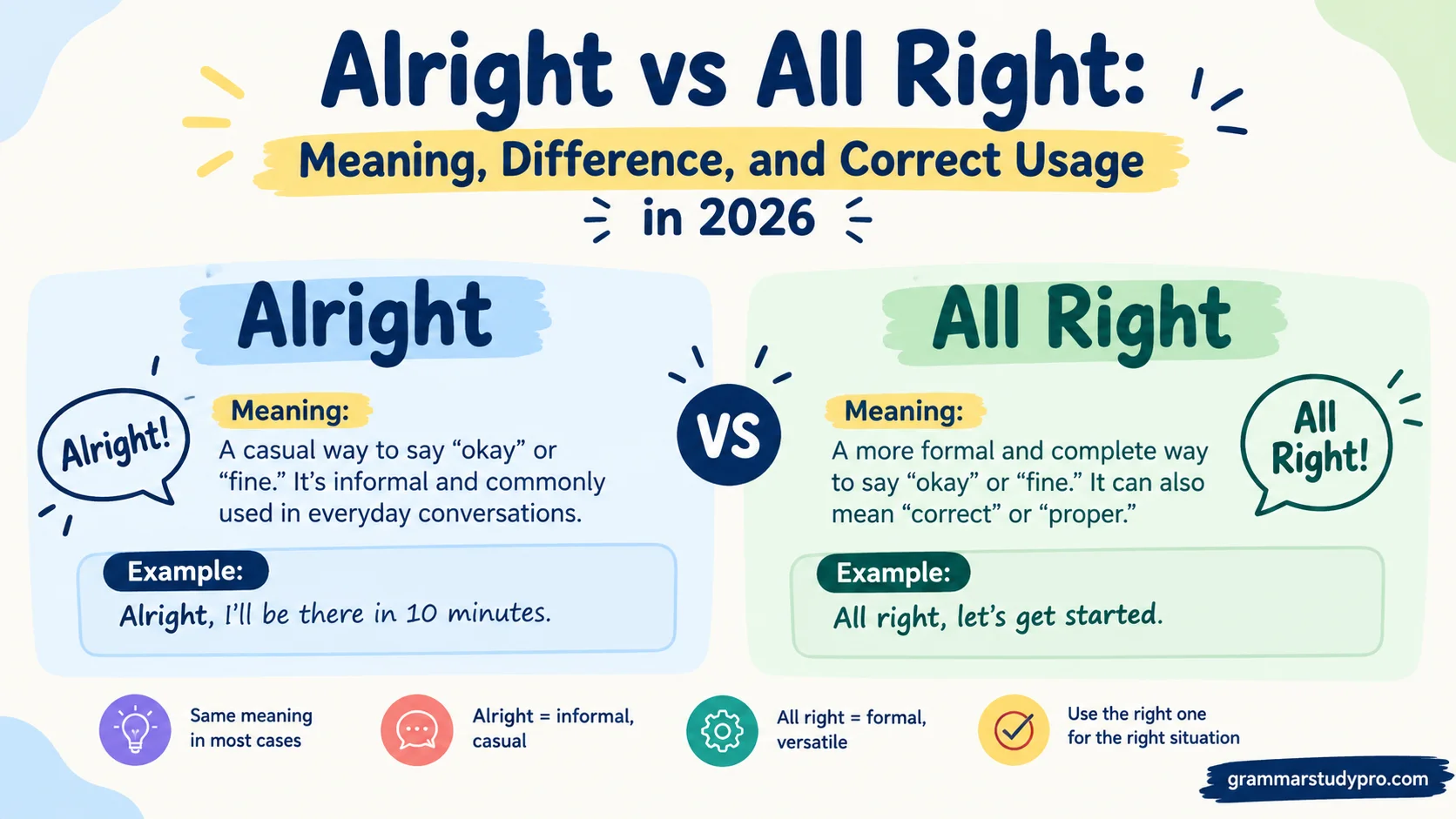
All right and alright generally mean the same thing: okay, fine, acceptable, or satisfactory. The main difference lies in spelling conventions and how different writing styles treat the one-word version.
- All right: The established standard spelling. It’s the safest choice for academic papers, professional emails, reports, and formal articles.
- Alright: A recognized one-word variant commonly used in casual conversations, text messages, dialogue, and informal writing.
- Allright: An incorrect spelling in standard English. Avoid combining the words this way.
Here’s a quick example:
- All right: “Are you all right after the long trip?”
- Alright: “Are you alright after the long trip?”
Both sentences ask whether someone is okay. However, if you’re unsure which form your teacher, editor, or employer expects, choose all right.
| Feature | All Right | Alright |
| Spelling | Two words | One word |
| General meaning | Okay, fine, acceptable, or correct | Usually the same |
| Formal writing | Preferred | Often discouraged by traditional style guides |
| Casual texting | Correct and natural | Common and natural |
| Creative writing | Suitable | May suit informal character dialogue |
| Safest choice for general writing | Yes | Depends on context |
The easiest rule to remember is this: Use “all right” when you want the safest standard form. Use “alright” when an informal style suits your purpose and your chosen style guide allows it.
All Right Meaning “Okay” or “Acceptable”
People often use all right to describe something that’s good enough or acceptable, even if it isn’t excellent.
For example:
- “The restaurant was all right, but the service was slow.”
- “Your answer is all right, although it needs more detail.”
- “The new schedule looks all right to me.”
Notice that all right doesn’t always express strong approval. If someone says a movie was all right, they might mean it was enjoyable enough but not particularly impressive.
You can also use it when asking permission.
- “Is it all right if I open the window?”
- “Would it be all right to call you tomorrow?”
- “Is this time all right for our meeting?”
In these examples, the expression means acceptable or suitable.
All Right Meaning “Well” or “Safe”
Another common use of all right concerns someone’s health, safety, or general condition.
Consider these examples:
- “Are you all right? You look upset.”
- “The passengers were all right after the emergency landing.”
- “I’m feeling all right now, thanks for asking.”
- “Did you get home all right last night?”
The last example uses all right as an adverb. It asks whether someone arrived home safely rather than whether their home was acceptable.
This distinction matters because the expression can describe both a person’s condition and the way an action happens.
All Right as a Way to Agree
Sometimes, all right has little to do with health or quality. Instead, it signals agreement, acceptance, or a decision to proceed.
For example:
- “All right, let’s get started.”
- “All right, I’ll send you the revised document.”
- “You make a good point. All right, let’s try your approach.”
- “All right, we can meet at seven.”
In conversation, it often works like okay or fine. A speaker might use it to accept a suggestion, end a discussion, or move to the next task.
Tip: Pay attention to punctuation and context. “All right, let’s go” expresses agreement, while “Everything is all right” describes a satisfactory condition.
What Does Alright Mean?
Alright is a one-word spelling variant of all right. It generally carries the same meanings, including okay, fine, acceptable, or satisfactory.
Although some traditional grammar guides discourage it, alright appears in modern English writing and has entries in major dictionaries. Merriam-Webster, for example, defines it as a synonym of all right and notes its increasing presence in published writing. However, all right remains more common in edited prose.
Here are a few examples:
- “I’m alright now, so you don’t need to worry.”
- “Alright, let’s meet outside the library.”
- “The movie was alright, but I wouldn’t watch it again.”
- “Are you alright after the long drive?”
Each sentence uses alright in a way that many English speakers will recognize.
Why Do People Write Alright?
English speakers often combine words over time. Spellings such as already and altogether show that English has many established one-word forms that developed from earlier combinations.
However, not every shortened spelling gains the same level of acceptance. Alright remains more controversial than already, especially in formal and carefully edited writing.
People use alright for several practical reasons:
- Convenience: One word can feel quicker to type in a message.
- Conversational tone: It often fits casual dialogue naturally.
- Familiarity: Readers frequently encounter it in informal writing.
- Style: Writers may prefer its appearance in dialogue, song titles, or other creative work.
Its widespread use doesn’t mean every editor accepts it. When writing for a school, workplace, or publication, check the relevant style requirements.
Main Differences Between Alright and All Right
The main difference between alright and all right concerns standard usage, not a strict difference in meaning.
Both forms can express agreement, describe an acceptable situation, or ask whether someone is okay. Nevertheless, they don’t always receive the same treatment from editors, teachers, and dictionaries.
Spelling and Standard Usage
The simplest distinction is how you write each expression.
- All right: Two words; the established standard form.
- Alright: One word; a widely used alternative.
- Allright: A nonstandard spelling that you should avoid.
For example:
Incorrect: “Everything will be allright.”
Correct: “Everything will be all right.”
You may see alright in books, websites, and personal messages. That doesn’t make allright an accepted substitute.
Formality and Tone
The audience and purpose of your writing can help you choose the better form.
In formal writing, all right is usually the safer option. It suits professional communication and avoids a spelling that some readers may consider nonstandard.
In informal writing, alright can sound natural and conversational. It often appears in fictional dialogue, text messages, and casual online discussions.
Compare these examples:
| Situation | Recommended sentence | Reason |
| Academic essay | “The proposed explanation is acceptable.” | More precise and formal |
| Business email | “The revised schedule is all right with us.” | Uses the standard spelling |
| Text message | “Alright, see you at six!” | Casual and conversational |
| Fictional dialogue | “‘Alright, let’s go,’ Maya said.” | May reflect the character’s voice |
| Formal report | “The results are satisfactory.” | More specific than all right |
Remember that all right isn’t automatically the best word for every formal sentence. In an academic paper, terms such as acceptable, satisfactory, or adequate may communicate your point more clearly.
Meaning and Context
Although the two spellings usually mean the same thing, the expression all right can also mean that every item is correct.
Consider these sentences:
- “The answers are all right.”
- “The answers are alright.”
The first sentence can mean that every answer is correct. Depending on context, it can also mean that the answers are satisfactory.
The second sentence usually describes the answers as acceptable or reasonably good.
Some writers deliberately use this distinction to separate correctness from general quality. However, it isn’t a universal rule. Merriam-Webster explains that all right can express both meanings, so readers shouldn’t assume that the spelling alone settles the question.
When accuracy matters, write a more precise sentence:
- “All five answers are correct.”
- “The answers are acceptable, but they need improvement.”
These versions remove the ambiguity entirely.
Acceptance in Dictionaries and Style Guides
One reason this spelling debate continues is that dictionaries and style guides don’t always take the same approach.
Some dictionaries record alright as an alternative spelling while noting that all right is more standard. Oxford Learner’s Dictionaries, for example, labels alright as nonstandard or informal and notes that some people avoid it in formal writing.
This difference in treatment explains why you might see alright in a published novel but receive a correction for using it in an academic paper.
For practical purposes, follow these guidelines:
- Use all right in formal or carefully edited writing.
- Use alright when an informal style suits the context.
- Follow your organization’s preferred style guide.
- Preserve the original spelling in direct quotations unless you clearly indicate an editorial change.
When to Use All Right
If you want to avoid unnecessary spelling debates, all right is the dependable choice. It works across a wide range of situations and follows established standard usage.
In Academic and Formal Writing
Teachers and editors may prefer all right over alright in essays, reports, and research papers.
However, both expressions can sound vague in formal prose. Whenever possible, choose a word that describes the situation more precisely.
For example:
- Less precise: “The results were all right.”
- More precise: “The results were satisfactory.”
- More precise: “The results met the minimum requirements.”
The best choice depends on what you mean. Satisfactory suggests that the results meet expectations, while adequate often means they meet a basic requirement.
In Professional Emails and Business Communication
In the workplace, all right is useful when you approve a suggestion, check someone’s well-being, or confirm an arrangement.
Examples include:
- “The proposed changes are all right with the marketing team.”
- “Is Thursday afternoon all right for the presentation?”
- “All right, I’ll share the updated file before noon.”
Still, consider the tone of the message. A direct statement such as “I approve the revised schedule” may communicate a business decision more clearly than “The schedule is all right.”
When You Want the Safest Standard Spelling
Use all right whenever you aren’t sure which form your audience prefers.
This approach is especially helpful when writing:
- School assignments and examinations
- Job applications and cover letters
- Business proposals
- Professional website content
- Reports and formal correspondence
You don’t need to avoid alright in every situation. You simply need to understand that all right is less likely to attract a style-based correction.
When to Use Alright
Although all right is the safer standard form, alright has a place in everyday English. It can suit a relaxed tone, especially when a writer wants dialogue or informal communication to feel natural.
In Text Messages and Casual Chats
Text messages often favor short, familiar expressions. In this setting, alright is widely understood and commonly used.
For example:
- “Alright, I’ll call you when I get home.”
- “Are you alright? You haven’t replied all day.”
- “Alright then, see you tomorrow.”
- “I’m alright, just a little tired.”
In these examples, the one-word spelling fits a casual conversation. You can also use all right in every sentence without changing the basic meaning.
The choice often comes down to personal preference and the tone you want to create.
In Dialogue and Creative Writing
Writers sometimes choose alright to preserve a character’s voice. Dialogue doesn’t always follow the same stylistic preferences as formal narration.
Consider this short example:
“Are you alright?” Daniel asked.
“I’m fine,” Mia replied. “I just need a minute.”
The spelling fits the informal exchange. Another writer might use all right instead, with no meaningful change in the conversation.
If you’re editing a novel, short story, or screenplay, consistency matters. Choose a spelling that fits the project’s style and use it consistently unless a specific reason calls for a change.
In Informal Online Content
You may encounter alright in social media posts, personal blogs, comments, and relaxed online discussions.
For example:
- “The new update looks alright so far.”
- “Alright, here’s what happened yesterday.”
- “Everything’s alright now.”
These uses are familiar to many readers. Nevertheless, if you’re publishing a grammar article, academic resource, or professional guide, all right is the more cautious editorial choice.
Alright vs All Right in Example Sentences
Examples make the distinction easier to remember. The following pairs show how both forms work in similar contexts.
| Meaning | All Right | Alright |
| Asking about well-being | “Are you all right?” | “Are you alright?” |
| Expressing agreement | “All right, let’s go.” | “Alright, let’s go.” |
| Describing someone’s condition | “She’s all right now.” | “She’s alright now.” |
| Describing an experience | “The trip went all right.” | “The trip went alright.” |
| Accepting a suggestion | “That’s all right with me.” | “That’s alright with me.” |
| Checking permission | “Is it all right if I leave early?” | “Is it alright if I leave early?” |
| Reassuring someone | “It’s all right; don’t worry.” | “It’s alright; don’t worry.” |
| Moving to a new topic | “All right, let’s discuss the next point.” | “Alright, let’s discuss the next point.” |
The meaning generally stays the same in these pairs. The spelling choice mainly reflects the conventions of the writer, editor, or publication.
More Examples of All Right in Sentences
Here are additional examples that demonstrate different uses of the standard two-word form.
- “Everything will be all right once we solve the problem.”
- “The teacher said my assignment was all right but needed more detail.”
- “Would it be all right to bring a guest?”
- “My brother is doing all right in his new job.”
- “All right, everyone, please take your seats.”
- “The package arrived all right, without any damage.”
Notice how the meaning changes with the context. The expression can describe a condition, ask permission, indicate agreement, or explain that something happened satisfactorily.
More Examples of Alright in Sentences
These examples show how alright appears in everyday communication.
- “Alright, I’ll wait for you outside.”
- “I hope you’re feeling alright today.”
- “The restaurant was alright, but the dessert was excellent.”
- “Alright, let’s give this another try.”
- “Don’t worry about me; I’ll be alright.”
- “Is seven o’clock alright for everyone?”
These sentences are easy to understand. However, if you’re using them in formal work, switching to all right will usually be the safer editorial choice.
Using Alright in Formal Documents Without Checking the Style
Suppose you’re preparing a report for your manager. You write:
“The project’s progress is alright.”
Although readers will understand your meaning, the sentence may sound too casual for a formal report.
A stronger version would be:
“The project’s progress is satisfactory.”
Alternatively, if you want to retain the original meaning and structure, write:
“The project’s progress is all right.”
The first revision offers a more precise description. The second follows the standard spelling.
Confusing “All Right” With “All the Answers Are Right”
The word right can mean correct, while the complete expression all right can mean acceptable or satisfactory.
Compare these examples:
- “All the answers are right.” Every answer is correct.
- “The answers are all right.” This can mean every answer is correct or that the answers are satisfactory.
- “The answers are alright.” This usually suggests that the answers are acceptable, though perhaps not excellent.
Context helps readers determine the intended meaning. When the distinction matters, use correct, accurate, or acceptable instead of relying on all right alone.
Is Alright One Word or Two?
The answer depends on which spelling you choose.
Alright is one word. All right is two words. Both spellings appear in modern English, but they don’t have the same status in every style guide.
Here’s a quick breakdown:
- All right: The traditional standard form, suitable for formal and informal writing.
- Alright: A recognized alternative often associated with informal usage.
- Allright: A nonstandard spelling that should be avoided.
Don’t confuse alright with all ready, either. These expressions have different meanings.
For example:
- “We’re all right.” This can mean we’re okay or safe.
- “We’re all ready.” This means everyone is prepared.
- “We’re alright.” This generally means we’re okay.
Although all right and alright are often interchangeable, all ready isn’t a spelling variant of either one.
Alright vs All Right: Which One Should You Use in 2026?
The practical recommendation remains straightforward in 2026: choose all right as your default spelling, especially in formal or carefully edited writing.
The one-word form alright remains widely used and recognized in dictionaries. However, its acceptance varies across editorial standards, so you should consider your audience before choosing it.
Use this simple decision guide:
| Your situation | Best choice | Why |
| School assignment | All right | Follows the safer standard convention |
| Professional email | All right | Suitable for edited business writing |
| Casual text message | Either | Both are widely understood |
| Fictional dialogue | Either | The writer can choose the intended style |
| Academic article | All right, or a more precise synonym | Avoids style objections and vague wording |
| Direct quotation | Preserve the original | Maintains the source’s exact wording |
| Uncertain audience | All right | The more widely accepted default |
A Simple Test Before You Choose
Before using either spelling, ask yourself two questions:
- Is this formal, academic, professional, or carefully edited writing? If so, use all right unless your style guide specifies otherwise.
- Is this casual dialogue or informal communication? If so, alright may fit naturally.
Also consider whether a more precise word would improve the sentence. For instance, “The results were adequate” tells readers more than “The results were all right.”
The aim isn’t to eliminate alright from English. It’s to choose the spelling and wording that suit your purpose.
FAQs
1. Is “alright” or “all right” correct?
Both alright and all right are accepted in modern English dictionaries. However, all right is generally preferred in formal, academic, and professional writing. Alright is more common in casual conversations and informal messages.
2. What is the main difference between alright and all right?
The main difference is spelling and formality. All right contains two words and is the traditional standard form. Alright combines them into one word and is widely used informally. Both can mean okay, satisfactory, or fine.
3. Is “alright” acceptable in formal writing?
Although some dictionaries accept alright, many editors and style guides still prefer all right in formal writing. For academic assignments, business documents, and professional emails, using all right is usually the safer choice.
4. What does “all right” mean in a sentence?
All right can mean satisfactory, correct, or okay, depending on the context. For example, “Everything is all right” means everything is fine. It can also appear in questions, such as “Are you all right?” when checking on someone’s well-being.
5. When should I use “alright” instead of “all right”?
You can use alright in text messages, casual conversations, and informal writing when it matches your tone. For formal documents, all right is generally the better option. Consider your audience and follow any spelling guidelines required for your work.
Conclusion
Understanding alright vs all right makes it easier to choose the right spelling for different situations. Both forms communicate similar meanings, including okay, fine, and satisfactory. However, all right remains the preferred choice in formal and professional writing,
while alright fits naturally into many informal conversations. When in doubt, choose all right to follow traditional English usage and keep your writing clear.