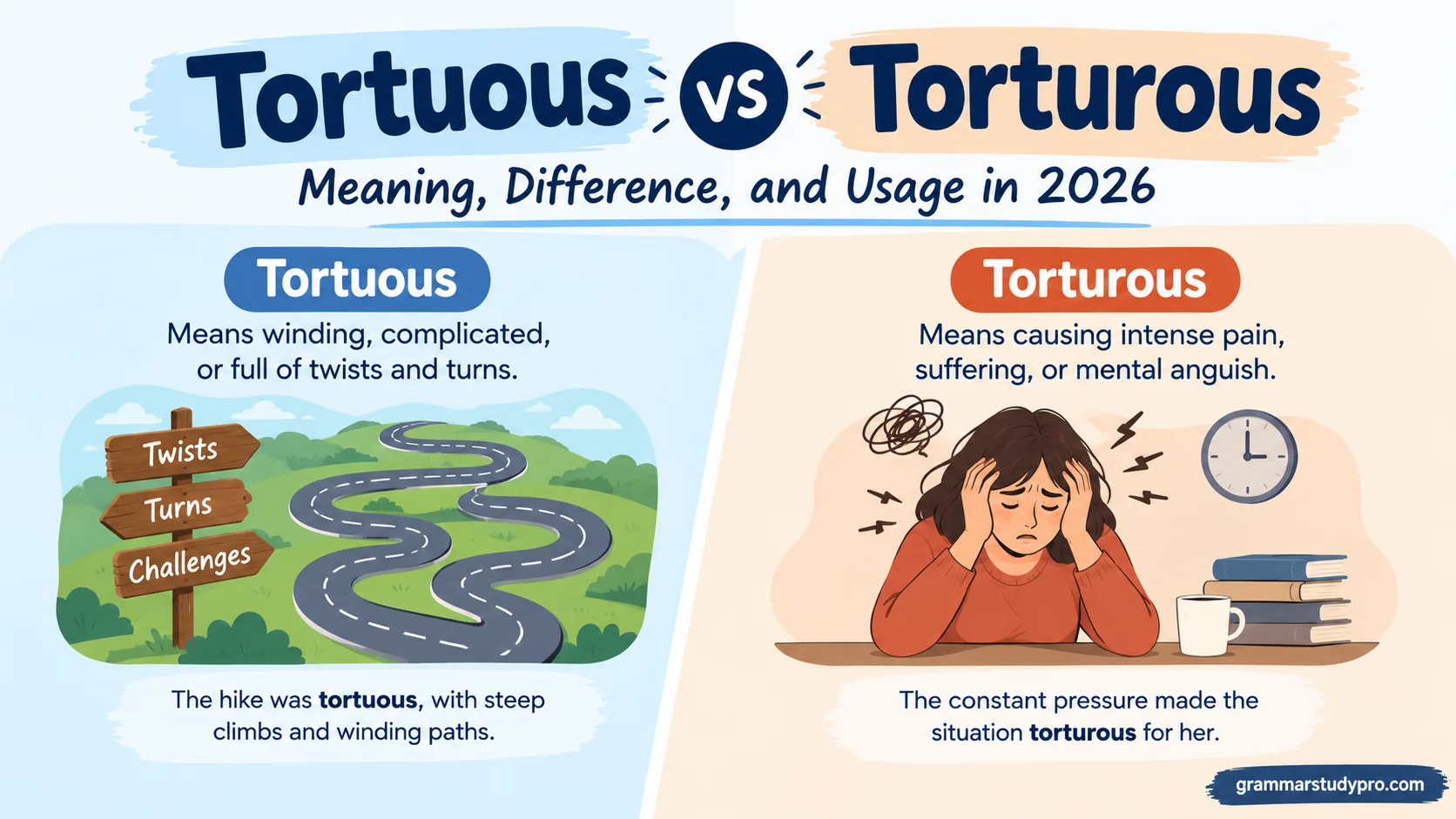
Tortuous vs Torturous can confuse writers because these commonly confused words have similar spellings and similar pronunciation, but they carry distinct meanings. Tortuous describes twists, turns, and bends, while torturous relates to torture, pain, and suffering. Just one letter creates a single-letter difference that changes the meaning. Both words have a shared origin in a Latin ancestor, which helps explain why these English words look and sound alike. Understanding their word meaning and context is important when choosing the right word.
Imagine a winding mountain road with a complicated path full of sharp turns. You can describe it as tortuous, just as you might describe a complex legal argument with many details and difficult steps. These examples show how tortuous can describe something complicated. However, a long medical treatment or an exhausting wait may feel torturous if it causes intense discomfort or emotional distress. Such experiences can be painful and distressing. When considering word choice in written work, think about the reader and the intended meaning. Careful attention to English usage helps you choose the correct usage in everyday writing and professional written communication.
A simple rule can improve your vocabulary: tortuous means winding or complicated, while torturous means causing great suffering. Both words can describe difficult situations, but the type of difficulty matters. A tortuous process might involve confusing steps, delays, or complicated decisions, whereas a torturous experience involves pain, distress, or discomfort. Word usage depends on meaning, not just spelling. Learning this spelling difference can help you avoid writing mistakes and use each word naturally.
Quick Answer:
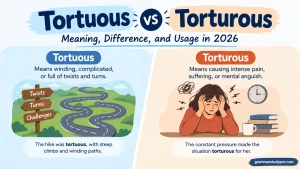
Tortuous means winding, twisting, indirect, or complicated. It often describes physical routes, confusing arguments, and complex processes.
Torturous means causing or involving pain, suffering, or extreme discomfort. It often describes difficult experiences, agonizing waits, and distressing situations.
Consider these examples:
- Tortuous: The tortuous road twisted through the mountains before reaching the village.
- Torturous: The torturous wait for the medical results made everyone anxious.
Here’s the easiest way to remember the difference:
- Tortuous = twists and turns.
- Torturous = torture and suffering.
If you’re describing something complicated or winding, choose tortuous. If you’re describing something painful or extremely unpleasant, choose torturous.
Comparison Overview
The following table summarizes the main differences between tortuous and torturous, including their meanings, common uses, and examples.
| Feature | Tortuous | Torturous |
| Part of speech | Adjective | Adjective |
| Main meaning | Winding, indirect, or complicated | Painful, distressing, or difficult to endure |
| Physical use | Winding roads, paths, and routes | Painful conditions or uncomfortable experiences |
| Figurative use | Complicated arguments, procedures, and reasoning | Agonizing waits, stressful events, and emotional suffering |
| Main emphasis | Shape, direction, or complexity | Pain, discomfort, or distress |
| Example | We followed a tortuous trail through the forest. | The torturous delay frustrated the passengers. |
| Memory trick | Think of twists and turns. | Think of torture and torment. |
Both words are adjectives, so they describe nouns. The difference lies in the quality they express.
For example, a process can be tortuous because it involves confusing steps. That same process might be torturous if the delays and uncertainty cause considerable distress.
The context determines which word communicates your meaning most accurately.
What Does Tortuous Mean?
The adjective tortuous describes something with many twists, turns, or complications. It can refer to a physical route that changes direction repeatedly or an abstract process that takes an indirect, confusing path.
According to the the word describes something with many turns or changes of direction that isn’t direct or simple. This definition also explains why writers use tortuous for complicated procedures and arguments.
For example, a winding mountain road is physically tortuous. A legal dispute involving years of complicated proceedings may be tortuous in a figurative sense.
Tortuous Meaning: Full of Twists and Turns
Picture a road that snakes around a mountain, doubles back along a hillside, and passes through several narrow bends. That road is tortuous because it doesn’t follow a straight or direct route.
The word works well when describing roads, trails, paths, rivers, and other things that bend or change direction frequently.
Here are some examples:
- The tortuous mountain road required careful driving.
- We followed a tortuous trail through the dense forest.
- The river took a tortuous course across the valley.
- Their journey through the old city involved a tortuous network of narrow streets.
Notice that none of these sentences necessarily describes pain. The word focuses on the route’s shape and direction.
A tortuous road might be beautiful, dangerous, or perfectly pleasant. Its defining feature is its winding layout, not the traveler’s emotional response.
Tortuous Meaning: Complicated or Indirect
The word tortuous also describes things that are difficult to follow because they involve unnecessary turns, complicated steps, or indirect reasoning.
For instance, an explanation may begin with a simple question but wander through unrelated details before reaching its point. You could describe that explanation as tortuous.
This figurative meaning commonly appears in formal writing, legal discussions, political commentary, and academic analysis.
Consider these examples:
- The tortuous approval process delayed the project for months.
- His tortuous argument made a straightforward question difficult to understand.
- The negotiations followed a tortuous path before the parties reached an agreement.
- The author used tortuous language that obscured the main idea.
In some contexts, tortuous can also suggest evasiveness or deviousness. A tortuous explanation, for example, might seem deliberately indirect rather than merely complicated. Context determines whether the word simply means convoluted or carries a more negative implication.
Remember: Something tortuous doesn’t have to cause suffering. It simply takes a winding, indirect, or complicated course.
Tortuous in a Sentence
The following examples show how tortuous works across different situations.
| Example sentence | Why tortuous fits |
| The tortuous road climbed through several mountain passes. | The road had many bends. |
| Resolving the dispute became a tortuous process. | The process involved complicated steps. |
| Her tortuous explanation left the audience confused. | The explanation was indirect and difficult to follow. |
| The detective uncovered a tortuous chain of events. | The events formed a complicated sequence. |
| The tortuous route added an hour to our drive. | The route was indirect and winding. |
These examples highlight an important point: tortuous describes how something proceeds, not necessarily how it feels.
What Does Torturous Mean?
The adjective torturous describes something that involves, causes, or resembles torture or severe suffering. It can refer to physical pain, emotional distress, or an experience that feels extremely unpleasant.
The includes situations involving considerable suffering or difficulty. The word also appears in everyday expressions that emphasize frustration, anxiety, or discomfort.
For example, a person might describe a painful recovery as torturous. Someone waiting for an important decision might call the uncertainty torturous because the experience causes intense stress.
The word doesn’t always imply literal torture. Writers often use it figuratively to emphasize how difficult an experience feels.
Torturous Meaning: Causing Pain or Suffering
When an experience involves substantial physical or emotional pain, torturous may be the right adjective.
It can describe painful conditions, distressing memories, harsh environments, and other circumstances that cause suffering. The word emphasizes the hardship involved rather than the structure or complexity of the situation.
Consider these examples:
- The patient described the recovery as torturous.
- Working in the extreme heat became a torturous experience.
- She struggled with torturous memories of the accident.
- The injured athlete endured a torturous rehabilitation period.
Each sentence highlights discomfort or suffering. None requires a winding route or complicated process.
The word can also describe mental anguish. Waiting for life-changing news, dealing with prolonged uncertainty, or reliving a distressing event may feel torturous even without physical pain.
Torturous Meaning: Extremely Unpleasant or Difficult to Endure
In everyday English, people frequently use torturous for experiences that feel almost unbearable.
A long meeting, an uncertain wait, or a frustrating administrative process might become torturous when it causes enough discomfort or distress. This is figurative usage rather than a claim that literal torture occurred.
For example:
- The final hour of the examination felt torturous.
- Waiting for the delayed flight became torturous.
- The endless paperwork made the application process torturous.
- The uncertainty surrounding the decision was torturous.
The word adds emotional force to a sentence. Compare a long wait with a torturous wait. The first describes duration, while the second emphasizes how difficult the wait feels.
However, torturous is a relatively strong word. For an ordinary inconvenience, annoying, tedious, or frustrating may communicate your meaning more naturally. Save torturous for situations where you want to emphasize substantial discomfort or distress.
Torturous in a Sentence
Here are more examples showing how to use torturous correctly.
| Example sentence | Why torturous fits |
| The torturous wait for the results made everyone nervous. | The wait caused intense anxiety. |
| He described the injury as a torturous ordeal. | The experience involved severe discomfort. |
| The final stages of recovery were torturous. | Recovery involved considerable suffering. |
| The uncertainty made the following weeks torturous. | Emotional distress made the experience difficult to endure. |
| The torturous heat made outdoor work exhausting. | The heat caused significant discomfort. |
The key distinction: Torturous tells readers about the suffering an experience causes or involves.
Main Differences Between Tortuous vs Torturous
Now that the definitions are clear, let’s examine how these words differ in real sentences. The easiest approach is to focus on the quality you’re trying to describe.
Tortuous Describes Shape or Complexity
Use tortuous when the central idea involves twists, turns, indirectness, or complicated reasoning.
For example:
The tortuous route through the countryside added twenty miles to the trip.
The sentence describes the route’s winding nature. It doesn’t necessarily suggest that the passengers suffered.
The same principle applies to abstract ideas:
The report presented a tortuous explanation of the company’s financial decisions.
Here, tortuous means the explanation was convoluted or difficult to follow.
Common combinations include:
- Tortuous road
- Tortuous path
- Tortuous route
- Tortuous argument
- Tortuous reasoning
- Tortuous process
- Tortuous negotiations
These phrases emphasize structure, direction, or complexity.
Torturous Describes Suffering
Use torturous when the main idea involves pain, distress, or an experience that’s difficult to endure.
For example:
The torturous journey left the passengers exhausted and uncomfortable.
This sentence focuses on the hardship of the journey rather than the route’s shape.
Similarly:
The torturous wait for the final decision tested everyone’s patience.
The wait caused distress. It might have involved uncertainty, anxiety, or frustration.
Common combinations include:
- Torturous experience
- Torturous wait
- Torturous ordeal
- Torturous pain
- Torturous conditions
- Torturous recovery
- Torturous memories
These combinations emphasize suffering or discomfort.
Can Something Be Both Tortuous and Torturous?
Yes. A single situation can be both tortuous and torturous when it has separate qualities that justify each word. This overlap explains why people sometimes confuse the adjectives.
Imagine driving along a narrow mountain road with sharp bends, steep climbs, and frequent hairpin turns. The road is tortuous because of its winding shape.
Now imagine that the same drive lasts for hours, causes motion sickness, and leaves everyone exhausted. The journey might also feel torturous because of the discomfort it causes.
Compare these sentences:
- Tortuous: The tortuous road wound through the mountains.
- Torturous: The rough ride along the mountain road became torturous.
- Both: The tortuous mountain route made the already exhausting journey torturous.
Each sentence emphasizes something different. The third describes both the winding route and the suffering associated with traveling it.
The same distinction applies to paperwork. A tortuous application process may involve confusing forms, indirect procedures, and repeated steps. If those obstacles create prolonged anxiety and frustration, the process may also be torturous.
The discusses this overlap and explains why context matters.
Tortuous vs Torturous Examples in Everyday English
Definitions help, but real-life examples make the distinction easier to remember. The following situations show how the correct word changes depending on what you want to emphasize.
Tortuous vs Torturous: Roads, Paths, and Journeys
Travel provides one of the clearest ways to understand these adjectives.
Use tortuous for a winding route and torturous for a painful or unpleasant journey.
- Tortuous: The tortuous road twisted through the hills and crossed several narrow bridges.
- Torturous: The bumpy ride became torturous after six hours without a break.
- Both: The tortuous route turned an already torturous journey into an exhausting ordeal.
The first sentence describes the road’s physical shape. The second focuses on discomfort. The third highlights both qualities.
A winding road isn’t automatically torturous. A scenic drive through mountain bends might be enjoyable, even when the route is tortuous.
Tortuous vs Torturous: Writing, Speech, and Arguments
Writers and speakers can also create tortuous or torturous experiences, depending on what happens.
Consider these examples:
- Tortuous: The professor’s tortuous explanation jumped between unrelated ideas.
- Torturous: Sitting through the confusing, three-hour lecture was torturous.
- Both: Reading the author’s tortuous argument became a torturous experience.
The first example focuses on the explanation’s confusing structure. The second describes the listener’s unpleasant experience. The third uses each adjective for a separate reason.
In professional writing, tortuous often works well for convoluted reasoning, complicated clauses, and indirect arguments. However, torturous is better when you want to stress how painful or frustrating the experience feels.
Tortuous vs Torturous: Waiting, Work, and Difficult Processes
Administrative tasks and long waits can involve both complexity and distress.
For instance, imagine applying for a permit that requires several forms, repeated reviews, and multiple approvals.
- Tortuous: The tortuous application process required six separate approvals.
- Torturous: Waiting months for the final decision became torturous.
- Both: The tortuous approval process created a torturous period of uncertainty.
These examples illustrate the difference between a complicated procedure and the emotional burden it creates.
You can apply the same distinction to job searches, legal proceedings, business negotiations, and other demanding situations.
Tortuous vs Torturous: Emotional and Physical Experiences
Emotional distress and physical pain usually call for torturous when suffering is the main point. By contrast, complicated thought processes or indirect discussions often call for tortuous.
Compare these sentences:
- Tortuous: The negotiation followed a tortuous sequence of proposals and counteroffers.
- Torturous: The prolonged uncertainty surrounding the negotiation became torturous.
- Tortuous: His tortuous reasoning made it difficult to understand his conclusion.
- Torturous: The painful recovery made every day feel torturous.
The distinction remains consistent across different subjects. Ask whether you’re describing complexity or suffering, then choose the word that matches.
Common Mistakes When Using Tortuous and Torturous
Even experienced writers sometimes confuse these adjectives. Their similar spellings make the mistake understandable, but a few simple checks can help you avoid it.
Using Torturous for Every Complicated Situation
A complicated situation isn’t necessarily painful or distressing. When you want to describe indirectness or complexity, tortuous is usually the better choice.
Incorrect for the intended meaning:
The lawyer presented a torturous argument full of complicated clauses.
Better:
The lawyer presented a tortuous argument full of complicated clauses.
The revised sentence emphasizes the argument’s structure. If the writer instead wanted to say that listening to the argument felt extremely unpleasant, torturous could work.
Using Tortuous When You Mean Painful
A painful experience doesn’t need to involve twists or complicated reasoning.
Incorrect for the intended meaning:
The patient endured a tortuous recovery after surgery.
Better:
The patient endured a torturous recovery after surgery.
The second sentence emphasizes suffering. However, tortuous recovery could make sense in a different context if the writer wanted to describe a complicated, indirect course of recovery.
Assuming the Words Are Never Interchangeable
Although the words have different core meanings, real sentences sometimes support both.
For example, a winding road may be tortuous, while a difficult journey along that road may be torturous. A complicated document might be tortuous to read and torturous to struggle through.
The important question isn’t whether a noun can ever take both adjectives. It’s whether the adjective expresses the intended meaning in that particular sentence.
Confusing Tortuous With Tortious
There’s another similar-looking word worth knowing: tortious.
Unlike tortuous and torturous, tortious belongs mainly to legal language. It describes conduct involving a tort, which is a civil wrong that can give rise to legal liability.
Compare these examples:
- Tortuous: The negotiations followed a complicated and indirect course.
- Torturous: The negotiations became an extremely stressful experience.
- Tortious: The lawsuit alleged that the company’s conduct was tortious.
Don’t use tortious simply because something is complicated or unpleasant. Its legal meaning is distinct.
How to Remember the Difference Between Tortuous and Torturous
A useful memory trick can save you from second-guessing your spelling every time these words appear.
Tortuous = Twists and Turns
Think of a road winding around a mountain. It changes direction repeatedly instead of following a straight path.
The word tortuous also describes figurative twists, such as a complicated argument or an indirect procedure.
Remember this association:
Tortuous = a twisting route or complicated path.
Torturous = Torture and Torment
The word torturous contains the same sequence of letters as torture at the beginning. That connection makes its meaning easier to recall.
When something causes intense pain, distress, or discomfort, torturous is often the right choice.
Remember this association:
Torturous = torture, torment, or suffering.
Ask One Simple Question
If the memory tricks don’t come to mind, ask yourself what you’re describing.
Is it winding, indirect, or complicated?
Choose tortuous.
Is it painful, distressing, or difficult to endure?
Choose torturous.
For example, a winding road is tortuous. An agonizing wait is torturous. If the road’s twists make the journey miserable, both words may fit different aspects of the same experience.
Synonyms for Tortuous and Torturous
Synonyms can help you avoid repetition, but choose them carefully. Similar words don’t always carry exactly the same meaning or tone.
Synonyms for Tortuous
Use these alternatives when you mean winding, indirect, or complicated.
| Synonym | Meaning | Example |
| Winding | Following a curved or twisting course | We took a winding road through the hills. |
| Circuitous | Taking a longer or less direct route | The driver chose a circuitous route. |
| Convoluted | Complicated and difficult to follow | The report offered a convoluted explanation. |
| Indirect | Not proceeding straight to a point | His indirect answer avoided the question. |
| Meandering | Following a wandering or irregular course | The story followed a meandering path. |
| Devious | Indirect in a potentially dishonest way | The investigation exposed a devious scheme. |
Choose winding for physical routes, convoluted for complex explanations, and circuitous for indirect routes or processes. Use devious when you want to suggest dishonesty or deliberate evasion.
Synonyms for Torturous
Use these alternatives when you want to emphasize pain, suffering, or extreme discomfort.
| Synonym | Meaning | Example |
| Agonizing | Causing intense physical or emotional pain | The wait was agonizing. |
| Excruciating | Extremely painful or intense | He experienced excruciating pain. |
| Harrowing | Deeply distressing or disturbing | She recounted a harrowing experience. |
| Tormenting | Causing severe mental or physical distress | The uncertainty was tormenting. |
| Distressing | Causing worry, sadness, or anxiety | The news was distressing. |
| Painful | Causing physical or emotional pain | The recovery was painful. |
These alternatives differ in intensity. Excruciating usually suggests extreme pain, while distressing can describe a broader range of upsetting experiences.
For everyday writing, a precise synonym may communicate your point better than either tortuous or torturous.
FAQs
1. What is the main difference between tortuous and torturous?
Tortuous means winding, twisting, or complicated. Torturous means causing extreme pain, suffering, or distress. For example, a winding road is tortuous, while a painfully long experience can be torturous.
2. Can tortuous and torturous be used interchangeably?
No, these words aren’t interchangeable in most situations. Although both can describe difficult situations, tortuous focuses on complexity or twists, while torturous emphasizes pain and suffering.
3. What is an example of tortuous in a sentence?
Here’s an example: “The tortuous mountain road took us several hours to cross.” In this sentence, tortuous describes a road with many twists and turns.
4. What is an example of torturous in a sentence?
Here’s an example: “Waiting for the final results was a torturous experience.” The word torturous describes the emotional distress caused by the long wait.
5. Why do people confuse tortuous and torturous?
People often confuse these words because they have similar spellings and pronunciation. However, the extra r in torturous helps distinguish its meaning, which relates to torture and suffering.
Conclusion
Understanding tortuous vs torturous becomes easier when you remember what each word describes. Use tortuous for winding roads, complicated arguments, and processes with many twists and turns.
Choose torturous when describing pain, suffering, or distressing experiences. Although these words look and sound similar, their meanings differ significantly. Choosing the correct word makes your writing clearer, more precise, and easier for readers to understand.