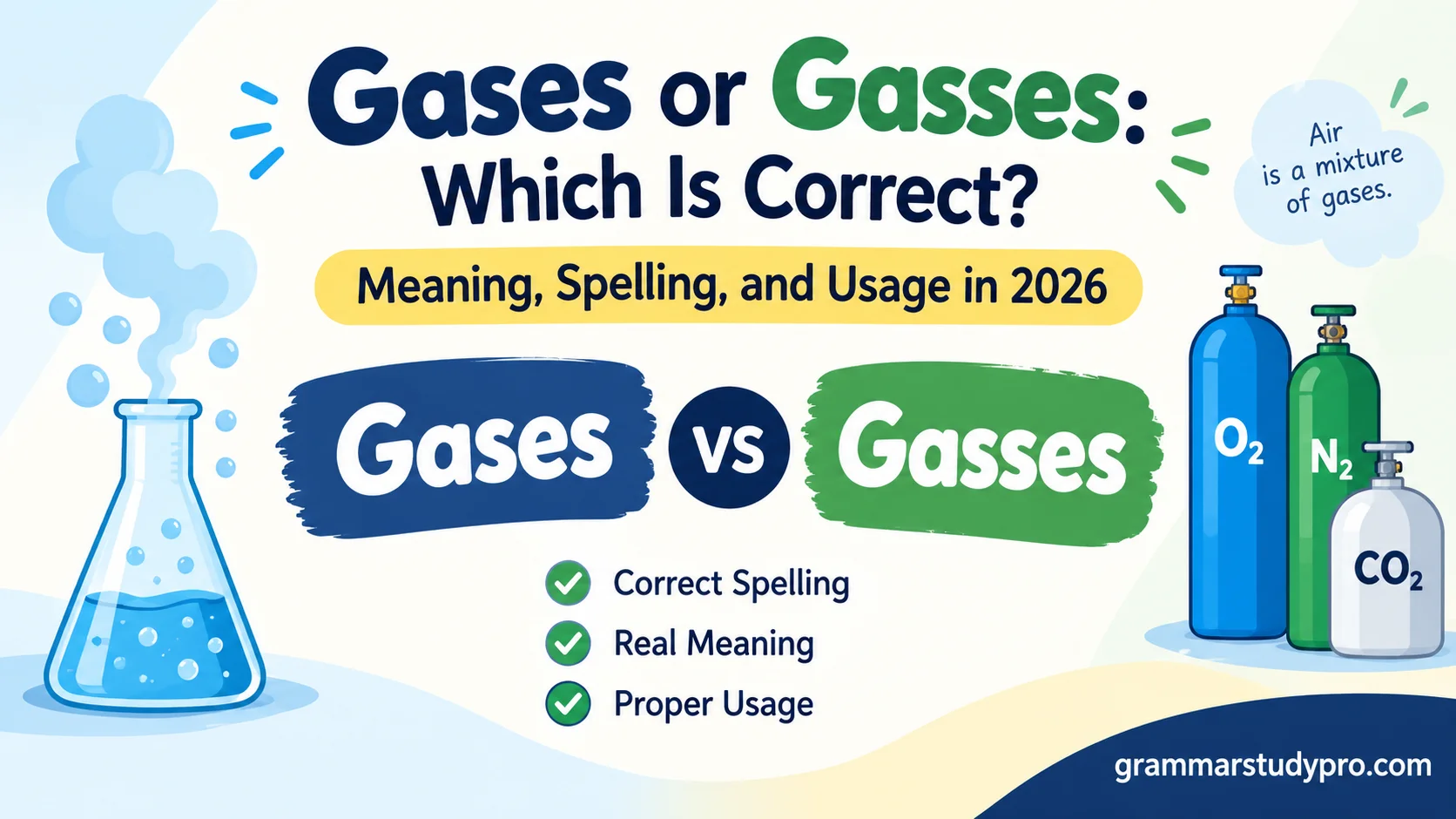
Gases or Gasses can confuse writers and English language learners because both words look almost the same and sound similar. However, their meanings and grammatical functions differ. Gases is the plural noun form of gas, referring to different types or amounts of gas. For example, oxygen and nitrogen are two different gases found in the air. In contrast, gasses is the third-person singular form of the verb to gas. It describes someone or something that releases gas, fills something with gas, or exposes something to gas. Small spelling changes can affect word meaning and usage, so understanding whether a sentence needs a noun or a verb helps you choose the correct spelling.
Many experienced writers make common grammar mistakes by using gasses instead of gases, or vice versa. Adding one letter changes the spelling, but the context determines which word fits. In real English usage, gases identifies multiple gases, while gasses describes an action performed by a person or thing. Understanding basic grammar, word forms, spelling differences, and sentence structure helps prevent spelling confusion and improves word choice. For example, a science lesson might discuss several gases in the atmosphere, while a sentence about a machine releasing gas might use the verb gasses. These practical examples show why both words are correct but cannot always replace each other.
A simple memory aid can make the difference easier to remember. Use gases when discussing oxygen, nitrogen, or other gas types, and use gasses when describing an action that requires the verb form. Pay attention to the sentence, the intended meaning, and the grammatical role of the word. This clear approach helps language learners, native speakers, and nonnative speakers improve their English usage. By learning the relevant grammar rules and practicing correct word selection, you can avoid common writing mistakes and use both spellings confidently.
Quick Answer
Gases is the standard and preferred plural of the noun gas in American English. Use it when referring to two or more gaseous substances or types of gas.
Gasses has two recognized uses. It can serve as an alternative plural noun, although gases is more common in standard writing. It also functions as the third-person singular form of the verb gas.
Here are three examples:
- Gases: The atmosphere contains several different gases.
- Gasses: The machine gasses the chamber before the experiment.
- Gasses: Some dictionaries recognize gasses as an alternative plural of gas.
The easiest rule to remember: Choose gases for the plural noun in most situations. Use gasses when the sentence calls for the verb form or when an accepted alternative noun spelling fits your context.
Comparison Overview
Although gases and gasses look similar, their spelling and grammatical functions can differ. The following table summarizes the main distinctions.
| Feature | Gases | Gasses |
| Part of speech | Plural noun | Verb or alternative plural noun |
| Main meaning | Two or more gases or types of gas | An action involving gas, or multiple gases in less common usage |
| Standard plural spelling | Yes | Accepted alternative |
| Preferred in American English | Yes, for the plural noun | Less common as a plural noun |
| Scientific writing | Generally preferred | Usually avoided for the plural noun |
| Verb example | The word isn’t normally a verb form | The equipment gasses the chamber |
| Environmental example | Greenhouse gases contribute to warming | Rarely preferred for this noun phrase |
One important detail makes the distinction clearer: gasses isn’t automatically wrong. Its correctness depends on how you use it.
When discussing oxygen, nitrogen, or carbon dioxide as substances, gases is generally the best choice. When describing an action performed by a person or machine, gasses may be the correct verb form.
Main Differences Between Gases and Gasses
The biggest difference between gases and gasses comes down to standard spelling, grammatical function, and context. Both can represent the plural of gas, but dictionaries generally identify gases as the more common form.
Gases Is the Standard Plural of Gas
When you want to describe more than one gas, gases is the safest spelling for most situations. It works in everyday English as well as scientific and technical writing.
For example, air contains several gases, including nitrogen, oxygen, and argon. Each substance has its own chemical properties, but all belong to the same broad category of matter.
Consider these examples:
- The laboratory measures different gases in the air.
- Several gases escaped from the damaged pipe.
- Scientists study how gases behave under high pressure.
- The atmosphere contains trace amounts of certain gases.
- The factory monitors its emissions of greenhouse gases.
In each sentence, gases refers to multiple substances or types of gas. The word doesn’t describe an action.
This spelling also appears in established scientific terms, including greenhouse gases, noble gases, and toxic gases. Using the standard form helps readers recognize the meaning immediately.
Gasses Can Also Be a Plural Noun
Here’s where the spelling question gets interesting: gasses isn’t necessarily a mistake when it functions as a plural noun.
Oxford Learner’s Dictionaries lists gases as the usual plural and gasses as a less frequent alternative. Cambridge Dictionary also recognizes gasses as a plural form of gas.
For example:
- The report discusses several industrial gasses.
- Some gasses can accumulate in poorly ventilated spaces.
- The researcher measured different gasses in the sample.
These sentences use a recognized spelling, although many editors would prefer gases.
Why choose the more common form? It promotes consistency and reduces distractions for readers who expect standard scientific terminology. If you’re writing an academic paper, school assignment, business report, or general-interest article, gases is usually the better option.
However, you shouldn’t automatically label every instance of gasses as incorrect. Context and the reference style matter.
Gases and Gasses as Verb Forms
The verb gas introduces another spelling detail. English changes its form to show tense and subject agreement, and different dictionaries record the forms slightly differently.
Oxford’s entry for the verb lists gases as the third-person singular present-tense form, alongside gassed for the past tense and gassing for the -ing form.
For example:
- The chemical process gases the material.
- The technician gases the chamber before testing.
- The treatment gassed the enclosed area.
- The system is gassing the chamber.
Some spelling references, including Dictionary.com, describe gasses as a verb form as well.
Because dictionaries differ in how they present this form, check the preferred reference for your publication.
For formal American English, gases is a well-supported choice for the third-person singular verb. Don’t assume that gasses must be the verb simply because it contains a double s.
When to Use Gases
The word gases appears in many fields because gas is a common state of matter and an important part of the atmosphere, industrial processes, and everyday life.
Gases in Science and Chemistry
In science, a gas is a state of matter whose particles move freely and spread out to fill the available space. Unlike solids, gases don’t have a fixed shape. Unlike liquids, they don’t have a fixed volume under ordinary conditions.
When you refer to more than one type of gas, use the plural gases.
Examples include:
- Oxygen: A gas that living organisms use in cellular respiration.
- Nitrogen: The main gas in Earth’s atmosphere.
- Carbon dioxide: A gas produced by respiration and many combustion processes.
- Helium: A light gas used in applications such as balloons and specialized equipment.
- Methane: A combustible gas found in natural gas and produced by several natural and human activities.
A chemistry textbook might say:
Several gases react differently when exposed to heat.
Here, gases identifies multiple substances. It doesn’t suggest that anything or anyone is performing an action.
Scientific writing often needs precise distinctions, so the conventional spelling matters. When discussing gas pressure, chemical reactions, or laboratory measurements, use gases for the plural noun unless a specific style guide directs otherwise.
Gases in Environmental Writing
Environmental articles frequently discuss greenhouse gases, which absorb and emit infrared radiation and contribute to the greenhouse effect. These gases influence Earth’s energy balance, although their effects vary according to their properties and atmospheric concentrations.
Common examples include carbon dioxide, methane, nitrous oxide, and water vapor.
Here are some natural examples:
- Researchers measured greenhouse gases released by transportation.
- Wetlands can emit gases such as methane.
- Governments track industrial emissions of greenhouse gases.
- The report compares atmospheric gases across several locations.
The phrase greenhouse gases is firmly established in environmental writing. You may occasionally see greenhouse gasses, but greenhouse gases is the more conventional choice.
For a published article, scientific report, or school assignment, stick with the familiar spelling. Readers can focus on the environmental information instead of wondering whether the spelling was intentional.
Gases in Everyday English
You don’t need a chemistry degree to use gases correctly. The word also appears in ordinary discussions about fuel, household safety, manufacturing, and air quality.
For example:
- The mechanic checked for exhaust gases inside the workshop.
- Workers evacuated the building after detecting dangerous gases.
- The plant releases several gases during production.
- Scientists examined the gases trapped inside the container.
Notice how gases acts as the name of the substances in every example.
If you’re unsure which spelling to choose, try replacing the word with substances or types of gas. If the sentence still makes sense, gases will usually fit.
For instance, “The laboratory analyzed several types of gas” becomes “The laboratory analyzed several gases.” The meaning stays the same.
When to Use Gasses
Although gases is the standard plural in most writing, gasses remains a recognized alternative noun spelling. Understanding this distinction helps you avoid correcting something that isn’t necessarily wrong.
Gasses as a Verb
The spelling of the verb gas depends on the dictionary and convention you follow. Oxford lists gases as the third-person singular form, while other references recognize gasses in certain verb contexts.
Consider these examples:
- The technician gases the chamber before testing.
- The chemical reaction gases the sample.
- The machine gassed the chamber during the previous test.
- The equipment is gassing the material.
The key point is that the sentence describes an action rather than simply naming several substances.
In American English, gas can also refer to gasoline. The expression gas up means to fill a vehicle with fuel:
- She gases up her car before a long trip.
- He gassed up the truck before leaving.
- They are gassing up at the station.
These examples use the verb gas, but the phrase gas up has its own established spelling patterns. Don’t confuse it with the plural noun gases.
Gasses in Informal and Specialized Contexts
In some publications, gasses appears as an alternative plural noun. You might encounter it in discussions about exhaust, industrial emissions, or atmospheric chemistry.
For example:
- The report examines several exhaust gasses.
- Certain gasses can build up in enclosed spaces.
- Engineers tested the gasses produced by the process.
These examples illustrate an accepted alternative, not a spelling that every editor will prefer. For formal scientific writing, exhaust gases and gases produced by the process are generally safer choices.
One more caution: gas-related terminology can describe dangerous substances or processes. In technical documents, choose precise wording and don’t rely on spelling alone to communicate a safety warning.
Gasses as a Plural Noun
The plural noun gasses follows a recognized spelling pattern, but it appears less often than gases in standard reference entries.
That difference matters when you’re choosing wording for an audience. A dictionary may accept both spellings, yet a style guide or editor may prefer one for consistency.
Use this simple approach:
- General writing: Choose gases.
- Scientific writing: Choose gases unless your publication specifies otherwise.
- Quotations: Preserve the original spelling when quoting a source.
- Editing someone else’s work: Check whether gasses is an intentional variant before changing it.
This approach respects both accepted usage and the expectations of readers.
Gases vs. Gasses Example Sentences
Sometimes, the fastest way to learn a spelling distinction is to see it in real sentences. The examples below show how both forms work and which spelling usually fits best.
| Example sentence | Preferred form | Explanation |
| The atmosphere contains several different gases. | Gases | Standard plural noun |
| Oxygen and nitrogen are common gases. | Gases | Refers to multiple substances |
| The laboratory measured toxic gases. | Gases | Standard scientific usage |
| Greenhouse gases contribute to the greenhouse effect. | Gases | Conventional environmental term |
| The report discusses several industrial gasses. | Gases preferred | Gasses is an accepted alternative plural |
| The technician gases the chamber before testing. | Gases | Third-person singular verb form listed by Oxford |
| She gasses up her car before work. | Gasses | A spelling variant used for the verb in some references |
| The mechanic gassed up the truck. | Gassed | Past-tense verb |
| The equipment is gassing the chamber. | Gassing | Present participle |
The table highlights an important distinction: the plural noun and the verb don’t always follow the same spelling pattern. When in doubt, consult a dictionary that matches your preferred variety of English.
More Examples of Gases in Sentences
Use gases when the sentence refers to substances or categories of gas.
- Chemistry: Several gases reacted when the temperature increased.
- Environmental science: The study measured greenhouse gases in the atmosphere.
- Manufacturing: Workers monitored gases released during production.
- Safety: The detector identifies certain hazardous gases.
- Education: Students learned how gases differ from liquids and solids.
- Research: Scientists compared gases collected from different locations.
Each example uses gases as a plural noun. The word identifies what the researchers measured, what the atmosphere contains, or what the equipment detected.
More Examples of Gasses in Sentences
You may encounter gasses as an alternative plural noun or as a verb form in some references.
- Alternative plural: The article discusses industrial gasses.
- Alternative plural: Different gasses can behave differently under pressure.
- Verb variant: The operator gasses the chamber before the procedure.
- Verb variant: The device gasses the sample during processing.
For formal writing, check the spelling against your chosen dictionary. When gasses serves as a plural noun, gases is generally the more conventional choice. When it serves as a verb, the preferred form can depend on the reference you follow.
Why Is Gases Spelled With One S Before -es?
English spelling can be tricky because familiar patterns have exceptions. The plural of gas is a good example.
Many nouns form their plurals by adding -s or -es. For instance, book becomes books, while box becomes boxes. The word gas follows the second pattern:
- Singular: gas
- Plural: gases
The spelling adds -es without doubling the final s. This is the conventional plural form recorded in major dictionaries.
Why Doesn’t Gas Become Gasses Every Time?
English sometimes doubles a final consonant when adding an ending. For example, stop becomes stopped and stopping. Doubling helps preserve the expected short vowel sound in these forms.
However, English doesn’t apply that pattern to every word. The plural of bus is buses, and the standard plural of gas is gases.
The verb forms introduce a separate pattern. Depending on the dictionary, the present-tense verb may appear as gases or gasses. The past-tense form is gassed, and the -ing form is gassing.
The takeaway is simple: don’t apply one spelling rule blindly to every word. Learn the standard forms of common words and check less familiar forms when necessary.
Common Mistakes to Avoid With Gases and Gasses
Even confident writers can mix up these spellings. Fortunately, a few simple checks can prevent most errors.
Using Gasses in Every Plural-Noun Context
One common mistake is assuming that doubling the final s makes the plural more correct.
For example:
Incorrect choice for standard usage: “The atmosphere contains several greenhouse gasses.”
Preferred: “The atmosphere contains several greenhouse gases.”
The first sentence uses a recognized alternative plural spelling, so it isn’t universally incorrect. However, the second follows the more conventional form used in scientific and environmental writing.
Assuming Gasses Is Always Incorrect
The opposite mistake is treating gasses as a spelling error in every context.
Major dictionaries recognize gasses as an alternative plural of gas. Some references also record it as a verb form. Therefore, the surrounding sentence matters.
Instead of correcting the word automatically, determine whether it functions as a noun or verb. Then check the intended style and meaning.
Confusing Gases With Gas’s
The words gases and gas’s look similar, but the apostrophe changes the meaning.
- Gases: The plural of gas.
- Gas’s: The possessive form of the singular noun gas or, in some contexts, a contraction of gas is.
Compare these examples:
- The laboratory measures several gases.
- The gas’s pressure increased during the experiment.
- The gas’s color changed after the reaction.
In the second and third sentences, gas’s indicates that something belongs to or relates to one gas. It doesn’t mean multiple gases.
Mixing Up Gasses, Gassed, and Gassing
Writers sometimes focus so much on the double s that they overlook tense and grammar.
| Word | Grammatical role | Example |
| Gas | Base verb or noun | They measure the gas. |
| Gases | Standard plural noun or third-person singular verb | The atmosphere contains gases. |
| Gasses | Alternative plural noun or a verb variant in some references | The report discusses industrial gasses. |
| Gassed | Past-tense or past-participle verb | The chamber was gassed. |
| Gassing | -ing form of the verb | The process is gassing the chamber. |
Remember that gassed and gassing are established verb forms. You don’t need to change them to match the plural noun gases.
Gases or Gasses in American English
American English recognizes both gases and gasses as plural forms of gas. However, gases is the more common and conventional choice in general and scientific writing. Oxford’s American English entry explicitly identifies gasses as the less frequent plural.
For everyday writing, the distinction is straightforward:
- Write gases in school assignments and research papers.
- Use greenhouse gases in environmental articles.
- Prefer toxic gases in safety reports.
- Use gasses when reproducing a quotation that contains that spelling.
- Follow your publication’s style guide if it specifies a particular variant.
What About Gas as a Word for Gasoline?
American English also uses gas to mean gasoline, the fuel commonly used in cars. This meaning is different from gas as a state of matter.
For example:
- We need to buy gas before the road trip.
- The car’s gas tank is almost empty.
- She gases up the car before leaving.
In these sentences, gas refers to fuel rather than a gaseous substance. You wouldn’t normally use gases to describe the gasoline in a vehicle’s tank because the noun is generally uncountable in this meaning.
This distinction helps prevent another common mix-up. The plural gases usually refers to gaseous substances, while gas can refer to gasoline without taking a plural ending.
FAQs
1. Is it gases or gasses?
Gases is the correct plural form of the noun gas. Gasses is the third-person singular form of the verb to gas. The correct choice depends on the meaning and grammatical role of the word in your sentence.
2. What is the plural of gas?
The plural of gas is gases. For example, oxygen, nitrogen, and carbon dioxide are different gases. Use this spelling when referring to more than one gas or type of gas.
3. What does gasses mean?
Gasses is a verb that describes someone or something releasing gas, filling something with gas, or exposing something to gas. For example, “The machine gasses the material during processing.”
4. Why do people confuse gases and gasses?
People often confuse these words because they look and sound similar. However, their grammatical functions differ. Gases is a plural noun, while gasses is a verb form. Understanding this distinction helps prevent spelling and grammar mistakes.
5. How can I remember when to use gases or gasses?
Remember that gases refers to multiple gases, while gasses describes an action. Check whether your sentence names substances or describes what someone or something does. This simple rule makes choosing the correct spelling easier.
Conclusion
Choosing between gases or gasses becomes easier when you understand their grammatical roles. Use gases as the plural form of the noun gas, and use gasses as the third-person singular form of the verb to gas. Although the words look similar, they serve different purposes in English. By checking the meaning and structure of your sentence, you can avoid common spelling mistakes and communicate clearly and confidently.