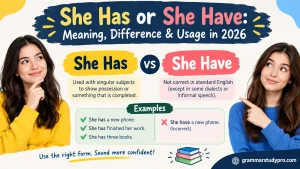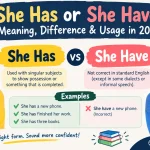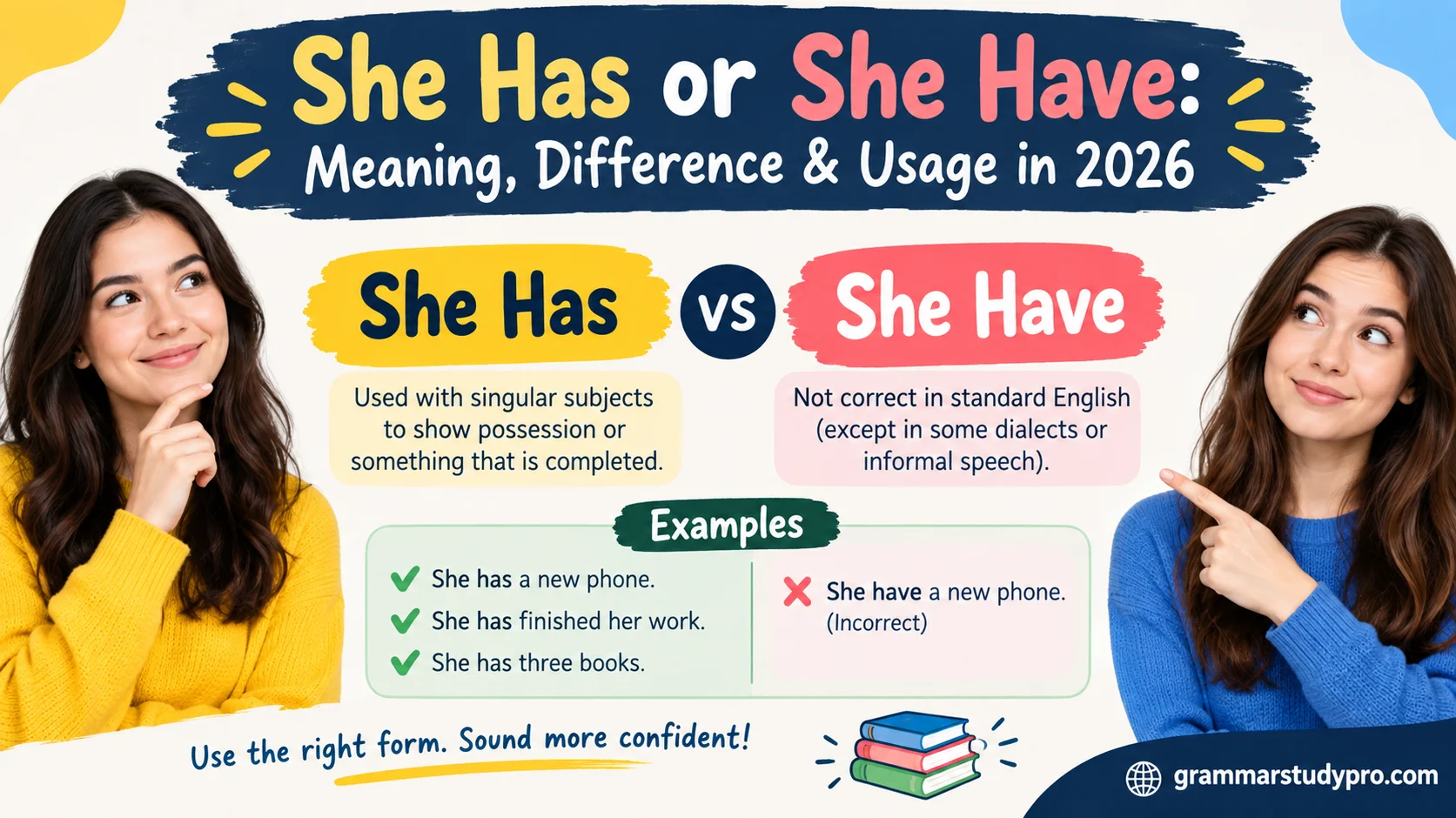
She Has or She Have is correct when she is a singular third person pronoun, so has matches verb agreement rules. In a sentence, she has a plan is correct, while she have is wrong in standard English language usage. Has shows present possession and also works in present perfect constructions. For example, she has a book and he has a new job. The subject, pronoun, auxiliary, and object must work together for the right tense and agreement. The key distinction becomes easier when you check the subject and pick the matching form.
The verb to have has different forms, and choosing between has and have depends on the subject and grammatical contexts. Has goes with singular subjects such as she, he, and it, while have goes with plural subjects and I, you, we, and they. These are basic grammar rules for proper verb usage, but to have is an irregular verb, which can make conjugating and conjugating correctly challenging. Learners must understand its verb endings and other grammatical rules. A useful guide is to check the subject, then pick the correct verb. You can substitute he for she or remove other nouns to make the pattern clearer.
In everyday conversation, you may hear she have, particularly in casual speech, but formal writing and standard editing normally require she has. These popular words commonly express possession, but their proper use depends on the subject. The plural form have works with I, you, we, and they, while has works with she, he, and it. Once you understand the clear explanations and examples, the key differences become easier to remember. The basic pattern is has for singular third-person subjects and have for plural subjects and the listed pronouns.
Quick Answer: Is It “She Has” or “She Have”?
The correct form in an ordinary present-tense statement is “she has.”
Use has when have is the main verb and she is the subject:
- She has a new phone.
- She has two brothers.
- She has enough money.
- She has a meeting today.
- She has a beautiful home.
Use have when another auxiliary or modal verb requires the base form:
- Does she have a phone?
- She doesn’t have a phone.
- Did she have a phone?
- She can have a phone.
- She will have a phone.
The distinction becomes much easier once you stop treating has and have as interchangeable forms.
The one-minute rule
| Situation | Correct form | Example |
| Normal present statement | has | She has a car. |
| Present question with does | have | Does she have a car? |
| Present negative with doesn’t | have | She doesn’t have a car. |
| Past question with did | have | Did she have a car? |
| After a modal | have | She might have a car. |
| Present perfect | has | She has finished. |
| Past simple statement | had | She had a car. |
| Future | have | She will have a car. |
That’s the heart of the issue. The rest of this guide explains why these forms work.
Comparison Overview
The easiest way to understand she has vs. she have is to compare them in real sentences.
| Sentence | Correct? | Why? |
| She has a dog. | ✅ | Has agrees with singular she. |
| She have a dog. | ❌ | Have doesn’t agree with she in a simple present statement. |
| Does she have a dog? | ✅ | Does carries the present-tense agreement. |
| Does she has a dog? | ❌ | The main verb must return to its base form after does. |
| She doesn’t have a dog. | ✅ | Doesn’t carries the tense and agreement. |
| She doesn’t has a dog. | ❌ | Has cannot follow doesn’t here. |
| She can have a dog. | ✅ | Have follows the modal can. |
| She can has a dog. | ❌ | A modal takes the base form. |
| She has finished her work. | ✅ | Has functions as the present-perfect auxiliary. |
| She had finished her work. | ✅ | Had forms the past perfect. |
Cambridge Grammar explains that have is an irregular verb and specifically identifies has as its present-simple third-person singular form.
Main Differences Between She Has and She Have
The main difference between she has and she have comes down to subject-verb agreement and auxiliary verbs.
“She Has” Is the Standard Present-Simple Form
When have acts as the main verb in a present-tense affirmative sentence, she requires has.
For example:
- She has a new apartment.
- She has three children.
- She has plenty of experience.
- She has a cold.
- She has breakfast at 7:30.
This happens because she is a third-person singular subject.
English normally marks the third-person singular present simple with a special verb form. With regular verbs, that often means adding -s, as in work → works. With have, English uses the irregular form has instead.
“She Have” Is Not Correct as a Simple Present Statement
Consider this sentence:
She have a new car.
The sentence sounds wrong because the subject she requires the third-person singular form has when have functions as the main verb.
The correct version is:
She has a new car.
This isn’t a difference in meaning. Both versions attempt to express possession. Only one follows standard English grammar.
“Have” Can Still Follow “She”
Here’s where many grammar explanations become too simplistic.
It’s incorrect to tell learners that have can never follow she.
It absolutely can:
- Does she have a passport?
- She doesn’t have a passport.
- She might have a passport.
- She will have a passport.
- She should have a passport.
The reason changes from sentence to sentence. In these constructions, another verb such as does, did, will, might, or should controls the grammatical structure.
What Does “She Has” Mean?
The verb have has many meanings in English. It can describe possession, relationships, experiences, activities, characteristics, conditions, and more.
“She Has” for Possession
This is probably the most familiar use.
- She has a car.
- She has a new laptop.
- She has $100 in her wallet.
- She has a house near the beach.
Here, has tells us that something belongs to or is available to her.
Cambridge gives possession as one of the major uses of have, including examples such as someone having a home or money.
“She Has” for Relationships
The verb can also describe family and social relationships.
- She has two sisters.
- She has three children.
- She has many close friends.
- She has an older brother.
Nothing mysterious happens here. She is singular, so the present-tense form is has.
“She Has” for Characteristics
English also uses have to describe physical or personal characteristics.
- She has blue eyes.
- She has curly hair.
- She has a friendly personality.
- She has a strong accent.
In each example, has connects she with something she possesses or displays.
“She Has” for Experiences and Activities
The verb have goes far beyond ownership.
You can say:
- She has breakfast at 8 a.m.
- She has a meeting this afternoon.
- She has a shower before work.
- She has a good time at parties.
- She has a conversation with her manager.
Cambridge notes that have can describe events, actions, experiences, and activities as well as possession.
“She Has” in the Present Perfect
There’s another major use:
She has finished her homework.
Here, has doesn’t mean possession. Instead, it works as an auxiliary verb.
The structure is:
She + has + past participle
Examples:
- She has finished.
- She has arrived.
- She has eaten.
- She has visited Canada.
- She has completed the project.
The present perfect uses have/has + the -ed form or another past participle, with has used for third-person singular subjects.
Why Is “She Have” Incorrect?
The answer lies in subject-verb agreement.
She Is a Third-Person Singular Subject
English grammar divides subjects into grammatical persons.
| Person | Singular | Plural |
| First person | I | We |
| Second person | You | You |
| Third person | He, she, it | They |
She belongs to the third-person singular category.
In the present simple, third-person singular subjects normally take a special verb form. British Council grammar guidance illustrates this with examples such as she works, while do/does also changes according to the subject.
With have, that special form is has.
Compare the Forms
| Subject | Form of have | Example |
| I | have | I have a question. |
| You | have | You have a question. |
| He | has | He has a question. |
| She | has | She has a question. |
| It | has | It has a problem. |
| We | have | We have a question. |
| They | have | They have a question. |
Notice the pattern.
I, you, we, they → have
He, she, it → has
That’s the basic agreement rule.
When Can “Have” Correctly Appear With “She”?
This is the section that separates a shallow grammar article from a genuinely useful one.
The phrase “she have” isn’t automatically wrong simply because she appears nearby. What matters is the grammatical construction.
Does She Have…?
In present-simple questions, English uses does with third-person singular subjects.
So you say:
Does she have a car?
Not:
Does she has a car?
Why?
Because does already carries the third-person singular present-tense marking. The following main verb stays in its base form: have.
British Council explains that English uses does for present-simple questions with third-person singular subjects such as she, he, and it.
Examples:
- Does she have a job?
- Does she have children?
- Does she have enough money?
- Does she have your phone number?
- Does she have any questions?
The formula is simple:
Does + she + have + …?
She Doesn’t Have…
The same principle applies to negatives.
Correct:
She doesn’t have a car.
Incorrect:
She doesn’t has a car.
The structure is:
She + does not + have
The contraction doesn’t already contains the third-person singular form of do. The main verb therefore remains have.
British Council likewise identifies doesn’t as the negative form used with third-person singular subjects in the present simple.
She Does Have…
English can also use does for emphasis.
For example:
She does have a point.
This construction can correct or strongly emphasize something.
Imagine two people arguing:
“She doesn’t understand the problem.”
The reply might be:
“Actually, she does understand the problem.”
The same pattern works with have:
- She does have enough money.
- She does have experience.
- She does have a choice.
- She does have the documents.
Again, does carries the grammatical marking while have stays in its base form.
She Can Have…
Modal verbs also require the base form of the following verb.
Examples:
- She can have the last piece.
- She could have another chance.
- She might have more information.
- She should have enough time.
- She would have a better opportunity.
So:
She can have it. ✅
Not:
She can has it. ❌
This follows a broader English pattern: modal verbs such as can, could, may, might, should, will, and would are followed by a base-form verb.
“She Has” vs. “She Have” in Different Sentence Types
The easiest way to see the difference is to put the forms side by side.
| Sentence type | Correct structure | Example |
| Affirmative present | She + has | She has a dog. |
| Negative present | She + doesn’t + have | She doesn’t have a dog. |
| Present question | Does + she + have? | Does she have a dog? |
| Emphasis | She + does + have | She does have a dog. |
| Past statement | She + had | She had a dog. |
| Past question | Did + she + have? | Did she have a dog? |
| Future | She + will + have | She will have a dog. |
| Modal | She + can + have | She can have a dog. |
This table reveals an important principle:
The form of the verb depends on the entire verb phrase, not just the subject.
She Has vs. She Have in Different Tenses
Tense changes the form you need.
Present Simple: She Has
Use has for a normal present-tense statement.
She has a new job.
This can describe a current situation or possession.
Past Simple: She Had
For the past, use had.
She had a new job last year.
The verb doesn’t remain has because had is the past form of have.
Future: She Will Have
After will, use the base form have.
She will have more responsibilities next year.
Not:
She will has more responsibilities.
Present Perfect: She Has Had
This construction looks unusual at first because it contains has and had together.
She has had the car for five years.
The first has is the auxiliary. The second had is the past participle of have.
The pattern is:
She + has + had + object
More examples:
- She has had enough.
- She has had several opportunities.
- She has had that phone since 2024.
Past Perfect: She Had Had
This may look awkward, but it is grammatically legitimate.
She had had the car for three years before she sold it.
The first had functions as the auxiliary. The second had is the past participle.
English occasionally creates these double forms because one word can serve different grammatical roles.
She Has Been vs. She Have Been
Another frequent mistake appears in perfect and continuous constructions.
Correct:
She has been working all morning.
Incorrect:
She have been working all morning.
The structure is:
She + has + been + verb-ing
Examples:
- She has been studying for two hours.
- She has been waiting since noon.
- She has been working from home.
- She has been learning Spanish.
- She has been living here since January.
The word has agrees with she. The word been follows the auxiliary structure.
This isn’t a special exception. It’s the same third-person singular principle appearing in a longer verb phrase.
Common Mistakes With She Has and She Have
Grammar mistakes become easier to fix when you understand the pattern behind them.
| Incorrect | Correct | Reason |
| She have a car. | She has a car. | She requires has in a simple present statement. |
| She have two brothers. | She has two brothers. | Third-person singular agreement. |
| She have finished. | She has finished. | Has forms the present perfect. |
| Does she has a car? | Does she have a car? | Does takes the agreement marking. |
| She doesn’t has a car. | She doesn’t have a car. | Doesn’t carries the tense. |
| She can has it. | She can have it. | Modals take the base verb. |
| She will has time. | She will have time. | Will takes the base verb. |
| Did she has time? | Did she have time? | Did takes the past-tense marking. |
| She might has a problem. | She might have a problem. | Might takes the base verb. |
A useful habit is to look for the auxiliary before choosing has or have.
If there’s no auxiliary and have is the present-tense main verb, she has is usually what you need.
Does She Have vs. Does She Has
This deserves special attention because it’s one of the most common forms searched by English learners.
Correct: Does She Have?
Does she have a car?
The formula is:
Does + subject + base verb
More examples:
- Does she have a passport?
- Does she have enough money?
- Does she have any experience?
- Does she have a meeting today?
- Does she have your address?
Incorrect: Does She Has?
Does she has a car? ❌
Why does it sound tempting?
Because learners remember:
She has a car.
Then they simply turn it into a question:
Does she has a car?
English doesn’t form the question that way.
Once does appears, the main verb returns to its base form:
Does she have a car?
Think of does as carrying the grammatical workload.
Did She Have vs. Did She Has
The same rule applies to past-simple questions.
Correct:
Did she have a car?
Incorrect:
Did she has a car?
The formula is:
Did + subject + base verb
Compare these three sentences:
- She had a car.
- Did she have a car?
- She didn’t have a car.
Notice how had appears in the affirmative statement but have returns in the question and negative.
That’s because did carries the past-tense marking.
She Has vs. She Had vs. She Will Have
A simple timeline makes the difference clearer.
Past → Present → Future
She had a car → She has a car → She will have a car
She Had
Use had for past situations.
She had a small apartment in college.
She Has
Use has for a present situation.
She has a larger apartment now.
She Will Have
Use will have for the future.
She will have a new apartment next year.
The auxiliary will requires the base form have, which explains why will has is incorrect.
She Has Got vs. She Has
You may also encounter has got:
She has got a new car.
This can express possession, much like:
She has a new car.
Cambridge notes that have got and have can express the same meaning in relevant possession contexts and describes have got as more informal.
For example:
- She has a new phone.
- She has got a new phone.
In everyday speech, you may hear both.
However, don’t confuse has got with every possible use of has. The constructions aren’t interchangeable in every sentence.
For example:
She has breakfast at 8.
You wouldn’t normally replace this with:
She has got breakfast at 8.
The meaning changes because has here describes an activity rather than simple possession.
American English: How Should You Use “She Has”?
For standard American English, the practical patterns are straightforward.
Use “She Has” for Affirmative Present Statements
- She has a new job.
- She has two dogs.
- She has enough time.
Use “She Doesn’t Have” for Present Negatives
- She doesn’t have a car.
- She doesn’t have enough money.
- She doesn’t have any questions.
Use “Does She Have?” for Present Questions
- Does she have a passport?
- Does she have children?
- Does she have a reservation?
Use “She Had” for the Past
- She had a different job before.
Use “She Will Have” for the Future
- She will have more time tomorrow.
Use “She Has” as a Present-Perfect Auxiliary
- She has finished the assignment.
- She has already left.
- She has visited Europe.
These patterns cover most situations you’ll encounter in everyday American English.
A Simple Rule to Remember She Has vs. She Have
If grammar rules usually make your eyes glaze over, remember two lines.
He, she, it → has
I, you, we, they → have
Then add one more rule:
After does, did, or a modal verb, use have.
That gives you these examples:
- She has a car.
- Does she have a car?
- She doesn’t have a car.
- Did she have a car?
- She might have a car.
- She will have a car.
- She should have a car.
This is much more reliable than memorizing individual sentences.
Real-Life Examples of She Has and She Have
Seeing the forms in context makes the pattern easier to remember.
Possession
- She has a new laptop.
- She has a beautiful apartment.
- Does she have a spare key?
- She doesn’t have a driver’s license.
Work
- She has a meeting at noon.
- Does she have work today?
- She doesn’t have enough time to finish.
- She will have more responsibilities next month.
Family
- She has two sisters.
- Does she have any children?
- She doesn’t have any brothers.
- She has always had a close relationship with her family.
Experiences
- She has traveled to Japan.
- Has she visited New York?
- She hasn’t visited Europe yet.
- She might have visited that museum before.
Daily Activities
- She has breakfast at 7.
- Does she have lunch at work?
- She doesn’t have dinner late.
- She will have coffee after the meeting.
Case Study: Why One Word Changes the Whole Sentence
Consider a simple situation involving a new employee named Sarah.
A colleague says:
Sarah has a meeting at 3 p.m.
That’s a normal affirmative statement.
Now another colleague asks:
Does Sarah have a meeting at 3 p.m.?
The word has changes to have because does now carries the present-tense grammatical marking.
A third colleague responds:
Sarah doesn’t have a meeting at 3 p.m.
Again, have appears because doesn’t carries the relevant present-tense form.
Finally, someone says:
Sarah might have a meeting at 3 p.m.
Here, might requires the base form.
So one underlying idea produces four different structures:
| Purpose | Sentence |
| Statement | Sarah has a meeting. |
| Question | Does Sarah have a meeting? |
| Negative | Sarah doesn’t have a meeting. |
| Possibility | Sarah might have a meeting. |
The noun changes from Sarah to she, but the grammar remains exactly the same.
A Useful Way to Think About “Has” and “Have”
Think of the verb phrase as a small team.
In a simple statement, has does the grammatical work:
She has a car.
But when does joins the sentence, does takes that role:
Does she have a car?
When will arrives, it takes control of the tense:
She will have a car.
When might arrives, the same thing happens:
She might have a car.
The main verb doesn’t need to carry every grammatical feature itself.
That’s why have keeps appearing after auxiliary and modal verbs.
Practice: Choose Has or Have
Try these examples without looking at the answers first.
- She ___ a new apartment.
- Does she ___ a new apartment?
- She doesn’t ___ a new apartment.
- She ___ already moved.
- She might ___ another apartment.
- Did she ___ an apartment before?
- She ___ three sisters.
- She should ___ enough money.
- She ___ been working all morning.
- Will she ___ enough time?
FAQs
Is “she has” or “she have” correct?
She has is correct in standard English. She is a singular third-person pronoun, so it takes has, not have. For example, “She has a car” is correct.
Why do we use “has” with she?
We use has because English verb agreement requires a singular third-person subject such as she, he, or it to take has in the present tense.
Is “she have” ever correct?
In standard English, she have is generally incorrect when have is the main verb. You may hear it in casual speech or certain nonstandard varieties, but she has is the standard form for formal writing.
What is the difference between “has” and “have”?
Has is used with he, she, and it, while have is used with I, you, we, and they and plural nouns. For example, “She has a book” and “They have books.”
How can I remember whether to use “has” or “have”?
Check the subject first. If the subject is he, she, or it, use has. If it is I, you, we, they, or a plural noun, use have.
Conclusion
The correct choice is she has, not she have, in standard English. The easiest way to remember this rule is to identify the subject before choosing the verb. Since she is singular and third person, has is the correct form for possession and many present perfect constructions. Once you understand this simple agreement rule, choosing between has and have becomes much easier in both everyday and formal writing.