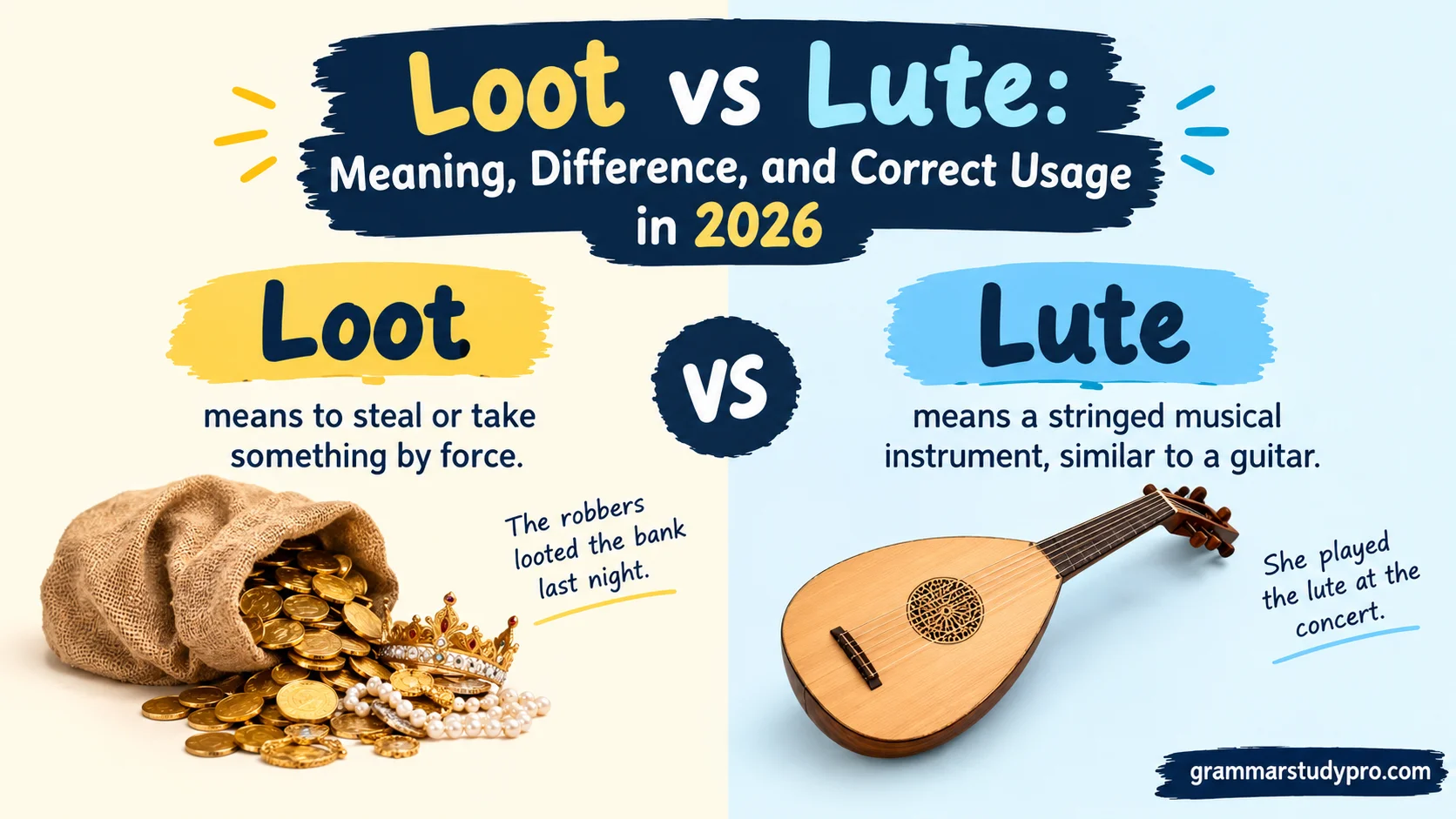
Loot vs Lute shows how similar-sounding terms can have different meanings in the English language. These words share a similar pronunciation in many English accents, so people sometimes get confused. They are examples of homophones, which can cause amusing misunderstandings when you mix up their spelling or word meanings. Understanding their definitions, pronunciation, and differences helps you improve your English vocabulary, grammar, and language usage. It also shows the richness of English and why clear communication matters in language learning.
The word loot refers to valuables, treasure, stolen property, or goods taken through an act of stealing, such as during a robbery or war. In everyday conversations, books, video games, and gaming terminology, loot often means rewards or items that a player collects after defeating an enemy. In contrast, a lute is a traditional musical instrument with strings, a rounded body, and a long neck. You may find it in historical discussions about music, musical instruments, and lute music. For example, a musician might play a lute at a concert. These practical examples show how the context of a sentence helps you identify the correct spelling and meaning. Think of a treasure chest for loot and a stringed instrument for lute.
When checking spelling, writing an article, or improving English vocabulary, use clear definitions, pronunciation guides, and a simple learning tool to remember each word. My recommended approach is to connect each term with a familiar image. These pronunciation tips make remembering words easier and strengthen your word usage and writing skills. For a short quiz, complete these sentences: “The player found valuable ___ in the cave” and “The musician tuned her ___ before the concert.” This simple guide covers the common uses of both words and helps you distinguish them through regular practice. Choose the word that matches the meaning you intend to express.
Quick Answer:
Loot means valuable goods, often stolen or taken by force. It can also work as a verb meaning to steal or plunder goods. In video games, loot commonly refers to items and rewards that players collect.
Lute is primarily a traditional stringed musical instrument. Musicians play it by plucking its strings, and it has a long history in European and Middle Eastern musical traditions.
Compare these examples:
- Loot: The adventurers collected valuable loot from the treasure chest.
- Lute: The musician played a beautiful melody on a lute.
The easiest way to remember the difference is this: You collect loot, but you play a lute.
Although the words often sound alike, their spelling depends on the meaning you want to express.
Comparison Overview
The following table summarizes the main differences between loot and lute.
| Feature | Loot | Lute |
| Main meaning | Valuable goods, often stolen or taken by force | A traditional stringed musical instrument |
| Part of speech | Noun and verb | Primarily a noun |
| Common pronunciation | /luːt/ | /luːt/ |
| Common contexts | Theft, historical plunder, video games, informal conversation | Music, musical history, instruments |
| Related forms | Looted, looting, looter | Lutes, lute player |
| Example as a noun | The police recovered the loot. | She learned to play the lute. |
| Example as a verb | The attackers tried to loot the store. | Lute is not commonly used as an everyday verb for playing music. |
The most important distinction is meaning. Loot describes goods or the act of taking them, while lute names an instrument. You cannot substitute one word for the other without changing the meaning of your sentence.
Main Differences Between Loot vs Lute
The difference between loot and lute becomes clearer when you examine their definitions, grammatical roles, and typical contexts.
Meaning and Definition
Loot usually refers to valuables taken illegally, by force, or during disorder. However, the word also appears in gaming, where players collect equipment, currency, and other rewards.
Lute, by contrast, refers mainly to a musical instrument with a rounded body, a neck, and strings that players pluck. Its meaning connects it to music rather than stolen property.
Consider these two sentences:
- The soldiers searched for loot after the battle.
- The musician tuned her lute before the performance.
The first sentence concerns valuables. The second describes an instrument. Even if you hear the same pronunciation, the surrounding words reveal which spelling makes sense.
Grammar and Parts of Speech
Another difference involves grammar. Loot can function as both a noun and a verb, while lute generally functions as a noun in ordinary English.
| Word | Grammatical role | Example |
| Loot | Noun | The thieves divided the loot. |
| Loot | Verb | The gang attempted to loot the store. |
| Lute | Noun | The performer carried a lute. |
| Lutes | Plural noun | The museum displayed several lutes. |
This distinction matters because the sentence structure can help you identify the correct word.
For example, in “They looted the warehouse,” looted describes an action. In “They found the loot,” the same word family refers to the goods themselves.
Pronunciation and Spelling
In many English accents, loot and lute share the pronunciation /luːt/. The vowel sound is the same one heard in words such as blue and flute.
Their spelling differs in the final vowel sequence:
- Loot contains oo.
- Lute contains u followed by e.
English spelling can be tricky because identical or similar sounds don’t always use identical letter patterns. That’s why you should rely on context instead of pronunciation alone.
Everyday Usage
You’ll encounter loot in conversations about stolen property, historical conflicts, and video games. You might hear someone say, “I found some great loot,” while discussing rewards collected during gameplay.
You’ll encounter lute in discussions about instruments, classical music, historical performances, and museums. For example, a music teacher might explain how a lute differs from a guitar.
Remember these contextual clues:
- Loot: treasure, stolen goods, plunder, rewards, equipment, valuables.
- Lute: music, strings, musician, instrument, melody, performance.
These associations make choosing the correct word much easier.
What Does Loot Mean?
The word loot has several related meanings, and its exact sense depends on the situation. It can describe stolen valuables, goods taken during conflict, rewards in a video game, or the act of stealing goods.
According to the the word functions as both a noun and a verb. Its gaming meaning is also well established in modern English.
Loot as a Noun
As a noun, loot refers to money, valuables, or other goods that someone has stolen or taken by force. The word often appears in news reports, crime stories, historical accounts, and conversations about treasure.
For example:
- The police recovered the stolen loot from an abandoned vehicle.
- The pirates divided their loot among the crew.
- Investigators searched the house for missing valuables and other loot.
- The museum worked to recover artifacts taken during a period of conflict.
In these examples, loot refers to the goods themselves, not the act of taking them.
The word also appears in casual conversations. Someone might use loot jokingly to describe a collection of purchases or goodies. However, this informal meaning doesn’t automatically imply criminal activity.
Grammar tip: Loot is generally an uncountable noun when it means stolen goods or a collection of valuables. You would normally say “some loot” or “a pile of loot,” rather than “a loot.”
Loot as a Verb
As a verb, loot means to steal goods from a place, particularly during disorder, a violent event, or a period of conflict. It can also describe taking money or assets dishonestly.
Consider these examples:
- The attackers looted several shops during the unrest.
- The thieves looted the warehouse before escaping.
- The officials were accused of looting public funds.
- The game character looted a chest after defeating the enemy.
Notice how the verb describes an action. It tells readers what someone did rather than identifying the goods they obtained.
The distinction between loot and steal is worth remembering. Steal is a broad term for taking something without permission. Loot often suggests taking goods from a place, especially on a larger scale or amid disorder. The terms overlap, but they aren’t interchangeable in every sentence.
Loot in Video Games
If you play role-playing games, action games, or multiplayer adventures, you’ve probably encountered the word loot many times.
In gaming, loot means items that players obtain during gameplay. These might include weapons, armor, coins, crafting materials, healing items, or special equipment. Players may find loot in treasure chests, defeat enemies to obtain it, or receive it as a mission reward.
For example:
- I found rare loot inside the hidden chest.
- The boss dropped valuable loot after the battle.
- We need better equipment before collecting loot in the next dungeon.
This gaming meaning doesn’t necessarily involve theft. A player can collect loot simply by completing a challenge or earning a reward.
The context changes the interpretation, but the spelling remains the same: loot.
What Does Lute Mean?
A lute is primarily a traditional stringed musical instrument that musicians play by plucking its strings. It typically has a rounded body, a neck, and strings arranged for melodic playing and accompaniment.
The instrument resembles a guitar in some respects, but its traditional shape and construction distinguish it from a modern guitar. The describes it as an early stringed instrument played like a guitar.
Lute as a Musical Instrument
The lute has an important place in musical history. European lutes became particularly prominent during the Renaissance and remained in use into the Baroque period. Musicians performed solo pieces, accompanied singers, and played in ensembles.
The instrument also has historical connections to the Middle Eastern oud. According to the the European lute developed from the oud tradition and became widely used in Europe during the medieval and early modern periods.
Lute Society of America
Here are some natural examples of lute in a sentence:
- The musician played a lute during the historical concert.
- She bought a lute to study Renaissance music.
- The museum displayed an antique lute beside other stringed instruments.
- The composer wrote a piece for voice and lute.
- Several musicians gathered to practice their lute repertoire.
In each example, lute names an instrument. It doesn’t mean stolen goods, treasure, or a reward.
A useful detail: The person who plays a lute is commonly called a lutenist. This word is useful when writing about historical music or musicians who specialize in the instrument.
Can Lute Have Another Meaning?
Yes. Although most readers associate lute with music, the word also has a technical meaning.
In specialized contexts, a lute can refer to a substance used to seal joints, close gaps, or make a container or apparatus airtight. It may also describe the act of applying such a sealing material.
For example:
- The technician applied lute to seal the joint.
- The laboratory used a sealing compound to prevent gas from escaping.
This technical use is much less common in everyday conversation than the musical meaning. If you’re writing about a concert, instrument, or musician, lute almost certainly refers to the stringed instrument.
However, context still matters. Technical writing may use the word differently from a music review.
Are Loot and Lute Homophones?
Yes, loot and lute are commonly treated as homophones because they share the same pronunciation in standard English varieties. A homophone is a word that sounds like another word but has a different spelling or meaning.
Both words are commonly pronounced /luːt/. The Cambridge Dictionary gives this pronunciation for loot, while Oxford lists the same pronunciation for lute.
This similarity explains why people sometimes confuse the spellings when writing from memory or transcribing speech.
Compare these sentences:
- “The explorers discovered valuable loot.”
- “The musician carried a lute.”
If you hear either sentence without seeing it written, the sound alone might not tell you which word the speaker used. The surrounding context provides the answer.
Other familiar English homophones include pair and pear, right and write, and flour and flower. Like these pairs, loot and lute require you to consider both meaning and context.
Remember: Homophones can sound identical without sharing a definition, spelling, or grammatical role.
Loot vs Lute Pronunciation Guide
Pronunciation won’t usually help you distinguish loot from lute, but learning the sound can still improve your English.
How to Pronounce Loot
The common pronunciation of loot is /luːt/.
Break it into three sounds:
- /l/ — the opening sound in look.
- /uː/ — the long vowel sound in blue.
- /t/ — the final sound in top.
Say the word naturally, keeping the vowel long enough to sound like the vowel in blue.
You can listen to the for an audio example.
How to Pronounce Lute
The usual pronunciation of lute is also /luːt/ in many English accents.
It begins with the same /l/ sound, contains the same long vowel, and ends with the same /t/ sound. The spelling difference doesn’t normally create a pronunciation difference between these two words.
For that reason, avoid trying to pronounce lute differently just because it contains the letter u followed by e.
Words That Rhyme With Loot and Lute
Because loot and lute commonly share a pronunciation, they rhyme with the same words.
| Word | Meaning |
| Boot | A type of footwear |
| Shoot | To fire a weapon or propel something |
| Flute | A musical wind instrument |
| Suit | A set of matching clothes or something appropriate |
| Root | The part of a plant that usually grows underground |
For a quick pronunciation exercise, read these words aloud: loot, lute, boot, flute, and suit.
You’ll hear the shared vowel and ending. However, use meaning rather than sound to choose between loot and lute when writing.
How to Use Loot and Lute in Sentences
Definitions help you understand words, but examples show you how to use them naturally. The following sentences demonstrate how loot and lute work in different situations.
Loot Examples in Everyday English
Use loot when discussing valuables, stolen goods, game rewards, or the act of taking goods illegally.
| Sentence | Meaning |
| The police recovered the stolen loot. | Valuables taken illegally |
| The pirates divided their loot among the crew. | Goods acquired through plunder |
| I found rare loot in the treasure chest. | Rewards collected in a game |
| The attackers looted the abandoned store. | The attackers stole goods |
| The thieves hid their loot underground. | Stolen valuables |
| The company was accused of looting public funds. | Dishonest removal of money |
Notice that loot changes its grammatical role depending on the sentence. In the first example, it names a collection of goods. In the fourth, looted describes an action.
This flexibility makes loot useful in many contexts, from informal gaming conversations to serious reports about theft or corruption.
Lute Examples in Everyday English
Use lute when referring to the musical instrument or discussing its role in music.
| Sentence | Meaning |
| She learned to play the lute. | She learned to play a musical instrument. |
| The musician tuned his lute before the concert. | The musician prepared his instrument. |
| The museum displayed a Renaissance lute. | The museum exhibited a historical instrument. |
| The composer wrote music for voice and lute. | The instrument accompanied a singer. |
| Several lutes appeared in the exhibition. | Multiple instruments were displayed. |
The examples also show how to use the plural form. One instrument is a lute, while two or more are lutes.
Loot vs Lute in One Sentence
Here’s a simple sentence that uses both words correctly:
“The adventurer collected the loot while the musician played a lute.”
Why does this sentence work?
- Loot refers to the valuable items the adventurer collected.
- Lute identifies the instrument the musician played.
This contrast makes the difference easy to remember. The words sound alike, but their meanings determine where they belong.
Common Mistakes When Using Loot and Lute
Confusing these words usually happens when someone relies on pronunciation instead of meaning. Fortunately, a few simple checks can prevent most spelling errors.
Using Lute When You Mean Loot
Incorrect: “The thieves escaped with the lute.”
Correct: “The thieves escaped with the loot.”
The first sentence describes thieves escaping with a musical instrument. That sentence could be correct if they actually stole a lute. However, if you mean stolen valuables in general, loot is the right choice.
Always ask yourself what the sentence describes. If it refers to money, stolen property, or treasure, choose loot.
Using Loot When You Mean Lute
Incorrect: “She practiced playing the loot.”
Correct: “She practiced playing the lute.”
The incorrect version uses the word for valuables instead of the musical instrument. Since the sentence discusses playing music, lute fits the intended meaning.
A simple clue is the verb play. People play instruments such as guitars, flutes, and lutes. In gaming, however, players can collect loot or loot a chest.
Choosing the Spelling by Sound Alone
English contains many words that sound alike but have different spellings. Loot and lute are a good example because their pronunciation often gives you no useful clue.
Instead, look for surrounding words that point toward the intended meaning.
- Words suggesting loot: stolen, treasure, valuables, recovered, plunder, rewards.
- Words suggesting lute: instrument, strings, musician, concert, melody, Renaissance.
For example, “The player collected the ___” could take either word depending on the intended meaning, although loot would be the natural choice for game rewards.
By contrast, “The musician tuned the ___” strongly suggests lute.
How to Remember the Difference Between Loot and Lute
You don’t need to memorize lengthy definitions to distinguish these words. A few simple associations will help you choose the correct spelling.
Remember That Loot Means Valuables
Connect loot with treasure, stolen goods, and rewards. Picture a treasure chest filled with coins or a game character collecting equipment after a battle.
Whenever you see a sentence about valuable goods, ask whether loot fits the meaning.
Examples include:
- The crew divided the loot.
- The player collected rare loot.
- Investigators recovered the stolen loot.
Remember That Lute Means Music
Associate lute with musicians, strings, melodies, and historical performances.
Imagine a musician sitting in a concert hall and plucking the strings of a traditional instrument. That mental picture points directly to lute.
Examples include:
- He played a lute at the concert.
- The museum preserved an old lute.
- She studied music composed for the lute.
Use the Collect-and-Play Memory Trick
The easiest reminder is:
Collect loot. Play a lute.
The verbs make the difference memorable because they naturally connect to each word’s common meaning.
| If the sentence mentions… | Choose… |
| Stolen valuables | Loot |
| Treasure or game rewards | Loot |
| Stealing goods from a place | Loot |
| A stringed musical instrument | Lute |
| A musician playing a historical instrument | Lute |
When you’re unsure, identify the subject of the sentence before choosing the spelling. That small step can prevent an otherwise easy mistake.
Quick Practice Quiz: Loot or Lute?
Ready to test what you’ve learned? Fill in each blank with loot or lute. Pay attention to the surrounding words because they provide the clues.
- The musician tuned her _____ before the concert.
- The police recovered the stolen _____.
- The player found rare _____ inside the treasure chest.
- The museum displayed a medieval _____.
- The attackers tried to _____ the store.
Answers and Explanations
| Question | Answer | Explanation |
| One | Lute | A musician tunes a musical instrument. |
| Two | Loot | The sentence refers to stolen valuables. |
| Three | Loot | In gaming, loot refers to collected rewards or items. |
| Four | Lute | A lute is a traditional stringed instrument. |
| Five | Loot | Here, loot is a verb meaning to steal goods. |
If you answered all five correctly, you’ve understood the main distinction between the words.
If you missed one, review the difference between loot as a noun and loot as a verb. Remember that lute generally names an instrument, while loot can describe either goods or an action.
FAQs
1. What is the main difference between loot and lute?
Loot refers to valuables, stolen goods, or rewards collected in a video game. A lute is a traditional stringed musical instrument. Although these words sound alike, their meanings and uses are completely different.
2. Are loot and lute homophones?
Yes, loot and lute are homophones in standard English pronunciation. They sound the same but have different spellings and meanings. You can use the surrounding sentence to determine which word fits.
3. How do you use loot in a sentence?
You can use loot as a noun or a verb. As a noun, it refers to valuables or rewards. As a verb, it means to steal goods, often during a riot or conflict.
Examples:
- The players collected valuable loot after defeating the enemy.
- The thieves tried to loot the abandoned store.
4. What does lute mean in English?
A lute is a traditional stringed musical instrument with a rounded body and a long neck. It has a long history in music and was especially popular in Europe during the Renaissance. Musicians play its strings to produce musical notes.
5. How can I remember the difference between loot and lute?
Connect loot with treasure, stolen goods, or video game rewards. Remember lute as a musical instrument. Picture a treasure chest for loot and a musician holding a lute. These simple mental images can help you remember the correct spelling.
Conclusion
Understanding loot vs lute becomes easy when you connect each word with its meaning. Loot relates to valuables, stolen goods, and gaming rewards, while lute refers to a traditional musical instrument. Although their pronunciation is identical in standard English, their spelling and context distinguish them. By practicing with example sentences and paying attention to context, you can use both words correctly and improve your English vocabulary.