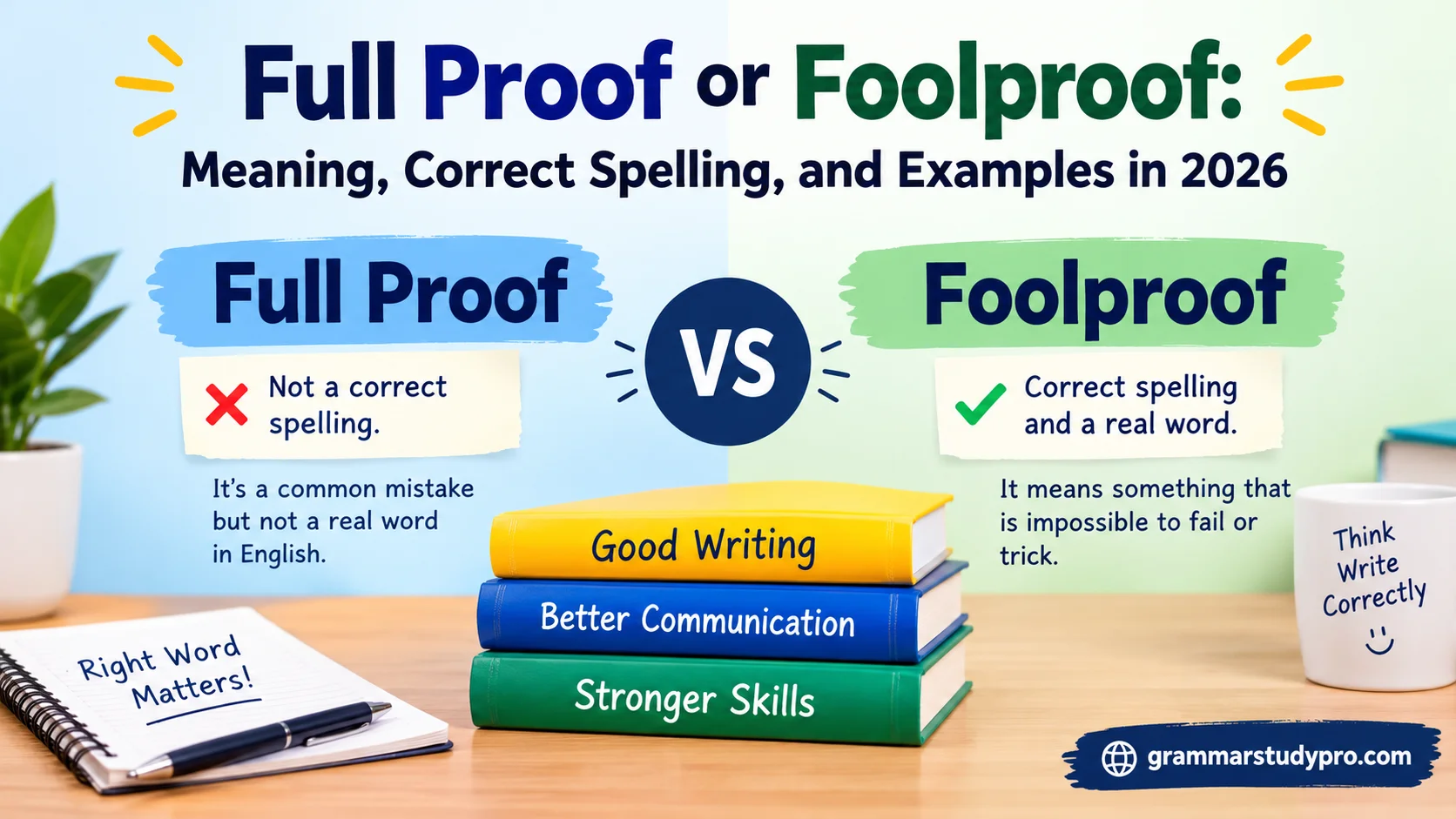
Full Proof or Foolproof is a common spelling question in the English language, especially when people encounter tricky words formed by joining smaller words. The correct spelling is foolproof, not full proof or fullproof. This compound word combines fool and proof through word formation to create a new word meaning. Other compound examples include flowerpot, formed from flower and pot, and waterproof, formed from water and proof. These examples explain the word structure, grammatical structure, and compound formation used in English spelling. Understanding how word components work together can improve language learning and help you avoid spelling errors and common misspellings.
The foolproof meaning becomes easier to understand when you examine the two words separately. A fool may describe a naive person who shows a lack of good judgment and is easily tricked by a clever ruse. In this compound, proof relates to being able to withstand a problem or remain protected against it. Together, they form a compound adjective and descriptive adjective meaning unlikely to fail or cause harm when used as intended. A foolproof design might include clear instructions, simple controls, and safety measures to support successful operation. For example, a fail-safe process can prevent mistakes and improve error prevention. Although no system is completely invulnerable, a reliable, dependable, and safe design can reduce the chance of error and offer better protection during practical use.
Understanding parts of speech can strengthen your vocabulary, grammar, and language skills. The adjective function of foolproof separates it from the words full and proof when they appear independently. You may see fullproof spelling in unedited writing, but it is not the proper spelling for this meaning. Similarly, fullproof meaning is not a standard English adjective definition. To improve word recognition, textual accuracy, and writing accuracy, focus on word choice, correct usage, and proper usage. Studying spelling rules, similar words, and spelling variations can also reduce incorrect spelling, linguistic confusion, and common spelling mistakes. When checking an English vocabulary entry or word definition, review the standard form and its usage examples. Remember the two Os in foolproof: one comes from fool, and the other follows it in the combined word. This simple word construction makes the correct form easier to recognize in written English, written communication, reading, and writing.
Quick Answer: Full Proof or Foolproof?
Foolproof is the standard spelling when you mean something designed to be easy to use, difficult to get wrong, or resistant to mistakes. Fullproof is not the standard spelling of this adjective.
The phrase full proof can work when full describes the noun proof, meaning evidence or support. However, the best wording depends on the sentence. In many cases, complete proof, sufficient proof, or conclusive evidence sounds more natural.
Consider these examples:
- Correct: This is a foolproof way to organize your files.
- Incorrect for this meaning: This is a fullproof way to organize your files.
- Potentially correct: The investigator requested full proof of the transaction.
- Often clearer: The investigator requested complete proof of the transaction.
The easiest rule to remember is simple: Use foolproof when you mean difficult to get wrong. Use full proof only when the two words have a suitable, separate meaning.
Comparison Overview
The main difference between full proof and foolproof comes down to their spelling, grammatical roles, and intended meanings.
| Feature | Foolproof | Full proof |
| Standard spelling | Yes | Possible as a two-word phrase |
| Main meaning | Designed to minimize mistakes or failure | Complete or sufficient proof, depending on context |
| Grammatical role | Adjective | Usually an adjective followed by a noun |
| Common context | Instructions, plans, recipes, systems | Evidence, claims, investigations |
| Example | We need a foolproof plan. | The claim requires full proof. |
| Common mistake | Assuming it guarantees perfect results | Using it to mean a mistake-resistant method |
One important detail deserves attention: foolproof doesn’t mean absolutely impossible to fail. It describes something designed to reduce errors or make mistakes less likely. Even a well-designed system can have limitations.
Likewise, full proof isn’t automatically wrong whenever those words appear together. The phrase simply doesn’t replace foolproof when you’re describing an easy-to-follow or dependable method.
Main Differences Between Full Proof or Foolproof
Although the phrases share similar sounds, their meanings separate them clearly. Understanding the difference helps you choose the right expression for emails, essays, reports, and everyday conversations.
Foolproof Describes Something Designed to Prevent Mistakes
The word foolproof works as an adjective. It describes a method, device, plan, or process that people can use easily with little risk of making an error.
For example:
- The company created a foolproof method for backing up important files.
- This foolproof recipe uses only five ingredients.
- We need a foolproof way to track customer orders.
In each sentence, foolproof tells readers something about the noun that follows it. The method is designed to reduce mistakes, the recipe is easy to follow, and the tracking process aims to avoid errors.
The defines the word in terms of a plan or machine that’s so simple and easy to understand that it’s difficult to use incorrectly.
Full Proof Can Refer to Complete Evidence
The expression full proof has a different grammatical structure. Here, full modifies the noun proof. The writer may intend to describe evidence that is complete or sufficient.
For example:
- The lawyer asked for full proof of the alleged transaction.
- The report should provide full proof to support its conclusions.
These sentences are understandable, but full proof isn’t always the most natural wording. In formal English, complete proof, sufficient evidence, or conclusive evidence may communicate the idea more clearly.
Consider the difference between these sentences:
- “We need a foolproof method to verify the documents.” This means the process should minimize mistakes.
- “We need sufficient evidence to verify the documents.” This means the available evidence must adequately support the claim.
The first sentence describes a process. The second focuses on evidence. That distinction matters more than the similarity between the words.
Is Fullproof a Real Word?
In standard US English, fullproof isn’t the established spelling of the adjective you’re looking for. When you want to describe something designed to prevent mistakes, write foolproof.
For example:
- Incorrect: We developed a fullproof strategy.
- Correct: We developed a foolproof strategy.
The same rule applies to common expressions such as foolproof instructions, foolproof system, and foolproof solution.
If you mean evidence that’s complete, use a suitable phrase with full and proof as separate words or choose a clearer alternative. Don’t combine them into fullproof simply because they sound similar.
What Does Foolproof Mean in Simple English?
In simple English, foolproof means easy to understand or use, with a design that helps prevent mistakes.
Imagine a recipe that lists every ingredient, gives precise measurements, and explains each cooking step in order. A beginner can follow it without guessing what to do next. You could describe that recipe as foolproof.
The word can also describe a carefully planned process. For instance, a business might create a checklist that helps employees catch missing information before submitting an order.
However, the term doesn’t promise perfection. A person might ignore the recipe, use the wrong ingredient, or skip an instruction. A foolproof process aims to prevent common errors, not eliminate every possible problem.
Is Foolproof an Adjective?
Yes. Foolproof is an adjective, which means it describes a person, thing, method, or situation.
Here are several examples:
| Phrase | Example sentence |
| Foolproof plan | We need a foolproof plan for the event. |
| Foolproof method | This is a foolproof method for organizing receipts. |
| Foolproof recipe | The cookbook includes a foolproof bread recipe. |
| Foolproof system | The team designed a foolproof system for checking entries. |
| Foolproof instructions | Clear diagrams make the instructions easier to follow. |
You can also use the word after a linking verb.
- The process seems foolproof.
- This recipe is almost foolproof.
- The new setup isn’t completely foolproof.
Notice that foolproof doesn’t change to match a plural noun. You can say a foolproof method or several foolproof methods. The adjective remains the same.
What Does Foolproof Mean in Everyday Conversations?
In everyday conversation, people often use foolproof to describe an idea that seems dependable or easy to carry out.
For example:
Friend A: “I’ve never made pancakes before. What should I do?”
Friend B: “Follow this recipe. It’s foolproof as long as you measure everything correctly.”
Here, the speaker means the recipe is simple enough for a beginner to follow.
People also use the word humorously when discussing a plan that appears certain to work.
“My foolproof plan was to leave early and avoid traffic. Unfortunately, everyone else had the same idea.”
The joke works because the plan wasn’t as reliable as the speaker expected. This is another reminder that people sometimes use foolproof casually rather than as a literal guarantee.
Why Do People Confuse Full Proof and Foolproof?
The confusion usually starts with pronunciation. When people hear the word spoken quickly, they may assume it contains full rather than fool.
Both words sound similar, especially in casual conversation. Their spellings differ by one vowel, but that small difference changes how the expression is written.
The Difference Between Fool and Full
The word fool refers to someone who acts unwisely or makes poor decisions. The word full generally means containing as much as possible or being complete.
The adjective foolproof combines fool with proof to express resistance to mistakes or misuse. Dictionary.com traces the word to American English usage around 1900–1905.
By contrast, full proof combines two separate words. Depending on context, it may describe complete proof, but writers often have more natural alternatives.
Compare these examples:
- Foolproof: The app has a foolproof setup process.
- Full proof: The investigation requires full proof of the claim.
- Clearer alternative: The investigation requires conclusive evidence.
The first sentence describes ease of use. The others concern the completeness or strength of evidence.
Why Spell-Check May Not Catch the Mistake
Spell-checkers can identify many spelling errors, but they don’t always recognize a word-choice problem.
For example, a document might contain the phrase “a full proof method.” Both full and proof are correctly spelled words. A basic spelling checker may therefore leave the phrase untouched even when the writer intends to say foolproof method.
To catch this error, check the meaning of the entire sentence.
Ask yourself:
- Am I describing something that’s difficult to get wrong?
- Am I talking about evidence that supports a claim?
- Would foolproof, complete proof, or sufficient evidence express my meaning more clearly?
This quick review can catch mistakes that a spelling tool misses.
How to Use Foolproof in a Sentence
The best way to learn a commonly confused word is to see how it works in different situations. The following examples show how foolproof fits naturally into everyday, professional, and educational writing.
Foolproof Examples in Everyday Life
Everyday situations offer some of the clearest examples of the word.
- Cooking: “This is a foolproof recipe for homemade pizza.” The recipe is easy to follow and designed to reduce common cooking mistakes.
- Planning: “She created a foolproof plan for packing before the trip.” Her plan helps prevent forgotten items and last-minute confusion.
- Technology: “The device has a foolproof setup process.” The instructions make installation straightforward.
- Household tasks: “He found a foolproof way to label the storage containers.” The method makes it easier to identify what’s inside each container.
Notice how the adjective describes the method or object rather than guaranteeing the final result. A recipe can be easy to follow even if someone accidentally burns the food.
Foolproof Examples at Work
In professional settings, foolproof often describes processes designed to reduce human error.
- “We need a foolproof system for checking customer orders.”
- “The manager introduced a foolproof checklist for closing the store.”
- “This isn’t a foolproof way to protect sensitive information.”
- “The new workflow makes it easier to spot missing details before submitting a report.”
These examples show how the word can make business writing concise. Instead of explaining at length that a process should be easy to follow and should reduce mistakes, a writer can simply call it foolproof.
However, use the word carefully in formal documents. If a system has known risks, terms such as error-resistant, well-tested, or designed to reduce mistakes may be more precise.
Foolproof Examples in School and Learning
Students and teachers can use foolproof when discussing methods that simplify a task.
- “The teacher shared a foolproof method for checking multiplication answers.”
- “This study schedule is almost foolproof if you follow it consistently.”
- “The guide provides foolproof instructions for formatting a research paper.”
- “There isn’t a foolproof shortcut for learning a new language.”
The last example illustrates an important point. Some tasks require practice, judgment, or personal effort. Calling a method foolproof doesn’t remove those requirements.
A Practical Case Study: Choosing the Right Word
Imagine a small online store that frequently ships incorrect orders. Its owner wants to introduce a new procedure that helps employees select the right products.
The owner might write:
“Our goal is to create a foolproof order-checking system.”
That sentence works because the owner wants a process designed to reduce errors.
Now imagine the owner needs documents showing that a customer paid for an order. The request changes:
“We need complete proof of payment.”
Here, foolproof wouldn’t fit because the owner isn’t describing an error-resistant process. The owner needs evidence of a transaction.
What this example teaches
Foolproof system
Describes a process designed to prevent mistakes.
Complete proof of payment
Describes evidence that supports a transaction.
The words may look alike, but their jobs are different. Once you identify the intended meaning, the correct choice becomes much easier.
Foolproof, Fool-Proof, and Full-Proof: Which Spelling Is Correct?
English compound words sometimes appear as one word, two words, or hyphenated forms. That variation can make spelling choices confusing, especially when two expressions sound alike.
For the intended adjective, foolproof is the standard spelling to use in modern US English. Some dictionaries and publications also show fool-proof, but the closed form is widely established.
Here’s how the main forms compare.
| Spelling | Correct usage | Example |
| Foolproof | Standard adjective | We need a foolproof solution. |
| Fool-proof | A less common variant | The instructions provide a fool-proof method. |
| Fullproof | Not the standard adjective spelling | Write foolproof method instead. |
| Full proof | Separate words when the context supports the meaning | The report requires complete proof. |
| Full-proof | Not the standard form for the intended adjective | Use foolproof plan instead. |
Should You Write Foolproof or Fool-Proof?
For ordinary US English writing, choose foolproof. It works in academic assignments, business emails, blog posts, and everyday messages.
For example:
- Preferred: “We developed a foolproof way to track expenses.”
- Less preferred: “We developed a fool-proof way to track expenses.”
The hyphenated version is recognizable, but you don’t need the hyphen in the standard closed spelling.
Consistency also matters. If you’re writing a long article, use foolproof throughout instead of switching between spellings without a reason.
Is Full-Proof Ever the Right Choice?
If you mean something designed to prevent mistakes, full-proof isn’t the appropriate spelling. Use foolproof.
If you’re talking about evidence, you may need a phrase such as full proof, but it can sound awkward depending on the sentence. In most formal writing, complete proof or sufficient evidence communicates the intended meaning more naturally.
For instance:
- Awkward: “The lawyer requested full-proof evidence.”
- Clearer: “The lawyer requested sufficient evidence.”
- Also clear: “The lawyer requested complete proof of the claim.”
The key is to choose the expression that matches your meaning, not merely the one that looks familiar.
Synonyms and Alternatives to Foolproof
Although foolproof is useful, it isn’t always the most precise word. Depending on your sentence, another adjective might communicate your idea more clearly.
| Synonym | Meaning | Example |
| Reliable | Consistently dependable | We need a reliable backup system. |
| Straightforward | Easy to understand | The application process is straightforward. |
| Easy to use | Simple to operate | The website is easy to use. |
| Error-resistant | Designed to reduce mistakes | The software includes an error-resistant workflow. |
| Fail-safe | Designed to limit danger or serious failure | The machine has a fail-safe mechanism. |
| Dependable | Trustworthy and consistent | She developed a dependable method. |
| Well-tested | Tested carefully before use | The team released a well-tested update. |
These words overlap, but they aren’t interchangeable in every situation.
Foolproof vs. Reliable
Foolproof emphasizes ease of use and resistance to mistakes. Reliable emphasizes consistent performance.
For example, a foolproof installation guide might help beginners set up a device correctly. A reliable device, meanwhile, works consistently over time.
Something can be reliable without being easy to operate.
Foolproof vs. Fail-Safe
These words have different emphases. A foolproof process aims to prevent errors or misuse. A fail-safe design aims to limit harm or move toward a safer state when something goes wrong.
For example, clear instructions might make a machine easier to operate. An automatic shutdown mechanism might provide a fail-safe response when the machine overheats.
In safety-related writing, don’t use foolproof as a substitute for a specific technical safety feature.
Foolproof vs. Straightforward
Straightforward means clear or uncomplicated. It doesn’t necessarily suggest that a process prevents mistakes.
Consider these examples:
- “The instructions are straightforward.” Readers can understand them easily.
- “The instructions are foolproof.” The instructions are designed to help users avoid mistakes.
Choose the word that conveys the level of protection or simplicity you intend.
Common Mistakes to Avoid When Using Foolproof
Even experienced writers can confuse similar-looking words. These practical checks will help you avoid the most common problems.
Writing Fullproof Instead of Foolproof
This is the main spelling mistake associated with the topic.
Incorrect: “The company introduced a fullproof method for handling complaints.”
Correct: “The company introduced a foolproof method for handling complaints.”
The correct word contains fool, not full. Remembering that distinction will prevent many errors.
Using Full Proof to Mean a Guaranteed Result
Suppose you want to describe a plan that’s difficult to get wrong. Writing “a full proof plan” doesn’t communicate that meaning clearly.
Instead, write:
- “We need a foolproof plan.”
- “The team developed a reliable approach.”
- “The instructions provide a straightforward process.”
Each option communicates a different shade of meaning, so choose the one that best fits your point.
Assuming Foolproof Means Completely Risk-Free
The word can sound absolute, but real systems have limitations. A well-designed process may still fail because of unexpected conditions, incorrect information, or human decisions.
For example, a foolproof-looking password recovery process could still be vulnerable if someone gains access to a user’s email account.
In technical or safety-related writing, avoid promises that the evidence doesn’t support. Phrases such as designed to reduce errors or helps prevent common mistakes may be more accurate.
Using Foolproof When Another Word Is More Precise
Writers sometimes use foolproof as a catch-all term for anything that works well. However, reliable, simple, and well-tested describe different qualities.
Before choosing a word, ask yourself what you want to emphasize:
- Ease of use: straightforward
- Consistent performance: reliable
- Resistance to mistakes: foolproof or error-resistant
- Protection when something fails: fail-safe
- Evidence supporting a claim: sufficient evidence or complete proof
This small distinction can make your writing more accurate and professional.
Easy Ways to Remember the Correct Spelling
If you often mix up full proof and foolproof, a simple memory trick can help.
Remember the Two O’s in Foolproof
Think of the word fool inside foolproof. The correct adjective contains the same spelling: f-o-o-l-p-r-o-o-f.
When you’re describing a method that’s difficult to get wrong, choose foolproof.
Memorize Common Phrases
Learning the word in familiar phrases makes it easier to recall when writing.
- Foolproof plan
- Foolproof recipe
- Foolproof method
- Foolproof instructions
- Foolproof system
- Foolproof solution
For example, remember this sentence:
“This foolproof recipe makes baking easier for beginners.”
When you associate the spelling with a common phrase, you’re less likely to replace fool with full.
Check the Meaning Before You Choose
If you’re still unsure, replace the word with a short explanation.
If you mean “designed to make mistakes less likely,” write foolproof.
If you mean “complete evidence,” consider complete proof or sufficient evidence.
This method works because it focuses on meaning rather than sound. Once you know what you want to say, the spelling becomes easier to choose.
FAQs
1. Is it full proof or foolproof?
Foolproof is the correct spelling when describing something designed to work reliably or be easy to use without mistakes. Full proof is not the standard spelling for this meaning.
2. What does foolproof mean?
Foolproof means unlikely to fail, cause harm, or go wrong when used as intended. For example, a foolproof guide provides simple, clear instructions that most people can follow easily.
3. Is fullproof a real word?
No. Fullproof is a common misspelling of foolproof. In standard English, write foolproof as one word when describing something reliable or easy to operate.
4. Why is foolproof written as one word?
Foolproof is a compound word formed by combining fool and proof. Like waterproof and flowerpot, it joins two word elements to create a single word with its own meaning.
5. Can I use foolproof in formal writing?
Yes. Foolproof is acceptable in both formal and informal writing. You can use it to describe a reliable method, a simple process, or a design intended to prevent mistakes.
Conclusion
The correct choice is foolproof, not full proof or fullproof, when you mean something designed to work reliably or be easy to use. Remember that foolproof combines fool and proof into one word, just as waterproof combines water and proof.
Using the correct spelling improves your grammar, vocabulary, and writing accuracy. When in doubt, check a trusted dictionary and choose foolproof for clear, standard English.