The Patron vs Benefactor distinction becomes clear when you understand how both words describe generosity, support, and financial assistance in different situations. A patron often supports art, culture, or an individual, while a benefactor usually provides money, resources, or other help to a person, organization, or cause. Although their meanings share similarities, their connotations, expectations, and proper usage can differ. For example, a cultural patron or artistic patron may fund an exhibition, support an artist, or preserve a tradition. A benefactor may provide substantial financial support, charitable giving, financial aid, or a financial contribution to a charitable or nonprofit organization. These terms may seem interchangeable, but understanding their definitions, histories, and subtle nuances improves English usage, vocabulary, word choice, and communication.
The difference also becomes clear when comparing a sponsor with a donor. A sponsor usually provides funding or financial backing for a project in exchange for publicity, public recognition, or sponsor benefits. A donor generally gives money, goods, or services to support charitable causes, often without expecting direct financial compensation. In the nonprofit sector, organizational funding, project funding, individual support, and community assistance help people and organizations achieve their goals. Providing goods, providing services, and giving money are all forms of charitable support. When reading a book or article, I find it helpful to consider what someone contributes and what they expect in return. This simple approach helps clear up confusion about terminology, patronage, philanthropy, donor recognition, and support and protection. It also helps explain how formal and ceremonial contexts influence the way people interpret relationships.
These distinctions are useful when writing, drafting a proposal, or preparing a speech for a fundraising dinner or special event. Imagine you attended a dinner where a speaker praised someone who supported an artist and helped an exhibition succeed. Calling that person a patron emphasizes artistic or cultural support, while calling them a benefactor highlights generosity and financial contribution. A practical guide that explains these distinct roles helps you understand their unique expectations, social relationships, and actual impact. Using precise wording shows respect, strengthens language clarity, and improves contextual interpretation. It also develops curiosity, understanding, and practical application when seeking support for a cause. By choosing the right words, you can communicate the exact meaning you intend, improve proposal writing, and build stronger philanthropy terminology and vocabulary. The key challenge is to look beyond surface meaning and understand the context, relationships, and differences that make each term appropriate.
Quick Answer: Patron vs Benefactor
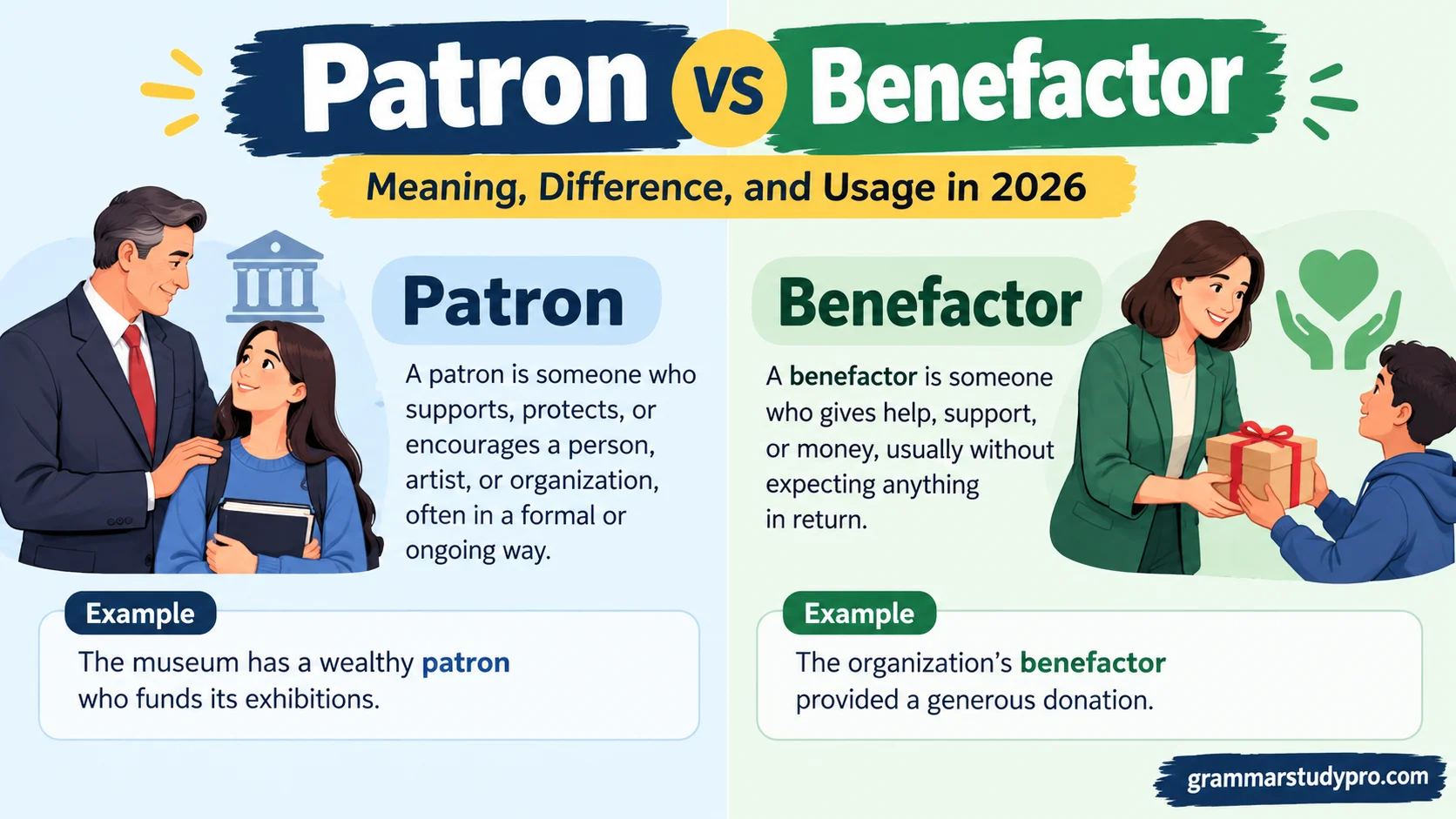
A patron is someone who supports a person, organization, business, or activity. The word can also mean a customer who visits a business, such as a restaurant or bookstore.
A benefactor is someone who provides help, resources, or benefits to another person or organization. The term often refers to someone who gives money, makes a charitable contribution, or provides valuable assistance.
Here is the simplest way to remember the difference:
- Patron: Someone who supports, sponsors, or uses a service.
- Benefactor: Someone who provides help or a benefit, often through a gift or financial contribution.
Examples:
- Maria is a patron of the local theater. She supports the theater and attends its performances.
- An anonymous benefactor paid for the school’s new library. This person provided financial assistance.
- James is both a patron and a benefactor of the museum. He regularly supports the museum and donated money for its expansion.
The main distinction is emphasis. Patron describes a person’s role as a supporter or customer, while benefactor highlights the help that person provides.
Comparison Overview: Patron vs Benefactor
Although patron and benefactor can describe people who support the same organization, their meanings differ in several important ways.
| Feature | Patron | Benefactor |
| Meaning | A supporter, sponsor, or customer | A person who provides help or benefits |
| Main emphasis | Support, backing, or participation | Assistance, generosity, or a beneficial contribution |
| Financial contribution | Possible but not required | Common but not required |
| Common settings | Arts, culture, businesses, institutions | Charities, education, healthcare, individuals |
| Customer meaning | Yes | No |
| Type of support | Financial, practical, cultural, or through patronage | Financial, material, or other meaningful assistance |
| Duration | May be occasional or ongoing | May be one-time or ongoing |
| Typical expression | Patron of the arts | Benefactor of a university |
| Example | The restaurant welcomed its patrons. | A benefactor funded the scholarship program. |
These differences are useful guidelines rather than strict rules. A patron can make a large donation, and a benefactor can support an organization for decades.
For instance, a person who purchases tickets to every theater performance may be a patron. If that same person pays for the theater’s new stage, the word benefactor may better emphasize the contribution.
The best word depends on what you want the reader to understand.
What Does Patron Mean?
Definition of Patron
A patron is a person who supports an individual, organization, activity, or institution. That support may involve money, purchases, public endorsement, or other forms of backing.
According to the word has two especially common meanings: a supporter of an activity or organization and a customer who uses a particular business.
Consider these examples:
- An individual who helps fund an art exhibition is a patron of the arts.
- Someone who regularly eats at a neighborhood café is a patron of that café.
- A business that supports a community music festival can be a patron of the event.
Notice that these people don’t necessarily provide the same kind of support. One may contribute money, another may purchase meals, and a third may support a public event. The word patron can describe all three roles.
Common Uses of Patron
The meaning becomes clearer when you look at the settings in which people use the word.
Patron of the arts: This expression describes someone who supports artists, museums, musicians, writers, theaters, or other cultural activities. Support may include financial contributions, purchases of artwork, or other assistance.
For example, The painter thanked her patrons for helping her organize the exhibition.
Patron of a business: In restaurants, hotels, stores, and similar establishments, a patron is a customer. The word often appears in formal announcements, public notices, and business writing.
For example, The restaurant asks all patrons to reserve their tables in advance.
Patron of an organization: A person may support a charity, cultural institution, or community initiative. Sometimes the title also reflects an official or honorary relationship with the organization.
For example, The organization welcomed a well-known patron to its annual fundraising event.
These uses share a central idea: the patron has a relationship with a person, business, activity, or institution. However, that relationship doesn’t always involve a charitable gift.
Patron Example Sentences
Here are additional examples showing how to use patron naturally.
| Example sentence | Meaning |
| She has been a patron of the local art museum for years. | She supports the museum. |
| The restaurant welcomed its patrons during the holiday season. | The restaurant welcomed its customers. |
| Several patrons helped fund the theater’s new production. | Supporters contributed to the production. |
| He became a patron of a young musician. | He supported the musician’s work. |
| The library thanked its patrons for their continued support. | The library acknowledged its supporters or users. |
Writing tip: When you use patron, check whether the context makes the intended meaning clear. In a sentence about a restaurant, readers will usually understand that the word means customer. In a sentence about an artist, they may interpret it as supporter or sponsor.
What Does Benefactor Mean?
Definition of Benefactor
A benefactor is someone who helps another person, group, or organization by providing money or other valuable assistance. The word often appears in discussions of charitable giving, education, healthcare, and public institutions.
The describes a benefactor as someone who gives money to help an organization, society, or person.
For example, imagine that a student cannot afford college tuition. A person pays the student’s fees without expecting repayment. The student could describe that person as a benefactor because the assistance makes an important educational opportunity possible.
A benefactor doesn’t have to be a billionaire, a famous philanthropist, or an anonymous donor. Someone who provides meaningful assistance can qualify, regardless of their wealth or public reputation.
The key point is that the word highlights the benefit provided to someone else.
Common Uses of Benefactor
Benefactors support people and organizations in many different ways.
Education: A benefactor may fund scholarships, donate school supplies, support research, or pay for new educational facilities.
Example: A generous benefactor established a scholarship for students from low-income families.
Healthcare: Hospitals, clinics, and medical research programs may receive support from benefactors who help pay for equipment, facilities, or treatment programs.
Example: The hospital thanked its benefactor for funding a new children’s treatment center.
Charity: A benefactor may provide money, food, clothing, shelter, or other resources to people facing difficult circumstances.
Example: An anonymous benefactor helped the shelter provide meals throughout the winter.
Arts and culture: A person who funds an orchestra, museum, theater, or artist may be described as a benefactor when the emphasis falls on the assistance they provide.
Example: The museum’s benefactor donated funds to preserve a collection of historic paintings.
In each example, the word draws attention to the help given and the difference it makes.
Benefactor Example Sentences
| Example sentence | What it tells the reader |
| An anonymous benefactor paid the student’s tuition. | Someone provided financial help. |
| The university honored its largest benefactor at the ceremony. | The university recognized a major supporter who provided assistance. |
| A generous benefactor helped the shelter expand its services. | The contribution helped the organization do more. |
| The hospital received a donation from a longtime benefactor. | The person has a history of providing support. |
| Her benefactor provided the resources she needed to complete her education. | The assistance helped her reach an important goal. |
A benefactor may remain anonymous or receive public recognition. The word describes the person’s helpful role, not whether others know their identity.
Main Differences Between Patron vs Benefactor
The most reliable way to distinguish these words is to look at the role each one emphasizes. Although both can describe supporters, they aren’t interchangeable in every situation.
Difference in Meaning: Patron vs Benefactor
A patron is someone who supports, sponsors, or uses a service. A benefactor is someone who provides help or a benefit to another person or organization.
Compare these sentences:
- The bookstore’s patrons browsed the new collection of novels.
- A benefactor donated $20,000 to help the bookstore open a children’s reading room.
In the first sentence, patrons means customers. In the second, benefactor identifies someone who provided financial assistance.
Now consider a person who supports an independent theater by attending performances and donating money for new equipment. That person could be both a patron and a benefactor.
The difference isn’t always about the person. Often, it’s about which part of the person’s role the writer wants to emphasize.
Difference in Financial Support
Money can play a role in both relationships, but the words don’t focus on it in the same way.
A patron may support an organization by purchasing tickets, buying artwork, attending events, or contributing funds. Financial support is common in patronage, but it isn’t necessary for every use of the word.
A benefactor, on the other hand, is commonly associated with giving money or resources that help someone else. The contribution might cover tuition, provide medical equipment, or support a community project.
For example:
- The gallery’s patrons attended the opening night. This describes visitors or supporters.
- A benefactor paid for the gallery’s new lighting system. This emphasizes the assistance provided.
One important detail: a benefactor doesn’t have to make a one-time donation. A person who provides regular assistance over several years can still be a benefactor.
Difference in Context
The setting often makes the correct word obvious.
| Context | More suitable word | Example |
| Restaurant customers | Patron | The restaurant’s patrons enjoyed the new menu. |
| Financial support for a scholarship | Benefactor | A benefactor funded the scholarship. |
| Ongoing support for artists | Patron | She is a patron of local artists. |
| Donation to a hospital | Benefactor | The hospital thanked its benefactor. |
| Support for a cultural institution | Either, depending on emphasis | He is a patron of the museum and a benefactor of its education program. |
A useful distinction emerges here. Patron can describe a customer’s ordinary interaction with a business, while benefactor generally implies that someone provides a benefit or assistance.
Difference in Tone and Formality
Both words appear in formal and everyday English, but they create slightly different impressions.
Patron is flexible. It works in customer service, arts and culture, business announcements, and discussions about institutional support. A restaurant might refer to its patrons in a notice about opening hours.
Benefactor sounds more focused on generosity and assistance. It commonly appears in fundraising announcements, university acknowledgments, charitable reports, and formal expressions of gratitude.
Compare:
The museum welcomed its patrons to the exhibition.
This sentence could refer to visitors or supporters.
The museum thanked its benefactor for funding the exhibition.
This sentence emphasizes the person’s contribution.
Neither word is automatically more respectful than the other. The appropriate choice depends on the relationship you want to describe.
When Should You Use Patron or Benefactor?
Choosing between these words becomes much easier when you ask one question: Am I describing someone’s role as a supporter or customer, or am I emphasizing the help they provided?
Use Patron When You Mean a Supporter or Customer
Choose patron when someone supports an activity, backs an organization, or uses a business.
Examples include:
- She is a regular patron of the neighborhood bookstore.
- The artist thanked his patrons for supporting the exhibition.
- The museum relies on its patrons to sustain its educational programs.
- The café introduced a loyalty program for its regular patrons.
In the bookstore example, patron simply means customer. Calling the person a benefactor would suggest that they provided special assistance, which the sentence doesn’t establish.
When writing about the arts, patron can also describe someone who supports creative work without making a particular donation the main point.
Use Benefactor When You Mean a Generous Helper or Donor
Choose benefactor when the sentence emphasizes financial assistance, valuable resources, or help that benefits someone else.
Examples include:
- A benefactor funded the school’s new scholarship program.
- The charity received a substantial gift from a private benefactor.
- The university recognized the benefactor who paid for its science laboratory.
- A local benefactor helped the community center purchase essential equipment.
In each example, the reader learns that someone provided assistance. The word draws attention to the contribution rather than the person’s general connection to the organization.
Remember that benefactor doesn’t automatically mean wealthy. The size of the contribution isn’t the defining feature; the person’s role in providing help is.
When Both Patron and Benefactor Are Correct
Sometimes, choosing only one word doesn’t tell the whole story.
Imagine that Elena regularly visits a local museum, attends its exhibitions, encourages friends to join, and donates money to fund a new gallery.
You could describe Elena in two ways:
- Patron of the museum: This emphasizes her support and ongoing involvement.
- Benefactor of the museum: This emphasizes the financial assistance she provided.
Both descriptions are accurate if the details support them. However, they highlight different aspects of her relationship with the museum.
This distinction is especially useful in biographies, annual reports, fundraising announcements, and articles about community contributions.
Patron vs Benefactor in Real-Life Situations
A few practical scenarios can help you apply the difference without memorizing complicated definitions.
| Situation | Best word | Why |
| Someone eats at a restaurant | Patron | The person is a customer. |
| Someone pays for a student’s scholarship | Benefactor | The person provides financial assistance. |
| Someone regularly supports an artist | Patron | The word emphasizes support for creative work. |
| Someone donates money to build a hospital wing | Benefactor | The contribution provides a direct benefit. |
| Someone visits a museum and funds its education program | Both | The person supports the museum and provides financial assistance. |
| Someone buys books from an independent bookstore | Patron | The person uses the business as a customer. |
| Someone supplies free computers to a community school | Benefactor | The person provides resources that help the school. |
A Practical Case Study: Supporting a Community Theater
Suppose a small theater needs money to stage its next production. Three people decide to help.
- Alex buys tickets to every performance and encourages friends to attend.
- Brooke donates money to cover the cost of costumes and lighting.
- Chris attends performances regularly and donates funds for a new rehearsal space.
How should the theater describe them?
Alex is a patron because Alex supports the theater through attendance and participation. Brooke is a benefactor because the donation provides direct financial assistance. Chris can be described as both a patron and a benefactor.
The example shows why the words sometimes overlap. Their difference lies in the specific relationship being described, not necessarily in how much money someone gives.
Patron vs Benefactor: Synonyms and Related Words
Although patron and benefactor have related meanings, their synonyms carry different shades of meaning. Understanding those differences can help you choose more precise words in professional, academic, and everyday writing.
Synonyms for Patron
Common synonyms for patron include:
- Supporter: Someone who backs a person, organization, or cause.
- Sponsor: Someone who provides money or resources for an event, person, or activity.
- Backer: Someone who supports an idea, project, or organization.
- Customer: Someone who buys goods or services.
- Advocate: Someone who publicly supports an idea, cause, or person.
These words aren’t interchangeable in every situation.
For example, a person who regularly eats at a restaurant is a customer or patron. Calling that person an advocate would suggest that they actively promote or defend something. Similarly, a sponsor often provides specific financial or material support, while a patron’s relationship with an organization may be broader.
Synonyms for Benefactor
Common synonyms for benefactor include:
- Donor: Someone who gives money, goods, or other resources.
- Contributor: Someone who provides money, effort, information, or other assistance.
- Philanthropist: Someone who supports charitable causes, often through substantial donations or organized giving.
- Giver: Someone who gives something to another person.
- Supporter: Someone who helps or backs a person, group, or cause.
Consider the difference between donor and benefactor. A person who donates old computers to a school is a donor. That person may also be called a benefactor when the sentence emphasizes how the computers help the school.
Likewise, a philanthropist may be a benefactor, but the terms emphasize different things. Philanthropist highlights charitable activity, while benefactor highlights the benefit provided.
Common Mistakes When Using Patron and Benefactor
Even experienced writers sometimes confuse these terms. The following mistakes are easy to avoid once you understand their meanings.
Calling Every Customer a Benefactor
A customer doesn’t automatically become a benefactor simply by purchasing something.
Incorrect for an ordinary customer: The restaurant thanked its benefactors for dining there.
More natural: The restaurant thanked its patrons for dining there.
The second sentence works because patrons can mean customers. The first suggests that the people provided some special benefit, such as financial assistance beyond ordinary purchases.
Assuming Every Patron Gives Money
Patronage doesn’t always involve donations.
For example, a person who regularly attends concerts at a community theater can be a patron. The person may help the theater by purchasing tickets and supporting its activities without making separate charitable contributions.
A better understanding of patron includes both financial supporters and customers.
Assuming a Benefactor Gives Only Once
A benefactor can provide assistance repeatedly. Nothing in the word requires a one-time gift.
For example:
The university’s longtime benefactor continued funding scholarships for several graduating classes.
This sentence uses benefactor correctly because the person continues to provide valuable assistance.
Treating Patron and Benefactor as Exact Synonyms
The words overlap, but replacing one with the other can change a sentence’s meaning.
Compare:
- The library welcomed its patrons. This could refer to people who use the library.
- The library thanked its benefactors. This points toward people who provided help or resources.
Before choosing either word, consider the relationship between the person and the organization. That simple step can prevent confusion.
FAQs
1. What is the main difference between a patron and a benefactor?
A patron usually supports an artist, cultural activity, or individual through money, resources, or protection. A benefactor generally provides financial assistance or other help to a person, organization, or charitable cause.
2. Can patron and benefactor be used interchangeably?
Yes, in some situations. Both words describe someone who offers support or assistance. However, patron often emphasizes an ongoing relationship with a person or activity, while benefactor highlights generosity and the help provided.
3. What is the difference between a patron and a donor?
A patron often supports an individual, institution, or artistic activity over time. A donor gives money, goods, or services, usually to support a charitable cause or organization. Their roles can overlap, depending on the context.
4. How is a benefactor different from a sponsor?
A benefactor provides assistance, often without expecting something in return. A sponsor typically funds an event, project, or organization in exchange for publicity, recognition, or another agreed benefit.
5. Can someone be both a patron and a benefactor?
Yes. Someone who regularly funds an artist’s work may be called a patron. If that person also provides substantial financial assistance to the artist or an organization, they may also be described as a benefactor.
Conclusion
Understanding patron vs benefactor helps you choose the right word for different situations. A patron often supports art, culture, an individual, or an institution, while a benefactor is generally known for providing financial assistance or other valuable help. Although their meanings sometimes overlap, context determines which term fits best.
Remember to consider the person’s role, the type of support they provide, and whether they expect recognition or another benefit. With these distinctions in mind, you can use both words more accurately in everyday conversations, professional writing, and fundraising proposals.