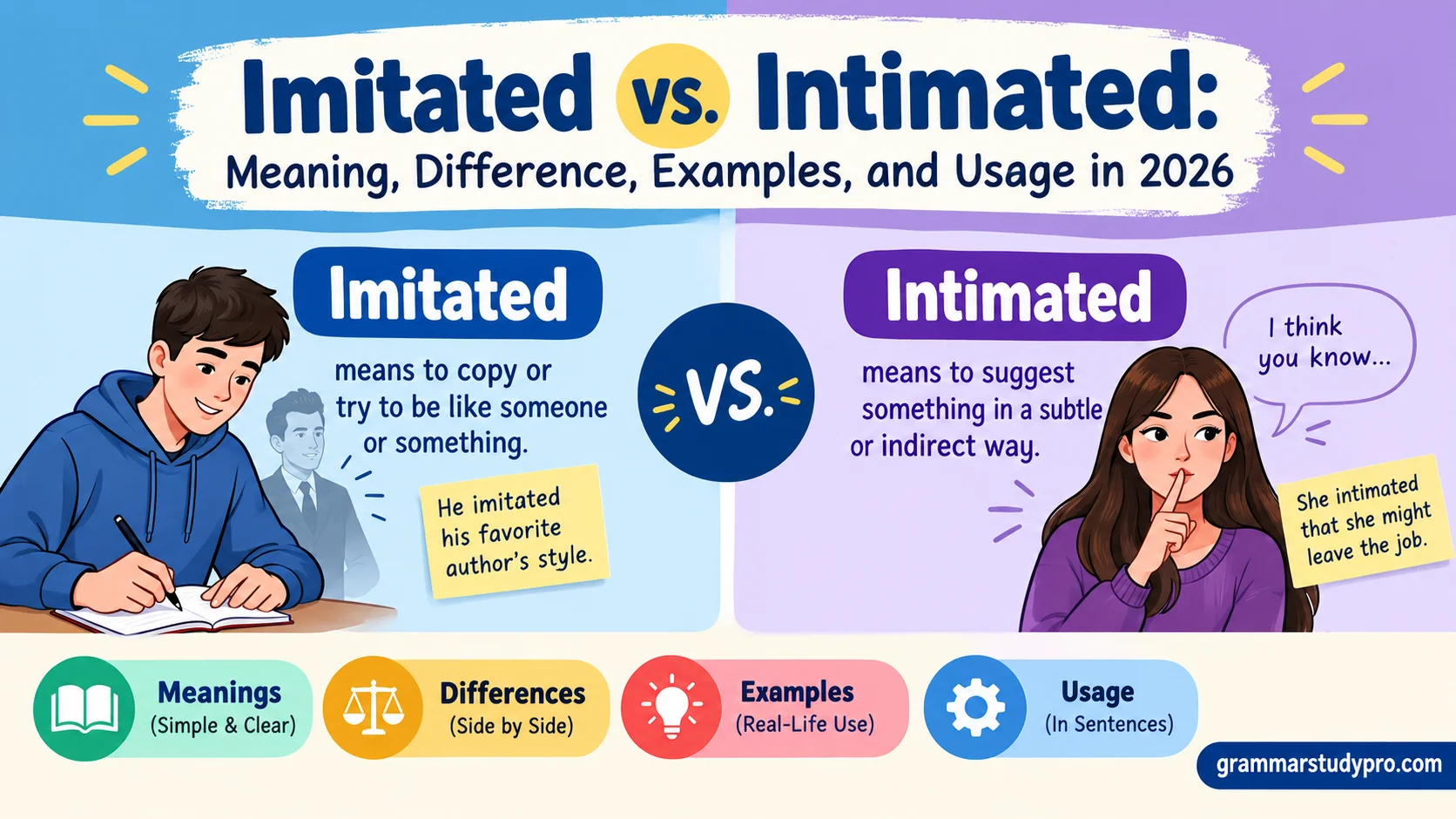
Imitated vs. Intimated shows how similar words can carry very different meanings and confuse learners, writers, and fluent English speakers. Imitated and Intimated may look similar, share similar spelling, and have similar pronunciation, but they mean very different things. Imitated means copied or mimicked, while Intimated means hinted or suggested without saying something directly. When you imitated someone, you copied their style, behavior, or an action. When you intimated something, you hinted at it without stating it plainly. For example, “She imitated her boss’s speaking style” means she copied it, while “She intimated that layoffs were coming” means she hinted at it without saying so outright. These two terms have no shared meaning, so swapping one for the other changes what a sentence says.
From my experience with the English language, this gap often creates a common mix-up. I have seen students, learners, and writers wondered whether they had imitated an action or intimated a message. Intimate can be an adjective meaning close or personal, but it can also work as a verb, adding another layer of confusion. It is a perfect example of how words can carry completely different meanings even when they sound alike. I remember writing in my notebook on March 28, 2024, that Every detail matters when mastering language. That thought still guides my journey through the vast landscape of vocabulary, with its twists and turns. At first glance, these words may seem interchangeable, but their distinct Meanings and Usage become clearer in writing and speech.
A simple way to use each word correctly is to remember that imitate means to copy actions, speech, or style, while intimate means to suggest or hint at something subtle and directly communicate it less openly. Picture a child copying a favorite superhero’s moves when remembering Imitated. For Intimated, picture a friend who feels unhappy and is sharing information through behavior or a choice of words. English learners and fluent speakers may struggle with these terms, and misusing them can lead to misunderstandings or amusing situations. To improve writing clarity, prevent embarrassing mistakes, and understand the exact meanings, study real-life examples, notice common errors, and remember the small shift in Meaning. If you discover more examples in a book or books, or Shop for bestsellers, keep exploring deeper examples and facing real challenges. The short answer is that Imitated connects with copying, while Intimated connects with suggesting subtly, and this distinction truly does matter when exploring language accurately.
Quick Answer
Imitated is the past tense and past participle of imitate. It means copied, mimicked, or reproduced the behavior, appearance, speech, sound, or style of someone or something.
Intimated is the past tense and past participle of intimate when intimate functions as a verb. It means suggested, indicated, or made something known without stating it directly. Cambridge labels this verb usage as formal.
| Word | Base verb | Meaning | Example |
| Imitated | imitate | Copied or mimicked | The child imitated his father’s gestures. |
| Intimated | intimate | Hinted or suggested indirectly | The manager intimated that changes were coming. |
| Intimidated | intimidate | Frightened or threatened | The new student felt intimidated by the large class. |
A useful shortcut is to replace the questionable word mentally.
- If copied fits, use imitated.
- If hinted or suggested fits, use intimated.
- If frightened fits, use intimidated.
That three-word test solves most cases quickly.
Comparison Overview
The difference between imitated vs. intimated becomes clearer when you look at what each word describes.
| Feature | Imitated | Intimated |
| Root verb | Imitate | Intimate |
| Part of speech | Past tense/past participle | Past tense/past participle |
| Main meaning | Copied or mimicked | Suggested indirectly |
| Basic idea | Reproduction | Indirect communication |
| Common object | Person, behavior, voice, style, action, sound | Idea, intention, possibility, feeling |
| Typical construction | imitated + object | intimated + that-clause |
| Everyday usage | Common | More formal |
| Example | She imitated his accent. | She intimated that she might leave. |
The distinction is worth remembering because these words don’t function as interchangeable synonyms.
Consider these two sentences:
He imitated the director.
He copied the director in some way.
He intimated that the director would resign.
He suggested that the director would resign without stating it directly.
The first sentence concerns copying. The second concerns indirect communication.
Main Differences Between Imitated vs. Intimated
The most important difference between imitated vs. intimated lies in the action each verb describes.
Imitated means copied or mimicked
When someone imitates another person, they reproduce something associated with that person. That might include speech, behavior, gestures, movement, style, or mannerisms.
Cambridge Dictionary describes imitate as behaving similarly to someone or something else or copying speech, behavior, and other characteristics.
For example:
- The actor imitated the singer’s distinctive voice.
- The child imitated her older brother.
- The comedian imitated the politician’s gestures.
- The student imitated the instructor’s technique.
- The designer imitated the style of an earlier collection.
In each sentence, something gets copied.
The copied thing doesn’t have to be a physical object. You can imitate an accent, a facial expression, a writing style, a movement, or even a broader pattern of behavior.
Intimated means hinted or suggested
When someone intimates something, they don’t state it plainly. Instead, they communicate the idea indirectly.
Cambridge defines the verb intimate as making clear what you think or want without saying it directly. It commonly appears with a that-clause.
For example:
- The manager intimated that layoffs were possible.
- She intimated that she disagreed with the proposal.
- He intimated that he might resign.
- The report intimated that the results needed further investigation.
- The official intimated that additional changes could follow.
Here, nobody is copying anything. The speaker is hinting at an idea.
The simplest distinction
Think of the two words as performing two completely different jobs:
IMITATED → COPY
INTIMATED → HINT
One reproduces something. The other communicates something indirectly.
What Does “Imitated” Mean?
Imitated is the past tense and past participle of imitate. The verb describes copying the way someone or something looks, sounds, behaves, moves, or operates.
The copied feature can be obvious or subtle.
A child might imitate a parent’s hand gestures. A comedian might imitate a celebrity’s voice. A musician might imitate a particular sound. A student might imitate a teacher’s method for solving a problem.
The word therefore covers much more than simple physical copying.
Examples of imitated
Consider these examples:
The toddler imitated her mother’s hand movements.
The toddler copied the movements.
The comedian imitated the actor’s voice.
The comedian reproduced the actor’s vocal style.
The apprentice imitated the craftsman’s technique.
The apprentice followed the same technique.
The artificial material imitated the appearance of natural stone.
The material reproduced a similar appearance.
The younger band imitated the sound of its musical influences.
The band copied characteristics of another musical style.
Cambridge’s examples similarly use imitate for copying speech, behavior, models, and natural characteristics.
What can you imitate?
You can imitate many different things, including:
- Speech: an accent or speaking style
- Behavior: someone’s habits or mannerisms
- Movement: a dance or physical technique
- Sound: an animal call or musical effect
- Appearance: a visual style
- Technique: a method used by an expert
- Style: an artistic or creative approach
- Example: a successful model or established pattern
That broad range explains why imitated appears in everyday speech as well as academic, artistic, scientific, and technical writing.
Imitated Grammar and Word Forms
Understanding the word family makes imitated easier to use correctly.
| Word | Grammatical role | Example |
| imitate | Base verb | Children imitate adults. |
| imitated | Past tense/past participle | She imitated her teacher. |
| imitating | Present participle | He is imitating the character. |
| imitation | Noun | Her imitation was convincing. |
| imitative | Adjective | The style is highly imitative. |
The most important construction is usually:
subject + imitated + object
For example:
Maya imitated her sister’s accent.
Here, Maya performs the action. Her sister’s accent receives the action.
The same pattern works with actions and styles:
The students imitated the instructor’s movements.
The artist imitated the older painting’s composition.
The actor imitated the character’s mannerisms.
What Does “Intimated” Mean?
Intimated is the past tense and past participle of the verb intimate.
In this verb form, intimate has nothing to do with the more familiar adjective intimate, as in an intimate friend or an intimate setting. Instead, it means to suggest something without stating it directly. Cambridge specifically identifies this verb usage as formal.
For example:
The director intimated that the project might be canceled.
The director didn’t necessarily announce the cancellation. Instead, the director gave an indirect indication.
Another example:
She intimated that she was unhappy with the decision.
The sentence suggests that she communicated her dissatisfaction without expressing it in completely direct terms.
Why “intimated” often sounds formal
You can usually replace intimated with hinted or suggested in ordinary writing.
Compare:
He intimated that he wanted to leave.
He hinted that he wanted to leave.
Both sentences communicate the same basic idea. However, hinted sounds more natural in casual conversation, while intimated has a more formal or literary flavor.
That doesn’t make intimated incorrect or outdated. It simply means the word has a narrower stylistic feel.
Common sentence patterns with intimated
The most useful pattern is:
subject + intimated + that + clause
Examples include:
- She intimated that she knew the answer.
- He intimated that the company might relocate.
- The report intimated that the problem was larger than expected.
- The minister intimated that further discussions were necessary.
Another structure is possible when the object represents what was communicated:
The letter intimated his intentions.
Still, the that-clause construction is especially useful for learners because it makes the meaning easy to recognize.
Imitated vs. Intimated in Sentence Structure
Grammar offers another reliable way to separate these words.
How “imitated” usually works
Imitate is a transitive verb. That means it normally takes a direct object.
You can say:
She imitated her teacher.
He imitated the actor’s voice.
The robot imitated the human movement.
The thing being copied follows the verb.
How “intimated” usually works
Intimate, when used as a verb, commonly introduces information indirectly.
A very common pattern is:
subject + intimated + that + statement
For example:
The CEO intimated that the company would expand.
The witness intimated that he knew more than he had said.
The author intimated that the ending was deliberately ambiguous.
The grammar mirrors the meaning. You’re not copying an object. You’re communicating an idea.
A practical grammar test
When you’re unsure, ask:
What comes after the verb?
If you’re identifying something that was copied, imitated probably fits.
If you’re introducing a proposition that someone hinted at, intimated probably fits.
This isn’t an infallible rule. English has plenty of exceptions and flexible constructions. Still, it’s an excellent practical clue.
Imitated vs. Intimated Examples
Examples make this distinction much easier to retain.
Examples of “imitated”
The child imitated her father’s laugh.
The actor imitated the singer’s mannerisms.
The student imitated the teacher’s method.
The bird imitated the sound it heard.
The comedian imitated several famous voices.
The new product imitated the design of an established model.
In every case, something is reproduced or copied.
Examples of “intimated”
The manager intimated that layoffs might occur.
She intimated that she wasn’t satisfied with the arrangement.
He intimated that the negotiations could continue.
The author intimated that the narrator was unreliable.
The statement intimated that further action might be necessary.
The candidate intimated that a policy change was possible.
In every case, the speaker or text suggests an idea without stating it directly.
Paired examples that show the difference
This is where the distinction becomes crystal clear.
Imitated:
The student imitated the professor’s speaking style.
Meaning: The student copied the professor’s style.
Intimated:
The student intimated that the professor was mistaken.
Meaning: The student indirectly suggested that the professor was mistaken.
Another pair:
Imitated:
The actor imitated the director’s voice.
Intimated:
The actor intimated that the director was unhappy.
The first concerns performance and copying. The second concerns communication and implication.
Common Mistakes With Imitated and Intimated
These words often appear in incorrect sentences because their spellings look deceptively familiar.
Mistake: Using “intimated” for copying
Incorrect:
He intimated her accent.
Correct:
He imitated her accent.
The accent is being copied. Therefore, imitated is the appropriate word.
Mistake: Using “imitated” for indirect communication
Incorrect:
She imitated that she planned to resign.
Correct:
She intimated that she planned to resign.
The second sentence describes an indirect suggestion. It doesn’t describe copying.
Mistake: Treating the two words as synonyms
The similar spelling doesn’t make the words interchangeable.
You can’t generally replace:
The child imitated his mother.
with:
The child intimated his mother.
The meaning changes completely and the resulting sentence may not express a sensible idea.
Likewise, replacing:
He intimated that he was leaving.
with:
He imitated that he was leaving.
doesn’t preserve the original meaning.
Imitated vs. Intimated vs. Intimidated
The third word deserves attention because it causes a separate spelling trap.
Intimidated comes from intimidate, which means to frighten or threaten someone, often to influence their behavior. Cambridge gives examples involving people feeling frightened or nervous and people being pressured through threats.
That gives us three different words:
| Word | Meaning | Example |
| Imitated | Copied or mimicked | She imitated his accent. |
| Intimated | Hinted or suggested indirectly | She intimated that she might resign. |
| Intimidated | Frightened or threatened | She felt intimidated by the hostile crowd. |
Notice how dramatically the meanings change.
“Intimidated” means frightened or pressured
For example:
The new employee felt intimidated during the first meeting.
The employee felt nervous or lacking confidence.
The witness was intimidated by the threat.
The witness experienced fear or pressure.
Don’t let an unfamiliar subject intimidate you.
Here, intimidate means to frighten or make someone feel less confident.
Cambridge defines intimidated as frightened or nervous because someone isn’t confident in a situation.
So remember:
Imitated → copied
Intimated → hinted
Intimidated → frightened
One extra syllable changes the entire meaning.
Imitate vs. Intimate: The Base Verbs
The easiest way to understand the past forms is to return to their base verbs.
Imitate
Imitate means to copy or behave similarly to someone or something.
Examples:
Children often imitate adults.
Actors learn to imitate different accents.
The material was designed to imitate natural stone.
Its central idea is reproduction.
Intimate as a verb
Intimate means to suggest that something is true or likely without saying so directly.
Examples:
He intimated that he knew the answer.
She intimated that the deadline could change.
Its central idea is indirect communication.
Don’t confuse the verb “intimate” with the adjective
The word intimate has several grammatical uses.
As an adjective, it can mean close, personal, or private:
They had an intimate friendship.
The restaurant has an intimate atmosphere.
As a noun, it can refer to a close friend.
As a verb, however, intimate means to suggest something indirectly.
The pronunciation also changes between the adjective and verb. The adjective has the stress pattern associated with IN-ti-mate, while the verb shifts stress toward the final syllable.
That distinction matters when you’re speaking as well as writing.
Imitated vs. Intimated Pronunciation
The spelling isn’t the only source of confusion. Their sounds deserve attention too.
How to pronounce “imitated”
The US pronunciation of imitate is approximately /ˈɪm.ə.teɪt/. Cambridge lists this pronunciation for American English.
The past form imitated follows the same basic stress pattern.
The opening syllable carries the primary stress. The word then moves through the remaining syllables before ending with the familiar -ated sound.
How to pronounce “intimated”
The verb intimate is pronounced differently from the adjective. In US English, Cambridge gives the verb as /ˈɪn.tə.meɪt/.
The past form intimated follows that verb pronunciation.
This creates a useful distinction:
- intimate as a verb has the final syllable stressed.
- intimate as an adjective has a different stress pattern.
Why the distinction matters
When reading quickly, the words can look almost interchangeable.
When speaking carefully, their different vowel and stress patterns provide additional clues.
Still, meaning and context remain the most reliable guides.
Imitated vs. Intimated in Everyday and Formal English
Not every grammatically correct word sounds equally natural in every setting.
“Imitated” works across many contexts
You can comfortably use imitated in casual conversation, education, entertainment, science, journalism, and technical writing.
For example:
My little brother imitated everything I did.
That sounds perfectly natural.
So does:
The researchers developed a model that imitated the behavior of the original system.
The verb adapts easily to both informal and technical contexts.
“Intimated” has a more formal tone
Intimated is grammatically normal, but it often sounds more formal than hinted or suggested. Cambridge explicitly labels the verb usage as formal.
Compare:
She hinted that she wanted to leave.
She intimated that she wanted to leave.
The first sounds more conversational. The second sounds more formal or literary.
That difference can matter when you’re choosing vocabulary for an audience.
When “hinted” may be better
If you’re writing a casual email, social post, or everyday dialogue, hinted may be clearer.
If you’re writing formal analysis, literary criticism, institutional prose, or a carefully worded report, intimated may fit naturally.
The goal isn’t to choose the more sophisticated-looking word. The goal is to choose the word that communicates the idea clearly.
Imitated vs. Intimated Synonyms
Knowing related words helps reinforce the difference.
Synonyms for “imitated”
Depending on the context, possible alternatives include:
- copied
- mimicked
- reproduced
- replicated
- mirrored
- emulated
These words aren’t perfect substitutes in every sentence.
For example, mimicked often suggests copying someone’s speech or movements. Cambridge notes that mimic commonly involves copying how a person speaks or moves.
Emulated, meanwhile, can carry the idea of trying to match or follow someone’s example, sometimes with an element of admiration.
Synonyms for “intimated”
Depending on context, alternatives include:
- hinted
- suggested
- implied
- indicated
- signaled
However, these words also have different shades of meaning.
For example, implied often focuses on meaning that follows indirectly from someone’s words or circumstances. Hinted usually suggests a less direct communication. Indicated can sound more neutral.
That’s why context still matters.
A Useful Case Study: One Situation, Three Words
Imagine a new employee joins a large company.
During the first meeting, the employee watches a senior manager carefully and begins copying the manager’s hand gestures and speaking style.
That employee imitated the manager.
Later, the employee tells a colleague:
“I don’t think the company will keep this department unchanged.”
The employee hasn’t directly announced anything. The employee has intimated that changes may be coming.
Then the employee walks into a tense meeting with several senior executives and feels nervous because the situation seems overwhelming.
The employee feels intimidated.
The three words now describe three separate events:
- Imitated: copied the manager.
- Intimated: hinted at possible changes.
- Intimidated: felt frightened or nervous.
This is more than a spelling exercise. Each word identifies a different type of action or experience.
How to Remember Imitated vs. Intimated
A good memory trick should be short enough to survive a busy Monday morning.
Use the copy-versus-hint test
Ask:
Does the sentence mean “copied”?
Use imitated.
Does it mean “hinted” or “suggested indirectly”?
Use intimated.
Does it mean “frightened” or “made nervous”?
Use intimidated.
Try the replacement test
Suppose you write:
The actor ______ the comedian’s voice.
Replace the blank with copied:
The actor copied the comedian’s voice.
The meaning works.
So:
The actor imitated the comedian’s voice.
Now try:
The manager ______ that the schedule might change.
Replace the blank with hinted:
The manager hinted that the schedule might change.
That works naturally.
So:
The manager intimated that the schedule might change.
The three-word memory rule
Keep this tiny formula handy:
IMITATED = COPIED
INTIMATED = HINTED
INTIMIDATED = FRIGHTENED
It won’t cover every possible grammatical nuance. For ordinary usage, however, it provides a remarkably effective shortcut.
Imitated vs. Intimated in Real-World Contexts
The following table puts the distinction into practical situations.
| Situation | Correct word | Reason |
| Copying someone’s accent | Imitated | An accent is being copied |
| Copying a dance move | Imitated | A movement is being reproduced |
| Copying a celebrity’s mannerisms | Imitated | Behavior is being mimicked |
| Reproducing a visual style | Imitated | The style is being copied |
| Suggesting a resignation | Intimated | The resignation is hinted at |
| Indicating dissatisfaction indirectly | Intimated | A feeling is suggested |
| Suggesting a future change | Intimated | The possibility is communicated indirectly |
| Feeling nervous around an imposing person | Intimidated | The person feels frightened or less confident |
| Being pressured through threats | Intimidated | Threats are being used to influence behavior |
The pattern is consistent: imitated deals with copying, intimated with indirect communication, and intimidated with fear or pressure.
Common Questions About Imitated vs. Intimated
What is the difference between imitated and intimated?
Imitated means copied or mimicked. Intimated means hinted or suggested without stating something directly. Cambridge identifies imitated as the past form of imitate and intimated as the past form of the verb intimate.
Is “intimated” the past tense of “intimate”?
Yes. When intimate functions as a verb, intimated is its past tense and past participle.
For example:
He intimated that he might leave.
Is “imitated” the past tense of “imitate”?
Yes. Imitated is both the past simple and past participle of imitate.
For example:
She imitated her instructor.
Does “intimated” mean “hinted”?
Yes. In its verb form, intimated means that someone suggested or communicated something without stating it directly.
Does “imitated” mean “copied”?
Yes. Imitated describes copying or reproducing the way someone or something looks, sounds, behaves, or acts.
Can imitated and intimated be used interchangeably?
No. They have different meanings.
Use imitated when something is copied.
Use intimated when something is suggested indirectly.
What is the difference between imitated, intimated, and intimidated?
The three words describe three different ideas:
- Imitated: copied
- Intimated: hinted or suggested
- Intimidated: frightened or threatened
Is “intimated” common in everyday English?
It is a valid English verb, but it generally has a more formal tone than hinted or suggested. Cambridge labels the verb usage as formal.
Which word should I use for copying someone’s behavior?
Use imitated.
She imitated her friend’s mannerisms.
Which word should I use when someone suggests something indirectly?
Use intimated when you want a formal or literary tone.
He intimated that the decision might change.
In everyday conversation, hinted or suggested may sound more natural.
FAQs
What is the difference between imitated and intimated?
Imitated means copied or mimicked. Intimated means hinted at or suggested something without saying it directly. For example, “He imitated his teacher” means he copied the teacher’s actions, while “He intimated that he was unhappy” means he hinted at his feelings.
Is intimated the same as imitated?
No. Intimated and imitated have different meanings. Imitated relates to copying someone or something, while intimated relates to suggesting or hinting at an idea, feeling, or message.
How do you use imitated in a sentence?
You can use imitated when someone copies another person’s actions, speech, style, or behavior. For example: “The child imitated his favorite superhero’s moves.”
How do you use intimated in a sentence?
Use intimated when someone suggests something indirectly instead of stating it plainly. For example: “The manager intimated that changes were coming soon.”
How can I remember the difference between imitated and intimated?
A simple trick is to connect imitated with imitation, which means copying. Connect intimated with a hint or indirect suggestion. If someone copies, use imitated. If someone hints, use intimated.
Conclusion
Imitated vs. Intimated can be confusing because the words look and sound similar, but their meanings are completely different. Imitated means copied or mimicked, while intimated means hinted or suggested indirectly. Remembering this basic distinction can help you avoid common mistakes in both writing and speech.