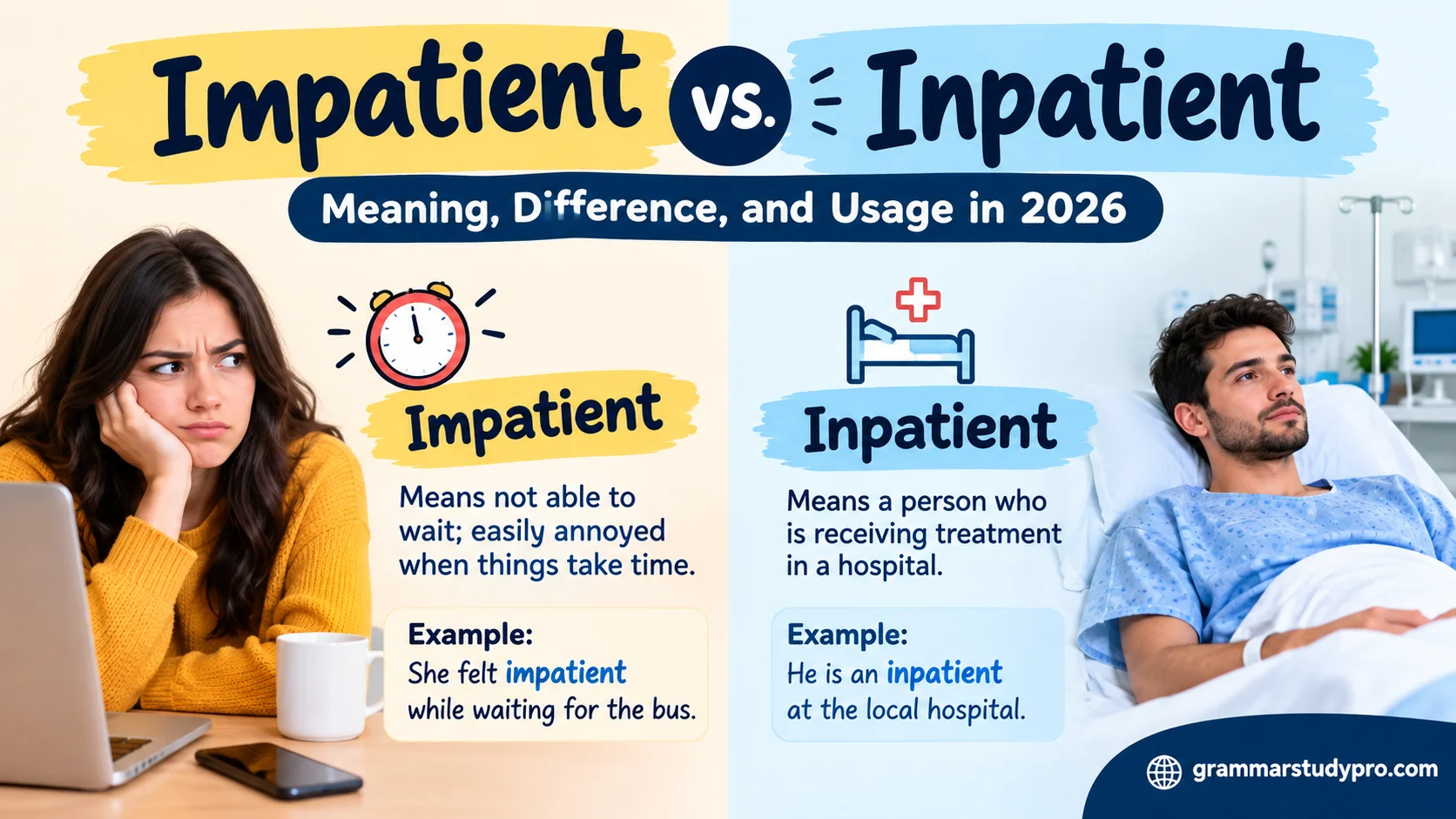
Impatient vs. Inpatient can confuse English learners, but one describes restlessness, while the other means a hospital patient receiving treatment. Impatient describes an emotional state in which a person lacks patience, feels annoyed or restless, and may start tapping their foot while waiting in lines. Inpatient, on the other hand, is a medical term used in healthcare for a person admitted to a hospital for treatment, usually involving an overnight stay or longer care. Although their spelling looks similar, these words have completely different meanings and usage.
This distinction becomes important in real-world settings, where choosing the wrong word can create confusion and change the meaning of a sentence. For example, an impatient customer may be annoyed about a delay, while an inpatient is someone receiving care inside a hospital. Remembering the context makes the difference easier: think of a person tapping their foot when you see impatient, and picture a hospital when you see inpatient. This simple memory trick can improve grammar skills, clarity, and accuracy in formal writing, emails, reports, and other forms of professional communication.
Quick Answer
The difference between impatient vs. inpatient is mainly about meaning and context:
- Impatient is an adjective that describes someone who dislikes waiting, becomes annoyed by delays, or wants something to happen quickly.
- Inpatient is primarily a noun referring to someone who stays in a hospital for medical treatment.
- Patient can mean someone who receives medical care, but it can also describe someone who waits calmly.
- Outpatient is the medical term for someone who receives hospital treatment without staying overnight.
The easiest way to remember the difference
Impatient = doesn’t want to wait.
Inpatient = stays in for medical care.
Consider these two sentences:
- “The customer became impatient after waiting for 30 minutes.”
- “The patient became an inpatient after being admitted to the hospital.”
The first sentence concerns waiting and frustration. The second concerns medical treatment and hospitalization.
That single distinction will solve most impatient vs inpatient questions.
Comparison Overview
The fastest way to understand these words is to put them side by side.
| Feature | Impatient | Inpatient |
| Part of speech | Adjective | Primarily a noun |
| Main meaning | Unwilling to wait or eager for something to happen | A person staying in a hospital for medical treatment |
| Common setting | Everyday conversation | Healthcare and medicine |
| Related word | Patient | Outpatient |
| Common phrase | Impatient with someone | Inpatient treatment |
| Example | “He became impatient with the delay.” | “She was admitted as an inpatient.” |
| Main idea | Waiting and eagerness | Hospital care and staying in |
Cambridge Dictionary defines impatient as describing someone who becomes annoyed because they have to wait or who wants something to happen as soon as possible. It defines inpatient as someone who goes into a hospital for medical care and stays there for one or more nights.
So although the words look like close relatives, their meanings take completely different paths.
Main Differences Between Impatient vs. Inpatient
The spelling difference is tiny. The semantic difference is not.
Impatient Describes an Attitude or Reaction
When you call someone impatient, you’re describing how that person feels or behaves.
An impatient person may dislike waiting in line, become frustrated when someone works slowly, or want an event to happen immediately.
For example:
“Maria became impatient when the meeting ran 45 minutes late.”
Maria isn’t receiving medical treatment. Her reaction to the delay makes impatient the correct word.
The word can also express eagerness rather than irritation. Someone may be excited and eager for something to happen without necessarily being angry.
For example:
“The students were impatient to see their final grades.”
Here, impatient means eager for something to happen soon. Cambridge specifically recognizes both the “annoyed by waiting” and “eager for something to happen” meanings.
Inpatient Describes a Medical Status
Inpatient belongs mainly to healthcare vocabulary.
An inpatient is a person who stays in a hospital for medical treatment. Cambridge’s American Dictionary definition specifies a person who stays one or more nights in a hospital to receive medical care.
For example:
“The hospital admitted the patient as an inpatient.”
The word doesn’t describe the person’s personality. It tells you something about the setting and arrangement of their medical care.
You’ll commonly encounter inpatient in phrases such as:
- inpatient care
- inpatient treatment
- inpatient admission
- inpatient unit
- inpatient facility
- inpatient rehabilitation
- inpatient surgery
- inpatient services
- inpatient stay
These expressions appear frequently in healthcare communication because medical systems need precise ways to distinguish different types of care.
The Context Usually Gives the Answer
If a sentence involves waiting, delays, frustration, or eagerness, think impatient.
If it involves hospital admission, overnight treatment, medical facilities, or inpatient care, think inpatient.
Here’s a simple mental shortcut:
Waiting problem → impatient
Hospital stay → inpatient
That rule won’t cover every specialized use of the words. For ordinary English, though, it handles the distinction neatly.
What Does Impatient Mean?
Impatient is an adjective. It describes a person who isn’t willing to wait calmly or who wants something to happen quickly.
Cambridge gives two closely related meanings. The first involves annoyance caused by waiting or by someone’s mistakes. The second involves eagerness for something to happen as soon as possible.
Impatient Meaning: Unwilling to Wait
This is the meaning people use most often in everyday conversation.
Consider:
“I became impatient after waiting in traffic for two hours.”
The speaker is frustrated because the situation is taking too long.
More examples include:
- “The children became impatient while waiting for dinner.”
- “He gets impatient when people arrive late.”
- “She was impatient with the slow internet connection.”
- “Don’t be impatient. Your turn is coming.”
- “The customer grew impatient after receiving no response.”
Notice the common theme: something is taking longer than the person wants.
Impatient Meaning: Eager for Something to Happen
The word has another important meaning.
Someone can be impatient to do something because they’re extremely eager to begin.
For example:
“She was impatient to start her new job.”
In this sentence, the speaker isn’t necessarily angry. She simply wants the event to happen soon.
You might also see:
- “He was impatient to hear the results.”
- “They were impatient to begin the journey.”
- “The children were impatient to open their presents.”
- “She was impatient for the announcement.”
This second meaning is especially useful because it prevents a common misunderstanding: impatient doesn’t always mean angry.
Sometimes it means intensely eager.
Common Forms of Impatient
The word has several related forms:
| Word | Part of Speech | Meaning | Example |
| patient | Adjective | Able to wait calmly | “She was patient during the delay.” |
| impatient | Adjective | Unwilling to wait or eager for action | “He became impatient.” |
| impatience | Noun | The feeling of being impatient | “Her impatience was obvious.” |
| impatiently | Adverb | In an impatient manner | “He waited impatiently.” |
Cambridge also lists impatience as the noun describing the feeling of annoyance caused by waiting or the desire for something to happen quickly.
What Does Inpatient Mean?
Inpatient is primarily a medical noun.
It refers to someone who stays in a hospital while receiving medical treatment. Cambridge defines an inpatient as a person who goes into a hospital for medical care and stays there for one or more nights during treatment.
For example:
“The hospital has several beds available for inpatients.”
The sentence doesn’t tell us whether those patients are calm, frustrated, cheerful, or impatient. It simply identifies them as people receiving care while staying in the facility.
Examples of Inpatient
Here are natural examples from medical contexts:
- “The doctor recommended inpatient treatment.”
- “The patient was admitted as an inpatient.”
- “The hospital increased its inpatient capacity.”
- “She spent five days as an inpatient.”
- “The facility provides inpatient rehabilitation.”
- “The insurance plan covers inpatient treatment.”
- “The hospital has a dedicated inpatient unit.”
The surrounding words make the meaning unmistakable.
Inpatient as a Medical Term
Healthcare professionals often distinguish between different care settings.
For example, a medical document might discuss:
- inpatient care
- outpatient care
- emergency care
- rehabilitation
- home-based care
The term inpatient therefore doesn’t describe a person’s emotional state. It identifies the type of care arrangement involved.
That distinction is especially important when reading medical documents, insurance information, hospital websites, or healthcare policies.
Inpatient vs. Outpatient
Once you’ve learned inpatient, the next word to understand is outpatient.
An outpatient receives medical care without staying in the hospital overnight. Cambridge defines an outpatient as someone who goes to a hospital for treatment but doesn’t stay any nights there.
| Term | Basic Meaning |
| Inpatient | Receives medical care while staying in the hospital |
| Outpatient | Receives medical care without staying overnight |
For example:
“The procedure was performed on an outpatient basis.”
This means the person received the treatment without remaining in the hospital overnight.
By contrast:
“The patient required inpatient care.”
This indicates that the person stayed in the facility for treatment.
The exact arrangements for a particular procedure can vary by patient, facility, and clinical circumstances. The key linguistic distinction is the care setting, not a specific procedure.
Impatient vs. Inpatient Pronunciation
Pronunciation can make these words even easier to confuse.
Cambridge gives the US pronunciation of impatient as /ɪmˈpeɪʃənt/ and inpatient as /ˈɪnˌpeɪʃənt/.
The important difference is at the beginning:
- impatient begins with the sound associated with im-.
- inpatient begins with the clearly pronounced in-.
The stress pattern also differs. Impatient places its main stress later in the word, while inpatient emphasizes the first element.
When people speak quickly, however, the words can still sound close. That’s one reason spelling mistakes happen.
If you’re writing, don’t rely on sound alone. Look at the meaning of the sentence.
How to Use Impatient in a Sentence
The grammar around impatient is worth learning because several common patterns appear repeatedly.
Impatient With
Use impatient with when you identify the person, behavior, or situation causing frustration.
Examples:
- “She was impatient with her coworker’s repeated questions.”
- “He became impatient with the slow service.”
- “The teacher grew impatient with the constant interruptions.”
The basic structure is:
subject + be + impatient with + person or thing
Cambridge specifically gives examples using impatient with.
Impatient To
Use impatient to when someone strongly wants to perform an action.
Examples:
- “She was impatient to begin.”
- “He was impatient to see the results.”
- “They were impatient to leave.”
The structure is:
subject + be + impatient + to + verb
This construction usually emphasizes eagerness rather than simple frustration.
Impatient For
Use impatient for when someone eagerly wants a particular thing or event.
Examples:
- “The team was impatient for an answer.”
- “Fans were impatient for the announcement.”
- “She was impatient for the holidays to begin.”
Cambridge documents both impatient to and impatient for as established usage patterns.
How to Use Inpatient in a Sentence
Because inpatient is a medical term, its surrounding vocabulary usually involves treatment.
Inpatient as a Noun
Examples:
- “The inpatient was transferred to another room.”
- “The hospital admitted several new inpatients.”
- “Each inpatient received an identification bracelet.”
Here, inpatient functions as a noun.
Inpatient Before Another Noun
The word also appears in combinations that describe medical services or settings.
Examples include:
- inpatient treatment
- inpatient care
- inpatient rehabilitation
- inpatient services
- inpatient facility
- inpatient unit
For example:
“The clinic offers both inpatient and outpatient services.”
Here, inpatient helps identify the type of service rather than acting as the main noun.
Common Mistakes With Impatient vs. Inpatient
A single letter can create a surprisingly awkward sentence.
Mistake: “I Am Inpatient With the Delay”
Incorrect:
“I am inpatient with the delay.”
Correct:
“I am impatient with the delay.”
The sentence concerns frustration caused by waiting. It has nothing to do with hospital treatment.
Mistake: “He Needs Impatient Treatment”
Incorrect:
“He needs impatient treatment.”
Correct:
“He needs inpatient treatment.”
The second sentence describes medical care provided in an inpatient setting.
Mistake: “She Was an Impatient”
Incorrect:
“She was an impatient.”
Correct:
“She was an inpatient.”
When you mean someone staying in a hospital for treatment, inpatient is the correct noun.
Mistake: Thinking Inpatient Means “Not Patient”
This mistake comes from looking at the spelling rather than the word’s established meaning.
Inpatient isn’t simply the opposite of patient.
In medical English, inpatient refers to a person receiving care while staying in a hospital. The relevant medical counterpart is outpatient.
Meanwhile, impatient relates directly to the everyday adjective patient because it describes someone who isn’t willing to wait calmly.
That’s an important distinction.
Impatient vs. Inpatient Examples Side by Side
Context becomes much clearer when the words appear in similar sentence patterns.
| Situation | Correct Word | Example |
| Someone hates waiting | Impatient | “He became impatient in the long line.” |
| Someone wants action quickly | Impatient | “She was impatient to get started.” |
| Someone is annoyed by delays | Impatient | “The customer grew impatient.” |
| Someone stays in a hospital | Inpatient | “He was admitted as an inpatient.” |
| Someone receives hospital treatment while staying there | Inpatient | “The facility provides inpatient care.” |
| Someone receives treatment without staying overnight | Outpatient | “She had the procedure as an outpatient.” |
The trick is to identify the subject of the sentence’s meaning.
Is the sentence talking about someone’s reaction to waiting? Choose impatient.
Is it talking about a person’s medical status? Choose inpatient.
Patient vs. Impatient vs. Inpatient vs. Outpatient
Four related words cause much of the confusion.
| Word | Meaning | Example |
| Patient | Able to wait calmly | “He was patient during the delay.” |
| Impatient | Unwilling to wait or eager for action | “She became impatient.” |
| Inpatient | A person staying in a hospital for treatment | “The inpatient received medical care.” |
| Outpatient | A person receiving medical care without staying overnight | “He received treatment as an outpatient.” |
This table reveals something interesting about English.
The word patient has two major everyday roles. It can describe someone’s ability to wait calmly, and it can refer to someone receiving medical care.
Add prefixes such as im-, in-, and out-, and the resulting words develop distinct meanings.
That’s why spelling alone isn’t enough. Context does the heavy lifting.
Case Study: How One Letter Changes the Meaning
Imagine a hospital administrator writing a sentence about a patient’s treatment.
The intended sentence is:
“The patient required inpatient treatment.”
That sentence tells the reader that the patient needed treatment while staying in the hospital.
Now replace inpatient with impatient:
“The patient required impatient treatment.”
The sentence no longer communicates the intended medical meaning. Instead, impatient treatment sounds like treatment delivered in an annoyed or hurried manner.
That’s not simply a spelling error. It changes the relationship between the words.
Now consider an everyday situation:
“The customer became impatient while waiting for assistance.”
Replace impatient with inpatient:
“The customer became inpatient while waiting for assistance.”
The sentence becomes incorrect because inpatient doesn’t describe frustration with waiting.
Context acts like a traffic sign. It tells you which word belongs on the road.
How to Remember the Difference Between Impatient and Inpatient
You don’t need a complicated mnemonic.
Use the first letters of the key ideas:
Impatient = Irritated by waiting
Think:
I = Irritated
Someone who is impatient may be annoyed because something is taking too long.
Inpatient = In medical care
Think:
IN = In
An inpatient is in the hospital or healthcare setting for treatment.
This isn’t a perfect linguistic explanation of the words’ history. It’s simply a practical memory trick.
And practical tricks are often what you need when you’re staring at a blank sentence and wondering which spelling belongs there.
Impatient vs. Inpatient in Professional Writing
The distinction becomes especially important in professional settings.
In Customer Service
Use impatient when describing a customer’s reaction.
“The customer became impatient after waiting for assistance.”
In Healthcare
Use inpatient when describing hospital-based care.
“The patient was transferred to the inpatient unit.”
In Academic Writing
Both words can appear, but their contexts remain distinct.
“Participants became impatient when the experiment was delayed.”
versus:
“The study examined outcomes among inpatient rehabilitation participants.”
In Business Writing
Impatient can describe customers, employees, investors, or managers who want results quickly.
“Customers are becoming impatient with repeated delivery delays.”
The medical word inpatient would have no place in that sentence unless healthcare services were actually being discussed.
Quick Facts About Impatient and Inpatient
Here are the key facts worth remembering:
- Impatient is an adjective.
- Inpatient is primarily a noun in standard dictionary definitions.
- Impatient can describe both annoyance and eagerness.
- Inpatient refers to someone receiving medical care while staying in a hospital.
- Outpatient is the corresponding medical term for someone who receives care without an overnight stay.
- Patient can describe someone who waits calmly.
- Patient can also refer to someone receiving medical treatment.
- Impatient with is a common grammatical pattern.
- Impatient to expresses eagerness to perform an action.
- Impatient for expresses eagerness for something to happen or arrive.
- The US pronunciation of impatient differs from inpatient in both stress and the opening sound.
5 faqs and conclusion
FAQs
1. What is the difference between impatient and inpatient?
Impatient describes someone who lacks patience or becomes annoyed while waiting. Inpatient is a medical term for a person admitted to a hospital for treatment and usually staying overnight.
2. Is an inpatient always in a hospital?
Generally, yes. An inpatient is a person formally admitted to a healthcare facility and receiving treatment that requires continued care, often overnight.
3. What does impatient mean in a sentence?
Impatient means unable or unwilling to wait calmly. For example: “She became impatient after waiting in line for an hour.”
4. How can I remember impatient and inpatient?
Use a simple memory trick. Think of impatient as a person tapping their foot because they cannot wait. Think of inpatient as someone inside a hospital receiving medical care.
5. Is inpatient a medical word?
Yes. Inpatient is commonly used in healthcare to describe someone who has been admitted to a hospital or another medical facility for treatment.
Conclusion
Understanding impatient vs. inpatient is easier when you focus on their meanings and contexts. Impatient relates to a person’s feelings, especially a lack of patience, while inpatient relates to medical care and hospital admission. Their spelling may look similar, but their meanings are completely different. Remembering these simple distinctions can help you avoid common mistakes and use both words confidently in everyday and professional English.