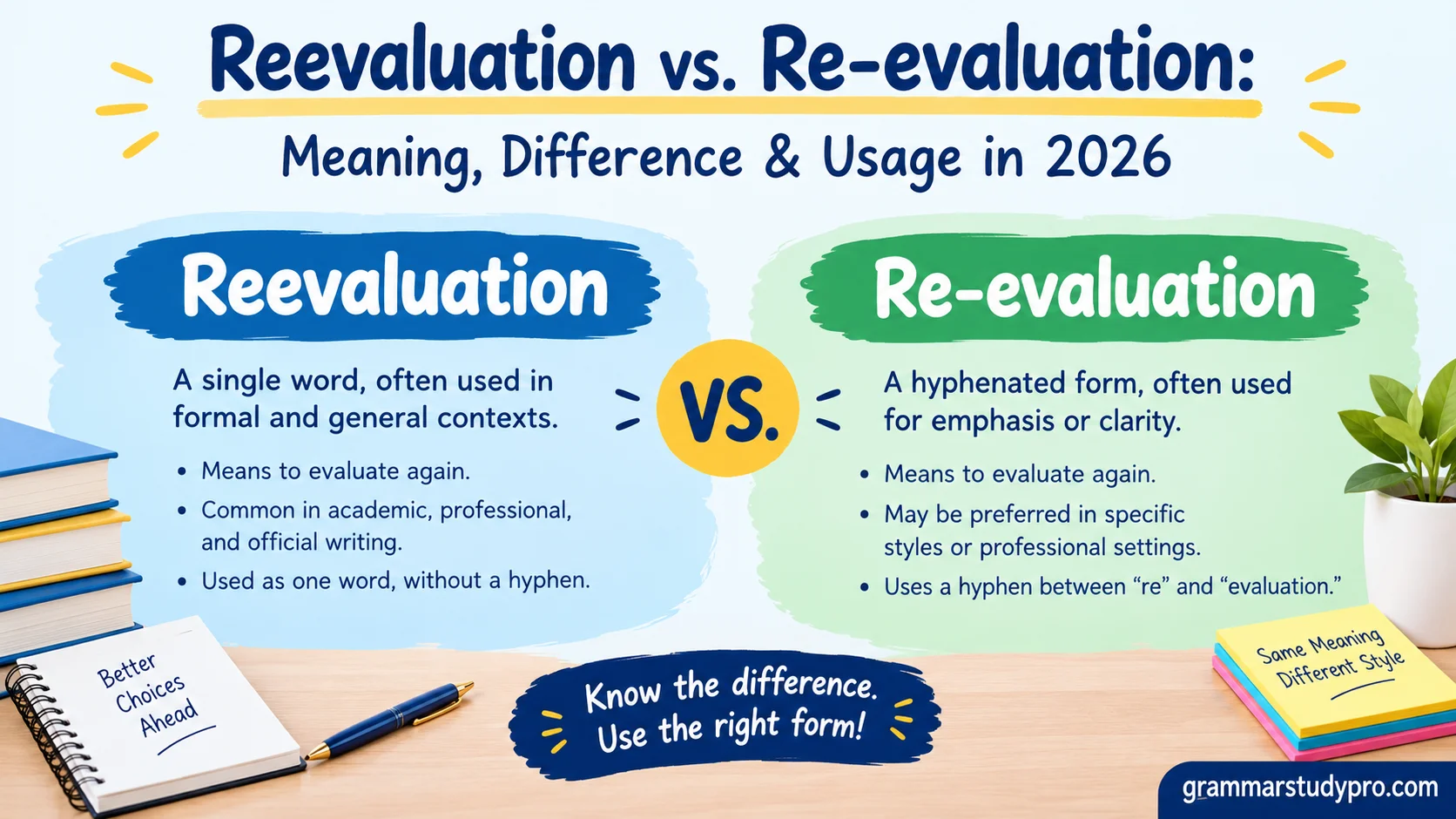
Reevaluation vs. Re-evaluation can confuse Many English learners and writers, but the choice becomes simple when you understand the writing conventions behind each form. Reevaluation is the standard closed form in modern English, while re-evaluation is also an accepted spelling when a style guide or regional preference uses a hyphen. In American English, the unhyphenated form is generally preferred, while British English often uses the hyphenated version. Although re evaluation may appear online, the three forms are not equally correct in every formal setting.
The right choice can depend on your writing style, dictionary, readers, and writing conventions, so checking the preferred form before preparing a document can help you write clearly and maintain consistent formatting. In professional writing, I find that choosing one spelling early makes the rest of the document much easier to manage. The difference becomes clearer through examples: an American company report may discuss a full reevaluation of a project timeline, while a British publication may use re-evaluation for the same process. Both terms describe evaluating something again, so their basic meaning remains similar. In academic writing and professional contexts, the main rule is to pick one form and keep it throughout the same piece.
This applies to emails, essays, professional documents, and digital content, where unnecessary switching between spellings can make the writing look inconsistent. Merriam-Webster, the AP Stylebook, and the Chicago Manual of Style are useful references for checking the American standard, especially when style preferences are unclear. The choice can also vary across industries, where specific grammar rules and editorial standards may apply. Reevaluation is often the preferred spelling under the modern closed-word pattern, while re-evaluation can still be technically fine when supported by the chosen style. The main mistake is treating both forms as completely interchangeable without considering the intended audience or house style. Simple memory tricks, comparison tables, common mistakes, and clear examples can help readers understand the regional conventions and accepted forms while making a consistent choice.
Quick Answer
Reevaluation and re-evaluation have the same basic meaning: the act or process of evaluating something again.
Both spellings are recognized in major dictionaries.
- Reevaluation = accepted closed spelling
- Re-evaluation = accepted hyphenated spelling
- Reevaluate = accepted verb form
- Re-evaluate = accepted hyphenated verb form
- Re evaluation = generally not the standard spelling of the word
Cambridge defines re-evaluation as the process or act of judging or calculating the quality, importance, amount, or value of something again. It also explicitly lists reevaluation as another form.
Oxford’s American English dictionary takes the reverse approach. It lists reevaluate as the main verb form and identifies re-evaluate as an alternative. Its entry also gives reevaluation as the related noun and notes re-evaluation as an alternative.
So if you’re wondering whether the hyphen changes the meaning, the answer is no.
Reevaluation and re-evaluation mean essentially the same thing. The main difference is the spelling convention used by a dictionary, publication, institution, or writer.
If you’re writing for a specific organization, follow its style guide. If no house style applies, choose one accepted spelling and use it consistently.
Comparison Overview
The easiest way to understand reevaluation vs. re-evaluation is to put the two forms side by side.
| Feature | Reevaluation | Re-evaluation |
| Part of speech | Noun | Noun |
| Basic meaning | Evaluation again | Evaluation again |
| Meaning difference | None of practical significance | None of practical significance |
| Spelling | Closed | Hyphenated |
| Dictionary status | Accepted | Accepted |
| Related verb | Reevaluate | Re-evaluate |
| Pronunciation | Essentially the same | Essentially the same |
| Best use | Follow your chosen style | Follow your chosen style |
| Main issue | Closed spelling | Hyphenation |
Cambridge’s current dictionary entry supports both noun forms. Oxford’s American English entry similarly recognizes reevaluation and re-evaluation.
This matters because online grammar discussions sometimes turn a style preference into a supposed grammar rule. That’s misleading.
English spelling doesn’t always operate like a mathematical formula. Some prefixes produce closed words. Others retain hyphens. Still others vary depending on the dictionary or editorial system.
Reevaluation vs. re-evaluation is one of those legitimate spelling variations.
Main Differences Between Reevaluation vs. Re-evaluation
Although the two spellings share the same meaning, a few practical differences are worth understanding.
The spelling is different
The most obvious difference is the hyphen.
Reevaluation combines the prefix re- with evaluation:
reevaluation
Re-evaluation keeps the prefix visually separate:
re-evaluation
That’s the entire visible distinction.
There isn’t a hidden difference in definition attached to that hyphen.
The meaning is essentially the same
Both words refer to evaluating something again.
For example:
The committee requested a reevaluation of the proposal.
You can write the same sentence as:
The committee requested a re-evaluation of the proposal.
The meaning doesn’t change.
In both cases, the committee is assessing the proposal again.
Cambridge uses the same core definition for re-evaluation and notes reevaluation as an alternative spelling.
The word can refer to more than a simple second look
“Evaluate again” doesn’t necessarily mean “change your mind.”
That’s an important distinction.
Suppose a company evaluates a product in January. New sales data arrive in June. The company reviews the product again.
That’s a reevaluation even if the company reaches exactly the same conclusion.
On the other hand, the new information might change the company’s assessment. That can also be called a reevaluation.
In other words, reevaluation describes the process, not necessarily the result.
Pronunciation generally stays the same
The hyphen doesn’t normally create a different pronunciation.
Cambridge gives the same pronunciation for its re-evaluate entry while recognizing reevaluate as an alternative.
The word is pronounced as a sequence beginning with the ree- sound rather than as though “ree” were a separate word.
For everyday writing, pronunciation isn’t the issue. Spelling consistency is.
What Does Reevaluation Mean?
Reevaluation means assessing something again.
The original evaluation might have happened days ago or decades ago. What matters is that someone is making another assessment.
The thing being reevaluated can be almost anything that can receive an assessment.
For example:
- A business strategy
- A scientific theory
- A student’s performance
- A financial plan
- A product’s effectiveness
- A research conclusion
- A person’s priorities
- A policy
- A contract
- A project
- A risk assessment
Oxford defines reevaluate as thinking about something again, especially to form a new opinion.
That definition captures an important part of the word’s everyday use.
You don’t necessarily reevaluate something because the first judgment was bad. You might simply have new information.
Breaking down the word
The structure becomes easier to understand when you separate its parts:
re- + evaluation = reevaluation
The prefix re- commonly carries the idea of doing something again.
The noun evaluation refers to the act of assessing something’s quality, value, importance, effectiveness, or other relevant characteristics.
Put them together and the meaning becomes straightforward:
reevaluation = evaluation again
The spelling may look awkward because re- meets a word beginning with e. That’s one reason the hyphenated version can feel visually clearer to some writers.
What Does Re-evaluation Mean?
Re-evaluation has the same core meaning as reevaluation.
Cambridge defines it as the process or act of judging or calculating the quality, importance, amount, or value of something for a second, third, or subsequent time.
Oxford likewise defines re-evaluation as thinking about something again, particularly to form a new opinion.
The hyphen doesn’t add a new definition.
Instead, it makes the structure more visible:
re- + evaluation
That can make the word easier to parse at a glance.
Consider this example:
The unexpected results triggered a re-evaluation of the original theory.
The reader can immediately see re- attached to evaluation.
However, the closed version works just as well:
The unexpected results triggered a reevaluation of the original theory.
Nothing about the underlying idea changes.
Why Are Both Reevaluation and Re-evaluation Used?
English has a long history of shifting compound-word conventions.
Words can move through several stages over time. A combination may begin as two separate words. It can later become hyphenated. Eventually, frequent use can turn it into a closed compound.
That doesn’t happen on a perfectly predictable schedule.
Prefixes don’t follow one universal hyphen rule
It’s tempting to invent a rule such as:
“Always hyphenate re- before a vowel.”
But actual dictionary usage doesn’t support such a simple rule.
Cambridge, for example, recognizes both re-examine and reexamine.
Oxford also has established entries for re-examine and re-evaluate while American English entries recognize closed alternatives such as reevaluate.
That tells you something useful: prefix spelling depends on established usage rather than one mechanical rule.
Hyphens can improve readability
A hyphen can act like a small road sign.
It tells your eye where one element ends and another begins.
That’s particularly noticeable when the prefix ends in a vowel and the base word begins with a vowel.
Compare:
- reevaluation
- re-evaluation
The second version makes the word’s construction visually obvious.
Still, readability isn’t enough to make the hyphen mandatory. Established dictionaries recognize the closed form too.
American English vs. British English
Regional spelling conventions can add another layer to the discussion.
However, don’t treat this as a rigid “Americans do X while British speakers do Y” rule.
Real-world usage overlaps.
American English
Oxford’s American English dictionary lists reevaluate as the primary form and identifies re-evaluate as an alternative. It also lists reevaluation with re-evaluation as the related alternative noun form.
That makes reevaluation a well-established choice in American English.
For a US-focused article, report, website, or business document, the closed form is therefore entirely legitimate.
British English
Cambridge’s English dictionary lists re-evaluate as the headword and gives reevaluate as an alternative. Its noun entry similarly lists re-evaluation with reevaluation as the alternative.
Oxford’s general English dictionary also has a re-evaluation entry.
This makes the hyphenated spelling especially familiar in British English reference material.
Don’t turn regional tendencies into absolute rules
The important point is not that one country owns one spelling.
Instead, dictionary conventions and editorial styles overlap across varieties of English.
A British publication may use reevaluation. An American organization may prefer re-evaluation. Neither situation automatically makes the writer’s spelling wrong.
The safest professional approach is simple:
Follow the style guide that governs your document.
If no style guide applies, pick an accepted form and remain consistent.
Reevaluation in Different Contexts
The word becomes much easier to understand when you see how people actually use it.
Reevaluation in business
Businesses constantly make decisions with incomplete information.
A company might launch a product based on projected demand. Six months later, actual sales reveal a different picture.
Management may then conduct a reevaluation of the product strategy.
For example:
The decline in demand prompted a reevaluation of the company’s pricing strategy.
That doesn’t automatically mean the strategy failed. It means the company is examining the strategy again using updated information.
Reevaluation in academic research
Research rarely ends with one conclusion carved in stone.
New studies can introduce evidence that changes how researchers understand earlier findings.
A reevaluation might examine:
- Earlier assumptions
- Statistical methods
- New evidence
- Previous interpretations
- Research limitations
- Competing explanations
For example:
The new findings led researchers to a reevaluation of the earlier model.
Here, the second assessment is important because the evidence has changed.
Reevaluation in education
Teachers and institutions may reevaluate academic performance, grading methods, curricula, or educational programs.
For example:
The school conducted a reevaluation of its reading program after reviewing student outcomes.
The term doesn’t imply that the original program was necessarily poor. The new evaluation may simply reflect additional data.
Reevaluation in personal decisions
The word also appears in ordinary conversation and personal writing.
Imagine someone spends several years pursuing a career that once seemed perfect. Their priorities change. They begin reconsidering what they want.
You could write:
The experience prompted a reevaluation of her career goals.
That’s more precise than simply saying she “changed her mind.”
A reevaluation suggests a process of reconsideration.
Reevaluation in professional assessments
Organizations may reevaluate procedures, risks, performance, contracts, or priorities.
A decision made under one set of circumstances may look different after circumstances change.
That’s why reevaluation often appears alongside words such as:
- strategy
- priorities
- policy
- approach
- performance
- evidence
- assumptions
- objectives
- methods
- results
Reevaluation vs. Re-evaluation Examples
Seeing the two forms in parallel makes the relationship crystal clear.
Example: Business
Reevaluation:
The company began a reevaluation of its marketing budget.
Re-evaluation:
The company began a re-evaluation of its marketing budget.
Meaning: identical.
Example: Research
Reevaluation:
The discovery prompted a reevaluation of the original hypothesis.
Re-evaluation:
The discovery prompted a re-evaluation of the original hypothesis.
Meaning: identical.
Example: Personal priorities
Reevaluation:
The move caused him to reevaluate his long-term priorities.
Re-evaluation:
The move caused him to re-evaluate his long-term priorities.
Meaning: identical.
Example: Policy
Reevaluation:
The new evidence led to a reevaluation of the policy.
Re-evaluation:
The new evidence led to a re-evaluation of the policy.
Again, the only visible change is the hyphen.
Reevaluation vs. Re-evaluation: Grammar and Word Forms
Understanding the related forms helps prevent inconsistent writing.
| Function | Closed form | Hyphenated form |
| Verb | reevaluate | re-evaluate |
| Present participle | reevaluating | re-evaluating |
| Past tense | reevaluated | re-evaluated |
| Noun | reevaluation | re-evaluation |
| Plural noun | reevaluations | re-evaluations |
Cambridge recognizes re-evaluate and reevaluate as alternatives and uses both forms in its examples.
Oxford’s American English entry gives reevaluate as the main verb and lists re-evaluate as an alternative.
Keep related forms consistent
If your document uses the closed style, you might write:
The committee will reevaluate the proposal after reviewing the reevaluation.
If you’re following a hyphenated style, you might write:
The committee will re-evaluate the proposal after reviewing the re-evaluation.
Neither system creates a different meaning.
The important thing is that your spelling doesn’t look accidental.
Reevaluation vs. Revaluation: An Important Difference
Here’s where a seemingly tiny spelling difference can actually change the meaning.
Reevaluation and revaluation are related words, but they aren’t interchangeable in every context.
What does revaluation mean?
Revaluation generally concerns calculating or changing the value of something again.
Cambridge specifically uses the word in finance, accounting, and economics. Its definitions include recalculating an asset’s value and increasing the value of a country’s currency relative to other currencies.
Oxford similarly defines revaluation as estimating something’s value again, especially when giving it a higher value. It also identifies currency revaluation as a distinct economic use.
Compare the two:
| Word | Main idea | Example |
| Reevaluation | Assessing something again | Reevaluation of a business strategy |
| Revaluation | Reassessing or increasing value | Revaluation of property |
| Re-evaluation | Same meaning as reevaluation | Re-evaluation of a proposal |
This distinction matters.
If a manager examines whether a company’s hiring strategy still works, that’s a reevaluation.
If an accountant reassesses the recorded value of an asset, that may be a revaluation.
The words overlap around the idea of assessing value. Their usual contexts differ.
Reevaluation vs. Reassessment
Reassessment is another close synonym.
Cambridge defines reassessment as a second or further assessment, particularly when someone needs to decide whether to change an earlier judgment or decision.
In many contexts, you can use reevaluation and reassessment interchangeably.
However, the emphasis can shift slightly.
- Reevaluation often focuses on examining value, quality, importance, effectiveness, or significance again.
- Reassessment often emphasizes making another judgment about a previous assessment or decision.
For example:
The company conducted a reevaluation of its marketing strategy.
This highlights another evaluation of the strategy.
The incident prompted a reassessment of the company’s risks.
This emphasizes reconsidering the earlier risk judgment.
Neither distinction is absolute. Context does much of the work.
Reevaluation vs. Re-examination
Re-examination is another related term, but it tends to emphasize looking at something again in detail.
Cambridge defines re-examination as looking at or considering something carefully and in detail again. It also recognizes reexamination as an alternative spelling.
Oxford similarly defines re-examination as examining or thinking about something again, especially when a change of opinion may be necessary.
A useful distinction is:
- Reevaluation → assess again
- Reassessment → judge again
- Re-examination → examine again in detail
- Reappraisal → reconsider the value or nature of something
- Revaluation → reassess value, particularly in financial contexts
These meanings overlap. They aren’t always perfect substitutes.
Case Study: Why Context Matters
Consider a fictional company called Northstar Analytics.
The company launches a subscription service after evaluating customer demand. Six months later, customer behavior changes.
Management now has three separate tasks.
First, it conducts a reevaluation of the product strategy.
The team asks whether the original strategy still makes sense.
Second, it conducts a reassessment of customer demand.
The team compares its original assumptions with current sales data.
Third, the finance department performs a revaluation of certain assets.
That process concerns financial values rather than the broader business strategy.
The three words may appear in the same report, but they don’t perform exactly the same job.
That’s the kind of distinction that makes vocabulary precise.
Common Mistakes With Reevaluation and Re-evaluation
Small spelling choices can make polished writing look less polished. These are the mistakes worth avoiding.
Mistake: Writing “re evaluation”
The standard forms are reevaluation and re-evaluation.
The open form re evaluation isn’t the normal dictionary spelling for this noun.
So write:
The project needs reevaluation.
or:
The project needs re-evaluation.
Not:
The project needs re evaluation.
Mistake: Assuming the hyphen changes the meaning
It doesn’t.
The hyphen separates the prefix visually. It doesn’t turn the word into a different concept.
Mistake: Claiming that one form is universally correct
That claim doesn’t match current dictionary evidence.
Cambridge explicitly recognizes both forms. Oxford’s American English dictionary does too.
Mistake: Mixing spelling styles without a reason
A document that uses reevaluate in one paragraph and re-evaluate in another can look inconsistent.
Consistency matters more than choosing one supposedly magical spelling.
Mistake: Confusing reevaluation with revaluation
This can cause a genuine meaning problem.
If you’re discussing a business strategy, reevaluation is likely the relevant word.
If you’re discussing the accounting value of an asset or a currency, revaluation may be the appropriate term.
Mistake: Creating a blanket rule for “re-”
Don’t assume every word beginning with re- follows the same hyphen pattern.
Dictionary usage demonstrates variation. Cambridge recognizes both re-examine and reexamine, for example.
English spelling has exceptions because English spelling has history.
Which Form Should You Use?
The practical answer depends on your writing environment.
Choose “reevaluation” when your style favors closed compounds
This form works naturally in American English and is explicitly recognized by Oxford’s American English dictionary.
For example:
The board approved a reevaluation of the company’s long-term strategy.
Choose “re-evaluation” when your style favors the hyphen
This is also fully established.
Cambridge uses re-evaluation as its main dictionary entry and lists reevaluation as an alternative.
For example:
The board approved a re-evaluation of the company’s long-term strategy.
What if you have no style guide?
Don’t overthink it.
Pick one accepted form.
Then use it consistently throughout the document.
That’s a much better approach than switching spellings every few paragraphs.
Reevaluation in Formal and Professional Writing
The word works comfortably in formal writing because it describes a common analytical process.
You’ll encounter it in areas such as:
- Business reports
- Academic research
- Financial analysis
- Education
- Policy documents
- Technical writing
- Organizational planning
- Scientific discussion
- Professional correspondence
Academic writing
The findings warrant a reevaluation of the original hypothesis.
The sentence sounds formal without becoming unnecessarily complicated.
Business writing
Recent sales data have triggered a reevaluation of the company’s pricing model.
This clearly identifies both the reason and the object of the reevaluation.
Professional communication
We will complete a reevaluation of the current process before implementing further changes.
The word works particularly well when an organization wants to signal careful review rather than an immediate reversal.
A Practical Style Checklist
Before publishing a document containing reevaluation or re-evaluation, check these points:
- Choose one accepted spelling.
- Check your organization’s style guide.
- Follow the dictionary convention relevant to your audience.
- Use the same approach for related forms.
- Avoid the open form “re evaluation.”
- Don’t confuse reevaluation with revaluation.
- Don’t assume the original decision was wrong simply because it was reevaluated.
- Check nearby terms such as reassessment and re-examination for precise meaning.
This takes less than a minute. It can also prevent an otherwise avoidable style inconsistency.
Quick Reference: Reevaluation vs. Re-evaluation
| Question | Answer |
| Are reevaluation and re-evaluation both accepted? | Yes. |
| Do they have different meanings? | No, not in ordinary usage. |
| What does reevaluation mean? | Evaluating or considering something again. |
| What does re-evaluation mean? | The same basic thing. |
| Is the hyphen required? | No. |
| Is “re evaluation” the standard form? | Generally no. |
| What is the verb? | Reevaluate / re-evaluate |
| What is the past tense? | Reevaluated / re-evaluated |
| What is the plural noun? | Reevaluations / re-evaluations |
| Does the hyphen normally change pronunciation? | No. |
| Should you mix both forms freely? | Prefer consistency within the same document. |
| Is reevaluation the same as revaluation? | No. They can have different meanings and contexts. |
FAQs
Is “reevaluation” or “re-evaluation” correct?
Both reevaluation and re-evaluation are correct. Reevaluation is more common in American English, while re-evaluation is commonly used in British English.
Is “re evaluation” correct?
Re evaluation is generally not the preferred spelling. In standard writing, use reevaluation or re-evaluation, depending on your chosen style.
Which spelling should I use in American English?
In American English, reevaluation is the standard closed form. It is widely used in professional, academic, and general writing.
Which spelling is preferred in British English?
Re-evaluation is commonly used in British English. However, the most important point is to follow the style guide used by your publication, school, workplace, or organization.
Can I use both spellings in the same document?
It is better to choose one spelling and use it consistently. Switching between reevaluation and re-evaluation in the same document can make your writing appear inconsistent.
Conclusion
Reevaluation and re-evaluation have the same basic meaning: evaluating something again. The main difference is their spelling and regional or style preference. Reevaluation is the standard form in American English, while re-evaluation remains common in British English. Whichever form you choose, follow your preferred style guide and use the same spelling consistently throughout your writing.