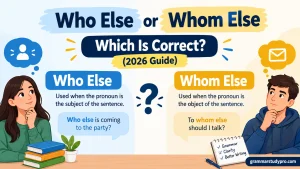
The Who to Contact or Whom to Contact difference becomes clearer when you understand parts of speech, subject–verb agreement, syntax, and sentence structure. Traditional grammar rules create a useful distinction, while modern English often favors simpler language in casual communication. For example, Who performs the action in “Who contacted you?” while whom receives it in “Whom did you contact?” This rule works well in a business email, report, or website content, where professional writing should stay clear and polished. Prepositions can require whom, as in “To whom should I send this?” Practical examples also show how modifiers, words, context, clause, structure, and usage help you choose the right form. Keeping sentences short and active improves clarity.
When I face the question of who to contact or whom to contact, I use a quick checklist instead of overthinking the grammar. First, identify role and decide whether the pronoun performs the action or receives it. Then apply he/him test, check prepositions, and match tone. This method helps English learners, students, professionals, and native speakers avoid common mistakes while improving their writing skills. It also makes the exact difference between the expressions easier to remember.
Whether you are writing an email, answering a question, or deciding whom to contact, these tricks can help you select the correct version every time. The origins of these forms may be interesting, but usage and context are often more useful. From my experience, I have seen how a single word can change the tone of formal communication, making the right form important for effective language and avoiding grammar mistakes.
Quick Answer
“Who to contact” and “whom to contact” have essentially the same meaning: they identify the person you should contact.
The traditional grammar rule favors “whom to contact” because the person being contacted functions as the object of the verb contact.
For example:
“I don’t know whom to contact.”
The underlying idea is:
“I should contact him.”
Because him is an object pronoun, traditional grammar uses whom.
However, “I don’t know who to contact” is extremely natural in contemporary American English. In ordinary conversation, emails, workplace communication, and general online writing, who often sounds more comfortable and less formal.
Here’s the practical distinction:
| Phrase | Traditional grammar | Modern American usage | Tone |
| Who to contact | Not the traditional object form | Very common | Natural and conversational |
| Whom to contact | Traditional object form | Still standard | Formal or careful |
| Who should I contact? | Common modern usage | Very common | Natural |
| Whom should I contact? | Traditional form | Still correct | Formal |
If you’re writing an ordinary professional email, “who to contact” will usually sound perfectly natural.
If you’re deliberately following traditional formal grammar, “whom to contact” fits the traditional rule.
Comparison Overview
The easiest way to understand who to contact vs. whom to contact is to separate meaning from grammatical form.
The meaning barely changes. The grammatical analysis does.
| Point of comparison | Who to contact | Whom to contact |
| Meaning | Which person you should contact | Which person you should contact |
| Traditional grammatical case | Subjective | Objective |
| Role of the person | Person identified as the contact | Person identified as the contact |
| Common in everyday American English | Yes | Less common |
| Formality | Neutral | More formal |
| Suitable for conversation | Yes | Can sound formal |
| Suitable for business email | Yes | Yes |
| Traditional grammar | Less preferred | Preferred |
| Meaning difference | Essentially none | Essentially none |
Purdue OWL explains the traditional distinction clearly: who belongs to the subjective case while whom belongs to the objective case.
The interesting part comes next.
English speakers don’t always preserve that distinction in everyday communication. In fact, whom has become noticeably less common in American English. Purdue OWL gives both formal constructions using whom and conversational alternatives using who.
That means grammar books and everyday speech can sometimes seem to disagree.
They aren’t necessarily contradicting each other. They’re describing different layers of English usage.
Main Differences Between Who to Contact or Whom to Contact
The main difference between who to contact and whom to contact isn’t meaning. It’s grammatical form, register, and modern usage.
Who to Contact
Who to contact asks which person you should reach out to.
For example:
“I don’t know who to contact about my application.”
The reader immediately understands the question. You’re looking for the appropriate person who can handle the matter.
This construction appears naturally in:
- Workplace emails
- Customer service messages
- School communication
- Everyday conversation
- Online forms
- Help-center pages
- Professional correspondence
- Informal writing
It doesn’t usually attract attention to itself.
That’s an important quality in practical writing. Good language should communicate the idea rather than make the reader stop and admire the grammar.
Whom to Contact
Whom to contact communicates the same basic idea but follows the traditional objective-case rule.
For example:
“Please let me know whom to contact regarding the application.”
Here, whom represents the person who receives the action of contact.
The construction can sound more formal because whom itself has become relatively uncommon in ordinary American conversation. Purdue OWL explicitly describes whom as more formal than who.
You may encounter it in:
- Formal correspondence
- Institutional documents
- Legal writing
- Traditional editorial prose
- Formal notices
- Academic writing
- Highly polished professional communication
Using whom isn’t automatically better. It simply gives the sentence a more traditional grammatical flavor.
What Does “Who to Contact” Mean?
Who to contact means which person you should contact.
The phrase usually appears inside a larger sentence:
“I don’t know who to contact.”
“Can you tell me who to contact?”
“She knows who to contact.”
“The website explains who to contact for technical support.”
The phrase doesn’t identify the person’s name. Instead, it asks or explains which person has the appropriate role or responsibility.
For example, imagine that your paycheck contains an error.
You might ask:
“Who should I contact about payroll?”
You’re not asking for a definition of payroll. You’re asking for the appropriate person or department.
The hidden structure of “who to contact”
Here’s where the grammar becomes interesting.
Consider:
“I don’t know who to contact.”
You can expand the meaning:
“I don’t know who I should contact.”
Now the grammatical relationship becomes easier to see.
The person is the one you should contact:
“I should contact him.”
Traditional grammar therefore identifies that person as an object and uses whom:
“I don’t know whom to contact.”
But everyday American English frequently uses who in this construction.
That explains why both versions appear in real-world writing.
What Does “Whom to Contact” Mean?
Whom to contact also means which person you should contact.
The difference comes from traditional pronoun case.
Compare these two sentences:
“Who called the office?”
and:
“Whom did you call?”
In the first sentence, who performs the action.
In the second, whom receives the action.
Purdue OWL identifies this distinction as the difference between subjective and objective pronoun case.
The same logic applies to:
“I don’t know whom to contact.”
You can mentally expand the sentence:
“I should contact him.”
Because him is the object form of he, traditional grammar uses whom.
Who vs. Whom: The Grammar Rule Explained Simply
The traditional rule is easier than it first appears.
Who is traditionally the subject
Use who when the person performs the action.
Examples:
- Who called you?
- Who sent the message?
- Who opened the door?
- Who manages the department?
- Who approved the request?
Try replacing who with he or she.
“She called you.”
That works.
So:
Who called you?
is the traditional form.
Whom is traditionally the object
Use whom when the person receives the action or follows a preposition.
Examples:
- Whom did you call?
- Whom did she invite?
- To whom did you speak?
- With whom did you travel?
- For whom is this package?
Try replacing whom with him or her.
“I called him.”
That works.
So:
Whom did you call?
follows the traditional rule.
Purdue OWL’s pronoun-case guide summarizes the relationship as who = subject and whom = object.
The He/Him Test for Who and Whom
When you’re stuck, use one of the oldest and most useful grammar tricks: the he/him test.
Ask yourself whether he/she/they or him/her/them fits the underlying sentence.
If “he” fits, use who
Who called?
Think:
He called.
Therefore:
Who called?
If “him” fits, traditional grammar favors whom
Whom did you call?
Think:
I called him.
Therefore:
Whom did you call?
Apply the test to “who to contact”
Start with:
“I don’t know ___ to contact.”
Expand it:
“I should contact ___.”
Now substitute:
“I should contact him.”
Because him is the object form, traditional grammar gives you:
“I don’t know whom to contact.”
That’s the cleanest explanation of why “whom to contact” exists.
However, the test explains the traditional grammatical structure. It doesn’t mean modern speakers must always use whom.
That’s where actual usage matters.
Is “Who to Contact” Grammatically Correct?
Yes, “who to contact” is standard and widely used in modern English, especially in conversational and general American English.
Traditional grammar makes a distinction between who and whom. Modern usage often weakens or avoids that distinction.
Purdue OWL notes that whom is not used very often in American English and gives conversational constructions in which who replaces the more formal whom.
The Chicago Manual of Style makes a similar broader point about usage: grammatical choices can depend on context and formality, and whom can sound noticeably formal even when it follows the traditional rule.
So these sentences can both appear naturally:
“I don’t know who to contact.”
“I don’t know whom to contact.”
The first sounds more conversational.
The second sounds more formal and traditional.
The meaning remains essentially the same.
Why “who” has become so common
English tends to favor forms that speakers find easy and natural.
The distinction between who and whom requires speakers to track grammatical case. In casual conversation, people often don’t maintain that distinction.
Instead, who acts as the default form.
You can see the same broader pattern elsewhere in English. Formal constructions often preserve older distinctions while everyday speech smooths them out.
Language isn’t a museum piece. It changes while people use it.
Is “Whom to Contact” Correct?
Yes.
“Whom to contact” is grammatically correct under the traditional objective-case rule.
For example:
“Please let me know whom to contact.”
The verb contact takes a direct object. The person receiving that action therefore takes the traditional objective form whom.
Purdue OWL’s pronoun-case guidance explicitly identifies whom as the objective form.
The important point is that correctness and naturalness aren’t always identical.
A sentence can follow a traditional rule yet sound more formal than most people expect in casual conversation.
That’s exactly what happens with many uses of whom.
“Who Should I Contact?” vs. “Whom Should I Contact?”
This pair creates another common grammar question.
Consider:
“Who should I contact?”
and:
“Whom should I contact?”
Traditional grammar favors whom because the person is the object of contact.
The underlying structure is:
“I should contact him.”
Yet “Who should I contact?” is extremely common in contemporary American English.
For everyday communication, it often sounds more natural.
Compare the two
| Sentence | Traditional analysis | Typical impression |
| Who should I contact? | Uses who where whom would traditionally appear | Natural and conversational |
| Whom should I contact? | Follows object-case rule | Formal or careful |
Neither sentence creates a different practical question.
Both ask for the appropriate person to contact.
“To Whom Should I Contact?” Is Usually the Wrong Construction
This is one of the most useful distinctions to remember.
Many writers know that whom can follow to, so they produce:
“To whom should I contact?”
That sentence sounds formal, but the problem isn’t formality. It’s verb structure.
The verb contact normally takes a direct object:
I contacted her.
Not:
I contacted to her.
Therefore, the standard construction is:
Whom should I contact?
Or, in ordinary modern usage:
Who should I contact?
However, to whom works perfectly with verbs that naturally take to:
“To whom should I send the report?”
Here, send can take an indirect recipient:
“I should send the report to him.”
Therefore:
To whom should I send the report?
is grammatically sound.
Compare these constructions
| Incorrect or awkward | Better construction | Why |
| To whom should I contact? | Whom should I contact? | Contact takes a direct object |
| To whom should I send it? | To whom should I send it? | Send can take a recipient with to |
| To whom should I speak? | To whom should I speak? | Speak to someone is standard |
| To whom should I write? | To whom should I write? | Write to someone is standard |
Purdue OWL illustrates the formal construction “To whom am I talking?” alongside the conversational “Who am I talking to?”
That’s a useful clue: don’t add “to” simply because “whom” sounds formal.
Who to Contact in Everyday Examples
The phrase appears in countless ordinary situations.
Workplace communication
“I’m not sure who to contact about my benefits.”
This sounds natural in an office email.
Customer service
“Could you tell me who to contact about a damaged order?”
The writer wants the appropriate representative or department.
School communication
“Do you know who to contact about course registration?”
Again, who sounds completely natural.
Job applications
“I’d like to know who to contact regarding the position.”
This is professional without sounding stiff.
Technical support
“Please tell me who to contact if the problem continues.”
The construction works naturally in instructions.
Whom to Contact in Formal Examples
Now compare some more traditional constructions.
“Please indicate whom to contact in an emergency.”
“The policy specifies whom to contact for additional information.”
“The notice explains whom to contact regarding appeals.”
These sentences aren’t wrong or unnatural. They’re simply more formal.
A legal document, policy manual, or institutional notice may preserve whom because the writer wants a traditional formal register.
That doesn’t mean every email needs the same treatment.
Who to Ask, Who to Call, and Similar Expressions
The same issue appears with many verbs.
You might wonder about:
- who to ask
- whom to ask
- who to call
- whom to call
- who to invite
- whom to invite
- who to consult
- whom to consult
- who to notify
- whom to notify
Traditional grammar applies the same object-case logic.
For example:
“I don’t know whom to ask.”
The underlying sentence is:
“I should ask him.”
Yet modern speakers commonly say:
“I don’t know who to ask.”
The pattern repeats with call:
“I don’t know whom to call.”
versus:
“I don’t know who to call.”
The first follows traditional case.
The second reflects widespread modern usage.
Once you understand the structure, you don’t need to memorize every individual expression.
Who and Whom After Prepositions
Prepositions create one of the clearest places where whom still appears.
Examples include:
- to whom
- with whom
- for whom
- from whom
- about whom
Consider:
“With whom did you travel?”
The underlying sentence is:
“I traveled with him.”
Because him follows the preposition with, traditional grammar uses whom.
But everyday English often moves the preposition:
“Who did you travel with?”
Purdue OWL gives similar formal and conversational contrasts involving whom and prepositions.
Formal vs. conversational patterns
| Formal | Conversational |
| To whom should I speak? | Who should I speak to? |
| With whom did you meet? | Who did you meet with? |
| For whom is this letter? | Who is this letter for? |
| From whom did you receive it? | Who did you receive it from? |
The formal versions aren’t automatically superior.
They simply use a more traditional structure.
A Practical Decision Guide for Who or Whom
When you’re writing quickly, use this sequence.
Ask who is performing the action
If the pronoun performs the action, traditional grammar points to who.
Who called?
Who approved the request?
Who manages the account?
Ask who receives the action
If the pronoun receives the action, traditional grammar points to whom.
Whom did you call?
Whom did she invite?
Whom should we notify?
Try the he/him test
Replace the pronoun mentally.
If he/she/they works, use who under the traditional rule.
If him/her/them works, use whom.
Consider the writing context
Modern American English often uses who where traditional grammar would use whom.
So don’t treat the traditional rule as the only factor.
Ask:
- Is this casual?
- Is this a formal document?
- Does the sentence sound natural?
- Does a particular style guide govern the writing?
- Would rewriting the sentence make it clearer?
That final question can save you a surprising amount of grammatical wrestling.
Who to Contact vs. Whom to Contact in Professional Writing
Professional writing doesn’t require you to make every sentence sound ceremonial.
In many workplace situations, clarity matters more than displaying traditional grammatical distinctions.
Compare:
“Could you tell me whom to contact about the invoice?”
with:
“Could you tell me who to contact about the invoice?”
Both are understandable.
The second generally sounds more relaxed and direct.
The first sounds more formal.
When “who to contact” works well
Use it naturally in:
- Internal emails
- Slack messages
- Customer support
- Team communication
- General business writing
- Instructions aimed at a broad audience
When “whom to contact” may fit
Consider it when writing:
- Formal institutional documents
- Legal or regulatory material
- Highly formal correspondence
- Traditional editorial prose
- Documents governed by a style preference
The Chicago Manual of Style notes that whom can be grammatically correct while still sounding conspicuously formal.
That distinction matters.
You don’t want a sentence to sound like it arrived wearing a three-piece suit when a clean shirt would have done the job.
When You Can Rewrite the Sentence
Sometimes the easiest solution is to avoid the who/whom problem entirely.
Instead of:
“I don’t know whom to contact.”
you could write:
“I’m not sure which person to contact.”
Or:
“Could you direct me to the appropriate contact?”
Or:
“Could you tell me which department handles this issue?”
These alternatives can improve clarity when the sentence feels awkward.
However, don’t rewrite every sentence simply to avoid whom. There’s nothing inherently wrong with the word.
The goal is clear, natural communication.
Common Mistakes With Who and Whom
Using “whom” just because the sentence sounds formal
A formal sentence can still use who correctly.
For example:
“Who is responsible for the project?”
The pronoun is the subject of is responsible, so who is appropriate.
Don’t assume that a serious tone requires whom.
Using “whom” after every preposition
Prepositions can take whom, but only when the underlying construction actually requires that preposition.
For example:
“To whom should I send this?”
works.
But:
“To whom should I contact?”
doesn’t follow the normal structure of contact.
Assuming “who” is always informal
Modern English uses who in plenty of professional contexts.
Purdue OWL explicitly recognizes conversational and modern constructions in which who replaces whom.
Assuming “whom” is outdated
It isn’t.
Whom remains a standard English pronoun. It simply occurs less often in everyday American speech and writing.
Confusing “who” with “who’s”
Remember:
- who = pronoun
- who’s = who is or who has
- whose = possessive form
For example:
“Who is responsible?”
becomes:
“Who’s responsible?”
But:
“Whose phone is this?”
asks about possession.
Case Study: Choosing the Right Wording for an Email
Imagine an employee needs help with a payroll issue.
The employee writes:
“Dear HR, I would like to know whom I should contact regarding an error in my paycheck.”
There’s nothing grammatically wrong with this sentence.
But the employee could also write:
“Hi, could you tell me who I should contact about an error in my paycheck?”
The second version sounds more conversational.
Now imagine the same message appears in a formal policy:
“Employees should contact the appropriate representative or consult the department directory to determine whom to contact regarding payroll disputes.”
Here, whom fits the formal register more naturally.
The lesson isn’t that one version always wins.
Context changes what sounds appropriate.
Who to Contact or Whom to Contact: Examples at a Glance
| Situation | Natural choice | Example |
| Casual conversation | Who | “Who should I contact?” |
| Workplace email | Who | “Do you know who to contact?” |
| Customer support | Who | “Who should I contact about my order?” |
| Formal notice | Whom | “Please identify whom to contact.” |
| Legal-style writing | Whom | “The notice specifies whom to contact.” |
| Traditional grammar exercise | Whom | “Whom should I contact?” |
| Formal prepositional phrase | Whom | “To whom should I send this?” |
| Everyday prepositional phrase | Who | “Who should I send this to?” |
A Simple Who vs. Whom Cheat Sheet
Keep this quick guide handy:
- Who = traditional subject form
- Whom = traditional object form
- Who to contact = common modern expression
- Whom to contact = traditional and formal expression
- Who should I contact? = very common modern English
- Whom should I contact? = traditional formal English
- To whom should I speak? = formal
- Who should I speak to? = conversational
- To whom should I contact? = generally incorrect because contact takes a direct object
The fastest memory trick
Think:
Who = he/she
Whom = him/her
If you can replace the word with he or she, traditional grammar points toward who.
If you can replace it with him or her, traditional grammar points toward whom.
Frequently Asked Questions About Who to Contact or Whom to Contact
Is “who to contact” correct?
Yes. “Who to contact” is widely used in modern American English and sounds natural in everyday speech and writing.
Traditional grammar analyzes the person being contacted as an object, which is why “whom to contact” also follows the traditional rule.
Is “whom to contact” correct?
Yes. “Whom to contact” is grammatically correct under the traditional objective-case rule.
The phrase means the same thing as “who to contact.” The primary difference is grammatical form and register.
Which is more common: “who to contact” or “whom to contact”?
“Who to contact” is more natural in contemporary American English.
Purdue OWL notes that whom is not used very often in American English and describes it as more formal than who.
Exact frequency can vary by type of writing, audience, and publication style.
Should I use “who” or “whom” in an email?
For most ordinary emails, “who” will sound natural.
For example:
“Could you tell me who to contact about this issue?”
If you’re writing highly formal material or following a style that preserves the traditional distinction, “whom” may be appropriate.
Is “who should I contact?” grammatically correct?
Yes. It is standard and extremely common in contemporary English.
Traditional grammar would generally prefer:
“Whom should I contact?”
But modern American usage frequently uses who in this position.
Is “whom should I contact?” correct?
Yes.
The person functions as the object of contact, so whom follows the traditional objective-case rule.
Is “to whom should I contact?” correct?
Generally, no.
The problem is the construction to contact. The verb contact normally takes a direct object:
“I contacted him.”
Use:
“Whom should I contact?”
or:
“Who should I contact?”
If you use to whom, choose a verb that naturally takes to, such as speak or send:
“To whom should I speak?”
Does “whom” sound outdated?
Not necessarily.
It remains a standard pronoun, especially in formal constructions. However, its use has declined in everyday American English, which can make it sound formal or deliberate. Purdue OWL specifically notes its relatively low frequency in American English.
Can “who” replace “whom”?
In many modern constructions, yes.
Contemporary English frequently uses who in places where traditional grammar would prescribe whom.
That doesn’t erase the traditional distinction. It reflects the way actual English usage has developed.
What’s the easiest way to remember who vs. whom?
Use the he/him test.
- He/she/they → who
- Him/her/them → whom
Then consider the context because modern American English often favors who in everyday communication.
FAQs
1. What is the difference between who and whom?
Who is a subject pronoun used for the person performing an action. Whom is an object pronoun used for the person receiving the action or following a preposition.
2. How can I remember whether to use who or whom?
Use the he/him test. If he fits the sentence, use who. If him fits, use whom.
3. Is “Who to Contact” grammatically correct?
Yes. Who to Contact is common and natural, especially in modern English and everyday communication. It is often preferred because it sounds simpler and more conversational.
4. Is “Whom to Contact” also correct?
Yes. Whom to Contact follows the traditional grammar rule because whom functions as the object of contact. It is more formal in tone.
5. Should I use who or whom in professional writing?
Both can be correct. Consider the context, grammar, and desired tone. Who is often natural in modern professional communication, while whom may suit more formal writing.
Conclusion
Choosing between Who to Contact or Whom to Contact becomes easier when you understand the grammatical role of each pronoun. Use who for the subject and whom for the object or after a preposition. The he/him test is a simple way to check your choice. With regular practice, you can use both forms confidently in emails, reports, questions, and other forms of professional writing.