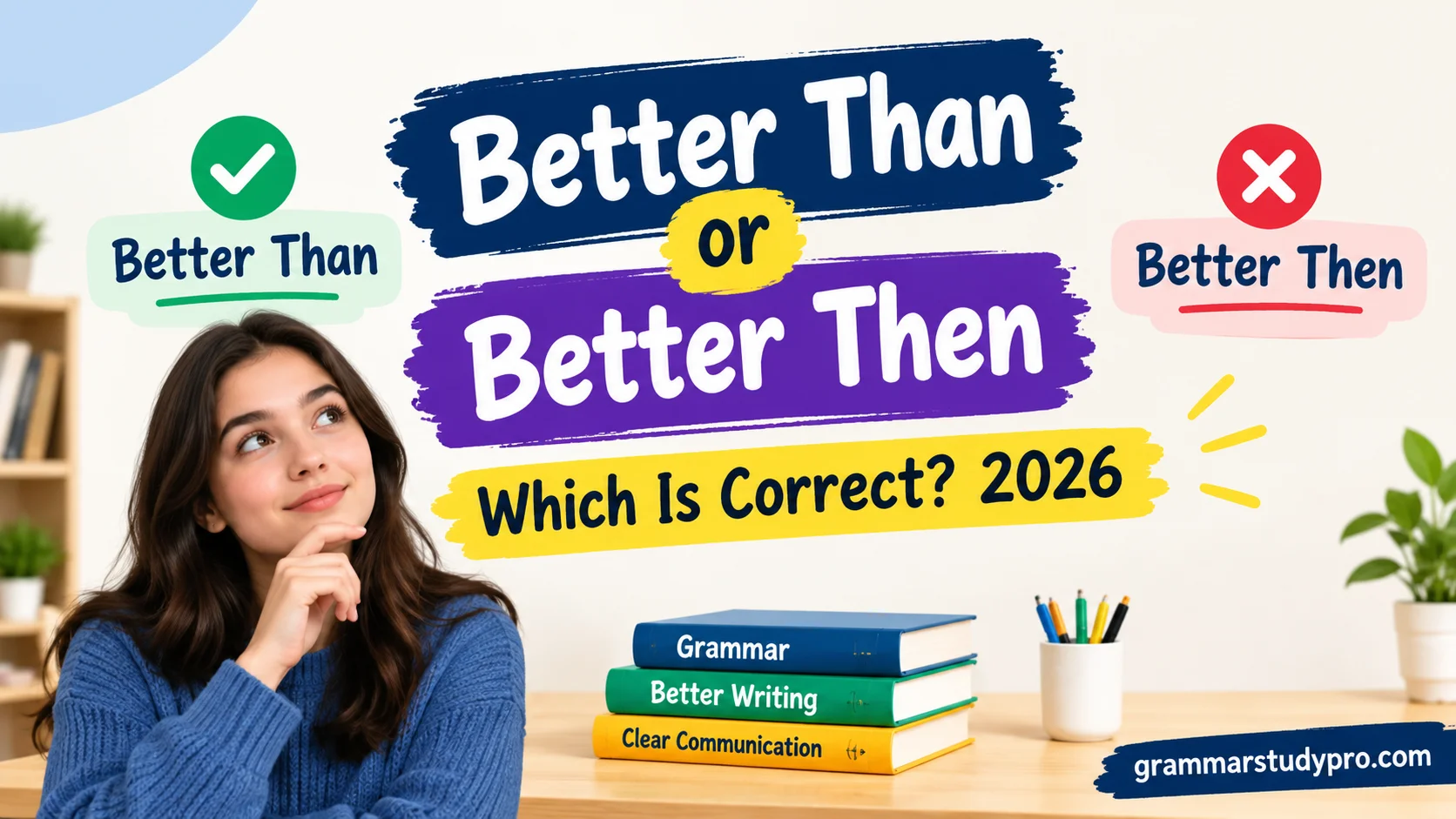
Better Than or Better Then can create grammar confusion because both expressions look almost identical and sound similar when spoken. However, a tiny difference changes their meaning. Use better than when making a comparison between two things. For example, “This laptop is better than my old one” shows that one item outshines another. In English grammar, than is the go-to choice for comparing things, and it creates a clear comparative expression with the correct sentence structure. These grammar rules apply to everyday messages, school assignments, professional emails, and blog posts. Remembering this correct expression helps you choose the right words and avoid a common mix-up.
The confusion often starts when writers confuse than with then. Although using better then for a direct comparison is an incorrect usage and a grammatical mistake, then can be correct when it refers to time, a particular time, or what happens next in a sequence. It can also act as a transition word to introduce the next step. The time reference and surrounding context determine its word function. Understanding this distinction helps you recognize correct usage, avoid a common error, and improve writing clarity. A helpful grammar guide can also strengthen your understanding of spelling, word choice, and language rules.
When checking a sentence, focus on its sentence meaning rather than appearance alone. Practical examples make the difference easier to understand: “This laptop is better than my old one” is a correct sentence because it expresses a comparison. By contrast, then connects ideas involving time or sequence. Whether you’re working on academic writing, professional communication, or everyday conversations, this simple approach can help you write clearly and avoid a common English mistake. Pay attention to meaning, context, and the way each phrase works in a sentence to make your writing more effective and your communication clearer.
Quick Answer:
Better than is the correct choice when you compare two people, things, actions, or situations. Better then can also be correct when then refers to a particular time or sequence.
Compare these examples:
- Correct: This phone is better than my previous one. (Than introduces a comparison.)
- Correct: I felt better then, after taking a short break. (Then refers to that time.)
- Correct: Make the introduction better, then revise the conclusion. (Then introduces the next action.)
- Incorrect for a comparison: This phone is better then my previous one.
Here’s the easiest rule to remember:
- Use than when comparing something with something else.
- Use then when referring to a time, the next event, or a result.
The right choice depends on what your sentence means, not simply on which word follows better.
Comparison Overview
The following table summarizes the main differences between better than and better then.
| Feature | Better Than | Better Then |
| Main purpose | Makes a comparison | Refers to time or sequence |
| Key word | Than | Then |
| Typical meaning | Superior to or preferable to something | At that time, next, or in that case |
| Common context | Comparing quality, ability, results, or preferences | Describing a past state or ordering actions |
| Example | This book is better than that one. | Things were better then. |
| Common mistake | Replacing than with then in comparisons | Assuming then can never follow better |
One important detail makes this comparison easier: neither word is automatically correct or incorrect on its own. The surrounding sentence determines the right choice.
For example, “Things were better then than they are now” uses both words correctly. Then identifies a past period, while than introduces the comparison between that period and the present.
That distinction is the key to mastering this expression.
Main Differences Between Better Than and Better Then
What Does Better Than Mean?
The phrase better than expresses a comparison. It tells readers that one person, object, action, or situation has greater quality, ability, value, or appeal than another.
The word better is the comparative form of good and well. The word than introduces the person or thing used as the standard of comparison.
Consider this sentence:
“This restaurant is better than the one we visited last week.”
The speaker compares two restaurants and considers the first one superior in some respect. Perhaps the food tastes fresher, the service is quicker, or the prices are more reasonable.
Here are more examples:
- This laptop is better than my old computer.
- Maria explains difficult grammar rules better than I do.
- The new website loads better than the previous version.
- Walking is sometimes better than driving in heavy traffic.
- Your second draft is better than the first.
Notice that better than doesn’t always describe something objectively superior. It can also express a personal preference or judgment.
For instance, one reader might find a mystery novel better than a romance novel, while another reader prefers the opposite. The phrase still makes a valid comparison even when opinions differ.
What Does Better Then Mean?
The phrase better then can be correct when better describes a condition and then refers to a particular time. It may also appear when better and then belong to separate parts of a sentence.
In this context, then often means at that time.
For example:
“I felt better then, after getting some rest.”
The sentence describes how the speaker felt at a particular moment. It doesn’t necessarily compare two things directly.
Consider these additional examples:
- Life seemed simpler then.
- The neighborhood was quieter then.
- I understood the lesson better then, when the teacher explained it again.
- The service was better then, before the restaurant changed owners.
In each example, then points to a time or period. Some sentences also contain an implied or explicit comparison, but the word then itself doesn’t introduce that comparison.
The distinction becomes especially important in longer sentences. Consider this example:
“Things were better then than they are now.”
Here, then means at that earlier time. The second word, than, introduces the comparison with the present.
Therefore, don’t assume that every appearance of better then is a mistake. Instead, check the role of each word in the complete sentence.
Than vs. Then: The Core Grammar Rule
The difference between than and then comes down to their grammatical functions.
Than commonly introduces a comparison. You often see it after comparative words such as better, faster, stronger, smaller, more, and less.
Examples:
- This route is shorter than the other one.
- He works faster than his colleagues.
- The second explanation is more helpful than the first.
Then, on the other hand, usually refers to time, sequence, or a result.
Examples:
- We ate dinner and then watched a movie.
- I was much happier then.
- If the first method fails, then try another approach.
A practical test can help you choose the correct word.
| Test | Word to Use | Example |
| Can you replace the word with compared with? | Than | This option is better than the other one. |
| Can you replace the word with at that time? | Then | I felt better then. |
| Does the word introduce the next action? | Then | Finish the report, then send it. |
| Does the word mean in that case? | Then | If you’re ready, then let’s begin. |
These tests work in many everyday situations. However, always consider the complete sentence because context can affect how a phrase functions.
When to Use Better Than in a Sentence
Use better than whenever you want to compare quality, performance, ability, or preference. The phrase works in casual conversations and formal writing alike.
Comparing Two People or Things
Comparisons are the most common reason writers use better than. You can compare almost anything, including products, people, places, ideas, and experiences.
Examples:
- This restaurant is better than the one we visited last month.
- My new phone is better than my old phone.
- Her presentation was better than mine.
- The library is better than the crowded coffee shop for studying.
- This explanation is better than the one in the textbook.
The comparison doesn’t need to involve two physical objects. You can compare abstract ideas, choices, or experiences as well.
For instance, “Honest feedback is better than empty praise” compares two approaches to communication. The sentence suggests that one approach offers greater value than the other.
Writing tip: When a sentence answers the question “Which option is superior or preferable?” you will usually need than.
Comparing Performance or Ability
You can also use better than to describe how well someone performs an activity. In these sentences, better often functions as an adverb rather than an adjective.
Examples:
- She sings better than her brother.
- The team played better than expected.
- He writes better than he did last year.
- Our new software performs better than the previous version.
- You explained the process better than I could.
Notice the difference between these two sentences:
- She is a better writer than her colleague.
- She writes better than her colleague.
In the first sentence, better describes the noun writer. In the second, it describes the verb writes. Both sentences use than correctly because both make comparisons.
This distinction can help you construct more precise sentences, especially in academic and professional writing.
Using Better Than Before, Better Than Expected, and Better Than Ever
Several common expressions use better than to compare a result with a previous condition, an expectation, or an established standard.
Better than before
This expression compares a current situation with an earlier one.
Example: “The website works better than before.”
The website has improved compared with its previous condition.
Better than expected
Use this expression when the result exceeds what someone anticipated.
Example: “The job interview went better than expected.”
The interview turned out more successfully than the speaker had predicted.
Better than ever
This phrase suggests that something has reached a level above its previous performance or condition.
Example: “Her confidence is better than ever.”
The speaker believes her confidence has improved beyond earlier levels.
Better than nothing
This expression describes something that has some value, even if it isn’t ideal.
Example: “A short revision session is better than nothing.”
The sentence suggests that a little preparation is preferable to doing no preparation at all.
These expressions appear frequently in conversations, articles, reviews, and workplace communication. Remembering them can help you recognize when than is the natural choice.
When Can Better Then Be Correct?
Although better than is the usual expression for comparisons, better then can appear in grammatically correct sentences. The important question is whether then refers to time, sequence, or a result.
Referring to a Past Time
The word then can mean at that time. Writers often use it to contrast an earlier period with the present.
Examples:
- I felt better then.
- Life seemed easier then.
- The town was quieter then than it is today.
- My computer worked better then, before its battery began failing.
- We had more free time then than we do now.
Consider this example:
“Things were better then than they are now.”
The sentence contains both words because they perform different jobs. Then identifies the earlier period, while than compares that period with the present.
This is a useful example to remember because it shows why you shouldn’t rely on the words’ appearance alone.
Describing a Sequence of Actions
Then can also indicate that one action follows another. In these situations, it may appear directly after better without creating a comparison.
Examples:
- Make the introduction better, then revise the conclusion.
- Choose a better title, then update the article.
- Improve the first draft, then check the grammar.
- Find a better image, then publish the page.
In the first example, better describes how the introduction should be improved. The word then introduces the next action.
Punctuation helps readers understand the structure. A comma often separates two actions when then introduces the second one.
Compare these sentences:
- Make the introduction better than the original.
- Make the introduction better, then revise the conclusion.
The first sentence compares two versions of an introduction. The second gives two instructions in sequence.
Expressing a Condition or Result
Sometimes then means in that case. It can introduce a result that follows from a condition.
Examples:
- If this version works better, then we’ll keep it.
- If the second option is better, then choose that one.
- If you feel better tomorrow, then you can return to work.
- If the new system performs better, then the company may adopt it.
In these sentences, better describes a condition or comparison, while then introduces a possible result.
The word then is optional in many conditional sentences. For example, “If this version works better, we’ll keep it” expresses the same basic idea.
However, including then can make the connection between the condition and its result more explicit.
Better Than vs. Better Then: Common Mistakes to Avoid
The easiest way to correct this error is to identify what the sentence actually means. Many mistakes happen because writers choose a word based on habit rather than grammar.
Here are common examples with corrections and explanations.
| Incorrect Sentence | Correct Sentence | Explanation |
| This phone is better then mine. | This phone is better than mine. | The sentence compares two phones. |
| She performed better then expected. | She performed better than expected. | Her performance is compared with an expectation. |
| This book is better then that one. | This book is better than that one. | The sentence compares two books. |
| I felt better than after resting. | I felt better then, after resting. | If the intended meaning is a specific time, then fits. |
| Improve the heading, than move on. | Improve the heading, then move on. | Then introduces the next action. |
| Things were better then than they are now. | Things were better then than they are now. | Both words are correct because they have different functions. |
The fourth example deserves some attention. The corrected version works when the writer means that the person felt better at a particular time after resting. If the writer intends to compare how they felt before and after resting, a clearer alternative is “I felt better after resting than I did before.”
That revision removes ambiguity and makes the comparison explicit.
Mistakes That Change the Meaning
Sometimes choosing the wrong word doesn’t just create a grammatical error. It can also make the sentence confusing.
Consider these two sentences:
- “I performed better than last year.”
- “I performed better then, last year.”
The first sentence clearly compares the speaker’s performance with last year’s performance. The second is awkward if the writer intends the same comparison because then doesn’t introduce the comparison.
A clearer time-reference sentence would be:
“I performed better back then, when I had more time to practice.”
The best correction doesn’t merely replace one letter. It makes the intended meaning clear.
Why Spell-Check Doesn’t Always Catch the Error
Both than and then are correctly spelled English words. As a result, a basic spell-checker may not flag the wrong choice.
For example, “This solution is better then the first one” contains two correctly spelled words but uses then incorrectly.
To catch this type of error, read the sentence for meaning rather than spelling alone.
Ask yourself:
- Am I comparing two things?
- Am I referring to a particular time?
- Am I describing what happens next?
- Am I introducing a possible result?
Your answer will usually reveal which word belongs in the sentence.
Easy Ways to Remember the Difference Between Than and Then
You don’t need to memorize complicated grammar rules to distinguish these words. A few simple tricks can help you make the right choice quickly.
Use the Comparison Test for Than
Remember that than commonly follows comparative words, including better, faster, stronger, older, more, and less.
Examples:
- This route is faster than the other one.
- Her explanation is clearer than mine.
- The new design looks better than the original.
When your sentence compares two things, than is usually the word you need.
One helpful question is: “Better compared with what?” If the sentence answers that question, than likely introduces the comparison.
Use the Time Test for Then
Try replacing then with at that time or after that. If the sentence still makes sense, then may be correct.
Examples:
- I felt better then. → I felt better at that time.
- We ate dinner and then watched a movie. → We ate dinner and after that watched a movie.
- The neighborhood was quieter then. → The neighborhood was quieter at that time.
This test is particularly helpful when describing past experiences or giving instructions.
Try the Letter Trick
A simple memory aid can make the distinction easier to recall:
- ThAn: Think of the a as a reminder of compArison.
- ThEn: Think of the e as a reminder of whEn.
These are memory tricks rather than formal grammar rules. Still, they can help you remember which word to choose when you’re writing quickly.
Practice With a Quick Grammar Quiz
Choose the correct word in each sentence before checking the answers.
- My new headphones sound better (than / then) my old ones.
- We finished our homework and (than / then) went outside.
- Life seemed simpler (than / then), before everything changed.
- This year’s results are better (than / then) last year’s.
- Find a better example and (than / then) explain your answer.
Answers and explanations
- Than — The sentence compares two sets of headphones.
- Then — The word introduces the next action.
- Then — The sentence refers to an earlier period.
- Than — The results are being compared across two years.
- Then — The sentence describes two actions in sequence.
If you missed any answers, revisit the comparison test and the time test. With practice, the distinction becomes easier to recognize.
Better Than or Better Then? More Example Sentences
Examples from different settings can help you apply the rule naturally. The following sentences show how the words work in everyday communication.
Better Than or Better Then in Everyday Conversations
- This coffee tastes better than yesterday’s.
- I felt better then, after getting some rest.
- Your explanation makes more sense than mine.
- The park was quieter then, before the new road opened.
- This restaurant is better than the one near my office.
The first, third, and fifth examples compare things directly. The second and fourth use then to refer to an earlier time.
Notice that “This coffee tastes better than yesterday’s” compares today’s coffee with yesterday’s coffee, with the noun coffee understood after yesterday’s.
Better Than or Better Then in School and Academic Writing
- This argument is better than the previous one.
- The student performed better than the teacher expected.
- The results looked better then, before the second test revealed a problem.
- This explanation is more useful than the one in the textbook.
- The class understood the topic better then, after the teacher provided another example.
In academic writing, precise comparisons matter because they show how evidence, results, and arguments relate to one another.
For instance, a research report might compare test results from two different periods. The writer can use than to compare the results and then to identify when a particular result occurred.
Better Than or Better Then in Professional Writing
- The revised proposal is better than the original.
- The new process works better than the old one.
- The project ran better then, before the team changed its workflow.
- This reporting method is more efficient than the previous approach.
- Improve the introduction, then review the conclusion.
Professional writing benefits from clear comparisons and instructions. Using the correct word helps readers understand whether you’re evaluating alternatives, referring to an earlier period, or describing the next step.
For example, “Improve the introduction, then review the conclusion” gives a clear sequence of tasks. Replacing then with than would make the sentence incorrect.
Better Than or Better Then in Digital Communication
- This version looks better than the first.
- My old photos looked better then than they do now.
- Fix the caption, then publish the post.
- This headline is more engaging than the original.
- The page performed better then, before the latest update.
Online writing often happens quickly, which makes small typing mistakes easy to overlook. A brief review can help you catch errors before publishing a post, sending a message, or updating a website.
For bloggers and content creators, the distinction also matters when comparing headlines, article versions, page performance, and earlier results.
Why Do People Confuse Than and Then?
The confusion between than and then is understandable. Both words contain four letters, share three letters in the same order, and can sound similar in everyday speech.
However, several common habits make the mistake more likely.
Similar spelling: The words differ by only one letter. When you’re typing quickly, it’s easy to select the wrong one.
Fast writing: Text messages, comments, and workplace chats often receive less proofreading than formal documents.
Autocorrect and typing errors: A typing tool may leave a correctly spelled but contextually incorrect word unchanged.
Uncertainty about grammar: Some writers remember that one form is common but don’t understand why it works.
Overreliance on sound: Because the words can sound similar in ordinary speech, pronunciation alone may not help you choose the correct spelling.
The best solution is to check the sentence’s meaning. Instead of asking which word looks right, ask what relationship you’re trying to express.
If you want to compare two things, use than. If you mean at that time, next, or in that case, consider then.
This approach helps you correct the error even when a spell-checker misses it.
FAQs
1. Is it better than or better then?
Better than is correct when comparing two things. For example, “This book is better than the last one.” Use then when discussing time or sequence.
2. Why do people confuse than and then?
People often confuse these words because they look and sound similar. However, than introduces comparisons, while then refers to time, order, or the next action.
3. Can better then ever be grammatically correct?
Yes, better then can appear in a grammatically correct sentence when better and then serve separate purposes. For example, “Things were difficult back then, but life is better now.” In this sentence, back then refers to the past.
4. How can I remember the difference between than and then?
Remember this simple rule: use than to compare things and then to describe what happens next. For example, “Tea is better than coffee” makes a comparison, while “Finish your work, then relax” shows sequence.
5. Is better than appropriate for formal writing?
Yes, better than is correct in formal and informal writing. You can use it in academic assignments, professional emails, reports, blog posts, and everyday messages whenever you compare two things.
Conclusion
Choosing between Better Than or Better Then becomes easier when you understand how each word works. Use than when comparing people, objects, ideas, or experiences. Use then when referring to a particular time or describing the next step in a sequence.
Before submitting an assignment or sending a professional email, check whether your sentence expresses a comparison or a time-related idea. This simple habit will help you avoid a common English grammar mistake and make your writing clearer, more accurate, and easier to understand.