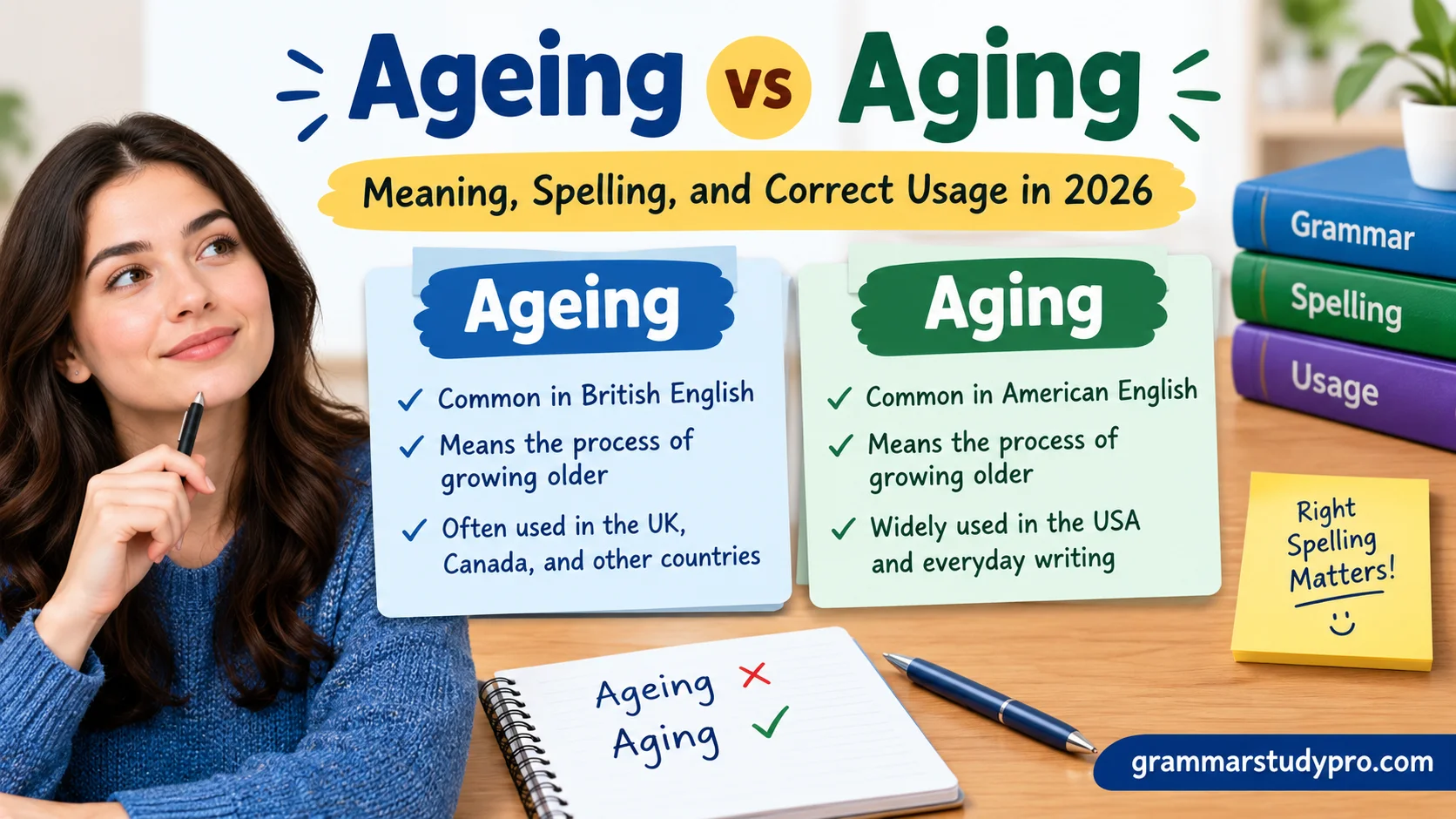
The Ageing vs Aging debate can confuse writers because both spellings have the same meaning and pronunciation, but their usage depends on regional English conventions. American writers and Canadian writers generally prefer aging, while British English and Australian English usually favor ageing. This difference reflects the English language, its spelling conventions, and the small quirks that make language interesting. The Australian Writers’ Centre, also called the Australian Writers Centre, explores these language differences through discussions of grammar, vocabulary, and everyday writing. Such discussions can dissect familiar words, offer a fresh perspective, and celebrate the occasional weirdness of English. Although these spelling variations may seem minor, understanding them helps writers choose the right form for their audience.
From a grammar and word formation perspective, age is a verb, while aging and ageing can function as a gerund or past participle, depending on the sentence. The main difference comes from dropping the e in American and Canadian spelling. However, ageism, which means discrimination based on age or age discrimination, keeps the same spelling everywhere. Both aging and ageing appear in books, websites, newspapers, and everyday conversations. The words have the same meaning and grammatical uses, so neither spelling is inherently incorrect. Outside North America, ageing is generally preferred, although aging can appear in international publications. These spelling conventions are part of English orthography, grammar rules, and regional language differences.
In practical writing, consistency matters more than choosing one spelling over the other. Whether you’re preparing a school assignment, blog post, business document, or other written communication, follow the relevant style guide and use the same spelling throughout. During content editing, proofreading, and publishing, check whether your audience expects American, British, Canadian, or Australian English. For example, choose aging for most American contexts and ageing for most British and Australian contexts. This simple approach improves editorial consistency, makes your writing easier to understand, and helps international readers follow your work without distraction.
Quick Answer: Ageing or Aging?
Both ageing and aging are correct spellings. The main difference is regional preference.
- Aging: The standard spelling in American English, commonly used in the United States.
- Ageing: The spelling generally preferred in British English and many publications that follow British spelling conventions.
- Meaning: Both describe the process of growing older or developing characteristics associated with age.
- Pronunciation: Both spellings are pronounced the same way in standard English.
- Correct usage: Choose the spelling that matches your audience or the style guide you’re following.
Here are two examples:
- American English: The population is aging rapidly.
- British English: The population is ageing rapidly.
Both sentences are grammatically correct. The spelling changes, but the meaning stays the same.
Easy rule to remember: Use aging for American English and ageing for British English. If you’re writing for a particular publication, follow its preferred spelling.
Comparison Overview
The following table summarizes the differences between ageing and aging so you can identify the correct form quickly.
| Feature | Aging | Ageing |
| Preferred English variety | American English | British English |
| Meaning | Growing older | Growing older |
| Pronunciation | The same | The same |
| Spelling | Omits the extra e | Retains the e |
| Grammatical uses | Noun, adjective, verb form | Noun, adjective, verb form |
| Formal writing | Correct | Correct |
| Everyday conversation | Correct | Correct |
| Best choice for US readers | Generally preferred | Less common |
| Best choice for UK readers | Less common | Generally preferred |
The key distinction is regional spelling, not meaning. Neither form is inherently more formal, more intelligent, or more grammatically correct than the other.
For example, an American newspaper might publish an article about healthy aging, while a British health organization might discuss healthy ageing. Both expressions refer to the same general process.
The same principle applies to phrases such as aging population, ageing population, aging process, and ageing process. Your choice should reflect the spelling conventions of your intended audience.
What Does Aging Mean?
Aging means the process of growing older or developing changes associated with the passage of time. It can describe people, animals, plants, materials, machines, and even entire populations.
According to aging is the American English spelling of ageing. The word can function as a noun, an adjective, or a verb form depending on how you use it in a sentence.
For example, consider these sentences:
- Aging is a natural part of life. — The word names a process.
- My aging parents enjoy traveling. — It describes people who are growing older.
- The population is aging rapidly. — It forms part of a verb phrase.
Although people often associate aging with wrinkles, gray hair, or reduced physical strength, the word covers much more than visible changes. It can also describe changes in memory, physical abilities, technology, materials, and social structures.
Aging as a Verb Form
The word aging is the present participle of the verb age. It appears in continuous verb phrases and can also introduce clauses that describe an ongoing process.
Examples include:
- My parents are aging gracefully.
- The country’s population is aging faster than expected.
- This wooden furniture is aging beautifully.
- As the equipment keeps aging, maintenance costs may increase.
Notice how the meaning changes slightly with the subject. People grow older, furniture develops a particular appearance, and equipment may become less reliable.
In each sentence, aging describes a process that is happening over time. The British versions use ageing without changing the sentence structure.
Aging as a Noun
As a noun, aging refers to the process of growing older. It often appears in discussions about health, biology, psychology, and society.
Examples:
- Healthy aging involves regular physical activity and balanced nutrition.
- Researchers study aging to understand changes in the human body.
- The effects of aging vary from person to person.
- Scientists investigate how aging affects memory and mobility.
In these examples, the word identifies a process rather than describing a specific person or object.
You will often see aging in expressions such as healthy aging, premature aging, and the aging process. British publications commonly use healthy ageing, premature ageing, and the ageing process instead.
Aging as an Adjective
Aging can also describe someone or something that is getting older. It often appears before a noun.
Consider these examples:
- The aging bridge requires regular inspections.
- She helps care for her aging father.
- The company plans to replace its aging computers.
- The city needs to repair its aging water pipes.
Here, aging gives readers additional information about the noun. An aging bridge may need repairs, while aging computers may struggle to run modern software.
However, aging does not automatically mean useless, unhealthy, or poorly maintained. Context determines whether growing older creates a problem.
An aging wooden table might become more attractive over time. An aging electrical system, on the other hand, may need an expert inspection.
What Does Ageing Mean?
Ageing means exactly the same thing as aging. The difference lies in spelling rather than meaning.
British English generally favors ageing, while American English usually favors aging. Oxford Learner’s Dictionaries identifies ageing as British English and lists aging as an especially North American variant.
The word can describe the natural process of growing older, the changes associated with age, or the gradual deterioration of certain objects.
For example:
- The ageing process affects people differently.
- She is ageing gracefully.
- The country has an ageing population.
- The factory operates with ageing machinery.
All four sentences use standard British spelling. An American writer could replace ageing with aging without changing the grammar or meaning.
Ageing in Everyday English
In everyday conversation, ageing often describes people and the visible or physical changes that occur over time.
Examples include:
- My dog is ageing, but he still enjoys long walks.
- Her parents are ageing well.
- Ageing doesn’t mean you have to stop learning.
- The actor spoke openly about the ageing process.
The word can sound neutral, positive, or negative depending on the surrounding language.
For instance, ageing gracefully often suggests accepting the passage of time with confidence. By contrast, an ageing building may suggest that repairs or modernization are becoming necessary.
The word itself doesn’t always carry a negative judgment. The context supplies the tone.
Ageing in Health, Science, and Everyday Descriptions
British English uses ageing in health-related discussions, scientific writing, and descriptions of demographic change.
Common expressions include:
- Healthy ageing: Maintaining physical, mental, and social well-being as people grow older.
- Skin ageing: Changes in skin structure and appearance over time.
- Premature ageing: Changes that appear earlier than typically expected.
- Population ageing: An increase in the proportion of older people within a population.
- Ageing infrastructure: Roads, bridges, pipes, or other systems that are becoming older and may require maintenance.
These expressions illustrate how broadly the word can be used. It doesn’t refer only to human appearance.
For example, a British report might discuss the challenges of population ageing, while an American report might examine the challenges of population aging. Both phrases describe the same demographic issue.
Main Differences Between Ageing vs Aging
The distinction between ageing and aging becomes easier to understand when you examine spelling, regional usage, pronunciation, and grammar separately.
Spelling Difference Between Ageing and Aging
The visible difference is one letter.
- Aging: A-g-i-n-g
- Ageing: A-g-e-i-n-g
The American form removes the final e from age before adding -ing. The British form retains that e.
Both forms are established English spellings. You shouldn’t mark ageing as incorrect simply because your preferred dictionary uses aging, or vice versa.
A useful comparison is:
| American English | British English |
| Aging process | Ageing process |
| Aging population | Ageing population |
| Aging parents | Ageing parents |
| Healthy aging | Healthy ageing |
| Premature aging | Premature ageing |
| Aging machinery | Ageing machinery |
The regional preference remains the same across these expressions.
| Audience | Recommended spelling |
| United States | Aging |
| United Kingdom | Ageing |
| Canada | Aging is preferred; ageing is also accepted |
| International publication | Follow the publication’s style guide |
| Academic journal | Follow the journal’s instructions |
These are general preferences rather than absolute rules for every publisher. A particular organization may adopt a different house style.
Pronunciation Difference Between Ageing and Aging
Although the spellings differ, ageing and aging have the same standard pronunciation.
Both are pronounced approximately AY-jing, with the IPA transcription /ˈeɪdʒɪŋ/. The word has two syllables, and the first syllable receives the main stress. Cambridge lists the same pronunciation for the two forms.
You don’t need to add another syllable when you see the extra e in ageing.
For example, the following expressions sound the same:
- Aging gracefully
- Ageing gracefully
- The aging process
- The ageing process
The spelling changes on the page, but the spoken word stays the same.
Difference in Meaning and Grammar
Neither spelling has a separate meaning. Both can function as a noun, adjective, or present participle.
| Grammatical role | American example | British example |
| Noun | Aging is natural. | Ageing is natural. |
| Adjective | The aging equipment needs repairs. | The ageing equipment needs repairs. |
| Verb form | The population is aging. | The population is ageing. |
The sentence structure remains unchanged. You don’t need to rewrite the surrounding words when switching between American and British spelling.
One important detail: the meaning of aging can vary with context. In ordinary usage, it refers to growing older. In accounting, however, aging can also describe the process of grouping outstanding customer balances according to how long they have remained unpaid. That specialized business meaning is separate from the spelling distinction.
Why Do Aging and Ageing Have Different Spellings?
The difference between aging and ageing reflects the way English spelling conventions have developed across different regions.
The base word is age. American English generally drops the final e before adding -ing, producing aging. British English commonly retains the e in this particular word, producing ageing.
However, English spelling doesn’t follow one perfectly consistent pattern. That’s why you shouldn’t assume that every word ending in e will behave exactly like age.
Consider these familiar spelling differences:
| American English | British English |
| Aging | Ageing |
| Color | Colour |
| Favorite | Favourite |
| Traveling | Travelling |
| Center | Centre |
| Organize | Organise |
These examples illustrate broader regional preferences. The differences don’t mean that one spelling system is inherently better than the other.
It’s also worth remembering that British spelling conventions can vary between words and publications. The most reliable approach is to consult a dictionary or style guide when you’re unsure.
For aging and ageing, the practical rule remains simple: use the form preferred by your intended audience.
Ageing vs Aging in Example Sentences
Examples make the spelling distinction easier to remember. In every pair below, the two sentences communicate the same idea. Only the spelling changes.
Examples About People
People are the most familiar subject associated with aging and ageing.
- American: My grandmother is aging gracefully.
- British: My grandmother is ageing gracefully.
- American: His aging parents enjoy spending time outdoors.
- British: His ageing parents enjoy spending time outdoors.
- American: Aging doesn’t prevent people from learning new skills.
- British: Ageing doesn’t prevent people from learning new skills.
These examples show that the words can describe a process, a person, or the general experience of growing older.
Examples About Health and Skin
Both spellings are common in discussions about health, physical changes, and scientific research.
- American: Researchers are studying the effects of aging on memory.
- British: Researchers are studying the effects of ageing on memory.
- American: Sun exposure can contribute to premature skin aging.
- British: Sun exposure can contribute to premature skin ageing.
- American: Healthy aging involves more than physical fitness.
- British: Healthy ageing involves more than physical fitness.
In health-related writing, the choice of spelling usually follows the publication’s regional conventions. The subject matter doesn’t require one spelling over the other.
Examples About Populations and Society
The words also appear in discussions about population trends, public services, and social planning.
- American: The aging population may increase demand for health care.
- British: The ageing population may increase demand for health care.
- American: Researchers are examining the economic effects of population aging.
- British: Researchers are examining the economic effects of population ageing.
- American: An aging workforce can create new training needs.
- British: An ageing workforce can create new training needs.
Here, the words refer to changes in the age distribution of people within a society or workforce.
Examples About Buildings, Equipment, and Products
Growing older isn’t limited to living things. Writers also use aging and ageing to describe objects that change over time.
- American: The aging bridge needs a thorough inspection.
- British: The ageing bridge needs a thorough inspection.
- American: The factory is replacing its aging machinery.
- British: The factory is replacing its ageing machinery.
- American: The company relies on aging computer systems.
- British: The company relies on ageing computer systems.
These examples also show why context matters. An aging bridge might need repairs, but an aging wooden table could develop an attractive finish.
The word identifies the passage of time or its effects. It doesn’t automatically tell you whether those effects are good or bad.
Which Spelling Should You Use in 2026?
The correct choice depends on where your readers live, which English variety your publication follows, and whether an editor has established a specific style.
You don’t need to memorize a long list of spelling rules. Start by identifying your audience.
When to Use Aging
Choose aging when writing in American English.
It’s the standard choice for:
- US-focused blog posts and website articles.
- American school assignments and college papers.
- Business documents prepared for US readers.
- American newspapers and magazines.
- Health articles that follow US spelling conventions.
- Marketing materials aimed primarily at American customers.
For example, if you’re publishing an article titled The Benefits of Healthy Aging, the spelling fits an American audience.
The same applies to phrases such as aging gracefully, aging parents, and aging infrastructure.
When to Use Ageing
Choose ageing when writing in British English or for a publication that prefers British spelling.
It’s commonly used in:
- UK-focused educational content.
- British newspapers and magazines.
- Publications following British English conventions.
- Academic writing that specifies British spelling.
- Reports about health, society, or an ageing population.
For example, a British publication might use the heading Understanding the Ageing Process.
The spelling is correct even if an American reader would usually expect aging process.
What If You’re Writing for an International Audience?
International writing requires a little more judgment because readers may use different spelling conventions.
The best approach is to establish a consistent editorial style before you begin.
Follow these steps:
- Identify your main audience. Decide whether you’re writing primarily for American, British, Canadian, or international readers.
- Choose a spelling standard. Use the regional form that best fits your audience.
- Check your style guide. Follow any requirements established by your publisher, employer, school, or client.
- Keep your spelling consistent. Avoid switching between aging and ageing without a clear reason.
- Preserve original spelling when appropriate. If you quote a source or reproduce an official title, retain its original wording unless your editorial requirements say otherwise.
For a US-focused website, aging is generally the practical choice. For a UK-focused website, ageing is generally preferable.
Neither form guarantees better search rankings. The more useful SEO practice is to satisfy the reader’s search intent, provide accurate information, and use the appropriate spelling consistently.
Common Mistakes to Avoid When Using Ageing or Aging
Although the difference is simple, a few common misunderstandings can lead to unnecessary corrections.
Assuming Ageing Is Always Incorrect
A writer who follows American English might see ageing and assume it contains a typo.
That assumption is incorrect. Ageing is a standard British spelling.
Correction: The spelling is appropriate when it matches the English variety being used.
Assuming Aging Is Only an Informal Form
Some readers believe aging is a shortened or casual version of ageing.
It isn’t. Aging is the standard American spelling and works in formal writing, academic papers, business reports, and professional publications.
Correction: Use aging confidently in formal American English.
Mixing Both Spellings in One Article
Imagine reading this paragraph:
“The aging population faces several challenges. These challenges include the needs of an ageing workforce and the costs associated with healthy aging.”
The paragraph isn’t necessarily grammatically wrong, but the changing spelling can make the writing feel inconsistent if the author intends to follow one regional standard.
Correction: Choose one form and apply it throughout the article, except when quoting sources or preserving official names.
Treating the Words as Different in Meaning
Another mistake is assuming that aging refers to people while ageing refers to objects, or that one form describes physical changes while the other describes emotional changes.
Neither distinction is correct.
Correction: Both spellings can describe people, objects, health, infrastructure, and populations.
Assuming the Extra E Changes Pronunciation
The additional e can make the British spelling look as though it should sound different.
However, both forms have the same standard pronunciation.
Correction: Learn the spelling difference as a regional convention rather than a pronunciation rule.
Here’s a quick reference table:
| Common mistake | Correct explanation |
| Ageing is misspelled. | It’s standard British English. |
| Aging is informal. | It’s standard American English. |
| The words have different meanings. | They have the same basic meaning. |
| The spellings have different pronunciations. | They are pronounced the same way. |
| Mixing the spellings never matters. | Consistency matters when following a regional style. |
Related Words: Age, Aged, Aging, and Ageism
Understanding related words helps you choose the right form in more complicated sentences.
Age
Age can function as a noun or a verb.
As a noun, it refers to the length of time someone or something has existed. As a verb, it means to grow older or develop changes over time.
Examples:
- Her age is listed on the form.
- People age at different rates.
- The cheese will age for several months.
Aged
Aged is the past tense and past participle of age. It can also function as an adjective.
Examples:
- The wine aged in oak barrels.
- The company replaced its aged equipment.
- The recipe calls for aged cheese.
Notice the difference between aging equipment and aged equipment. The first emphasizes an ongoing process of growing older. The second describes equipment that is already old.
The distinction depends on the sentence, although the two expressions can sometimes describe the same object.
Aging and Ageing
These forms describe an ongoing process or its effects.
Examples:
- The aging building needs repairs.
- The ageing building needs repairs.
- Scientists are investigating the aging process.
- Scientists are investigating the ageing process.
Use the spelling that matches your chosen English variety.
Ageism
Ageism means prejudice, stereotyping, or discrimination based on a person’s age.
For example:
- An employer rejects an otherwise qualified applicant because of their age.
- A company assumes older workers cannot learn new technology.
- A service provider treats customers unfairly because they belong to a particular age group.
Unlike aging and ageing, the standard spelling ageism is generally used in both American and British English.
The word refers to unfair attitudes or treatment, not to the natural process of growing older.
FAQs
1. What is the difference between ageing and aging?
Ageing and aging have the same meaning and pronunciation. The main difference is regional spelling. American and Canadian English generally use aging, while British and Australian English usually prefer ageing.
2. Is ageing or aging correct in American English?
Aging is the standard spelling in American English. You should use it in American school assignments, business documents, blog posts, and other writing intended for a US audience.
3. Is ageing the British English spelling?
Yes, ageing is generally preferred in British English. It is also commonly used in Australian English and other varieties that follow British spelling conventions.
4. Why does ageism keep its spelling in American English?
The word ageism keeps the same spelling in American, British, Canadian, and Australian English. Although Americans usually drop the e in aging, that spelling change does not apply to ageism, which means discrimination based on someone’s age.
5. Are ageing and aging pronounced differently?
No, ageing and aging generally have the same pronunciation and grammatical uses. Both can function as a gerund or a present participle of the verb age. The choice depends on the spelling convention you follow, not on a difference in meaning.
Conclusion
The difference between ageing vs aging comes down to regional spelling conventions rather than meaning or pronunciation. Use aging when writing for an American audience and ageing when following British or Australian English conventions.
Most importantly, remain consistent throughout your writing. Whether you’re preparing a school assignment, publishing a blog post, or editing a business document, choosing the appropriate spelling helps your content look clear, professional, and suitable for your readers.