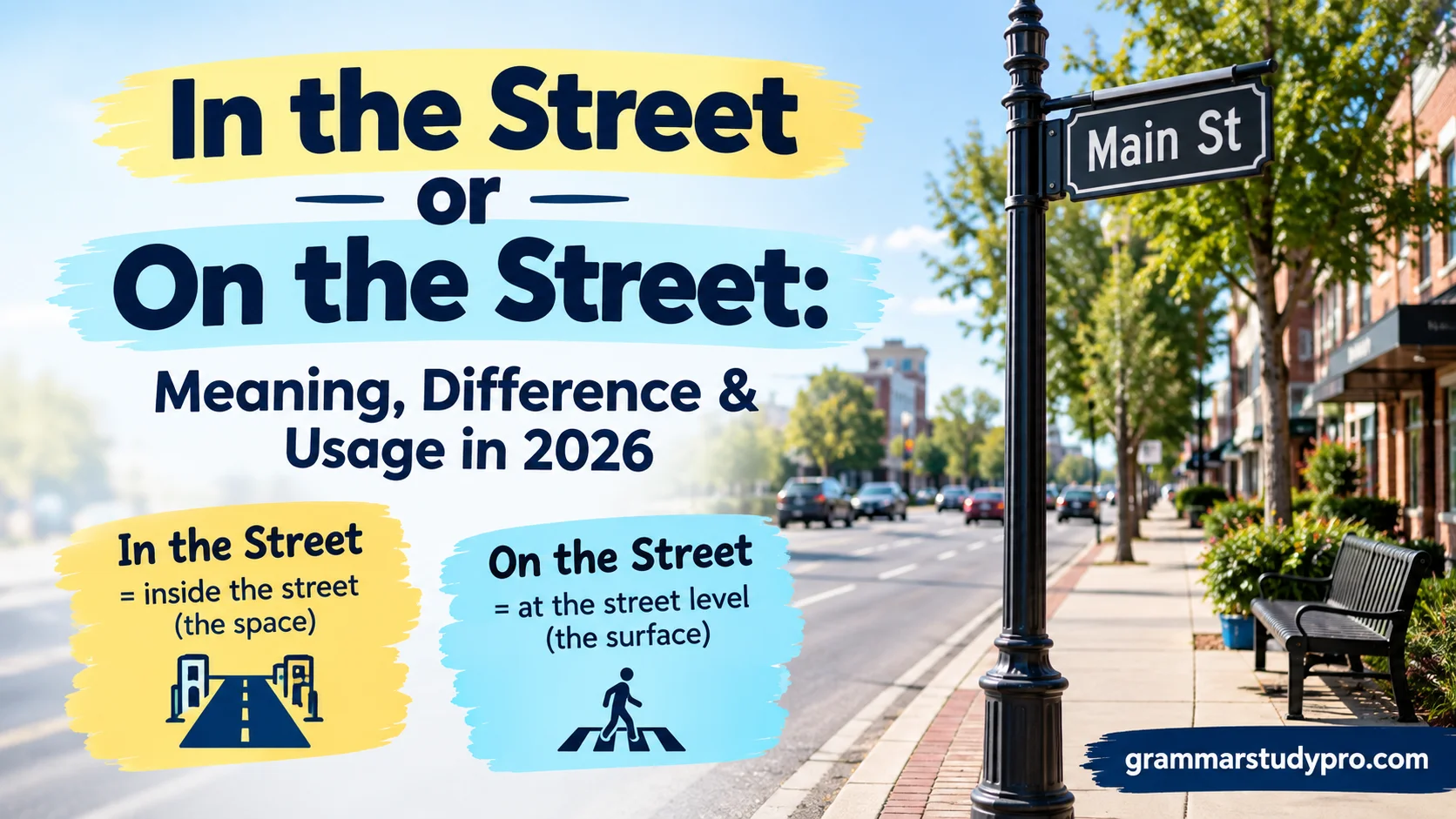
In the Street or On the Street can confuse learners because both phrases are correct English, but each one has different purposes in different situations. In standard American English, on the street usually describes a location, address, everyday activity, or general presence near a street. For example, she lives on the street explains where she lives, while on the street may describe someone taking part in an everyday activity near a street.
In the street has a more physical meaning because it can place someone within the boundaries of a street, physically inside the roadway, where moving traffic may be present. She was standing in the street places her on the actual road, which may create a feeling of urgency or sound alarming. However, British English also commonly uses in the street as a standard location phrase, so the choice can depend on the variety of English your readers use. This difference becomes easier to understand when learners separate literal usage from idiomatic usage.
When speaking or writing, use this guide to remember the correct usage and avoid common mistakes. Think about the meaning you want each phrase to express, then check whether you mean an address, a general presence, or a position on the actual road. Simple examples can help you understand the distinction quickly and feel more natural and confident when using English prepositions.
Quick Answer
Both “in the street” and “on the street” are correct. The right choice depends on what you mean.
In American English, use on the street when you’re talking about a general location along a street, especially a street address.
“She lives on Oak Street.”
Use in the street when you want to emphasize that someone or something is physically within the roadway or street area.
“The children were playing in the street.”
Here’s the simplest way to remember it:
| Expression | Typical meaning | Example |
| on the street | Located along or associated with a street | “The store is on Main Street.” |
| in the street | Physically within the roadway or street space | “A car stopped in the street.” |
| on the streets | Often refers to public street life or living without stable housing, depending on context | “The organization helps people living on the streets.” |
| at the street | Usually unnatural for an ordinary street location | “Meet me at the street corner.” |
One important qualification matters: British English can use “in the street” more broadly than American English. So a sentence that sounds unusual to an American speaker may sound perfectly ordinary to a British speaker.
Comparison Overview
The difference becomes easier once you look at what each preposition makes you picture.
| Feature | On the street | In the street |
| General street location | Very common | Possible, especially in British English |
| Street address | Standard in American English | Usually incorrect for this meaning |
| Within roadway | Possible, but less specific | Strongly suggests this meaning |
| Shops and businesses | Very common | Usually not preferred in American English |
| People walking nearby | Common | Can imply they are in the roadway |
| Objects occupying roadway | Possible | Often more natural |
| Traffic-related situations | General | Strong roadway emphasis |
| British English | Common | Also broadly used |
| American English | Common for general location | Common for physical roadway location |
Think of on as pointing to a street as a location or route. Think of in as treating the street as a space that something can occupy.
That distinction isn’t absolute. English prepositions depend heavily on context.
Main Differences Between In the Street or On the Street
The most useful distinction between in the street or on the street comes down to how you conceptualize the location.
“On the Street” Means Along or Associated With a Street
In American English, on the street commonly identifies a person’s or object’s location in relation to a particular street.
For example:
“The bookstore is on Pine Street.”
The bookstore doesn’t need to sit directly on the asphalt. It may stand beside the road with its entrance facing the sidewalk. The phrase simply places it along Pine Street.
That’s why Americans naturally say:
- “I live on Elm Street.”
- “The restaurant is on Fifth Avenue.”
- “There’s a bank on this street.”
- “Her office is on Market Street.”
- “We found a hotel on the main road.”
The preposition connects the person, building, or business with the street as a location.
“In the Street” Emphasizes the Street as a Physical Space
In the street creates a different mental image.
Here, the street itself functions more like an area that contains someone or something.
For example:
“A dog is in the street.”
The sentence suggests that the dog has entered the roadway or street area.
Likewise:
“There’s a fallen tree in the street.”
The tree physically occupies the roadway. It may obstruct traffic, which makes in particularly natural.
Other examples include:
- “Don’t stand in the street.”
- “The ball rolled into the street.”
- “A truck broke down in the street.”
- “There was broken glass in the street.”
- “The protesters gathered in the street.”
The focus isn’t simply the street’s name or general location. The focus is physical position within the street space.
What Does “On the Street” Mean?
The phrase on the street has several closely related uses.
On the Street for a General Location
You can use on the street when you’re talking about someone being somewhere along a street.
For example:
“I saw Maria on the street yesterday.”
This doesn’t necessarily mean Maria stood in the traffic lane. She could have been walking along the sidewalk, entering a shop, or simply somewhere in the street environment.
Similarly:
“There are several cafés on the street.”
The cafés are associated with that street.
On the Street for Street Addresses
This is one of the clearest rules in American English.
When giving a street address without the house number, Americans normally use on:
- “I live on Washington Street.”
- “The office is on Jefferson Avenue.”
- “The school is on Oak Road.”
- “Their apartment is on King Street.”
You wouldn’t normally say:
“I live in Washington Street.”
That construction sounds incorrect in standard American English when you’re identifying the street where someone lives.
Instead:
“I live on Washington Street.”
Notice that in still works naturally with larger areas:
- “I live in Chicago.”
- “I live in Illinois.”
- “I live in the neighborhood.”
- “I live in an apartment.”
The preposition changes because the type of location changes.
On the Street for Shops and Buildings
Businesses commonly use on when identifying their street location.
Examples:
“There’s a bakery on Main Street.”
“The new pharmacy is on First Avenue.”
“The restaurant is on the corner of King Street.”
The building itself isn’t literally sitting on the road. Instead, on the street identifies its location along that street.
What Does “In the Street” Mean?
The phrase in the street generally gives a stronger sense of physical presence inside the street area.
In the Street for People
Consider:
“The man was standing in the street.”
This sentence makes the roadway feel important. You might imagine the man standing between lanes of traffic or somewhere vehicles normally travel.
Compare that with:
“The man was on the street.”
The second sentence provides much less information about his exact physical position.
He could be:
- walking along the sidewalk
- outside a store
- standing near a parked car
- crossing the road
- simply somewhere in the street environment
In the Street for Objects
In the street works especially well when an object occupies the roadway.
Examples include:
- “A bicycle was left in the street.”
- “A large branch fell in the street.”
- “There was water in the street.”
- “A tire was lying in the street.”
- “The construction equipment is in the street.”
In each case, the reader can picture the object occupying the street itself.
In the Street for Activities
You can also use in the street when an activity takes place there.
Examples:
- “The children were playing in the street.”
- “People were dancing in the street.”
- “The protesters were marching in the street.”
- “Neighbors gathered in the street.”
- “The performers put on a show in the street.”
Here, in emphasizes the street as the physical setting for the activity.
In the Street vs. On the Street for Walking
Walking provides a useful example because both expressions can be grammatical.
“She was walking on the street.”
This can describe someone walking along the street or within the broader street environment.
Now compare:
“She was walking in the street.”
This more strongly suggests that she was actually walking in the roadway.
Context can make the difference clearer:
“She was walking on the street when she saw an old friend.”
The focus is the general location.
“She was walking in the street because the sidewalk was blocked.”
Now the roadway itself matters.
The second sentence gives the reader a reason to imagine her away from the sidewalk.
In the Street or On the Street for Playing?
This is another common question.
Both expressions can occur, but “play in the street” often emphasizes physical activity within the street area.
“The children were playing in the street.”
You can imagine children running around, kicking a ball, or playing games in the roadway.
Meanwhile:
“The children were playing on the street.”
This can describe their general location, although the exact image depends on the speaker and regional variety of English.
If you’re describing a safety situation in American English, in the street often communicates the physical position more clearly.
In the Street or On the Street for Standing?
The same principle applies to standing.
“He was standing on the street.”
This gives a general location.
“He was standing in the street.”
This places him more clearly inside the roadway or street area.
For example:
“The driver got out and found a man standing in the street.”
The sentence creates a much more specific image.
That’s because in makes the street function as the space containing the person.
In the Street or On the Street for Driving?
When discussing vehicles, on the street is very common.
Examples:
- “There are too many cars on the street.”
- “She was driving on the street.”
- “The bus stopped on the street.”
- “Several cars were parked on the street.”
However, in the street can become natural when you emphasize an obstruction or physical position.
For example:
“A truck broke down in the street.”
The truck isn’t merely associated with that street. Its position in the roadway creates a problem.
This subtle difference is why context matters more than memorizing a rigid rule.
American English vs. British English
Regional usage deserves special attention because in the street or on the street doesn’t behave identically in every English-speaking community.
American English Usage
American English strongly favors on for street addresses and general locations associated with a named street.
Examples:
- “I live on Main Street.”
- “The store is on Oak Avenue.”
- “There’s a café on the street.”
- “I met him on the street.”
American English also uses in the street when the roadway itself becomes the focus.
Examples:
- “The children were playing in the street.”
- “A car stopped in the street.”
- “Don’t leave that box in the street.”
British English Usage
British English can use in the street more broadly.
For example:
“There were people in the street.”
A British speaker may use this simply to describe people outside in the public street area. It doesn’t automatically mean every person stood directly in a traffic lane.
That distinction matters for English learners. A grammar explanation based entirely on American English can make perfectly ordinary British usage look incorrect.
The safest approach is to identify the variety of English you’re writing or speaking.
If you’re using American English, on the street is generally the natural choice for a street location or address. Use in the street when the physical street space matters.
In the Street vs. On the Street: Common Situations
The following examples make the difference easier to recognize.
| Situation | Natural American English example | Why |
| Address | “I live on Oak Street.” | Street address |
| Business location | “The café is on Main Street.” | Location along a street |
| General encounter | “I saw him on the street.” | General street environment |
| Child in roadway | “The child was in the street.” | Physical roadway |
| Road obstruction | “There was a tree in the street.” | Object occupies roadway |
| Street parking | “My car is parked on the street.” | General street parking |
| Roadway activity | “People were dancing in the street.” | Activity occupies street area |
| Traffic | “There were many cars on the street.” | General traffic/location |
“On the Street” vs. “On the Streets”
Adding an s changes the expression’s meaning and sometimes its tone.
On the Street
The singular phrase usually refers to a particular street or a general street location.
“I met him on the street.”
“The store is on the street.”
On the Streets
The plural expression can refer to public street life more broadly.
For example:
“The organization provides meals to people living on the streets.”
In this context, on the streets can refer to people without stable housing.
However, the phrase doesn’t always mean homelessness.
Consider:
“The journalist spent years working on the streets.”
Here, the meaning depends entirely on context. It could refer to reporting from public spaces, covering crime, or working directly with people in communities.
So don’t automatically interpret on the streets as a synonym for homelessness.
Is “At the Street” Correct?
At the street isn’t normally the expression you want when identifying a street location.
For a street address, American English uses on:
“I live on Green Street.”
For a specific point, at becomes much more useful:
- “Meet me at the corner.”
- “Wait at the intersection.”
- “I’ll see you at the traffic light.”
- “The accident happened at the end of the street.”
Compare:
❌ “Meet me at Main Street.”
with:
✅ “Meet me on Main Street.”
or:
✅ “Meet me at the corner of Main Street and First Avenue.”
The second sentence identifies a precise point.
Common Mistakes With In the Street and On the Street
These errors often come from translating prepositions directly from another language.
| Incorrect or less natural sentence | Better American English | Explanation |
| “I live in Main Street.” | “I live on Main Street.” | Use on for a street address. |
| “The store is in Fifth Avenue.” | “The store is on Fifth Avenue.” | A venue is located along the avenue. |
| “Meet me in the street corner.” | “Meet me at the street corner.” | At identifies the point. |
| “The car is on the middle of the street.” | “The car is in the middle of the street.” | The fixed phrase is in the middle. |
| “The children are on the street” when they’re blocking traffic | “The children are in the street.” | In emphasizes the roadway. |
Not every supposedly “wrong” sentence is universally wrong. Regional English and context can change what sounds natural.
Why English Uses “On” With Streets
The pattern becomes easier when you compare streets with other locations.
English commonly treats streets as routes or surfaces that people occupy, travel along, or associate themselves with.
That’s why you hear:
- on Main Street
- on the highway
- on the road
- on the sidewalk
- on the pavement
However, English doesn’t apply this logic mechanically. You can also say:
- in the road
- in the street
- in the middle of the road
Those expressions shift attention toward the physical space.
In other words, the preposition doesn’t simply describe geography. It helps the listener understand how you’re viewing the location.
A Simple Way to Choose Between In and On
When you’re uncertain, ask yourself one question:
Am I identifying the street as a location, or am I describing something physically occupying it?
If you’re identifying the location, on will often work in American English.
“The hotel is on King Street.”
If you’re emphasizing physical occupation of the roadway, in will often fit better.
“A truck is in the street.”
The Three-Question Test
Is it a street address?
Use on.
“She lives on Park Avenue.”
Is something physically occupying the roadway?
Use in.
“A fallen tree is in the street.”
Are you identifying a precise point?
Consider at.
“Meet me at the corner.”
This simple test won’t solve every regional usage question. It will, however, handle most everyday American English situations.
Case Studies: How Context Changes the Meaning
Case Study: The Child Near Traffic
Imagine a parent looking outside and saying:
“My son is on the street.”
The statement tells you where he is generally. It doesn’t clearly indicate whether he’s on the sidewalk.
Now imagine the parent says:
“My son is in the street!”
The second sentence sounds more urgent because in highlights his physical position within the roadway.
The difference isn’t merely grammatical. The preposition changes the mental picture.
Case Study: A Business Address
Suppose someone asks where a bookstore is located.
“It’s on Jefferson Street.”
That’s a straightforward location.
If someone instead says:
“It’s in Jefferson Street.”
An American listener may wonder whether the speaker means something else, because in isn’t the normal preposition for a street address.
The same pattern appears with:
- roads
- avenues
- boulevards
- drives
- lanes
For example:
“The restaurant is on Sunset Boulevard.”
Case Study: A Blocked Road
Now picture a fallen tree.
“There’s a tree on the street.”
This could simply identify its general location.
But:
“There’s a tree in the street.”
The second sentence strongly suggests that the tree occupies the roadway.
That distinction becomes especially useful when describing accidents, construction, traffic hazards, and emergency situations.
In vs. On vs. At for Locations
These three prepositions often cause confusion, so it helps to compare them directly.
| Preposition | Typical function | Example |
| in | Within an area or space | “The car is in the street.” |
| on | Along or associated with a street or surface | “The shop is on Main Street.” |
| at | At a particular point | “Meet me at the corner.” |
The same idea appears elsewhere in English:
- in a city
- on a street
- at an intersection
For example:
“I live in Boston.”
“I live on Oak Street.”
“Meet me at the corner.”
Each preposition gives the location a different level or type of focus.
Figurative Meanings of “On the Street”
Not every use of on the street describes a literal location.
“On the Street” and Housing
In certain contexts, on the street can mean that someone has no stable home.
For example:
“He spent several months on the street.”
This is a figurative or idiomatic use.
“On the Streets”
The plural version can carry the same meaning:
“The charity works with people living on the streets.”
But again, context matters.
“The Man on the Street”
The man on the street is an established expression meaning an ordinary member of the public.
For example:
“How would the average person on the street understand this?”
The phrase isn’t literally identifying a particular man standing beside a road.
Practical Examples of In the Street or On the Street
For Addresses
- “I live on Main Street.”
- “Her office is on Fifth Avenue.”
- “The hotel is on King Road.”
For General Locations
- “I saw him on the street.”
- “There are several stores on this street.”
- “She met an old friend on the street.”
For Roadway Situations
- “The dog ran into the street.”
- “Don’t stand in the street.”
- “A truck stopped in the street.”
- “There was glass in the street.”
For Activities
- “The children were playing in the street.”
- “People were dancing in the street.”
- “The protesters gathered in the street.”
For Specific Points
- “Meet me at the corner.”
- “Wait at the intersection.”
- “The store is at the end of the street.”
Practice: Choose In, On, or At
Try these sentences before checking the answers.
- I live ___ Main Street.
- The dog ran ___ the street.
- Meet me ___ the corner.
- There’s a pharmacy ___ Fifth Avenue.
- The children were playing ___ the street.
- I saw Sarah ___ the street.
- A truck stopped ___ the middle of the street.
- There was a bicycle ___ the street.
Answers
- on — “I live on Main Street.”
- into — “The dog ran into the street.”
- at — “Meet me at the corner.”
- on — “There’s a pharmacy on Fifth Avenue.”
- in — “The children were playing in the street.”
- on — “I saw Sarah on the street.”
- in — “A truck stopped in the middle of the street.”
- in — “There was a bicycle in the street.”
Notice that the answers don’t follow one mechanical formula. Meaning determines the preposition.
FAQs
1. Is “in the street” correct English?
Yes. “In the street” is correct when you mean being physically within the street or roadway. It can also be common in British English for describing a location.
2. Is “on the street” correct English?
Yes. “On the street” is especially common in American English for talking about a location, address, or general presence near a street.
3. What is the main difference between “in the street” and “on the street”?
“In the street” usually suggests being within the roadway, while “on the street” usually describes a location, address, or general presence near the street.
4. Should I say “she lives in the street” or “she lives on the street”?
In standard American English, “she lives on the street” is the natural choice when describing where someone lives. British English may use “in the street” in some contexts.
5. How can I remember the correct usage?
Think about the meaning. Use “in the street” when someone is physically in the roadway. Use “on the street” for an address, general location, or everyday presence.
Conclusion
Choosing between “in the street” and “on the street” depends on meaning and variety of English. “On the street” is generally preferred in American English for locations and addresses, while “in the street” often emphasizes physical position within the roadway. Paying attention to context makes the difference easier to remember and helps you use both phrases naturally.