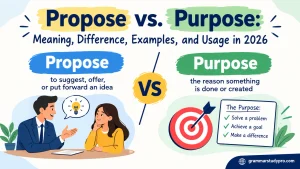
Propose vs. Purpose can seem similar, but knowing each word’s function helps you choose the correct term in everyday and professional writing. Their similar spelling can create hesitation and confusion, yet the subtle distinction is easy to understand when you examine their meanings and grammatical roles. Propose works as a verb and means to suggest an idea, plan, or course of action, while purpose works as a noun and explains the reason, intention, or goal behind something. As a writer, I find that people often mixing these words can cause problems in formal writing, academic writing, meetings, emails, essays, and casual conversations. A simple way to break it down is to remember that proposing describes something you actively do, while purpose explains why an idea exists. You might propose an idea during a meeting, present a suggestion in a business proposal, or propose a marketing strategy with the objective of increasing sales. The purpose of that action may be to reach specific business goals. Once you look at real sentences and recognize how each word operates, the difference becomes much clearer.
This difference also matters because choosing the wrong one can subtly change the meaning and make your communication seem unclear or off track. When drafting a proposal document, you may write a statement about a business proposal, explain its purpose, and then propose a specific plan. A strong speaker should speak and explain ideas clearly and accurately, while effective professional communication depends on understanding each word in its context. Learning these core functions can elevate your communication skills and confidence, especially when similar terms cause you to slow down. Think of propose as a word that helps push an idea forward, while purpose tells you why that idea matters. This simple, practical approach avoids unnecessary jargon and overcomplication. With practice, the confusion begins to fade, and you start to notice how each word changes a sentence. Once people realize this difference, they can use both words naturally in writing, communication, and real life without mixing them up.
Quick Answer
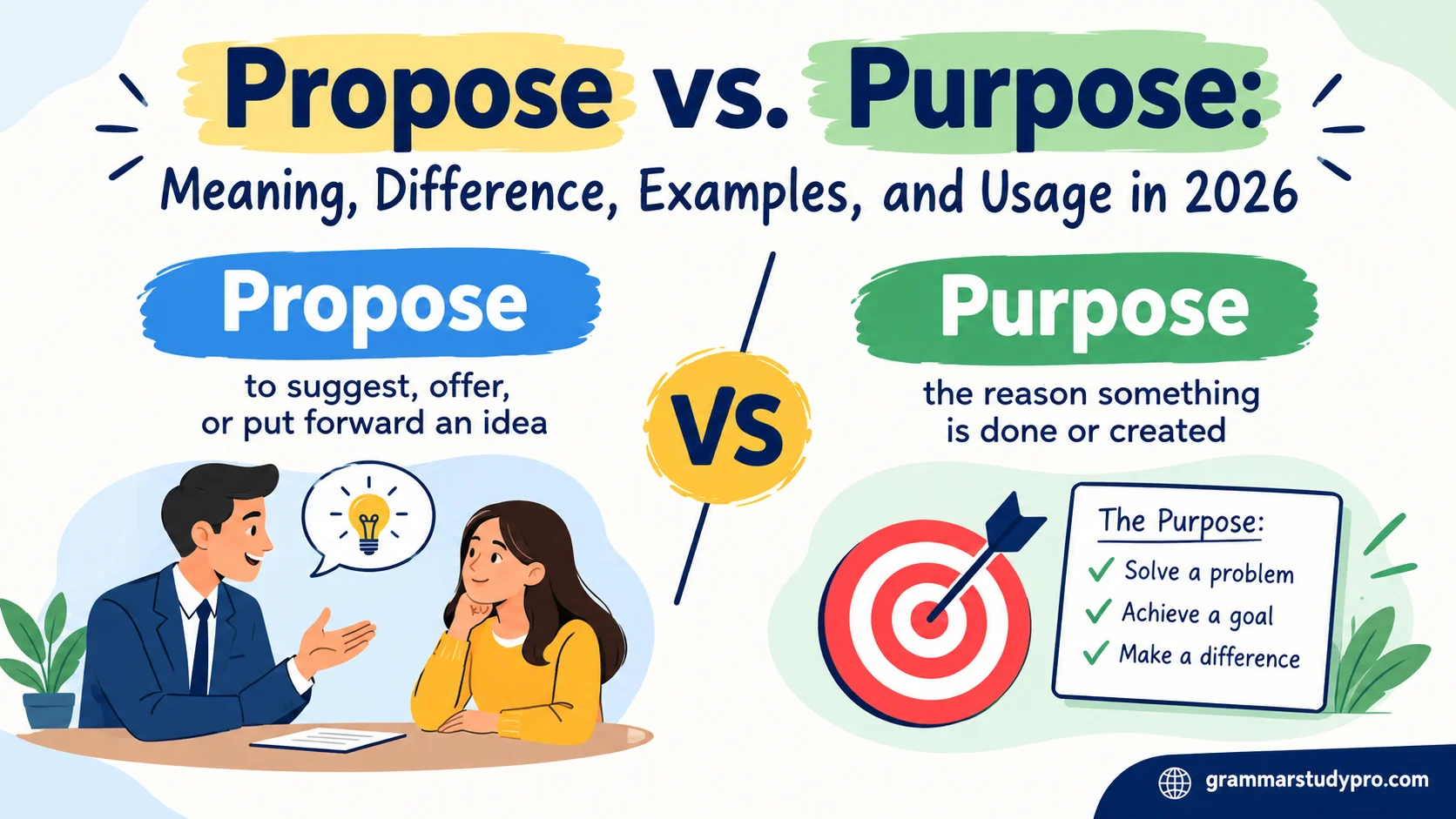
Propose and purpose have different meanings and usually serve different grammatical roles.
- Propose is primarily a verb.
- Purpose is primarily a noun.
- Propose means to suggest, put forward, intend, or ask someone to marry.
- Purpose means the reason, aim, intended result, or use of something.
- Proposal is the noun connected to propose.
- On purpose means intentionally.
- Propose to do something can mean intend to do something.
- Propose to someone means ask that person to marry you.
A useful memory trick is:
You propose an idea. You explain its purpose.
Cambridge Dictionary lists propose as a verb with meanings including suggesting a plan or action, intending to do something, and asking someone to marry. It defines purpose primarily as the reason for doing something or the reason something exists.
Comparison Overview
The fastest way to understand propose vs. purpose is to place them side by side.
| Feature | Propose | Purpose |
| Part of speech | Mainly verb | Mainly noun |
| Core meaning | Suggest or put forward | Reason, aim, or intended use |
| Main question answered | What is someone suggesting? | Why is something done or used? |
| Example | They proposed a new plan. | The purpose of the plan is to save time. |
| Another meaning | Ask someone to marry | Determination or sense of direction |
| Common expression | propose to someone | on purpose |
| Related word | proposal | purposeful |
| Pronunciation | /prəˈpoʊz/ | /ˈpɝː.pəs/ |
The pronunciation difference matters too. In US English, propose is pronounced /prəˈpoʊz/, while purpose is /ˈpɝː.pəs/. Notice where the stress falls: proPOSE emphasizes the second syllable, while PURpose emphasizes the first.
Main Differences Between Propose vs. Purpose
The most important distinction is simple: propose describes an action, while purpose describes a reason or aim.
Propose is usually an action
When you propose something, you’re putting an idea, plan, suggestion, or course of action forward for consideration.
For example:
- The engineer proposed a safer design.
- Maria proposed changing the schedule.
- The committee proposed a new rule.
- The researcher proposed an alternative explanation.
In each sentence, someone takes an idea and presents it.
Cambridge describes this use of propose as offering or suggesting a possible plan or action for other people to consider.
Purpose explains “why”
When you talk about purpose, you’re explaining the reason behind an action, object, system, project, or decision.
For example:
- The purpose of the meeting is to discuss the budget.
- The purpose of the tool is to simplify data entry.
- The purpose of the study was to examine customer behavior.
- The purpose of the campaign was to raise awareness.
Here, the word purpose answers a basic question:
Why?
Cambridge defines purpose as why someone does something or why something exists. It also includes meanings connected to intended results, uses, determination, and personal direction.
Propose can involve intention
There’s another important meaning of propose that sometimes causes confusion.
In formal English, propose can mean intend to do something:
- How do you propose to solve the problem?
- We propose to expand the facility next year.
- I don’t propose to discuss that issue today.
Cambridge specifically identifies this construction as a formal use meaning “to intend to do something.”
So propose doesn’t always mean “suggest.” Context determines the meaning.
Purpose can describe determination
Purpose also has an abstract meaning connected with determination or a clear sense of direction.
For example:
- She worked with a strong sense of purpose.
- The project gave him a renewed sense of purpose.
- He approached the task with real purpose.
This meaning is different from the basic idea of “reason,” although the concepts remain closely related. Cambridge includes determination and a feeling of having a reason for what you do among the meanings of purpose.
What Does Propose Mean?
Propose is a versatile verb with several distinct meanings. The surrounding words usually tell you which meaning applies.
Propose means to suggest an idea or plan
This is the most common meaning in professional, academic, and everyday contexts.
You use propose when you put something forward for another person or group to consider.
Examples include:
- The manager proposed a flexible work schedule.
- The scientists proposed a new explanation.
- She proposed a solution to the problem.
- The committee proposed several changes.
- He proposed a different approach.
The object can be a plan, solution, idea, change, motion, policy, method, or other possible action.
For example:
The team proposed a new way to organize customer records.
The team isn’t necessarily carrying out the idea yet. They’re presenting it for consideration.
Propose can introduce a formal motion
In meetings and organizations, propose can have a more formal meaning.
Someone can propose a motion for a group to discuss or vote on.
For example:
The chair proposed a motion to change the meeting schedule.
Cambridge specifically recognizes propose a motion as a formal meeting construction.
Propose can mean recommend someone
You can also propose someone for a position or membership.
For example:
The committee proposed Sarah for membership.
This use means suggesting that someone should be selected or considered for a particular role.
Propose can mean intend
In formal writing, propose can mean that someone intends to do something.
Examples:
- The company proposes to open two new stores.
- How do you propose to handle the situation?
- The researchers propose to examine the issue further.
The structure propose to + verb is particularly useful here.
Propose can mean ask someone to marry
In a completely different context, propose to someone means to ask that person to marry you.
For example:
He proposed to his partner during a weekend trip.
The difference between the two constructions is important:
- propose a plan = suggest a plan
- propose to someone = ask someone to marry you
Cambridge lists the marriage meaning separately from the suggestion and intention meanings.
Propose can also mean make a formal toast
At a formal event, someone can propose a toast.
For example:
I’d like to propose a toast to the newlyweds.
Here, propose means to invite people to express good wishes or respect by raising their glasses and drinking.
What Does Purpose Mean?
Purpose is mainly a noun. It describes the reason something happens, the reason something exists, or the intended aim or use of something.
Purpose means the reason for an action
This is the core meaning.
For example:
- What is the purpose of this meeting?
- The purpose of the experiment is to test the theory.
- The purpose of the visit was to inspect the facility.
In each case, purpose explains why the action occurs.
Purpose means intended use
An object can also have a purpose.
Consider a screwdriver. Its purpose is to drive or remove screws.
A fire extinguisher has a different purpose. Its intended use is to help control fires.
In ordinary language:
What is the purpose of this button?
You’re asking what the button is designed or intended to do.
Cambridge includes “an intended result or use” among the meanings of purpose.
Purpose can mean aim
Purpose often overlaps with words such as aim, objective, and goal.
For example:
The purpose of the project is to reduce energy consumption.
You could also describe the project’s aim or objective. However, these words aren’t identical in every context.
A purpose often explains the broader reason behind something. A goal may focus more specifically on an outcome someone wants to achieve.
Purpose can mean determination
Consider this sentence:
She entered the new role with a strong sense of purpose.
This doesn’t simply mean she knew why the role existed. It suggests that she had direction, motivation, and determination.
That gives purpose a more personal dimension.
“On purpose” means intentionally
One of the most common expressions with purpose is on purpose.
If you do something on purpose, you do it intentionally rather than accidentally.
Examples:
- I didn’t break the glass on purpose.
- He ignored the message on purpose.
- Did you do that on purpose?
Cambridge defines on purpose as doing something intentionally rather than by accident.
Propose vs. Purpose Examples
Seeing the words in context makes the distinction much easier.
Workplace examples
The manager proposed a four-day workweek.
The manager suggested the idea.
The purpose of the proposal was to improve employee retention.
The sentence explains why the idea existed.
Academic examples
The researchers proposed a new method for measuring air quality.
The researchers presented a method for consideration.
The purpose of the study was to evaluate the method.
The sentence explains the study’s aim.
Business examples
The company proposed expanding into a new market.
The company put forward a possible course of action.
The purpose of the expansion was to reach more customers.
The sentence explains the reason for that action.
Everyday examples
She proposed meeting for coffee.
She suggested the meeting.
The purpose of the meeting was to catch up.
The second sentence explains why they planned to meet.
Marriage-related example
He proposed to her during their vacation.
Here, proposed has the marriage meaning.
You wouldn’t replace it with purposed. The words aren’t interchangeable.
How to Use Propose in a Sentence
Knowing the definition isn’t enough. You also need to know the grammatical patterns that naturally follow propose.
Propose + noun
Use this structure when you directly name the idea or action being suggested.
Examples:
- They proposed a solution.
- She proposed a new schedule.
- The board proposed several changes.
- He proposed a compromise.
This is one of the most straightforward patterns.
Propose + -ing form
You can follow propose with a gerund when suggesting an activity.
Examples:
- She proposed changing the deadline.
- They proposed building a smaller facility.
- He proposed meeting again next week.
Cambridge provides examples of propose followed by an -ing form.
Propose + that-clause
This structure works especially well in formal and academic writing.
Examples:
- She proposed that we postpone the meeting.
- The researchers proposed that the model be revised.
- He proposed that the company change its strategy.
Cambridge also documents the propose + that structure.
Propose to + verb
This construction can express an intended action, particularly in formal English.
Examples:
- The company proposes to expand.
- How do you propose to solve the problem?
- They propose to launch the product next year.
Don’t automatically interpret every instance of propose to as a marriage proposal. The next word and the overall context matter.
Propose to + person
When the construction is propose to someone, the meaning can involve marriage.
For example:
He proposed to Anna last summer.
The grammar gives you an important clue: Anna is the person receiving the marriage proposal.
How to Use Purpose in a Sentence
The noun purpose has several common patterns worth learning.
The purpose of + noun
This is perhaps the most useful structure.
Examples:
- The purpose of the meeting is to review the budget.
- The purpose of the device is to measure temperature.
- The purpose of the exercise is to improve balance.
The purpose of + -ing
You can also explain the reason for an activity.
For example:
The purpose of collecting this information is to identify patterns.
This construction frequently appears in academic, professional, and technical writing.
For the purpose of + -ing
This expression sounds more formal.
Examples:
- The data was collected for the purpose of analyzing customer behavior.
- The documents were prepared for the purpose of verifying the transaction.
In everyday writing, simpler alternatives often sound more natural:
The data was collected to analyze customer behavior.
The longer construction isn’t wrong. It simply has a more formal tone.
For business, tax, or legal purposes
The plural form purposes appears in many fixed expressions.
Examples:
- for tax purposes
- for business purposes
- for legal purposes
- for insurance purposes
- for administrative purposes
Cambridge’s business dictionary gives several examples of this pattern.
Serve a purpose
Something serves a purpose when it has a useful function or role.
For example:
The warning label serves an important purpose.
You can also say:
The feature serves no practical purpose.
This construction focuses on usefulness rather than a person’s personal motivation.
Propose vs. Purpose: Common Grammar Patterns
| Pattern | Meaning | Example |
| propose + noun | Suggest something | She proposed a solution. |
| propose + -ing | Suggest an activity | He proposed changing the plan. |
| propose + that | Formally suggest | They proposed that we wait. |
| propose to + verb | Intend to do something | They propose to expand. |
| propose to + person | Ask someone to marry | He proposed to her. |
| purpose of + noun | Reason or aim | The purpose of the meeting… |
| purpose of + -ing | Reason for an activity | The purpose of testing… |
| for the purpose of | Intended reason | For the purpose of comparison… |
| on purpose | Intentionally | She did it on purpose. |
| serve a purpose | Have a useful function | The feature serves a purpose. |
This table captures an important point: the words differ not only in meaning but also in the grammatical patterns that naturally surround them.
Propose vs. Purpose Pronunciation
Pronunciation can add another layer of confusion because the spellings look so similar.
How to pronounce propose
In US English:
propose = /prəˈpoʊz/
The main stress falls on the second syllable:
pro-POSE
The final sound is a /z/ sound. Cambridge gives the US pronunciation as /prəˈpoʊz/.
How to pronounce purpose
In US English:
purpose = /ˈpɝː.pəs/
The main stress falls on the first syllable:
PUR-pus
Cambridge gives the US pronunciation as /ˈpɝː.pəs/.
An easy pronunciation trick
Think of the stress like this:
- proPOSE → stress at the end
- PURpose → stress at the beginning
That difference becomes especially noticeable when you say the words aloud.
Propose, Proposal, and Proposed
The propose vs. purpose comparison becomes easier once you understand the word family around propose.
Propose
Propose is a verb.
The committee proposed a new policy.
Proposal
Proposal is a noun.
It usually means a suggestion, plan, or formal idea put forward for consideration.
The committee submitted a proposal.
Cambridge defines proposal as a suggestion and, in business contexts, as a formal suggestion, plan, or idea that is often written.
Proposed
Proposed can function as the past form of propose or as an adjective.
Examples:
The committee proposed several changes.
The proposed changes will take effect next year.
The first sentence describes an action. The second describes changes that someone has put forward.
Purpose
Purpose isn’t another form of propose. It’s a separate word with a different meaning and grammatical role.
The purpose of the proposed changes is to simplify the process.
This sentence brings the relationship into focus:
proposed tells you about the changes that were put forward.
purpose tells you why those changes exist or are being considered.
Propose vs. Proposal vs. Purpose
These three words often appear together in business, education, research, and professional writing.
| Word | Part of speech | Basic meaning | Example |
| Propose | Verb | Suggest or put forward | They proposed a new system. |
| Proposal | Noun | Suggested plan or idea | They submitted a proposal. |
| Purpose | Noun | Reason, aim, or intended use | The purpose is to improve efficiency. |
Consider this natural example:
The team proposed a plan. The proposal explained how the plan would work. Its purpose was to reduce unnecessary costs.
Each word has a separate job.
That’s the key.
Common Mistakes With Propose vs. Purpose
Mistake: Treating propose and purpose as synonyms
They’re related conceptually in some contexts, but they’re not interchangeable.
Incorrect:
She purposed a new marketing strategy.
Better:
She proposed a new marketing strategy.
The standard everyday verb for suggesting the strategy is proposed.
Mistake: Confusing proposal with purpose
A proposal is something put forward.
A purpose is the reason or intended aim.
For example:
The proposal recommends a new training system.
The purpose of the system is to improve employee performance.
One describes the plan. The other explains its reason.
Mistake: Assuming “propose to” always means marriage
It doesn’t.
Compare:
They propose to build a new office.
Here, propose to build means intend or plan to build.
Now compare:
He proposed to his partner.
Here, the meaning is marriage.
Context does the heavy lifting.
Mistake: Confusing “on purpose” with “for a purpose”
These expressions aren’t identical.
On purpose means intentionally.
She deleted the file on purpose.
For a purpose means for a particular reason or intended use.
The file was created for a specific purpose.
The first describes intentional behavior. The second describes reason or intended use.
Is “Purpose” Ever a Verb?
Yes, although this is where beginners can easily get tangled.
Most everyday uses of purpose are as a noun:
The purpose of the meeting is to discuss the budget.
However, English dictionaries also recognize purpose as a verb in specialized or formal usage meaning to intend or resolve.
That doesn’t make purpose a normal substitute for propose.
In ordinary modern writing, if you mean “suggest a plan,” use propose:
She proposed a new approach.
If you mean “reason or aim,” use purpose:
The purpose of the approach is to reduce costs.
This distinction keeps your writing natural and precise.
Propose vs. Purpose in Academic Writing
Academic writing uses both words frequently, but they perform different jobs.
Propose in research
Researchers often propose theories, explanations, models, methods, or hypotheses.
Examples:
- The researchers proposed a new model.
- The authors propose that several factors contribute to the outcome.
- The study proposes an alternative explanation.
Here, propose signals that the writer is putting forward an idea for consideration.
Purpose in research
Academic papers frequently use purpose to explain the reason for a study.
Examples:
- The purpose of this study is to examine consumer behavior.
- The primary purpose of the experiment was to test the hypothesis.
- The research was conducted for the purpose of evaluating the method.
A useful distinction is:
Researchers propose ideas. Studies have purposes.
That’s not an absolute rule, but it’s a reliable guide for many academic sentences.
Propose vs. Purpose in Business English
Business communication offers some of the clearest examples of the difference.
Imagine a company wants to reduce delivery delays.
A manager might write:
I propose introducing regional distribution centers.
That sentence presents an idea.
The manager might then explain:
The purpose of this change is to shorten delivery times.
That sentence explains the reason.
A formal document could then become a proposal:
The proposal outlines the cost, timeline, staffing requirements, and expected results.
The three terms form a neat chain:
Propose → Proposal → Purpose
The company proposes an idea.
The written proposal describes it.
The purpose explains why the idea matters.
A Practical Case Study: One Project, Three Words
Imagine a school wants to reduce food waste in its cafeteria.
The school administrator proposes a new system that lets students choose smaller portions.
The school creates a written proposal explaining the system, expected costs, staffing requirements, and implementation timeline.
The purpose of the system is to reduce unnecessary food waste while giving students more control over portion sizes.
Notice how naturally the three words fit together:
The administrator proposed a portion-control system. The proposal described how it would work. The purpose of the system was to reduce food waste.
This is the distinction in action. No complicated grammar lesson is needed once the roles become visible.
Propose vs. Purpose Synonyms
Understanding related words can sharpen your vocabulary.
Synonyms related to propose
Depending on context, propose can be close to:
- suggest
- recommend
- present
- offer
- put forward
- submit
- nominate
- intend
- plan
These aren’t perfect replacements in every sentence.
For example, nominate works when putting forward a person for a position. It doesn’t normally replace propose when suggesting a general solution.
Merriam-Webster’s thesaurus likewise groups propose with words such as suggest, offer, recommend, present, and put forward.
Synonyms related to purpose
Depending on context, purpose can be related to:
- reason
- aim
- goal
- objective
- intention
- function
- use
- mission
Again, context matters.
For example, function often describes what something is designed to do:
The function of the switch is to control the lights.
Purpose can describe the same basic idea:
The purpose of the switch is to control the lights.
But in a personal context, purpose can refer to meaning or direction:
She found a new sense of purpose.
Function wouldn’t carry the same meaning there.
Propose vs. Purpose: A Quick Decision Test
When you’re unsure which word to use, ask yourself one question.
Are you putting an idea forward?
Use propose.
They proposed a new schedule.
Are you explaining why something exists or happens?
Use purpose.
The purpose of the schedule is to reduce delays.
Are you referring to a written plan?
Use proposal.
The team submitted a proposal.
Are you saying something happened intentionally?
Use on purpose.
He changed the settings on purpose.
This four-part test handles most everyday situations.
Propose vs. Purpose Practice Quiz
Choose propose, purpose, proposal, or an appropriate form.
Questions
- The committee ___ a new safety procedure.
- What is the ___ of this device?
- The researchers ___ a different explanation.
- The main ___ of the study is to examine the results.
- The company submitted a detailed ___.
- He did it ___.
- The organization ___ to expand its services.
- The ___ of the program is to improve access.
- She ___ changing the meeting time.
- He ___ to his partner during their vacation.
Answers
- proposed
- purpose
- proposed
- purpose
- proposal
- on purpose
- proposes
- purpose
- proposed
- proposed
The important part isn’t memorizing the answer key. Look at what each word does.
If the sentence needs an action of suggesting, choose a form of propose.
If it needs a reason or aim, choose purpose.
If it needs the plan or suggestion itself, choose proposal.
FAQs
What is the difference between propose and purpose?
Propose is a verb meaning to suggest an idea, plan, or action. Purpose is a noun that means the reason, intention, or goal behind something.
How do you use propose in a sentence?
You can use propose when someone suggests an idea, plan, or course of action. For example, “I propose a new marketing strategy for the company.”
How do you use purpose in a sentence?
Use purpose when explaining why something exists or why someone does something. For example, “The purpose of the meeting is to discuss the new strategy.”
Is propose a verb or a noun?
Propose is a verb. It describes an action, such as suggesting or presenting an idea.
Is purpose a verb or a noun?
Purpose is usually a noun. It refers to the reason, intention, or goal behind an action, object, or activity.
Conclusion
Understanding propose vs. purpose becomes easier when you remember their basic roles. Propose describes what you suggest or do, while purpose explains why something is done. Keeping this simple distinction in mind can help you write and speak more clearly, whether you’re working on an email, essay, business proposal, or everyday conversation.