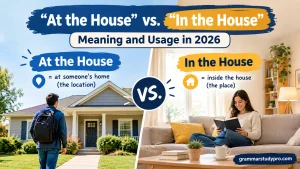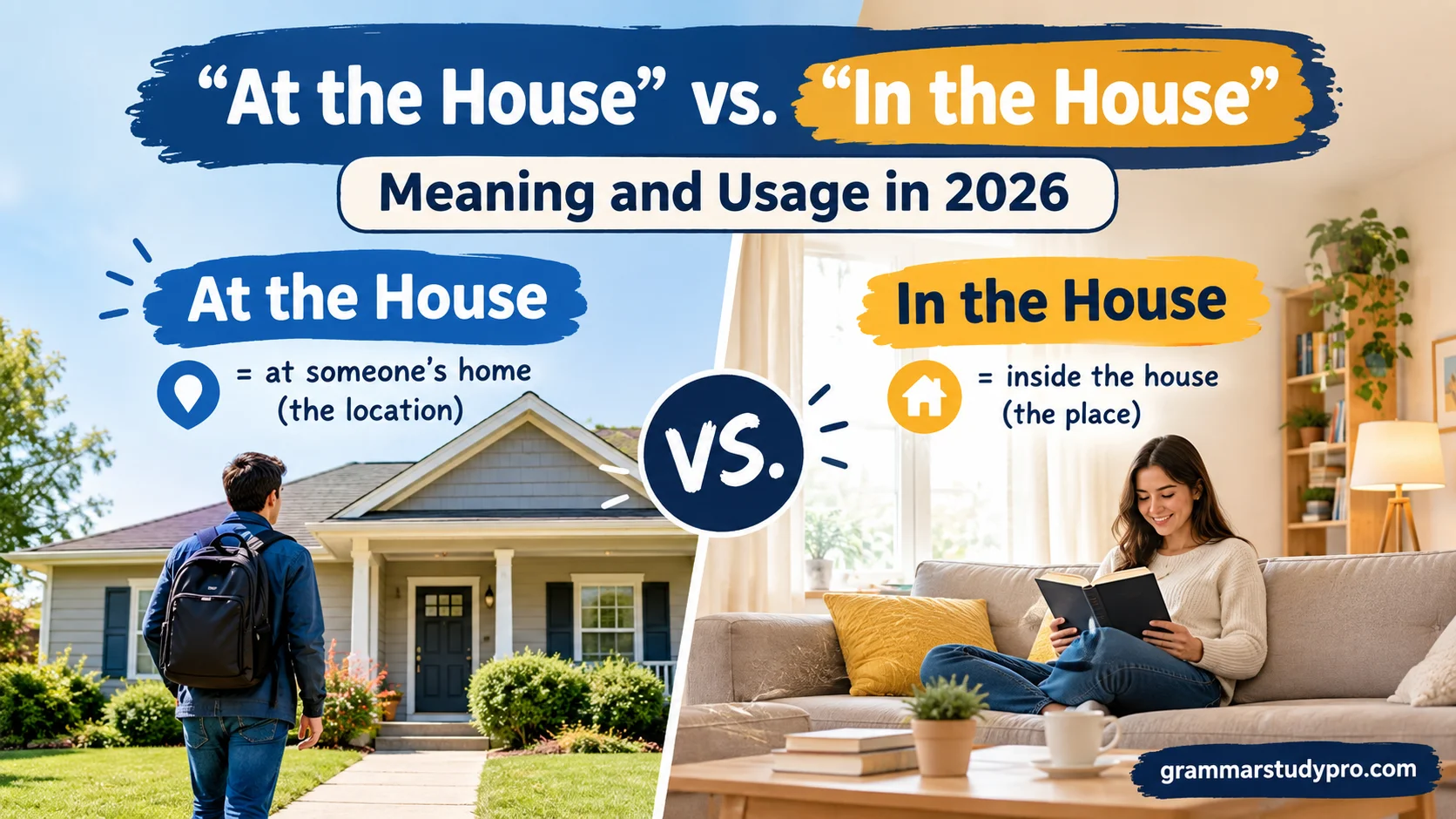
“At the House” vs. “In the House” helps English learners understand tricky prepositions, different meanings, and natural usage in context today. When these short phrases seem almost identical, confusion can follow, but their meaning becomes clear when you consider location. At the house usually refers to a general location, such as being near the property, outside, or approaching a home for a social visit. You might say, “I’ll meet you at the house later.” However, in the house points directly to being inside the building, where you are physically surrounded by walls and rooms. This main difference makes the concept easier: at gives a broader sense of location, while in focuses on the inside space. A simple approach is to think about where you are instead of relying on instinct, because choosing the wrong form can change the meaning and cause misunderstanding in communication.
The structure becomes clear through real examples from everyday life, books, movies, social environments, and professional environments. From my experience and observation, this helps learners stop guessing and start thinking about context, making these patterns less random and easier to control. The distinction may seem tricky or confusing, almost like a nightmarish maze of grammar rules, especially when strict rules appear illogical. The feeling can seem Kafkaesque, recalling the Czech writer Franz Kafka and his bureaucratic systems. Yet the essence stays simple: at can describe a place for a party or visit, while in describes the reality of being within someone’s home or another private environment. Once you use phrases correctly, your understanding develops naturally, reducing powerlessness, helplessness, and the overwhelming feeling that can come from wondering which form is correct.
Quick Answer
“At the house” usually means at the house or its general location/property. It focuses on the house as a place or point on a map rather than specifically saying someone is indoors.
“In the house” means inside the house. It focuses on the interior of the building.
For example:
- “I’ll meet you at the house.” → The house is the meeting location.
- “I’ll wait for you in the house.” → The speaker will wait inside the building.
- “Tom is at the house.” → Tom is at that property or location.
- “Tom is in the house.” → Tom is physically inside the building.
A simple rule works in most everyday situations:
Use “at” when the house is the location. Use “in” when the inside of the house matters.
However, context matters. “At the house” doesn’t necessarily mean someone is standing outside. It can refer to someone who is inside the house as part of the broader location.
Comparison Overview
The clearest way to understand “at the house” vs. “in the house” is to compare what each preposition emphasizes.
| Phrase | Main meaning | Spatial focus | Example |
| At the house | At the house/property as a location | General location | “We’re at the house.” |
| In the house | Inside the house | Interior space | “We’re in the house.” |
| At home | At one’s home | Residence/general location | “I’m at home.” |
| To the house | Toward or to the house | Destination | “We’re going to the house.” |
| Into the house | Moving inside the house | Movement into an interior | “She went into the house.” |
| Inside the house | Within the interior | Strong interior emphasis | “The dog is inside the house.” |
The distinction is primarily about perspective.
When you say “at the house,” imagine the house as a location on a map. When you say “in the house,” imagine yourself looking at the interior.
That difference may be subtle, but it can change the mental picture created by the sentence.
Main Differences Between “At the House” vs. “In the House”
The biggest difference between “at the house” and “in the house” involves the amount of spatial information each phrase provides.
“At the House” Focuses on the Location
The preposition at often identifies a particular point, place, or location.
Consider:
“I’ll see you at the house.”
The speaker isn’t necessarily emphasizing the inside of the building. The important information is where the meeting will happen.
The house could have a driveway, porch, yard, garage, or other areas associated with the property. The phrase can cover that broader setting.
That’s why “at the house” works naturally when talking about visits, meetings, pickups, deliveries, and gatherings.
“In the House” Focuses on the Interior
The preposition in creates a stronger sense of enclosure.
When someone says:
“I’ll see you in the house.”
the natural interpretation is that the meeting will happen inside the building.
The speaker could be distinguishing the interior from the yard, driveway, porch, or street.
For example:
“Don’t leave the package outside. Put it in the house.”
Here, in clearly contrasts with being outside.
The Difference Is About What You Want to Emphasize
Neither preposition is automatically better.
Instead, ask what information matters.
If you’re identifying a general location: use at.
If you’re specifying an interior location: use in.
This distinction appears throughout English:
- at the office → general workplace location
- in the office → inside the office
- at the school → school as a location
- in the school → inside the school building
- at the restaurant → restaurant as a location
- in the restaurant → inside the restaurant
The same spatial principle helps explain “at the house” vs. “in the house.”
What Does “At the House” Mean?
“At the house” means being at a particular house or its associated location.
The phrase doesn’t necessarily tell you exactly where on the property someone is standing.
They could be:
- Inside the house
- On the porch
- In the driveway
- In the yard
- Near the entrance
- Somewhere else immediately associated with the property
The exact interpretation depends on context.
Examples of “At the House”
Here are several natural examples:
- “I’ll meet you at the house at six.”
- “She’s at the house with the children.”
- “We’re at the house now.”
- “There’s a plumber at the house.”
- “He left his car at the house.”
- “Everyone is gathering at the house tonight.”
- “The delivery driver is at the house.”
- “We spent the afternoon at the house.”
Notice that none of these sentences necessarily requires the person to be inside the building.
“At the House” Can Refer to the Broader Property
Imagine someone asks:
“Where’s Jake?”
You might answer:
“He’s at the house.”
That tells the listener Jake’s general location. It doesn’t answer whether Jake is sitting in the living room, standing on the porch, or working in the garage.
The phrase gives location without interior precision.
That’s often exactly what the speaker needs.
“At the House” Is Common for Meetings and Plans
Suppose two friends are arranging where to meet.
“Where should we meet?”
“Let’s meet at the house.”
The phrase works because the house serves as the meeting point.
The speaker isn’t necessarily concerned with whether everyone waits in the kitchen or stands outside. The important thing is the location.
What Does “In the House” Mean?
“In the house” means physically within the house’s interior.
The phrase gives more specific spatial information than “at the house.”
For example:
“The children are in the house.”
This normally means the children are indoors.
Likewise:
“I heard a strange noise in the house.”
The phrase places the source of the noise inside the building.
Examples of “In the House”
- “The kids are in the house.”
- “Your jacket is in the house.”
- “I heard someone in the house.”
- “It’s warmer in the house.”
- “There’s nobody in the house.”
- “The dog is in the house.”
- “She left her phone in the house.”
- “We stayed in the house during the storm.”
Each example focuses on the interior.
“In the House” Can Create a Clear Inside/Outside Contrast
This becomes particularly obvious when a sentence contrasts indoor and outdoor locations.
For example:
“The children are playing outside, but their parents are in the house.”
Here, in matters because the sentence establishes two different spaces.
Another example:
“The guests are in the house, while the musicians are setting up in the yard.”
The phrase immediately creates a mental picture of people occupying the building’s interior.
Does “At the House” Mean Inside the House?
Not necessarily.
This is one of the most common points of confusion.
If someone says:
“John is at the house.”
you can’t always conclude that John is inside the building.
He might be:
- Sitting in the backyard
- Standing on the porch
- Working in the garage
- Waiting in the driveway
- Inside the house
The phrase simply places John at that location.
By contrast:
“John is in the house.”
specifically indicates an interior location.
Why Context Can Change the Interpretation
Imagine a family member calls and asks:
“Where are you?”
You answer:
“I’m at the house.”
They may reasonably understand that you’re at the property. In casual conversation, they might assume you’re inside if nothing suggests otherwise.
Now imagine someone asks:
“Is Dad outside?”
You answer:
“No, he’s in the house.”
The second sentence provides exactly the detail the listener needs.
So “at” doesn’t always exclude the interior. It simply doesn’t make the interior the grammatical focus.
Why Do We Use “At” With a House?
The answer becomes clearer when you understand the general function of at.
English often uses at to identify a particular location or point.
Consider these common expressions:
- at home
- at work
- at school
- at the office
- at the station
- at the airport
- at the door
- at the house
In each case, the speaker can treat the place as a location rather than focusing on its physical interior.
For example:
“I’m at the office.”
This doesn’t necessarily mean you’re standing outside the office door. You might be sitting at your desk.
The sentence simply identifies the office as your current location.
The same idea applies to:
“I’m at the house.”
The house functions as the location being identified.
Why Do We Use “In” With a House?
In expresses a position within an enclosed space.
A house is a physical structure with an interior. Therefore, English naturally uses in when the speaker wants to identify something as being inside it.
Compare:
- “The car is at the house.”
- “The car is in the garage.”
The first gives the broader location. The second gives a specific enclosed space.
Another example:
- “The children are at the house.”
- “The children are in the house.”
The first tells you where they are generally. The second tells you they’re indoors.
“At the House” vs. “At Home”
These expressions overlap sometimes, but they aren’t identical.
“At home” normally refers to someone’s home or residence.
“I’m at home.”
“At the house” normally identifies a particular house.
“I’m at the house.”
The house doesn’t necessarily have to belong to the speaker.
For example:
“We’re at Grandma’s house.”
Here, at identifies Grandma’s house as the location.
You could also say:
“We’re at the house.”
if the context already makes the specific house clear.
Compare These Sentences
| Sentence | What it emphasizes |
| “I’m at home.” | My home/residence |
| “I’m at the house.” | A particular house/location |
| “I’m in the house.” | The interior of the house |
| “I’m inside the house.” | Strong emphasis on being indoors |
The surrounding conversation determines which expression makes the most sense.
“In the House” vs. “Inside the House”
“In the house” and “inside the house” have very similar meanings.
However, inside can add emphasis.
Compare:
“The dog is in the house.”
with:
“The dog is inside the house.”
The second version can sound more deliberate, especially when contrasting inside with outside.
For example:
“The dog is inside the house. Don’t let it out.”
Here, inside reinforces the location.
In ordinary conversation, though, in the house is usually enough.
“At the House” vs. “To the House”
Another important distinction involves movement.
At generally describes where someone is.
To commonly identifies a destination.
Compare:
“She is at the house.”
and:
“She went to the house.”
The first describes her location. The second describes movement toward a destination.
This difference becomes even clearer with:
“She went to the house and waited at the house.”
The movement takes her to the location. Once she arrives, she is at that location.
“In the House” vs. “Into the House”
The same principle applies to in and into.
“In” Describes Location
“The boy is in the house.”
He is already inside.
“Into” Describes Movement
“The boy ran into the house.”
He moved from outside to inside.
This distinction matters because in and into aren’t simply interchangeable versions of the same preposition.
| Expression | Function | Example |
| in the house | Location | “She is in the house.” |
| into the house | Movement inward | “She walked into the house.” |
“At the House” vs. “In the House” in Everyday Situations
The best way to master this distinction is to see how real conversations use both expressions.
When You’re Meeting Someone
“Meet me at the house.”
The house is the meeting location.
If you say:
“Meet me in the house.”
you’re making the meeting place more specific. The listener should expect to meet you indoors.
When You’re Looking for Someone
“Is Mark here?”
“Yes, he’s at the house.”
This provides a general location.
But if the question is:
“Is Mark outside?”
you might answer:
“No, he’s in the house.”
The second answer supplies the exact spatial distinction the question requires.
When Someone Is Visiting
“We’re at the house all weekend.”
This can refer to spending time at the property generally.
But:
“We’re staying in the house.”
puts more emphasis on staying inside the building.
When Describing a Party
“There’s a party at the house tonight.”
The house functions as the venue.
Now consider:
“Everyone is dancing in the house.”
The focus shifts to what is happening inside.
Both phrases can describe the same event without being redundant.
Common Mistakes With “At the House” and “In the House”
Understanding the mistakes can make the rule stick faster.
Mistake: Thinking “At” Always Means Outside
This isn’t correct.
“At the house” can include the house itself and its surrounding property.
Someone can say:
“I’m at the house.”
while sitting inside the living room.
The phrase simply doesn’t specifically emphasize the interior.
Mistake: Assuming the Two Phrases Always Mean Exactly the Same Thing
They can overlap in context, but their spatial focus differs.
“At the house” gives broader location information.
“In the house” gives interior information.
When precision matters, that difference becomes important.
Mistake: Using “In” When You Mean a Meeting Location
Consider:
“The contractor will meet us in the house.”
This suggests the contractor will meet you inside.
If the intended meaning is simply the property as a meeting point, then:
“The contractor will meet us at the house.”
is often more appropriate.
Mistake: Confusing “At the House” With “At Home”
These expressions aren’t interchangeable in every situation.
“I’m at home.”
usually means you’re at your own home.
“I’m at the house.”
usually points to a particular house established by context.
American English Usage of “At the House”
In American English, “at the house” commonly appears in everyday conversations involving location and plans.
Examples include:
- “I’ll be at the house tonight.”
- “Meet us at the house.”
- “She’s waiting at the house.”
- “The kids are at the house.”
- “There’s someone at the house.”
- “We’re having dinner at the house.”
The phrase often sounds natural when the house represents the broader destination or setting.
The exact meaning still depends on the conversation.
American English Usage of “In the House”
American English also uses “in the house” frequently when speakers need to emphasize an interior location.
Examples include:
- “He’s in the house.”
- “The keys are in the house.”
- “I heard a noise in the house.”
- “The children are in the house.”
- “There’s food in the house.”
- “Nobody is in the house.”
Here, in creates a clear mental boundary: outside the building versus inside it.
Real-World Case Studies
Case Study: Picking Up a Friend
Suppose you’re driving to your friend’s home.
You text:
“I’m at the house.”
This tells your friend you’ve arrived at the property.
You might be sitting in your car outside.
Now imagine you’ve entered the building and text:
“I’m in the house.”
Your friend now knows you’re indoors.
Lesson: Use at for the broader arrival location. Use in when the interior matters.
Case Study: A Family Gathering
Imagine a family gathering at a relative’s property.
Someone asks:
“Where is everyone?”
You reply:
“Most people are at the house.”
The phrase describes the gathering generally.
Later, someone asks:
“Where are the children?”
You respond:
“They’re in the house.”
Now you’re identifying their specific indoor location.
Lesson: Speakers can naturally switch between at and in during the same conversation.
Case Study: A Strange Noise
Imagine you’re outside and hear a strange sound.
You tell a neighbor:
“There’s a strange noise in the house.”
Here, in matters because you’re locating the sound inside the building.
If you instead say:
“There’s a lot of activity at the house.”
the phrase gives a broader impression. The activity could involve people inside, outside, or around the property.
Lesson: Choose the preposition according to the spatial detail you need.
A Practical Decision Guide for “At the House” vs. “In the House”
When you’re unsure, ask yourself one question:
Am I talking about the house as a location or about the inside of the house?
If you’re talking about the general location, choose:
at the house
If you’re talking specifically about the interior, choose:
in the house
You can use this quick guide:
| What you mean | Use |
| A general location | at the house |
| A meeting point | at the house |
| A property where an event occurs | at the house |
| Inside the building | in the house |
| An object located indoors | in the house |
| A sound coming from indoors | in the house |
| An indoor activity | in the house |
When both sound possible, think about what picture you want the listener to form.
FAQs
Is “at the house” correct English?
Yes, “at the house” is correct. It usually describes a general location, such as being near or around a home.
Is “in the house” correct English?
Yes, “in the house” is also correct. It normally means that someone is inside the house, within its rooms or walls.
What is the main difference between “at the house” and “in the house”?
The key difference is location versus inside space. At the house gives a broader idea of where someone is, while in the house shows that the person is physically inside.
Can I use “at the house” for a social visit?
Yes. For example, you can say, “We’re meeting at the house tonight.” The phrase focuses on the house as the meeting location rather than specifically saying everyone is inside.
How can I remember which phrase to use?
Think about the context. If you mean the general place or meeting point, use at the house. If you mean being physically inside the building, use in the house.
Conclusion
Understanding “at the house” and “in the house” becomes much easier when you focus on the intended location. At the house describes a broader place or meeting point, while in the house emphasizes being inside the building. Once you notice this small difference in everyday English, choosing the right preposition becomes more natural and less confusing.