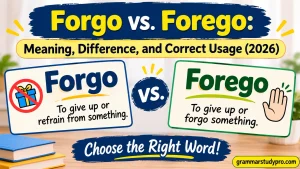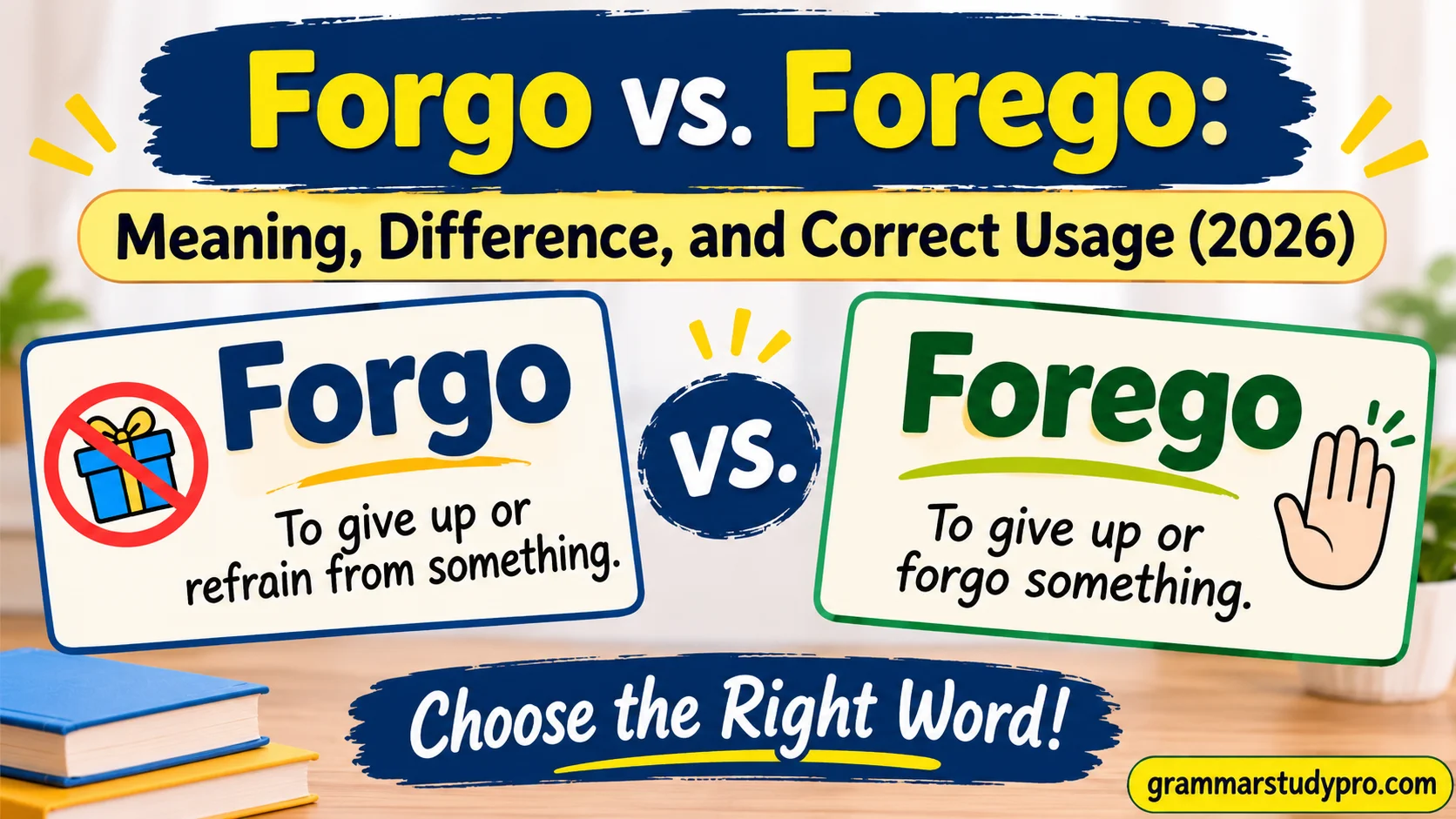
Forgo vs. Forego can confuse writers because the words look alike, yet their traditional meanings and uses are different in English writing.
Forgo means to give up, do without, or pass up something voluntarily. For example, you might skip dessert to reduce your sugar intake or refrain from an activity. It can also describe choosing to omit, avoid, or abstain from something. In more formal situations, you might sacrifice, relinquish, waive, or renounce a right or opportunity. Forego, traditionally, means to precede something or come before it in time, place, or order. Its common participial forms are foregone and foregoing.
For instance, a foregone conclusion describes an outcome that seems certain before a decision is announced. Similarly, a foregoing statement refers to information presented earlier. You may encounter these expressions in legal writing, an effective brief, or a statement of facts. An agenda might even mention that the secretary’s report will precede the board’s vote, although using forego this way is rare.
The grammatical difference becomes important in formal writing, including legal documents, an academic paper, a business report, or a professional email. Although dictionaries recognize Forego as an alternative spelling of Forgo in its modern sense, their traditional meanings remain different. This overlap explains their common usage and occasional confusion in books, articles, and everyday conversations. Here’s a simple way to remember the distinction: think of fore in before when discussing sequence, and associate forgo with giving something up. This memory trick can improve your word choice, vocabulary, and writing clarity. It also helps you avoid common errors, incorrect usage, and awkward mistakes in professional and academic writing.
Quick Answer:
Forgo means to give something up, abstain from something, or decide to do without something you would otherwise enjoy or use.
Forego traditionally means to precede something or come before it in time or order. However, it also works as an accepted alternative spelling of forgo in the sense of giving something up.
Here is the simplest way to distinguish their traditional meanings:
- Forgo: To give something up or do without it.
- Forego: To come before or precede something.
Consider these examples:
- Forgo: Maria decided to forgo dessert to reduce her sugar intake.
- Forego: The foregoing paragraph explains the main purpose of the research.
In the first sentence, Maria chooses to do without dessert. In the second, foregoing refers to the paragraph that appeared earlier.
Quick tip: When you mean giving something up, choose forgo. When you mean something that comes before another thing, use forego or its forms, such as foregoing and foregone.
Comparison Overview: Forgo vs. Forego
Although forgo and forego share a pronunciation, their traditional meanings and usage differ. Looking at their grammatical forms makes the distinction easier to understand.
| Comparison Point | Forgo | Forego |
| Primary meaning | To give up or do without something | To precede or come before something |
| Alternative meaning | None needed | An accepted variant of forgo |
| Part of speech | Verb | Verb |
| Pronunciation | /fɔrˈɡoʊ/ | /fɔrˈɡoʊ/ |
| Present tense | Forgo | Forego |
| Third-person singular | Forgoes | Foregoes |
| Simple past | Forwent | Forewent |
| Past participle | Forgone | Foregone |
| Present participle | Forgoing | Foregoing |
| Common expression | Forgone opportunity | Foregoing discussion |
| Typical context | Sacrifice, abstention, or refusal | Sequence, time, or previously mentioned information |
The table highlights an important detail: the spellings can overlap when forego means giving something up. Nevertheless, the traditional meaning of forego remains distinct.
For example, you can write either of these sentences:
- She decided to forgo the expensive vacation.
- She decided to forego the expensive vacation.
Both communicate that she chose not to take the vacation. However, forgo is generally the clearer and more conventional spelling for this meaning.
On the other hand, consider this sentence:
- The foregoing discussion covers the essential details.
Here, foregoing refers to information presented earlier. Replacing it with forgoing would change the intended meaning.
Main Differences Between Forgo and Forego
The easiest way to understand these words is to examine what each one communicates. One describes a decision to go without something while the other traditionally describes something that comes before.
Meaning of Forgo
The verb forgo means to voluntarily give up something, refrain from doing something, or decide not to use something.
It often describes a choice involving a benefit, pleasure, opportunity, or personal preference. The thing someone gives up might be enjoyable or useful, but another priority makes the sacrifice worthwhile.
For example, imagine someone saving money for a new home. Instead of purchasing expensive clothes every month, that person decides to forgo unnecessary shopping.
The decision involves giving up a temporary pleasure to achieve a larger financial goal.
You can use forgo in several situations:
- Food and drinks: She decided to forgo coffee before her medical appointment.
- Money: The family chose to forgo expensive vacations to save for retirement.
- Entertainment: He agreed to forgo the concert because he had an important examination.
- Opportunities: They decided to forgo the offer because it didn’t match their expectations.
- Personal preferences: I sometimes forgo television to spend more time reading.
Notice that each example describes a deliberate decision. The person chooses not to enjoy, receive, or participate in something.
The word also appears frequently in formal writing because it communicates sacrifice without requiring lengthy explanations.
For instance:
“Employees may forgo certain benefits in exchange for additional compensation.”
This sentence communicates a specific decision in a professional setting.
Meaning of Forego
The traditional meaning of forego is to precede something or come before it in time, place, or order.
The word connects with the prefix fore-, which means earlier, previous, or ahead. You can recognize the same prefix in familiar words such as foreword, forefather, and forehead.
Unlike forgo, traditional forego doesn’t describe giving something up. Instead, it establishes a relationship between two things in a particular sequence.
For example:
“The introduction foregoes the detailed explanation of the research findings.”
This sentence uses foregoes to indicate that the introduction comes before the detailed explanation.
However, the traditional meaning appears more commonly in forms such as foregoing and foregone.
Consider these additional examples:
- The foregoing chapters explain the history of the organization.
- The information presented in the foregoing section supports the argument.
- The events that forewent the announcement influenced public opinion.
The last example uses forewent to describe something that happened earlier. Although grammatically possible, this construction sounds unusual in contemporary English.
In most everyday and professional writing, precede, come before, or occur earlier will communicate the idea more naturally.
When Are Forgo and Forego Interchangeable?
This is where the distinction becomes slightly more complicated.
Although the traditional meanings differ, major dictionaries recognize forego as an alternative spelling of forgo when the intended meaning involves giving something up.
The American Heritage Dictionary identifies forego as a variant of forgo. Oxford also lists both spellings for the meaning of deciding not to have or do something.
For example:
- She chose to forgo her afternoon snack.
- She chose to forego her afternoon snack.
Both sentences are acceptable when the writer means that she decided not to have the snack.
However, this doesn’t mean the words are interchangeable in every situation.
Compare the following examples:
| Sentence | Correct Interpretation |
| He decided to forgo the opportunity. | He gave up the opportunity. |
| He decided to forego the opportunity. | He gave up the opportunity; forego is an accepted variant. |
| The foregoing statement needs clarification. | The statement appeared earlier. |
| The forgoing statement needs clarification. | Incorrect if the intended meaning is previously mentioned. |
The distinction depends on context rather than pronunciation.
For clear communication, use forgo when discussing sacrifice or abstention. Reserve forego for its traditional meaning when discussing sequence or precedence.
Forgo vs. Forego: The Difference in One Sentence
You don’t need to memorize complicated grammatical rules to remember these words.
Simply associate forgo with giving something up and forego with coming before something.
- Forgo: I will forgo the extra expense to save money.
- Forego: The foregoing explanation describes the earlier decision.
A useful memory trick is to connect the letter e in forego with the word before. Both contain the same spelling pattern.
However, remember that forego can also mean giving something up as an accepted spelling variant.
Understanding the Meaning and Usage of Forgo
Now that you understand the basic distinction, let’s examine how forgo works in actual sentences.
Forgo as a Verb
Forgo functions as a verb and generally takes a direct object. That object identifies whatever someone chooses to give up, avoid, or do without.
For example:
- She decided to forgo the invitation.
- The company agreed to forgo additional charges.
- He chose to forgo his usual afternoon coffee.
In each sentence, the verb acts on something specific.
You can also use forgo in different grammatical constructions:
Present tense:
- I forgo unnecessary purchases whenever possible.
- She forgoes dessert during the week.
Past tense:
- We forwent the opportunity to travel abroad.
- He forwent his usual lunch break.
Present participle:
- They are forgoing unnecessary expenses this year.
- She is forgoing her usual weekend activities.
Past participle:
- The company has forgone several optional expenses.
- He had forgone the opportunity before receiving the final offer.
These forms allow you to use the word naturally across different tenses and sentence structures.
Common Situations Where You Can Use Forgo
Although forgo sounds somewhat formal, it fits many everyday situations.
Here are some practical examples that show how the word works.
Giving up food or drinks
People often forgo certain foods or drinks because of personal preferences, health goals, or dietary choices.
- I decided to forgo dessert after dinner.
- She sometimes forgoes coffee in the afternoon.
- He chose to forgo sugary drinks for a month.
Saving money
Financial decisions often require people to sacrifice short-term enjoyment.
- We decided to forgo an expensive vacation this year.
- The couple agreed to forgo unnecessary purchases.
- She chose to forgo a new phone and save the money.
Declining opportunities
Sometimes an opportunity doesn’t match your priorities. In that situation, forgo communicates your decision clearly.
- He decided to forgo the promotion because it required frequent travel.
- The company chose to forgo the partnership.
- They willingly forwent the opportunity to expand.
Avoiding unnecessary activities
You can also use forgo when someone chooses not to participate in an activity.
- I will forgo the meeting because my presence isn’t necessary.
- She decided to forgo the weekend trip.
- They agreed to forgo the traditional celebration.
In each situation, the word communicates a conscious choice rather than an accidental absence.
Synonyms and Related Words for Forgo
Several English words share meanings with forgo. However, their precise meanings and grammatical patterns can differ.
| Synonym | Meaning | Example |
| Abstain | Choose not to participate or indulge | He decided to abstain from alcohol. |
| Relinquish | Give up possession, control, or a right | She relinquished her position. |
| Renounce | Formally reject or give up something | He renounced his claim. |
| Sacrifice | Give something up for another purpose | They sacrificed their free time. |
| Refrain | Deliberately avoid an action | Please refrain from interrupting. |
| Waive | Voluntarily give up a right or claim | She waived the additional fee. |
| Decline | Politely refuse an offer or invitation | He declined the invitation. |
| Do without | Manage despite lacking something | We can do without another television. |
Although these words overlap, they aren’t perfect substitutes.
For example, waive usually refers to giving up a right, fee, or claim. Meanwhile, abstain often describes avoiding an activity or behavior.
Choose the synonym that communicates your exact intention rather than replacing forgo automatically.
Understanding the Meaning and Usage of Forego
The word forego deserves special attention because its traditional meaning differs from its accepted alternative use.
Understanding this distinction becomes particularly useful when reading formal documents or writing detailed explanations.
Forego as a Verb Meaning to Precede
When forego means to precede, it describes something that comes earlier than another event, statement, or action.
The word can refer to chronological order or physical sequence.
For example:
- The introductory remarks forego the main presentation.
- The events that forewent the ceremony shaped the final decision.
- The preceding explanation describes the circumstances that forewent the agreement.
These examples demonstrate the traditional meaning. However, the construction can sound formal or uncommon in modern American English.
In most cases, simpler alternatives will improve readability.
For instance:
Instead of:
“The introductory remarks forego the main presentation.”
You could write:
“The introductory remarks come before the main presentation.”
Both communicate the same sequence, but the second sounds more natural to most readers.
Foregoing: Meaning and Correct Usage
Foregoing commonly means previously mentioned, stated, or discussed.
It often appears in formal documents where writers need to refer to information presented earlier.
For example:
“The foregoing discussion explains why the company changed its policies.”
Here, foregoing refers to the discussion that appeared before the current sentence.
You might encounter this word in:
- Academic research papers.
- Legal agreements.
- Business reports.
- Government documents.
- Professional correspondence.
- Formal instructions.
Consider these additional examples:
- Please review the foregoing paragraphs before submitting your application.
- The foregoing evidence supports the researcher’s conclusion.
- Based on the foregoing information, the committee approved the proposal.
- The foregoing sections describe the organization’s responsibilities.
- All parties must follow the requirements outlined in the foregoing agreement.
In each example, foregoing points backward to something already presented.
Important distinction: Foregoing can also function as the present participle of forego when that verb means giving something up.
For example:
“By foregoing unnecessary expenses, the family saved enough money for a vacation.”
Here, foregoing means giving up expenses rather than referring to earlier information.
Context determines the intended meaning.
Foregone: Meaning and Correct Usage
Foregone is the traditional past participle of forego. It also appears in a particularly familiar English expression: foregone conclusion.
A foregone conclusion describes an outcome that seems certain, inevitable, or already decided.
For example:
- The team’s victory seemed like a foregone conclusion.
- Everyone considered the election result a foregone conclusion.
- Her promotion became a foregone conclusion after the successful project.
The expression suggests that the result was predictable before the final decision or event occurred.
However, foregone can also appear as the past participle of forego when it means giving something up.
For example:
“She had foregone several luxuries to pay for her education.”
This sentence uses foregone as an alternative form of forgone.
Compare the two expressions:
| Expression | Meaning |
| Foregone conclusion | An outcome considered certain or inevitable |
| Forgone opportunity | An opportunity someone gave up |
| Foregone opportunity | An accepted alternative spelling when meaning an opportunity someone gave up |
| Foregone event | An event that occurred earlier, in the traditional sense |
The difference between forgone and foregone matters because both spellings can be correct, depending on the intended meaning and dictionary convention.
Forgo vs. Forego: Verb Forms and Conjugation
Verb forms create another common source of confusion. Both words have irregular past-tense forms, and their spellings overlap in several places.
Understanding the forms will help you avoid mistakes in longer sentences.
| Verb Form | Forgo: Give Up | Forego: Precede |
| Base form | Forgo | Forego |
| Third-person singular | Forgoes | Foregoes |
| Simple past | Forwent | Forewent |
| Past participle | Forgone | Foregone |
| Present participle | Forgoing | Foregoing |
Notice that the two words share several grammatical forms. This overlap partly explains why writers confuse them.
Forgo vs. Forwent
Forwent is the simple past tense of forgo.
Use it when describing a completed decision to give something up.
Examples:
- She forwent her usual breakfast to catch the early train.
- We forwent the expensive hotel and booked a smaller room.
- He forwent the opportunity to attend the conference.
- The organization forwent additional funding to avoid increasing its budget.
The word forwent may sound formal in everyday conversation. However, it remains grammatically correct.
You can replace it with gave up, skipped, or declined when you want a more conversational tone.
Forgo vs. Forgone
Forgone is the past participle of forgo.
It usually appears with auxiliary verbs such as has, have, or had.
Examples:
- She has forgone several luxuries to save money.
- They had forgone the opportunity before receiving the invitation.
- The company has forgone additional expenses this year.
Remember the difference:
- Forgo: She wants to forgo dessert.
- Forwent: She forwent dessert yesterday.
- Forgone: She has forgone dessert several times.
Each form communicates the same basic idea but fits a different grammatical structure.
Forgoing vs. Foregoing
The distinction between forgoing and foregoing depends on the meaning.
Forgoing describes the act of giving something up.
Examples:
- He is forgoing his afternoon coffee.
- Forgoing unnecessary purchases helped them save money.
- The company is forgoing additional investments this quarter.
Foregoing traditionally refers to something that comes before or has already been mentioned.
Examples:
- The foregoing information explains the problem.
- The foregoing chapters describe the research process.
- Please consider the foregoing recommendations.
However, foregoing can also describe giving something up because dictionaries accept forego as a variant of forgo.
For example:
“By foregoing expensive vacations, they managed to purchase their first home.”
Both forgoing and foregoing can therefore communicate abstention. The spelling forgoing makes the intended meaning clearer.
Forgo vs. Forego: Examples in Everyday and Professional Writing
Definitions help you understand a word, but practical examples show how it works in real sentences.
The following examples cover different writing situations and demonstrate how context changes the intended meaning.
Examples of Forgo in Everyday Sentences
Use forgo when someone chooses to avoid, sacrifice, or do without something.
- I decided to forgo dessert because I was already full.
- She agreed to forgo her weekend plans to help her parents.
- We sometimes forgo expensive restaurants to save money.
- He chose to forgo the extra toppings on his pizza.
- They decided to forgo their annual vacation this year.
- My brother will forgo the concert to prepare for his examination.
- The family decided to forgo unnecessary purchases.
- She willingly forwent the opportunity to work overseas.
- The company has forgone several optional expenses.
- He is forgoing his usual afternoon break today.
These examples demonstrate that forgo works with both physical things and abstract opportunities.
Examples of Forego Meaning to Precede
Use traditional forego when describing something that comes before another thing.
- The introductory section foregoes the detailed explanation.
- The earlier events that forewent the announcement influenced the outcome.
- The preliminary remarks forego the main discussion.
- The events that forewent the agreement deserve further attention.
- The historical circumstances that forewent the decision remain relevant.
Although these sentences demonstrate the traditional meaning, many writers prefer precede or come before for greater clarity.
Examples of Foregoing in Formal Writing
Foregoing frequently appears in professional and academic contexts.
Here are some examples:
- The foregoing discussion highlights the main research findings.
- Please review the foregoing terms before signing the agreement.
- The foregoing paragraphs explain the responsibilities of each department.
- Based on the foregoing evidence, the researchers revised their conclusion.
- The foregoing analysis identifies several areas for improvement.
- The foregoing statements provide important background information.
- All participants must comply with the conditions described in the foregoing document.
These sentences use foregoing to refer to previously presented material.
Examples of Foregone in Common Expressions
The phrase foregone conclusion is one of the most recognizable uses of foregone.
Examples:
- Their victory was a foregone conclusion after the final round.
- The committee’s decision seemed like a foregone conclusion.
- Everyone expected the result because it appeared to be a foregone conclusion.
- Her selection as team captain became a foregone conclusion.
- The outcome was almost a foregone conclusion from the beginning.
You can also use forgone when discussing something voluntarily sacrificed.
Examples:
- The family regretted the forgone opportunity.
- He remembered the luxuries he had forgone.
- The forgone benefits made the decision more difficult.
The distinction is worth remembering: foregone conclusion is the established expression, while forgone opportunity clearly communicates something that someone gave up.
Common Mistakes to Avoid When Using Forgo and Forego
Even experienced writers sometimes confuse these words. Their similar appearance and overlapping meanings make proofreading especially important.
Here are some mistakes worth avoiding.
Using Forego When You Mean Give Something Up
Writers sometimes assume that forego is always incorrect when discussing sacrifice. That’s not entirely accurate.
Major dictionaries accept it as an alternative spelling of forgo in this context.
However, forgo remains the more straightforward choice.
Incorrect understanding:
“Forego is always wrong when describing something someone gives up.”
Better understanding:
“Forego is an accepted variant of forgo, but forgo is generally preferred for this meaning.”
For example:
- Preferred: She decided to forgo the opportunity.
- Also accepted: She decided to forego the opportunity.
Both sentences communicate the same decision.
Confusing Foregoing With Forgoing
This mistake can change the meaning of an entire sentence.
Consider these examples:
Sentence A: The foregoing explanation describes the problem.
Meaning: The explanation appeared earlier.
Sentence B: Forgoing unnecessary expenses helped the business grow.
Meaning: Giving up unnecessary expenses helped the business grow.
The words look similar, but their grammatical roles and meanings differ.
Before choosing either spelling, ask yourself whether you’re referring to earlier information or describing a decision to give something up.
Misunderstanding the Phrase Foregone Conclusion
Some writers assume foregone conclusion describes a conclusion someone has abandoned.
That’s not what the expression means.
A foregone conclusion describes an outcome that appears certain or inevitable.
For example:
“After winning every previous match, the team’s victory seemed like a foregone conclusion.”
The sentence suggests that the result appeared predictable before the final match ended.
The expression has an established meaning, so avoid interpreting it literally as a conclusion someone gave up.
Choosing a Word Without Considering Context
Because forgo and forego share the same pronunciation, listening won’t help you choose the spelling.
You must understand the intended meaning.
Compare:
- She decided to forgo the meeting. (She chose not to attend.)
- The foregoing meeting discussed the proposed changes. (The meeting happened earlier.)
The first sentence describes a decision. The second refers to something previously mentioned.
Context provides the answer.
How to Remember the Difference Between Forgo and Forego
A simple memory trick can make these words easier to remember.
Instead of memorizing lengthy definitions, connect each spelling with a familiar word or idea.
Associate Forgo With Giving Something Up
Think of forgo whenever someone chooses to go without something.
For example:
- I will forgo the extra expense.
- She decided to forgo dessert.
- They chose to forgo the opportunity.
The word usually involves a sacrifice, refusal, or deliberate decision.
Remember this simple connection:
Forgo = Give up.
Associate Forego With Before
The spelling forego contains fore, which means earlier or ahead.
You can recognize the same prefix in familiar words:
- Foreword: A section appearing before the main text of a book.
- Forefather: An ancestor from an earlier generation.
- Forehead: The front part of the head.
- Foregoing: Something previously mentioned.
This connection makes the traditional meaning easier to remember.
Forego = Go before.
Use a Simple Memory Trick
Whenever you’re unsure which spelling to use, ask yourself one question:
“Am I talking about giving something up or something that came before?”
If you’re describing a sacrifice, use forgo.
If you’re describing earlier information, use foregoing or another appropriate form of forego.
Here are two examples to remember:
- She decided to forgo the expensive meal.
- The foregoing explanation covers the important details.
One describes a choice. The other points backward.
Forgo vs. Forego: Which Spelling Should You Use in 2026?
Both spellings have legitimate uses, but your intended meaning should determine your choice.
When discussing abstention, sacrifice, or giving something up, forgo is generally the clearest and preferred spelling.
For example:
- We decided to forgo unnecessary expenses.
- She chose to forgo the opportunity.
- He will forgo dessert tonight.
Although forego also works in these sentences, forgo avoids confusion with the traditional meaning of coming before something.
When referring to earlier information, use foregoing.
For example:
- The foregoing section explains the requirements.
- The foregoing discussion provides useful background.
When describing an inevitable outcome, use the established expression foregone conclusion.
For example:
“The final result seemed like a foregone conclusion.”
For professional and academic writing, consistency matters. Follow your chosen dictionary or editorial style guide throughout the document.
The following table provides a practical guide:
| What You Want to Express | Recommended Word |
| Give something up | Forgo |
| Avoid a benefit or pleasure | Forgo |
| Describe something previously mentioned | Foregoing |
| Describe something that came earlier | Forego |
| Describe an almost certain outcome | Foregone conclusion |
| Describe something voluntarily sacrificed in the past | Forgone |
The safest approach is simple: use forgo for giving something up and reserve forego for its traditional meaning of preceding something.
FAQs
1. What Is the Main Difference Between Forgo and Forego?
Forgo means to give up, skip, or voluntarily go without something. Forego traditionally means to come before something in time, place, or order. However, dictionaries also recognize forego as an alternative spelling of forgo.
2. Is Forgo or Forego the Correct Spelling?
Both spellings are correct, but their traditional meanings differ. Forgo is the standard choice when you mean giving something up. Forego traditionally describes something that precedes another event.
3. What Does Foregone Conclusion Mean?
A foregone conclusion is an outcome that seems certain or predictable before it officially happens. For example, everyone expected the winning team to succeed because of its strong performance.
4. Can Forego Be Used Instead of Forgo?
Yes. Some dictionaries accept forego as an alternative spelling of forgo when describing giving something up. However, using forgo is generally clearer when you mean to sacrifice or voluntarily avoid something.
5. How Can I Remember the Difference Between Forgo and Forego?
Think of fore as part of before to remember the traditional meaning of forego. Associate forgo with giving something up or going without it. This simple connection makes choosing the right word easier.
Conclusion
Understanding Forgo vs. Forego becomes easier when you remember their traditional meanings. Use forgo when you decide to give something up, skip an activity, or go without an opportunity. Use forego when you mean to precede something in time or order. Although both spellings sometimes overlap in modern dictionaries,
choosing forgo for the meaning of giving something up usually makes your writing clearer. Pay attention to the sentence’s context, and you’ll avoid this common spelling mistake in everyday, academic, and professional writing.