Die vs Dice can confuse board game players, but knowing when to use each word makes game rules and everyday conversations clearer and more accurate.
Both words describe game pieces used in a board game, casino, and other games of chance. A traditional gaming cube has six sides, with dots showing numbers one through six on its numbered faces. Players toss or roll these small cubes to create different number combinations. Depending on the game, the numbers on the sides facing up determine the sum, the next move, or the winner. You can see these objects in craps, casino games, and almost every dice game, where understanding the basic dice terminology helps players follow the rules.
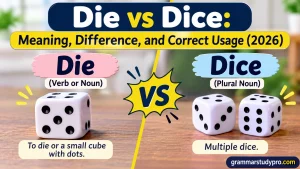
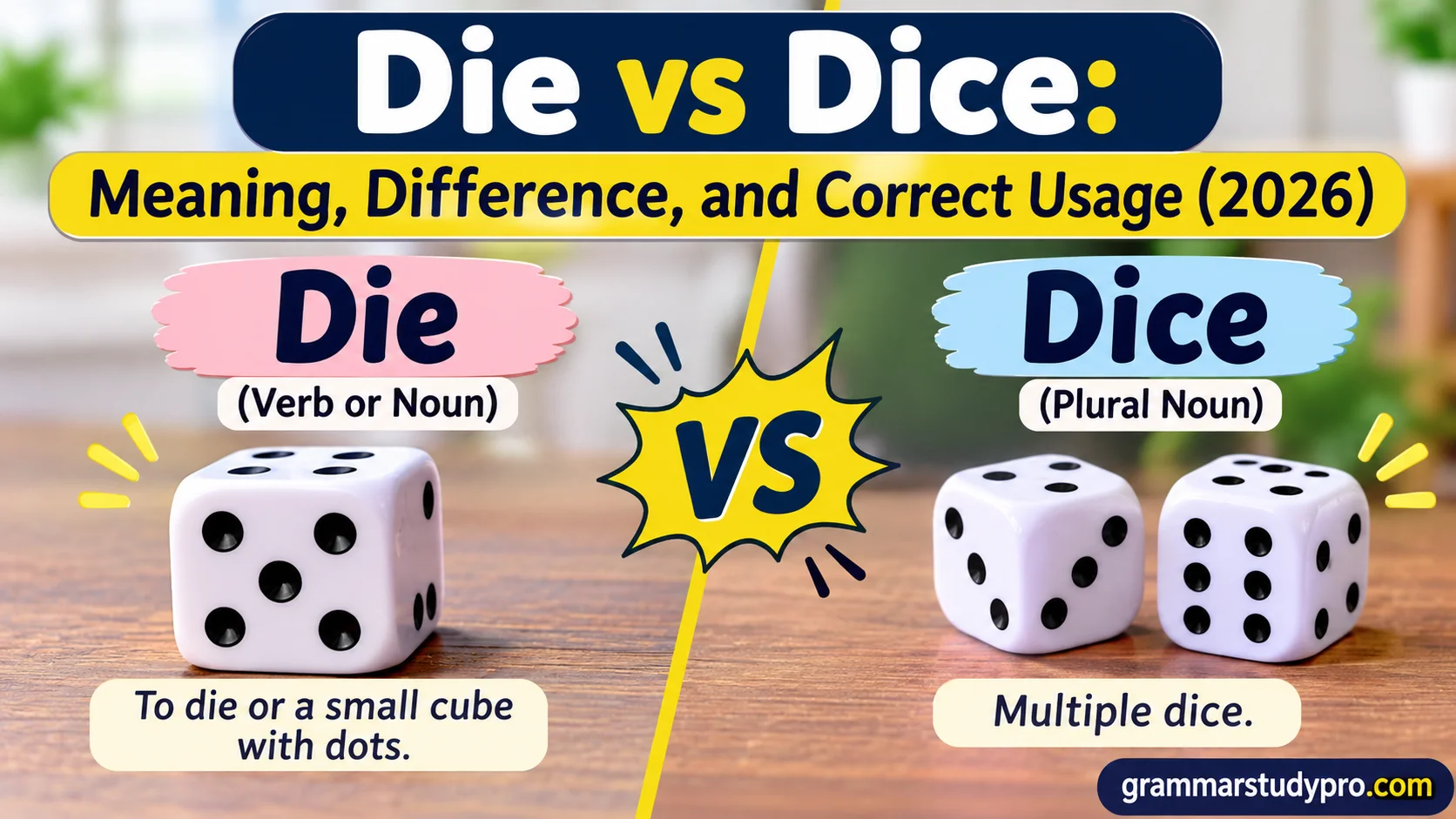
The main distinction comes from their grammatical roles and noun forms. Traditionally, die is the singular form, meaning one die, a single die, or one single object. It is a singular noun that describes a single cube or one gaming cube. On the other hand, dice is the plural form and plural noun used for two or more cubes or multiple dice. These objects, also described as cubes or small cubes, have different word forms depending on their number. This distinction is important in English grammar and helps you make better word choice. Their Latin origins provide another interesting detail: die comes from datum, while dice comes from dicia. Knowing their meanings makes correct usage easier, even though modern English and modern usage sometimes differ from traditional grammar.
In casual conversation, many English speakers use dice for both a singular object and multiple objects. This happens frequently in spoken English and everyday conversations, but traditional grammar still uses die for one object. You may hear expressions such as “roll the dice,” “all or nothing,” and “lucky sevens” in the language of luck. Gamblers, dealers, and casino visitors often hear the noise of slot machines inside a vibrant casino, where luck, chance, probability, winning, and losing are part of the experience. When dice land, players may look for doubles, where both pieces show the same number. These outcomes help decide the winners and losers. Whether you’re writing game instructions, explaining rules, or improving your writing and written communication, understanding the number distinction brings clarity to dice terminology and gaming terminology. It also helps you understand expressions such as “the die is cast.”
Quick Answer:
The traditional distinction between die vs dice is simple: die is the singular form and dice is the plural form of the noun referring to a gaming cube.
However, modern English also recognizes dice as a singular noun. People commonly say “a dice” when referring to one gaming cube, especially in everyday American English.
Here is the basic difference:
- Die: Traditionally refers to one numbered gaming cube.
- Dice: Traditionally refers to two or more numbered gaming cubes. It can also refer to one cube in modern usage.
Examples:
- I rolled one die and got a six.
- She rolled two dice during the game.
- He picked up a dice from the floor.
If you’re following traditional grammar, use one die and two dice. In casual conversation, however, one dice is also widely understood and accepted.
Comparison Overview: Die vs Dice
Although die and dice share the same basic meaning, they differ in traditional grammatical usage.
| Feature | Die | Dice |
| Traditional form | Singular | Plural |
| Modern usage | Singular | Singular and plural |
| Meaning | One gaming cube | One or more gaming cubes |
| Part of speech | Noun | Noun |
| Pronunciation | /daɪ/ | /daɪs/ |
| Example | One die | Two dice |
| Common context | Traditional or formal writing | Everyday and informal writing |
The easiest way to remember their relationship is one die, two dice. Nevertheless, don’t assume that every modern reference to a single dice represents a grammatical mistake.
What Does Die Mean?
The word die has several meanings in English. Its meaning depends on the context and how you use it in a sentence.
When discussing games, die traditionally refers to one small cube with numbered or dotted sides. Players roll it to generate a random number and determine their next move.
Die as a Singular Noun
As a gaming noun, die describes one cube with six faces. Each face usually displays a number from one through six using dots or numerals.
For example, when you play a board game that requires two cubes, you might pick up one die in each hand. Each object remains a die individually.
You can use this word in several situations:
- Board games: One die determines how many spaces a player moves.
- Tabletop games: Players roll a die to determine an outcome.
- Casino games: A die helps generate random results in certain games.
- Educational activities: Teachers use a die to teach counting and probability.
Here are some examples that demonstrate the correct usage:
Examples of Die in Sentences
- I rolled one die and got a six.
- The red die landed on the number four.
- She picked up the die after it fell beneath the table.
- Each player receives a single die before the game begins.
- The blue die stopped rolling near the edge.
- He bought a new die for his tabletop game.
- My little brother dropped the die while playing.
Notice how each sentence refers to one gaming cube. That’s the traditional reason die takes its singular form.
Other Meanings of Die
The word die doesn’t always describe a gaming object. It also has other meanings that you should recognize.
As a verb, die means to stop living. It can also describe something that stops functioning, disappears, or gradually comes to an end.
Examples:
- Plants may die without enough water.
- The battery will die if you leave the device running.
- His excitement began to die after the announcement.
- The engine may die if it runs out of fuel.
The word also functions as a technical noun in manufacturing. A die is a specialized tool that cuts, shapes, stamps, or forms materials.
For example, manufacturers use metal dies to produce specific shapes in metal sheets. Printing and leatherworking industries also use specialized dies for cutting and marking materials.
Importantly, these technical meanings have different plural forms. The plural of a manufacturing die is dies, not dice.
What Does Dice Mean?
The word dice traditionally represents the plural form of die. It refers to two or more small cubes that players roll during games.
Most traditional gaming dice have six sides. Each side displays one to six dots or numbers, allowing players to generate different results.
You can find dice in popular games such as Monopoly, Yahtzee, backgammon, and many tabletop role-playing games.
For example, when a player rolls two dice and gets a three and a five, the combined result is eight. That number might determine movement, scoring, or another action.
Dice as a Plural Noun
In traditional English grammar, dice refers to more than one gaming cube.
Unlike regular nouns that form plurals by adding -s or -es, this word follows an irregular plural pattern.
Consider these examples:
- One die becomes two dice.
- One die becomes three dice.
- One die becomes four dice.
- One die becomes six dice.
The spelling doesn’t change when you increase the quantity beyond two.
Examples of Dice in Sentences
Here are several examples showing how to use dice correctly as a plural noun:
- We need two dice to play the board game.
- She rolled the dice and won the round.
- Both dice landed on different numbers.
- He picked up three dice from the floor.
- The red and blue dice belong to different players.
- My brother shook the dice before throwing them.
- The dice stopped rolling near the game board.
Each example refers to multiple gaming cubes. Therefore, dice works as the traditional plural noun.
Dice as a Singular Noun in Modern English
Here’s where the distinction becomes interesting. Although traditional grammar treats dice as plural, modern English also uses it as a singular noun.
You’ll frequently hear someone say, “Pass me a dice,” when asking for one gaming cube. This construction appears in everyday conversations and modern English usage.
Major dictionaries also recognize this development. Collins lists dice as both singular and plural in contemporary English. Oxford identifies die as an alternative, especially in North American English.
Collins English Dictionary+2
For example:
- He picked up a dice from the carpet.
- I need another dice for this game.
- She bought a colorful dice for her collection.
These sentences reflect modern usage rather than the traditional singular-plural distinction.
However, if you’re writing a formal grammar lesson or following a style guide that maintains the traditional distinction, one die remains the safer choice.
Dice as a Verb
Besides functioning as a noun, dice also works as a verb. In cooking, it means cutting food into small, roughly cube-shaped pieces.
You might encounter this word in recipes, cooking instructions, and food preparation guides.
For example:
- Please dice the onions before adding them to the pan.
- She dices fresh tomatoes for the salad.
- He diced the potatoes into small cubes.
- We are dicing carrots for tonight’s soup.
The verb has several common forms:
| Verb form | Example |
| Base form | Dice the vegetables. |
| Third-person singular | She dices the onions. |
| Past tense | He diced the potatoes. |
| Present participle | They are dicing carrots. |
| Past participle | The vegetables have been diced. |
Remember that dice as a verb has nothing to do with the singular or plural distinction of gaming objects.
Main Differences Between Die and Dice
Although both words can describe gaming cubes, their grammatical differences deserve attention. Understanding these distinctions helps you avoid mistakes in formal writing and everyday communication.
Singular vs Plural Meaning: Die vs Dice
The biggest difference between these words involves number.
Traditionally, die identifies one gaming cube while dice identifies multiple cubes. This relationship follows an irregular plural pattern similar to other English words.
For example:
- One child, two children.
- One tooth, two teeth.
- One mouse, two mice.
- One die, two dice.
Notice that the plural form doesn’t simply add an s to the singular noun.
However, modern English sometimes uses dice for both singular and plural meanings. The surrounding sentence usually makes the intended quantity clear.
Grammatical Differences Between Die and Dice
The number of objects affects the verbs and other grammatical elements in your sentence.
When you use die as a traditional singular noun, pair it with singular verbs and determiners. When you use dice as a plural noun, use plural agreement.
Compare these examples:
| Sentence | Explanation |
| The die is missing. | Traditional singular usage |
| The dice are missing. | Traditional plural usage |
| A die has six sides. | Singular noun |
| Two dice have six sides each. | Plural noun |
| The dice is missing. | Modern singular usage |
The final example uses dice as a singular noun. It works in modern English when the context clearly refers to one object.
However, avoid switching between singular and plural agreement without a clear reason.
Differences in Everyday and Formal Writing
Your writing situation can influence which word you should choose.
In everyday conversations, people often use dice regardless of quantity. Most listeners understand the intended meaning without difficulty.
Formal writing generally benefits from the traditional distinction because it makes the number of objects immediately clear.
Consider these situations:
| Writing situation | Recommended usage |
| Formal grammar article | One die, two dice |
| Academic explanation | One die, multiple dice |
| Casual conversation | A dice or a die |
| Traditional board game instructions | Roll one die |
| Everyday gaming discussion | Roll the dice |
| Product description | One die or a set of dice |
For educational content, consistency matters more than choosing an unnecessarily complicated construction.
If you introduce die as the singular form, maintain that distinction throughout your explanation.
Pronunciation Differences Between Die and Dice
Although their meanings are closely related, die and dice have different final sounds.
- Die: /daɪ/
- Dice: /daɪs/
Both words begin with the same vowel sound. However, dice ends with an /s/ sound that doesn’t appear in die.
You can remember their pronunciation through these simple comparisons:
- Die rhymes with sky.
- Dice rhymes with rice.
- Die has one syllable.
- Dice also has one syllable.
Pronunciation becomes easier when you practice both words aloud. Pay attention to the final consonant in dice.
Die vs Dice: Which One Should You Use?
Choosing between these words becomes straightforward once you identify your intended meaning.
If you’re referring to one gaming cube and want traditional grammar, choose die. If you’re referring to multiple cubes, choose dice.
However, modern English allows dice as a singular noun in common usage.
When to Use Die
Use die when you want to identify one gaming cube under traditional English grammar.
This form works especially well in educational materials, formal explanations, and writing that emphasizes grammatical precision.
Use die in these situations:
- When describing one gaming cube.
- When explaining the singular form of the noun.
- When writing traditional board game instructions.
- When teaching irregular plural nouns.
- When using established expressions such as “the die is cast.”
Examples:
- I found one die underneath the table.
- The player rolled a single die.
- This die has six numbered sides.
- Every participant receives one die.
When to Use Dice
Use dice when referring to multiple gaming cubes. You can also use it as a singular noun when following modern usage.
Here are some situations where dice works naturally:
- When discussing two or more gaming cubes.
- When describing a game involving multiple dice.
- When explaining random results in board games.
- When referring to one gaming cube in modern informal English.
- When discussing food cut into small cubes.
Examples:
- She rolled two dice during the competition.
- The dice landed on five and six.
- He collects unusual gaming dice.
- Please dice the onions before cooking.
Choosing the Right Word in Different Contexts
Sometimes the surrounding context makes the correct choice obvious.
Let’s look at several practical situations:
Board game instructions: If a game requires one cube, traditional instructions might say, “Roll the die to move your piece.” When the game requires two, they might say, “Roll both dice together.”
Casino discussions: People generally use dice when discussing games involving multiple gaming cubes. For example, “The players shook the dice before placing their bets.”
Everyday conversations: Someone might say, “I found a dice under the sofa.” This reflects common modern usage, although a die follows traditional grammar.
Academic writing: When explaining probability, distinguish between one die and multiple dice. This makes mathematical examples easier to follow.
Product descriptions: A seller might describe an individual gaming cube as a die or use the more familiar term dice in a product listing.
The important point is to consider your audience and maintain consistent usage.
Common Mistakes to Avoid When Using Die and Dice
Even simple words can cause confusion when they have irregular forms or multiple meanings. Here are some mistakes worth avoiding.
Using Dice for One Object in Traditional Writing
One common mistake involves using dice as a singular noun in writing that follows traditional grammar.
For example:
- Incorrect under traditional grammar: I rolled one dice.
- Correct under traditional grammar: I rolled one die.
However, remember that modern dictionaries recognize singular dice too. Therefore, the first sentence isn’t automatically incorrect in every modern English context.
If you want to avoid confusion in formal writing, choose one die.
Using Dies as the Plural of a Gaming Die
Another frequent mistake involves adding -s to die to create dies.
For gaming cubes, the traditional plural is dice, not dies.
Compare these examples:
- One die, two dice.
- One die, three dice.
- One manufacturing die, two manufacturing dies.
The final example is important because dies is correct when discussing manufacturing tools.
Merriam-Webster distinguishes these plural forms in its dictionary entry. It lists dice and dies for different meanings of the noun die.
Merriam-Webster+1
Confusing Dice With the Verb Dies
The words dice and dies can look similar, but they have different grammatical functions.
Dice can describe gaming cubes or the action of cutting food into small pieces. Meanwhile, dies is the third-person singular form of the verb die.
Compare these examples:
- The player rolled two dice.
- The old engine dies unexpectedly.
- She dices fresh vegetables.
- The plant dies without water.
Notice the difference between dices and dies.
The first describes cutting something into cubes. The second describes something stopping its life or functioning.
Using Dices as the Plural of Dice
Some writers mistakenly believe that dices represents multiple gaming cubes.
However, dices isn’t the standard plural of the gaming noun. The plural remains dice.
For example:
- Incorrect: I bought three dices.
- Correct: I bought three dice.
Nevertheless, dices is a real English word when used as a verb.
For instance, “She dices the carrots” is grammatically correct because dices describes an action performed by one person.
Die vs Dice in Real-Life Examples
Looking at practical situations makes the difference easier to understand. The following examples show how these words work in gaming, cooking, manufacturing, and everyday communication.
| Situation | Example | Correct usage |
| One gaming cube | I found one die. | Die |
| Two gaming cubes | She rolled two dice. | Dice |
| Three gaming cubes | He bought three dice. | Dice |
| Modern singular usage | Pass me a dice. | Dice |
| Board game instructions | Roll both dice together. | Dice |
| Cooking instructions | Dice the onions finely. | Dice |
| Manufacturing | The factory replaced its damaged dies. | Dies |
| Figurative expression | The die is cast. | Die |
| Verb describing death | The battery dies quickly. | Dies |
A Practical Case Study: Choosing Between Die and Dice
Imagine you’re writing instructions for a board game that uses one gaming cube.
Your first sentence reads:
“The player must roll one dice to determine the next move.”
Although readers will understand the sentence, traditional grammar recommends a small correction.
Improved sentence:
“The player must roll one die to determine the next move.”
Now imagine the game requires two gaming cubes.
You can write:
“The player must roll two dice to determine the next move.”
The second sentence follows the traditional plural form.
This simple example shows why understanding the distinction matters. You can make instructions clearer without changing their meaning.
Common Expressions and Idioms With Die and Dice
Both words appear in familiar English expressions. Some refer to taking risks while others describe decisions, opportunities, or unsuccessful attempts.
Learning these expressions helps you understand how native English speakers use them beyond literal gaming situations.
The Die Is Cast
The die is cast is an established expression that describes a decision or action that cannot easily be reversed.
It suggests that someone has made an important choice and must now accept its consequences.
For example:
- After signing the contract, the die was cast.
- She announced her resignation, and the die was cast.
- Once the company launched its new product, the die was cast.
This expression has historical roots in the idea of throwing a die and accepting the result.
Roll the Dice
The expression roll the dice means taking a chance or accepting uncertainty.
People use it when they make decisions without knowing exactly what will happen.
Examples:
- Starting a new business means rolling the dice.
- He decided to roll the dice and change careers.
- Sometimes you must roll the dice to achieve something worthwhile.
The expression connects directly to gaming, where every roll can produce an unpredictable result.
No Dice
No dice is an informal American expression that means something isn’t possible, acceptable, or successful.
People often use it when rejecting a request or describing an unsuccessful attempt.
Examples:
- I asked for an extension, but no dice.
- We tried to find tickets, but no dice.
- He wanted to borrow my car, but I told him no dice.
This expression works naturally in casual conversations rather than formal academic writing.
Load the Dice
The expression load the dice means arranging circumstances to give someone an unfair advantage or disadvantage.
It comes from the idea of using weighted or altered dice to influence the outcome of a game.
Examples:
- The unfair rules loaded the dice against smaller businesses.
- The competition seemed fair, but someone had loaded the dice.
- Poor access to education can load the dice against disadvantaged students.
You can also use the expression figuratively when discussing business, politics, competitions, and everyday situations.
Tips for Remembering the Difference Between Die and Dice
If you frequently confuse these words, a few simple reminders can help.
Remember the traditional singular-plural relationship. One die becomes two dice. You don’t need to add another ending to form the plural.
Here are some practical memory tips:
- One die: Think of one gaming cube.
- Two dice: Remember that the plural form changes to dice.
- Modern singular dice: Recognize that contemporary English also accepts this construction.
- Manufacturing dies: Remember that specialized cutting and shaping tools use dies as their plural.
- Dice as a verb: Connect this meaning with cutting food into small cubes.
A useful memory trick is to remember the phrase “one die, many dice.” It captures the traditional grammatical relationship in just four words.
FAQs
1. What is the difference between die and dice?
Die is the singular form, referring to one gaming cube. Dice is the plural form, referring to two or more gaming cubes. For example, you roll one die but use two dice in most board games.
2. Is dice singular or plural?
Traditionally, dice is a plural noun used for two or more gaming cubes. However, many English speakers also use it as a singular noun in casual conversation. Both uses are common in modern English.
3. Is it correct to say one dice or one die?
In traditional English grammar, one die is correct because die refers to a single object. Saying one dice is common in informal speech, but it isn’t the standard grammatical form.
4. What is the plural of die?
The plural of die is dice. For example, one die becomes two dice when you use another gaming cube.
5. Why do people say roll the dice instead of roll the die?
People usually say roll the dice because most games involve two or more gaming cubes. However, when you’re rolling only one cube, roll the die is grammatically correct.
Conclusion
Understanding die vs dice becomes easier when you remember their number difference. Die refers to one gaming cube, while dice traditionally describes two or more. Although people sometimes use dice for both forms in everyday conversations,
die remains the standard singular noun. Whether you’re discussing board games, explaining casino rules, or writing instructions, choosing the correct word makes your English clearer and more accurate.