Do Not vs. Don’t can seem confusing, but both forms express the same meaning and differ mainly in tone, formality, writing context, and purpose.
Both expressions are grammatically correct, but their word usage depends on the situation. Don’t is a contracted form of do not, created by combining the auxiliary verb “do” with “not” using an apostrophe. In everyday English, conversational English, and a friendly conversation, don’t creates a more natural expression with a relaxed tone. For example, “Don’t worry about it” sounds friendly, while “Do not worry about it” feels more direct. However, formal writing, professional writing, and professional emails often favor do not because it creates a more serious writing style.
You might also see it on an official warning sign, such as “Do Not Enter,” where a clear negative expression gives a direct instruction. Both forms carry the same negative meaning, but their different tones can change how readers understand your message. Good writing skills also require attention to grammatical rules, sentence structure, sentence clarity, punctuation, spelling, and word choice. One of the common mistakes is writing “dont” instead of “don’t,” which is incorrect usage because it misses the apostrophe.
Learning the proper usage of contractions in formal communication and informal communication improves written communication, spoken communication, and professional communication. With practice and a better understanding of these English expressions, you can write clear sentences, create clearer sentences, improve language accuracy, maintain a professional appearance, and express yourself confidently and correctly. These practical examples and simple rules can help you avoid mistakes and improve your English language skills.
Quick Answer:
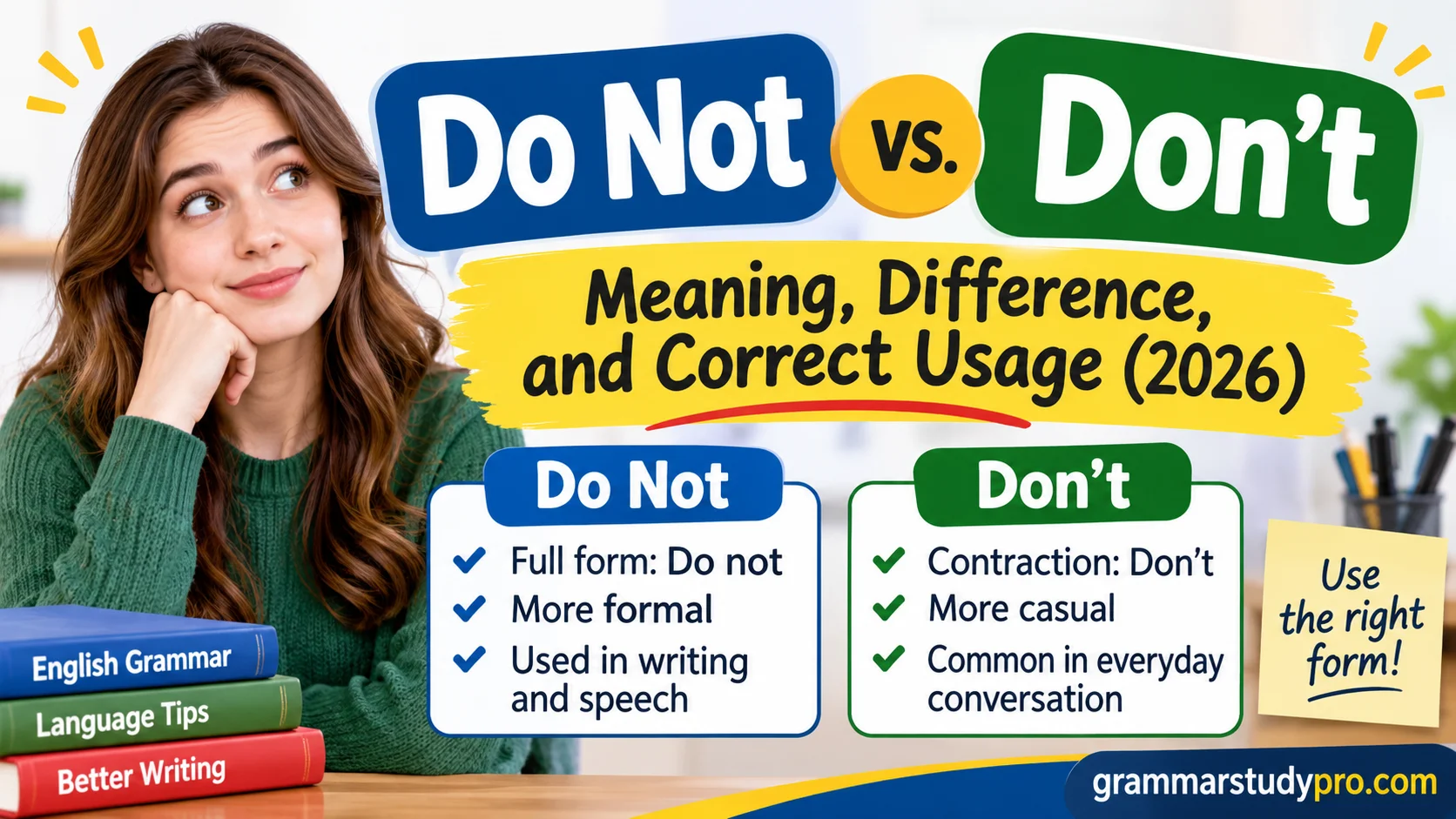
Do not is the full form of don’t, which is a contraction of do and not. Both expressions make a sentence negative and communicate the same basic meaning.
The main difference involves tone, emphasis, and writing style.
- Do not: Generally sounds more formal, direct, or emphatic. Writers commonly use it in official instructions, warnings, academic writing, and professional documents.
- Don’t: Sounds more conversational and relaxed. People frequently use it in everyday speech, text messages, friendly emails, and informal writing.
Consider these examples:
- Do not: Do not forget to bring your identification card.
- Don’t: Don’t forget to bring your identification card.
Both sentences give the same reminder. However, the first sounds slightly more formal while the second feels more conversational.
Remember: Choose do not when the situation calls for a full or emphatic expression. Choose don’t when you want a natural, conversational tone.
Comparison Overview: Do Not vs. Don’t
Although these expressions have different written forms, their grammatical functions remain identical. Both use the auxiliary verb do to create negative statements, questions, and commands.
The following table highlights their main similarities and differences.
| Feature | Do Not | Don’t |
| Meaning | Expresses negation | Expresses negation |
| Grammatical function | Negative auxiliary construction | Contracted negative auxiliary construction |
| Word form | Full form | Contraction |
| Original words | Do + not | Do + not |
| Formality | Often more formal | Generally more conversational |
| Tone | Direct, neutral, or emphatic | Relaxed and conversational |
| Apostrophe | Not needed | Required |
| Spoken English | Common, especially for emphasis | Extremely common |
| Written English | Formal and informal contexts | Mostly informal and conversational contexts |
| Example | Do not touch the equipment. | Don’t touch the equipment. |
One important point deserves attention: don’t is not grammatically incorrect in formal English. Some academic institutions, professional organizations, and style guides discourage contractions. Others allow them when they suit the intended voice.
Therefore, the best choice depends on your audience, purpose, and writing guidelines.
What Does Do Not Mean?
Definition and Meaning of Do Not
The expression do not combines the auxiliary verb do with the negative word not. Together, they create a negative construction that denies an action, expresses disagreement, or gives an instruction against something.
In simple terms, do not tells someone that an action doesn’t happen, isn’t wanted, or shouldn’t happen.
For example:
- I do not understand this question.
- They do not support the proposed changes.
- We do not accept payments through personal accounts.
- Do not open the emergency exit without permission.
In each example, do not makes the statement or instruction negative.
Grammatically, do not usually appears before the base form of the main verb. This rule matters because the auxiliary verb carries the grammatical information while the main verb stays in its basic form.
Consider this sentence:
Correct: She does not like spicy food.
Incorrect: She does not likes spicy food.
The second sentence incorrectly adds an -s to the main verb. Because does already marks third-person singular agreement, the main verb must remain like.
Examples of Do Not in Sentences
Seeing the expression in different situations makes its meaning easier to understand.
| Sentence | Purpose |
| Do not enter this room. | Prohibition |
| I do not remember his name. | Lack of memory |
| They do not agree with the decision. | Disagreement |
| We do not need additional assistance. | Expressing a lack of need |
| Do not leave your belongings unattended. | Warning |
| I do not believe that explanation. | Expressing disbelief |
| The instructions do not mention this requirement. | Providing information |
Notice how the same expression performs several functions. Sometimes it denies an action. In other situations, it communicates a rule or expresses an opinion.
When to Use Do Not
The full expression works particularly well when your message needs clarity, authority, or emphasis.
Here are some common situations where do not is appropriate.
Formal documents and professional communication
Business reports, official letters, legal documents, and workplace policies often use full forms. They create a direct and professional tone.
Example: Employees do not have permission to share confidential company information.
Official notices and warnings
Public signs frequently use do not because instructions need to remain clear and unmistakable.
Example: Do not block the emergency exit.
Academic writing
Some academic institutions and publication guidelines prefer full forms. Following the required style guide matters more than applying one universal rule.
Example: The results do not support the original hypothesis.
Statements requiring emphasis
When you want to stress a denial or prohibition, the full expression can make the negative element more noticeable.
Example: I do not want another explanation.
The speaker can place additional vocal stress on not to reinforce the message.
What Does Don’t Mean?
Definition and Meaning of Don’t
Don’t is the contraction of do not. It combines the auxiliary verb do and the negative word not into one shorter expression.
The apostrophe replaces the omitted letter in the contraction. This small punctuation mark helps readers recognize the shortened form.
In everyday English, people use don’t to express disagreement, deny an action, communicate preferences, or give negative instructions.
For example:
- I don’t like waiting in long lines.
- They don’t understand the new policy.
- We don’t have enough information.
- Don’t touch the electrical wires.
Each sentence communicates a negative idea. The contraction simply makes the wording shorter and more conversational.
According to English speakers commonly use contractions in everyday speech and informal writing. These shortened forms combine words while keeping their original grammatical meaning.
Examples of Don’t in Sentences
Here are several examples showing how don’t works in different situations.
| Sentence | Meaning or Purpose |
| I don’t know the answer. | Expresses a lack of knowledge |
| We don’t need another meeting. | Expresses a lack of need |
| They don’t live nearby. | Describes a negative fact |
| Don’t forget your appointment. | Gives a reminder |
| Don’t make unnecessary changes. | Gives an instruction |
| I don’t agree with that decision. | Expresses disagreement |
| You don’t have to explain everything. | Shows that something isn’t necessary |
| Don’t worry about the results. | Offers reassurance |
These examples demonstrate why don’t appears so often in everyday communication. It helps people express negative ideas without making their sentences sound unnecessarily stiff.
When to Use Don’t
The contracted form works naturally in situations where conversational language feels appropriate.
Everyday conversations
People regularly use don’t when speaking with friends, family members, colleagues, and acquaintances.
Example: I don’t think we should leave so early.
Text messages and online communication
Shortened expressions make casual messages sound natural and direct.
Example: Don’t forget to send me the pictures!
Friendly emails
When writing to someone you know well, don’t can make your message warmer and less formal.
Example: Don’t hesitate to contact me if you need anything.
Conversational blog posts
Writers often use contractions to create a friendly relationship with readers.
Example: You don’t need expensive equipment to start learning photography.
Stories and dialogue
Contractions help fictional characters sound more realistic because everyday conversations rarely sound like formal documents.
Example: “Don’t tell anyone what happened yesterday,” Sarah whispered.
However, remember that contractions aren’t automatically inappropriate in professional writing. The audience and the organization’s writing standards determine whether they fit.
Main Differences Between Do Not and Don’t
Although do not and don’t share the same meaning, their differences become noticeable in certain situations. Understanding these distinctions helps you choose the right expression.
Full Form vs. Contraction: Do Not vs. Don’t
The most obvious difference involves their structure.
Do not contains two separate words. Meanwhile, don’t combines those words through contraction.
The apostrophe represents the omitted letter. Without it, the contraction becomes incorrectly written.
Consider these examples:
- Full form: We do not accept late applications.
- Contracted form: We don’t accept late applications.
Both sentences communicate the same information. However, the first uses the complete grammatical expression while the second uses its shortened equivalent.
This distinction applies to several other English contractions too:
| Full Form | Contraction |
| Do not | Don’t |
| Does not | Doesn’t |
| Did not | Didn’t |
| Is not | Isn’t |
| Are not | Aren’t |
| Cannot | Can’t |
| Will not | Won’t |
| Should not | Shouldn’t |
Each contraction follows its own spelling pattern. Therefore, don’t assume that every negative expression forms its contraction identically.
Formality and Tone
Formality is one of the most noticeable differences between these expressions.
Do not often sounds more formal, authoritative, or deliberate. Writers frequently choose it for official instructions, workplace policies, and public warnings.
Don’t usually sounds more relaxed and conversational. It fits naturally into personal messages, everyday discussions, and informal writing.
Compare these examples:
| Do Not | Don’t |
| Do not interrupt the presentation. | Don’t interrupt the presentation. |
| We do not accept cash payments. | We don’t accept cash payments. |
| Do not share your password. | Don’t share your password. |
| I do not understand your concern. | I don’t understand your concern. |
Neither expression automatically makes a sentence polite or impolite. The surrounding words and situation matter just as much.
For instance, “Do not contact me again” sounds firm and direct. Meanwhile, “Don’t contact me again” can sound equally serious depending on the speaker’s delivery.
Emphasis and Stress
Sometimes, speakers choose the full expression because they want their negative message to stand out.
The word not can receive strong vocal stress. This makes the denial or prohibition more noticeable.
For example:
- I do not support this decision.
- I don’t support this decision.
Both statements communicate disagreement. However, emphasizing not in the first sentence can make the speaker’s opposition sound especially firm.
Consider another situation:
A manager notices someone entering a restricted area.
- “Don’t enter that room.”
- “DO NOT enter that room.”
The second instruction may communicate greater urgency or authority. Its impact comes from the full expression and the way the speaker emphasizes it.
Important: The full form doesn’t always create stronger emphasis automatically. Intonation, punctuation, and context influence how readers interpret a statement.
Written English vs. Spoken English
Both expressions appear in spoken and written English. However, their frequency and suitability depend on the communication setting.
In everyday conversations, don’t often feels more natural because speakers regularly shorten common expressions.
For example:
“Why don’t we order something for dinner?”
This sounds relaxed and ordinary. The alternative, “Why do we not order something for dinner?” sounds more deliberate and may suggest emphasis or contrast.
In writing, the choice depends on the document’s purpose.
- Casual blog posts commonly use don’t.
- Official notices often use do not.
- Personal emails comfortably accommodate either form.
- Academic assignments may require full forms depending on institutional guidelines.
- Marketing content often uses contractions to create an approachable voice.
The explains that writers should adjust their language according to their audience and purpose.
Professional and Academic Writing
A common misconception suggests that professional writers must always avoid contractions. That’s too restrictive.
Some academic and professional styles prefer full forms. Others accept contractions when they improve readability and suit the document’s voice.
For example, the confirms that contractions can appear in scholarly writing. However, writers should avoid excessive use and consider their context.
The also explains that contractions can work in formal communication when writers use standard forms appropriately.
Consider these examples:
More formal:
The research findings do not support the original assumption.
Conversational professional writing:
The research findings don’t support the original assumption.
Both sentences are grammatically correct. Your organization’s style guide should determine which version you use.
Meaning and Grammatical Function
One important difference does not exist: their basic grammatical meaning.
Both expressions use the auxiliary verb do to form a negative construction. Neither changes the tense or fundamental meaning of the sentence simply because it uses a contraction.
Compare:
- I do not understand the instructions.
- I don’t understand the instructions.
Both describe the speaker’s present lack of understanding.
Likewise:
- They do not attend the weekly meetings.
- They don’t attend the weekly meetings.
Both describe a repeated or habitual situation.
The difference concerns presentation rather than the underlying grammatical function.
Grammar Rules for Using Do Not and Don’t Correctly
Knowing the meaning of these expressions is only half the job. You also need to understand how they work with different subjects and verbs.
Use Do Not With the Correct Subject
In the simple present tense, do not works with several subjects.
These include:
- I
- You
- We
- They
- Plural nouns
Examples:
- I do not eat seafood.
- You do not need another invitation.
- We do not support that proposal.
- They do not understand the instructions.
- The students do not have enough time.
However, third-person singular subjects require does not rather than do not in standard English.
These subjects include:
- He
- She
- It
- Singular nouns
Examples:
- He does not drive to work.
- She does not enjoy horror movies.
- It does not look familiar.
- My brother does not drink coffee.
Remember this simple rule: use do not with plural subjects and the first-person singular pronoun I. Use does not with third-person singular subjects.
Use Don’t With the Correct Subject
The same subject-verb agreement rule applies to don’t.
Use don’t with I, you, we, they, and plural nouns.
Examples:
- I don’t understand the question.
- You don’t need to wait.
- We don’t have enough supplies.
- They don’t visit us regularly.
- My friends don’t watch television often.
For he, she, it, and singular nouns, use doesn’t.
Examples:
- He doesn’t understand the question.
- She doesn’t drive at night.
- It doesn’t work properly.
- My neighbor doesn’t own a car.
The following table makes the distinction easier to remember.
| Subject | Full Negative Form | Contracted Form |
| I | Do not | Don’t |
| You | Do not | Don’t |
| He | Does not | Doesn’t |
| She | Does not | Doesn’t |
| It | Does not | Doesn’t |
| We | Do not | Don’t |
| They | Do not | Don’t |
| The children | Do not | Don’t |
| My father | Does not | Doesn’t |
| The employees | Do not | Don’t |
Common mistake: Writing “She don’t like coffee” is incorrect in standard English. The correct sentence is “She doesn’t like coffee.”
Always Use the Base Form of the Main Verb
One of the most important rules involves the verb following do not or don’t.
The main verb must remain in its base form. You shouldn’t add an unnecessary -s, -ed, or -ing ending.
For example:
| Incorrect Sentence | Correct Sentence |
| He doesn’t likes tea. | He doesn’t like tea. |
| She don’t understands me. | She doesn’t understand me. |
| They don’t enjoys football. | They don’t enjoy football. |
| I do not wants help. | I do not want help. |
| We doesn’t need permission. | We don’t need permission. |
Why does this happen?
The auxiliary verb carries the grammatical information. In the third-person singular, does already marks the subject correctly.
Therefore, the main verb doesn’t need another -s.
Compare:
- She likes chocolate.
- She does not like chocolate.
- She doesn’t like chocolate.
Notice how likes changes to like when the negative auxiliary appears.
Using Do Not and Don’t in Negative Commands
Both expressions can create negative commands. These sentences tell someone to avoid performing a particular action.
The grammatical pattern is straightforward:
Do not + base form of the verb
Don’t + base form of the verb
Examples:
- Do not touch the wet paint.
- Don’t touch the wet paint.
- Do not cross the road without looking.
- Don’t cross the road without looking.
- Do not leave your luggage unattended.
- Don’t leave your luggage unattended.
Cambridge Grammar explains that both forms can create negative imperatives. It also identifies do not as the stronger and more formal option in many instructional contexts.
The difference becomes particularly noticeable on public signs.
For example:
- Official warning: Do not enter.
- Friendly reminder: Don’t forget to close the gate.
- Safety instruction: Do not operate this machine without training.
The full form often suits serious instructions. However, the contracted form works perfectly well for ordinary reminders.
Do Not vs. Don’t in Different Writing Situations
Choosing between these expressions becomes easier when you consider where the sentence will appear.
Do Not vs. Don’t in Formal Writing
Formal writing generally favors complete expressions when the writer wants a traditional, professional tone.
However, this doesn’t mean contractions are always forbidden.
For example, consider these sentences:
Formal document:
Employees do not have permission to disclose confidential information.
Conversational document:
Employees don’t have permission to disclose confidential information.
Both are correct. The first may better suit a formal policy document, while the second feels more conversational.
When preparing formal writing, consider:
- The organization’s preferred writing style.
- The expectations of your intended audience.
- Whether the document requires a consistent formal tone.
- Whether contractions might make important instructions seem too casual.
Do Not vs. Don’t in Informal Writing
Informal writing allows more flexibility. Contractions often make sentences sound natural and friendly.
For example:
- I don’t know what happened yesterday.
- We don’t need to buy anything else.
- Don’t forget to call your sister.
- They don’t want to leave yet.
Using do not in these situations isn’t incorrect. However, repeating full forms throughout a casual conversation can make the writing feel unnecessarily stiff.
Do Not vs. Don’t in Professional Emails
Professional emails can be formal, neutral, or conversational. Your relationship with the recipient helps determine the appropriate tone.
Consider these examples:
| Situation | Example |
| Formal instruction | Do not share this document externally. |
| Friendly reminder | Don’t forget to review the attachment. |
| Official announcement | We do not accept applications after the deadline. |
| Informal workplace discussion | I don’t think we need another meeting. |
| Professional request | Please do not hesitate to contact our office. |
When emailing a client or senior executive, the full form may suit a more formal message.
For everyday communication with familiar colleagues, don’t usually feels natural.
Do Not vs. Don’t in Signs and Warnings
Public signs need to communicate instructions quickly. That’s why the full expression frequently appears in official warnings.
Examples include:
- DO NOT ENTER.
- DO NOT PARK HERE.
- DO NOT TOUCH THE EQUIPMENT.
- DO NOT BLOCK THIS EXIT.
Capital letters and the full form make these instructions visually prominent.
However, friendly signs may use contractions:
- Don’t forget your umbrella!
- Don’t feed the animals.
- Don’t leave your bicycle here.
The distinction isn’t a strict grammar requirement. It reflects the intended tone and seriousness of the message.
Do Not vs. Don’t in Academic Writing
Academic writing follows specific conventions. Some universities and instructors discourage contractions because they prefer a consistently formal style.
However, academic publishers don’t all follow the same policy.
For example, MLA permits contractions in its publications when they suit the writing. Meanwhile, other academic guidelines may prefer complete forms.
Consider these examples:
Traditional academic style:
The results do not demonstrate a significant relationship between the variables.
Less formal academic style:
The results don’t demonstrate a significant relationship between the variables.
Both sentences communicate the same finding. Nevertheless, students should follow their instructor’s requirements rather than assuming one convention applies everywhere.
Common Mistakes to Avoid When Using Do Not and Don’t
Even experienced English writers sometimes confuse contractions and negative verb forms. Fortunately, a few simple rules can prevent most mistakes.
Writing Dont Instead of Don’t
One common spelling mistake involves leaving out the apostrophe.
The correct spelling is don’t, not dont.
The apostrophe represents the omitted letter in the original expression. It isn’t decorative punctuation.
Compare:
- Incorrect: Dont forget your homework.
- Correct: Don’t forget your homework.
- Incorrect: I dont understand the question.
- Correct: I don’t understand the question.
Whenever you write this contraction, place the apostrophe between the n and t.
The same principle applies to contractions such as doesn’t, didn’t, and can’t.
Using Don’t Instead of Doesn’t
Another frequent mistake involves third-person singular subjects.
Remember that don’t works with I, you, we, they, and plural nouns. Meanwhile, doesn’t works with he, she, it, and singular nouns.
Examples:
| Incorrect | Correct |
| He don’t like football. | He doesn’t like football. |
| She don’t understand. | She doesn’t understand. |
| My brother don’t drive. | My brother doesn’t drive. |
| The computer don’t work. | The computer doesn’t work. |
This rule applies whether you use the full form or contraction.
- He does not like football.
- He doesn’t like football.
Both sentences are correct.
Adding -S to the Main Verb
Some writers mistakenly add an -s ending after doesn’t.
However, the auxiliary verb already carries the third-person singular marking.
Therefore, the main verb must remain in its base form.
Incorrect examples:
- She doesn’t enjoys swimming.
- He doesn’t plays tennis.
- My mother doesn’t cooks dinner.
Correct examples:
- She doesn’t enjoy swimming.
- He doesn’t play tennis.
- My mother doesn’t cook dinner.
Here’s an easy trick: whenever you use doesn’t, check whether the next verb has an unnecessary -s.
Confusing Don’t With Didn’t
Although these expressions look similar, they refer to different tenses.
- Don’t: Present-tense negative form.
- Didn’t: Past-tense negative form.
Consider these examples:
| Don’t | Didn’t |
| I don’t like coffee. | I didn’t like coffee. |
| They don’t visit us. | They didn’t visit us. |
| We don’t understand. | We didn’t understand. |
| She doesn’t work here. | She didn’t work here. |
Notice another important detail: didn’t works with all subjects.
You don’t need to change it to didn’ts for third-person singular subjects.
Also, the main verb stays in its base form after didn’t.
Correct: She didn’t attend the meeting.
Incorrect: She didn’t attended the meeting.
Using Double Negatives
A double negative occurs when a sentence contains two negative expressions that cancel or reinforce each other.
In standard written English, avoid constructions such as:
- I don’t know nothing.
- She doesn’t want no help.
- They don’t have nobody available.
For standard English, write:
- I don’t know anything.
- She doesn’t want any help.
- They don’t have anybody available.
Some dialects use negative concord, where multiple negative words express one negative meaning. However, standard academic and professional English generally avoids this construction.
Do Not vs. Don’t: Examples in Everyday English
Practical examples make grammar rules easier to remember. The following sections show how both expressions work across common sentence structures.
Examples With Personal Pronouns
Personal pronouns frequently appear with do not and don’t. The correct form depends on the subject.
| Subject | Full Form Example | Contracted Example |
| I | I do not understand. | I don’t understand. |
| You | You do not need permission. | You don’t need permission. |
| We | We do not agree. | We don’t agree. |
| They | They do not live here. | They don’t live here. |
For third-person singular subjects, use does not or doesn’t.
- He does not remember my name.
- He doesn’t remember my name.
- She does not enjoy cooking.
- She doesn’t enjoy cooking.
These examples demonstrate how the full and contracted forms follow the same subject-verb agreement rules.
Examples With Negative Instructions
Negative commands tell people what they should avoid doing.
Both expressions work naturally in this construction.
| Do Not | Don’t |
| Do not touch the painting. | Don’t touch the painting. |
| Do not open this container. | Don’t open this container. |
| Do not feed the animals. | Don’t feed the animals. |
| Do not leave the lights on. | Don’t leave the lights on. |
| Do not cross this boundary. | Don’t cross this boundary. |
The full form often appears in official instructions. The contraction usually suits friendly reminders and casual directions.
Examples in Questions and Answers
Both forms can also appear in negative questions.
A negative question may express surprise, seek confirmation, or suggest an expectation.
Examples:
- Do you not remember my birthday?
- Don’t you remember my birthday?
- Why do you not trust his explanation?
- Why don’t you trust his explanation?
- Do they not understand the instructions?
- Don’t they understand the instructions?
The full form can sound more formal or emphatic. The contracted version generally feels more conversational.
Consider this short exchange:
Person A: Don’t you want to join us?
Person B: I don’t think I can make it today.
Now compare a more deliberate version:
Person A: Do you not want to join us?
Person B: I do not think I can make it today.
Both conversations are grammatically correct. The difference lies mainly in their tone and delivery.
Examples in Professional and Casual Conversations
The same message can sound slightly different depending on your choice.
| Situation | More Formal | More Conversational |
| Expressing disagreement | I do not agree with this proposal. | I don’t agree with this proposal. |
| Giving advice | Do not make unnecessary changes. | Don’t make unnecessary changes. |
| Explaining a problem | We do not have sufficient information. | We don’t have enough information. |
| Giving a reminder | Do not forget the deadline. | Don’t forget the deadline. |
| Discussing preferences | I do not enjoy crowded places. | I don’t enjoy crowded places. |
Neither version automatically improves the message. The right choice depends on the situation and intended audience.
A Practical Case Study: Choosing Between Do Not and Don’t
Imagine a company preparing three different messages for its employees.
The first message appears in an official security policy. The second goes into a friendly team email. The third appears on a restricted laboratory door.
Here is how the wording might change.
| Communication | Recommended Wording | Reason |
| Official security policy | Employees do not share passwords. | Maintains a formal policy tone. |
| Friendly team email | Don’t forget to update your passwords. | Sounds approachable and natural. |
| Laboratory warning | DO NOT ENTER WITHOUT AUTHORIZATION. | Communicates a clear prohibition. |
The company doesn’t need three different grammatical rules. It simply needs to match the wording to each communication setting.
This example highlights an important lesson: grammar determines correctness, but context helps determine style.
Do Not vs. Don’t: Which One Should You Use?
The right choice becomes simple once you understand the audience and purpose of your sentence.
Use do not when you want a complete expression that suits formal instructions, official notices, or emphatic statements.
Use don’t when you want a shorter expression that sounds natural in everyday communication.
The following table provides a quick reference.
| Writing Situation | Recommended Choice |
| Official warnings | Do not |
| Government notices | Do not |
| Formal policies | Do not |
| Academic assignments | Follow the required style guide |
| Friendly emails | Don’t |
| Casual conversations | Don’t |
| Text messages | Don’t |
| Conversational articles | Don’t |
| Strong prohibitions | Do not |
| Everyday reminders | Don’t |
However, these recommendations aren’t absolute grammar rules. Both forms are standard English.
Before choosing, ask yourself three simple questions:
- Who will read this? Consider whether your audience expects formal or conversational language.
- What message am I communicating? Serious instructions may benefit from the full form.
- What writing style should I follow? Check any institutional or professional requirements.
Once you answer these questions, selecting the appropriate form becomes much easier.
FAQs
Is “Do Not” or “Don’t” grammatically correct?
Both do not and don’t are grammatically correct. They express the same negative meaning, but their tone differs. Do not sounds more formal, while don’t feels natural in everyday conversations.
Is “Don’t” a contraction of “Do Not”?
Yes. Don’t is the contracted form of do not. The apostrophe replaces the missing letter in the contraction. It makes sentences shorter and more conversational.
Should I use “Do Not” in formal writing?
Yes. Do not is generally a better choice for formal documents, business emails, academic writing, and official instructions. It gives your writing a more professional tone.
Can I use “Don’t” in professional emails?
Yes. You can use don’t in friendly or conversational professional emails. However, do not may sound more appropriate when writing formal notices, policies, or serious instructions.
Is “Dont” correct without an apostrophe?
No. Dont is an incorrect spelling in standard English. The correct spelling is don’t, with an apostrophe between the letters n and t.
Conclusion
Understanding Do Not vs. Don’t makes choosing the right expression much easier. Both forms communicate the same negative meaning, but they create different tones. Use do not when you want a formal, direct, or professional style. Choose don’t when writing casual messages or having everyday conversations.
Remember to include the apostrophe when writing don’t. This small punctuation mark makes a big difference in correct English usage. By considering your audience and writing situation, you can use both expressions naturally and confidently.