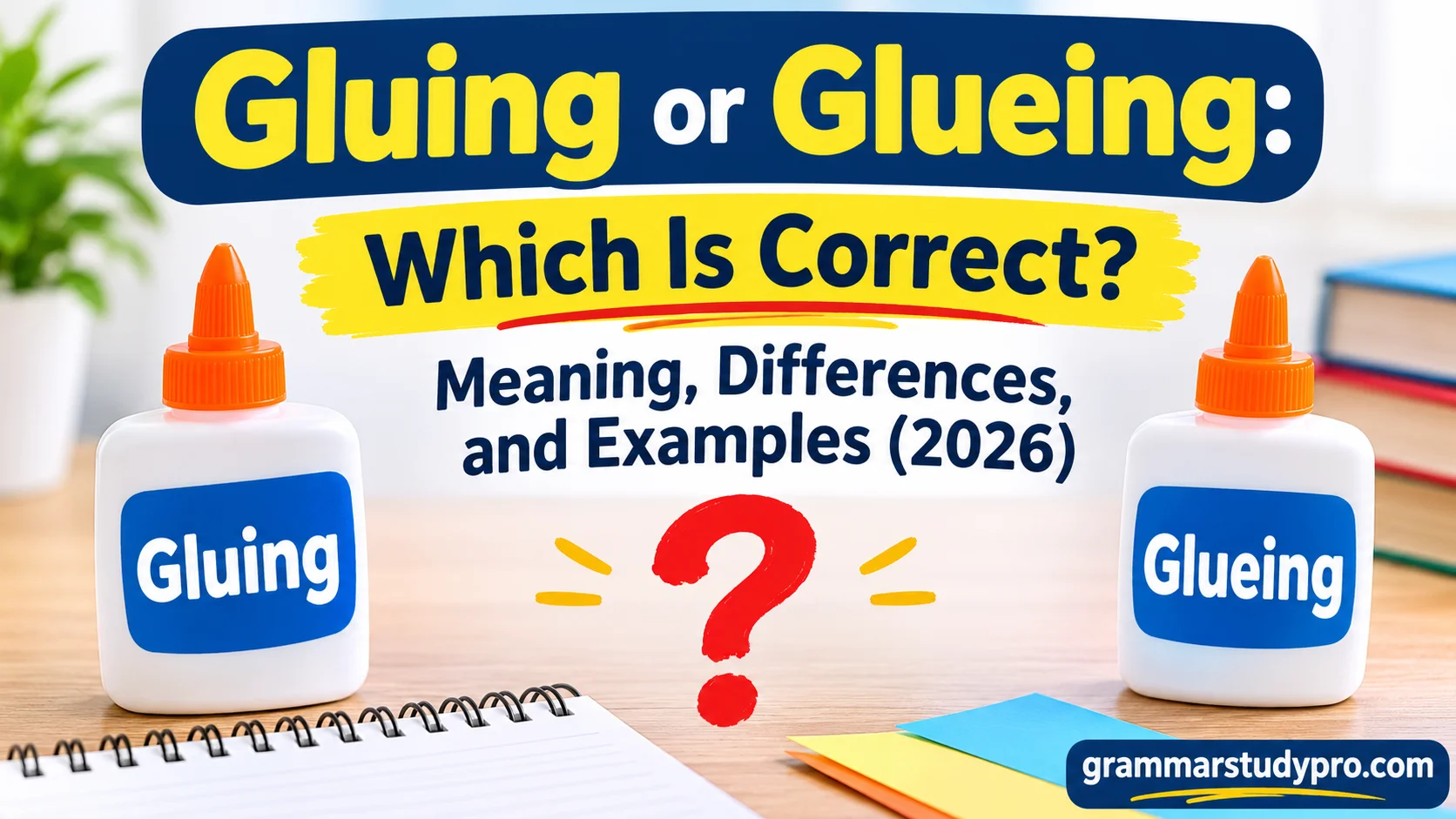
Gluing or Glueing can confuse writers, but gluing is the preferred American spelling because it follows the common rule for adding -ing to verbs.
English spelling has several variations because American English and British English sometimes follow different regional spelling conventions. Some words have more than one correct spelling, and their use can depend on different writing contexts. Both forms share the same meaning, but Gluing is the preferred spelling, while Glueing remains a recognized variant. The difference involves just one letter, yet choosing the right form improves your word choice and writing accuracy. Understanding these spelling differences also helps you recognize how English words change across different styles and regions.
The base word, glue, is a verb. To create its present participle, you normally remove the final e before adding the -ing suffix. This follows a common pattern in English spelling and grammar rules. Therefore, dropping the final e produces Gluing, while retaining the final e creates Glueing. This process is an example of word formation, including changes to word endings and different verb forms. Although English has spelling exceptions, understanding English grammar, spelling conventions, and the participle form makes the correct form easier to recognize. For standard American usage, Gluing is generally the safer spelling.
When writing school assignments, workplace documents, emails, or craft instructions, consistency makes your work easier to read. The same applies to professional communication, educational writing, and everyday writing. Choosing one spelling style throughout your written communication helps avoid unnecessary confusion. American readers will generally expect Gluing, especially in professional writing and everyday messages. Whether you’re preparing documents, sharing messages, or improving your written English, follow the appropriate spelling rules for your audience. Better understanding of English vocabulary and language usage helps you make confident spelling choices.
Quick Answer:
Gluing is the preferred spelling in American English. Glueing is a documented alternative spelling, not a different word with a different meaning.
Both forms describe attaching, joining, or fastening something with glue. The main difference concerns spelling preference rather than grammar or meaning.
For example:
- Preferred: She is gluing the broken pieces of the vase together.
- Alternative: She is glueing the broken pieces of the vase together.
Both sentences describe the same action. Nevertheless, gluing is the better default choice for American English essays, professional writing, websites, and everyday communication.
The spelling follows a familiar English pattern: when a verb ends in a silent e, writers usually drop that letter before adding -ing. That’s why glue becomes gluing rather than glueing in standard usage.
Comparison Overview: Gluing vs. Glueing
The simplest way to understand gluing vs. glueing is to compare their spelling, meaning, and everyday use.
| Feature | Gluing | Glueing |
| Meaning | Attaching something with glue | Attaching something with glue |
| Spelling status | Standard, preferred form | Recognized alternative form |
| American English | Recommended choice | Less common |
| Grammatical role | Gerund or present participle | Gerund or present participle |
| Pronunciation | Generally the same | Generally the same |
| Spelling pattern | Drops the final e | Retains the final e |
| Formal writing | Best default choice | Acceptable when the variant is intended |
| Example | She is gluing the paper. | She is glueing the paper. |
The table highlights the essential point: the two spellings have the same meaning and grammatical function. You don’t need to learn separate definitions or memorize different rules for using each form in a sentence.
For most writers, the practical decision is straightforward. Choose gluing unless you have a specific reason to follow a source, publication, or style guide that uses glueing.
Dictionary references are useful when you encounter this kind of variation provide useful starting points for checking the word and its spelling variants.
Main Differences Between Gluing and Glueing
Although gluing and glueing look slightly different, they don’t represent two separate words. Both are forms of the verb glue, and both refer to the act of joining objects with an adhesive.
The difference comes from how writers form the -ing form of a verb ending in e. English generally drops the final silent e before adding -ing, but some words have established alternative spellings.
Gluing Is the Preferred Spelling in American English
When writing in American English, gluing is the spelling to use in most situations. It follows the common spelling pattern and gives readers the familiar, standard form.
You can use gluing in nearly any context involving adhesive, whether you’re describing a school project, repairing furniture, making a scrapbook, or assembling a model.
Consider these examples:
- The students are gluing pictures onto their science posters.
- I’m gluing the loose corner of the book cover.
- She spent the afternoon gluing paper flowers onto invitations.
- The technician is gluing the small component into place.
- Gluing the pieces together requires a steady hand.
Each sentence uses the same form to describe an action. The surrounding words determine whether gluing describes something happening now or functions as a noun.
For example, in “She is gluing the pieces together,” the word describes an ongoing action. In “Gluing takes patience,” it functions as the subject of the sentence.
The spelling remains the same in both cases. Once you remember that glue normally becomes gluing, you can use the form confidently in a wide range of sentences.
Glueing Is a Recognized Alternative Spelling
The spelling glueing retains the final e from the base word glue. Although it appears less often in ordinary American English writing, it is a documented alternative.
For example:
- She is glueing the paper to the cardboard.
- They spent the morning glueing small pieces onto the model.
- He finished glueing the label onto the package.
These sentences communicate the same meaning as their gluing equivalents. The additional e doesn’t change the action, tense, or grammatical role.
It’s important not to confuse a less common spelling with a word that has no recognized use. English contains spelling variations, and dictionary entries sometimes record alternatives that differ in frequency or regional preference.
However, you don’t need to choose the less common form simply because the base word contains an e. For general American English writing, gluing remains the clearest choice.
What Does Gluing Mean?
Gluing means attaching, joining, or fastening one thing to another with glue or another suitable adhesive. The word comes from the verb glue, which describes using an adhesive substance to make objects stick together.
People use the word in many everyday situations. A child might glue paper shapes onto a poster, a carpenter might glue wooden components together, and an artist might glue fabric onto a decorative surface.
The precise materials and methods vary, but the basic idea remains the same: an adhesive helps hold two or more surfaces together.
Here are some common examples:
- Crafts: Gluing colored paper onto a greeting card.
- Repairs: Gluing a loose piece back onto a household object.
- Woodworking: Gluing two wooden surfaces together.
- School projects: Gluing photographs onto a presentation board.
- Model making: Gluing small components into their correct positions.
The word can also describe the process itself rather than a particular moment of action. For example, “Gluing the pieces together took twenty minutes” refers to the activity as a whole.
Gluing as a Present Participle
A present participle is the -ing form of a verb. It often appears with a helping verb to describe an action that is happening or was happening at a particular time.
In this construction, gluing helps form a continuous verb tense.
Examples include:
- She is gluing the torn page back into her notebook.
- They are gluing the cardboard pieces together.
- He was gluing the broken handle when I arrived.
- We were gluing decorations onto the display board.
- The children will be gluing their projects together tomorrow.
Notice how the helping verb changes while gluing stays the same. The choice between gluing and glueing doesn’t determine whether an action occurs in the present, past, or future.
Instead, the helping verb and the sentence structure establish the time of the action.
This distinction is helpful when editing your writing. If you need to describe an ongoing activity, use the appropriate helping verb and the standard gluing form.
Gluing as a Gerund
A gerund is a verb’s -ing form that functions as a noun. Although it comes from a verb, it can serve as a sentence’s subject or object.
For example, consider this sentence:
Gluing requires patience and attention to detail.
Here, gluing names an activity. It doesn’t describe someone performing the action at that exact moment.
More examples include:
- Gluing is an important step in this craft project.
- I enjoy gluing paper shapes onto handmade cards.
- She learned that gluing requires a clean surface.
- Careful gluing helps the model remain stable.
A gerund can also appear after certain verbs, including enjoy, avoid, and finish.
For example, “I enjoy gluing paper decorations” and “She finished gluing the pieces together” both use gluing as part of a gerund construction.
Whether the word functions as a gerund or a present participle, the spelling remains gluing in standard American English.
Why Is It Spelled Gluing Instead of Glueing?
The answer comes from a common English spelling rule involving verbs that end in a silent e.
When you add -ing to many verbs ending in a silent e, you drop the final letter first. This creates a smoother, established spelling rather than retaining every letter of the original word.
The pattern looks like this:
- Make becomes making.
- Take becomes taking.
- Write becomes writing.
- Bake becomes baking.
- Glue becomes gluing.
In each case, the final e disappears before -ing is added. The spelling of gluing follows the same general pattern.
The Rule for Dropping the Final E
English spelling rules help explain many common word forms. The final-e rule is especially useful because it applies to numerous everyday verbs.
| Base verb | Correct -ing form | Example |
| Make | Making | She is making a paper flower. |
| Take | Taking | He is taking careful notes. |
| Write | Writing | I’m writing a short letter. |
| Bake | Baking | They are baking fresh bread. |
| Use | Using | We are using a stronger adhesive. |
| Glue | Gluing | She is gluing the pieces together. |
These examples show why gluing fits a familiar pattern. Keeping the final e would depart from the spelling most American readers expect.
However, the rule isn’t absolute. English has historical spelling patterns, established exceptions, and alternative forms. You should treat the rule as a helpful guide rather than a promise that every verb behaves identically.
For instance, dyeing retains the e to distinguish it from dying, the -ing form of die. The words have different meanings, so their spellings help readers tell them apart.
Why English Spelling Can Be Confusing
English spelling often reflects a mixture of historical development, pronunciation, and established usage. As a result, a rule that works for many words won’t necessarily explain every form.
Consider the following examples:
- See → seeing: The final e remains because the word ends in two e letters.
- Agree → agreeing: The double e remains in the -ing form.
- Die → dying: The spelling changes to avoid an awkward form and preserve the established pattern.
- Glue → gluing: The final e normally drops before -ing is added.
These examples show why memorizing a single rule isn’t always enough. You also need to recognize common word patterns and check a dictionary when a spelling seems uncertain.
For glue, the standard American English form is straightforward: gluing. The existence of the alternative glueing doesn’t erase the general rule; it simply shows that English usage sometimes allows more than one spelling.
Gluing vs. Glueing: Example Sentences
Examples make spelling rules easier to remember because they show how words work in real situations. The following sentences demonstrate the preferred spelling and the recognized alternative in everyday contexts.
Examples of Gluing in Everyday Writing
Use gluing when you want a clear, conventional spelling in American English.
- Craft projects: I’m gluing colorful paper shapes onto the front of a birthday card.
- Home repairs: Dad is gluing the broken wooden handle back onto the drawer.
- School assignments: The students are gluing photographs onto their history presentation boards.
- Scrapbooking: She enjoys gluing ticket stubs and photographs into her scrapbook.
- Model making: We finished gluing the model airplane before dinner.
- Furniture repairs: Gluing the loose joint may help stabilize the chair.
- Packaging: The worker is gluing the label onto the cardboard box.
- Art projects: He spent an hour gluing fabric pieces onto the canvas.
Notice that gluing works naturally in different sentence structures. It can follow a helping verb, appear after another verb, or act as the subject of a sentence.
Examples of Glueing in Sentences
The alternative spelling glueing communicates the same action. You may encounter it in texts that follow a particular spelling preference.
- She is glueing the paper onto the cardboard.
- They are glueing the small pieces together for their school project.
- He spent the afternoon glueing decorative stones onto the frame.
- Glueing the loose pieces together took longer than expected.
These examples don’t introduce different grammatical rules. They simply demonstrate the alternative spelling in context.
For consistency, American English writers should generally use gluing throughout a document. Switching between gluing and glueing without a reason can distract readers and make the writing look less polished.
Is Gluing or Glueing Correct in American English?
For American English, gluing is the preferred spelling. It follows the usual rule for adding -ing to a verb that ends in a silent e.
The alternative glueing is documented in English references, but most writers don’t need to use it in ordinary American English prose.
Consider these situations:
| Writing situation | Recommended spelling | Reason |
| School essay | Gluing | Follows the common spelling pattern |
| Business report | Gluing | Clear and conventional |
| Craft instructions | Gluing | Familiar to American readers |
| Blog article | Gluing | Best default for American English |
| Quoted historical text | Preserve the original | Maintains the source’s wording |
| Publication with a specific style guide | Follow the guide | Ensures consistency |
For example, a craft tutorial might say, “Start by gluing the paper pieces onto the backing.” The wording is direct, natural, and easy to understand.
The alternative spelling would communicate the same instruction. However, there’s little practical benefit to choosing it when gluing is already the established preference for American English writing.
If you’re editing a document, focus on consistency. Use the preferred spelling unless you need to reproduce a source exactly or follow a publication’s stated conventions.
Is Gluing or Glueing Correct in British English?
British English also uses gluing, and dictionary references document glueing as an alternative. Therefore, the distinction isn’t simply a case of American English using one spelling and British English using the other.
British spelling does have recognizable differences from American spelling. For example, British English often uses colour where American English uses color. However, the gluing question doesn’t follow that familiar regional pattern in the same straightforward way.
If you’re writing for a British publication, consult its preferred dictionary or style guide. Some editors may favor a particular form, and following that preference helps maintain consistency.
For general writing, gluing is a practical choice for both American and British audiences. You don’t need to assume that glueing is required simply because your readers live in the United Kingdom.
Common Mistakes to Avoid When Using Gluing
A few common misunderstandings make this spelling question more confusing than necessary. Fortunately, each one has a simple solution.
Assuming Glueing Has a Different Meaning
The additional e doesn’t create a new meaning. Both gluing and glueing describe the same action.
For example, “She is gluing the paper” and “She is glueing the paper” communicate the same basic information.
Calling Glueing Completely Incorrect
It’s misleading to claim that glueing never exists or cannot be found in reputable English references. The spelling is documented as an alternative.
Still, recognizing an alternative doesn’t mean you should choose it every time. For most American English writing, gluing remains the better default.
Assuming Glueing Is Exclusively British
The difference isn’t a strict American-versus-British distinction. Both spellings appear in English-language references, so avoid assigning either form exclusively to one region without reliable evidence.
Forgetting the Final-E Rule
Writers sometimes retain the final e simply because it appears in the base word. However, verbs such as make, write, and glue generally drop that letter before adding -ing.
Remembering this pattern makes gluing easier to spell correctly.
Confusing Gluing With Glued
Although both words come from glue, they serve different grammatical purposes.
| Word | Grammatical form | Example |
| Glue | Base verb | I need to glue the pieces together. |
| Gluing | -ing form | She is gluing the pieces together. |
| Glued | Past tense | He glued the pieces together yesterday. |
| Glued | Past participle | The pieces have been glued together. |
The correct form depends on the sentence. Use gluing for an ongoing action or a gerund, and use glued when the sentence requires the past tense or past participle.
Related Words and Their Correct Forms
Comparing gluing with other -ing forms helps you understand why English spelling can seem inconsistent.
| Base word | -ing form | Spelling pattern |
| Make | Making | Drops the final e |
| Bake | Baking | Drops the final e |
| Write | Writing | Drops the final e |
| Use | Using | Drops the final e |
| Glue | Gluing | Drops the final e |
| See | Seeing | Retains the double e |
| Agree | Agreeing | Retains the double e |
| Die | Dying | Changes the spelling |
These examples reveal a useful pattern. Many verbs ending in a silent e drop that letter before taking -ing. Words that end in ee, however, generally retain both letters, as in seeing and agreeing.
The word dying illustrates another established spelling pattern. It comes from die, but the spelling changes to avoid the form dieing, which could be confused with dyeing.
You don’t need to memorize every exception at once. Start with the common patterns, then consult a reliable dictionary when a word has an unusual or disputed form.
For glue, the practical answer remains simple: write gluing in ordinary American English.
FAQs
1. Is it gluing or glueing?
Gluing is the preferred spelling in American English. Glueing is also a recognized variant, but it is less commonly used. For most writing, gluing is the better choice.
2. Why is gluing spelled without an e?
The verb glue ends with a silent e. English spelling rules usually require dropping the final e before adding the -ing suffix. That’s why glue becomes gluing.
3. Is glueing grammatically incorrect?
No, glueing isn’t necessarily incorrect. It is an accepted spelling variant found in English references. However, gluing follows the more common spelling pattern and is generally preferred.
4. What is the present participle of glue?
The present participle of glue is gluing. You form it by removing the final e and adding -ing. For example: “She is gluing the pieces together.”
5. Should I use gluing in professional writing?
Yes. Gluing is the safer choice for professional writing, school assignments, emails, and craft instructions. It follows standard American spelling conventions and is widely recognized.
Conclusion
Both gluing and glueing communicate the same meaning, but they aren’t equally common. Gluing is the preferred spelling, especially in American English, because it follows the usual rule of dropping a silent e before adding -ing.
Although glueing is a recognized variant, gluing remains the more practical choice for everyday and professional writing. When in doubt, choose gluing to keep your spelling clear and consistent.