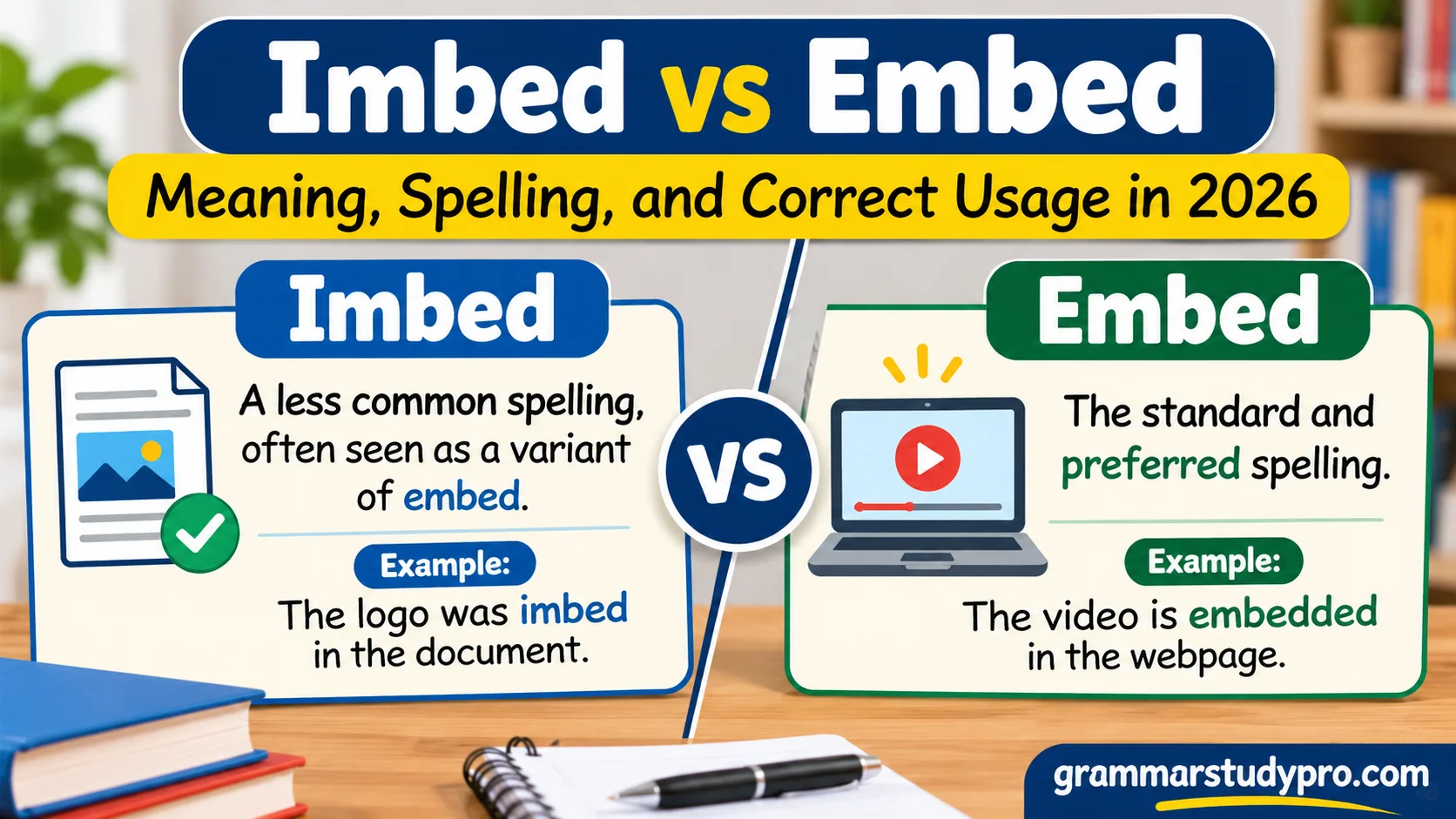
Imbed vs Embed explains why two spellings can share one meaning, even though modern English strongly prefers embed in formal writing today!
Both words belong to the same group of similar words because they have nearly identical meanings. They are verb variations that describe fixing or setting something firmly inside a surrounding mass. Although their spelling differences make them look slightly different, they express the same idea. In everyday English, you may encounter both spellings, but embed remains the standard spelling. It is the preferred word in modern English usage, particularly across academic writing, professional writing, business, and technology.
On the other hand, imbed is less common and somewhat archaic. You can still use it without making a grammatical mistake, but embed is the safer choice in most writing situations. For example, digital publishing, online media, and web development regularly use the word when integrating videos and images into a webpage or website. Related forms include embedded and imbedded, which follow the same spelling variations. Understanding this word comparison makes word choice easier and helps you follow standard English conventions in formal and everyday written communication.
Quick Answer:
Embed is the preferred spelling for most modern American English writing. Imbed is also correct, but it’s less common. Both words mean to place something firmly within a material or to incorporate something into a larger structure, system, or idea.
For example:
- Embed: The developer will embed a video in the article.
- Imbed: The sharp fragment became imbedded in the wooden board.
Both sentences use the words correctly. You can use either spelling when the context calls for it, but embed is generally the safer choice for professional writing, digital content, and everyday communication.
Here’s the simplest way to remember the distinction: the meaning stays the same, but the spelling most readers expect is embed.
Comparison Overview
The following table summarizes the main similarities and differences between imbed and embed.
| Feature | Embed | Imbed |
| Correct spelling | Yes | Yes |
| Basic meaning | To fix inside or incorporate | Same as embed |
| Commonness | More widely used | Less widely used |
| Modern American English | Preferred general form | Accepted alternative |
| Digital content | Standard choice | Less common |
| Physical objects | Correct | Correct |
| Figurative meanings | Correct | Correct |
| Past tense | Embedded | Imbedded |
| Present participle | Embedding | Imbedding |
| Best choice for most readers | Recommended | Acceptable when preferred |
The biggest takeaway is that neither spelling creates a separate meaning. Both can describe a physical object lodged inside a material or an idea that becomes part of a larger system.
For instance, a company might embed safety into its training program. Another writer could use imbed in a similar sentence without changing the intended meaning. Still, the first version will generally look more familiar to contemporary readers.
Dictionaries such as recognize embed and its alternative spelling imbed. When you need to choose one for a new article, consistency and current usage matter more than trying to assign each word a separate definition.
What Does Embed Mean?
The verb embed describes placing something firmly inside another object or making it an integral part of something larger. Its exact meaning depends on the context, but the central idea remains the same: something becomes situated within a surrounding structure.
According to the embed can describe physical objects, digital media, and electronic components. The word also appears in figurative expressions and specialized fields.
Let’s look at its main uses.
Embed as a Physical Action
In its literal sense, embed means to fix an object firmly into a material or surrounding mass. The object usually becomes lodged within something else rather than simply resting on its surface.
For example, a small stone might become embedded in wet concrete. A piece of glass could embed itself in a wooden frame after a window breaks.
Here are a few more examples:
- The builder embedded metal rods in the concrete foundation.
- A tiny fragment of glass became embedded in the rubber sole.
- The artist embedded colorful stones in the sculpture.
- The bullet embedded itself in the wooden door.
- The gardener embedded stepping-stones along the pathway.
Notice how the word describes a relationship between an object and its surroundings. The stone doesn’t merely touch the concrete; it becomes fixed within it.
This meaning often appears in construction, medicine, geology, and manufacturing. For example, a doctor might describe a foreign object as embedded in tissue. A construction worker might discuss metal supports embedded in concrete.
Embed as a Figurative Expression
You don’t always need a physical object to use embed. The word also describes an idea, habit, belief, or quality that becomes a lasting part of something.
Think about a school that makes kindness part of its daily routines. Teachers encourage students to help classmates, share resources, and treat others respectfully. Over time, kindness becomes embedded in the school’s culture.
The same idea applies to organizations, families, communities, and personal habits.
Consider these examples:
- The company wants to embed honesty into its business practices.
- Years of practice embedded discipline into her daily routine.
- Respect for elders remains deeply embedded in the community.
- The teacher embedded critical thinking into every lesson.
- Fairness should be embedded in the hiring process.
In these sentences, nothing needs to enter a physical object. Instead, a quality becomes an established part of a larger system.
The expression deeply embedded is especially common when describing beliefs, social attitudes, traditions, and long-standing habits. It suggests that something has become difficult to separate from the surrounding culture or structure.
For instance, saying that a tradition is deeply embedded in a community implies more than occasional participation. The tradition has become part of the community’s identity.
Embed in Technology and Digital Content
In modern writing, embed often refers to placing digital content directly inside another digital environment. You may encounter this usage when building a website, creating an online course, or preparing a digital report.
A blogger can embed a video in an article so readers can watch it without visiting a separate page. A teacher can embed an interactive activity in an online lesson. A business can embed a chart in a presentation.
Common examples include:
- Embedding a YouTube video in a blog post.
- Embedding a map on a business website.
- Embedding a spreadsheet in a digital report.
- Embedding audio in an online learning resource.
- Embedding a social media post on a news page.
The word also appears in technical documentation. For example, a developer might explain how to embed media into a webpage or how an application handles embedded content.
One important distinction is worth remembering: embedding content is not always the same as linking to it.
A hyperlink usually directs users to another location when they click it. Embedded content, by contrast, appears within the host document or webpage when the necessary technology and permissions allow it.
| Situation | Example | What happens |
| Embedded video | A video appears inside a blog post | Readers can watch it within the page |
| Hyperlinked video | A text link opens a video page | Readers follow the link to another location |
| Embedded chart | A chart appears within a report | The chart forms part of the document’s presentation |
| Linked chart | A report contains a link to a chart | Readers open the chart separately |
Embedding doesn’t guarantee that content will always display. Browser restrictions, privacy settings, permissions, or technical problems may prevent it from loading.
Still, embed remains the standard verb for describing this process. In technology articles and website instructions, using imbed instead may confuse readers who expect the more familiar spelling.
Embed in Journalism and Specialized Fields
The word embed also has established meanings in professional and academic settings.
In journalism, an embedded reporter accompanies a military unit or another organized group to report from within its activities. This arrangement can provide access to events that an outside reporter might find difficult to observe.
For example:
- The news organization embedded a reporter with the military unit.
- The embedded journalist documented daily life near the conflict zone.
The word also appears in linguistics. An embedded clause or sentence sits within a larger grammatical structure.
Consider this example:
She knows that the train leaves at six.
The clause that the train leaves at six appears inside the larger sentence. A linguist may describe it as an embedded clause.
Technical fields use the word in other ways, too. An embedded system is a computer system built into a larger device to perform particular functions. Examples include controllers in washing machines, automotive electronics, and industrial equipment.
These uses demonstrate why embed is more than a word for putting one object inside another. It can describe a physical relationship, a technical arrangement, or a structural relationship between ideas.
What Does Imbed Mean?
Imbed is an alternative spelling of embed. It carries the same basic meanings and can be used in similar grammatical contexts.
The directs readers to embed. Oxford also recognizes the relationship between the two forms in its
The important point is that imbed isn’t a separate word with a different definition. It is a recognized spelling variant.
Definition and Meaning of Imbed
Like embed, imbed can describe an object fixed inside a material. It can also refer to an idea or quality that becomes part of a larger structure.
For example:
- The sharp fragment became imbedded in the wooden board.
- Workers imbedded small stones in the garden path.
- The training program imbedded safety practices into daily routines.
- The tradition remained imbedded in the family’s history.
Each sentence uses imbed in a way that corresponds to embed. Replacing the alternative spelling with the more common form wouldn’t change the intended meaning.
However, readers encounter embed more often in contemporary general writing. That familiarity makes it a practical choice for writers who want to avoid distracting readers with an unusual spelling.
Is Imbed a Real Word?
Yes. Imbed is a recognized English word, not simply a typo that dictionaries ignore.
The lists the word and directs readers to embed for its definition. The also recognizes imbed as an alternative form.
This distinction matters because a word can be correct without being the most common choice.
English has many accepted spelling variants. Some appear regularly in everyday writing, while others remain less familiar to most readers. Imbed belongs to the second category.
If you find imbed in a book, article, or older document, you shouldn’t automatically assume the writer made a spelling mistake. The writer may have chosen the alternative form or followed an established editorial preference.
Nevertheless, when you’re writing for a broad audience, embed is usually the more practical option.
Main Differences Between Imbed and Embed
Although the two words share the same meaning, a few practical differences can help you choose between them.
Meaning and Definition: Imbed vs Embed
The most important similarity is also the easiest to overlook: imbed and embed mean the same thing.
Both words can describe:
- Fixing an object firmly inside a material.
- Incorporating a quality into a system or culture.
- Including digital media within a document or webpage.
- Describing certain technical or grammatical structures.
Compare these sentences:
| Using embed | Using imbed |
| The nail embedded itself in the wood. | The nail imbedded itself in the wood. |
| The school embedded teamwork into its curriculum. | The school imbedded teamwork into its curriculum. |
| The developer embedded a video in the article. | The developer imbedded a video in the article. |
The paired examples illustrate the spelling variation. However, for digital media and other modern professional contexts, embed is the more familiar choice.
You don’t need to select one spelling for physical objects and another for abstract ideas. The distinction isn’t based on meaning.
Spelling and Popularity
The main difference concerns how commonly people use each spelling.
Embed is the standard form most readers will recognize immediately. It appears in dictionary headwords, technology documentation, professional writing, and everyday descriptions of objects or ideas incorporated into larger structures.
Imbed remains acceptable, but it is less common.
This preference matters most when writing for readers who expect conventional contemporary spelling. A familiar spelling allows them to focus on your message instead of pausing to consider whether you’ve made an error.
For example, a website tutorial will usually sound more natural when it says, “Embed the video in your article.” The alternative isn’t inherently wrong, but it may look unusual to readers accustomed to digital terminology.
Don’t confuse frequency with correctness, though. A less common spelling doesn’t automatically become incorrect simply because writers prefer another form.
Usage in Formal and Professional Writing
When you write a report, business email, school assignment, or website article, consistency and reader expectations matter.
For most professional situations, choose embed. It is widely recognized and works across a broad range of subjects.
Use it when discussing:
- Digital media and website development.
- Business values and company culture.
- Educational methods and training.
- Construction and manufacturing.
- Scientific and technical processes.
- Journalism and grammatical structures.
You can use imbed when a publication, organization, or established document consistently prefers that spelling. Otherwise, the more familiar form is the safer editorial choice.
For example, imagine that you’re preparing a technology guide for new website owners. The sentence “Click the option to embed a video” is immediately recognizable. The same instruction using imbed remains understandable, but it may not match the terminology readers see elsewhere.
A good editing rule is simple: choose the familiar spelling unless you have a clear reason to do otherwise.
Pronunciation of Imbed and Embed
Both words share the same standard pronunciation. The spelling changes, but the spoken form doesn’t.
Their pronunciation in IPA is:
/ɪmˈbɛd/
The stress falls on the second syllable. The opening sound is a short vowel, followed by the consonant sounds in bed.
You don’t need to learn two pronunciations or change your speech when switching between the spellings. In ordinary conversation, the words sound the same.
This is another reason the difference can confuse English learners. When two spellings represent the same spoken word and meaning, familiarity becomes the most useful guide.
When Should You Use Embed Instead of Imbed?
Choosing the right spelling becomes easier when you consider your audience and the type of writing you’re producing. Although both forms are correct, embed is the better default for most situations.
Use Embed in Everyday Writing
When describing something placed firmly inside another object, use embed unless you have a specific reason to choose the alternative.
For example:
- The carpenter embedded metal fasteners in the wooden frame.
- Small stones were embedded in the concrete walkway.
- The glass fragment became embedded in the door.
- The artist embedded pieces of colored glass in the sculpture.
These examples show how embed works with physical objects. It can describe an action someone performs or a condition that results from that action.
Notice the difference between these two sentences:
- The worker embedded the metal rod in the wall.
- The metal rod was embedded in the wall.
The first sentence emphasizes the worker’s action. The second emphasizes the rod’s position. Both use the same verb correctly.
Use Embed for Websites and Digital Media
If you’re writing about websites, applications, or online publishing, embed is the preferred choice.
For instance, a blogger might embed a video to explain a complicated topic. A teacher might embed a quiz in a digital lesson so students can answer questions without leaving the page.
Here are some natural examples:
- Embed the video below the introduction.
- The website allows visitors to embed interactive maps.
- She embedded an audio recording in her presentation.
- The developer embedded a chart in the dashboard.
The word also appears in technical instructions, where consistent terminology helps users follow each step. Using embed keeps your instructions aligned with common digital vocabulary.
Use Embed for Figurative Meanings
Choose embed when describing qualities, beliefs, habits, or values that become part of a larger system.
Consider a company that wants employees to follow strong safety practices. Instead of relying on occasional reminders, managers incorporate safety checks into daily routines. Over time, safety becomes embedded in the company’s working culture.
Other examples include:
- Parents can embed good habits through consistent routines.
- The teacher embedded practical exercises into the course.
- Trust is deeply embedded in their relationship.
- The organization aims to embed fairness into its hiring process.
These examples describe something that becomes an established part of a larger whole. No physical insertion needs to occur.
When Is Imbed Acceptable?
You can use imbed when you prefer the alternative spelling or need to follow a particular publication’s style.
For example, a writer might use imbedded in a document that already uses that spelling throughout. Changing every instance to embedded could be unnecessary if the publication accepts the alternative and consistency matters.
However, consider three practical guidelines:
- Follow the required style guide. A publisher or employer may have its own spelling preferences.
- Keep related forms consistent. Avoid switching between embed, imbedded, and imbedding without a reason.
- Consider your readers. The more familiar spelling usually makes professional writing easier to scan.
You don’t need to avoid imbed completely. Just recognize that embed is the more widely expected form.
Embedded vs Imbedded: Which Spelling Is Correct?
The same spelling preference applies to the past-tense forms of these verbs. Embedded and imbedded are both accepted, but embedded is generally the more familiar form.
Embedded as the Preferred Past-Tense Form
Embedded is the past tense and past participle of embed. Writers also use it as an adjective to describe something fixed within a material or incorporated into a larger structure.
Examples include:
- The technician embedded the sensor in the machine.
- The video was embedded in the article.
- The embedded image appeared beneath the heading.
- These beliefs are deeply embedded in the culture.
The word works in different grammatical structures without changing its spelling. For example, you can write “She embedded the chart” or “The chart was embedded in the report.”
Imbedded as an Alternative
Imbedded is the corresponding past-tense and past-participle form of imbed.
For example:
- The technician imbedded the sensor in the machine.
- The video was imbedded in the article.
- The imbedded fragment was difficult to remove.
These forms are valid, but they are less familiar to many contemporary readers. If you’re writing a new article or professional document, embedded is usually the better option.
Embedding vs Imbedding
The same principle applies to the present participle and gerund forms.
Embedding is the standard form used in most modern writing. Imbedding is an accepted alternative.
| Standard form | Alternative form | Example |
| Embed | Imbed | Embed the image in the report. |
| Embedded | Imbedded | The image was embedded in the report. |
| Embedding | Imbedding | She is embedding the image in the report. |
A gerund uses the -ing form as a noun. For example, “Embedding videos can improve the usefulness of an online lesson” uses embedding to name an activity.
A participle can form part of a verb phrase, as in “The developer is embedding the video.”
Both grammatical uses follow the same spelling preference.
Imbed vs Embed Examples in Sentences
Examples make spelling differences easier to understand because they show how the words work in real contexts.
Examples of Embed
Here are ten examples using the more common spelling.
- The builder embedded steel supports in the concrete foundation.
- A small piece of glass became embedded in the wooden frame.
- The developer embedded a video in the blog post.
- The teacher embedded a short quiz in the online lesson.
- The company wants to embed accessibility into its design process.
- Years of practice embedded discipline into her routine.
- The journalist was embedded with a military unit.
- The software uses an embedded system to control the equipment.
- The writer embedded a quotation in the paragraph.
- Fairness should be embedded in every stage of the hiring process.
These examples cover physical, figurative, technical, grammatical, and digital uses. The common thread is that something becomes part of a surrounding structure or system.
Examples of Imbed
The following examples demonstrate the alternative spelling.
- The sharp fragment became imbedded in the wooden board.
- Workers imbedded small stones along the garden path.
- The sample was imbedded in a supporting material.
- The old custom remained imbedded in the community’s traditions.
- The researcher described how the idea was imbedded in the model.
- The metal piece became imbedded in the damaged surface.
Each sentence communicates a meaning similar to its embed counterpart. The alternative spelling doesn’t create a new definition.
Side-by-Side Examples of Imbed vs Embed
Use this comparison to see how the two forms work in equivalent sentences.
| With embed | With imbed |
| The thorn embedded itself in his finger. | The thorn imbedded itself in his finger. |
| She embedded the video in her presentation. | She imbedded the video in her presentation. |
| The values are embedded in the company’s culture. | The values are imbedded in the company’s culture. |
| The technician embedded the sensor in the device. | The technician imbedded the sensor in the device. |
| The lesson became embedded in the student’s memory. | The lesson became imbedded in the student’s memory. |
Remember: Both spellings can communicate the same idea. The standard form embed is usually preferable when you want your writing to match contemporary usage.
Common Mistakes to Avoid With Imbed and Embed
Even though the distinction is straightforward, a few common mistakes can make your writing less clear.
Assuming Imbed Is Always Incorrect
Some writers treat imbed as a misspelling simply because they encounter embed more often. However, dictionaries recognize imbed as an alternative spelling.
If you see imbedded in a published document, don’t assume the author has made an error. Check whether the spelling is accepted before correcting it.
Thinking Imbed and Embed Have Different Meanings
Another mistake is trying to assign a separate definition to each word.
For example, you might assume that embed refers only to technology while imbed describes physical objects. That distinction doesn’t hold. Both spellings can describe physical insertion and figurative incorporation.
Choose between them based on spelling preference, not meaning.
Mixing Different Spellings in One Article
Consistency helps readers focus on your ideas rather than your word choices.
Suppose a technology article uses embed in one section, imbedded in another, and imbedding later without a clear reason. Readers may wonder whether the author intends a distinction.
A better approach is to use one spelling family throughout:
- Embed
- Embedded
- Embedding
This pattern keeps your terminology consistent and aligns with common modern usage.
Confusing Embedding With Linking
When writing about digital content, remember that embedding and linking describe different actions.
An embedded video typically appears within a webpage or application. A hyperlink usually directs the reader to another location.
For example, a travel blog might display a map directly inside an article. That map is embedded. If the blog simply provides a link to an external map, it links to the resource instead.
Understanding this distinction helps you choose precise words when writing tutorials or technical instructions.
Synonyms for Embed and Imbed
Sometimes another verb communicates your meaning more clearly. The best synonym depends on whether you’re describing physical placement, inclusion, or a lasting influence.
| Synonym | Meaning | Example |
| Insert | Put something into another thing | Insert the card into the slot. |
| Implant | Place something firmly within a body or structure | The surgeon implanted a medical device. |
| Incorporate | Make something part of a larger whole | The teacher incorporated feedback into the lesson. |
| Integrate | Combine something with an existing system | The company integrated the new software into its workflow. |
| Enclose | Surround or contain something | The packaging enclosed the fragile object. |
| Ingrain | Establish a habit or belief deeply | Practice helped ingrain the habit. |
| Lodge | Become stuck or firmly positioned | A small stone lodged in the tire. |
These words overlap with embed, but they aren’t interchangeable in every situation.
For instance, integrate often emphasizes combining separate elements into a functioning system. Lodge usually describes something becoming stuck in a particular place. Ingrain works especially well for habits, beliefs, and attitudes.
Choose the word that best captures the action you want to describe.
FAQs
1. Is Imbed or Embed the Correct Spelling?
Both imbed and embed are correct English spellings. However, embed is the standard and more widely accepted choice in modern writing. You should use it in academic, professional, and everyday communication.
2. Do Imbed and Embed Have the Same Meaning?
Yes, both words have exactly the same meaning. They describe fixing, placing, or setting something firmly within another object or surrounding material. The difference lies in spelling and usage frequency, not meaning.
3. Why Is Embed More Common Than Imbed?
Embed has become the preferred spelling through modern English usage. It appears frequently in technology, publishing, media, and business. Meanwhile, imbed is less common and is often considered somewhat archaic.
4. Is Imbedded or Embedded Correct?
Both imbedded and embedded are correct past-tense and past-participle forms. However, embedded is much more common in contemporary English. For consistency, choose embedded in professional and academic writing.
5. Should I Use Embed in Formal Writing?
Yes, embed is the better choice for formal writing. It follows standard modern English conventions and is widely recognized by readers. Using it also keeps your spelling consistent across academic papers, business documents, and website content.
Conclusion
The difference between imbed vs embed comes down to spelling preference and modern usage. Both words are correct and share the same meaning, but embed is the more common and widely preferred form.
Whether you’re writing an academic paper, creating website content, or preparing a business document, choosing embed is the safest option. You can still recognize imbed as a valid alternative, but embed fits modern English writing more naturally.