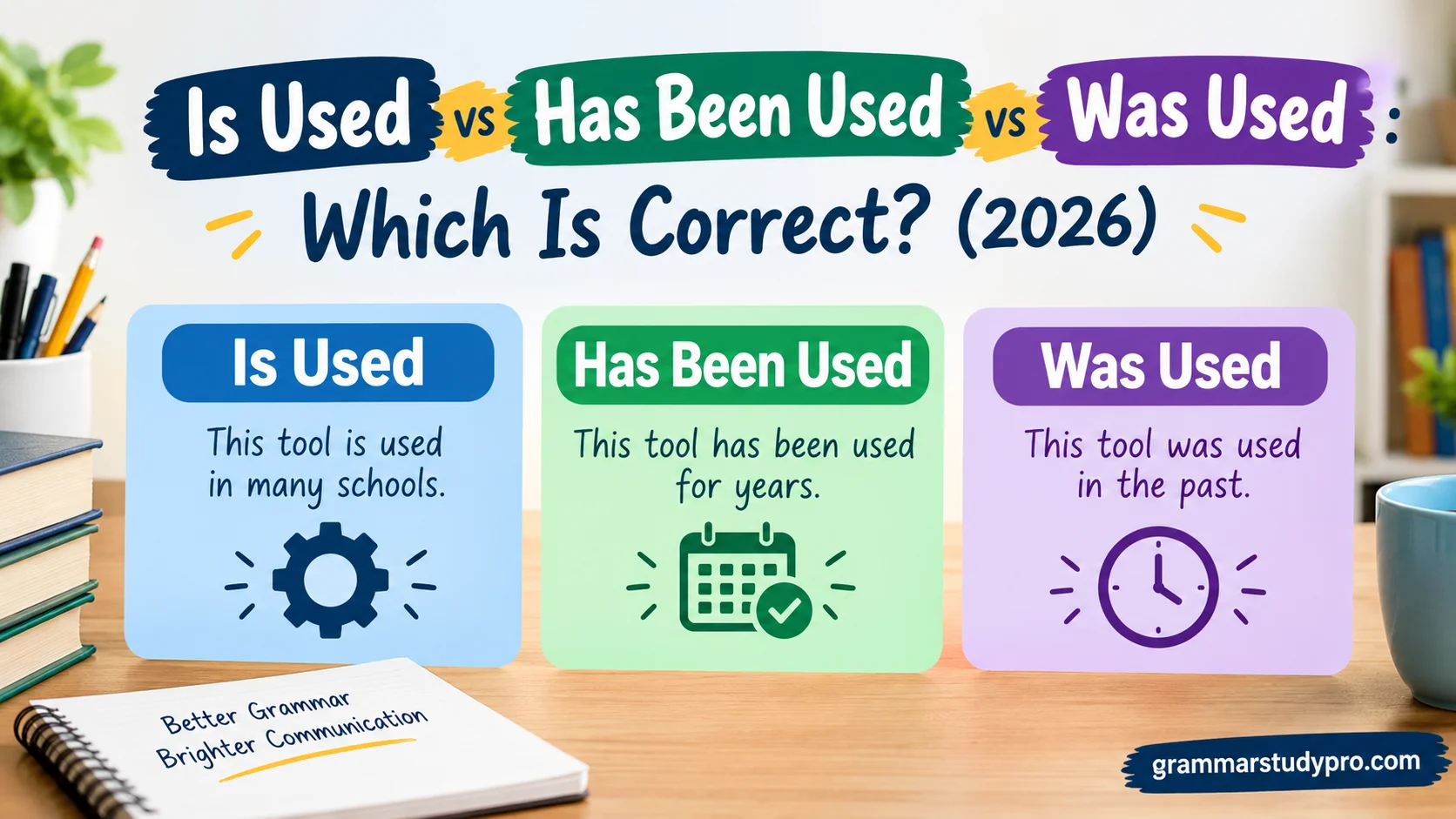
Is Used vs Has Been Used vs Was Used explains how verb tenses show when an action happens and why context matters.
In English grammar, choosing the correct verb tense helps you communicate clearly in written English and spoken English. The expressions is used, has been used, and was used are all grammatically correct, but their meanings change according to the time frame. For example, “This tool is used every day” describes a regular activity or repeated action in the present tense. However, “This tool has been used for many years” connects a past action with the present and uses the present perfect tense to show ongoing relevance. In contrast, “This tool was used yesterday” describes a completed event in the simple past tense. These verb phrases use the passive voice, which focuses on the action rather than the person performing it. Understanding these tense differences makes verb selection easier and helps English learners avoid common grammar mistakes.
To understand these expressions, learn the basic grammar rules, verb forms, and tense formation. The passive structure combines a form of be with a past participle, while helping verbs and auxiliary verbs indicate the tense. For example, has and have are popular verbs that require correct subject-verb agreement. This also explains the differences between has vs. have and has been vs. have been.
Remember that has been followed by an -ing verb can form the present perfect continuous tense, but has been used is a passive form of the present perfect. Checking the time reference before choosing an expression is a useful practical editing habit. It improves grammatical accuracy, sentence structure, and effective communication in clear emails, academic papers, workplace reports, and everyday messages. With regular language learning and practice, you can improve your English proficiency, writing skills, speaking skills, and grammatical confidence.
Quick Answer
Is used, has been used, and was used are all correct. The right choice depends on whether you describe a general practice, past use connected to the present, or a completed event in the past.
- Is used: Describes a general fact, regular practice, or current function. Example: This software is used by thousands of people.
- Has been used: Describes use that began in the past and continues up to now, or past use that remains relevant to the present. Example: This software has been used for ten years.
- Was used: Describes use during a past event or period. Example: This software was used during yesterday’s presentation.
Remember this simple distinction: use is used for general or current situations, has been used for past-to-present connections, and was used for completed past events.
However, these are guidelines rather than rigid rules. Context determines which form communicates your intended meaning most accurately.
Comparison Overview
The easiest way to understand these expressions is to compare their grammatical forms, typical uses, and examples side by side.
| Feature | Is Used | Has Been Used | Was Used |
| Grammatical form | Present simple passive | Present perfect passive | Past simple passive |
| Main time focus | Present facts or regular practices | Past use with present relevance | Completed past events |
| Typical purpose | Describing functions, habits, or procedures | Describing experience, results, or use up to now | Describing historical or finished events |
| Common time clues | Usually, often, every day | Since, for, recently, so far | Yesterday, last year, in 2020 |
| Example | This method is used in schools. | This method has been used for years. | This method was used last year. |
Notice that used remains the past participle in all three expressions. The helping verbs determine the tense and shape the time relationship.
The table also highlights an important distinction: has been used does not always mean something is still being used. It can describe completed use that matters to the current situation.
Main Differences Between Is Used vs Has Been Used vs Was Used
The most important difference between these expressions lies in tense, time reference, and context. All three use the passive voice, but each communicates a different relationship between an action and the time you are discussing.
What Does “Is Used” Mean?
Is used is the present simple passive form of the verb use. Writers use it to describe general facts, regular practices, established procedures, and the functions of things.
The expression focuses on what happens generally or what role something serves. It doesn’t necessarily describe an action happening at this exact moment.
For example:
- This machine is used to package food.
- English is used as a common language in many international settings.
- This formula is used to calculate the area of a circle.
- The conference room is used for weekly meetings.
- This word is used informally in everyday conversation.
Each sentence describes a general practice or function rather than one specific, completed event.
Consider the sentence, “This machine is used to package food.” It tells you what the machine does as part of its normal function. You don’t need to know when someone last operated it.
The present simple passive also works well when you want to describe established facts without identifying the person performing the action.
Grammar structure:
Subject + am/is/are + past participle
Examples:
- The device is used for testing.
- These devices are used for testing.
- I am used in this process. (This is grammatical only in a context where the speaker means they are employed or utilized in the process.)
The subject determines whether you use am, is, or are. For singular third-person subjects such as the device, use is used.
What Does “Has Been Used” Mean?
Has been used is the present perfect passive form. It connects an earlier action with the present, often by emphasizing experience, results, duration, or relevance.
You might choose this expression when the exact time of use doesn’t matter. You may also use it when something has seen repeated use over a period extending to the present.
For example:
- This research method has been used in several studies.
- The software has been used by our team since 2020.
- This room has been used for training many times.
- The old equipment has been used extensively.
- The technique has been used to solve similar problems.
These sentences describe past use from a present-day perspective. The speaker cares about the experience, accumulated use, or current significance of the action.
Look at this example: “The software has been used by our team since 2020.” The word since identifies the starting point, while the present perfect connects that earlier starting point to now.
However, has been used does not automatically mean continued use. Consider this sentence:
“The emergency backup system has been used to restore the missing files.”
The restoration may already be complete. The sentence emphasizes the system’s use and its relevance to the current situation rather than claiming that someone is still using it.
Grammar structure:
Subject + has/have + been + past participle
Examples:
- The tool has been used several times.
- The tools have been used several times.
Use has with singular third-person subjects such as the tool. Use have with plural subjects and with I, you, we, and they.
What Does “Was Used” Mean?
Was used is the past simple passive form. It describes an action or situation that occurred in the past, often during a finished period.
This expression works particularly well when you discuss historical events, completed projects, previous procedures, or something that served a purpose at an earlier time.
For example:
- The machine was used yesterday.
- The building was used as a hospital during the war.
- The team was used to test the new procedure. (Here, the intended meaning is that the team served as the group used for testing.)
- The old software was used until 2022.
- This method was used in the final experiment.
These sentences locate the action in a past context. The speaker presents the use as a past event rather than emphasizing its connection to the present.
Suppose you write, “The old software was used until 2022.” This sentence identifies a former period of use and suggests that the period ended then. It doesn’t, by itself, tell readers what replaced the software.
Grammar structure:
Subject + was/were + past participle
Examples:
- The computer was used during the test.
- The computers were used during the test.
Use was with singular subjects such as the computer. Use were with plural subjects such as the computers.
How the Three Forms Change a Sentence’s Meaning
Comparing the same subject across all three forms reveals the difference more clearly than memorizing definitions alone.
| Sentence | Meaning |
| This laboratory is used for medical research. | Describes the laboratory’s general function. |
| This laboratory has been used for medical research for twenty years. | Connects a long period of use with the present. |
| This laboratory was used for medical research in 2018. | Describes use during a specific past period. |
The subject and basic activity remain the same. What changes is the speaker’s perspective on time.
Consider another example involving a phone:
- Is used: This phone is used for business calls. The sentence describes its usual purpose.
- Has been used: This phone has been used for five years. The sentence emphasizes its history of use up to now.
- Was used: This phone was used during the interview yesterday. The sentence describes a completed past event.
A single expression may be appropriate in one context but misleading in another. That’s why you should consider what you want the reader to understand, not simply which tense sounds familiar.
When to Use “Is Used”
Choose is used when your sentence describes a general practice, current function, or repeated activity. The present simple passive often appears in instructions, educational explanations, scientific descriptions, and workplace documents.
For General Facts and Established Practices
Use is used to describe accepted methods or common practices.
Examples:
- A compass is used to determine direction.
- A comma is used to separate certain elements in a sentence.
- Solar energy is used to generate electricity.
- This measurement system is used throughout the organization.
These statements explain how something generally works or how people typically use it. They don’t point to a single occasion.
For Regular or Repeated Uses
The expression also works when something serves the same purpose repeatedly.
Examples:
- The main hall is used for staff meetings every Monday.
- This template is used whenever the company prepares a report.
- The machine is used twice a day to inspect products.
Time expressions such as every Monday, regularly, and twice a day can signal a recurring practice.
For Current Functions and Purposes
When you explain what an object, method, or system does, is used is often the natural choice.
For example, “A thermometer is used to measure temperature” explains the instrument’s function. It doesn’t claim that someone is holding or operating a thermometer right now.
You can also use this form in definitions and educational content:
- A password is used to protect access to an account.
- A microscope is used to examine tiny objects.
- A map legend is used to explain symbols on a map.
Common Time Expressions With “Is Used”
The following words and phrases often appear with the present simple passive:
- Usually
- Often
- Regularly
- Every day
- Generally
- In most cases
These expressions provide clues, not absolute rules. A sentence can use is used without any time marker when the general meaning is clear.
When to Use “Has Been Used”
Choose has been used when the sentence connects earlier use with the present. This form is particularly useful when discussing experience, duration, accumulated results, or previous actions that matter now.
For Experience Up to the Present
Use the present perfect passive when the history of use matters more than its exact date.
Examples:
- This approach has been used in several successful projects.
- The equipment has been used by different research teams.
- This expression has been used in English for centuries.
These sentences report experience accumulated over time. They don’t identify one specific, finished occasion.
For Use That Continues Over a Period
When something has been used for a period extending to the present, the present perfect passive often fits naturally.
Examples:
- This system has been used since 2019.
- The same teaching method has been used for several years.
- This building has been used as a library for decades.
The phrases since 2019 and for several years help establish the connection between the past and the present.
Still, the surrounding context matters. A sentence such as “The building has been used as a library for decades” normally suggests an ongoing role. It doesn’t guarantee that the building remains a library today if additional context indicates otherwise.
For Recent Use or Present Results
Sometimes you use the present perfect passive because the result matters now.
For example:
“The backup system has been used to recover the missing files.”
The sentence highlights the recovery process and its present relevance. The action itself may already be finished.
Other examples include:
- The new procedure has been used to correct the error.
- This tool has been used to identify the damaged component.
- The updated form has been used to process the applications.
Common Time Expressions With “Has Been Used”
These expressions frequently appear with the present perfect passive:
- Since last year
- For several months
- Recently
- Already
- So far
- Over the years
- Many times
Use these phrases as helpful clues rather than automatic rules. For example, recently can also appear with the simple past when the speaker presents an event as a completed occurrence.
Compare:
- The software has been used recently. (Emphasizes recent experience or present relevance.)
- The software was used recently during the trial. (Presents the use as a past event.)
Both can be grammatical. The intended meaning and surrounding context guide your choice.
When to Use “Was Used”
Choose was used when you describe a completed past action or a situation associated with an earlier period. This form is common in historical accounts, incident reports, project summaries, and descriptions of former purposes.
For Completed Actions at a Specific Past Time
When a sentence includes a finished time such as yesterday or last Friday, the simple past usually works best.
Examples:
- The printer was used yesterday.
- The new procedure was used during Monday’s meeting.
- The machine was used in the final test last week.
- The old password was used before the account was updated.
These sentences place the action in a past period that the speaker treats as finished.
In standard American English, a specific finished-time expression normally favors the simple past rather than the present perfect. Therefore, “The printer was used yesterday” is more appropriate than “The printer has been used yesterday.”
For Historical Events and Former Purposes
The past simple passive is especially useful when describing how people used something in earlier times.
Examples:
- The building was used as a hospital during the war.
- This instrument was used by early astronomers.
- The factory was used to manufacture agricultural equipment.
- The classroom was used as a temporary office during renovations.
These examples focus on past circumstances. The building, instrument, factory, or classroom may have a different purpose today.
For Past Events in Stories and Reports
Writers often use was used when describing the steps of a completed experiment, investigation, or project.
For example:
“The research team collected the samples on Tuesday. Each sample was used to test a different treatment.”
The past simple passive keeps the timeline consistent. It also lets the writer focus on the samples instead of repeatedly naming the people who handled them.
You might see the same structure in business reports:
- The original budget was used to estimate initial costs.
- The revised document was used during the final review.
- The backup database was used to restore the missing records.
Common Time Expressions With “Was Used”
Look for expressions that place the action in a finished past period:
- Yesterday
- Last week
- Last month
- In 2019
- Two days ago
- At that time
- During the previous meeting
- Before the new system was introduced
These phrases often support the past simple. However, a past time reference alone doesn’t always require was used. A sentence may use the present perfect when the time period remains open or the speaker emphasizes a present result.
Is Used vs Has Been Used vs Was Used: Examples in Sentences
The following examples show how these expressions work in everyday, academic, professional, and historical contexts.
Everyday English Examples
| Is Used | Has Been Used | Was Used |
| This knife is used to cut vegetables. | This knife has been used for years. | This knife was used to prepare dinner last night. |
| The car is used for daily travel. | The car has been used by three family members. | The car was used on our trip last weekend. |
| This app is used to track expenses. | This app has been used since January. | This app was used during last month’s project. |
What to notice: The first column describes general use or purpose. The second highlights previous use and its connection to the present. The third identifies a past event or period.
Academic and Scientific Writing Examples
Academic writing often uses passive constructions because the method, result, or process matters more than the person performing it.
- Is used: This equation is used to estimate the sample’s average value.
- Has been used: This analytical technique has been used in several published studies.
- Was used: This analytical technique was used in the experiment conducted in 2024.
Each example serves a different purpose. The first explains a general method. The second summarizes accumulated research experience. The third reports the method used in a particular completed experiment.
For a research paper, choose the form that accurately represents the study’s timeline. Don’t use the present perfect merely because a sentence sounds more formal.
Workplace and Business Examples
These distinctions also matter in reports, emails, training documents, and project updates.
- Is used: This spreadsheet is used to calculate monthly expenses.
- Has been used: This spreadsheet has been used by the finance team since March.
- Was used: This spreadsheet was used to prepare last quarter’s report.
Imagine a manager documenting a new reporting process. The present simple describes the standard procedure. The present perfect describes the spreadsheet’s history through the present. The past simple identifies its role in a completed report.
Choosing the correct form helps colleagues understand whether you’re describing a standard practice, an ongoing history, or a finished task.
Historical and Educational Examples
Historical writing often relies on the past simple because it discusses events and practices tied to earlier periods.
- Is used: This traditional instrument is used in some modern performances.
- Has been used: This instrument has been used in musical traditions for centuries.
- Was used: This instrument was used in royal ceremonies during the eighteenth century.
Notice that the same instrument can appear in all three sentences. Each sentence simply highlights a different aspect of its use.
The first describes a current practice. The second emphasizes its history and continuing relevance. The third identifies a particular historical setting.
Common Grammar Mistakes With Is Used, Has Been Used, and Was Used
Even experienced writers sometimes confuse these forms. Fortunately, a few practical checks can help you avoid the most common mistakes.
Using “Has Been Used” With a Finished Past Time
The present perfect generally doesn’t combine with a specific finished-time expression to describe the same completed event in standard American English.
Incorrect in the intended standard context: “The device has been used yesterday.”
Correct: “The device was used yesterday.”
The word yesterday identifies a finished past period. The simple past matches that time reference.
However, don’t assume that every sentence containing a past-related word requires the simple past. Expressions such as recently can work with either tense depending on the intended meaning.
Confusing Present Facts With Past Events
A statement about a current practice usually needs the present simple passive.
Compare these sentences:
- “This method is used in most classrooms.” This describes a general practice.
- “This method was used in that classroom last year.” This describes a past situation.
Neither sentence is inherently better. The difference lies in the information each one communicates.
If you write was used when you mean a current practice, readers may think the practice has ended or belongs to an earlier period.
Assuming “Has Been Used” Always Means Continued Use
This misunderstanding can change the meaning of an entire paragraph.
Consider the sentence: “The emergency key has been used to open the locked cabinet.”
The sentence reports a past action with present relevance. It doesn’t say that anyone is still using the key.
Compare that with: “The emergency key has been used regularly for the past six months.”
The second sentence suggests repeated use throughout a period extending to the present. Even then, the exact circumstances depend on context.
The rule is simple: the present perfect connects past actions with the present, but it doesn’t always describe an action that continues.
Mixing Up “Is Used” and “Is Being Used”
These expressions look similar, but they describe different situations.
| Expression | Meaning | Example |
| Is used | General function or regular practice | This room is used for training. |
| Is being used | An action in progress at the present time | This room is being used right now. |
The first sentence explains the room’s usual purpose. The second emphasizes its current use.
The difference comes from the progressive form is being used, which highlights an ongoing action rather than a general practice.
Using the Wrong Auxiliary Verb
Subject agreement matters even when the main verb stays unchanged.
Incorrect: “The machines has been used for years.”
Correct: “The machines have been used for years.”
More examples:
- The report is used for reference.
- The reports are used for reference.
- The report has been used before.
- The reports have been used before.
- The report was used last week.
- The reports were used last week.
Check the subject first. Then select the correct auxiliary verb before adding the past participle used.
Is “Used To” the Same as “Is Used”?
No. Is used, used to, and be used to have different meanings and grammatical structures. They can look similar, but you shouldn’t treat them as interchangeable.
Is Used: A General Function or Purpose
The phrase is used often describes how something works or what someone uses it for.
Example: “This tool is used to cut metal.”
Here, is used is the passive form of use. The infinitive to cut explains the tool’s purpose.
Used To: A Past Habit or Situation
The expression used to describes a past habit or state that no longer applies or isn’t presented as current.
Example: “I used to cut metal by hand.”
This sentence means the speaker regularly performed the activity in the past. It doesn’t describe the tool’s general purpose.
More examples:
- I used to work at that factory.
- She used to walk to school.
- We used to use a different system.
Be Used To: Being Accustomed to Something
The phrase be used to means being familiar or comfortable with something through experience.
Example: “I am used to working with metal.”
The word to functions as a preposition here, so a noun or gerund often follows it.
Compare the three structures:
| Expression | Meaning | Example |
| Is used to do something | Something serves a purpose | This device is used to measure pressure. |
| Used to do something | A past habit or state | I used to measure pressure manually. |
| Be used to doing something | Being accustomed to an activity | I am used to measuring pressure manually. |
The distinction matters because changing one small word can change the entire meaning of your sentence.
Is There a Difference in American and British English?
The basic grammar of is used, has been used, and was used remains the same in American and British English. Both varieties use the present simple passive, present perfect passive, and past simple passive.
However, speakers sometimes differ in how they choose between the present perfect and simple past, especially when discussing recent events.
For example, an American speaker might naturally say:
“I already used the new software.”
A British speaker might prefer:
“I have already used the new software.”
Both sentences can be correct in their respective contexts. The difference concerns the broader use of the present perfect and simple past, not a special rule that applies only to used.
In standard American English, the simple past often appears with already, just, and yet in contexts where British English commonly favors the present perfect. Both varieties still use the present perfect when its meaning and context call for it.
For your writing, follow these practical guidelines:
- Use is used for general facts and established practices.
- Use has been used when the present perfect meaning fits your context.
- Use was used for completed past events, particularly those tied to a finished time.
- Maintain consistent usage throughout a document unless the context requires a change.
The most important factor isn’t the speaker’s location. It’s the meaning you want your sentence to convey.
How to Choose the Correct Form
You don’t need to memorize dozens of isolated examples. Instead, ask yourself three questions before choosing the verb form.
Ask These Three Questions
Question: Am I describing a general fact or regular practice?
If yes, choose is used when the subject is singular.
Example: “This formula is used to calculate interest.”
For a plural subject, use are used.
Question: Am I connecting earlier use with the present?
If yes, consider has been used or have been used, depending on the subject.
Example: “This formula has been used in several reports.”
The present perfect is especially appropriate when the experience, duration, or result matters now.
Question: Am I describing a completed past event?
If yes, choose was used for a singular subject or were used for a plural subject.
Example: “This formula was used in the 2023 report.”
A finished time expression often makes this choice straightforward.
Check the Time Expression
Time expressions can help you identify the correct form, but they shouldn’t replace your understanding of the sentence.
| Time expression | Common choice | Example |
| Every day | Is used | The machine is used every day. |
| Since 2021 | Has been used | The machine has been used since 2021. |
| For five years | Has been used | The machine has been used for five years. |
| Yesterday | Was used | The machine was used yesterday. |
| Last month | Was used | The machine was used last month. |
| Recently | Has been used or was used | Choose based on the intended time perspective. |
One particularly useful distinction is the difference between since and for.
- Since identifies a starting point: “The system has been used since June.”
- For identifies a duration: “The system has been used for six months.”
Both commonly appear with the present perfect when the period extends to the present. However, you can also use for with the simple past when describing a finished period.
Example: “The system was used for six months before the company replaced it.”
Check the Subject and Sentence Structure
All three expressions use the passive voice. The passive construction places the person or thing receiving the action in the subject position.
Compare:
- Active: “The technician uses the machine.”
- Passive: “The machine is used by the technician.”
The active sentence focuses on the technician. The passive sentence focuses on the machine.
Use the following structures to check your grammar:
- Present simple passive: subject + am/is/are + used
- Present perfect passive: subject + has/have + been + used
- Past simple passive: subject + was/were + used
Remember that used is the past participle in these constructions. The auxiliary verbs establish the tense.
Case Study: Choosing the Right Form in a Workplace Report
Imagine that a company introduces a new inventory system. A manager must describe its purpose, history, and role in a completed project.
Each statement needs a different verb form.
Situation one: Explaining the system’s normal function
“The inventory system is used to track stock levels.”
This sentence describes the system’s general purpose. The present simple passive is appropriate because the statement explains what the system does.
Situation two: Describing its history
“The inventory system has been used by the company since 2022.”
This sentence connects the system’s earlier introduction with the present. It suggests that the period of use extends to now.
Situation three: Reporting a completed project
“The inventory system was used to prepare the annual stock report last week.”
The sentence describes a specific task completed during a finished past period. The past simple passive makes that timeline clear.
What This Case Study Teaches
The three expressions don’t compete to be the universally correct choice. Each one answers a different question:
- What is the system generally used for?
- What is its history of use up to now?
- What role did it play in a completed event?
Once you identify the question your sentence answers, the correct verb form becomes much easier to select.
FAQs
1. What is the difference between is used and has been used?
Is used describes a current fact, regular activity, or general practice. Has been used connects a past action to the present. For example, “This tool is used daily” describes a regular activity, while “This tool has been used for years” emphasizes its use over time.
2. When should I use was used?
Use was used when describing an action that happened in the past and is presented as completed. For example, “The machine was used yesterday.” The sentence places the action in a finished time frame.
3. Is has been used grammatically correct?
Yes, has been used is grammatically correct. It follows the present perfect passive structure, which uses has been followed by a past participle. For example, “The method has been used successfully.”
4. What is the difference between has been used and was used?
Has been used connects a past action with the present, while was used places the action in a finished past time. For example, “This technique has been used for years” highlights its history and present relevance. “This technique was used last year” refers to a specific past period.
5. Is is used passive voice?
Yes, is used is a present simple passive construction. It combines the present form of be with the past participle used. For example, “English is used worldwide” focuses on the language’s use rather than the people who use it.
Conclusion
Understanding is used vs has been used vs was used helps you choose the right verb tense for each situation. Use is used for current facts and regular activities, has been used to connect past actions with the present, and was used for completed past actions.
Pay attention to time expressions and context when writing sentences. With regular practice, you can improve your grammar, write more clearly, and communicate more confidently in everyday conversations and professional settings.