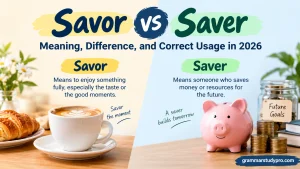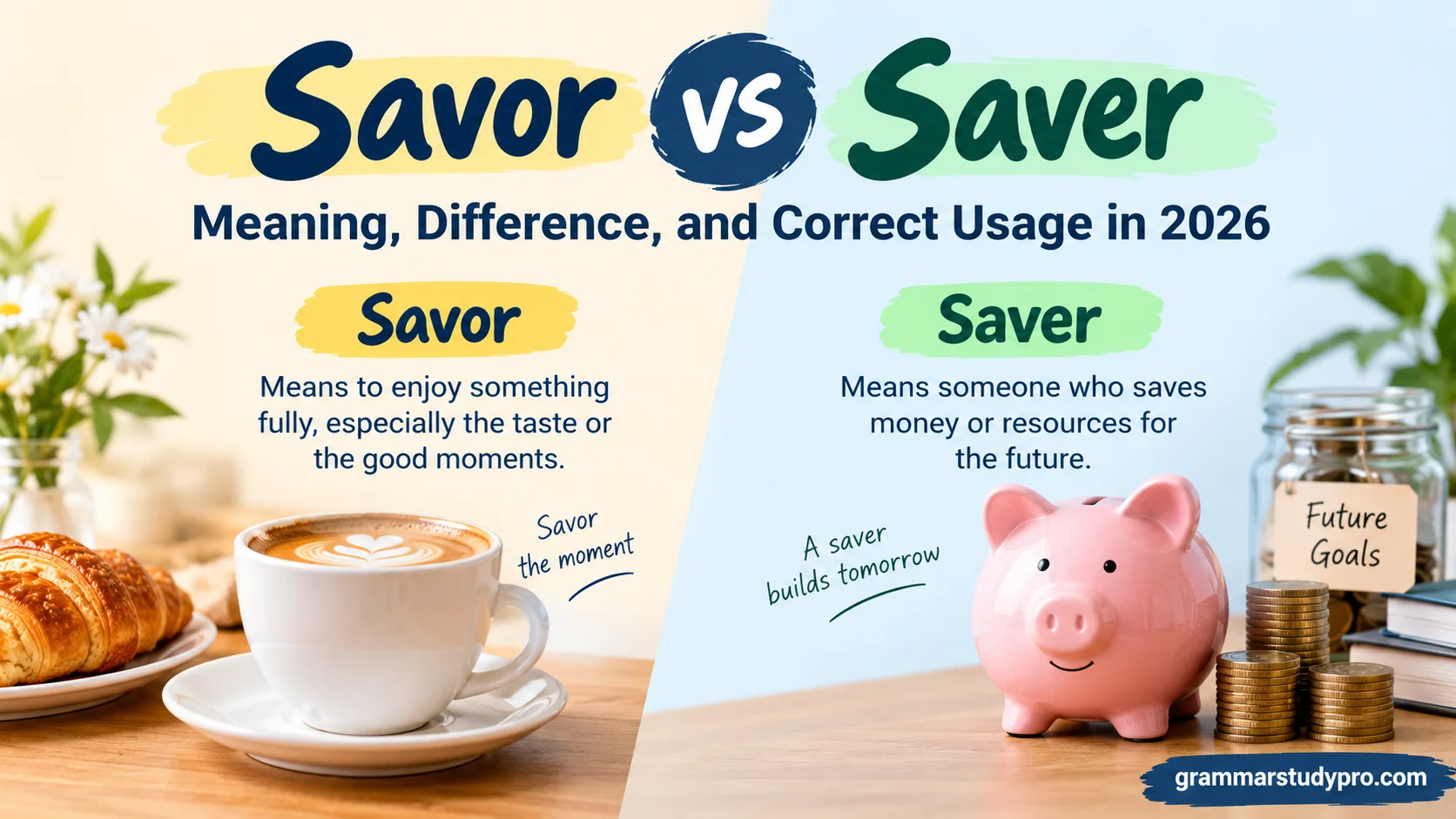
Savor vs Saver can be confusing because these words sound similar but have different meanings and uses in American English. Use savor when you enjoy food, a drink, or a pleasant experience fully, and use saver for a person or thing that saves money, time, or resources. Understanding their spelling, pronunciation, grammatical roles, and contextual meaning helps you choose the correct word in everyday conversations, school assignments, professional emails, and blog posts.
For example, you savor a delicious meal by enjoying every bite, while a saver regularly sets money aside for a future vacation or other needs. Although these words have a similar sound, they are not exact homophones because their vowel sounds differ. Learning this distinction improves your vocabulary, English grammar, sentence structure, word choice, and communication skills. Practical examples and side-by-side comparisons can also help you remember the difference, express ideas clearly, and use both words correctly in different situations, whether you are discussing enjoyment, financial habits, money management, or future planning.
Quick Answer:
Savor means to enjoy something fully or appreciate it slowly. It can also refer to a distinctive taste, quality, or character.
Saver is a noun that describes a person who saves money or a thing that helps conserve resources such as time, energy, or space.
Here are two simple examples:
- Savor: She took her time to savor the rich chocolate cake.
- Saver: My brother is a careful saver who puts money aside every month.
The easiest way to remember the difference is to connect savor with enjoyment and saver with saving.
| Word | Meaning | Example |
| Savor | To enjoy or appreciate fully | We savored every moment of the trip. |
| Saver | A person or thing that saves | This appliance is an energy saver. |
In American English, savor is the standard spelling. British English commonly uses savour for the same word. However, saver remains the correct spelling when referring to someone or something that saves.
Comparison Overview: Savor vs Saver
Although savor and saver share several letters and sound similar, they serve different purposes in a sentence. Their meanings, grammatical roles, and common contexts help distinguish them.
| Feature | Savor | Saver |
| Primary meaning | To enjoy or appreciate something fully | Someone or something that saves |
| Part of speech | Verb and noun | Noun |
| Common use | Food, memories, experiences, achievements | Money, time, energy, space |
| Related verb | Savor | Save |
| Past-tense form | Savored | Saved is the past tense of save |
| Present participle | Savoring | Saving is the present participle of save |
| American spelling | Savor | Saver |
| British spelling | Savour | Saver |
| Example | He savored the peaceful afternoon. | She is a regular saver. |
The biggest difference is the idea each word communicates. Savor focuses on enjoyment or appreciation, while saver focuses on preservation or conservation.
For example, you might savor your morning coffee by drinking it slowly and enjoying its flavor. Meanwhile, a coffee machine with an energy-saving feature might help reduce electricity use. You savor the experience, but the machine helps save energy.
Keep this distinction in mind, and you’ll find it easier to choose the right word.
What Does Savor Mean?
The word savor means to enjoy something fully, especially by paying attention to its taste, quality, or emotional value. It often suggests that you appreciate an experience rather than rush through it.
You can savor a delicious meal, a quiet afternoon, a personal achievement, or a special moment with someone you love. The word encourages the idea of slowing down and appreciating what you have.
For example:
- We stopped talking for a moment to savor the delicious food.
- She wanted to savor her final evening in Paris.
- He savored the satisfaction of completing a difficult project.
In each example, savor describes appreciation. The experience might involve food, emotion, or personal achievement, but the central idea remains the same.
Savor as a Verb
The most common use of savor is as a verb. It describes the act of enjoying or appreciating something fully.
When you use savor as a verb, the object usually identifies what someone enjoys. That object might be a physical thing, such as a meal, or an abstract experience, such as success.
Consider these examples:
- Food: I savor every bite of homemade apple pie.
- Travel: They savored their final day at the beach.
- Success: The athlete savored her first championship victory.
- Memories: We still savor the memories of our childhood summers.
- Quiet moments: He savors the silence before the busy workday begins.
Notice that savor doesn’t necessarily mean eating or drinking. Although food is a common context, the word also describes emotional experiences and meaningful moments.
For instance, a student might savor the feeling of passing a challenging examination. A parent might savor a child’s first steps. In both cases, the word expresses appreciation for something meaningful.
Grammar tip: When you use savor as a verb, its form changes according to the sentence’s tense and subject.
- Present: She savors her morning tea.
- Past: She savored her morning tea.
- Future: She will savor her morning tea.
- Present continuous: She is savoring her morning tea.
These forms all describe the same general idea: enjoying something fully.
Savor as a Noun
Although people use savor more often as a verb, it can also function as a noun. As a noun, it refers to a distinctive taste, flavor, or quality.
For example:
- The soup had a rich, smoky savor.
- The traditional recipe preserves the savor of the original dish.
- The novel captures the savor of life in a small coastal town.
In the first two sentences, savor relates to taste or flavor. In the third, it describes the distinctive character of a place and its way of life.
This noun usage is less common in everyday American English than the verb. People generally use words such as flavor, taste, or character when those words fit the context more naturally.
However, recognizing the noun form helps you understand why savor doesn’t always describe an action.
Common Forms of Savor
The word savor has several forms that you’ll encounter in everyday writing.
| Form | Grammatical use | Example |
| Savor | Base verb or noun | I savor peaceful mornings. |
| Savors | Third-person singular verb | She savors every opportunity. |
| Savored | Simple past or past participle | They savored the victory. |
| Savoring | Present participle or gerund | He is savoring the experience. |
The spelling follows a regular pattern in American English. Add -s for the third-person singular present tense, -ed for the past tense, and -ing for the present participle.
British English typically uses savour, savours, savoured, and savouring. The meaning stays the same; only the regional spelling changes.
One useful detail: savory is a related American English word that commonly describes food with a salty, spicy, or non-sweet flavor. However, savory and savor don’t have identical grammatical uses.
For example, you might say, “The restaurant serves savory pies.” Here, savory describes the pies rather than naming the act of enjoying them.
What Does Saver Mean?
The word saver is a noun that describes a person or thing that saves something. The exact meaning depends on what gets saved, whether it’s money, time, energy, space, or even a life.
Unlike savor, which often expresses enjoyment, saver relates to keeping something available, preventing waste, or avoiding loss.
For example:
- My sister is a careful saver who plans her spending.
- This shortcut is a real time-saver.
- Energy-saving appliances can help households reduce electricity use.
- The paramedic acted as a lifesaver during the emergency.
Each example uses saver or a related compound to describe a person or thing that helps preserve something valuable.
Saver as a Person Who Saves Money
One of the most common meanings of saver refers to a person who sets aside money instead of spending all their income.
A saver might put money into a bank account, build an emergency fund, or save toward a major purchase. Some people save regularly, while others set aside whatever remains after paying their expenses.
Consider these examples:
- Daniel is a disciplined saver who transfers money into his savings account every payday.
- My parents were careful savers who planned for unexpected expenses.
- Even a small monthly contribution can help a new saver develop a consistent habit.
The word doesn’t automatically mean someone is wealthy. A saver could have a modest income and still develop good saving habits.
For example, someone who sets aside $25 each week saves $1,300 over 52 weeks, before interest or withdrawals. The amount might seem small at first, but regular contributions can add up.
In financial discussions, saver often appears alongside words such as spender, budget, deposit, and savings account.
Here’s a simple distinction:
- Saver: A person who puts money aside.
- Spender: A person who uses money to buy goods or services.
- Savings: Money accumulated for future use.
- Save: The action of keeping money rather than spending it.
These terms are related, but they don’t perform the same grammatical job.
Saver as Something That Conserves Resources
A saver can also refer to something that helps reduce waste or conserve a resource. In this sense, the word often appears in compound nouns.
Common examples include:
- Time-saver: Something that reduces the time needed to complete a task.
- Money-saver: Something that helps reduce spending.
- Energy-saver: A device or method that reduces energy use.
- Space-saver: Something designed to use less room.
- Lifesaver: A person or thing that rescues someone or provides essential help.
For instance, a meal-preparation routine can be a time-saver for a busy family. A folding desk can be a space-saver in a small apartment.
Similarly, a reliable friend who helps you during a difficult situation might be a lifesaver. The word can be literal in rescue contexts or figurative in everyday conversation.
Notice how the meaning changes with the word that comes before saver. A time-saver preserves time, while a money-saver reduces expenses. The general idea of saving remains consistent.
Common Forms and Related Words of Saver
Understanding the word saver becomes easier when you compare it with related forms of save.
| Word | Part of speech | Meaning | Example |
| Save | Verb | To keep, protect, or conserve | I save money every month. |
| Saver | Noun | A person or thing that saves | My brother is a regular saver. |
| Savings | Noun | Money accumulated or an amount saved | Her savings covered the repair. |
| Saving | Verb form or noun modifier | The act of conserving or reducing use | Saving energy reduces waste. |
| Saved | Past tense or past participle | Kept, protected, or rescued | They saved enough for a car. |
| Lifesaver | Compound noun | Someone or something that provides crucial help or rescue | That extra day was a lifesaver. |
A common mistake is to treat these forms as interchangeable. They aren’t.
For example, “I saver money every month” is incorrect because saver is a noun. The correct sentence is “I save money every month.”
Likewise, “She is a careful save” is incorrect. You need the noun saver: “She is a careful saver.”
The simple rule is to use save for the action and saver for the person or thing associated with that action.
Main Differences Between Savor and Saver
The difference between savor and saver becomes clear when you compare their meanings, grammatical roles, and sentence patterns.
Difference in Meaning: Savor vs Saver
The most important difference is what each word communicates.
Savor expresses enjoyment, appreciation, or a distinctive quality. Saver identifies someone or something that saves.
Compare these examples:
- She savored the delicious meal.
- She became a careful saver after starting her first job.
The first sentence describes an experience. The second describes a person and a habit.
Here are more examples that show how changing the word changes the meaning.
| Sentence with savor | Sentence with saver |
| He savored his vacation. | He is a regular saver. |
| She savored the rich flavor of the soup. | This appliance is an energy saver. |
| We savored our time together. | The shortcut is a time-saver. |
| They savored their success. | The discount was a money-saver. |
You can’t simply substitute one word for the other and preserve the original meaning. Each belongs in a different context.
Difference in Parts of Speech
Grammar provides another reliable way to distinguish these words.
Savor can work as both a verb and a noun. As a verb, it describes enjoying or appreciating something. As a noun, it refers to a distinctive taste or quality.
Saver, on the other hand, functions primarily as a noun. It names a person or thing that saves.
Consider these sentences:
- Verb: I savor the quiet moments before sunrise.
- Noun: The dish has a deep, smoky savor.
- Noun: My father is a careful saver.
In the first sentence, savor describes an action. In the second, it identifies a quality. In the third, saver names a person.
A useful editing trick is to examine the word’s position. If the sentence needs an action, savor may fit. If it needs a noun identifying someone or something that saves, saver is the likely choice.
However, always check the intended meaning rather than relying on sentence position alone.
Difference in Context and Usage
Context often makes the correct choice obvious. Think about what the sentence describes.
Use savor when discussing:
- The taste of food or drinks.
- A memorable trip or special occasion.
- The satisfaction of reaching a goal.
- A quiet moment or enjoyable experience.
- The distinctive flavor or character of something.
Use saver when discussing:
- Someone who regularly puts money aside.
- A product that reduces energy consumption.
- A tool that saves time or effort.
- Furniture or equipment designed to conserve space.
- A person or thing that provides essential help.
For example, a traveler might savor a beautiful sunset after spending the day exploring a new city. That same traveler might use a money-saving app to manage vacation expenses.
Both words can appear in a single discussion, but they describe different ideas.
Difference in Pronunciation and Spelling
In standard American English, savor and saver are generally pronounced the same way or very similarly. Both have two syllables, and their vowels can sound identical in many American accents.
Their spelling, however, provides a useful clue:
- Savor ends in -or.
- Saver ends in -er.
The final letters distinguish the words visually, even when your pronunciation doesn’t.
This similarity can cause problems when writing from memory or relying on speech-to-text software. A dictation program might select the wrong word if the surrounding sentence doesn’t provide enough context.
For example, if you dictate “I want to savor this moment,” the intended meaning is enjoyment. If you dictate “I am a saver,” the intended meaning concerns saving.
Practical tip: When the words sound alike, pause and ask yourself what you mean. Are you describing enjoyment, or are you referring to saving something?
Difference Between Savor, Saver, and Save
Because these three words share similar letters, it’s worth comparing them directly.
| Word | Meaning | Example |
| Savor | Enjoy or appreciate fully | I savor my morning coffee. |
| Saver | A person or thing that saves | My sister is a careful saver. |
| Save | Keep, protect, conserve, or rescue | I save a little money each week. |
The difference between savor and save is particularly important.
Imagine that you buy a box of chocolates. You might save two chocolates for tomorrow and savor the one you eat today.
The first action involves keeping something for later. The second involves enjoying what you’re experiencing now.
This example captures the difference in a way that’s easy to remember.
Savor vs Saver Examples in Sentences
Examples help you understand how each word works in everyday English. The following sentences cover food, relationships, work, personal finance, and other familiar situations.
Examples of Savor in Sentences
Use savor when you want to describe enjoying something or appreciating its distinctive qualities.
- I like to savor my morning coffee before starting work.
- They savored every moment of their family vacation.
- She paused to savor the applause after her performance.
- Take your time and savor every bite of the meal.
- He is savoring the excitement of his recent promotion.
- We stopped beside the lake to savor the peaceful surroundings.
- The chef added fresh herbs to deepen the dish’s savor.
These examples show that savor works in several situations. You can use it for physical sensations, emotional experiences, and memorable occasions.
It also suggests a certain attitude. Someone who savors a moment usually pays attention to it rather than rushing past it.
Examples of Saver in Sentences
Use saver when describing a person or thing that saves money, time, energy, space, or something else valuable.
- My sister is a disciplined saver who plans for the future.
- This software is a major time-saver for our team.
- Switching to efficient lighting can make a difference as an energy-saver.
- The folding table is a practical space-saver for small apartments.
- He became a regular saver after getting his first job.
- Keeping a spare charger in the car can be a real lifesaver.
- Shopping during a sale can be a money-saver when you need the items anyway.
The context determines which type of saving the sentence describes. A person might save money, a tool might save time, and a compact design might save space.
One spelling detail matters here: compounds such as time-saver and money-saver often use a hyphen, although styling can vary by publication and dictionary. Follow the style guide you use and remain consistent.
Savor vs Saver: Side-by-Side Examples
Compare these pairs to see how the intended meaning determines the correct word.
| Example with savor | Example with save or saver |
| She savored the dessert. | She saved some dessert for later. |
| He savored his free time. | He used a time-saver to finish work faster. |
| We savored the weekend. | We saved money for the weekend. |
| They savored their success. | They are savers who plan their spending. |
| I savored the taste of the coffee. | This coffee maker is an energy saver. |
Notice that some comparisons use save rather than saver. That’s intentional. The verb save often describes the action that relates to the noun saver.
For instance, “She saved some dessert” describes an action. “She is a saver” describes a person. Neither sentence means the same thing as “She savored the dessert.”
Common Mistakes When Using Savor and Saver
Even experienced writers can confuse similar-sounding words. These common mistakes show what to watch for when editing your sentences.
Using Saver When You Mean Enjoy
Incorrect: I want to saver this special moment.
Correct: I want to savor this special moment.
The sentence describes appreciating an experience, so savor is the right choice. Saver is a noun and cannot replace the verb in this construction.
Another example:
- Incorrect: We saver every bite of the meal.
- Correct: We savor every bite of the meal.
When the subject performs the action of enjoying something, use the verb savor.
Using Savor When You Mean Save Money
Incorrect: I savor money every month for emergencies.
Correct: I save money every month for emergencies.
The intended meaning involves setting money aside, not enjoying it. Therefore, the verb save is correct.
If you want to describe the person who follows that habit, use saver instead:
- I save money every month.
- I am a regular saver.
Both sentences are correct, but they emphasize different things. The first describes an action, while the second describes a person.
Confusing Savor With Save
The words savor and save can appear in similar situations, but their meanings differ.
Imagine you’re eating a slice of birthday cake. You might savor each bite because you enjoy its flavor. You might also save another slice for a family member who arrives later.
Here are some more examples:
- Savor: She savored the last few minutes of her holiday.
- Save: She saved the remaining vacation days for December.
- Savor: He savored the taste of fresh strawberries.
- Save: He saved some strawberries for tomorrow’s breakfast.
The easiest way to distinguish these verbs is to ask whether the sentence describes enjoying something now or keeping something for later.
Confusing American and British Spellings
English spelling varies across regions, and savor provides a good example.
American English generally uses savor, while British English commonly uses savour. Both forms have the same meaning.
| American English | British English |
| Savor | Savour |
| Savors | Savours |
| Savored | Savoured |
| Savoring | Savouring |
However, saver is a separate word, not an alternative spelling of savour.
For example:
- American: I savor every moment of the trip.
- British: I savour every moment of the trip.
- Both varieties: She is a careful saver.
If you’re writing for an American audience, use savor. If you’re following British English conventions, savour is generally appropriate. In either variety, use saver when you mean someone or something that saves.
How to Remember the Difference Between Savor and Saver
A simple memory trick can help you choose the right word without checking a dictionary every time.
Savor = enjoy. Saver = save.
Connect savor with a pleasant experience, such as enjoying a warm cookie fresh from the oven. Connect saver with someone who puts money aside for future needs.
Here are three quick reminders:
- Savor a flavor: Think about enjoying a favorite meal.
- Be a saver: Think about putting money into a savings account.
- Use a time-saver: Think about a shortcut that helps you finish a task faster.
You can also use a simple question: Am I describing enjoyment, or am I describing something that saves?
If the sentence describes appreciating an experience, choose savor. If it identifies a person or thing that saves, choose saver.
For example, “I savor my weekends” describes enjoyment. “I am a saver” describes a financial habit.
This trick works because it connects each word with a clear idea rather than relying on spelling alone.
Savor vs Saver: Which Word Should You Use?
Choosing between savor, saver, and save becomes easier when you identify the meaning your sentence needs.
Use this practical guide:
- Choose savor when describing enjoyment, appreciation, taste, or a distinctive quality.
- Choose saver when referring to a person who saves or something that conserves resources.
- Choose save when describing the action of keeping, protecting, conserving, or rescuing something.
Consider the following examples.
Sentence one: She wanted to ___ every moment of the trip.
The correct answer is savor because she wants to enjoy the experience fully.
Sentence two: He is a careful money ___.
The correct answer is saver because the sentence identifies a person who regularly puts money aside.
Sentence three: This appliance helps ___ electricity.
The correct answer is save because the sentence describes an action that reduces energy use.
A Short Practice Quiz
Test your understanding with these examples before checking the answers.
- I want to ___ the flavor of this homemade soup.
- My brother is a regular ___ who plans his spending.
- This shortcut is a real time-___.
- We should ___ some money for unexpected expenses.
- She paused to ___ the moment after receiving her award.
Answers:
- Savor
- Saver
- Saver
- Save
- Savor
If you answered all five correctly, you’ve grasped the key distinction. If you missed one, look at the sentence’s meaning rather than how the word sounds.
FAQs
1. What is the main difference between savor and saver?
Savor means to enjoy something slowly and fully, such as a delicious meal or a special moment. Saver refers to a person or thing that saves money, time, or other resources.
2. Is savor a verb or a noun?
Savor is commonly used as a verb. For example, “I savor every bite of my favorite dessert.” It can also be a noun when it refers to a distinctive taste or flavor.
3. What does saver mean in English?
A saver is a person or thing that saves something. For example, “She is a careful saver who sets aside money for her next vacation.” The word can also describe something that helps save time or resources.
4. Are savor and saver homophones?
No. Although savor and saver look similar and may sound alike to some learners, their vowel sounds differ in standard American English. Therefore, they are not exact homophones.
5. How can I remember the difference between savor and saver?
Connect savor with enjoying food, drinks, or pleasant experiences. Connect saver with saving money, time, or resources. This simple association helps you select the correct spelling when writing sentences.
Conclusion
Understanding savor vs saver becomes easier when you connect each word with its purpose. Use savor when you want to enjoy a meal, appreciate a special moment, or experience something fully. Choose saver when referring to someone who saves money or something that conserves time and resources.
Remembering this distinction improves your vocabulary, spelling, and everyday English writing. When you understand the meaning and context of each word, you can choose the correct term confidently in conversations, emails, assignments, and blog posts.