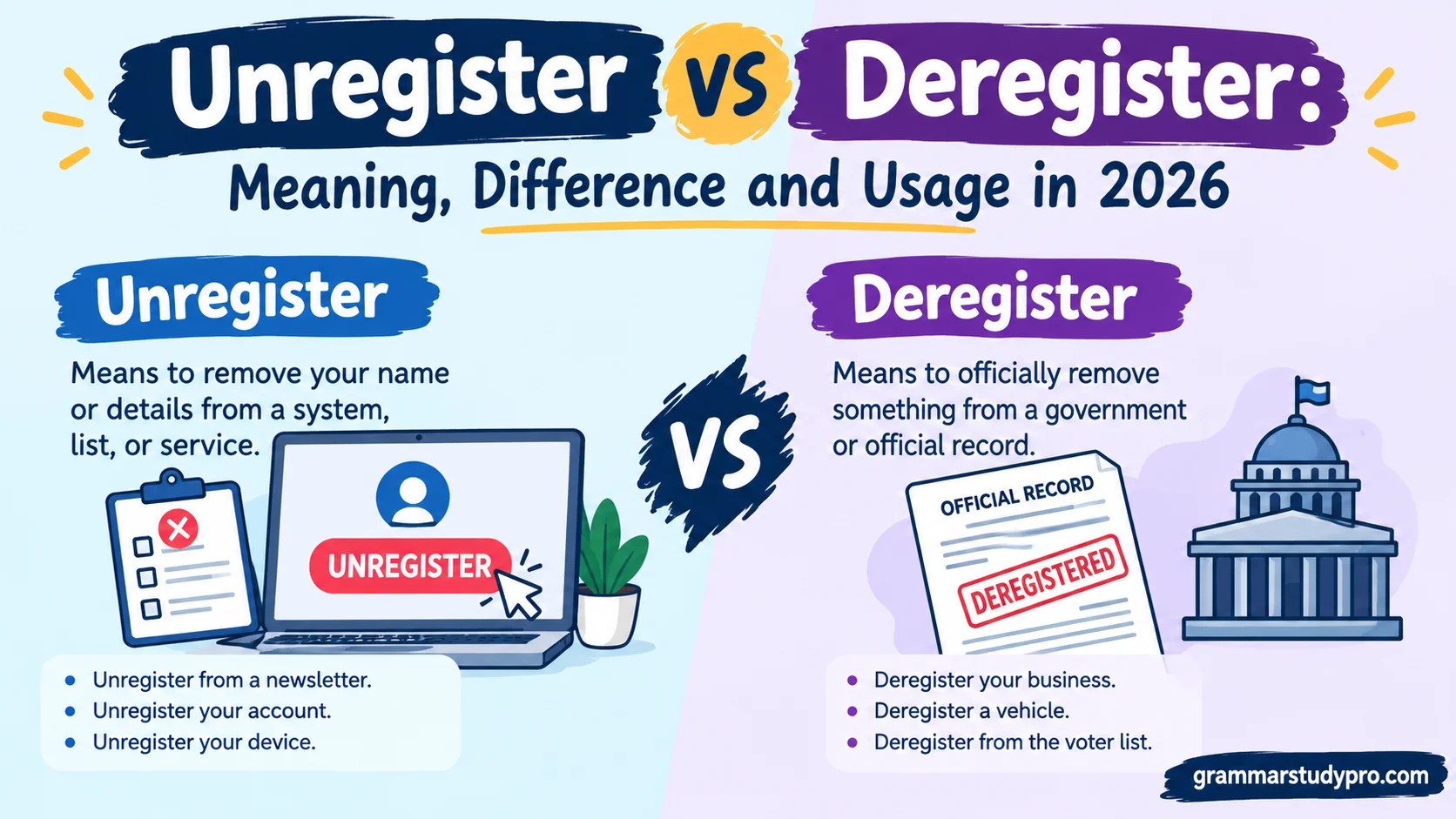
Unregister vs Deregister are English verbs used for removing something from a registration system, but context often decides the more natural choice. Unregister and deregister share a similar meaning and process, as both can describe removing someone or something from a registration, registry, or register. They can be interchangeable, but the better choice depends on the type, context, and variety of English. In everyday English, software, and account-related contexts, unregister is a standard choice for an entry in a list, system, or service, especially when you want to remove or undo a registration.
The difference is easier to notice in technical contexts. In computing, unregister commonly appears with APIs, devices, and event listeners, while deregister is often found in formal, administrative, regulatory, educational, business, and legal language. A person, device, account, organization, registered item, item, car, or company can be described using either term depending on the registration system. However, professional licenses and securities may more naturally appear with deregister. This difference is mainly about terminology and tone, rather than a fixed grammatical rule.
The two versions have the same word at their core, which creates an overlap that can make English speakers hesitate. Dictionary evidence supports this connection: Wiktionary lists the terms as related synonyms, while Collins explains deregistering as removing something from a register. The historical split can also be described as a 1,000-year linguistic turf war involving Germanic and Latin roots, although those roots do not control every modern use. Instead of relying on the popular rule that one term is always correct and the other always wrong, consider what is being removed, what kind of system is involved, and whether the wording fits the setting.
Quick Answer
Unregister and deregister both describe reversing or ending registration, but they often appear in different contexts.
- Unregister commonly appears in software, technology, devices, accounts, and other systems where registration is being undone.
- Deregister commonly appears in official, administrative, institutional, and regulatory contexts where something is removed from a register.
- The two words overlap significantly.
- Neither word is automatically more correct in every situation.
- Unsubscribe, withdraw, and cancel aren’t always interchangeable with either term.
- When an organization has a defined process, use the terminology that organization uses.
For example:
Unregister the device from your account.
sounds natural in a technology setting.
Meanwhile:
The company applied to deregister its shares.
fits an administrative or corporate setting more naturally.
The distinction isn’t a brick wall. It’s more like a sliding scale.
Comparison Overview
| Feature | Unregister | Deregister |
| Basic meaning | Undo registration | Remove from a register |
| Part of speech | Verb | Verb |
| Common technical use | Very common | Possible |
| Software use | Common | Possible |
| Device/account use | Common | Possible |
| Official register | Possible | Common |
| Administrative writing | Possible | Common |
| Can describe a person’s action? | Yes | Yes |
| Can describe an organization’s action? | Yes | Yes |
| Can describe removal by an authority? | Yes | Yes |
| Related noun | Unregistration | Deregistration |
| Universal difference | No | No |
The most important point is the final row.
There isn’t a universal rule saying unregister belongs only to technology while deregister belongs only to government records. Real English usage is broader than that.
For example, dictionary examples of deregister include companies, shares, vehicles, systems, and individuals. Collins also gives examples involving people being removed from systems and organizations being deregistered.
Main Differences Between Unregister and Deregister
The difference between unregister and deregister becomes easier to understand when you stop looking only at the prefixes.
Unregister Usually Emphasizes Undoing Registration
The verb unregister focuses naturally on reversing an act of registration.
Wiktionary defines it as “to undo the process of registration” and records both transitive and intransitive uses.
That makes it particularly useful when someone wants to reverse an earlier registration.
Consider these examples:
- Unregister the device before selling it.
- Unregister the application from the system.
- Users can unregister their accounts.
- The developer needs to unregister the event listener.
- You can unregister from the service at any time.
In each case, the idea is straightforward: something was registered and the registration is being undone.
Deregister Emphasizes Removal From a Register
Deregister focuses more directly on removing someone or something from a register.
Collins defines the verb as removing oneself, a car, or another item from a register. It also lists deregistration as the related noun.
That makes the word especially natural when the register itself matters.
For example:
- The owner decided to deregister the vehicle.
- The company applied to deregister its shares.
- The organization was deregistered.
- The professional was removed from the register.
- The business decided to deregister from the program.
The register can be physical, digital, institutional, corporate, professional, or administrative.
Context Often Matters More Than the Prefix
A common mistake is to assume that un- always means one thing while de- always means another.
English doesn’t work that neatly.
The prefixes provide useful clues, but established usage ultimately determines meaning. Words develop through repeated use, and specialized fields often develop their own terminology.
For example, software developers frequently talk about registering and unregistering components. An administrative agency may instead talk about registering and deregistering an organization.
The underlying action can be remarkably similar.
Deregister Often Sounds More Administrative
Although neither word has a universal formality level, deregister often carries an institutional or administrative tone.
Compare:
Unregister your old device.
with:
The company must deregister from the official register.
The first sounds like an instruction inside a technical system. The second sounds like an administrative procedure.
That’s a usage tendency, not a grammar law.
You can find deregister in technical contexts and unregister in administrative contexts. The surrounding terminology determines what sounds natural.
What Does Unregister Mean?
Unregister is a verb that means to undo or reverse registration.
It can be transitive:
Unregister the device.
Here, someone performs the action on the device.
It can also be intransitive:
Users can unregister at any time.
Here, the user performs the action without a direct object.
The verb has several forms:
| Form | Example |
| Base form | unregister |
| Third-person singular | unregisters |
| Past tense | unregistered |
| Past participle | unregistered |
| Present participle | unregistering |
Unregister in Technology
Technology provides one of the clearest environments for unregister.
Software systems often require components to register themselves before they can receive events, use services, or participate in a framework. When that relationship needs to end, developers may use the verb unregister.
For example, a system might:
- Register a component.
- Use that component.
- Detect that it is no longer needed.
- Unregister the component.
The same concept appears with event listeners.
A program can register a listener so that it receives notifications. When the listener should stop receiving them, the developer can unregister it.
The exact terminology varies between programming languages and frameworks. Still, register/unregister is a familiar conceptual pair in software.
Unregister for Devices and Accounts
The word also works naturally with digital products.
Imagine that you’ve replaced your phone. A service might ask you to unregister the old device before adding the new one.
Likewise, a platform might allow users to unregister an account, service, or device.
These examples make the meaning intuitive:
register → use the system → unregister
The action reverses the earlier registration.
Unregister Doesn’t Always Mean “Erase Everything”
This distinction matters.
Unregistering something doesn’t necessarily mean deleting every piece of information associated with it.
For example, removing a device from an account might leave historical records, purchase information, logs, or other data.
The exact consequences depend on the system.
So don’t assume:
unregister = permanently delete
Those are different actions unless the system specifically defines them as equivalent.
What Does Deregister Mean?
Deregister means to remove someone or something from a register.
Collins gives examples involving people, cars, companies, systems, and other registered entities. Dictionary.com likewise defines it as removing oneself, a car, or another item from a register.
The word has these common forms:
| Form | Example |
| Base form | deregister |
| Third-person singular | deregisters |
| Past tense | deregistered |
| Past participle | deregistered |
| Present participle | deregistering |
| Noun | deregistration |
Deregister in Official Records
The word is particularly useful when a formal register exists.
Consider a company recorded in an official corporate register. If the company completes a formal process to remove itself from that register, deregister can accurately describe the action.
The same pattern can apply to:
- Companies
- Vehicles
- Professional registrations
- Institutional records
- Regulatory registers
- Shares
- Organizations
- Official systems
The important concept isn’t necessarily government involvement.
It’s removal from a register.
Deregister Doesn’t Always Mean Government Action
This is one of the biggest misconceptions surrounding the word.
Some explanations describe deregister as though only a government or regulatory authority can perform the action. That’s too narrow.
The subject can be a person or organization removing itself.
For example:
The company decided to deregister.
Here, the company is performing or initiating the action.
Likewise:
She chose to deregister from the program.
The person is the actor.
The word describes the removal process. It doesn’t automatically identify who has authority to perform it.
Unregister vs Deregister in Software and Programming
Technology creates some of the clearest examples of overlapping terminology.
Register and Unregister Form a Natural Pair
In software, developers often think in lifecycle pairs:
- register / unregister
- connect / disconnect
- attach / detach
- subscribe / unsubscribe
- install / uninstall
The pairing is useful because the second action reverses the first.
For example:
Register an event listener → unregister the event listener.
That doesn’t mean every programming framework uses unregister. Some APIs use terms such as remove listener, detach, or unsubscribe instead.
Always follow the terminology of the particular framework or API.
Why Technical Writers Often Prefer Unregister
Technical interfaces benefit from short, symmetrical commands.
If a system uses:
Register device
it may naturally use:
Unregister device
The two commands mirror each other.
That consistency helps users understand the interface without learning a new administrative term.
Deregister Can Still Appear in Technology
Technology doesn’t belong exclusively to unregister.
Dictionary examples and modern usage show that deregister can describe removing information from digital systems too.
For instance, a service might instruct users to deregister a phone number or leave a system.
So the better rule is:
Use the term established by the technical system you’re describing.
That’s more reliable than trying to force every technology-related sentence into one vocabulary pattern.
Unregister vs Deregister for Vehicles
Vehicle registration offers a useful contrast.
When discussing a formal vehicle register, deregister can sound especially natural:
The owner decided to deregister the vehicle.
The reason is contextual. Vehicle registration often involves a formal record maintained by an authority.
However, unregister isn’t automatically grammatically wrong simply because a vehicle is involved.
The terminology can vary by country, agency, and specific process.
If a government department officially calls its process vehicle deregistration, that wording should be retained when explaining that process.
Why Precision Matters With Vehicles
Vehicle registration can involve several different actions:
- Registration
- Deregistration
- Transfer of ownership
- Cancellation
- Suspension
- De-registration for export
- Temporary removal from use
These aren’t necessarily the same legal process.
That’s why replacing an official term with a casual synonym can create confusion.
In legal or regulatory writing, the authority’s terminology takes priority over general English preference.
Unregister vs Deregister for Companies and Organizations
Corporate records provide another strong example.
A company may be listed on an official register. Removing it from that register can be described as deregistering the company.
Collins gives a real usage example involving a company applying to deregister its ordinary shares.
This is a good illustration of why deregister often feels more natural in formal corporate language.
However, don’t assume every organization uses the same terminology.
Depending on the jurisdiction and process, you may encounter terms such as:
- Deregister
- Strike off
- Dissolve
- Cancel registration
- Remove from the register
- Wind up
These expressions can have distinct legal meanings.
Deregister isn’t automatically synonymous with dissolve.
A company can cease registration under one process while corporate dissolution involves additional legal steps.
Unregister vs Deregister in Education
Education provides another interesting case because several related verbs can describe leaving a course or program.
You might see:
- unregister
- deregister
- withdraw
- unenroll
- cancel enrollment
- drop a course
These terms aren’t necessarily interchangeable.
For example, a university might define withdrawal as leaving a course after enrollment. Another institution might use deregistration for a formal administrative process.
A student shouldn’t assume that a dictionary synonym has the same institutional effect.
The Practical Rule
When you’re writing about a specific school, university, training provider, or certification body, use its official terminology.
That’s especially important when explaining deadlines, refunds, academic records, or eligibility.
A word can be linguistically understandable while still being administratively inaccurate.
Unregister vs Deregister vs Unsubscribe
These terms frequently appear together online, but they don’t mean exactly the same thing.
| Term | General meaning | Typical example |
| Unregister | Undo registration | Unregister a device |
| Deregister | Remove from a register | Deregister a company |
| Unsubscribe | Stop receiving a subscription/service | Unsubscribe from emails |
| Withdraw | Leave a course, application, or process | Withdraw from a course |
| Cancel | Stop or invalidate something | Cancel a booking |
The distinction becomes important with email.
If you stop receiving a newsletter, unsubscribe is normally the clearest choice.
Saying:
I deregistered from the newsletter.
may be understandable, but unsubscribed is more natural in ordinary American English.
Likewise, if you leave a university course, withdraw or drop the course may be more precise than either unregister or deregister.
Is Unregister a Correct English Word?
Yes.
Unregister is an established English verb.
Wiktionary records it as both a transitive and intransitive verb. It defines the transitive use as undoing the registration process and gives examples from software and online services.
The word also appears in technical terminology and everyday digital instructions.
So the claim that unregister isn’t a real English word is incorrect.
Unregister vs Unregistered
Don’t confuse the verb with the adjective or participle.
Unregister describes an action:
Unregister the device.
Unregistered describes a state:
The device is unregistered.
That distinction is important.
Something described as unregistered simply isn’t currently registered. The word itself doesn’t always tell you whether it was registered in the past.
For example:
The vehicle is unregistered.
That sentence doesn’t necessarily tell you whether the vehicle was previously registered and later removed from the register.
You need additional context to know its history.
Is Deregister a Correct English Word?
Yes.
Deregister is a well-established English verb.
Collins includes the verb and the related noun deregistration. Dictionary.com also records the word and gives examples from contemporary reporting.
The word isn’t limited to one industry.
It can describe the removal of:
- Vehicles
- Companies
- Shares
- People
- Organizations
- Accounts
- Services
- Other registered entities
Its precise meaning depends on the object and the system involved.
Can Unregister and Deregister Be Used Interchangeably?
Sometimes.
That’s the short answer.
The longer answer depends on context.
Suppose a software platform says:
Unregister your device.
Replacing that with:
Deregister your device.
would usually be understandable. It might even be perfectly acceptable in some systems.
However, if the software documentation consistently uses unregister, changing the terminology could make the instructions less consistent.
Now consider:
The company applied to deregister its shares.
Replacing deregister with unregister might still communicate the broad idea. Yet the original wording fits formal corporate terminology more naturally.
This is the difference between semantic possibility and natural usage.
A synonym can carry roughly the same meaning without being equally idiomatic in every setting.
Common Mistakes With Unregister and Deregister
Mistake: Treating One Word as Correct and the Other as Wrong
This is the biggest mistake.
Both words are established verbs. Their meanings overlap.
The better approach is to examine context.
Mistake: Saying Unregister Means “Never Registered”
That interpretation isn’t reliable.
Unregister explicitly describes undoing registration in dictionary definitions.
Meanwhile, unregistered simply describes something that isn’t registered.
Don’t confuse the action with the resulting state.
Mistake: Saying Deregister Always Means Government Removal
That’s too restrictive.
A person or company can deregister itself. The register can also belong to a private organization or digital system.
Mistake: Confusing Deregister With Dissolve
These words can have very different legal implications.
A company can be deregistered without that automatically meaning every corporate obligation disappears.
Always check the relevant jurisdiction and official process.
Mistake: Using Unregister When You Mean Unsubscribe
If you’re talking about marketing emails, newsletters, or recurring communications, unsubscribe is usually the clearest word.
Registration and subscription are related concepts, but they’re not identical.
Mistake: Ignoring Official Terminology
If an organization calls a process deregistration, don’t rewrite it as unregistration merely because the latter seems more familiar.
Official terminology exists for a reason.
A Practical Way to Choose the Right Word
When you’re unsure between unregister and deregister, use this simple process.
Ask What You’re Removing
If you’re talking about a device, software component, event listener, or account, unregister may fit naturally.
If you’re talking about a formal register, company record, vehicle registration, or institutional listing, deregister may sound more natural.
Check the System’s Own Vocabulary
This step beats almost every general rule.
If an application says Unregister Device, use that wording.
If a government agency calls its process Deregistration, use deregistration.
Terminology consistency improves clarity.
Check Whether You Actually Mean Another Verb
Ask yourself whether the action is really:
- Unsubscribing
- Withdrawing
- Canceling
- Deleting
- Disconnecting
- Deactivating
- Removing
Sometimes the problem isn’t choosing between unregister and deregister.
Sometimes neither word is the right one.
Unregister vs Deregister: Example Sentences
Examples With Unregister
- Please unregister the old device from your account.
- Developers must unregister the event listener when the component closes.
- You can unregister from the service through your account settings.
- The application automatically unregisters inactive components.
- Before replacing the hardware, unregister the existing device.
- Users can unregister their accounts through the settings page.
- The plugin needs to unregister itself before shutting down.
- The software lets administrators unregister unused services.
Examples With Deregister
- The owner decided to deregister the vehicle.
- The company applied to deregister its shares.
- The organization was formally deregistered.
- She chose to deregister from the program.
- The authority may deregister the organization under certain conditions.
- The company plans to deregister from the official register.
- The vehicle must be deregistered before export.
- The professional was removed from the relevant register after the process was completed.
Examples Where Both May Work
Some situations allow either verb:
You can unregister from the system.
You can deregister from the system.
Both can communicate the general idea of leaving a registration system.
The preferred choice depends on the system’s terminology and the style of the surrounding text.
Case Study: Choosing the Word for a Software Product
Imagine a software company creates a device-management platform.
Its interface contains two buttons:
- Register Device
- Unregister Device
That pairing is clear and intuitive.
Now imagine the help center suddenly says:
To deregister your device, open the administration panel.
The sentence isn’t necessarily wrong. Yet it introduces a different term for the same lifecycle action.
For users, that creates unnecessary friction.
A better documentation strategy would normally maintain the product’s established terminology:
To unregister your device, open the administration panel.
The lesson is broader than this one word pair:
Technical writing should prioritize terminology consistency.
Case Study: Choosing the Word for an Official Register
Now imagine a regulatory authority maintains a formal register of companies.
Its official procedure is titled:
Application for Deregistration
In that environment, replacing the official term with unregistration would be unnecessary.
The formal process already has an established name.
A clear article or guide should therefore say:
Companies can apply for deregistration when they meet the relevant requirements.
Here, deregister fits the administrative setting and matches the organization’s terminology.
Grammar: Unregister and Deregister
Both words function as verbs.
Unregister
- Base: unregister
- Present: unregisters
- Past: unregistered
- Participle: unregistering
- Past participle: unregistered
Examples:
I unregister the device.
She unregisters the application.
They unregistered the account.
We are unregistering the component.
Deregister
- Base: deregister
- Present: deregisters
- Past: deregistered
- Participle: deregistering
- Past participle: deregistered
- Noun: deregistration
Examples:
I deregister the vehicle.
The company deregisters the account.
They deregistered the organization.
The agency is deregistering the entity.
Deregistration can take several days.
What Is the Noun Form?
The most established noun associated with deregister is deregistration.
For example:
Deregistration of the vehicle requires additional documentation.
With unregister, the noun unregistration exists and can be understood, especially in technical contexts. However, writers often avoid it when a more natural phrase such as removal from the register or unregistering communicates the idea more clearly.
This is another reason not to force a perfect grammatical symmetry between the two verbs.
English doesn’t always distribute word forms evenly.
American English: Unregister vs Deregister
For American readers, context remains the key factor.
Unregister feels particularly natural in technology and software documentation.
Examples include:
- Unregister device
- Unregister application
- Unregister listener
- Unregister service
Deregister also exists in American English, although it can carry a more administrative or institutional flavor depending on the context.
The important point is that neither word belongs exclusively to one national variety of English.
Regional usage can vary, especially in government, education, vehicle registration, and corporate administration.
What Does “Deregistered” Mean?
Deregistered is the past tense and past participle of deregister.
It generally means that someone or something has been removed from a register.
For example:
The company was deregistered.
This tells you that the company was removed from the relevant register.
Similarly:
The vehicle was deregistered.
This indicates that its registration was removed or ended.
The exact legal consequence depends on the applicable registration system.
What Does “Unregistered” Mean?
Unregistered generally means not registered.
It can describe a current state rather than the action that produced that state.
For example:
The device is unregistered.
This tells you that the device isn’t currently registered.
It doesn’t necessarily tell you whether:
- It was never registered.
- Someone unregistered it.
- Its registration expired.
- The system removed it.
- Registration failed.
- The record was deleted.
Context supplies that missing information.
That distinction is crucial when writing precise documentation.
Unregister vs Deregister: The Simple Rule to Remember
If you need a practical shortcut, remember this:
Unregister often sounds natural when you’re undoing registration inside a system. Deregister often sounds natural when you’re removing something from a formal register.
But treat that as a usage guideline, not an absolute grammatical law.
The safest choice depends on three things:
- The context
- The established terminology
- The exact action being performed
If the official system calls it deregistration, use deregistration.
If the software interface says unregister, use unregister.
If you’re stopping an email subscription, use unsubscribe.
If you’re leaving a course, use withdraw or the institution’s official term.
Precision beats prefix theory every time.
FAQs
Is unregister the same as deregister?
Unregister and deregister have very similar meanings. Both can describe removing a person, device, account, company, or other item from a registration system. The main difference is usually context, terminology, and tone.
When should I use unregister?
Use unregister when talking about removing something from a software system, list, service, API, device, or event listener. It is especially common in computing and other technical contexts.
When should I use deregister?
Deregister is often preferred in formal, administrative, legal, regulatory, educational, and business contexts. For example, it can describe removing a company, vehicle, license, or securities registration from an official register.
Are unregister and deregister interchangeable?
In many situations, yes. Both words can mean to undo a registration or remove something from a register. However, the terminology normally used by a particular system or organization can make one word sound more natural than the other.
Is unregister or deregister the correct word?
Neither word is always correct or always wrong. The appropriate choice depends on the context and registration system. Unregister is common in software and computing, while deregister often appears in formal and official settings.
Conclusion
Unregister vs Deregister can be confusing because both verbs describe the removal of something from a registration system. In everyday software and computing contexts, unregister is often natural, while deregister is frequently used in formal, legal, administrative, and regulatory language. When choosing between them, consider the type of registration, the terminology already used by the system, and the tone of your sentence.