Continuous vs Continous Learn the correct spelling, meaning, and usage of continuous, plus simple tips to avoid this common English spelling mistake.
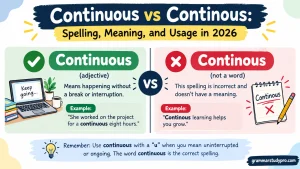
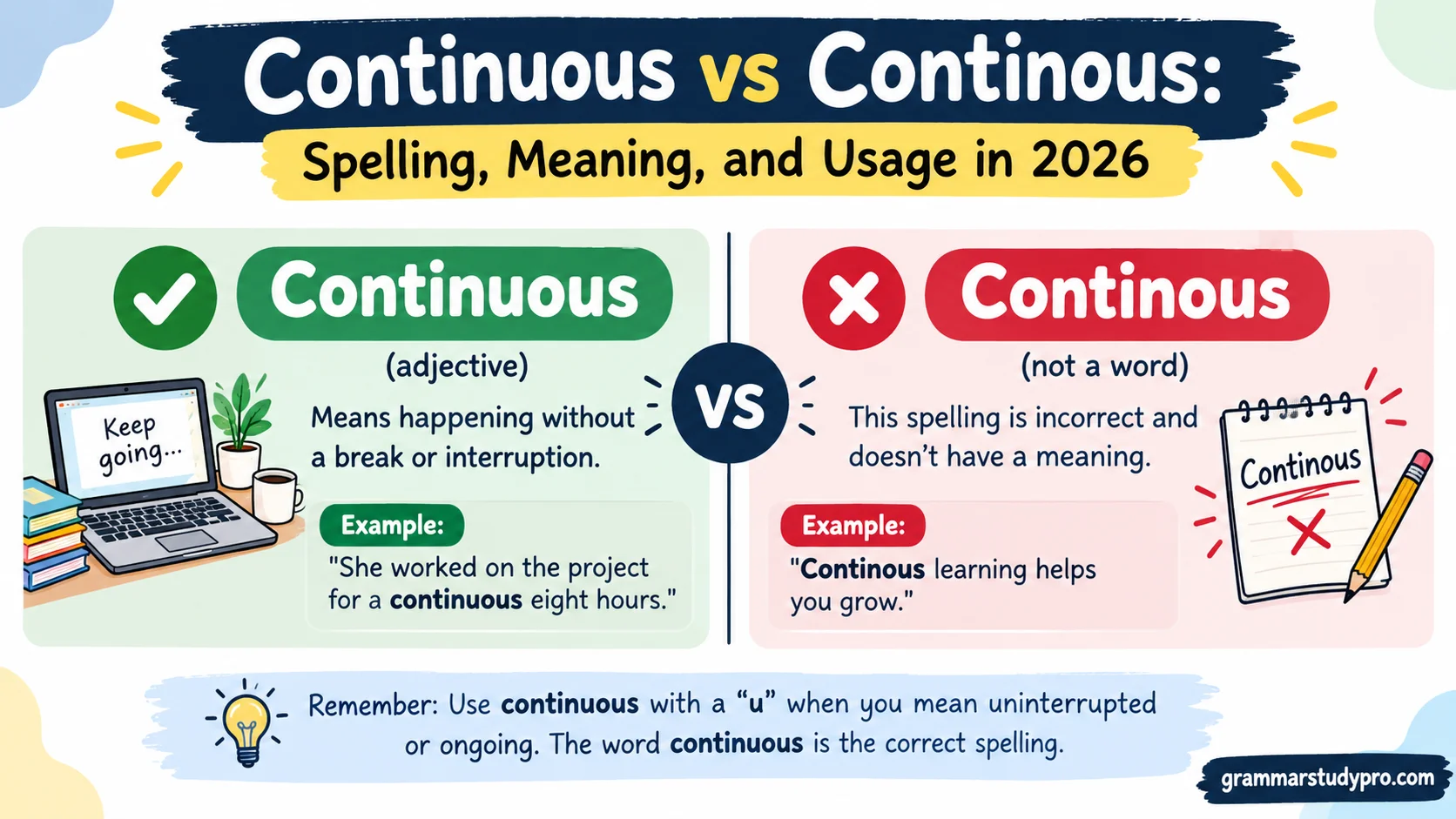
The correct spelling in Continuous vs Continous is continuous, not continous. This common spelling mistake occurs because the correct word contains the letter u after the second n. In standard English, continuous is an adjective formed from the verb continue by adding the suffix -ous and removing the last letter e. Understanding this word formation and spelling change improves your English spelling, grammar, vocabulary, and spelling accuracy. The word means happening without interruption, as in continuous rain, continuous noise, or a continuous supply of electricity.
It can also describe an unbroken line or unbroken path. Although continual relates to ongoing events, it often means something happens repeatedly, with breaks between events. In contrast, continuous describes an ongoing action without a pause, while continuously is its related adverb. Learning these related words helps you understand continuous vs continual and use each word correctly. For better writing, check your spelling in emails, school assignments, business reports, and website content. Accurate spelling makes professional writing and academic writing clearer and more trustworthy. When reviewing a draft, correct continous to continuous. Studying practical examples, common corrections, and simple spelling tips can improve your everyday writing. Resources such as Learna Language can also help strengthen your language skills and understanding of English.
Quick Answer:
Continuous is the correct spelling. Continous is a misspelling and should not be used as the standard form in formal or informal English.
The word continuous means continuing without stopping or extending without a break. It works as an adjective in sentences such as:
- The continuous noise made it difficult to concentrate.
- The factory needs a continuous supply of electricity.
- A continuous line runs along the center of the road.
Remember this simple spelling pattern:
Continue → Continuous
The word continuous retains the u found in continue. If you write continous, you’ve accidentally left that letter out.
Comparison Overview: Continuous vs Continous
Although continuous and continous look almost identical, only one is the accepted spelling of the word. The distinction is straightforward: continuous is correct, while continous is a spelling error.
| Feature | Continuous | Continous |
| Spelling | Correct | Incorrect |
| Standard English word | Yes | No, not as the standard spelling of continuous |
| Meaning | Continuing without interruption or gaps | No separate standard meaning intended here |
| Part of speech | Adjective | — |
| Correct example | The continuous rain lasted all afternoon. | The continous rain lasted all afternoon. |
| Suitable for formal writing | Yes | No |
| Related word | Continue | Intended word is usually continuous |
The incorrect example in the table illustrates a common typo. Replacing continous with continuous fixes the spelling without changing the intended meaning.
Main Differences Between Continuous vs Continous
There are three key points to remember when comparing these spellings.
- Correctness: Continuous is the accepted spelling in standard English. Continous is a misspelling.
- Meaning: Continuous describes something that carries on without interruption or extends without gaps. Continous has no separate standard meaning in this context.
- Usage: Use continuous in schoolwork, business communication, articles, reports, and everyday writing.
For example, consider these sentences:
- Correct: “The company provides continuous customer support.”
- Incorrect: “The company provides continous customer support.”
Both sentences communicate the same intended idea. However, only the first uses the correct spelling.
One useful detail is that continuous can describe both time and physical space. A continuous process may run without stopping, while a continuous line extends without a break. The precise meaning depends on the noun it describes.
What Does Continuous Mean?
The adjective continuous describes something that continues without interruption or forms an unbroken whole. It often suggests that an activity, condition, sound, or physical feature carries on without a meaningful gap.
For example, continuous rainfall means rain that keeps falling without a noticeable break during the period being described. A continuous line, on the other hand, is a line without gaps.
According to the continuous commonly describes something that happens or exists without stopping. The word appears in everyday conversation, technical writing, education, science, and business.
Continuous Means Without Interruption
When people use continuous to describe an activity or condition, they usually mean it keeps going without stopping.
Consider these examples:
- Continuous noise: A sound that keeps going without a break.
- Continuous rainfall: Rain that falls without a noticeable interruption.
- Continuous operation: A machine or system that runs without stopping.
- Continuous pain: Pain that persists rather than coming and going.
- Continuous monitoring: Checking a condition without meaningful interruptions in the monitoring process.
The word doesn’t always mean something lasts forever. Context matters.
For example, a machine might operate continuously for eight hours before someone switches it off. The operation was continuous during those eight hours, even though it eventually ended.
Likewise, a meeting can involve continuous discussion for an hour. That description doesn’t mean the discussion continues indefinitely. It means no meaningful interruption occurred during the period being discussed.
Continuous Means Unbroken or Connected
The word can also describe something that extends across a space without gaps.
For example:
- The artist drew a continuous line across the page.
- A continuous path connected the two gardens.
- The road followed a continuous stretch of coastline.
- The fence created a continuous boundary around the property.
- A continuous strip of fabric covered the opening.
In these examples, continuous describes physical connection rather than an activity that keeps happening.
This distinction is helpful when choosing the right word. If you’re describing a sound that never stops, continuous refers to time. If you’re describing a line without breaks, it refers to an unbroken physical form.
Continuous in English Grammar
In grammar, continuous appears in the term continuous tense, which is also called the progressive tense.
These verb forms describe actions that are in progress at a particular time. They generally use a form of be followed by a verb ending in -ing.
| Verb form | Example | Meaning |
| Present continuous | She is reading a book. | The action is in progress now. |
| Past continuous | She was reading a book. | The action was in progress at a past time. |
| Future continuous | She will be reading a book. | The action will be in progress at a future time. |
The word continuous is correct in this grammatical term. You shouldn’t write continous tense when referring to the progressive form.
Keep in mind that grammar terminology varies between teaching resources. Some call these forms progressive, others use continuous, and many use both terms.
Why Is Continous Incorrect?
The spelling continous is incorrect because it leaves out a u that belongs in the standard spelling of continuous.
The correct form is:
c-o-n-t-i-n-u-o-u-s
The incorrect form is:
c-o-n-t-i-n-o-u-s
Look closely at the middle of each word. The correct spelling includes the sequence u-o-u near the end. The misspelling omits the first of those three letters.
How the Word Continuous Is Formed
One helpful way to understand the spelling is to connect continuous with the verb continue.
The word continuous is formed from the same word family as continue and continuation. In the adjective continuous, the final e of continue drops before the suffix -ous.
The pattern is:
- Continue: The base verb.
- Continuous: The adjective describing something uninterrupted.
- Continuously: The adverb describing how an action happens.
- Continuation: The noun describing the act or process of continuing.
Notice that the u remains in continuous. Remembering the connection with continue makes it easier to avoid the common misspelling.
Why People Write Continous
Several everyday writing habits can lead to this error.
Typing too quickly: When you’re writing quickly, your fingers may skip a letter. Because continous looks similar to the correct word, the error may go unnoticed.
Uncertainty about the word ending: English spelling patterns aren’t always predictable. Writers sometimes omit a letter when they aren’t sure how a word ending should look.
Visual familiarity: Once you’ve seen a misspelling several times, it can start to look normal. Familiarity, however, doesn’t make the spelling correct.
Limited proofreading: Spell-checking may catch the mistake, but not every writing workflow includes a careful review. A quick final check can prevent an avoidable error.
The practical solution is simple: learn the correct letter sequence and check the word whenever you’re unsure.
Continuous vs Continous Examples in Sentences
Examples make the spelling difference easier to recognize. The following sentences show how continuous works in everyday, professional, academic, and technical contexts.
Correct Examples Using Continuous
- The continuous sound of the air conditioner disturbed my sleep.
- Our office needs a continuous supply of internet service.
- Continuous rainfall caused delays on several roads.
- The hospital uses continuous monitoring to track the patient’s condition.
- The company encourages continuous improvement in its customer service.
- A continuous yellow line marks the center of the road.
- The machine requires continuous cooling during operation.
- She worked for three hours with continuous concentration.
- The software records data through continuous monitoring.
- The teacher explained the present continuous tense with simple examples.
Each sentence uses continuous as an adjective. It describes a noun such as sound, supply, rainfall, monitoring, or improvement.
The examples also show why the word is useful across different subjects. You might encounter it in a science report, a workplace email, a grammar lesson, or an everyday conversation.
Incorrect Examples Using Continous
The sentences below contain the misspelling continous. Each one needs a spelling correction.
| Incorrect sentence | Correct sentence |
| We need continous improvement. | We need continuous improvement. |
| The machine makes a continous noise. | The machine makes a continuous noise. |
| There was continous rain overnight. | There was continuous rain overnight. |
| The road has a continous yellow line. | The road has a continuous yellow line. |
| The system requires continous monitoring. | The system requires continuous monitoring. |
| She is studying the continous tense. | She is studying the continuous tense. |
Notice that the correction doesn’t require rewriting the entire sentence. You only need to replace the misspelled word with continuous.
A Practical Example: Correcting a Workplace Report
Imagine that an employee writes the following sentence in a company report:
The software requires continous monitoring to identify errors quickly.
The intended meaning is clear, but the spelling mistake makes the report look less polished.
The corrected version reads:
The software requires continuous monitoring to identify errors quickly.
This small change improves the writing without changing its meaning. In professional communication, details like spelling help readers focus on your message rather than your mistakes.
The same principle applies to school assignments, website articles, technical documents, and job applications. Correct spelling supports clear communication.
How to Remember the Spelling of Continuous
If you often write continous by mistake, memorizing the entire word may not be necessary. A short spelling pattern can help you recall the missing letter whenever you need it.
Remember the Word Continue
The easiest memory trick is to start with continue.
Think of the two words together:
- Continue
- Continuous
Both words contain the letter u after the second n. When you change continue into continuous, the final e drops, but the u stays.
A simple reminder is:
Continue has a u. Continuous has a u, too.
This isn’t a rule that applies to every English word ending in -ous. It’s a memory aid for this particular word family.
Break Continuous Into Smaller Parts
Looking at a long word as a sequence of letters can help you catch omissions.
Write the word slowly:
C-O-N-T-I-N-U-O-U-S
Then check the middle and ending. The letters U-O-U appear in that order before the final s.
You can also compare the two spellings visually:
- Correct: continuous
- Incorrect: continous
The missing u becomes easier to spot when you know exactly where to look.
Use the Word in a Sentence
Spelling practice becomes more useful when you connect a word with its meaning.
Try memorizing one of these sentences:
- Continuous practice helps you improve.
- The continuous rain lasted all morning.
- Our team focuses on continuous improvement.
Write one sentence from memory, then check your spelling. Repeating the word in a meaningful context can help you remember it better than copying the letters without understanding them.
Use a Dictionary or Spell-Check Tool
A dictionary is useful when you’re uncertain about a word’s spelling or meaning. You can check continuous in theor consult.
Spell-checking tools can also catch common typing mistakes. However, don’t rely on them alone. A quick manual review helps you catch errors that automated tools may overlook.
For important documents, check both spelling and context. The correct word should fit the meaning of the sentence as well as follow standard spelling.
Continuous vs Continual vs Continuously
The spelling mistake isn’t the only point worth understanding. The words continuous, continual, and continuously look alike, but they serve different purposes in a sentence.
Knowing the difference helps you choose the right word instead of simply choosing the correct spelling.
Continuous vs Continual: What’s the Difference?
Both continuous and continual describe something that continues. However, they often emphasize different patterns.
Continuous generally describes something that happens without interruption. Continual often describes something that happens repeatedly, sometimes with breaks between occurrences.
Compare these examples:
- Continuous: The machine produced a continuous humming sound.
- Continual: The continual interruptions made it difficult to concentrate.
In the first sentence, the humming carries on without stopping. In the second, interruptions happen repeatedly, with work resuming between them.
| Feature | Continuous | Continual |
| Main idea | Without interruption | Happening repeatedly |
| Typical example | Continuous rainfall | Continual interruptions |
| Common context | Ongoing processes and unbroken conditions | Repeated events or recurring situations |
| Does it always mean the same thing? | No | No |
This distinction is a useful guideline, not an absolute rule. In actual English usage, the meanings sometimes overlap. For example, some dictionaries recognize continual in contexts where something persists over time.
For a straightforward choice, ask yourself whether you mean without a break or happening again and again.
Continuous vs Continuously: Adjective or Adverb?
The difference between continuous and continuously is grammatical.
- Continuous is an adjective. It describes a person, thing, condition, or process.
- Continuously is an adverb. It describes how an action happens.
Consider these examples:
- The continuous noise annoyed the neighbors.
- The machine operated continuously throughout the shift.
- We need continuous access to the database.
- The application runs continuously in the background.
In the first and third sentences, continuous describes nouns. In the second and fourth, continuously describes how the machine operated or how the application runs.
A quick test can help you decide which form you need. If you’re describing a noun, you may need continuous. If you’re explaining how an action takes place, continuously may fit better.
Continuous vs Continuation
Another related word is continuation, a noun that refers to the act of continuing something or the part that follows an earlier part.
For example:
- The continuous rain lasted for several hours.
- The continuation of the meeting was scheduled for Friday.
The first sentence describes uninterrupted rain. The second refers to the meeting’s continuation at a later time.
Although these words share a word family, you can’t swap them freely. Their grammatical roles and meanings differ.
Common Continuous vs Continous Mistakes to Avoid
Even when you understand the definition, small spelling and grammar mistakes can slip into your writing. These are the most useful errors to watch for.
Leaving Out the U
The most common issue in this comparison is writing continous instead of continuous.
Incorrect: The team needs continous training.
Correct: The team needs continuous training.
Tip: Check for the u between the n and the o near the end of the word.
Confusing Continuous With Continual
These words overlap in some contexts, but their usual meanings aren’t identical.
Incorrect for the intended meaning: The continual sound never stopped for an entire hour.
More precise: The continuous sound never stopped for an entire hour.
The first sentence isn’t necessarily grammatically wrong. However, continuous communicates uninterrupted duration more directly.
Using Continuous Instead of Continuously
An adjective can’t always replace an adverb.
Incorrect: The machine operates continuous.
Correct: The machine operates continuously.
The verb operates needs an adverb here because the sentence explains how the machine operates.
However, this sentence is also correct:
“The machine requires continuous maintenance.”
Here, continuous describes the noun maintenance.
Assuming Spell-Check Catches Everything
Spell-checking tools are helpful, but they shouldn’t replace proofreading. Some errors remain undetected, especially when a misspelling resembles a valid word or appears in an unfamiliar context.
To improve accuracy:
- Check words you’re uncertain about in a reputable dictionary.
- Read important documents aloud.
- Review spelling after making substantial edits.
- Pay special attention to frequently mistyped words.
- Check whether each word fits the sentence grammatically.
These habits can prevent small errors from appearing in otherwise strong writing.
FAQs
1. Is it continuous or continous?
Continuous is the correct spelling. Continous is a misspelling because it leaves out the letter u after the second n. Always write continuous in formal and informal English.
2. What does continuous mean?
Continuous means happening without interruption or stopping. For example, continuous rain falls without a break, while a continuous supply of electricity keeps running without interruption.
3. Why is continuous spelled with a u?
The word continuous comes from continue with the suffix -ous. During this word formation, the final e is removed, producing continuous. Remembering this spelling pattern can help you avoid the common error continous.
4. What is the difference between continuous and continual?
Continuous describes something that continues without a break. Continual usually describes something that happens repeatedly, often with breaks between events. For example, continuous noise never stops, while continual interruptions happen again and again.
5. What is the adverb form of continuous?
The adverb form is continuously. It describes an action that happens without interruption. For example: “The machine ran continuously throughout the night.”
Conclusion
The main difference between continuous vs continous is simple: continuous is the correct spelling, while continous is incorrect. Remember the u after the second n to avoid this common spelling mistake. Understanding its meaning and the difference between continuous and continual will also help you choose the right word.
With regular practice and careful proofreading, you can improve your English spelling and write more confidently in emails, school assignments, business reports, and everyday communication.