Tear vs tare may look like variants of the same word at a glance, but they belong to separate worlds. They have different origins, different meanings, and different uses. This word confusion often happens because their pronunciation can sound similar. Words like these can be homophones, which sound alike but have different spellings or meanings. Understanding these word differences improves your English grammar and vocabulary.
The difference becomes clear when you use each word in a sentence. Tear the paper means to rip paper, while tare the weight refers to subtracting a container’s weight from the total measurement to find the net weight of its contents. Although tear has two different meanings, its pronunciation changes depending on whether it means ripping something or a drop of liquid from the eye. Tare is a less common word, but it remains important when weighing goods and packaging. Knowing the correct meaning helps you choose the correct word, avoid an incorrect word, and improve word choice in the right sentence context.
When I compare these words, I find that checking the meaning first helps prevent mistakes. Instead of focusing only on spelling or sound, consider the action or idea your sentence describes. This approach improves correct usage, supports better word selection, and makes everyday word usage more accurate. The keyword Tear vs Tare highlights a useful lesson in English grammar: words can look or sound similar without being interchangeable. Understanding their multiple meanings, spelling differences, and purpose makes the confusion easier to resolve.
Quick Answer: Tear vs Tare
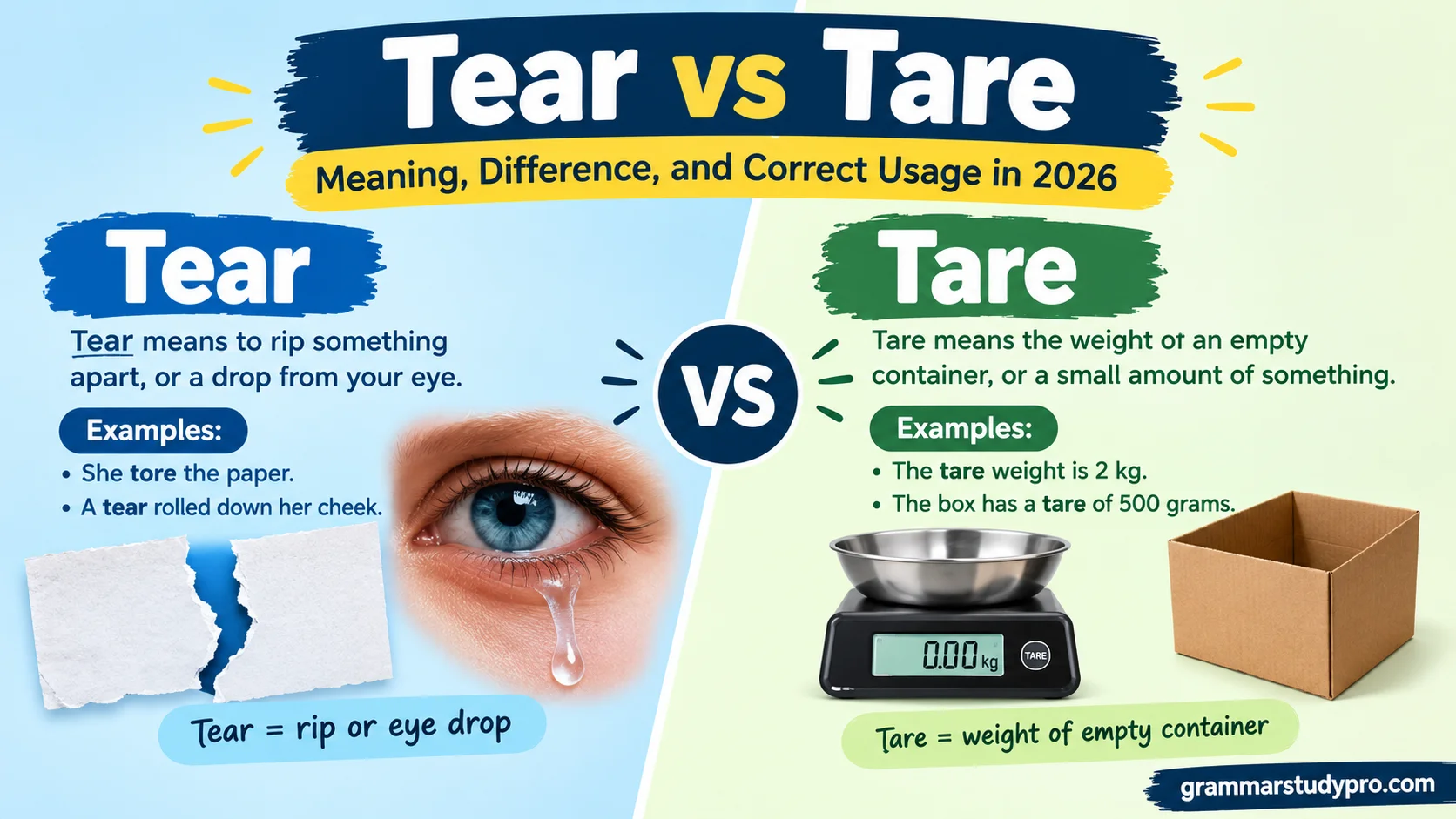
Tear means to rip or pull something apart. It can also refer to a drop of fluid that comes from the eye. Tare refers mainly to a container’s weight or the process of excluding that weight when measuring something.
Here are two examples:
- Tear: Be careful not to tear the paper while opening the envelope.
- Tare: Tare the kitchen scale before adding the flour.
Remember this simple distinction:
- Use tear when something rips, gets damaged, or comes from the eye.
- Use tare when you’re weighing ingredients, packaging, or other items.
For example, you might find a tear in a shirt, but a shipping label might list the tare weight of a container. Both spellings are correct. The intended meaning determines which one you should use.
Comparison Overview: Tear vs Tare
Although tear and tare share a pronunciation in one common use, their definitions and grammatical roles differ. The easiest way to tell them apart is to examine what the sentence describes.
| Feature | Tear | Tare |
| Main meaning | To rip, split, or pull apart | The weight of a container or packaging |
| Additional meaning | A drop of fluid from the eye | A deduction for container weight |
| Part of speech | Noun and verb | Noun and verb |
| Pronunciation | Rhymes with air for ripping; ear for eye fluid | Rhymes with air |
| Past tense | Tore, when referring to ripping | Tared, when referring to weighing |
| Past participle | Torn, when referring to ripping | Tared, when referring to weighing |
| Common setting | Everyday conversation, clothing, paper, emotions | Cooking, shipping, laboratories, commercial weighing |
| Example | The child tore the page. | The tare weight is 200 grams. |
The definitions align with entries from Both words have other meanings, but the distinctions above cover their most relevant everyday and technical uses. 【turn426539search3】【turn426539search0】
One important detail deserves attention: tear has two distinct pronunciations because it represents different meanings. When you talk about ripping paper, it sounds like air. When you describe a drop from someone’s eye, it sounds like ear.
Tare uses the first pronunciation in standard American English. That shared sound explains why people sometimes confuse the spellings.
What Does Tear Mean?
The word tear has several common meanings. It can describe an action, the damage that action causes, or a drop of fluid from the eye. The sentence tells you which meaning applies.
Tear as a Verb: To Rip or Pull Apart
When tear functions as a verb, it usually means to pull something apart by force. The action may create a rough opening, damage the material, or separate one piece from another.
You might tear a sheet of paper accidentally, tear open a package, or tear a piece of fabric while working. The word also describes forceful movement, as in the storm tore through the town.
Here are several examples:
- Please don’t tear the envelope because I need to keep it.
- I accidentally tore my shirt on a sharp branch.
- The puppy tore the paper bag into pieces.
- Strong winds tore several signs from their posts.
- She tore open the package before reading the label.
Notice that the past tense changes from tear to tore. English doesn’t form this verb’s standard past tense by simply adding -ed.
The verb can also describe emotional pain. For example, the sentence “The news tore her heart apart” uses tear figuratively. No physical ripping occurs, but the expression communicates intense distress.
Tear as a Noun: A Rip or Hole
Tear also works as a noun when you want to describe damage caused by ripping. Instead of naming the action, it identifies the resulting split or opening.
Consider the difference between these sentences:
- Verb: I accidentally tore my jeans.
- Noun: There’s a tear in my jeans.
In the first sentence, tore describes an action. In the second, tear identifies the damage.
More examples include:
- The tailor repaired a small tear in my jacket.
- A large tear appeared along the edge of the paper.
- Check the bag for any tears before packing the groceries.
- The old curtain had a tear near the bottom.
This distinction helps you choose the correct grammatical form. If you’re naming the damaged area, use the noun tear. If you’re describing the action that caused it, use the verb tear or its appropriate form.
Tear as a Noun: A Drop From the Eye
The other common noun tear means a drop of fluid produced by the eyes. Tears help keep the eye’s surface moist and clear away irritating particles. Emotional reactions can also cause tears to appear or flow.
This meaning has a different pronunciation from the word used for ripping. In American English, the eye-related noun rhymes with ear.
Examples make the difference clear:
- A tear rolled down her cheek.
- His eyes filled with tears after the emotional speech.
- Smoke made my eyes water and brought on a tear.
- She wiped a tear from the corner of her eye.
The context usually removes any doubt. If a sentence mentions crying, sadness, joy, or watery eyes, it probably uses tear in this sense.
However, tear can also function as a verb related to crying. The expression tear up means to begin producing tears, often because of emotion.
For example:
- I teared up when I heard the good news.
- She tears up whenever she watches that scene.
Don’t confuse teared up with the past tense of ripping. When someone says, “I teared up,” they mean their eyes filled with tears. When someone says, “I tore up the letter,” they mean they ripped it apart.
Other Uses of Tear
Beyond its basic definitions, tear appears in expressions that describe speed, force, and separation.
For instance, someone might tear through a task by completing it quickly. A car might tear down the road, meaning it travels at high speed. You might also tear yourself away from a book when it’s time to leave.
These expressions use the ripping-related pronunciation, which rhymes with air.
| Expression | Meaning | Example |
| Tear through | Move or work rapidly | He tore through the paperwork before lunch. |
| Tear down | Move quickly along a route | The cyclist tore down the hill. |
| Tear away | Separate or pull away | She couldn’t tear herself away from the book. |
| Tear apart | Separate into pieces or severely criticize | The reviewers tore apart the proposal. |
These expressions don’t change the basic spelling. The word remains tear, even when it describes rapid movement or figurative separation rather than literal damage.
For further definitions and usage examples, consult【turn426539search3】
What Does Tare Mean?
The word tare most commonly appears in weighing and measurement. It identifies the weight of a container or packaging, or the adjustment that accounts for that weight when measuring the contents.
For example, imagine weighing flour in a mixing bowl. The scale measures the bowl and flour together unless you account for the bowl’s weight. The tare function lets you exclude the bowl’s weight from the displayed measurement.
Although this meaning often appears in technical settings, you don’t need specialized training to understand it. A kitchen scale offers one of the simplest examples.
Tare as a Noun: The Weight of a Container
Tare weight means the weight of an empty container, packaging, or vehicle that must be accounted for when determining the net weight of its contents or cargo.
You might encounter this term on shipping documents, product labels, warehouse records, and weighing equipment.
For example, suppose a jar weighs 150 grams when empty. After you fill it with honey, the combined weight reaches 650 grams. The honey itself weighs 500 grams.
Here’s the calculation:
| Measurement | Weight |
| Empty jar (tare weight) | 150 g |
| Jar plus honey (gross weight) | 650 g |
| Honey alone (net weight) | 500 g |
The standard formula is:
Net weight = Gross weight − Tare weight
Using the figures above:
650 g − 150 g = 500 g
The distinction matters because the container isn’t part of the product’s net contents. If you include the jar’s weight when reporting the honey alone, your measurement will be inaccurate.
The explains this concept in relation to containers, vehicles, and goods. 【turn426539search2】
Gross Weight, Tare Weight, and Net Weight Explained
These three terms often appear together, so it’s worth understanding how they differ.
- Gross weight: The combined weight of the goods and the container or packaging.
- Tare weight: The weight of the empty container, packaging, or relevant vehicle.
- Net weight: The weight of the goods themselves, excluding the tare.
Consider a shipping crate containing machine parts. The crate weighs 12 kilograms, while the parts weigh 88 kilograms. Together, they weigh 100 kilograms.
In this example:
- Gross weight: 100 kg
- Tare weight: 12 kg
- Net weight: 88 kg
The figures reconcile because 100 − 12 = 88.
In commercial settings, the exact meaning of a weight entry depends on what the shipment includes and how the weighing process defines the relevant container or vehicle. Always check the applicable documentation when precise shipping measurements matter.
Tare as a Verb: Adjusting a Scale
Tare can also function as a verb. It means to determine, allow for, or compensate for the weight of a container.
On many digital scales, the tare button resets the displayed weight to zero while the container remains on the platform. The scale can then display the weight of whatever you add.
Here’s how the process works in a kitchen:
- Place an empty mixing bowl on the scale.
- Wait for the scale to display the bowl’s weight.
- Press the tare button to reset the display to zero.
- Add flour until the display shows the desired amount.
- Press tare again if you want to add another ingredient separately.
For example, you might place a bowl on the scale and see 350 grams. After pressing tare, the display reads zero. Add 200 grams of sugar, and the scale shows 200 grams rather than 550 grams.
The tare function doesn’t make the bowl lighter. It changes the scale’s reference point so you can measure the ingredients without including the bowl’s weight in the displayed result.
Here are examples of tare as a verb:
- Tare the scale before adding the flour.
- I tared the balance before measuring the sample.
- She tares the scale between ingredients.
- The technician tared the container before weighing the material.
The standard verb forms are tare, tares, tared, and taring. The also defines the verb as determining or indicating a container’s tare. 【turn426539search4】
Where You’ll Encounter Tare
Although tare isn’t as common as tear in everyday conversation, it plays a practical role in several fields.
Cooking and baking: A kitchen scale uses tare to exclude the weight of a bowl or plate. This helps you measure ingredients accurately.
Laboratories: Technicians account for the weight of containers, dishes, or filters when measuring samples. The tare may be established before the sample is added.
Shipping and freight: Companies distinguish the weight of cargo from the weight of containers and other relevant equipment. This information helps describe a shipment accurately.
Product packaging: Packaging weight can be separated from the weight of the product itself. That distinction matters when recording net contents.
Retail weighing: A scale may account for the container holding a product so the measurement reflects the goods rather than the packaging.
There is also a less common botanical meaning of tare. Dictionaries use the word for certain vetch plants and their seeds. However, in a comparison of tear vs tare, the measurement-related meaning is usually the most useful one to learn first. 【turn426539search0】【turn426539search4】
Main Differences Between Tear and Tare
The main difference between tear and tare comes down to meaning and context. Tear usually describes ripping, damage, or fluid from the eye. Tare refers mainly to container weight and weighing adjustments.
However, meaning isn’t the only distinction worth learning. Pronunciation, grammar, and common word combinations also help you select the right spelling.
Meaning and Context: Tear vs Tare
The fastest way to distinguish these words is to identify the action or object described in the sentence.
Use tear when a sentence involves ripping paper, damaging clothing, creating a hole, or crying. Use tare when it involves a scale, an empty container, packaging weight, or a measurement adjustment.
Compare these examples:
- Correct: The dog made a tear in the cushion.
- Correct: The tare weight of the empty box is 300 grams.
- Incorrect: The dog made a tare in the cushion.
- Incorrect: The tear weight of the empty box is 300 grams.
The incorrect sentences use real English spellings, but the words don’t fit their intended meanings.
A useful clue is the surrounding vocabulary. Words such as ripped, fabric, paper, and crying often point toward tear. Terms such as scale, gross weight, net weight, and container often point toward tare.
Pronunciation Differences Between Tear and Tare
The pronunciation of tear depends on its meaning. This is one reason the word can confuse English learners and native speakers alike.
| Word or meaning | Pronunciation clue | Rhymes with |
| Tear, meaning rip | Like “tair” | Air |
| Tear, meaning a drop from the eye | Like “teer” | Ear |
| Tare, meaning container weight | Like “tair” | Air |
The ripping-related tear and tare are homophones in standard American English. Homophones are words that sound alike but have different meanings and spellings.
The eye-related tear has a different vowel sound. For example, “Don’t tear the paper” and “A tear rolled down her cheek” use the same spelling but different pronunciations.
You can check the pronunciations in【turn426539search3】【turn426539search0】
Grammar and Word Forms: Tear vs Tare
Knowing the correct spelling is only part of the job. You also need the right form of each word.
When tear means to rip, it follows an irregular pattern. Its past tense is tore, and its past participle is torn. By contrast, the weighing-related verb tare follows a regular pattern: tared is its past tense and past participle.
| Word | Grammatical form | Example |
| Tear | Present tense | I tear the paper carefully. |
| Tears | Present tense, third-person singular | She tears the wrapping slowly. |
| Tore | Past tense | He tore the receipt. |
| Torn | Past participle | The envelope has been torn. |
| Tare | Base form | Tare the scale first. |
| Tares | Present tense, third-person singular | The operator tares the scale. |
| Tared | Past tense or past participle | She tared the scale before weighing the flour. |
| Taring | Present participle | He is taring the balance. |
One historical detail can cause confusion. Some dictionaries list tare as an archaic past-tense form of the ripping-related verb tear. However, tore is the standard modern past tense you should use in everyday and professional writing. 【turn426539search3】【turn426539search6】
For example, write “She tore the paper,” not “She tare the paper.”
Tear vs Tare in Sentences
Examples are often the easiest way to remember a spelling distinction. The following sentences show how each word works in realistic situations.
Correct Examples Using Tear
Use tear when you mean to rip something, describe a rip, or refer to fluid from the eye.
- Please don’t tear the instructions; I still need them.
- I tore my jeans while climbing over the fence.
- There is a small tear in the curtain.
- The child wiped a tear from her cheek.
- The wind tore through the garden.
- His eyes began to tear up during the farewell.
- The old document has several tears along its edges.
- Be careful not to tear the label when opening the package.
Each sentence uses tear according to its intended meaning. The surrounding words make that meaning clear.
Correct Examples Using Tare
Use tare when discussing container weight or adjusting a scale.
- The tare weight of the empty container is 250 grams.
- Please tare the scale before adding the rice.
- The technician tared the balance before weighing the sample.
- We recorded the gross weight and the tare weight separately.
- Press the tare button to reset the displayed measurement.
- The packaging weighs 40 grams, so its tare weight must be accounted for.
- She tared the scale before measuring the second ingredient.
- The shipping record lists the vehicle’s tare weight separately from its cargo weight.
In each example, the context involves weighing or measurement rather than ripping or crying.
Incorrect vs. Correct Usage of Tear and Tare
The following table summarizes common errors and explains how to fix them.
| Incorrect sentence | Correct sentence | Explanation |
| Please tare the paper. | Please tear the paper. | The action involves ripping. |
| There is a tare in my shirt. | There is a tear in my shirt. | The sentence describes damage. |
| The tear weight is 250 grams. | The tare weight is 250 grams. | The term refers to container weight. |
| I tare the envelope yesterday. | I tore the envelope yesterday. | Tore is the standard past tense of ripping-related tear. |
| Tare the cardboard so it opens. | Tear the cardboard so it opens. | The sentence describes pulling material apart. |
| I tore the scale before adding flour. | I tared the scale before adding flour. | The sentence describes a weighing adjustment. |
Pay particular attention to the last example. Tore and tared may look similar, but they describe entirely different actions.
Common Mistakes When Using Tear and Tare
Even when you understand both definitions, a few mistakes can creep into your writing. These are the ones worth watching for.
Using Tare When You Mean Rip
Because tare and ripping-related tear sound alike, it’s easy to confuse them when writing quickly.
For example, “Please tare the wrapping” is incorrect if you mean to rip the packaging open. The correct sentence is “Please tear the wrapping.”
Tip: If you can replace the word with rip without changing the sentence’s meaning, choose tear.
Writing Tear Weight Instead of Tare Weight
Tare weight is the established term for the weight of a container, packaging, or vehicle without its contents or cargo.
Writing tear weight in a shipping document or measurement report introduces a spelling error. It may also confuse readers who expect the standard technical term.
For example:
- Incorrect: The box has a tear weight of 150 grams.
- Correct: The box has a tare weight of 150 grams.
Confusing the Two Pronunciations of Tear
The spelling tear represents both a ripping-related word and an eye-related word. Don’t assume that every occurrence has the same pronunciation.
Compare:
- “I don’t want to tear the letter.” — The word rhymes with air.
- “A tear rolled down his face.” — The word rhymes with ear.
The sentence’s meaning determines the pronunciation. The spelling stays the same.
Using Teared Instead of Tore
When tear means to rip, its standard past tense is tore.
- Incorrect: I teared the paper into pieces.
- Correct: I tore the paper into pieces.
However, teared up is correct when describing eyes filling with tears. For example, “She teared up when she heard the news.”
The distinction depends on the meaning. Use tore for ripping and teared up for beginning to cry.
How to Remember Tear vs Tare
You don’t need to memorize a complicated rule to distinguish these words. Two simple associations will help you choose the right spelling.
- Tear = rip. Think of tearing paper, ripping fabric, or making a hole.
- Tare = scale. Think of weighing flour, measuring a container, or calculating packaging weight.
Try these short practice questions.
Choose the correct word for each sentence.
- Don’t ___ the important document. (tear or tare)
- Press the button to ___ the kitchen scale. (tear or tare)
- The package lists a ___ weight of 300 grams. (tear or tare)
- A small ___ appeared in the sleeve. (tear or tare)
- She ___ the letter into four pieces yesterday. (tore or tared)
Answers: tear, tare, tare, tear, tore.
If you can identify what the sentence describes, you can usually select the correct word without hesitation.
Tear vs Tare in Everyday and Professional Writing
These words appear in different settings, and understanding their uses helps you communicate clearly.
Tear vs Tare in Everyday Writing
In everyday conversation, tear appears more often when people discuss damaged objects, paper, clothing, or emotions.
For example, you might write, “I noticed a tear in my backpack,” or “The movie made me tear up.” Both sentences use tear correctly because they refer to damage and crying.
Tare is less common in casual conversation unless you’re cooking, weighing something, or discussing packaging.
Tear vs Tare in Cooking and Laboratory Measurements
In a kitchen, the tare function helps you measure ingredients without including the bowl’s weight. If a recipe requires 180 grams of flour, you can place the bowl on the scale, tare it, and add flour until the display reaches 180 grams.
The same basic principle applies in laboratory work. A technician may account for a container’s weight before measuring a sample. Accurate tare handling helps separate the mass of the sample from the mass of its container.
Tear vs Tare in Shipping and Business Documents
Shipping and freight records often distinguish gross weight, tare weight, and net weight. Using the correct term helps readers understand which weight a document reports.
For example, a shipment may have a gross weight of 500 kilograms and a tare weight of 70 kilograms. Its net cargo weight is 430 kilograms.
Writing tear weight instead of tare weight can make a document look unprofessional and create confusion. In technical writing, correct terminology matters as much as correct spelling.
FAQs
1. What is the difference between tear and tare?
Tear means to rip something apart or refers to a drop of liquid from the eye. Tare refers to the weight of an empty container or the process of subtracting that weight from a total measurement.
2. Is tear or tare the correct word?
Both words are correct, but they have different meanings. Use tear when talking about ripping paper or crying. Use tare when discussing weight measurements, containers, or packaging.
3. Do tear and tare sound the same?
Yes, tear (when it means ripping) and tare are pronounced the same way in standard English. However, tear has another pronunciation when it refers to a drop of liquid from the eye.
4. What does “tare the weight” mean?
“Tare the weight” refers to removing or accounting for the weight of an empty container when measuring its contents. This helps determine the net weight of the product alone.
5. How can I remember the difference between tear and tare?
Remember that tear is associated with ripping or crying, while tare is associated with weighing. Thinking about the sentence’s meaning helps you choose the correct spelling.
Conclusion
Understanding Tear vs Tare becomes easier when you focus on meaning and context. Although the words can sound alike, they serve different purposes. Use tear when referring to ripping something or a drop from the eye, and use tare
when discussing container weights and measurements.Learning these distinctions will help you improve your spelling, grammar, and everyday writing.