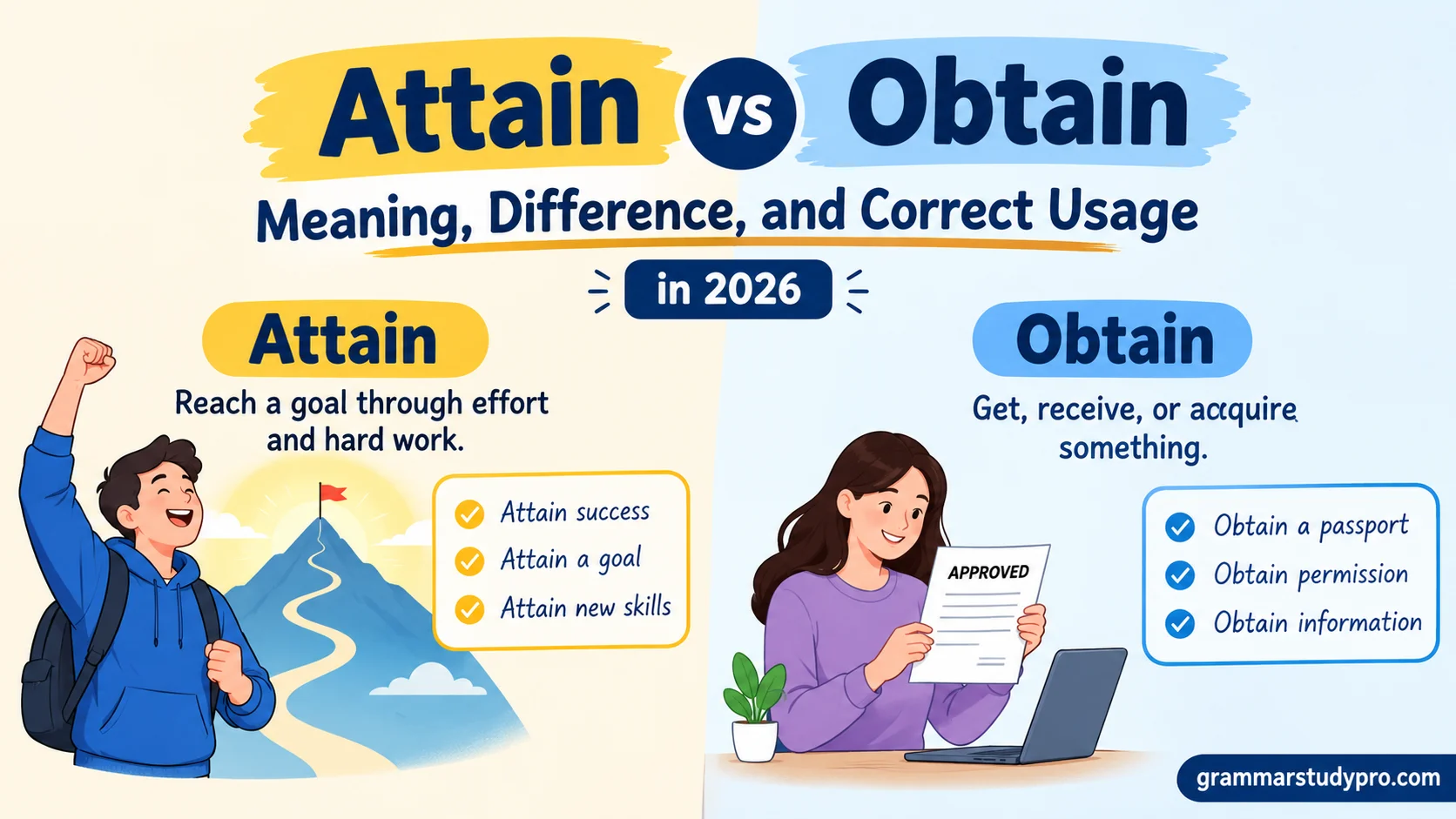
Attain vs Obtain can confuse English learners because both verbs describe getting something, but they differ in meaning and usage.
Attain usually refers to achieving a goal through effort, skill, persistence, or personal growth, while obtain means acquiring something through a process, transaction, request, purchase, or receipt. For example, you can attain success through personal effort or attain a high level of proficiency through study and practice. However, you obtain information, obtain a certificate after passing an English exam, or obtain permission to access documents and supplies. In English vocabulary and English grammar, attain often relates to intangible achievements, statuses, and abstract goals, whereas obtain commonly relates to tangible items, information, and possession. This semantic difference explains why the two verbs are not interchangeable in every context.
Understanding their meanings, connotations, synonyms, and contextual usage helps you make better word choices. Think of attain as an achievement-oriented verb and obtain as an acquisition-oriented verb. Goal attainment, effort-based achievement, and skill-based achievement involve reaching a goal, reaching a milestone, or working to achieve a goal. In contrast, information acquisition and transaction-based acquisition describe the act of getting something through a specific method. Although attain, obtain, achieve, acquire, and gain are related words, their correct usage depends on the action you want to express. These practical examples and real-life situations can help you remember the distinction. One useful memory trick is to connect attain with working toward a goal and obtain with getting something you need.
For precise writing, professional writing, and natural writing, choosing the correct verb improves writing accuracy, language precision, and communication skills. Whether you are preparing an academic paper, writing a business email, practicing academic writing, improving professional communication, or focusing on everyday writing, these practical usage tips can help you communicate with confidence. When a sentence emphasizes an abstract goal, personal achievement, or level of success, attain may be the better choice. When it describes receiving information, purchasing supplies, requesting documents, or gaining possession of something, obtain is often more suitable. Regular practice, language learning, exam preparation, and vocabulary development can strengthen your writing skills. Learning strategies, memory techniques, and grammar tips also help reduce common mistakes and errors while building vocabulary. By comparing definitions, usage contexts, and specific actions, you can choose the right verb with an appropriate professional tone and academic language.
Quick Answer: Attain vs Obtain
The main difference between attain vs obtain comes down to achievement versus acquisition.
- Attain means to reach or achieve something through progress, effort, or development. Examples include attain success, attain a goal, and attain a certain level.
- Obtain means to get, acquire, or secure something. Examples include obtain permission, obtain a certificate, and obtain information.
Consider these examples:
- Attain: Maria studied for several years to attain fluency in English.
- Obtain: Maria contacted her school to obtain an official transcript.
In the first sentence, Maria reaches a particular level of ability. In the second, she gets an official document.
Easy memory trick: You attain a goal or level, but you obtain something you need or want to acquire. This is a useful guideline rather than an absolute rule because both verbs have broader meanings.
Comparison Overview: Attain vs Obtain
Although attain and obtain share some meanings, they don’t emphasize the same part of an experience. One often describes reaching a result, while the other usually describes getting something into your possession or securing access to it.
| Comparison point | Attain | Obtain |
| Definition | To reach or achieve something | To get, acquire, or secure something |
| Primary focus | Achievement or reaching a state | Acquisition or possession |
| Common expressions | Attain a goal, attain success, attain proficiency | Obtain permission, obtain records, obtain information |
| Physical objects | Usually not the natural choice for simply getting an object | Commonly used for acquiring physical objects |
| Abstract concepts | Attain knowledge, attain independence | Obtain knowledge, obtain approval |
| Formal writing | Common in academic and professional writing | Common in administrative, academic, and professional writing |
| Everyday alternative | Reach, achieve | Get, acquire, secure |
Both verbs can appear in formal writing, and neither always requires considerable effort. The object and context determine which word sounds most natural. Cambridge Dictionary defines attain in terms of reaching or succeeding in getting something, while obtain focuses on getting something through means such as asking, buying, working, or producing it.
For example, a researcher might attain a high level of expertise after years of study. The same researcher might obtain permission to conduct an experiment. One phrase emphasizes expertise gained; the other emphasizes approval secured.
What Does Attain Mean?
Attain is a verb that means to reach, achieve, or successfully gain something. It commonly describes goals, standards, levels, positions, and conditions that someone reaches over time or through a process.
The word often appears when the result matters more than the act of acquiring something. It can suggest progress, development, or a milestone, although hard work isn’t always necessary.
According to attain can describe reaching a particular grade, achieving an objective, or reaching a major condition such as independence.
Attain a Goal or Objective
When you attain a goal, you successfully reach an outcome you wanted to achieve. The goal might involve education, business, health, personal growth, or another area of life.
Consider these examples:
- After months of preparation, Nina attained her target score on the entrance exam.
- The company attained its annual sales objective.
- He changed his daily habits to attain his fitness goals.
- The organization worked to attain its goal of expanding access to education.
In each sentence, attain emphasizes reaching a desired result. The verb fits especially well when the goal represents a milestone or a clear endpoint.
However, achieve and reach may work just as well in many situations. For instance, “She achieved her target score” sounds equally natural. Your choice depends on the tone and the emphasis you want.
Attain Success, Excellence, or Mastery
People also use attain to describe success, expertise, or a high level of performance. These outcomes often develop through learning, experience, or practice.
Examples include:
- The musician attained a remarkable level of technical skill.
- She hopes to attain excellence in her chosen field.
- The athlete attained a personal best during the competition.
- Years of practice helped him attain mastery of the instrument.
Notice how these examples focus on a result or level rather than a physical object. The musician reaches a level of skill, and the athlete achieves a measurable performance.
Still, attain doesn’t guarantee that a person worked for years to reach the result. The verb simply highlights the achievement or state reached. The surrounding sentence provides any additional information about effort or time.
Attain a Level, Rank, or Standard
Another common use involves reaching a specific level, rank, age, or standard. This usage appears in education, professional development, sports, government, and technical writing.
For example:
- Students must attain the required proficiency level before advancing.
- The athlete attained the qualifying standard for the competition.
- She attained the rank of captain after years of service.
- The equipment must attain a specified temperature before testing begins.
The important idea is reaching a defined point. A proficiency level, military rank, and temperature can all represent a target or threshold.
This is why attain works naturally with nouns such as level, rank, standard, and age. It connects the subject with a point reached in a process.
Attain an Age or State
The meaning of attain extends beyond goals that people consciously pursue. It can also describe reaching a particular age, condition, or status.
Examples:
- Applicants must have attained the age of 18.
- The nation attained independence after a long struggle.
- The tree can attain considerable height under suitable conditions.
- The project finally attained its intended level of stability.
In these examples, attain doesn’t necessarily describe a personal ambition. Someone reaches an age through the passage of time, and a tree reaches a certain height through growth.
The verb therefore covers both deliberate achievements and changes that occur over time. The shared idea is reaching a particular point or condition.
What Does Obtain Mean?
Obtain means to get, acquire, or secure something. People often use it when they need to request, purchase, locate, earn, or otherwise gain access to something.
The verb frequently appears in formal and professional contexts. For example, a student might obtain a transcript, a researcher might obtain data, and a contractor might obtain written permission before beginning work.
Cambridge Dictionary includes examples involving permission, books, and experimental results. Its definition also recognizes that people can obtain something by asking for it, buying it, working for it, or producing it.
Obtain Documents, Records, or Certificates
One of the clearest uses of obtain involves official documents. These might include certificates, transcripts, licenses, reports, permits, or records.
Examples:
- You can obtain a copy of your birth certificate from the relevant government office.
- She contacted the university to obtain her academic transcript.
- The employee obtained a copy of the signed agreement.
- Applicants must obtain the required documents before submitting their applications.
In each case, the subject acquires a document. The sentence doesn’t focus on reaching a goal or developing a skill.
For everyday conversation, get often sounds more relaxed. “I need to get my transcript” is natural in casual speech, while “I need to obtain my transcript” may suit an official email or formal instruction.
Obtain Permission, Approval, or a License
People frequently use obtain when referring to permission or official authorization. The word highlights the act of securing approval from someone who has the authority to grant it.
Examples:
- The contractor obtained permission before renovating the building.
- The company must obtain regulatory approval before launching the product.
- She obtained a license to operate the business.
- Researchers obtained consent from participants before collecting their responses.
These examples illustrate an important point: obtaining something doesn’t always mean physically possessing an object. Permission, approval, and consent are abstract, yet people can still obtain them.
The word also suits situations in which someone must follow a procedure. A person may complete an application, provide evidence, or receive a decision before obtaining the required authorization.
Obtain Information, Evidence, or Results
Obtain also appears in academic research, investigations, and data analysis. In these contexts, it refers to getting information or producing a result through a particular method.
Examples:
- The researchers obtained data from a nationwide survey.
- The lawyer obtained additional evidence during the investigation.
- The team obtained accurate results after repeating the experiment.
- Students can obtain information from the university’s official website.
These sentences focus on gaining access to information or producing findings. The word doesn’t necessarily suggest that the information itself represents a personal achievement.
In scientific writing, you might see a sentence such as, “The researchers obtained similar results in both experiments.” Here, obtained describes the results produced by the experimental process.
Obtain an Object, Resource, or Service
Unlike attain, obtain commonly describes acquiring physical things. You can obtain a book, a tool, a supply, or an item that may be difficult to find.
Examples:
- He obtained a rare book from a private collector.
- The charity obtained additional supplies for the shelter.
- The business obtained funding for its expansion.
- She obtained the replacement part from an authorized supplier.
The verb doesn’t specify exactly how the acquisition happened. The subject might buy the object, receive it, request it, or find a way to secure it.
However, obtain can sound formal when a simple everyday verb would work better. In a casual conversation, “I bought a new notebook” usually sounds more natural than “I obtained a new notebook.”
Choose the word based on your audience and purpose. Formality should improve the sentence, not make it sound stiff.
Main Differences Between Attain vs Obtain
The difference between attain and obtain becomes easier to understand when you examine what each verb emphasizes. Their meanings overlap, but they often fit different situations.
Achievement vs Acquisition
The clearest distinction is between reaching an outcome and acquiring something.
Consider these sentences:
- Attain: Priya attained her goal of becoming a teacher.
- Obtain: Priya obtained her teaching certificate.
The first sentence describes a personal or professional objective. The second describes acquiring a qualification or official document.
Now compare two more examples:
| Attain | Obtain |
| Attain financial independence | Obtain a bank statement |
| Attain a high level of skill | Obtain a training certificate |
| Attain a performance target | Obtain management approval |
| Attain a leadership position | Obtain a copy of the appointment letter |
These patterns provide a helpful starting point. Still, they aren’t rigid rules. The exact sentence may change which verb sounds most natural.
Effort vs the Process of Getting Something
Another difference involves the process described by the verb. Attain often highlights progress toward a result, while obtain highlights gaining or securing something.
For example:
- She trained consistently to attain a high level of fitness.
- She contacted the clinic to obtain a copy of her test results.
The first sentence emphasizes development. The second emphasizes acquiring information through a request.
However, don’t assume that attain always requires years of effort. A person can attain a particular age simply by living long enough. Likewise, obtaining something can require considerable work, persistence, or planning.
The distinction concerns the focus of the sentence, not the difficulty of the task.
Abstract Outcomes vs Physical Objects
Writers often use attain with abstract outcomes and obtain with physical objects. This pattern is useful, especially when you’re unsure which word fits.
For example:
- The student attained a high level of mathematical understanding.
- The student obtained a copy of the mathematics textbook.
The first sentence describes a level of knowledge. The second describes acquiring a physical item.
Yet abstract nouns don’t belong exclusively to attain. You can obtain permission, knowledge, information, funding, and approval. These expressions are standard because obtain covers much more than physical possession.
Formality and Everyday Usage
Both verbs are appropriate in formal writing. Neither one automatically makes a sentence more professional or grammatically correct.
Compare these examples:
- Casual: I need to get permission from my manager.
- Formal: I need to obtain permission from my manager.
- Natural: She reached her target for the month.
- Formal: She attained her target for the month.
The formal alternatives may suit reports, applications, academic writing, and official correspondence. However, everyday English often favors shorter and more familiar verbs.
For example, “I need to obtain some groceries” sounds unnecessarily formal in an ordinary conversation. “I need to buy some groceries” is clearer and more natural.
The goal isn’t to choose the longest word. It’s to choose the word that communicates your meaning accurately.
When Can You Use Attain and Obtain Interchangeably?
Although the two verbs have different typical uses, they sometimes overlap. This happens most often when the object is an abstract concept, such as education, knowledge, wealth, or independence.
Dictionary.com explains that attain and obtain can sometimes replace each other when they mean gaining something intangible, particularly when effort is involved. However, the emphasis may change.
Attain an Education vs Obtain an Education
Both expressions can work, but they emphasize slightly different ideas.
- Attain an education: Emphasizes reaching an educational level or achieving an educational outcome.
- Obtain an education: Emphasizes gaining access to or receiving an education.
For example:
“Despite financial difficulties, Lena worked hard to attain an education.”
This sentence highlights education as an important achievement.
“Despite financial difficulties, Lena worked hard to obtain an education.”
This version emphasizes her efforts to gain access to educational opportunities.
Neither sentence is automatically wrong. The surrounding context determines which emphasis makes more sense.
Attain Financial Independence vs Obtain Financial Independence
These expressions can also overlap, although attain financial independence is a particularly natural choice when discussing a long-term goal.
Consider the difference:
- She hopes to attain financial independence before turning 40.
- She hopes to obtain the funding necessary to start her business.
The first sentence describes reaching a desired financial condition. The second describes securing a resource that may help her reach that condition.
You could also say someone obtained financial independence, especially when emphasizing the result of gaining it. However, attained often presents independence as a milestone or condition reached.
Attain Knowledge vs Obtain Knowledge
Both expressions are possible, but the context matters.
- Through years of study, he attained an advanced level of scientific knowledge.
- The researcher obtained new information from the experiment.
The first sentence describes a level of understanding. The second describes acquiring specific information.
You can also say obtain knowledge when you mean gaining knowledge through a source or process. The difference isn’t that knowledge belongs exclusively to one verb. Instead, consider whether you’re emphasizing a level reached or information acquired.
Attain a Degree vs Obtain a Degree
This example deserves special attention because both expressions are understandable and can be correct.
- Attain a degree: Emphasizes reaching an educational achievement.
- Obtain a degree: Emphasizes gaining or receiving the qualification.
For example:
“After years of study, Daniel attained his goal of earning a degree.”
“After completing the required coursework, Daniel obtained his degree.”
The first sentence uses attained with goal. The second uses obtained with the qualification itself.
In everyday academic writing, earn a degree is another highly natural choice. It directly emphasizes the work and requirements involved in completing a qualification.
The practical lesson is simple: overlapping meanings don’t make two words identical. Choose the verb that best matches the point you want to make.
Attain vs Obtain in Real-Life Situations
Knowing the definitions helps, but real-world examples make the distinction easier to apply. Different settings also reveal which expressions sound most natural.
Attain vs Obtain in Education
Students and teachers regularly encounter both verbs in academic contexts.
Use attain when discussing learning outcomes, proficiency, or academic targets:
- She attained an advanced level of English proficiency.
- The student attained the required score on the examination.
- The school aims to help more students attain their academic goals.
Use obtain when discussing documents, information, or qualifications:
- He obtained a copy of his transcript.
- The researcher obtained data from student interviews.
- She obtained permission to conduct the study.
Here’s a useful distinction: a student can attain proficiency and obtain a certificate that documents a qualification. One describes ability; the other describes acquiring an official credential.
Attain vs Obtain in Business and Professional Writing
In business, the right verb can make reports and emails more precise.
Examples of attain:
- The team attained its quarterly sales target.
- The company attained a higher level of operational efficiency.
- The employee attained the professional standard required for promotion.
Examples of obtain:
- The project manager obtained approval for the revised budget.
- The company obtained funding for its expansion.
- The team obtained customer feedback through an online survey.
Notice the distinction between a target and an approval. A team attains a performance target because it reaches a desired result. It obtains approval because an authorized person or organization grants it.
For a formal report, you might write:
“The department attained its annual performance target after obtaining approval for additional staffing.”
This sentence uses both verbs naturally. It also demonstrates how the actions can relate to each other without having the same meaning.
Attain vs Obtain in Law and Administration
Official procedures frequently involve obtaining permission, consent, licenses, or records. The word works well because these things must often be requested or secured.
Examples:
- Applicants must obtain a valid permit before beginning construction.
- The organization obtained written consent from all participants.
- The applicant must have attained the minimum required age.
- The agency obtained the records needed for its review.
The age example illustrates a different use of attain. People reach a certain age; they don’t usually acquire it through a request or transaction.
By contrast, a permit generally comes from an authority. The applicant obtains it by completing the necessary process.
Always check the noun that follows the verb. It often provides the clearest clue.
Attain vs Obtain in Personal Development
Personal development combines both kinds of outcomes. People work toward goals while acquiring resources that help them reach those goals.
Consider these examples:
- She hopes to attain greater emotional balance.
- He obtained information about a professional certification.
- They attained financial stability after improving their budgeting habits.
- The student obtained access to an online learning platform.
In the first and third examples, the verbs emphasize reaching a condition. In the second and fourth, they emphasize gaining information or access.
This distinction is useful when writing about health, careers, education, finances, and personal growth. It lets you describe not only what happened but also what kind of result someone reached.
Attain vs Obtain vs Achieve vs Acquire
English offers several verbs for reaching goals and getting things. Although attain, obtain, achieve, and acquire sometimes overlap, each has its own common uses.
| Word | Main meaning | Common expressions | Example |
| Attain | Reach a goal, level, or condition | Attain proficiency, attain success | She attained fluency in Spanish. |
| Obtain | Get or secure something | Obtain permission, obtain a record | He obtained a copy of the report. |
| Achieve | Successfully accomplish something | Achieve a goal, achieve success | They achieved their main objective. |
| Acquire | Gain possession, knowledge, or a skill | Acquire property, acquire knowledge | She acquired new technical skills. |
Attain vs Achieve
Attain and achieve have considerable overlap. Both can describe reaching a goal or successfully gaining a result.
For example:
- She attained a high level of proficiency.
- She achieved a high level of proficiency.
Both sentences are understandable. However, attain often emphasizes reaching a level or state, while achieve often highlights successful accomplishment.
Compare attain independence with achieve a sales target. These are natural combinations, although neither verb is limited to those expressions.
Obtain vs Acquire
Obtain and acquire both mean getting something. Their differences can be subtle.
- The researcher obtained permission to conduct the experiment.
- The company acquired a smaller competitor.
Obtain often emphasizes securing something through a process or request. Acquire frequently emphasizes gaining possession, ownership, knowledge, or a new characteristic.
For example, you might obtain a passport but acquire a new skill. These are common patterns rather than strict grammatical restrictions.
Which Word Should You Choose?
Use these quick guidelines:
- Choose attain when you want to emphasize reaching a level, goal, or condition.
- Choose obtain when you want to emphasize getting or securing something.
- Choose achieve when you want to emphasize successful accomplishment.
- Choose acquire when you want to emphasize gaining possession, knowledge, or a skill.
Don’t treat these as four completely separate categories. Their meanings sometimes overlap. Context determines the most natural choice.
Common Mistakes When Using Attain and Obtain
Even experienced writers occasionally choose a verb that doesn’t fit the intended meaning. These are the mistakes worth watching for.
Using Attain for an Ordinary Physical Object
Consider this sentence:
- Less natural: He attained a copy of the report.
- Better: He obtained a copy of the report.
The first sentence sounds unusual because attain typically emphasizes reaching an outcome rather than simply acquiring an object.
If the subject gets a book, document, tool, or other physical item, obtain is usually more suitable.
However, don’t turn this pattern into an absolute rule. The verb attain has several meanings, and its best use depends on the expression as a whole.
Using Obtain When You Mean Achieve a Goal
Consider these examples:
- Less natural: She obtained her goal of becoming a doctor.
- Better: She attained her goal of becoming a doctor.
- Also natural: She achieved her goal of becoming a doctor.
The problem is the expression obtained her goal. In ordinary English, people generally attain or achieve a goal rather than obtain one.
However, the sentence changes if the object changes:
“She obtained the medical license required to practice.”
Here, obtained fits because the sentence describes securing a credential.
Adding an Unnecessary Preposition After Attain
In most ordinary sentences, attain takes a direct object without a preposition.
- Incorrect for the intended meaning: She attained to her goal.
- Correct: She attained her goal.
- Correct: She attained a high level of proficiency.
There are specialized or older constructions involving attain to, but you don’t need them for normal modern writing. When you mean reaching a goal, level, or condition, use attain directly with the object.
Choosing a Word Based Only on Effort
A common misconception is that attain always involves hard work, while obtain describes an easy process.
That distinction doesn’t hold in every sentence.
- She attained the age of 21.
- He obtained a rare manuscript after months of searching.
The first example describes reaching an age. The second describes acquiring something through a lengthy process.
Focus on the meaning of the verb, not the amount of effort involved. Effort may influence the context, but it doesn’t determine the correct word by itself.
How to Choose Between Attain and Obtain
When you’re unsure whether to use attain or obtain, look at the noun that follows the verb. Then consider what you want the sentence to emphasize.
Follow These Simple Steps
Identify what the sentence describes. Is it a goal, level, standard, age, or condition? If so, attain may be the better choice.
Ask whether someone is getting or securing something. If the sentence involves permission, a document, information, or a physical object, consider obtain.
Check the intended meaning. Sometimes both verbs work, but they emphasize different aspects of the situation.
Consider a more natural alternative. Depending on the context, achieve, reach, earn, get, or acquire may communicate your meaning more clearly.
Here are a few quick examples:
- She worked hard to attain her career goals.
- The company had to obtain regulatory approval.
- He hopes to attain a higher level of proficiency.
- She contacted the office to obtain her records.
- The student attained the required score and obtained a certificate.
That last example illustrates the distinction especially well. A student reaches the required score and then acquires a certificate.
Practice Quiz: Attain or Obtain?
Test your understanding with these five sentences. Choose the verb that best fits each context.
Fill in the blanks with the correct form of attain or obtain.
- After years of practice, Maya finally ___ a high level of fluency.
- You must ___ written permission before entering the restricted area.
- The company hopes to ___ its annual performance target.
- He contacted the university to ___ a copy of his transcript.
- The applicant must have ___ the minimum required age.
Answers and Explanations
Attained: After years of practice, Maya finally attained a high level of fluency.
Attain fits because the sentence describes reaching a level of ability.
Obtain: You must obtain written permission before entering the restricted area.
Obtain describes securing authorization from the appropriate authority.
Attain: The company hopes to attain its annual performance target.
The company wants to reach a particular performance goal.
Obtain: He contacted the university to obtain a copy of his transcript.
The transcript is a document that he needs to acquire.
Attained: The applicant must have attained the minimum required age.
The applicant must have reached a specified age. The phrase must have attained is grammatically correct because it refers to a requirement that must already be satisfied.
FAQs
1. What is the main difference between attain and obtain?
Attain means achieving something through effort, practice, or persistence. Obtain means getting or acquiring something through a process, request, purchase, or receipt. For example, you attain success through hard work but obtain a certificate after passing an exam.
2. Can attain and obtain be used interchangeably?
No, attain and obtain are not always interchangeable. Although both verbs describe getting something, attain usually emphasizes achievement, while obtain emphasizes acquisition. Choosing the correct verb depends on the sentence’s meaning and context.
3. What are some examples of attain in a sentence?
Here are three examples of attain in everyday and professional English:
- She worked hard to attain her career goals.
- He hopes to attain a high level of proficiency in English.
- The athlete trained for years to attain success in international competitions.
Each example describes reaching a goal or achieving something through effort.
4. What are some examples of obtain in a sentence?
Here are three examples of obtain in different contexts:
- You must obtain permission before entering the building.
- She contacted the office to obtain information about the course.
- He hopes to obtain a certificate after completing the training.
These sentences emphasize acquiring something through a process or action.
5. How can I remember when to use attain or obtain?
Use this simple memory trick: attain means achieve, while obtain means acquire. If you are working toward a goal, attain is usually appropriate. If you are getting a document, permission, information, or an item, obtain is often the better choice. Practice with different sentences to build confidence.
Conclusion
Understanding attain vs obtain helps you communicate more clearly and choose the right words in everyday, academic, and professional writing. Remember that attain generally focuses on reaching goals or achieving success through effort, while obtain focuses on acquiring something through a process, request, purchase, or receipt.
For example, you attain success through dedication but obtain permission by requesting approval. Once you understand this distinction, you can avoid common grammar mistakes, improve your vocabulary, and use both verbs naturally and accurately.