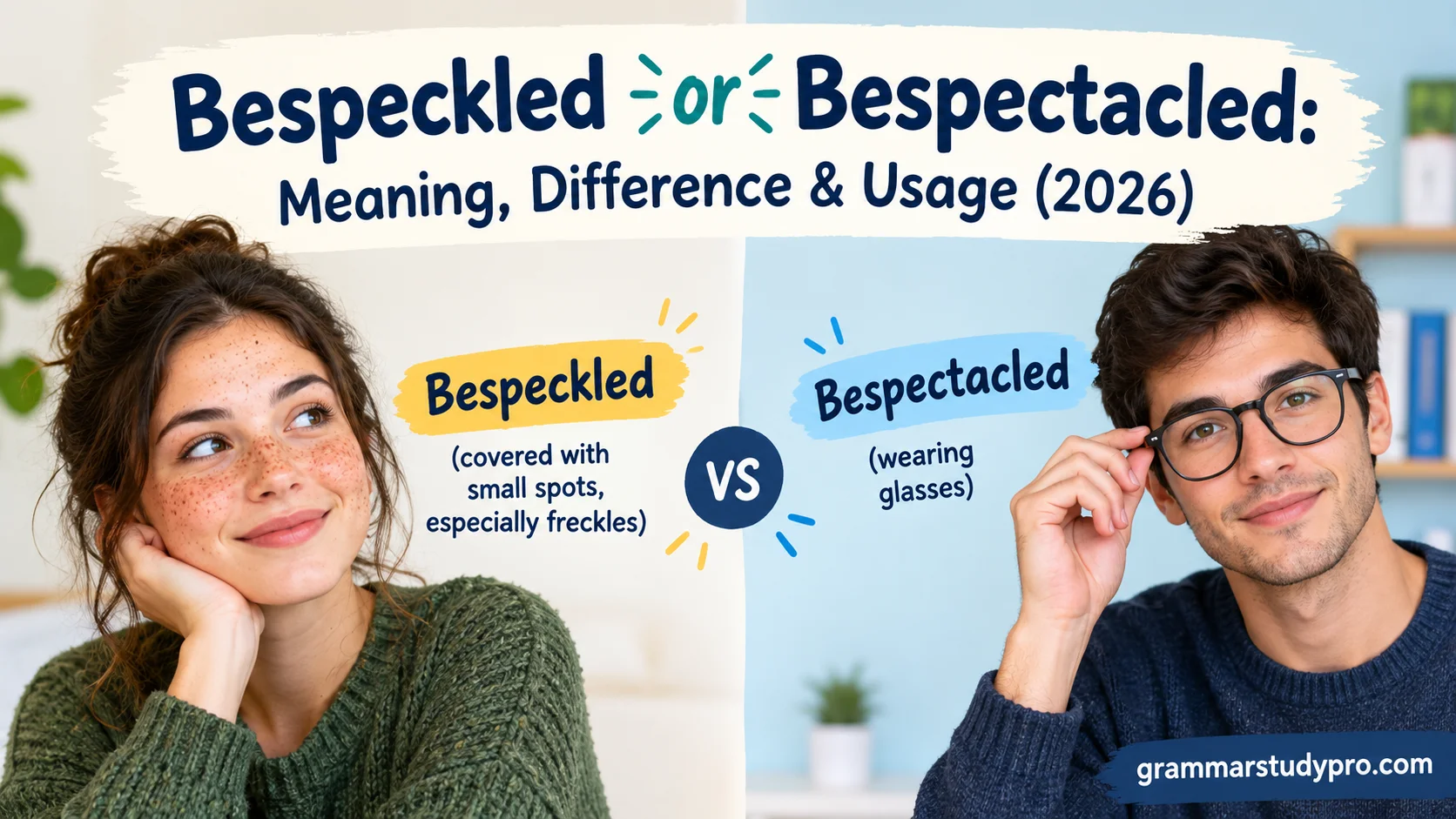
Bespeckled or Bespectacled can look and sound similar, yet these two words describe different things and have different meanings in English. Bespeckled describes something covered or marked with small spots, speckles, or scattered marks, while bespectacled describes a person wearing eyeglasses or glasses. Both words begin with bespec- and contain similar letters, so learners and writers may mix their meanings. The difference becomes useful when describing people, objects, clothing, surfaces, and appearances.
As a writer and lifelong student of language, I have found that a clear guide, simple examples, and a memory trick can reduce confusion. In a short story, a small change between these words can alter the meaning of a sentence, so choosing the right word supports clear, polished writing. When a term fits its context, it is worth taking time to check spelling, use, and meaning. Modern English requires a comprehensive approach that can explore where each word should belong, how someone might say or write it, and how a detail can shape a scene or character.
In editing, I check grammar, usage, and parts of speech, then label each term as an adjective, compound description, or word modifying a noun. I also run quick tests for modifier placement and subject–verb agreement, making short edits that help replace confusing phrasing with the correct choice without changing tone or rhythm. This process improves style, consistency, and clarity through practice, analysis, and attention to semantics, structure, and vocabulary. I have learned that strong grammar, solid vocabulary, and deeper interpretation create a big difference when working on sentence construction, proofreading, and application, while this approach supports better communication, sharper understanding, and more confident writing.
Quick Answer
Bespeckled means covered or marked with small spots, specks, or flecks.
Bespectacled means wearing glasses or spectacles.
They are both correct English words, but they aren’t synonyms and can’t normally replace each other.
| Word | Meaning | What it usually describes | Example |
| Bespeckled | Covered with small spots or specks | Objects, surfaces, animals, clothing, skin, patterns | The egg was bespeckled with brown marks. |
| Bespectacled | Wearing glasses | A person or another character described as wearing glasses | The bespectacled professor entered the room. |
The fastest way to remember the distinction is:
Speck = spot → bespeckled
Spectacles = glasses → bespectacled
Oxford defines speckle as a small colored mark or spot and defines speckled as covered with small marks or spots.
Meanwhile, Cambridge defines bespectacled as “wearing glasses” and labels the word formal. Oxford similarly defines it as “wearing spectacles” and marks it as formal.
Comparison Overview
The easiest way to understand bespeckled vs. bespectacled is to put the two words side by side.
| Feature | Bespeckled | Bespectacled |
| Core meaning | Covered with small spots or specks | Wearing glasses |
| Related word | Speck / speckle | Spectacles |
| Main idea | Small marks or dots | Eyewear |
| Typical subject | Objects, surfaces, animals, clothing, skin | People |
| Example noun | A bespeckled egg | A bespectacled teacher |
| Common alternative | Speckled, spotted, flecked | Wearing glasses |
| Register | Descriptive | Formal or literary |
| Interchangeable? | No | No |
There’s an important point here: neither word is the “correct spelling” of the other.
Both are legitimate words. You choose between them according to meaning.
If you mean covered with spots, choose bespeckled. If you mean wearing glasses, choose bespectacled.
That distinction remains the same whether you’re writing an email, an essay, a novel, a news article, or a character description.
Main Differences Between Bespeckled and Bespectacled
The difference becomes much clearer when you examine what each word actually describes.
Bespeckled Means Covered With Small Spots
Bespeckled describes something that has small visible spots, specks, or flecks on it.
The underlying word speck refers to a very small mark or spot. Oxford defines speckle as a small colored mark or spot against a background of another color.
So you might describe:
- a bespeckled egg
- a bespeckled leaf
- a bespeckled bird
- a bespeckled wall
- a bespeckled shirt
- a bespeckled page
- a bespeckled stone
- a bespeckled surface
For example:
The old ceramic bowl was bespeckled with tiny blue marks.
The word paints a visual picture. You can almost see those little marks scattered across the bowl.
Bespectacled Means Wearing Glasses
Bespectacled describes someone who wears glasses or spectacles.
Cambridge gives the straightforward definition “wearing glasses,” while Oxford defines the adjective as “wearing spectacles.” Both dictionaries identify the word as formal.
For example:
The bespectacled professor adjusted his glasses before beginning the lecture.
Here, bespectacled tells you something about the professor’s appearance. It doesn’t say anything about his personality, intelligence, profession, or age.
You can use it with many nouns referring to people:
- a bespectacled teacher
- a bespectacled student
- a bespectacled scientist
- a bespectacled writer
- a bespectacled doctor
- a bespectacled journalist
- a bespectacled researcher
- a bespectacled librarian
Cambridge’s corpus examples also show the adjective being used in descriptions of scholars, scientists, students, writers, and other people.
Why Are Bespeckled and Bespectacled So Easy to Confuse?
The spelling creates the trap.
Look at the two words carefully:
bespeckled
bespectacled
Both begin with be-. Both contain the letters spe. Both end with -cled. Both function as adjectives.
Your eyes can skim over the middle of either word and miss the crucial difference.
But their word families give you a reliable shortcut.
The Bespeckled Word Family
The key word is speck.
A speck is a tiny spot or mark. A speckle is a small spot or a pattern of small spots. Oxford’s dictionary entry confirms this connection.
That gives you:
speck → speckle → bespeckled
Think about dust specks, paint specks, ink specks, or tiny spots on an egg.
The Bespectacled Word Family
The key word is spectacles.
In the relevant sense, spectacles means glasses. Oxford defines spectacles as two lenses held in a frame that rests on the nose and ears.
That gives you:
spectacles → bespectacled
So the spelling itself provides the clue.
SPECK = spots
SPECTACLES = glasses
Once that connection sticks, the two words become much harder to confuse.
What Does Bespeckled Mean?
Bespeckled means marked or covered with small spots, specks, or flecks.
It can describe natural patterns as well as marks created by people or environmental conditions.
Consider an egg with scattered brown spots. You could call it bespeckled. A bird with small markings across its feathers could also have a bespeckled appearance.
The word can also work in more literary descriptions.
For example:
The moonlit pond was bespeckled with floating leaves.
Or:
Her blue dress was bespeckled with tiny drops of paint.
The exact nature of the marks depends on context.
Bespeckled Examples
Here are several natural examples:
- The robin’s egg was bespeckled with brown marks.
- The artist wore a bespeckled apron after a long afternoon in the studio.
- Tiny stars bespeckled the dark sky.
- The old manuscript was bespeckled with ink stains.
- The stone had a bespeckled surface.
- The bird’s feathers were bespeckled with pale spots.
- The child’s face was bespeckled with freckles.
Notice that bespeckled doesn’t require perfectly round dots. The general idea is a surface or appearance marked by small scattered spots or flecks.
What Does Bespectacled Mean?
Bespectacled means wearing glasses.
It is especially useful when you want to incorporate the visual detail directly into a noun phrase.
Instead of writing:
The professor who was wearing glasses entered the room.
You can write:
The bespectacled professor entered the room.
The second version is more compact and descriptive.
However, bespectacled has a more formal or literary flavor. Cambridge explicitly labels it formal, and Oxford does the same.
In everyday American English, wearing glasses will often sound more natural.
For example:
I spoke to a man wearing glasses.
That’s completely ordinary conversational English.
Compare it with:
I spoke to a bespectacled man.
The second sentence is correct, but it sounds more deliberate and descriptive.
Neither version is wrong. The choice depends on the tone you want.
Bespeckled vs. Bespectacled Examples
Context makes the distinction almost impossible to miss.
When Bespeckled Is Correct
The bespeckled egg sat in the basket.
The egg has small spots.
The artist’s bespeckled shirt was covered with tiny flecks of paint.
The shirt has small marks.
The bird had bespeckled feathers.
The feathers have small spots.
The page was bespeckled with ink.
The page has scattered ink marks.
When Bespectacled Is Correct
The bespectacled teacher walked into the classroom.
The teacher wears glasses.
A bespectacled scientist explained the experiment.
The scientist wears glasses.
The bespectacled librarian pointed toward the reference section.
The librarian wears glasses.
We interviewed a bespectacled writer after the event.
The writer wears glasses.
The test is simple: replace the adjective with a plain-English phrase.
If “covered with small spots” works, bespeckled probably fits.
If “wearing glasses” works, bespectacled probably fits.
Can a Person Be Bespeckled?
Yes.
This is an important nuance because the distinction is sometimes oversimplified.
Bespeckled doesn’t exclusively describe objects. It can describe a person’s face, skin, clothing, or another visible feature when that feature has small spots or specks.
For example:
Her face was bespeckled with freckles.
Here, the person’s face has small spots.
That isn’t the same meaning as:
She was bespectacled.
In the second sentence, the person is wearing glasses.
The difference lies in what characteristic you’re describing.
If you’re talking about spots, bespeckled can work. If you’re talking about glasses, bespectacled is the appropriate word.
Can You Use Bespeckled and Bespectacled in the Same Sentence?
Absolutely.
In fact, putting them together creates one of the easiest ways to remember their meanings.
The bespectacled artist wore a bespeckled apron.
The artist wears glasses.
The apron has small marks or specks.
Another example:
The bespectacled researcher examined the bespeckled specimen.
The researcher wears glasses.
The specimen has small spots.
This is more than a clever sentence. It demonstrates the precise semantic difference between the two adjectives.
Are Bespeckled and Bespectacled Interchangeable?
No.
They describe different characteristics.
Consider this sentence:
The bespeckled professor adjusted his glasses.
A reader may interpret bespeckled as describing spots or specks on the professor’s appearance. If the intended meaning is simply that he wears glasses, bespectacled is clearer.
Better:
The bespectacled professor adjusted his glasses.
Now reverse the situation:
The bespectacled wall was covered with blue spots.
That doesn’t make sense if you mean the wall has spots.
Better:
The bespeckled wall was covered with blue spots.
The wall is marked with spots. It isn’t wearing glasses.
That’s why spell-check alone can’t solve this problem. Both words are legitimate English words. Software can recognize the spelling while still missing the semantic mistake.
Bespeckled vs. Speckled
Another useful comparison is bespeckled vs. speckled.
These words are closely related.
Oxford defines speckled as “covered with small marks or spots.”
So these can often describe the same basic visual feature:
a speckled egg
a bespeckled egg
The main difference is stylistic and grammatical context.
Speckled is the simpler and more familiar adjective. Bespeckled comes from the verb bespeckle and can give the description a somewhat more literary or deliberate feel.
For everyday writing, speckled will often be the natural choice:
The bird had speckled feathers.
For more vivid descriptive prose, bespeckled can work well:
The bird’s breast was bespeckled with tiny silver-gray marks.
Neither word automatically makes the sentence better. The right choice depends on the effect you’re after.
Bespectacled vs. Wearing Glasses
The same principle applies to bespectacled.
| Phrase | Meaning | Style |
| Bespectacled | Wearing glasses | Formal/descriptive |
| Wearing glasses | Has glasses on | Everyday |
| With glasses | Has glasses | Casual and concise |
| Glasses-wearing | Characterized by wearing glasses | Neutral but less common |
Cambridge specifically identifies bespectacled as formal.
So in a casual conversation, you might say:
There’s a man wearing glasses at the door.
In a character description, you might write:
A bespectacled man stood beside the door.
The second version compresses the same information into a single adjective.
That’s one reason writers still use bespectacled. It can make descriptive prose tighter without changing the underlying meaning.
How to Use Bespeckled in a Sentence
There are several useful grammatical patterns.
Bespeckled Before a Noun
This is the simplest structure:
a bespeckled egg
a bespeckled surface
bespeckled feathers
Bespeckled After a Linking Verb
You can also place it after a verb such as was or looked:
The stone was bespeckled.
The old table looked bespeckled with paint.
Bespeckled With + Marks
This construction is especially useful when you want to identify the material or marks.
The page was bespeckled with ink.
The fabric was bespeckled with paint.
The shell was bespeckled with brown spots.
This structure lets you describe both the visual pattern and what created it.
How to Use Bespectacled in a Sentence
Bespectacled most often appears before a noun referring to a person.
Before a Noun
a bespectacled professor
a bespectacled student
a bespectacled journalist
After Descriptive Adjectives
It can also appear alongside other adjectives:
The quiet, bespectacled researcher reviewed the report.
A gray-haired, bespectacled professor entered the lecture hall.
The adjective simply adds another physical detail.
As Part of a Larger Description
The bespectacled librarian leaned over the desk and searched the catalog.
Here, the word works efficiently because it identifies the person’s appearance without interrupting the sentence with a longer clause.
Common Mistakes With Bespeckled and Bespectacled
These mistakes usually happen because writers remember the overall shape of the word rather than its meaning.
Mistake: Using Bespeckled for Someone Wearing Glasses
Incorrect for that intended meaning:
The bespeckled teacher adjusted her glasses.
If the teacher’s glasses are the detail you want to highlight, use:
The bespectacled teacher adjusted her glasses.
Mistake: Using Bespectacled for a Spotted Object
Incorrect for the intended meaning:
The bespectacled egg had brown markings.
Use:
The bespeckled egg had brown markings.
Mistake: Assuming Bespectacled Means Intelligent
This is a subtle but important point.
A writer might describe a character as bespectacled in a context that also suggests the character is scholarly or academic. That can create a cultural association between glasses and intelligence.
However, bespectacled itself does not mean intelligent, scholarly, serious, or academic.
It only describes someone wearing glasses.
The surrounding context may suggest other traits. The adjective itself doesn’t.
Mistake: Assuming Bespeckled Always Means Freckled
Freckles can create a bespeckled appearance, but the words aren’t identical.
Freckled specifically refers to freckles. Oxford defines freckled in terms of small, pale brown spots, especially on the face or skin.
Bespeckled is broader. It can refer to many kinds of small spots or marks.
So:
a freckled face
is more specific than:
a bespeckled face.
A Practical Test for Choosing the Right Word
When you’re stuck between bespeckled or bespectacled, don’t stare at the spelling. Test the meaning.
Ask:
Are you talking about spots?
If yes, use bespeckled.
The jacket was bespeckled with paint.
Replace the word:
The jacket was covered with small spots of paint.
The meaning works.
Are you talking about glasses?
If yes, use bespectacled.
The bespectacled doctor entered the room.
Replace the word:
The doctor wearing glasses entered the room.
Again, the meaning works.
This substitution trick is useful because it focuses on meaning rather than spelling.
Bespeckled or Bespectacled: Corrected Sentences
| Confusing sentence | Better sentence | Reason |
| The bespeckled teacher adjusted her glasses. | The bespectacled teacher adjusted her glasses. | The teacher wears glasses. |
| The bespectacled wall had blue dots. | The bespeckled wall had blue dots. | The wall has small marks. |
| The bespeckled professor wore spectacles. | The bespectacled professor wore spectacles. | Glasses are the intended detail. |
| The bespectacled egg had brown spots. | The bespeckled egg had brown spots. | The egg is spotted. |
| A bespeckled scientist entered the laboratory. | A bespectacled scientist entered the laboratory. | The scientist wears glasses. |
| The bespectacled page was covered in ink dots. | The bespeckled page was covered in ink dots. | The page has small marks. |
These aren’t spelling corrections in the usual sense. They’re meaning corrections.
That’s the real source of the confusion.
Pronunciation of Bespeckled and Bespectacled
Pronunciation can add another layer of confusion because the words have similar rhythms.
Cambridge gives bespectacled the pronunciation /bɪˈspek.tə.kəld/ in both its UK and US entries.
Oxford gives the same broad pronunciation pattern: /bɪˈspektəkld/.
The key point isn’t memorizing every phonetic symbol. It’s recognizing that bespectacled contains the recognizable spectacle element.
For bespeckled, the important sound connection is with speck and speckle.
When speaking quickly, the words can feel deceptively similar. That’s another reason the root-word memory trick works so well.
Think:
- speck → tiny mark
- spectacles → glasses
Then attach the meaning to the sound.
Case Study: One Sentence, Two Very Different Images
Consider these two sentences:
The bespeckled scientist entered the laboratory.
What does the reader picture?
Possibly a scientist with small marks on their face or clothing. The exact location depends on context.
Now change one adjective:
The bespectacled scientist entered the laboratory.
The image changes immediately. Now the scientist is wearing glasses.
The sentence structure barely changes. The adjective changes only slightly in appearance. Yet the visual information changes completely.
That’s why precise word choice matters.
A good adjective doesn’t merely decorate a sentence. It controls what the reader notices.
A Second Case Study: The Library
Imagine a librarian sitting behind an old wooden desk.
The librarian wears round glasses. The desk has tiny ink stains from decades of use.
You could write:
The bespectacled librarian sat behind the bespeckled desk.
Every adjective does one job.
Bespectacled tells you about the librarian’s glasses.
Bespeckled tells you about the desk’s marks.
Now imagine swapping them:
The bespeckled librarian sat behind the bespectacled desk.
The sentence suddenly creates a very different image.
The librarian appears marked with spots. The desk somehow appears to be wearing spectacles.
That’s grammatical wordplay, not the intended meaning.
Bespeckled and Bespectacled: Synonyms and Alternatives
Sometimes the best solution isn’t either word.
Choose the simpler alternative if it fits your audience better.
Alternatives for Bespeckled
Depending on context, you might use:
- speckled
- spotted
- flecked
- dotted
- freckled when specifically referring to freckles
- marked in some contexts
The best choice depends on what kind of marks you’re describing.
For example:
a speckled egg
sounds natural.
a spotted egg
can also work, although it may suggest a somewhat different pattern.
a freckled egg
would be unusual unless the context deliberately treats the markings like freckles.
Precision matters.
Alternatives for Bespectacled
Depending on tone, you could use:
- wearing glasses
- wearing spectacles
- with glasses
- wearing eyeglasses
In everyday American English, wearing glasses is often the most straightforward choice.
In formal or descriptive prose, bespectacled can be useful because it compresses that phrase into one adjective.
Is Bespectacled Formal?
Yes.
Both Cambridge and Oxford label bespectacled as a formal adjective.
That doesn’t mean the word is old-fashioned or incorrect. It simply means it has a more formal or literary feel than ordinary phrases such as wearing glasses.
Compare:
The man wearing glasses waited outside.
with:
The bespectacled man waited outside.
The first sounds conversational.
The second sounds more like a written description.
That distinction can be useful when you’re choosing vocabulary for different types of writing.
Is Bespeckled Formal?
Bespeckled is also more descriptive than everyday alternatives such as spotted or speckled. It can fit naturally into literary, artistic, nature, and descriptive writing.
However, the important distinction isn’t whether the word sounds formal. The primary issue is meaning.
You can use bespeckled whenever the context genuinely involves small marks or specks.
For everyday writing, though, speckled will often be the simpler choice.
FAQs
1. What does bespeckled mean?
Bespeckled means covered with small spots, speckles, or scattered marks. It can describe a surface, object, clothing, skin, or another thing that has visible marks.
2. What does bespectacled mean?
Bespectacled describes a person who is wearing eyeglasses. For example, “The bespectacled teacher entered the classroom” means the teacher was wearing glasses.
3. What is the main difference between bespeckled and bespectacled?
The main difference is their meaning. Bespeckled refers to spots or marks, while bespectacled refers to someone wearing glasses. Although the words look similar, they cannot normally be used interchangeably.
4. Is bespeckled an adjective?
Yes. Bespeckled is an adjective used to describe something covered with small spots or marks. For example, “She wore a bespeckled dress” describes a dress with scattered spots or marks.
5. Is bespectacled a correct English word?
Yes. Bespectacled is a correct adjective used to describe someone who wears eyeglasses. It is useful when you want to mention a person’s appearance without simply saying that the person is wearing glasses.
Conclusion
Bespeckled and bespectacled may look almost alike, but their meanings are clearly different. Bespeckled relates to spots, speckles, or scattered marks, whereas bespectacled refers to a person wearing eyeglasses. Remembering this simple distinction can help you choose the right word and avoid confusion in your writing.