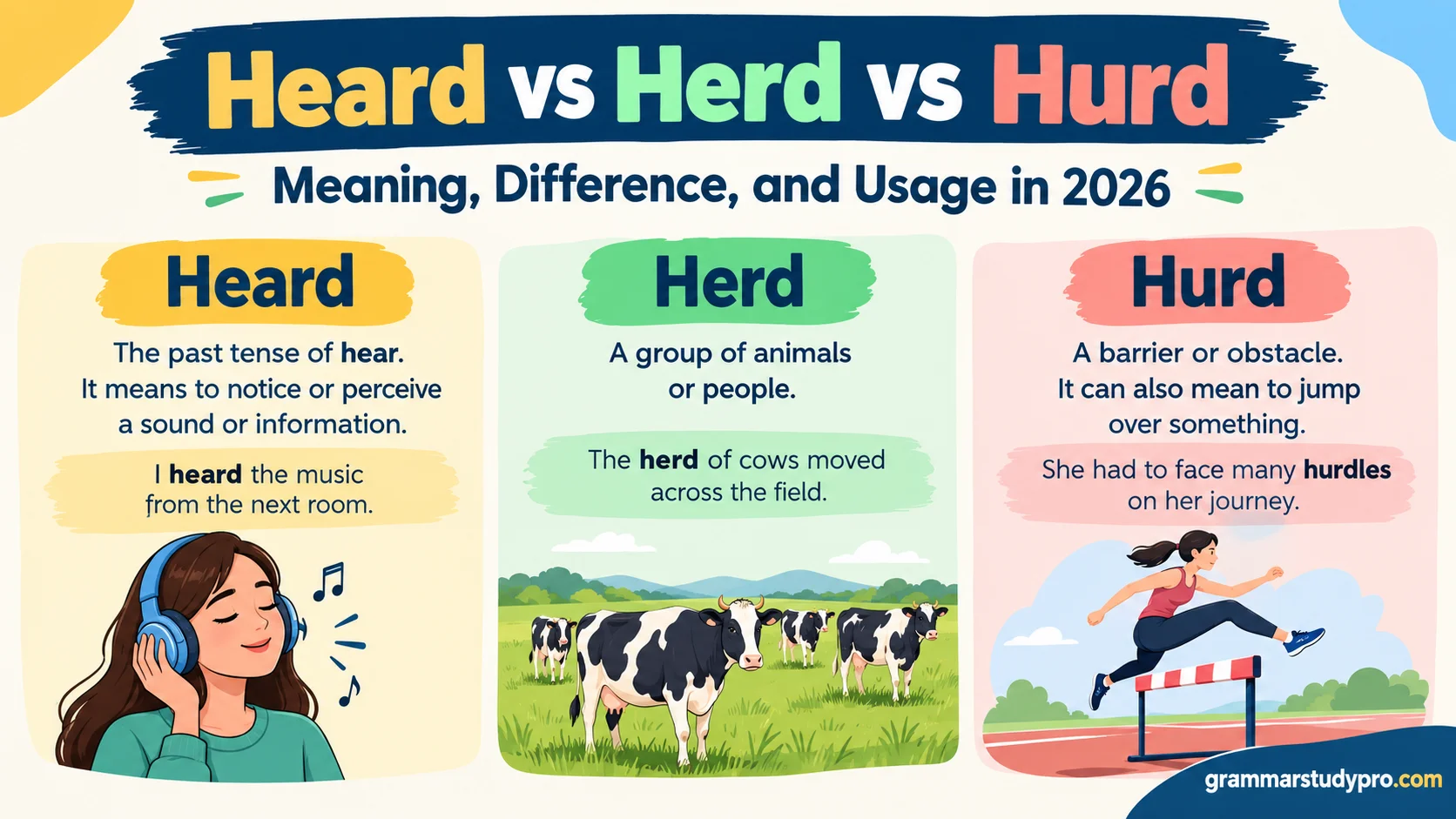
Heard vs Herd vs Hurd can seem confusing because these homophones sound alike, but their meanings and uses are different in everyday use. Heard, Herd, and Hurd have three spellings, yet they do not share the same meaning or context. Heard is the past tense and past participle of hear and connects with hearing, listening, perceiving, and noticing a sound, noise, or statement. Herd works as a collective noun for a group of animals, people, or crowds, and it can also function as a verb meaning to move people or animals together. Hurd, however, is usually a proper name, surname, brand, or name variant found in specialized, historical, or regional contexts. It is rarely used in ordinary, normal, or modern writing, so calling it not a word would miss an important point.
I have found myself second-guessing these forms while writing a formal email, academic paper, school assignment, article, social post, or professional document. A small slip or mistake can change an entire sentence or message, cause embarrassment, and make communication less clear. The quickest way to choose correctly is to ask what the sentence means and pay attention to the surrounding context. If you heard something, think about listening or a sound. If you mean a herd, think about animals, people, or others moving together. If you see Hurd, check for a surname, proper name, or specific variant. This habit supports clearer speaking and writing, especially for a native speaker or learner trying to avoid the wrong word.
For me, grammar drill routines, practice, practicing, and regular exposure make these tricky sets easier to remember. Learning their deeper patterns supports mastering correct word usage, while examples make the differences feel more natural. A small mix-up can become a trip hazard when crafting notes, drafting something typed in a professional tone, or trying to improve your style. Careful editing, checking, and improving help, especially when you are stuck and need to dive deeper into the distinctions instead of guessing. Identically pronounced forms become easier when you focus on spelling, meaning, and usage. The good news is that these homophones are easier to remember through everyday situations, including wildlife, farming, a professional document, or a name you stumble upon.
Quick Answer
Here is the heard vs herd vs hurd distinction in its simplest form:
- Heard = the past tense or past participle of hear.
- I heard a strange noise.
- She has heard that story before.
- Herd = a group of animals or the act of moving animals or people together.
- A herd of cattle crossed the road.
- The farmer herded the sheep into the pen.
- Hurd = not the standard everyday spelling of heard or herd. It can occur as a surname, as well as in historical, regional, or specialized uses.
- Mr. Hurd spoke at the meeting.
So remember:
Hear → heard
Animals → herd
Hurd → usually a name or specialized usage
The biggest trap is pronunciation. Heard and herd are homophones in standard American English, meaning they have the same pronunciation but different spellings and meanings. Cambridge gives both words the American pronunciation /hɝːd/.
Comparison Overview
| Word | Part of speech | Main meaning | Example |
| heard | Verb; sometimes adjective | Past tense/past participle of hear | I heard the announcement. |
| herd | Noun | A group of animals | A herd of elephants crossed the plain. |
| herd | Verb | To move or gather people or animals as a group | They herded the cattle into the barn. |
| Hurd | Proper noun | A surname; also found in specialized or historical uses | Hurd was listed as the speaker. |
Dictionary sources make the grammatical difference particularly clear. Heard is the simple past and past participle of hear, while herd works as both a noun and a verb.
The spelling hurd deserves a little more nuance. Collins and Dictionary.com record Hurd in connection with the British political figure Douglas Hurd. The Dictionaries of the Scots Language also records hurd as an older Scots noun with meanings including a heap or pile and a large mass.
In other words, hurd exists in English-related records, but that doesn’t make it an interchangeable spelling for heard or herd.
Main Differences Between Heard vs Herd vs Hurd
The easiest way to understand the three words is to separate meaning, grammar, and context.
| Difference | Heard | Herd | Hurd |
| Connected to hearing? | Yes | No | No |
| Refers to an animal group? | No | Yes | No in ordinary modern English |
| Can function as a verb? | Yes | Yes | Not as the standard modern English equivalent of hear |
| Can function as a noun? | Generally no in ordinary use | Yes | Yes in some historical/regional uses |
| Common everyday English? | Yes | Yes | Usually no |
| Common as a surname? | Rarely relevant | Rarely relevant | Yes |
| Same pronunciation as the others? | Often sounds like herd | Often sounds like heard | Depends on the specific use |
The practical distinction is therefore straightforward. Heard describes something perceived or learned through hearing. Herd describes a group or the act of moving a group. Hurd usually belongs to a name or specialized context.
What Does “Heard” Mean?
Heard is the simple past tense and past participle of the verb hear. Dictionary.com identifies it directly as both forms of hear.
The verb hear can involve physically perceiving sound, but English uses it more broadly. You can hear a song, hear someone’s voice, hear a rumor, or hear about an event.
That’s why the word appears in many different kinds of sentences.
Heard as the Past Tense of Hear
When something happened in the past, heard commonly replaces hear.
Compare:
- Present: I hear music.
- Past: I heard music.
More examples:
- I heard a loud bang outside.
- She heard someone knocking at the door.
- We heard birds singing in the garden.
- He heard the phone ring.
- They heard a strange noise during the night.
The important clue is simple: the sentence involves something someone perceived with their ears or received through hearing.
Heard for Information or News
English doesn’t restrict hear to physical sounds.
You can also say:
- I heard the news yesterday.
- Have you heard about the new restaurant?
- She heard that the meeting had been canceled.
- We heard from the manager this morning.
In these examples, heard means that someone received information, usually through speech, communication, or a report.
That’s an important distinction because the sentence doesn’t necessarily involve an obvious sound.
Heard as a Past Participle
Heard also serves as the past participle of hear.
For example:
- I have heard that song before.
- She has heard enough.
- We had heard the story already.
- They have heard the announcement.
The pattern is:
hear → heard → heard
Unlike regular verbs such as walk → walked → walked, hear changes its form irregularly.
Heard as an Adjective
Heard can also appear in adjective-like constructions describing something perceived through hearing.
For example:
- a rarely heard song
- a well-heard warning
- heard information
Dictionary.com records an adjective use for heard meaning something perceived by the ear or learned through hearing.
What Does “Herd” Mean?
Herd has two major everyday roles: it can be a noun or a verb.
As a noun, it generally refers to a group of animals. As a verb, it describes moving animals or people together as a group. Cambridge gives both uses and includes examples involving cattle, elephants, goats, children, and passengers.
Herd as a Noun
The most familiar meaning of herd is a group of animals that live, feed, travel, or remain together.
Examples include:
- a herd of cattle
- a herd of elephants
- a herd of deer
- a herd of goats
- a herd of horses
For example:
A herd of elephants moved toward the river.
Here, herd identifies the group.
The sentence has nothing to do with hearing. That’s the fastest way to separate herd from heard.
Herd as a Verb
Herd can also describe the action of making animals move together.
For example:
The farmer herded the cattle into the barn.
Other examples include:
- The rancher herded the sheep toward the gate.
- The shepherd herded the goats down the hill.
- The workers herded the animals into a fenced area.
Cambridge defines this verb as making animals move together as a group.
The word can also describe people moving together.
The teachers herded the children onto the buses.
That doesn’t mean the children became animals. Instead, herded emphasizes the act of directing a group of people together toward a particular place.
Herd Can Refer to People
English sometimes uses herd figuratively for groups of people.
For example:
He didn’t want to follow the herd.
Here, the herd means the larger group whose behavior someone is following.
Cambridge labels this people-related sense as mainly disapproving. The wording can suggest that individuals are behaving alike rather than making independent choices.
That’s why context matters.
Calling a group of elephants a herd is neutral. Calling people the herd can sound critical or dismissive.
What Does “Hurd” Mean?
This is where many heard vs herd vs hurd explanations become too simplistic.
You may see articles claiming that hurd isn’t a word at all. That statement isn’t fully accurate.
In ordinary modern English, hurd is not the standard spelling of heard or herd. If you mean that you listened to something, write heard. If you mean a group of animals, write herd.
However, Hurd appears in legitimate names and specialized language.
Hurd as a Surname
Hurd can be a surname. Collins and Dictionary.com, for example, include Hurd in entries connected with Douglas Hurd, the British politician.
So this sentence can be perfectly correct:
Hurd attended the conference.
If Hurd is the person’s surname, changing it to Heard would actually create an error.
Capitalization provides an important clue here. Hurd as a person’s surname normally begins with a capital letter.
Hurd in Historical and Regional English
The story gets even more interesting when historical English varieties enter the picture.
The Dictionaries of the Scots Language records hurd as an older Scots noun. Its documented meanings include a heap or pile, a large mass, and a large boulder in certain regional uses.
The dictionary also traces the word through Scots usage and provides historical citations.
That doesn’t mean you should start using hurd in ordinary American English. It simply demonstrates why the blanket statement “hurd is not a word” isn’t linguistically precise.
Hurd as a Common Spelling Mistake
In everyday writing, however, a lowercase hurd is often intended as a misspelling.
For example:
❌ I hurd someone call my name.
The standard form is:
✅ I heard someone call my name.
Likewise:
❌ A hurd of cattle stood near the fence.
The standard form is:
✅ A herd of cattle stood near the fence.
So the useful rule is:
Don’t use “hurd” as a casual alternative spelling for heard or herd.
Why Do Heard and Herd Sound the Same?
The pronunciation is the heart of this spelling problem.
Heard and herd are homophones. A homophone is a word that shares its pronunciation with another word while having a different spelling and meaning.
In American English, both are pronounced /hɝːd/. Cambridge lists that pronunciation for both heard and herd.
That creates a classic writing problem.
If someone says:
“I heard a herd of cattle.”
You can understand the sentence immediately when you hear it. But if someone asks you to spell the two words without context, the identical sound creates room for mistakes.
The meaning solves the puzzle.
Heard belongs to the world of hearing.
Herd belongs to the world of groups.
A Useful Memory Trick
Think of these two connections:
Hear → Heard
Animals → Herd
The first connection is grammatical. The second is semantic.
If you’re describing something that reached someone’s ears, choose heard.
If you’re describing a group of cattle, elephants, deer, or similar animals, choose herd.
Heard vs Herd Pronunciation
For standard American English, the two words are pronounced the same:
| Word | IPA | Meaning |
| heard | /hɝːd/ | Past tense of hear |
| herd | /hɝːd/ | Group of animals; move a group |
| Hurd | Context-dependent | Usually a name or specialized term |
This is why pronunciation alone can’t tell you which spelling to use.
You need context.
For example:
I ___ a noise.
The blank describes hearing. Therefore:
I heard a noise.
Now consider:
A ___ of horses entered the field.
The blank describes a group of animals. Therefore:
A herd of horses entered the field.
Same sound. Completely different meaning.
Heard vs Herd Grammar Explained
Understanding the grammar makes the difference even easier to remember.
Heard Is a Form of Hear
The basic verb pattern is:
| Form | Example |
| hear | I hear music. |
| heard | I heard music. |
| heard | I have heard that song. |
Heard therefore functions as both the simple past and past participle of hear.
Herd Is a Noun
When herd identifies a group, it acts as a noun.
The herd moved toward the water.
A herd of deer crossed the road.
The noun can appear with articles and modifiers:
- a herd
- the herd
- a large herd
- a wild herd
- a herd of cattle
Herd Is Also a Verb
When herd describes an action, it becomes a verb.
The rancher herded the cattle into the field.
Its common forms include:
- herd
- herds
- herded
- herding
That versatility makes herd different from heard, which comes specifically from the verb hear.
Heard vs Herd Examples in Sentences
The following examples show how context determines the correct spelling.
Examples With Heard
- I heard a strange noise outside.
- She heard someone knocking.
- We heard the announcement this morning.
- Have you heard this song before?
- They heard about the changes yesterday.
- I have heard that story many times.
- He had heard the warning before leaving.
Every example involves hearing, receiving information, or having previously received information.
Examples With Herd
- A herd of cattle stood near the river.
- The herd moved across the grassland.
- We watched a herd of elephants from a safe distance.
- A large herd of deer crossed the road.
- The farmer herded the sheep into the pen.
- The guides herded the visitors toward the exit.
The noun examples describe groups. The verb examples describe moving or directing groups.
Examples With Hurd
When Hurd is a name:
- Hurd spoke during the meeting.
- The article quoted Hurd on the subject.
- Hurd was listed among the conference speakers.
When hurd appears in a historical or regional source, its meaning depends on that source and dialect. The Dictionaries of the Scots Language, for example, documents meanings that aren’t part of ordinary contemporary American English.
Common Mistakes With Heard, Herd, and Hurd
These mistakes usually happen because writers rely on sound rather than meaning.
Mistake: Writing Herd Instead of Heard
Incorrect:
❌ I herd someone calling my name.
Correct:
✅ I heard someone calling my name.
The sentence describes hearing a voice, so heard is required.
Mistake: Writing Heard Instead of Herd
Incorrect:
❌ A heard of cattle crossed the road.
Correct:
✅ A herd of cattle crossed the road.
The sentence describes a group of cattle, so herd is correct.
Mistake: Using Hurd for Either Word
Incorrect:
❌ I hurd the announcement.
Correct:
✅ I heard the announcement.
Incorrect:
❌ A hurd of elephants walked past.
Correct:
✅ A herd of elephants walked past.
Mistake: Assuming Hurd Is Always Wrong
This mistake goes in the opposite direction.
If someone’s surname is Hurd, you shouldn’t “correct” it to heard.
For example:
Mr. Hurd gave the presentation.
That’s a proper name. The spelling belongs to the person.
How to Choose Between Heard and Herd
When you’re unsure, don’t stare at the spelling. Look at the meaning.
Ask: Is the sentence about hearing?
If yes, choose heard.
I ___ the phone ring.
Answer: heard
Ask: Is the sentence about a group of animals?
If yes, choose herd.
A ___ of cows crossed the field.
Answer: herd
Ask: Is Herd Being Used as a Verb?
If the sentence describes moving a group together, use herd or one of its forms.
The farmer ___ the goats into the barn.
Answer: herded
Ask: Is Hurd a Name?
If the word identifies a person or established proper name, keep Hurd.
This four-question method works because it focuses on meaning rather than pronunciation.
Heard vs Herd in Common Phrases
Both words appear in familiar English expressions.
Common Expressions With Heard
Have you heard…?
Used when asking whether someone knows or has received information.
Have you heard about the new store?
Make yourself heard
This means to make sure people notice or listen to what you are saying.
She spoke loudly enough to make herself heard.
Heard it through the grapevine
This means receiving information through informal communication or rumors.
Hear, hear!
This expression signals strong agreement with what someone else has said. Cambridge defines it as an expression used to strongly agree with another person’s statement.
Common Expressions With Herd
Follow the herd
This means copying what the larger group does instead of acting independently.
He didn’t want to follow the herd.
Herd mentality
This phrase describes a tendency for people to adopt the behavior or opinions of a larger group.
Like herding cats
This humorous expression describes trying to organize people or things that are extremely difficult to control.
Cambridge lists like herding cats as an idiom associated with herd.
Heard vs Herd in Real-World Context
The distinction becomes much easier when you see how each word behaves in different situations.
Everyday Conversation
I heard you were moving.
Here, heard means receiving information.
Wildlife
A herd of elephants approached the water.
Here, herd identifies the animal group.
Farming
The farmer herded the cattle into the enclosure.
Here, herded describes the action of moving the animals.
News and Information
We heard the news this morning.
Again, the word relates to receiving information.
People’s Names
Hurd joined the discussion.
Here, Hurd may be a surname.
The context acts like a signpost. Once you know what the sentence is actually saying, the spelling becomes much easier.
A Practical Case Study: “I Heard a Herd”
Consider this sentence:
I heard a herd of cattle outside.
At first glance, it looks repetitive. Yet it demonstrates the difference perfectly.
Heard tells us what the speaker experienced.
Herd tells us what the speaker experienced.
The sentence could mean:
The speaker perceived the sound made by a group of cattle outside.
Notice how both words can sit next to each other without confusion when written correctly.
Now change the spelling:
❌ I herd a heard of cattle outside.
The sentence becomes nonsensical because the meanings no longer fit their grammatical roles.
This is the central lesson of heard vs herd: sound doesn’t determine spelling; meaning and grammar do.
Heard vs Herd vs Hurd Quick Grammar Test
Choose the correct word for each sentence.
Questions
- I ___ a loud crash downstairs.
- A ___ of deer entered the clearing.
- Have you ___ the latest announcement?
- The farmer ___ the sheep toward the barn.
- Mr. ___ attended the conference.
- We had ___ that the store was closing.
- The ___ moved toward the water.
- She ___ someone calling her name.
Answers
1. heard
The sentence describes perceiving a sound.
2. herd
The word refers to a group of deer.
3. heard
The speaker is asking whether someone has received information.
4. herded
The word functions as a verb describing the movement of sheep.
5. Hurd
Here, the spelling is appropriate if Hurd is the person’s surname.
6. heard
The phrase uses the past participle of hear.
7. herd
The noun refers to a group of animals.
8. heard
The sentence describes perceiving someone’s voice.
FAQs
What is the difference between Heard, Herd, and Hurd?
Heard is the past tense and past participle of hear, while herd means a group of animals or people. Hurd is mainly used as a surname, proper name, or specialized term.
Is Heard pronounced the same as Herd?
Yes. Heard and herd are pronounced the same in standard American English. However, their spellings, meanings, and uses are different.
What does Herd mean?
Herd usually means a group of animals, such as cattle, elephants, or deer. It can also be a verb meaning to move or guide people or animals together.
Is Hurd a correct English word?
Hurd can be a valid spelling, but it is not the ordinary word used for hearing or a group of animals. It commonly appears as a surname, proper name, brand, or historical or regional form.
How can I remember Heard vs Herd vs Hurd?
Connect each word with its meaning. Heard relates to hearing something, herd relates to a group, and Hurd is usually a name. Looking at the sentence context makes the correct choice much easier.
Conclusion
Understanding Heard vs Herd vs Hurd becomes simple when you focus on meaning rather than sound alone. Heard describes something you perceived through hearing, herd refers to a group or the act of moving a group together, and Hurd is mainly associated with names and specialized uses. Although these words can sound alike, their different spellings and meanings make them useful in different situations. With regular reading, writing, and practice, you can recognize the correct form quickly and avoid common mistakes.