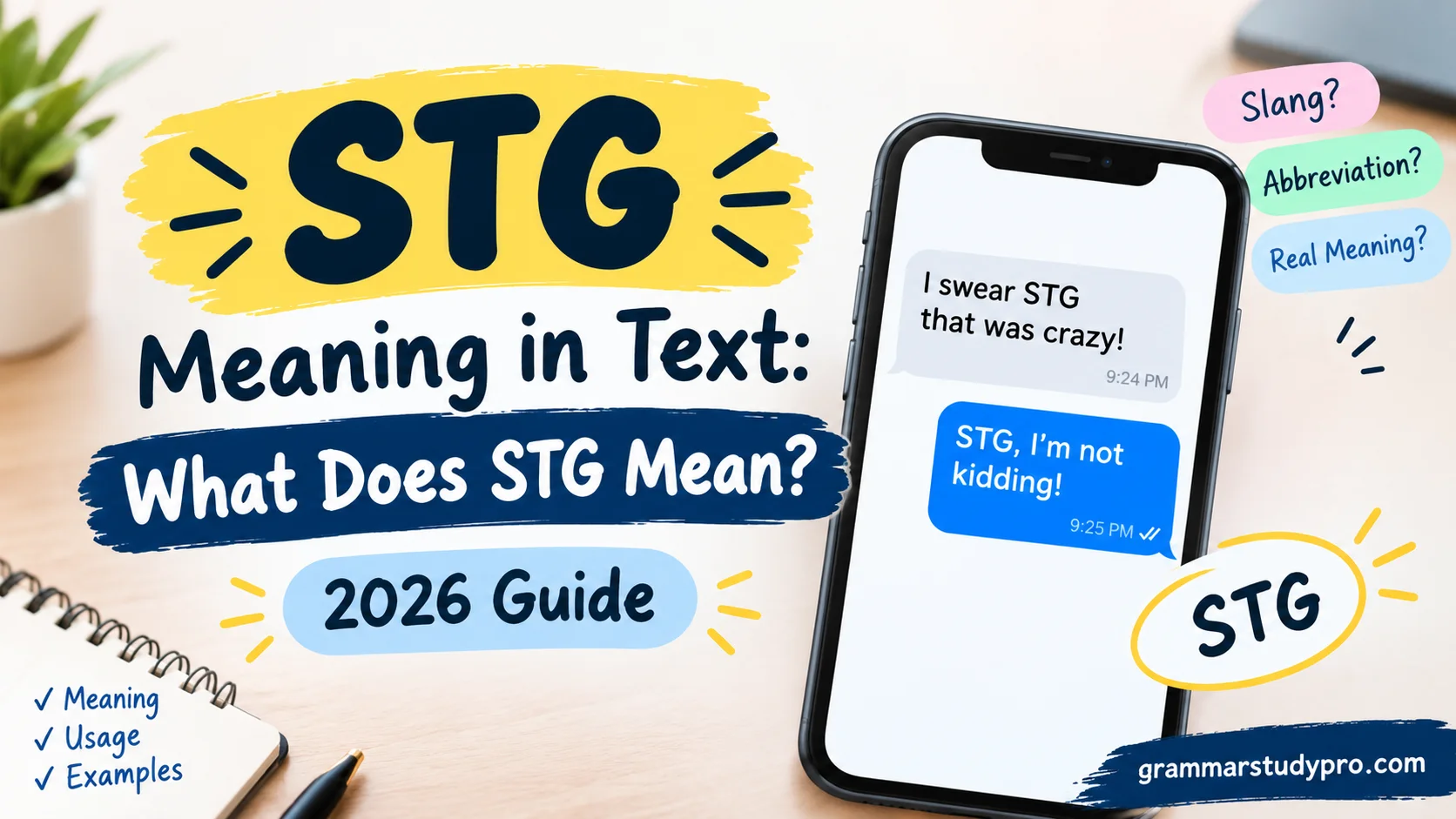
STG Meaning in Text stands for Swear to God, a popular acronym used on social media to express honesty, emphasize a statement, or show strong feelings in everyday conversations.
People use STG in messages, chats, and online conversations when they want to show they’re telling the truth, making a serious statement, or strongly expressing feelings. This internet slang appears on Snapchat, TikTok, Instagram, and other social platforms because it makes a longer phrase quicker to type. Its meaning depends on the tone of conversation and the situation. For example, “STG, I told you everything!” expresses truthfulness, while “STG, that was so funny!” shows emotion and strong feelings. These slang expressions add emphasis, sincerity, and emotional expression to text messages without requiring a long explanation.
In daily use, STG is one of many internet abbreviations found in messaging apps, social networking posts, and social media comments. It supports casual typing, informal language, and natural online messaging, although strong emphasis can sound serious, playful, or annoyed depending on the conversation context. Knowing STG helps you understand modern conversations, reply confidently, and avoid misunderstandings when texting friends or browsing comments. Learning common abbreviations improves digital communication and makes everyday communication clearer and more engaging. As modern slang trends change, recognizing the meaning of STG helps you understand its usage across messaging platforms. Always read the whole message before deciding what someone means.
STG Meaning in Text: Quick Answer
STG means “swear to God” in texting and internet slang.
It usually adds emphasis to a statement. Depending on context, it can mean something close to:
- “I promise.”
- “I’m telling the truth.”
- “Seriously.”
- “I really mean this.”
- “Believe me.”
For example:
“STG I didn’t eat your leftovers.”
The sender is emphasizing that the claim is true.
Another example:
“STG that was the funniest thing I’ve ever seen.”
Here, STG adds intensity rather than defending against an accusation.
The abbreviation is informal. You’ll mainly encounter it in texts, DMs, group chats, comments, gaming conversations, and other casual online settings.
What Does STG Stand For?
STG stands for “Swear to God.”
Each letter represents the first letter of a word:
| Letter | Word |
| S | Swear |
| T | To |
| G | God |
STG is an initialism, meaning people generally understand the letters individually rather than treating them as a pronounceable word.
You’ll also see the lowercase version “stg.” In casual messaging, capitalization usually doesn’t change the meaning.
For example:
- “STG I’m telling the truth.”
- “stg I’m telling the truth.”
Both communicate essentially the same idea.
The phrase itself comes from the spoken expression “swear to God.” Digital communication simply compresses the longer phrase into three characters. Wiktionary lists STG as an internet-slang and text-messaging initialism for “swear to God.”
What Does STG Mean in Texting?
In texting, STG adds emotional weight to whatever follows or surrounds it.
Think of it as putting verbal emphasis in bold.
Someone might write:
“STG, I didn’t know.”
That can mean, “I genuinely didn’t know.”
Or:
“This is the best burger ever, STG.”
That doesn’t necessarily involve a literal oath. The sender is simply emphasizing how strongly they feel about the burger.
STG Can Show Honesty
One of the most common uses is to reinforce a claim.
For example:
“STG I left my phone at home.”
The sender wants you to believe them.
STG Can Show Frustration
STG can also introduce an irritated statement:
“STG if he does that again, I’m leaving.”
Here, the abbreviation makes the complaint sound more forceful.
STG Can Add Excitement
The expression isn’t always negative.
“STG we got front-row seats!”
The sender is emphasizing excitement or disbelief.
STG Can Make a Joke More Dramatic
Internet conversations love exaggeration. STG can make an ordinary statement sound deliberately dramatic.
“STG this cat has more attitude than my entire family.”
The phrase adds comic emphasis rather than making a formal promise.
STG Meaning on Snapchat, TikTok, Instagram, and Other Platforms
The basic STG meaning doesn’t change significantly from platform to platform.
You may encounter it in:
- Snapchat messages
- TikTok comments
- Instagram DMs
- Group chats
- WhatsApp messages
- Discord
- Gaming chats
- X posts and replies
- Reddit discussions
- Ordinary SMS texts
The platform can influence the style and tone, but STG normally retains its “swear to God” meaning in casual internet slang.
For example, a TikTok comment might say:
“STG this happens every time.”
A private Snapchat message might say:
“stg I wasn’t ignoring you.”
The underlying meaning remains similar. The surrounding conversation tells you what emotion the sender is adding.
Current discussions of online language also highlight how punctuation, emojis, message length, and conversational context can affect how digital messages are interpreted.
How STG Changes Meaning With Context
Here’s where things get interesting.
The literal expansion stays the same, but the conversational function can change.
| Example | Likely meaning | Tone |
| “STG I didn’t do it.” | I’m telling the truth | Defensive |
| “STG that’s amazing.” | I really mean it | Excited |
| “STG I’m exhausted.” | I’m seriously exhausted | Frustrated |
| “STG, listen to me.” | Take me seriously | Insistent |
| “STG 😂” | Seriously / I can’t believe this | Playful |
| “I love this song, STG.” | I genuinely love it | Enthusiastic |
That distinction matters because STG doesn’t automatically mean anger.
A reader who focuses only on the abbreviation might miss the actual tone.
Capitalization Can Add Emphasis
Capital letters can sometimes make a message feel stronger:
STG I’m done.
Compared with:
stg i’m done
The meaning is still essentially identical. However, capitalization, punctuation, emojis, and the surrounding language can affect how intense the message feels.
Punctuation Matters Too
Compare these:
“STG I didn’t say that.”
“STG, I didn’t say that!”
“stg 😂 I didn’t say that”
The first could sound defensive. The second feels more emphatic. The third might turn the situation into a joke.
Digital communication strips away voice tone and facial expressions. Tiny textual signals therefore do more work.
Common Ways People Use STG
STG to Prove You’re Telling the Truth
This is probably the clearest use.
“STG I saw him at the mall.”
The sender is emphasizing that the story isn’t made up.
STG to Emphasize an Opinion
Someone can also use STG when they strongly believe something.
“STG that was the best concert ever.”
The person isn’t necessarily responding to doubt. They’re simply turning up the volume on their opinion.
STG to Express Frustration
This usage is especially common in complaints.
“STG this computer never works when I need it.”
The abbreviation intensifies the frustration.
STG to Emphasize a Promise
Someone may use STG before promising something.
“STG I won’t tell anyone.”
Here, the phrase reinforces the seriousness of the promise.
STG as Playful Exaggeration
Friends often use dramatic language jokingly.
“STG if you eat my fries again, we’re no longer friends.”
Nobody necessarily expects this to be interpreted as a literal oath. The humor comes from exaggeration.
STG vs. ISTG: What’s the Difference?
ISTG means “I swear to God.”
STG and ISTG are extremely close. The main difference is the inclusion of “I.”
| Abbreviation | Full meaning | Typical effect |
| STG | Swear to God | Short, emphatic |
| ISTG | I swear to God | More explicitly personal |
| ONG | On God | Emphasis or sincerity |
For example:
“STG that’s true.”
and:
“ISTG that’s true.”
Both reinforce the speaker’s claim.
ISTG can feel slightly more direct or personal because the subject “I” appears explicitly. However, context matters more than this small grammatical difference.
ISTG is also widely used to express frustration, seriousness, surprise, or a playful threat.
STG vs. ONG: What’s the Difference?
ONG generally means “on God.”
The two expressions occupy similar conversational territory because both can emphasize sincerity or certainty.
For example:
“STG, that’s true.”
“ONG, that’s true.”
Both can communicate strong conviction.
Still, they’re not identical expressions. STG directly abbreviates “swear to God,” while ONG comes from the phrase “on God.”
The choice often comes down to personal texting style, community slang, and the specific sentence.
STG vs. Other Texting Abbreviations
STG belongs to a much larger family of internet shorthand.
| Abbreviation | Meaning | What it usually communicates |
| STG | Swear to God | Sincerity or emphasis |
| ISTG | I Swear to God | Strong personal emphasis |
| ONG | On God | Strong agreement or sincerity |
| FR | For Real | Agreement or seriousness |
| TBH | To Be Honest | Candid opinion |
| NGL | Not Gonna Lie | Honest admission |
| OMG | Oh My God | Surprise or shock |
| SMH | Shaking My Head | Disbelief or disappointment |
One important distinction is STG vs. OMG.
They aren’t interchangeable simply because both contain religious language.
“OMG, that’s incredible!”
expresses surprise.
“STG, that’s incredible!”
emphasizes the speaker’s conviction or intensity.
That small difference can completely change the message.
Is STG a Bad Word?
Not exactly.
STG isn’t generally classified as profanity simply because it abbreviates “swear to God.” However, some people may consider it inappropriate because it invokes God or uses religious language casually.
That distinction matters.
Whether STG feels acceptable can depend on:
- Personal religious beliefs
- Family norms
- Age and social group
- Workplace expectations
- Cultural background
- The seriousness of the conversation
- The relationship between the people communicating
For a close friend, STG may seem completely ordinary.
In a formal workplace email, it would sound out of place.
Is STG Offensive?
There isn’t one universal answer.
Some people use it casually without intending any religious statement. Others may prefer not to use expressions that invoke God as an oath.
So if you’re unsure about your audience, choose a neutral alternative such as:
- “I promise.”
- “I assure you.”
- “Honestly.”
- “I’m serious.”
- “I can confirm that.”
Context is the whole ball game here.
Is STG Appropriate in Professional Messages?
Usually, no.
STG belongs primarily to informal digital communication. A professional email should normally use direct language instead.
Instead of:
“STG I sent the report yesterday.”
Write:
“I can confirm that I sent the report yesterday.”
Instead of:
“STG this needs to be fixed.”
Write:
“This issue needs to be addressed.”
The second versions sound clearer and more professional. They also leave less room for someone to misread your tone.
What Does STG Mean From a Girl?
If a girl sends “STG,” the abbreviation itself doesn’t have a special female-specific meaning.
It still generally means “swear to God.”
The mistake people often make is trying to extract romantic meaning from an ordinary slang term.
Consider:
“STG you’re so funny 😂”
That could simply be friendly enthusiasm.
Now consider:
“STG I missed you.”
That carries more emotional weight, but the surrounding relationship creates that meaning. STG itself doesn’t automatically make a message romantic.
What Does STG Mean From a Guy?
The same principle applies when a guy uses STG.
There isn’t a separate male-specific definition.
For example:
“STG bro, I didn’t take your charger.”
is simply an emphatic denial.
Likewise:
“STG that game was insane.”
is an enthusiastic reaction.
Don’t interpret STG in isolation. Look at the complete sentence, the conversation before it, and the relationship between the people involved.
Case Study: How the Same STG Can Sound Different
Consider three fictional conversations.
Case Study: A Disagreement
Alex: “You deleted the file.”
Jordan: “STG I didn’t.”
Here, STG functions as a defense. Jordan is emphasizing honesty.
Case Study: Excitement
Alex: “How was the concert?”
Jordan: “STG, it was incredible.”
Now the same three letters emphasize enthusiasm.
Case Study: Frustration
Alex: “He forgot the appointment again.”
Jordan: “STG, he does this every time.”
This version sounds irritated.
The abbreviation didn’t change. The context did.
That’s the key to understanding STG in real conversations.
How to Reply When Someone Texts “STG”
Your response should match the tone of the conversation.
If They’re Proving Something
You could respond:
“Okay, I believe you.”
If They’re Excited
Try:
“Seriously? That’s awesome!”
If They’re Frustrated
A simple:
“I know. That’s frustrating.”
can keep the conversation moving.
If They’re Joking
Match the energy:
“😂 You’re being dramatic.”
There’s no special response required for STG. Treat it like the underlying phrase and respond to the actual message.
Other Meanings of STG
Although “swear to God” is the common meaning in texting, STG isn’t exclusive to internet slang.
Context can produce completely different meanings.
For example, Wiktionary records STG as an unofficial abbreviation associated with the British pound sterling and also lists security threat group as a U.S. prison-related initialism. It also records the texting meaning “swear to God.”
That means you shouldn’t automatically expand every STG you encounter as “swear to God.”
STG in Gaming
Gaming communities can develop their own abbreviations. If STG appears in a game guide, clan document, or technical discussion, check the surrounding terminology before assuming it’s slang.
STG in Technical or Professional Contexts
Acronyms often become overloaded across industries. An abbreviation appearing in a report, database, product specification, or organization document may have nothing to do with texting.
Context beats the dictionary.
Common Misunderstandings About STG
STG Doesn’t Automatically Mean Someone Is Angry
A person can use STG while excited, amused, serious, defensive, or frustrated.
STG Isn’t Automatically Profanity
It abbreviates a religious expression, but whether someone considers that inappropriate depends on personal and cultural context.
STG Doesn’t Have a Secret Romantic Meaning
If someone sends STG, don’t automatically treat it as flirting.
STG and ISTG Aren’t Completely Different Slang Terms
They’re closely related expressions. ISTG simply includes the first-person “I.”
STG Doesn’t Always Have to Be Literal
People frequently use exaggerated language online. Someone writing “STG this is the best sandwich ever” isn’t necessarily making a formal oath.
Is STG Still Used in 2026?
Yes. STG remains recognizable as internet and texting slang in 2026, with current slang references continuing to define it as “swear to God.”
That doesn’t mean every age group or online community uses it equally. Internet slang is highly fluid. Some expressions become mainstream while others fade into specific communities.
Recent writing about digital communication also shows how quickly texting conventions evolve, particularly among different generations.
So it’s more accurate to say that STG remains an established texting abbreviation rather than claiming it’s universally popular.
FAQs
What does STG mean in text messages?
STG means “Swear to God.” People use it in text messages to show honesty, emphasize a statement, or express strong feelings. For example, “STG, I didn’t do it!” suggests that the sender wants the reader to believe them.
Is STG slang used on social media?
Yes, STG is common internet slang on platforms such as Snapchat, TikTok, and Instagram. People use it in chats, comments, and direct messages to communicate quickly and express emotions.
Does STG always mean someone is telling the truth?
No. Although STG often emphasizes honesty, it does not guarantee that someone is telling the truth. The expression can also show frustration, excitement, surprise, or humor, depending on the conversation.
How do you use STG in a sentence?
You can use STG at the beginning or within an informal message to add emphasis. For example, “STG, that was the funniest movie ever!” expresses excitement, while “I’m serious, STG” reinforces a statement.
Is STG appropriate for formal conversations?
STG is generally best for casual conversations with friends or on social media. In professional emails, academic writing, or formal discussions, phrases such as “I assure you” or “I’m telling the truth” are more appropriate.
Conclusion
Understanding STG meaning in text makes online conversations easier to follow. STG stands for “Swear to God” and is commonly used to express honesty, emphasize a statement, or communicate strong emotions. You may encounter it in text messages, social media comments, and everyday chats. Remember that its exact tone depends on the context, so consider the entire message before interpreting what someone means.