DTM Meaning in Text explains why this three-letter abbreviation can confuse readers across text messages, comments, and social media posts.
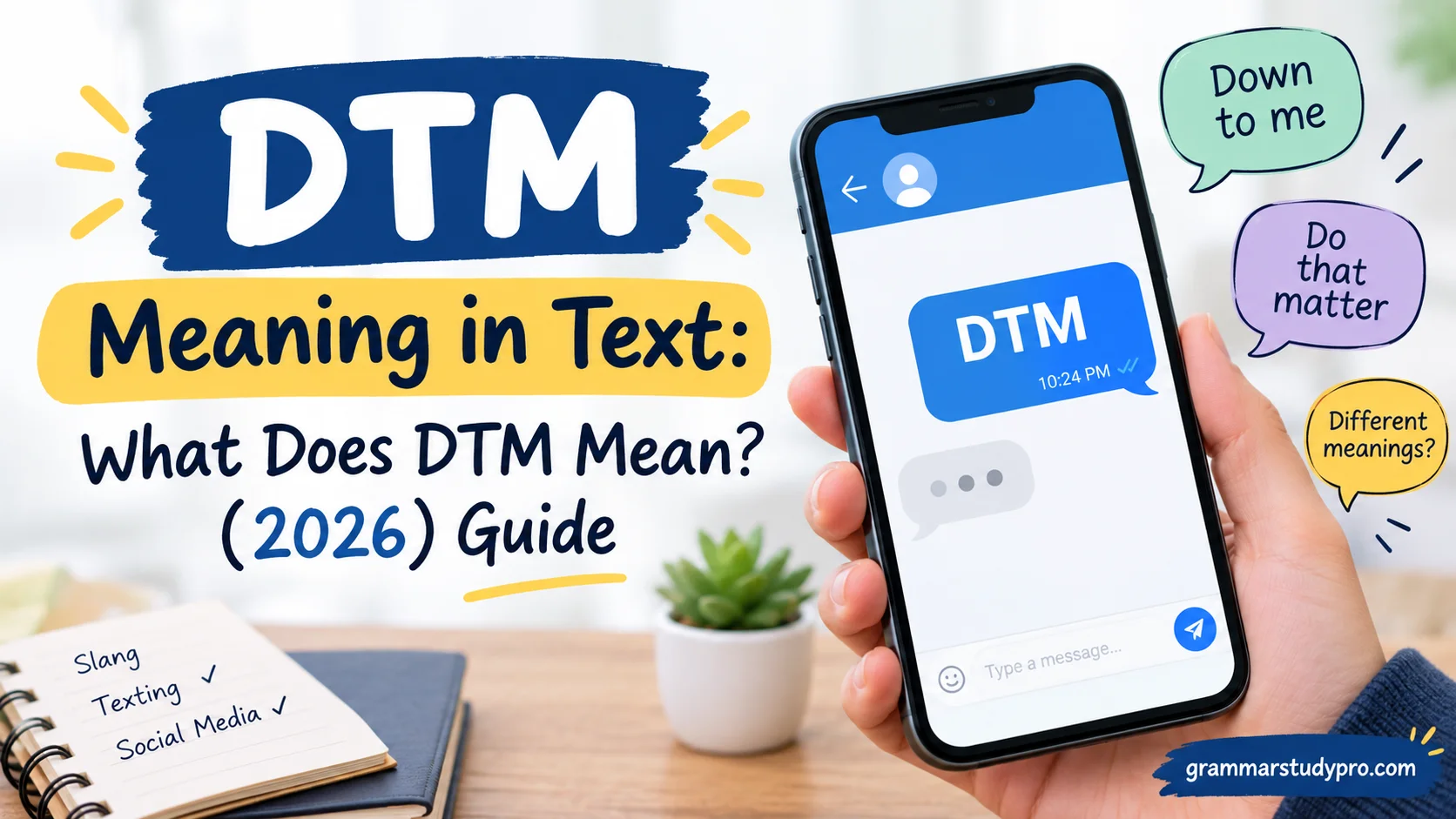
In internet slang and texting slang, DTM commonly stands for Doing Too Much. It describes someone who is overreacting, trying too hard, or creating unnecessary drama. People use it when someone’s behavior seems overly dramatic, excessive, or overly intense, especially when they are putting in more effort than the situation requires. This simple phrase is one of many internet abbreviations and short forms found in fast-moving conversations. Dictionary.com has documented this slang usage since at least 2018, reflecting the growth of slang expressions in digital conversations and online communication.
However, DTM in a text can have different meanings, depending on the context. In casual texts, casual texting, and informal communication, it can express exaggeration, annoyance, or reactions to someone’s actions. During conversations about plans, DTM may mean Down to Meet, suggesting an interest in making plans or meeting someone. These alternative meanings explain why confusing abbreviations, common abbreviations, and texting abbreviations sometimes cause misunderstandings. To interpret DTM correctly, examine the surrounding words, message context, context clues, and relationship context between the people texting. These details reveal the intended meaning, the speaker’s tone, and their communication style in a real conversation or casual conversation.
To understand what does dtm mean in text, consider how people use the abbreviation and what they are discussing. The common meanings and alternative interpretation become clearer when you examine the conversational tone, emotions, and how messages express emotions. For example, a friend might use DTM to describe someone making a small disagreement unnecessarily dramatic. Another person might use it while discussing plans, where the intended meaning fits an invitation to meet. This guide to DTM usage shows how short forms, digital language, and informal language depend on context. By considering text interpretation, message interpretation, and social interactions, you can understand which meaning fits the situation and respond naturally without giving an awkward response. Both DTM and dtm, like other slang terms, make more sense when you consider the full conversation instead of interpreting the abbreviation alone.
Quick Answer: What Does DTM Mean in Text?
DTM usually means “Doing Too Much” in casual texting and social media.
It’s used to describe someone who is overreacting, being dramatic, acting extra, trying too hard, or taking something too far. Current slang references continue to use DTM this way across texting and social platforms.
For example:
“You called him 10 times? You’re DTM 😂”
Here, DTM means “you’re doing too much.”
However, DTM can also mean “Down to Meet” when the conversation involves making plans.
“You DTM Friday?”
In that case, the sender is asking whether you’re down to meet.
So, if you want the simplest rule:
If DTM describes someone’s behavior, it probably means “Doing Too Much.” If it appears while making plans, “Down to Meet” may fit better.
What Does DTM Mean in Texting?
The most familiar slang meaning of DTM is “Doing Too Much.”
People use the phrase when someone’s actions seem excessive compared with the situation. That could mean overreacting to a small problem, making an ordinary event unnecessarily dramatic, or putting far more effort into something than expected.
Think of it as a quick way to say:
- “You’re doing too much.”
- “You’re going overboard.”
- “You’re being extra.”
- “You’re taking this too far.”
- “You’re making this bigger than it needs to be.”
The phrase doesn’t necessarily mean someone has done something wrong. Friends often use it as playful teasing.
For example, imagine someone spends three hours decorating the house for a casual movie night. A friend might text:
“Bro, you’re DTM 😂.”
The speaker probably isn’t genuinely angry. They’re joking that the preparation has become hilariously excessive.
On the other hand, DTM can sound sharper during an argument:
“Why are you DTM right now? I already apologized.”
Here, the sender probably believes the other person is continuing the argument unnecessarily.
DTM Full Form
When used as slang, the basic expansion is:
D = Doing
T = Too
M = Much
So:
DTM = Doing Too Much
The abbreviation simply compresses a familiar phrase into three letters. That’s common in digital communication, where short forms can make fast conversations easier.
What Does “Doing Too Much” Mean?
Understanding the full phrase makes DTM meaning in text much easier to recognize.
“Doing too much” describes behavior that someone considers excessive or unnecessary. The phrase can refer to actions, words, emotions, effort, or reactions.
For example, someone might be DTM if they:
- Send 15 messages after receiving no reply.
- Turn a tiny disagreement into a major argument.
- Make an elaborate production out of a simple event.
- Keep bringing up an issue after everyone else has moved on.
- Try extremely hard to impress someone.
- Overreact to a harmless joke.
- Make a simple situation unnecessarily complicated.
The key idea is excess.
It doesn’t mean the behavior is objectively excessive. That’s important. DTM usually expresses the sender’s judgment about someone’s behavior.
One person may see enthusiasm. Another may see “doing too much.”
Example
“You bought a new outfit just to grab coffee? DTM 😂”
The sender isn’t necessarily criticizing the outfit. They’re joking about the amount of effort involved.
That’s why tone and relationship matter.
DTM Meaning on Social Media
DTM appears in texts, comments, direct messages, and casual social-media conversations. Slang references specifically document its use on platforms such as TikTok, Snapchat, and other social sites.
On social media, the abbreviation often works as a quick reaction.
Someone posts an exaggerated story.
Another person comments:
“DTM 😭”
The commenter may mean:
“You’re doing way too much.”
The abbreviation is especially useful when a longer sentence would feel unnecessary. Social-media comments often favor short reactions, and DTM fits neatly into that style.
DTM on TikTok
On TikTok, DTM can function as a reaction to someone’s:
- Dramatic behavior
- Over-the-top reaction
- Excessive effort
- Elaborate outfit or presentation
- Long explanation
- Attention-grabbing behavior
For example:
“Girl you’re DTM 😭”
Depending on the video and relationship between the users, this could be teasing rather than hostile.
DTM on Instagram
On Instagram, you’ll find DTM in:
- Comments
- DMs
- Group chats
- Story replies
- Casual conversations
The meaning generally follows the same context rule. If someone is reacting to behavior, “Doing Too Much” is a strong interpretation.
DTM on Snapchat
Snapchat conversations tend to be informal, so abbreviations such as DTM can appear naturally between friends.
For example:
“Why you DTM today 😂”
That most likely means:
“Why are you doing too much today?”
DTM Meaning in Different Texting Contexts
The same abbreviation can change tone dramatically depending on the situation.
DTM Between Friends
Among friends, DTM is often playful.
Friend 1: “I made a 40-slide presentation convincing everyone to go on vacation.”
Friend 2: “You’re DTM 😭”
Nobody necessarily feels offended. The phrase simply points out the ridiculous amount of effort.
DTM During an Argument
During conflict, the same abbreviation can become more critical.
Person 1: “I already said I was sorry three times.”
Person 2: “You’re DTM.”
Here, the speaker thinks the other person is prolonging the disagreement.
The abbreviation may therefore carry more emotional weight than it would in a joke.
DTM in Dating Conversations
Dating conversations create another layer of ambiguity.
If someone says:
“You DTM 😂”
after receiving several affectionate messages, they might be teasing the other person for being overly intense.
But if someone says:
“DTM tonight?”
while discussing weekend plans, “Down to Meet” makes more sense.
Context does the heavy lifting.
DTM in Group Chats
Group chats are fertile ground for slang because people communicate quickly and casually.
One person might send a dramatic reaction. Another person replies:
“DTM bro 😭”
The intended meaning is usually that the first person is overdoing it.
DTM Meaning: “Doing Too Much” vs. “Down to Meet”
These are two meanings worth separating because both can appear in casual conversations.
| DTM meaning | What it means | Typical context | Example |
| Doing Too Much | Acting excessively or going overboard | Arguments, jokes, comments, reactions | “Why are you DTM over that?” |
| Down to Meet | Willing to meet or hang out | Plans, dating, social arrangements | “You DTM tonight?” |
The easiest way to distinguish them is to examine the grammar and topic.
If DTM describes someone’s behavior, “Doing Too Much” fits naturally:
“You’re DTM.”
If DTM appears in a question about plans, “Down to Meet” may fit:
“You DTM after work?”
Current slang references recognize both meanings. Slang.net, for example, lists “Doing Too Much” and “Down to Meet” as two uses of DTM.
There’s no need to force one definition onto every message.
How to Tell What DTM Means in a Text
When someone sends DTM without explaining it, don’t guess immediately. Look for a few simple clues.
Check the Words Around DTM
The sentence often provides the biggest clue.
“You DTM.”
This naturally reads as:
“You’re doing too much.”
Meanwhile:
“DTM Saturday?”
can naturally mean:
“Down to meet Saturday?”
The surrounding words change the interpretation.
Look at the Conversation Topic
Ask yourself what you were discussing immediately beforehand.
| Conversation topic | Likely interpretation |
| Someone’s behavior | Doing Too Much |
| An argument | Doing Too Much |
| A funny reaction | Doing Too Much |
| Making weekend plans | Down to Meet |
| Arranging a meetup | Down to Meet |
| Technical/geographic discussion | Digital Terrain Model |
That last example is important because DTM isn’t exclusively slang.
Pay Attention to Emojis
Emojis can reveal tone.
“You’re DTM 😂”
usually feels playful.
Compare that with:
“You’re DTM. Stop.”
That version sounds much more serious.
The letters haven’t changed. The punctuation and surrounding language have.
Consider Who Sent It
A close friend can call you DTM as a joke. A stranger saying the same thing may sound dismissive.
That’s why abbreviations can’t always be decoded like mathematical formulas. Human communication carries tone that isn’t contained in the letters themselves.
Is DTM Positive, Negative, or Neutral?
DTM doesn’t have one fixed emotional tone.
Most often, “Doing Too Much” is a mild criticism. However, friends can use it affectionately or humorously.
Consider these examples:
“You DTM 😂”
Playful.
“Why are you DTM over this?”
Critical.
“Bro you’re DTM 😭😭”
Likely teasing or amused.
“You’re DTM. I’m done talking.”
Much more confrontational.
The phrase can also describe something positively excessive. Some slang references note that DTM can describe going above and beyond, depending on context.
For instance, someone might jokingly call an elaborate birthday celebration “DTM” because it goes far beyond expectations.
So don’t automatically interpret DTM as an insult.
Realistic Examples of DTM in Text Messages
Examples make the distinction much easier to understand.
Example: Overreacting
Alex: “He didn’t text back for 20 minutes.”
Sam: “And you blocked him? You’re DTM.”
Meaning: You’re doing too much.
Example: Excessive Effort
Alex: “I made a 25-page document for our two-hour road trip.”
Sam: “Bro, DTM 😂”
Meaning: You’re putting way too much effort into this.
Example: Social Media
Comment: “DTM 😭”
Meaning: You’re being excessive or over-the-top.
Example: Making Plans
Alex: “DTM Friday?”
Sam: “Yeah, after 7.”
Meaning: Are you down to meet Friday?
Example: Playful Dating Conversation
Alex: “I sent you six good morning texts.”
Sam: “You’re DTM 😂”
Meaning: You’re being a little over-the-top.
The surrounding conversation changes the meaning. That’s the central lesson.
A Quick Case Study: Why Context Changes DTM
Imagine receiving this message:
“You DTM.”
You can’t confidently interpret the abbreviation from those three words alone.
Now consider three different conversations.
Conversation A — Argument
“You brought up the same mistake five times.”
“You DTM.”
Here, Doing Too Much clearly fits.
Conversation B — Weekend Plans
“I’m free Saturday.”
“You DTM?”
Here, Down to Meet becomes a plausible interpretation.
Conversation C — Geography Class
“We need the bare-earth elevation data for this project.”
“Use the DTM.”
Now we’re no longer dealing with texting slang. We’re talking about a Digital Terrain Model.
The letters stayed identical. The context changed completely.
DTM as a Technical Term: Digital Terrain Model
Outside texting slang, DTM can mean “Digital Terrain Model.”
In geographic information systems, surveying, mapping, and elevation analysis, the term describes digital information representing terrain.
The exact technical definition varies somewhat by country and data convention. The U.S. Geological Survey notes that some countries use DTM as essentially synonymous with digital elevation models. In U.S. usage, USGS describes a DTM as a vector dataset using three-dimensional breaklines and mass points to characterize bare-earth terrain.
USGS also distinguishes terrain models from surface models because vegetation and structures can affect what an elevation dataset represents.
In simple terms:
A DTM helps represent the shape and elevation of the ground itself.
That meaning belongs to a technical conversation, not an ordinary Snapchat message.
USGS: “A digital terrain model (DTM)” can characterize the shape of “bare-earth terrain.”
So if someone in a GIS class says, “Open the DTM,” don’t interpret it as slang.
Other Meanings of DTM
DTM can have additional meanings in specialized communities. The important point is that not every DTM definition belongs to texting slang.
Some current slang references list additional informal expansions such as “Dead to Me” or “Don’t Text Me.” These uses are much more dependent on the specific community and conversation than the established “Doing Too Much” slang use.
That’s why a dictionary-style list of every possible expansion isn’t always helpful.
A better approach is to ask:
What was the person talking about?
If they were arguing with you, the intended phrase could be very different from a message about meeting Friday night.
DTM vs. Similar Texting Abbreviations
DTM can become easier to understand when you compare it with other common texting shortcuts.
| Abbreviation | Meaning | Common use |
| DTM | Doing Too Much | Calling out excessive behavior |
| DM | Direct Message | Private social-media message |
| ATM | At the Moment | Describing the current situation |
| FR | For Real | Agreement or emphasis |
| NGL | Not Gonna Lie | Introducing an honest opinion |
| TBH | To Be Honest | Giving an opinion |
| IDK | I Don’t Know | Expressing uncertainty |
| BTW | By the Way | Adding another point |
Don’t let the three-letter format fool you. These abbreviations can look interchangeable at a glance, yet they perform completely different jobs.
Is DTM Formal or Informal?
DTM is informal when used as texting slang.
It’s appropriate for casual conversations where everyone understands the shorthand.
That can include:
- Text messages
- Group chats
- Social-media comments
- DMs
- Casual online communities
- Conversations between friends
It’s generally better to avoid slang abbreviations such as DTM in:
- Business emails
- Academic assignments
- Job applications
- Formal reports
- Official correspondence
- Professional documents
If clarity matters, write the full phrase.
Instead of:
“Are you DTM tomorrow?”
write:
“Are you available to meet tomorrow?”
And instead of:
“You’re DTM.”
you can write:
“You’re doing too much.”
The longer version removes ambiguity.
How to Respond When Someone Says “DTM”
Your response depends on what they mean.
If DTM Means “Doing Too Much”
You could respond casually:
- “What did I do? 😂”
- “How am I doing too much?”
- “Okay, fair enough.”
- “I’m just having fun.”
- “My bad, I got carried away.”
If they’re clearly joking, matching their tone usually works.
If DTM Means “Down to Meet”
The response becomes much more straightforward:
- “Yeah, what time?”
- “Sure, where?”
- “I can meet after 7.”
- “Not tonight. Maybe tomorrow?”
When the conversation involves plans, don’t overthink it.
Common Mistakes When Interpreting DTM
A few mistakes can turn a simple text into an unnecessarily confusing exchange.
Assuming DTM Always Means One Thing
This is the biggest mistake.
“You DTM” and “DTM tonight?” can mean completely different things.
Ignoring the Conversation
The message before DTM often contains the answer.
If someone was complaining about your reaction, “Doing Too Much” makes sense. If they were arranging dinner, “Down to Meet” may make more sense.
Assuming DTM Is Always Negative
Not necessarily.
Among friends, DTM can be playful teasing. Tone matters.
Using DTM in Formal Writing
Slang belongs in casual communication. Formal writing usually benefits from the full phrase.
Treating Every Online Definition as Universal
Internet slang doesn’t work like a legal dictionary.
Different communities can use the same abbreviation differently. Current references themselves show variation in the meanings associated with DTM.
FAQs
What does DTM mean in text messages?
DTM usually means “Doing Too Much.” People use it when someone is overreacting, acting dramatically, or trying harder than necessary in a situation.
Can DTM mean Down to Meet?
Yes, DTM can mean “Down to Meet” when people discuss plans. It suggests that someone is willing or interested in meeting another person.
Is DTM slang used on social media?
Yes, DTM is common in casual texting, online conversations, and social media posts. People use it to react to someone’s behavior or express an opinion quickly.
How can I tell which meaning of DTM someone intends?
Look at the surrounding words, tone, and context. If someone is criticizing dramatic behavior, DTM probably means “Doing Too Much.” If they are discussing plans, it may mean “Down to Meet.”
Is DTM appropriate for formal conversations?
DTM is informal internet slang, so it is generally better suited to messages with friends and casual social media conversations. In professional settings, use the full phrase to avoid confusion.
Conclusion
Understanding DTM Meaning in Text is easier when you consider the conversation instead of focusing on the abbreviation alone. Although “Doing Too Much” is a common meaning, “Down to Meet” can also make sense when people discuss plans. Pay attention to the context, tone, and surrounding words to understand the intended message. Once you recognize these differences, you’ll find it easier to interpret DTM and respond naturally in everyday digital conversations.