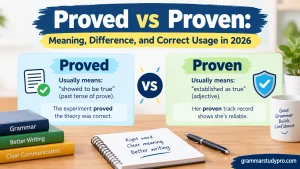
Proved vs Proven explains how two forms of the verb prove work differently in English sentences, helping you choose the correct word for your writing.
When you compare proved and proven, focus on their grammatical purpose, role, and context. Proved is the regular past tense, as in “She proved the claim,” and it also works as a past participle after auxiliaries, such as “has proved.” Meanwhile, proven often acts as an adjective that modifies a noun, as in “A proven method saves time.” It describes something reliable, effective, or established. These correct forms appear in books, news articles, academic papers, and everyday conversations. Understanding their grammatical roles, verb forms, and parts of speech improves your word choice and writing skills. British English often favors “has proved” in conservative British prose, while many American writers accept “has proven” in American contexts. This language variation is a normal part of English usage, so neither form is always wrong.
A few Quick tests make this grammar comparison easier. Use the adjective test when the word appears before a noun: “a proven record” or “a proven technique.” The auxiliary test helps you choose between “has proved” and “has proven” after have or another auxiliary verb. Your audience, dialect, and writing style can influence that choice. For example, “She (pronoun) proved (verb past) the theory (noun)” and “The theory was proved” or “The theory was proven” are all understandable expressions. However, grammatical context, adjective placement, and tense distinction affect your choice. Check agreement, sentence structure, verb agreement, and grammatical consistency when editing a school assignment, professional report, or piece of academic writing. Follow your audience expectations and maintain consistency throughout the piece. If you need greater clarity, choose a plain alternative such as “was shown” or “demonstrated.” These expressions can communicate your meaning without unnecessary second-guessing.
Strong learning habits help you remember grammar rules and usage rules. Keep a notebook near your desk, jot down useful grammar tips, and save reference notes you can refer to when needed. Repetition, practical examples, and note-taking make difficult language points easier to remember. If you have a colander-type brain, information may seem to seep out through little holes, making you look up the same rule over and over and wonder why it will not stick. Think of a starchy noodle sticking to a colander: a helpful reminder can keep the lesson in your memory. These weekly grammar tips improve learning, rule retention, and information retention while reducing forgetfulness. Build better study habits, strengthen language learning, and work toward writing improvement by the end of the year. Understanding the difference between proved and proven helps you apply the right form in formal writing, everyday messages, and other forms of written communication. With practice, your grammar knowledge, writing accuracy, editorial accuracy, and precision can improve, helping you produce clearer sentences and more precise writing.
Quick Answer:
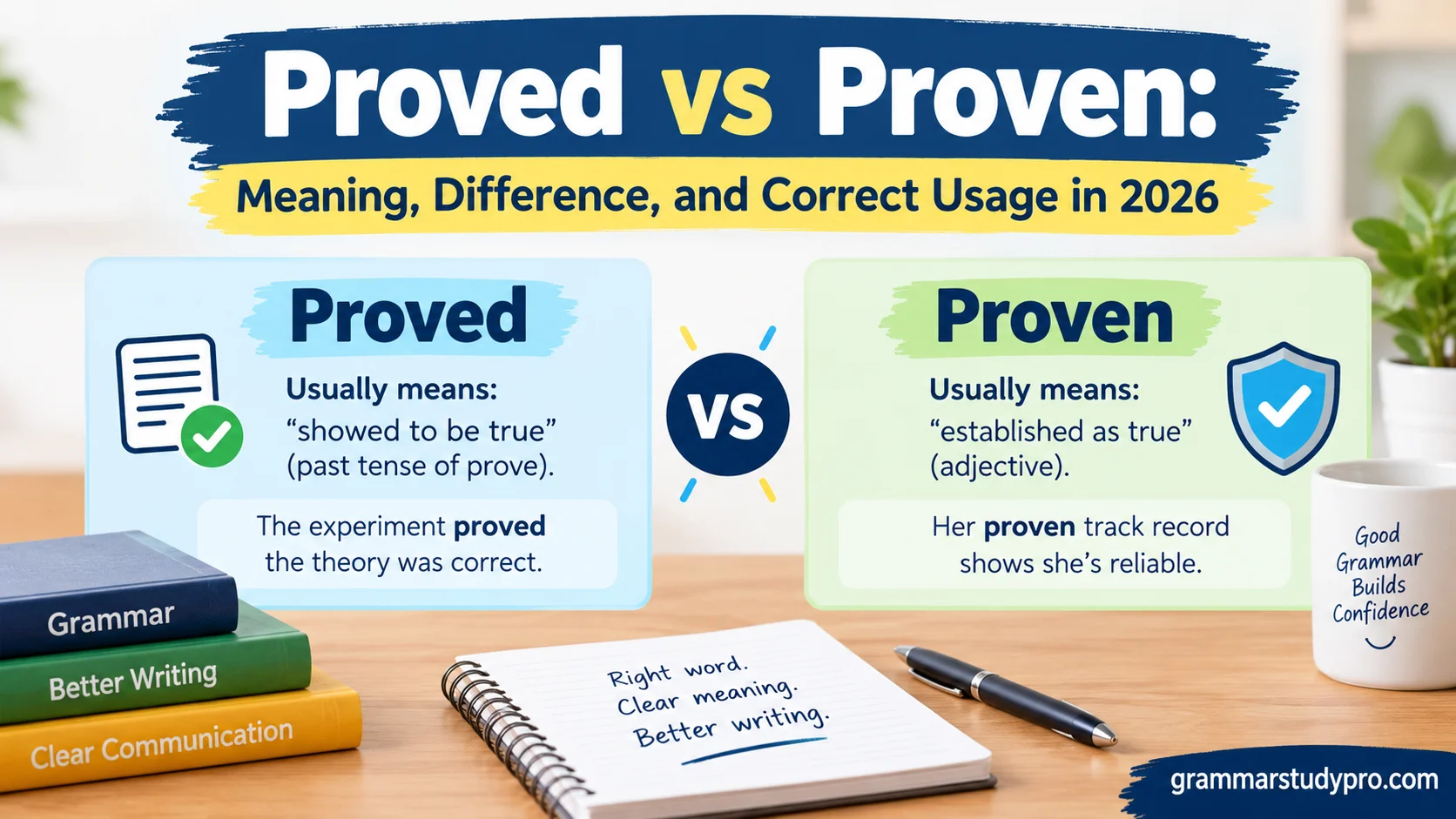
Proved is the simple past tense of prove. Proven is an accepted past participle and a common adjective. Both proved and proven can work as past participles in perfect tenses and passive constructions.
Here are three quick examples:
- Proved: The experiment proved that the original theory was incorrect.
- Proven: The company uses a proven method to improve customer service.
- Both are correct: The new system has proved effective. / The new system has proven effective.
Notice how the meaning stays almost identical in the final pair. The choice depends on grammatical structure, regional preference, and writing style rather than a strict difference in meaning.
Use this simple guide:
| If you want to… | Preferred choice | Example |
| Describe a completed past action | Proved | The evidence proved her point. |
| Describe an established method | Proven | This is a proven technique. |
| Use a past participle after has, have, or had | Either | The approach has proved/proven successful. |
| Use the familiar expression about legal innocence | Proven | Everyone is innocent until proven guilty. |
The easiest rule to remember: Use proved for the simple past tense and proven when an adjective fits naturally. For other past-participle constructions, either form may work.
Comparison Overview: Proved vs Proven
Although these words share the same root and often communicate the same idea, their grammatical roles explain why writers sometimes prefer one over the other.
| Feature | Proved | Proven |
| Base verb | Prove | Prove |
| Simple past tense | Yes | No |
| Past participle | Yes | Yes |
| Adjective | Possible, but less common | Very common |
| General meaning | Demonstrated or established something | Established as true, effective, or reliable |
| Perfect tense | The research has proved useful. | The research has proven useful. |
| Before a noun | A result proved by testing | A proven result |
| American English | Standard | Standard |
| British English | Standard and common as a verb form | Accepted, especially as an adjective |
The key distinction involves grammar rather than a completely different meaning. Both forms can describe something that evidence has established.
For example, consider these sentences:
- The investigation proved that the records were inaccurate.
- The investigation has proven that the records were inaccurate.
- The investigation produced a proven explanation for the discrepancy.
The first sentence uses the simple past tense. The second uses a past participle after has. The third uses proven as an adjective.
All three sentences are grammatical, although the best choice may depend on the surrounding text and your preferred style guide.
Main Differences Between Proved and Proven
Meaning of Proved
Proved is the simple past tense of prove. It describes an action that demonstrated something to be true, established a fact, or showed that an idea was incorrect.
You can use it when discussing evidence, experiments, arguments, personal achievements, and everyday situations.
For example:
- The witness proved that he had been at home.
- The experiment proved the researchers’ original prediction wrong.
- She proved her ability to manage a difficult project.
- The results proved that the first calculation contained an error.
In each sentence, proved describes something that happened in the past. The word focuses on the act of demonstrating or establishing a point.
However, proved doesn’t always mean that someone established an absolute truth beyond every possible doubt. Its precise strength depends on the context.
A mathematical proof can establish a theorem within a defined system. A scientific experiment, on the other hand, may support a hypothesis without proving it universally true. Good writing reflects that distinction.
Example in context:
“The trial proved that the new process reduced production time.”
This sentence tells readers that the trial established a result. If the evidence only suggested a possible improvement, however, indicated or suggested might be more accurate.
Meaning of Proven
Proven is a past participle of prove that also commonly functions as an adjective. Writers often use it to describe something that has demonstrated its effectiveness, reliability, or truth.
You’ll frequently see proven in professional writing, advertising, education, science, and everyday expressions.
Examples include:
- The business follows a proven strategy for managing inventory.
- She has a proven record of delivering projects on time.
- The researchers tested a proven method for measuring temperature.
- His proven leadership skills helped the team finish the project.
As an adjective, proven usually tells readers that someone has tested, demonstrated, or established something successfully.
For instance, a proven method is a method with evidence supporting its effectiveness. A proven track record refers to a history of demonstrated performance or achievement.
However, context still matters. A company shouldn’t call a strategy proven merely because it sounds promising. The claim should rest on relevant evidence or demonstrated results.
Example in context:
“The organization adopted a proven approach to employee training.”
Here, proven describes the approach. It suggests that the method has demonstrated its value through experience, testing, or results.
Grammatical Difference Between Proved and Proven
To understand proved vs proven, you need to distinguish three grammatical terms: simple past tense, past participle, and adjective.
The simple past describes an action that occurred in the past. A past participle works with auxiliary verbs in perfect tenses and passive constructions. An adjective describes a quality or characteristic.
Consider the following examples:
| Grammatical role | Example | Explanation |
| Simple past | The test proved the theory wrong. | Proved describes a completed past action. |
| Past participle | The test has proved the theory wrong. | Proved follows the auxiliary verb has. |
| Past participle | The test has proven the theory wrong. | Proven also works after has. |
| Adjective | The test used a proven technique. | Proven describes the technique. |
The first distinction is straightforward: proved is the standard simple past form. You wouldn’t normally write “Yesterday, the experiment proven the theory wrong.”
The other constructions offer more flexibility. Both “has proved” and “has proven” are accepted forms of the present perfect tense.
The same flexibility appears in passive constructions:
- The claim was proved by the available evidence.
- The claim was proven by the available evidence.
Both sentences are grammatical. Writers may prefer one form for stylistic or regional reasons.
Remember that proven isn’t simply an adjective, and proved isn’t limited to the simple past tense. Each form has more than one grammatical use.
Proved vs Proven in American English
American English accepts both proved and proven. However, proven is especially familiar in adjective phrases and many perfect-tense constructions.
For example, American readers regularly encounter expressions such as:
- A proven strategy
- A proven solution
- Proven results
- A proven track record
- Innocent until proven guilty
These expressions are natural and widely understood. You don’t need to replace proven with proved just to make your writing grammatically correct.
At the same time, American English uses proved as the simple past tense and as a past participle.
Consider these examples:
- The audit proved that the figures were inaccurate.
- The new equipment has proved useful.
- The new equipment has proven useful.
All three are acceptable. In the last two sentences, the difference reflects usage preference rather than a change in the underlying message.
For academic and professional writing, follow the style guide required by your school, employer, journal, or publisher. Consistency matters more than choosing one form as universally superior.
Proved vs Proven in British English
British English also recognizes both forms. However, proved is often favored as a verb form in British usage, while proven remains well established as an adjective.
For example:
- The investigation proved the allegation false.
- The new approach has proved effective.
- The organization introduced a proven approach to staff training.
The final sentence uses proven naturally as an adjective. British writers don’t need to avoid it.
These patterns describe general tendencies, not strict boundaries between British and American English. Individual writers, publishers, and subject areas may follow different conventions.
If you’re writing for a British publication, check its editorial preferences before standardizing every past participle as proved. If you’re writing for an American audience, the same principle applies.
The practical lesson is simple: both forms are accepted in both varieties of English. Grammar, context, and editorial consistency should guide your choice.
When to Use Proved
Use Proved for Completed Past Actions
When you describe something that happened and established a result in the past, proved is the natural choice.
Examples:
- The teacher proved that the answer was incorrect.
- The investigation proved the report unreliable.
- His performance proved that he was ready for promotion.
- The final calculation proved the original estimate inaccurate.
These sentences focus on an action that occurred in the past. Because proved is the simple past tense, it fits directly without a helping verb.
A useful test is to add a specific past-time expression. If your sentence describes what happened yesterday, last week, or during a completed experiment, proved will often be the correct choice.
For example:
“Last month, the audit proved that several invoices contained errors.”
Here, proved directly describes the completed action. Using proven in the same simple past construction would be nonstandard.
Use Proved After Has, Have, or Had
You can use proved as a past participle after auxiliary verbs such as has, have, and had.
Examples:
- The new schedule has proved effective.
- Her experience has proved valuable.
- The team had proved its ability before the championship began.
- The evidence has proved useful to investigators.
These sentences use perfect tenses. The auxiliary verb helps establish the relationship between the action and another point in time.
Importantly, proved isn’t restricted to the simple past tense. This is one of the most common misconceptions about the word.
You can also write:
- The new schedule has proven effective.
- Her experience has proven valuable.
- The team had proven its ability before the championship began.
The alternative form proven works in these examples, too. Choose the form that suits your audience and maintains consistency throughout the document.
Use Proved in Formal or Editorial Writing
Some writers and editors prefer proved as the past participle because it follows the regular pattern used by many English verbs.
For example:
- The findings have proved significant.
- The new procedure has proved reliable.
- The evidence had proved insufficient for the conclusion.
This preference can make a document consistent with a particular publication’s house style. However, it doesn’t establish that proven is grammatically wrong.
If your organization specifies proved in its editorial guidelines, follow that rule. Otherwise, both forms are available for appropriate past-participle constructions.
When to Use Proven
Use Proven as an Adjective
The adjective proven is particularly common when describing something that has demonstrated its value, reliability, or effectiveness.
Here are some common combinations:
| Expression | Meaning | Example |
| Proven method | An approach with demonstrated results | We used a proven method to check the data. |
| Proven ability | A demonstrated skill or capacity | She has proven ability in project management. |
| Proven strategy | An approach supported by successful results | The business adopted a proven strategy. |
| Proven track record | A history of demonstrated performance | The candidate has a proven track record of success. |
| Proven solution | A solution shown to work in relevant circumstances | The team selected a proven solution to the problem. |
These expressions appear frequently in resumes, business reports, marketing materials, and professional recommendations.
For instance, a hiring manager might write, “We need someone with a proven ability to lead a team.” The adjective emphasizes demonstrated ability rather than a promise or an untested claim.
Still, be careful with broad claims. A method that works in one setting may not work equally well in another. The word proven should reflect the available evidence.
Use Proven in Perfect-Tense Constructions
Although many people associate proven with adjectives, it also works as a past participle.
Examples:
- The new policy has proven successful.
- Their research has proven valuable.
- The revised design has proven more durable than the original.
- She has proven that she can handle the responsibility.
In each sentence, proven appears in a verb construction rather than functioning solely as an adjective before a noun.
You can often substitute proved without changing the basic meaning:
- The new policy has proved successful.
- Their research has proved valuable.
- The revised design has proved more durable than the original.
- She has proved that she can handle the responsibility.
The choice depends on the writer’s preferred usage and the publication’s style. Both forms are accepted.
Use Proven in Familiar Expressions
Certain expressions have become firmly established in everyday English. One prominent example is “innocent until proven guilty.”
The phrase reflects the principle that a person should be treated as innocent unless guilt is established through the applicable legal process.
Other common expressions include:
- A proven method
- Proven results
- A proven track record
- A proven ability
- A proven remedy
These phrases sound natural because English speakers commonly use proven to describe established results or demonstrated qualities.
However, familiar wording doesn’t mean the adjective guarantees success in every situation. A proven technique can still fail when conditions change or someone applies it incorrectly.
Proved vs Proven Example Sentences
Seeing these words in different settings makes the distinction easier to remember. The following examples demonstrate their use in everyday, academic, professional, and legal writing.
Proved vs Proven in Everyday Conversation
Everyday conversations often describe personal experiences, discoveries, and decisions.
- The rain proved that we should have brought umbrellas.
- She proved her point during the discussion.
- His actions have proven that he can be trusted.
- The shortcut proved slower than the main road.
- Their friendship has proved stronger than either expected.
Notice that proved often describes a result discovered through experience. Proven works naturally in the present perfect and in descriptions of established qualities.
Proved vs Proven in Academic and Scientific Writing
Academic writing requires particular care because the strength of a claim must match the evidence.
Examples include:
- The calculation proved that the proposed solution was mathematically incorrect.
- The experiment proved useful for identifying measurement errors.
- The researchers have proven the theorem under the stated assumptions.
- The findings have proved valuable for further investigation.
Mathematics and empirical science don’t always use the word prove in the same way. A mathematical proof establishes a conclusion through valid logical steps within a formal framework. Scientific experiments generally provide evidence supporting or challenging hypotheses.
For that reason, scientific writers often prefer words such as supports, suggests, or provides evidence for when the results don’t establish a universal conclusion.
Writing tip: Choose proved or proven according to grammar, but choose proved, demonstrated, or supported according to what the evidence actually establishes.
Proved vs Proven in Business Writing
In business communication, proven frequently describes reliable processes, established skills, and successful approaches.
Examples:
- The company proved its ability to meet the delivery deadline.
- The revised process has proven effective at reducing errors.
- The manager has a proven track record of leading successful projects.
- The team proved that the proposed budget was realistic.
These examples highlight a useful distinction. Proved often narrates what a person or organization demonstrated. Proven often describes an approach or capability supported by experience.
However, both forms can appear in either type of sentence. The surrounding grammar determines which construction fits.
Proved vs Proven in Legal and News Writing
Legal writing uses proved and proven when discussing evidence, allegations, and findings. Writers must also distinguish allegations from established facts.
Examples:
- The evidence proved that the document had been altered.
- The court found that the allegation had been proven.
- The report showed that the original account was inaccurate.
- The defendant was presumed innocent unless guilt was established through the applicable legal process.
The familiar phrase “innocent until proven guilty” uses proven as a past participle in a passive construction.
Important distinction: An allegation isn’t automatically proven because someone reports it or presents a piece of evidence. In legal writing, describe findings accurately and avoid implying that a claim has been established when it remains disputed.
Common Mistakes to Avoid With Proved and Proven
Mistake: Assuming Proven Is Always Incorrect
Some writers believe proven is an informal substitute that should never appear in formal English. That belief is incorrect.
Both forms are accepted past participles. For example:
- Correct: The new treatment has proven effective in the studied population.
- Also correct: The new treatment has proved effective in the studied population.
The best choice depends on the intended meaning, the evidence, and the style of the publication.
Mistake: Using Proven as the Simple Past Tense
The simple past tense is proved, not proven.
Incorrect: Yesterday, the experiment proven the hypothesis.
Correct: Yesterday, the experiment proved the hypothesis.
The word yesterday identifies a completed past event. In that construction, the standard verb form is proved.
Remember that proven can still appear in a sentence about the past when the grammar calls for a past participle or adjective.
Mistake: Thinking Proven Only Works Before Nouns
Although proven commonly appears before nouns, it can also function as a past participle after a helping verb.
For example:
- The strategy has proven effective.
- Their approach has proven successful.
- The evidence had proven insufficient.
These sentences are grammatical. You don’t need to place a noun immediately after proven.
Mistake: Treating Regional Preferences as Absolute Rules
American and British English both accept proved and proven. Their usage patterns can differ, but neither variety reserves one form exclusively for all formal writing.
For example, an editor might prefer “has proved useful,” while another accepts “has proven useful.” Both can be correct.
The solution is straightforward: follow the relevant style guide and avoid switching forms without a reason.
Mistake: Confusing Proven With Proof
Proven and proof come from the same word family, but they perform different grammatical jobs.
- Proven: The company uses a proven system.
- Proof: The company supplied proof of the system’s effectiveness.
- Proved: The company proved that the system worked.
Use proven as an adjective or past participle, proof as a noun, and proved as a verb form when the sentence requires it.
Proved vs Proven vs Prove vs Proof
Understanding the entire word family helps prevent additional grammar mistakes.
| Word | Part of speech | Function | Example |
| Prove | Verb, base form | To demonstrate that something is true | We must prove the claim. |
| Proved | Simple past and past participle | Describes an action or a completed demonstration | She proved her point. |
| Proven | Past participle and adjective | Describes something established or demonstrated | This is a proven technique. |
| Proof | Noun | Evidence or information that establishes something | The results provide proof of the claim. |
How to Use Prove
Use prove for the base form of the verb, including after modal verbs such as can, will, and must.
Examples:
- We need to prove that the calculation is correct.
- The next experiment may prove the theory wrong.
- She will prove her ability through her work.
How to Use Proof
Use proof when referring to evidence or confirmation rather than the action of demonstrating something.
Examples:
- The investigators found proof of the error.
- Do you have proof that the payment was made?
- The document provided proof of ownership.
A useful reminder is that prove describes an action, proved and proven are verb forms, and proof names the evidence or confirmation.
Is Proved or Proven More Correct?
Neither form is universally more correct. The right choice depends on the grammatical role of the word.
Use proved when:
- You need the simple past tense.
- You describe a completed action that established a result.
- Your style guide prefers proved as the past participle.
Use proven when:
- You need an adjective describing an established quality or result.
- You’re using a familiar phrase such as proven method or proven track record.
- You prefer it as the past participle in a construction such as has proven effective.
When comparing “has proved” with “has proven,” don’t assume that one is grammatically correct and the other isn’t. Both are accepted.
The same principle applies to “was proved” and “was proven.” Both forms work in passive constructions.
Ultimately, grammar determines which forms are possible, while context and style help you choose between accepted alternatives.
FAQs
1. Is it proved or proven?
Both proved and proven are correct forms of the verb prove. Use proved for the simple past tense, as in “She proved her point.” Use proven as an adjective, as in “a proven method.” Both forms can also work as past participles.
2. Is “has proved” or “has proven” correct?
Both expressions are grammatically correct. Has proved is common in British English, while has proven is widely accepted in American English. Choose the form that fits your audience and maintain consistency throughout your writing.
3. Should I use proved or proven in formal writing?
You can use either form in formal writing, depending on the sentence and your preferred style. Proven often works well before a noun, as in “a proven strategy.” Proved frequently appears when describing a completed action, as in “The researcher proved the theory.”
4. Is proven an adjective or a verb?
Proven can function as both an adjective and a past participle. In “a proven technique,” it describes the noun technique. In “Scientists have proven the result,” it forms part of the verb phrase.
5. Is “the theory was proved” or “the theory was proven” correct?
Both sentences are correct. The choice often depends on regional preference and writing style. British writers may prefer “the theory was proved,” while American writers commonly use both expressions.
Conclusion
Understanding Proved vs Proven helps you make clearer and more confident word choices. Remember that proved is the regular simple past tense, while proven often serves as an adjective describing something reliable or established. Both can function as past participles, too. Consider your sentence, audience, and preferred variety of English before choosing a form. With regular practice, you can use both words naturally in academic assignments, professional reports, and everyday writing.