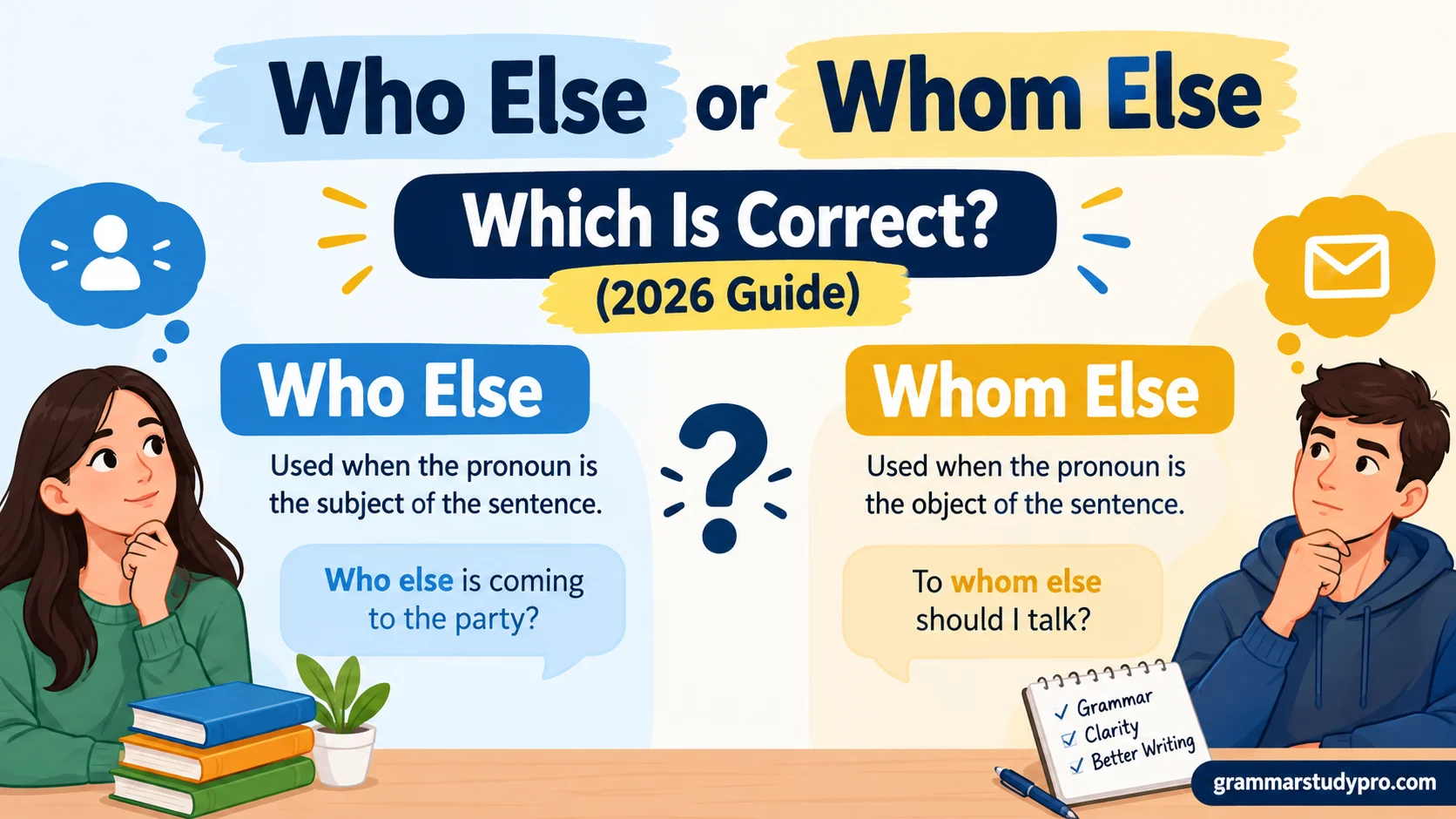
Learn Who Else or Whom Else with simple examples to understand subject and object pronouns, correct grammar, and everyday English usage with confidence.
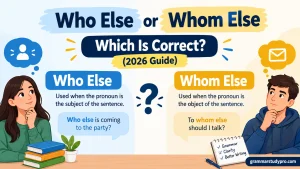
Who Else or Whom Else can confuse English learners, confident writers, and even native English speakers, but a few simple rules make the difference easier to understand. In English grammar, who acts as a subject pronoun for someone performing an action, while whom acts as an object pronoun for someone who receives the action. These relative pronouns have different grammatical functions, subject roles, and object roles.
In modern English, everyday English, and conversational English, people strongly prefer who else in most situations, while whom else remains useful in formal writing, professional emails, and contexts requiring strict grammatical precision. For example, “Who else is coming to the meeting?” uses who as the subject, while “Whom else did you invite?”
uses whom as the object of the verb. Understanding sentence structure, parts of speech, traditional grammar, and standard English helps you choose the correct phrase. When you feel confusion or hesitation while writing, try replacing the pronoun with “he” or “him.” If “he” fits, use who; if “him” fits, use whom. This practical grammar rule improves correct usage, grammatical correctness, clarity, and accuracy. With regular practice, usage examples, and better grammar learning, you can strengthen your writing skills, language skills, and communication skills and gain grammatical confidence in both formal contexts and informal contexts.
Quick Answer:
Both “who else” and “whom else” are grammatically correct, but the appropriate choice depends on the pronoun’s role in the sentence and the level of formality.
- Who else traditionally serves as the subject of a sentence. Example: “Who else wants to participate?”
- Whom else traditionally serves as an object of a verb or preposition. Example: “Whom else did you invite?”
- Who else is common in everyday American English, including many questions where traditional grammar would use whom.
- Whom else is more common in formal constructions, especially when it follows a preposition directly. Example: “To whom else should I send the letter?”
Here’s a simple rule to remember: Use who when the pronoun acts as the subject. Use whom when traditional grammar requires an object pronoun. In ordinary conversation, however, who is widely accepted in object questions.
Comparison Overview
Although both phrases ask about another person or group, they differ in their traditional grammatical function and typical usage.
| Feature | Who else | Whom else |
| Basic meaning | Which other person or people | Which other person or people |
| Traditional grammatical role | Subject | Object |
| Everyday American English | Very common | Less common |
| Formal writing | Appropriate when grammatically suitable | Appropriate in traditional object constructions |
| Example with a subject | Who else is coming? | Not appropriate in this construction |
| Example with a verb object | Who else did you invite? (common modern usage) | Whom else did you invite? (traditional usage) |
| Example after a preposition | Who else should I speak to? (conversational) | To whom else should I speak? (formal) |
| General tone | Natural and conversational | Often formal or traditional |
The key point is that the word else doesn’t determine whether you should use who or whom. Instead, the pronoun’s grammatical function determines the traditional choice.
For example, “Who else called?” and “Whom else did you call?” use different pronouns because the sentence structures differ. The first asks about the person making the call. The second asks about the person receiving it.
Main Differences Between Who Else and Whom Else
Understanding the grammatical roles of who and whom is the easiest way to distinguish these expressions. Let’s examine the rules with practical examples.
Who Else Is Used as a Subject
A subject performs an action or occupies the grammatical position that the sentence describes. In a question, who commonly asks which person performs an action or has a particular quality.
Consider these examples:
- Who else called this morning? The person identified by the question performs the action of calling.
- Who else wants a copy? The person identified by the question wants something.
- Who else is attending the meeting? The pronoun identifies another person who is attending.
- Who else knows the answer? The pronoun identifies someone who possesses the knowledge.
- Who else was selected for the team? The pronoun functions as the subject of the passive construction was selected.
In each sentence, who else asks about an additional person or additional people. The word else expands the question beyond someone already mentioned or understood.
Suppose your manager says that Maria and James will attend a meeting. You might ask, “Who else is attending?” You’re asking which additional people will be there.
The same rule applies when you use who else in statements or indirect questions:
- I wonder who else knows about the announcement.
- Tell me who else plans to attend.
- We need to find out who else is available.
In these examples, who else remains the subject of its own clause, even though the entire sentence has a different structure.
Whom Else Is Used as an Object
An object receives the action of a verb or follows a preposition. Traditional English grammar uses whom when the pronoun occupies an object position.
For example:
- Whom else did you invite? You performed the action of inviting, and the person identified by the question receives that action.
- Whom else did the committee interview? The committee interviewed the person being asked about.
- Whom else have you contacted? The pronoun is the object of contacted.
- To whom else should I send the report? The pronoun follows the preposition to.
- With whom else did she collaborate? The pronoun follows the preposition with.
The distinction becomes clearer when you compare the roles of the people involved.
In “Who else invited you?” the person asked about performed the action of inviting. In “Whom else did you invite?” the person asked about received the invitation.
The sentences may contain similar words, but their grammatical relationships differ.
Remember: Traditional grammar distinguishes the person performing the action from the person receiving it. That’s why who and whom aren’t always interchangeable in formal writing.
Why Modern English Often Uses Who for Objects
Here’s where everyday English differs from the traditional classroom rule. Many English speakers use who instead of whom in object questions, particularly when the pronoun appears at the beginning of a sentence.
For example:
- “Who else did you invite?”
- “Who else should we contact?”
- “Who else have you told?”
- “Who else are you waiting for?”
These constructions are natural and widely used in contemporary American English. They don’t automatically become unacceptable because who functions as an object.
Compare the following pairs:
| Traditional object form | Common modern form |
| Whom else did you invite? | Who else did you invite? |
| Whom else should we contact? | Who else should we contact? |
| For whom else did you prepare a seat? | Who else did you prepare a seat for? |
| With whom else did you travel? | Who else did you travel with? |
The first column follows traditional object-pronoun usage. The second column reflects common contemporary English, especially in conversation and less formal writing.
Notice that the final pair also changes the position of the preposition. Formal English often places a preposition before whom, while conversational English commonly places it at the end of the question.
Neither style is automatically better in every situation. Choose the form that suits your audience, sentence structure, and writing style.
How the Word Else Affects Meaning
The word else means something like “additional,” “other,” or “besides the person or people already considered.” It doesn’t change the basic subject-object rule.
Consider these examples:
- Who else wants coffee? Which additional person wants coffee?
- Whom else did you ask? Which additional person did you ask?
- To whom else should we send the invitation? Which other person should receive the invitation?
You can often remove else without changing the underlying grammatical role:
- Who wants coffee?
- Whom did you ask?
- To whom should we send the invitation?
Because the pronoun’s role remains the same, the traditional choice remains the same too.
How to Choose Between Who Else and Whom Else
You can usually choose the right phrase by examining the sentence rather than relying on how formal it sounds. Three practical checks can help you make the decision.
Use the He/Him Test
The he/him test is a traditional grammar trick for distinguishing who from whom. Replace the pronoun with a personal pronoun and see which form fits the sentence.
- If he, she, or they fits the subject position, traditional grammar favors who.
- If him, her, or them fits the object position, traditional grammar favors whom.
Here’s how the test works in practice.
Example: Who else is waiting?
Answer: He is waiting.
Because he fits, the traditional choice is who else.
Example: Whom else did you invite?
Answer: You invited him.
Because him fits the object position, traditional grammar favors whom else.
Example: To whom else did you speak?
Answer: You spoke to him.
The pronoun follows the preposition to, so whom is the traditional choice.
This test is especially useful when you’re editing formal writing or checking a sentence for traditional grammatical accuracy.
However, don’t apply it too rigidly to ordinary conversation. Even when the test points toward whom, modern English often uses who in questions such as “Who else did you invite?”
Check Whether a Preposition Comes Before the Pronoun
Prepositions provide another useful clue. Words such as to, with, for, and about can introduce phrases that contain an object.
In formal English, whom usually follows a preposition directly.
Examples include:
- To whom else should I send the application?
- With whom else did the director speak?
- For whom else was the award intended?
- About whom else did the journalist write?
These sentences follow traditional formal usage.
In everyday American English, people often move the preposition to the end and use who instead:
- Who else should I send the application to?
- Who else did the director speak with?
- Who else was the award intended for?
- Who else did the journalist write about?
Both patterns communicate essentially the same meaning. The first set sounds more formal, while the second generally feels more conversational.
One important detail: a preposition doesn’t always appear directly beside its object. In “Who else did you speak to?” the preposition to appears at the end, but the question remains natural English.
Identify the Pronoun’s Role in the Whole Clause
Sometimes the easiest approach is to identify the action and the people involved.
Consider these three sentences:
- Who else called the office? The person asked about made the call.
- Whom else did the office call? The office made the call to the person asked about.
- Who else did the office call? The same question expressed in common modern English.
The third sentence demonstrates why context matters. Traditional grammar favors whom as the object, but contemporary American English often favors who in that position.
When you write for a specific publication, teacher, or style guide, follow its requirements. Otherwise, prioritize clear, natural wording.
Who Else vs. Whom Else: Examples in Real Sentences
Seeing these phrases in realistic situations makes the difference easier to remember. The following examples cover conversations, workplaces, school assignments, and formal correspondence.
Examples of Who Else
Use who else when the pronoun acts as the subject under traditional grammar. It’s also the usual choice in many everyday object questions.
| Example sentence | Explanation |
| Who else is coming to dinner? | Asks about additional people who will attend. |
| Who else knows the password? | The pronoun is the subject of knows. |
| Who else wants to volunteer? | The pronoun is the subject of wants. |
| Who else called you yesterday? | The person asked about made the call. |
| Who else did you meet at the conference? | Common modern usage with who as an object. |
| Who else should we contact? | Natural wording for a workplace question. |
| Who else can help with this project? | Asks about other potential helpers. |
| Who else was invited to the ceremony? | The pronoun is the subject of a passive construction. |
Notice that who else works in several sentence structures. It can introduce a direct question, appear in an indirect question, or function as the subject of a passive construction.
For example, “I wonder who else was invited” is an indirect question. The embedded phrase who else identifies the people who received invitations.
Examples of Whom Else
Use whom else when traditional grammar calls for an object pronoun. These examples are particularly useful in formal correspondence and edited prose.
| Example sentence | Explanation |
| Whom else did you invite? | The pronoun is the object of invite. |
| Whom else should the manager interview? | The manager interviews the person being asked about. |
| Whom else have you contacted? | The pronoun is the object of contacted. |
| To whom else should I send the document? | The pronoun follows to. |
| With whom else did the researcher collaborate? | The pronoun follows with. |
| For whom else did you reserve a seat? | The pronoun follows for. |
These sentences can sound formal, especially in casual conversation. That doesn’t make them incorrect. Their suitability depends on the context and the tone you want to establish.
For instance, “To whom else should I send the document?” may fit a formal letter. In a quick message to a coworker, “Who else should I send the document to?” will usually sound more natural.
When Is Who Else Better Than Whom Else?
Choosing a phrase isn’t just about grammar. Audience, tone, and context also affect how your sentence sounds.
Everyday Conversations and Text Messages
In ordinary conversation, who else is generally the easiest and most natural choice. English speakers commonly use it in subject questions and object questions alike.
Consider these everyday examples:
- Who else is coming to the party?
- Who else did you tell?
- Who else wants pizza?
- Who else are we waiting for?
- Who else should I invite?
Using whom in every object question can make a casual conversation sound unnecessarily stiff. Imagine texting a friend, “Whom else are you waiting for?” The sentence follows traditional object usage, but it may feel overly formal for the situation.
That doesn’t mean you should never use whom casually. Some speakers use it naturally, and certain expressions have a distinctly formal or traditional feel. The point is to choose wording that fits the conversation.
Professional Emails and Workplace Communication
Professional writing calls for clarity, not formality for its own sake. In most modern workplace emails, who else works perfectly well.
For example:
- Who else needs access to the shared folder?
- Who else should attend the meeting?
- Who else have you contacted about the proposal?
- Who else can review the final draft?
These questions sound professional without becoming stiff.
However, whom else can fit a formal sentence when its grammatical role calls for an object pronoun.
For example:
“To whom else should we direct future correspondence?”
This construction suits a formal letter or carefully edited document. In an ordinary internal email, “Who else should we send future correspondence to?” would also be understandable and natural.
Practical advice: Don’t replace who with whom merely to make an email sound more professional. Check the grammar and choose the wording that suits your workplace.
Academic and Formal Writing
Academic writing sometimes favors traditional grammatical distinctions, especially when a publication or instructor specifies a formal style.
Consider these examples:
- To whom else should the findings be submitted?
- With whom else did the researcher collaborate?
- For whom else was the survey designed?
These constructions are appropriate when the pronoun follows a preposition directly.
However, formal writing doesn’t automatically require whom in every object question. A sentence such as “Who else participated in the study?” is entirely appropriate because who else serves as the subject.
Likewise, many modern editors accept who in object questions, depending on the publication’s style.
If you’re preparing an assignment, check your instructor’s requirements. If you’re writing for a journal, follow its editorial guidelines. Consistency matters more than inserting formal-sounding words wherever possible.
Common Mistakes With Who Else and Whom Else
Even experienced writers sometimes hesitate over these expressions. Most errors come from treating whom as a more sophisticated version of who rather than recognizing its grammatical function.
Using Whom When the Pronoun Is the Subject
Under traditional grammar, this sentence is incorrect:
“Whom else is coming to dinner?”
The pronoun is the subject of is coming, so the traditional correction is:
“Who else is coming to dinner?”
The same principle applies to questions such as:
- Who else knows about the announcement?
- Who else wants to participate?
- Who else was selected?
In each example, the pronoun identifies the person or people occupying the subject position.
Assuming Who Is Always Wrong as an Object
This is another common misconception.
Some people believe that every object question must use whom. However, modern English regularly uses who in questions such as:
- Who else did you invite?
- Who else should I call?
- Who else are you waiting for?
Traditional grammar may favor whom in these object positions, but everyday American English commonly accepts who.
The important distinction is between traditional grammatical preference and actual modern usage. Don’t label a widely accepted conversational construction incorrect simply because it doesn’t preserve the older distinction.
Using Who After a Preposition in Formal Constructions
Consider this sentence:
“To who else should I speak?”
In formal edited English, the traditional version is:
“To whom else should I speak?”
Here, whom follows the preposition to directly.
You can also restructure the question for a more conversational tone:
“Who else should I speak to?”
Both versions express the same basic idea. The difference lies in construction and register.
Choosing Whom Just to Sound More Formal
A longer or less familiar word doesn’t automatically improve a sentence. Using whom without checking its grammatical role can create an actual error.
For example:
- Incorrect under traditional grammar: Whom else is available?
- Correct: Who else is available?
The second sentence is both natural and grammatically appropriate. Replacing who with whom would not make it more polished.
A good writer chooses words for accuracy and clarity. Formality should never come at the expense of correct sentence structure.
Who Else or Whom Else? Quick Decision Guide
If you’re still unsure, use this table to check the sentence you’re writing.
| Your sentence | Recommended form | Why |
| ___ is coming with us? | Who else | Subject of the question. |
| ___ wants to volunteer? | Who else | Subject of wants. |
| ___ did you invite? | Who else / whom else | Who is common today; whom follows traditional object grammar. |
| To ___ should I send this? | Whom else | Traditional object form after to. |
| ___ should we contact? | Who else | Natural modern usage; whom is the traditional object form. |
| With ___ did you travel? | Whom else | Traditional object form after with. |
| ___ called the manager? | Who else | Subject of called. |
| ___ did the manager call? | Who else / whom else | Modern and traditional object forms, respectively. |
For the quickest check, follow these steps:
- Step one: Find the verb and identify who performs the action.
- Step two: If the pronoun is the subject, use who.
- Step three: If the pronoun is an object, consider whom in traditional or formal constructions.
- Step four: In everyday English, remember that who is widely used in object questions.
- Step five: If a preposition directly precedes the pronoun in a formal sentence, whom is generally the traditional choice.
This approach gives you a reliable starting point without forcing you to memorize every possible sentence.
FAQs
1. Is it who else or whom else?
Both phrases are grammatically correct, but they serve different purposes. Use who else when asking about someone performing an action. Use whom else when asking about someone receiving an action.
2. When should I use who else?
Use who else when the person is the subject of a sentence. For example, “Who else wants to join the meeting?” Here, who refers to the person performing the action of wanting to join.
3. When should I use whom else?
Use whom else when the person acts as an object. For example, “Whom else did you invite?” The word whom refers to the person receiving the action of the verb invite.
4. Is who else more common than whom else?
Yes. Who else is much more common in modern English, everyday conversations, and informal writing. People still use whom else in formal writing and situations where traditional grammatical rules matter.
5. How can I remember the difference between who else and whom else?
Try replacing the word with he or him. If he fits the sentence, use who else. If him fits, use whom else. For example, “Who else called?” works with “He called,” while “Whom else did you call?” works with “You called him.”
Conclusion
Understanding Who Else or Whom Else becomes easier when you focus on the role each pronoun plays in a sentence. Use who else for the subject performing an action and whom else for the object receiving it. Although traditional grammar makes this distinction, modern English often favors who else in everyday communication.
When you’re unsure, use the he/him test to check your choice. With regular practice, you’ll improve your grammar, write more clearly, and choose the right phrase with confidence.