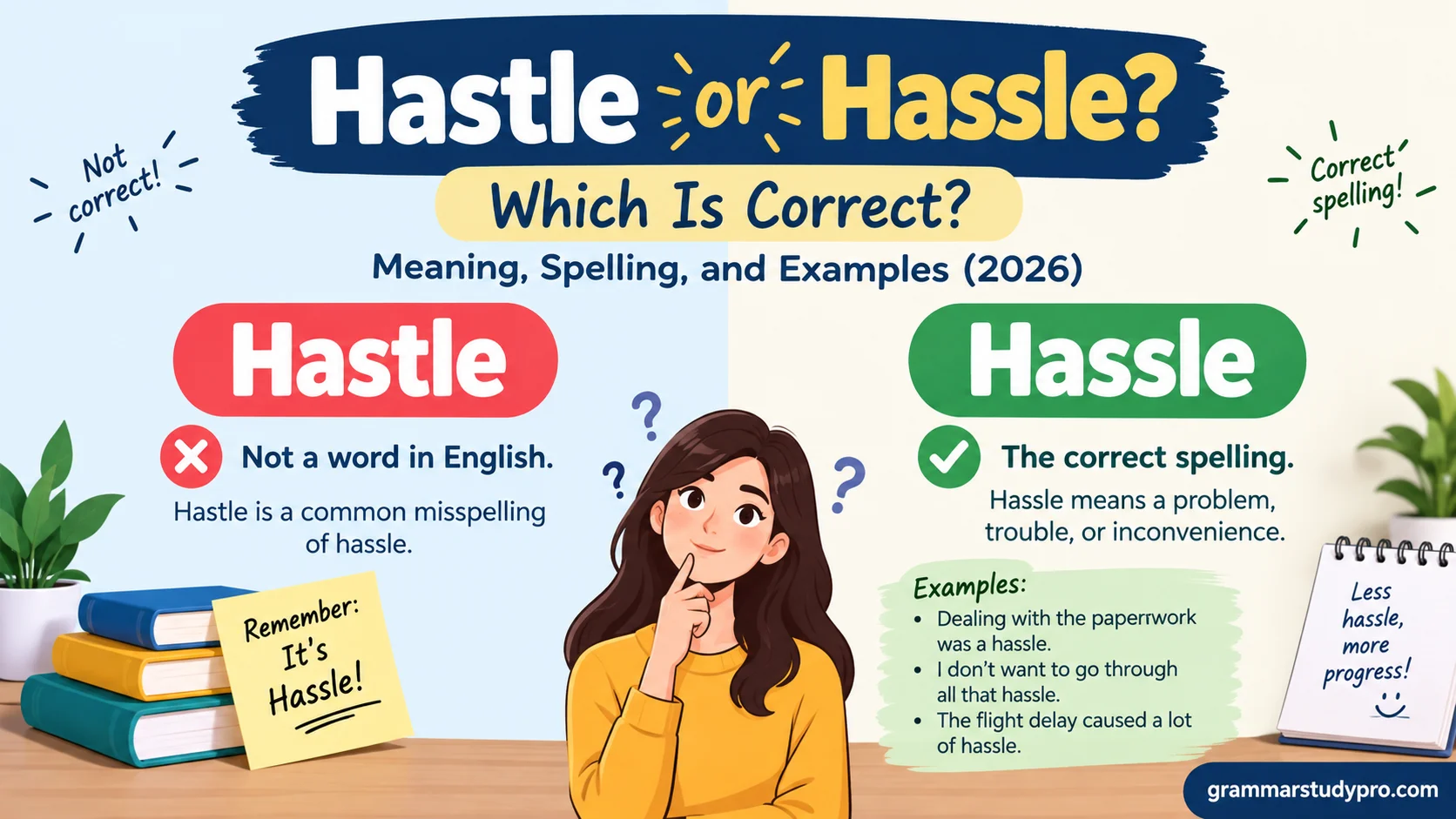
Hastle or Hassle is a common spelling question, and knowing the difference helps you avoid confusion in everyday writing. In English, hassle is the correct spelling of a standard word that means trouble, annoyance, inconvenience, or an irritating situation. Hastle is a common misspelling and is not recognized as a standard English word. You may encounter this error in emails, social media posts, school assignments, or professional writing because the two forms look and sound similar. Choosing the correct spelling improves your English vocabulary, writing confidence, spelling accuracy, and communication skills. It also helps prevent spelling mistakes from interrupting the reader’s flow, lowering writing quality, or weakening your message in academic, formal, and professional settings.
Hassle works as both a noun and a verb. As a noun, it describes a problem or bothersome situation. For example, “Getting the paperwork ready was a hassle” means the task caused unnecessary trouble. As a verb, it means to bother someone or cause trouble, as in “Please don’t hassle me while I’m working.” You can use the word in daily conversations, casual speech, quick texts, online content, business writing, and academic writing. Students, teachers, and working professionals benefit from learning its correct usage because accurate spelling supports clear communication and creates a more professional impression. When you understand the word’s meaning and recognize the difference between the two spellings, you can make better word choices and express your message with greater clarity.
To avoid this common error, build simple proofreading habits. If you type “hastle” and your spell-check feature marks it red, pause and double-check the word before you click send. Consult a dictionary, spelling guide, reference material, or trusted style guide to confirm the accepted spelling and modern usage. Careful proofreading and editing can catch typing errors, simple typos, and other small mistakes before they affect your credibility. Practical examples and reliable language resources can also strengthen your grammar knowledge, spelling rules, and overall writing skills. A final check helps you write clearly at school or work, maintain a polished tone, and leave a positive, lasting impression.
Quick Answer:
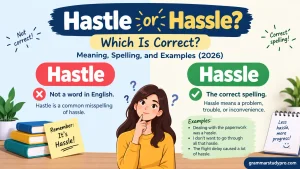
Hassle is the correct spelling. Use it when you mean a problem, an inconvenience, an annoying task, or the act of bothering someone.
Hastle is a misspelling when used with this intended meaning. It isn’t a standard alternative spelling of hassle.
Here are the two spellings side by side:
| Spelling | Correct or incorrect? | Meaning |
| Hassle | Correct | Trouble, inconvenience, annoyance, or to bother someone |
| Hastle | Incorrect for this meaning | A common spelling mistake |
Examples:
- Correct: Getting a refund turned into a real hassle.
- Incorrect: Getting a refund turned into a real hastle.
- Correct: Please stop hassling me about the decision.
- Incorrect: Please stop hastling me about the decision.
Easy rule to remember: If you mean trouble or annoyance, spell it H-A-S-S-L-E. Remember the double s and leave out the t.
Comparison Overview
The main difference between hastle and hassle is spelling accuracy. In standard English, hassle is the recognized word for inconvenience or bothering someone.
| Feature | Hassle | Hastle |
| Standard English spelling | Yes | No, not for the intended meaning |
| Meaning | Trouble, inconvenience, or to bother | No standard equivalent meaning |
| Used as a noun | Yes | No |
| Used as a verb | Yes | No |
| Past tense | Hassled | Not the standard form |
| Present participle | Hassling | Not the standard form |
| Common expression | Hassle-free | Hastle-free is incorrect |
| Example | The paperwork was a hassle. | The paperwork was a hastle. |
The distinction matters because a single letter can make an otherwise clear sentence look incorrect. When you describe a frustrating task or ask someone to stop bothering you, hassle is the spelling you need.
For a dictionary-backed definition and examples, consult
Main Differences Between Hastle or Hassle
Understanding the difference becomes easier when you look beyond the letters. The correct spelling also determines which word forms you should use and how the word fits into a sentence.
Hassle Is the Correct Standard Spelling
Hassle is an established English word. It commonly describes an annoying situation that takes extra time, effort, or patience.
For example, imagine that you order a new phone online. The phone arrives damaged, customer service sends you to three different departments, and the refund takes weeks. You might say, “Getting my money back was such a hassle.”
The word captures more than a simple problem. It often suggests that something requires unnecessary effort or creates frustration.
You can use hassle in casual conversations, workplace messages, emails, and many other everyday situations.
Examples include:
- Renewing my license was a hassle.
- I don’t want the hassle of changing hotels.
- The new payment system saves customers a lot of hassle.
- Finding a parking spot during the concert was a real hassle.
In each sentence, the word describes an inconvenience or a frustrating experience.
Hastle Is a Common Spelling Mistake
When someone writes hastle to mean trouble or inconvenience, they usually intend to write hassle.
The mistake can happen while typing quickly, proofreading carelessly, or remembering the word’s spelling incorrectly. However, the standard word does not contain a t.
Consider this sentence:
Incorrect: “Preparing the documents was a hastle.”
Correct: “Preparing the documents was a hassle.”
The second sentence uses the recognized spelling and communicates the intended meaning correctly.
One small qualification is worth remembering: an unusual spelling might appear in a proper name, username, brand, or specialized context. That possibility doesn’t make hastle an accepted alternative to hassle in ordinary English.
Hassle Can Be a Noun or a Verb
Another important distinction is that hassle has two common grammatical roles. It can name an unpleasant situation or describe an action.
As a noun, it refers to the inconvenience itself:
- The airport security line was a hassle.
- I don’t need the hassle of another subscription.
- Returning the shoes turned into a bigger hassle than expected.
As a verb, it means to bother, annoy, or pressure someone:
- Don’t hassle your coworker about the mistake.
- The reporters hassled the actor with repeated questions.
- My brother keeps hassling me to lend him money.
Recognizing the grammatical role helps you choose the right form. If you’re describing an irritating experience, use hassle. If you’re describing someone bothering another person, use the appropriate verb form, such as hassles, hassled, or hassling.
What Does Hassle Mean?
The word hassle describes trouble, inconvenience, annoyance, or unwanted effort. It often refers to situations that make a simple task more difficult than necessary.
For instance, booking a doctor’s appointment might be easy. However, if the website crashes, the phone line stays busy, and the available appointments disappear, the process becomes a hassle.
The word can also describe a person who repeatedly bothers someone. Its exact meaning depends on how you use it in a sentence.
Hassle as a Noun
As a noun, hassle refers to a frustrating task, difficult situation, or annoying experience. It can describe something minor, such as a long checkout line, or a more complicated process, such as resolving a billing error.
Here are some examples:
- “Moving to another apartment is a hassle.” The move requires time, planning, and physical effort.
- “I don’t want the hassle of returning this laptop.” The speaker wants to avoid the inconvenience of the return process.
- “Getting through airport traffic was a hassle.” The journey involved an annoying delay.
- “The new software eliminates the hassle of manual data entry.” The software makes the task easier.
You can also use hassle with adjectives such as unnecessary, major, constant, and extra.
For example, “The company introduced a new system to reduce unnecessary hassle.”
Hassle as a Verb
As a verb, hassle means to bother, annoy, or pressure someone. It often suggests repeated or unwanted attention.
For example:
- “Please don’t hassle me while I’m studying.”
- “The customer hassled the employee about the refund.”
- “My friends keep hassling me to join their trip.”
- “The reporters hassled the politician with questions.”
Notice that the verb focuses on an action directed toward someone. In contrast, the noun describes the inconvenience or trouble itself.
Compare these sentences:
| Sentence | Grammatical role | Meaning |
| The application process is a hassle. | Noun | The process is inconvenient. |
| The manager keeps hassling me. | Verb | The manager keeps bothering me. |
This distinction makes it easier to use hassle correctly in both speech and writing.
What Does Hastle Mean?
In standard English, hastle is not the correct spelling of the word meaning trouble or inconvenience. Writers generally use it by mistake when they intend to write hassle.
For example, you might see a sentence like this in an informal message:
“Getting the tickets was such a hastle!”
The intended meaning is clear, but the spelling is incorrect. The standard version is:
“Getting the tickets was such a hassle!”
The same correction applies to related forms. When the intended word is hassle, use hassles, hassled, and hassling rather than forms built around the misspelling hastle.
Why Do People Confuse Hastle and Hassle?
Several everyday writing habits can explain the confusion.
- Typing too quickly: A writer may insert an unnecessary letter without noticing.
- Unfamiliar spelling: Someone who has heard the word more often than they’ve read it might remember the sound but not the exact spelling.
- Autocorrect mistakes: Spell-checking tools don’t always catch every error, especially when the surrounding sentence remains understandable.
- Visual similarity: Both forms look similar enough that a reader may overlook the difference.
The best solution is simple: learn the standard spelling and check the word when proofreading.
Why Do People Spell Hassle as Hastle?
Spelling errors often happen when people rely on how a word looks rather than remembering its established form. The confusion between hastle and hassle is a good example.
Although the words differ by only one letter, that letter doesn’t belong in the standard spelling of hassle.
Hassle Pronunciation and Spelling
In US English, hassle is commonly pronounced /ˈhæs.əl/. The stress falls on the first syllable.
The sound can help you recognize the word, but pronunciation alone won’t always reveal the correct spelling. English contains many words whose written forms don’t perfectly match their sounds.
When learning hassle, remember both its pronunciation and its spelling:
- Start with the sound represented by has.
- Keep the two consecutive s’s in the written word.
- Finish with le.
- Don’t insert a t.
For a reference pronunciation and additional usage examples
The Double-S Spelling Pattern
One of the easiest ways to remember the correct spelling is to focus on the double s.
The word is spelled H-A-S-S-L-E.
A useful memory trick is to repeat this phrase: “Two S’s, no T.”
Whenever you’re unsure whether to write hastle or hassle, recall that short reminder. It won’t explain every detail of English spelling, but it works well for this particular word.
How to Use Hassle Correctly in a Sentence
The best way to master a word is to see how people use it in realistic situations. Hassle appears naturally in conversations about work, travel, shopping, household responsibilities, and everyday problems.
Examples of Hassle as a Noun
Use hassle when you want to name an inconvenient situation or a task that requires more effort than expected.
| Example sentence | What it means |
| Finding a reliable mechanic can be a hassle. | The search takes time and effort. |
| I don’t want the hassle of switching banks. | The speaker wants to avoid extra work. |
| The delayed shipment caused a lot of hassle. | The delay created several inconveniences. |
| Getting a refund shouldn’t be such a hassle. | The return process is unnecessarily difficult. |
| Preparing for the move was a major hassle. | The move required considerable effort. |
These examples show how hassle can describe different levels of inconvenience. You don’t need a serious problem to use the word; even a minor annoyance can qualify.
Examples of Hassle as a Verb
Use hassle as a verb when someone bothers, pressures, or annoys another person.
- “Don’t hassle the receptionist about a policy she can’t change.”
- “My neighbors hassled me about the noise.”
- “The salesperson kept hassling us to buy the extended warranty.”
- “Stop hassling your sister over such a small mistake.”
- “He felt hassled by constant phone calls during his vacation.”
The verb often carries a negative tone because it suggests unwanted pressure or repeated annoyance.
However, context still matters. A sentence about someone asking a question once doesn’t automatically imply harassment or serious misconduct. Hassle is a broad, informal word, and its meaning depends on the situation.
Hassle, Hassles, Hassled, and Hassling: Correct Word Forms
Once you’ve learned the correct spelling, it’s helpful to understand how the word changes in different sentences.
| Word form | How it’s used | Example |
| Hassle | Base verb or singular noun | The paperwork is a hassle. |
| Hassles | Plural noun or present-tense verb | She hassles her brother. |
| Hassled | Past-tense verb or past participle | They hassled me yesterday. |
| Hassling | Present participle or gerund | Stop hassling your teammate. |
| Hassle-free | Compound adjective | We chose a hassle-free service. |
Hassle vs. Hassles
Use hassle for a singular inconvenience or as the base form of the verb. Use hassles for multiple inconveniences or with a third-person singular subject in the present tense.
Examples:
- Singular noun: “The registration process is a hassle.”
- Plural noun: “Traveling with young children comes with its hassles.”
- Verb: “He hassles his coworkers about small mistakes.”
Hassled vs. Hassling
Use hassled when describing a past action or a completed experience.
For example: “The customers hassled the staff yesterday.”
Use hassling for an ongoing action or as a gerund.
For example: “She is tired of her coworkers hassling her about the schedule.”
Remember one useful spelling rule: when you add -ing to hassle, drop the final e. That’s why hassling is correct, not hassleing.
Is Hassle-Free or Hastle-Free Correct?
Hassle-free is the standard spelling. It describes something that avoids unnecessary trouble or inconvenience.
Examples:
- The website offers hassle-free booking.
- We had a hassle-free check-in experience.
- Automatic payments make bill management more hassle-free.
You might also see hassle-free in advertisements, product descriptions, and customer service messages. In each case, it suggests that a process is simple or convenient.
Common Expressions With Hassle
English speakers use hassle in several familiar expressions. Learning these phrases helps you recognize the word in conversation and use it naturally.
Hassle-Free
Hassle-free means free from unnecessary trouble or inconvenience.
For example: “The online application made registration hassle-free.”
Businesses often use this expression to describe easy returns, simple booking systems, or convenient services. However, it remains a descriptive phrase rather than a guarantee that a process will never cause problems.
A Lot of Hassle
This phrase emphasizes the amount of trouble involved in a situation.
Example: “Changing my flight at the last minute caused a lot of hassle.”
It works well in everyday conversations when you want to describe an inconvenient experience without sounding overly formal.
Give Someone Hassle
To give someone hassle means to bother, criticize, or cause trouble for them.
Example: “The supervisor gave the employee hassle over a minor delay.”
This expression is informal and may sound more natural in conversation than in formal business writing.
Worth the Hassle
Use worth the hassle when weighing the benefits of something against the effort it requires.
Example: “The cheaper ticket saved me money, but the long journey wasn’t worth the hassle.”
This phrase is especially useful when discussing purchases, travel plans, work decisions, and other situations involving a trade-off between convenience and benefit.
Hassle vs. Similar Words: Which One Fits Best?
Although hassle is useful in everyday English, it doesn’t mean exactly the same thing as every related word. Choosing the right alternative can make your writing more precise.
| Word | Meaning | Example |
| Hassle | Annoying inconvenience or unwanted effort | Returning the product was a hassle. |
| Trouble | A broad problem or difficulty | We had trouble finding the entrance. |
| Inconvenience | Something that disrupts comfort or ease | We apologize for the inconvenience. |
| Annoyance | Something that causes irritation | The constant notifications were an annoyance. |
| Complication | An added difficulty that makes something harder | A missing document caused a complication. |
| Harassment | Unwanted conduct that may be persistent, threatening, or abusive | The employee reported workplace harassment. |
Hassle vs. Trouble
Trouble is broader than hassle. It can describe anything from a minor difficulty to a serious problem.
For example, “I had trouble opening the file” simply means the task was difficult. “Opening the file turned into a hassle” suggests that the process was frustrating or unnecessarily complicated.
Hassle vs. Inconvenience
Inconvenience often sounds more formal and polite. You might use it in a customer service email or an official announcement.
For example:
“We apologize for the inconvenience caused by the service interruption.”
In casual conversation, you could say, “Sorry for the hassle.”
Both expressions can communicate regret, but their tone differs slightly.
Hassle vs. Harassment
These words shouldn’t be treated as interchangeable. Hassle often describes ordinary annoyance or unwanted pressure, while harassment can refer to more serious or persistent conduct.
For instance, a confusing refund process might be a hassle. Repeated threatening or abusive behavior may raise concerns about harassment.
Choosing the right word helps you communicate the seriousness of a situation accurately.
How to Remember the Correct Spelling of Hassle
You don’t need to memorize a complicated spelling rule to avoid this mistake. A few practical habits can help you remember the correct form.
Remember the Double S
The simplest trick is to remember that hassle has two S’s and no T.
Write the word a few times if necessary:
- Hassle
- Hassle-free
- Hassling
- Hassled
Seeing the correct spelling in different forms helps reinforce the pattern.
Check for the Unnecessary T
When proofreading, pay attention to the middle of the word. If you’ve written hastle, remove the unnecessary t and restore the second s.
This quick check is particularly useful when editing emails, school assignments, blog posts, and workplace documents.
Practice With Short Sentences
Try using the word in three different contexts:
- “The paperwork was a hassle.”
- “Please stop hassling me.”
- “We found a hassle-free solution.”
Each sentence demonstrates a different form or use. Practicing with complete sentences helps you remember more than studying the spelling in isolation.
FAQs
1. Is it Hastle or Hassle?
Hassle is the correct spelling in standard English. Hastle is a misspelling and is not recognized as a standard English word. Use hassle when describing trouble, annoyance, or inconvenience.
2. What does hassle mean?
Hassle means an annoying situation, difficulty, or unnecessary trouble. For example, “Finding a parking spot was a hassle” means finding a place to park was difficult or frustrating.
3. Can hassle be used as both a noun and a verb?
Yes, hassle works as both a noun and a verb. As a noun, it describes a problem or inconvenience. As a verb, it means to bother or pressure someone. For example, “Stop hassling me while I work.”
4. Why do people confuse hassle and hastle?
People often confuse these spellings because they look similar and may sound almost identical in everyday speech. Fast typing, unfamiliarity with the correct spelling, and overlooking spell-check warnings can also lead to mistakes.
5. How can I remember the correct spelling of hassle?
Practice writing hassle in sentences and check unfamiliar words with a trusted dictionary. Remember that the standard spelling contains “hass” followed by “le.” Proofreading your emails, assignments, and social media posts can help you avoid this common error.
Conclusion
Choosing hassle instead of hastle helps you maintain accurate, clear, and professional writing. Remember that hassle describes trouble, annoyance, or the act of bothering someone, while hastle is not a standard English word.
Whether you’re writing an email, completing a school assignment, or posting on social media, take a moment to check your spelling. This simple habit can improve your writing confidence, strengthen your communication skills, and help you express your ideas more effectively.