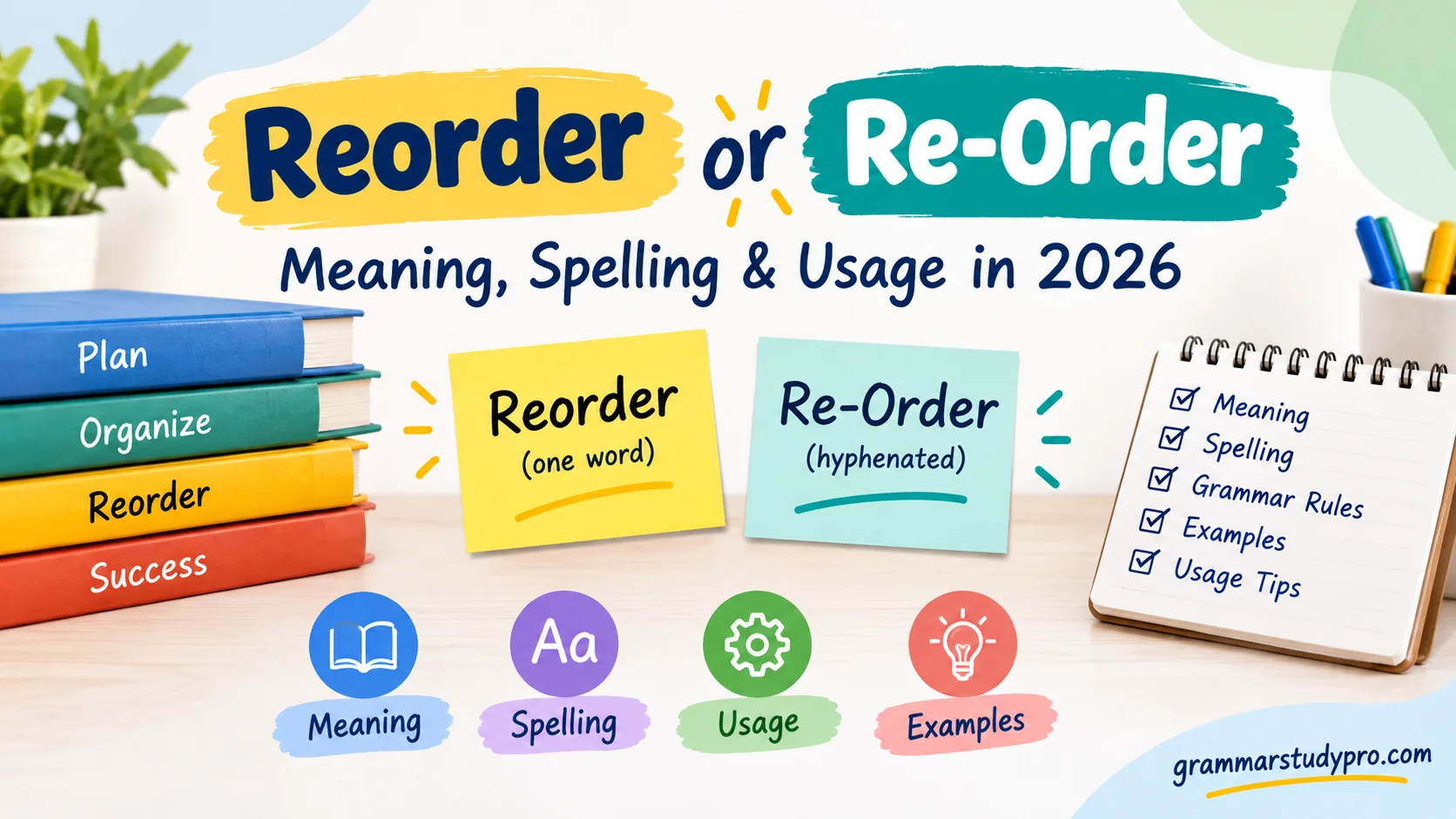
Reorder or Re-Order can seem confusing, but its standard modern spelling depends on context, usage, and clear word formation. In American English, reorder is the preferred and correct standard English form, written as one word with no hyphen. It works as a verb and noun, while British English may sometimes use re-order with a hyphen for emphasis. For English learners, the prefix re means again, but you should not always separate it from the base word. Understanding the difference between reorder vs re order helps you write accurately in shopping, everyday communication, and content writing. I find that checking the meaning, spelling, and usage together improves clarity, especially when typing and dealing with autocorrect or changing suggestions.
In business, the same term has a practical role in a Shopify store, e-commerce business, and the wider retail world. Managing inventory requires good inventory management, a reliable inventory system, and clear stock management. When stock is low or sold out, the process of reordering products supports stock replenishment and helps customers buy what they need. Businesses can use inventory reorder strategies to manage stock efficiently, while e-commerce platforms may offer a reorder option that lets shoppers quickly purchase previous items, saving time and effort. These strategies can transform how a store handles reordering, while a practical guide may explain eight strategies for improving the overall system.
In digital systems, reordering can also describe an action involving rearrangement, repetition, or placing items once more in a useful order. This supports organization and keeps work smooth when handling lists, data, and products. From my experience with online shopping and inventory strategies, a well-planned system makes daily management easier and gives the process a more consistent structure. The business meaning, form, logical flow, understanding, and communication around the word all matter when choosing the right expression. Whether you are ordering products again, arranging information, or writing sentences, careful usage can enhance the message while keeping the American and British English distinction clear.
Quick Answer
“Reorder” is the standard modern spelling in most situations.
Use reorder when you mean:
- To order something again: “We need to reorder more supplies.”
- To change the sequence of something: “Please reorder these paragraphs.”
- To arrange items differently: “The software lets users reorder the columns.”
“Re-order” is a possible hyphenated variant, but it isn’t usually necessary in modern general writing.
“Re order” is generally not the correct spelling when you intend the verb reorder.
The simple rule
In most modern writing, choose “reorder” as one word.
However, context matters. If reorder could create confusion, rewriting the sentence may be clearer than adding a hyphen.
Comparison Overview
The difference between reorder and re-order isn’t primarily a difference in meaning. The main issue concerns spelling and style.
| Form | Typical use | Meaning | General recommendation |
| reorder | Verb and noun | Order again or change an existing order | Preferred |
| re-order | Hyphenated variant | Usually the same meanings as reorder | Acceptable in some styles |
| re order | Separated words | Not normally used for this verb | Avoid |
Consider these examples:
- “Reorder the books by author.” → Change their sequence.
- “Reorder the books from the publisher.” → Order another batch.
- “Re-order the books.” → Understandable, but the hyphen usually isn’t needed.
- “Re order the books.” → Generally incorrect for the intended verb.
The surrounding words usually reveal which meaning the writer intends.
For example, “reorder the books alphabetically” clearly refers to changing their sequence. Meanwhile, “reorder the books because the store sold out” suggests purchasing another batch.
Main Differences Between Reorder and Re-Order
The biggest difference is form rather than meaning.
Reorder Is the Modern Default
In contemporary English, reorder normally appears as a closed compound.
The prefix re- attaches directly to order, producing a single word:
re + order = reorder
This follows a broader pattern in English:
- rewrite
- reread
- rebuild
- reconsider
- reorganize
- reappear
- reorder
When a prefix becomes established with a base word, English often treats the resulting form as one word.
That’s why reorder looks and functions naturally in modern writing.
Re-Order Is a Hyphenated Variant
The spelling re-order isn’t incomprehensible or automatically ungrammatical. Writers may use it when a publication’s house style calls for it or when they believe the hyphen improves readability.
Still, there’s an important distinction between possible usage and preferred usage.
A word appearing somewhere in print doesn’t necessarily mean you should choose that spelling. English contains many competing forms because spelling conventions change over time and differ between publishers.
For ordinary modern American English, reorder is the cleaner default.
Re Order Is Usually Not the Right Form
Writing re order as two separate words creates a different problem.
The prefix re- isn’t functioning as an independent word here. It combines with order to create the verb reorder.
So this:
“Please re order the products.”
should normally become:
“Please reorder the products.”
If the writer wants to make the repeated action explicit, another option is:
“Please order the products again.”
That version avoids any possible ambiguity.
What Does Reorder Mean?
Reorder has two major everyday meanings.
The first involves purchasing or requesting something again. The second involves changing an existing sequence.
Those meanings look similar on the page but describe different actions.
Reorder Means “Order Again”
In commercial contexts, reorder commonly means to place another order for something previously purchased.
For example:
“The restaurant needs to reorder coffee beans.”
The restaurant isn’t rearranging coffee beans. It needs to purchase another supply.
You’ll see this meaning frequently in:
- Retail
- E-commerce
- Manufacturing
- Restaurants
- Warehousing
- Office administration
- Supply-chain management
- Procurement
Consider these examples:
- “The office needs to reorder printer cartridges.”
- “Customers can reorder products from their purchase history.”
- “The retailer reordered the popular shoes.”
- “The warehouse manager reordered the missing components.”
In each sentence, reorder means order again.
Reorder Means “Change the Order”
The second major meaning involves changing the sequence of existing items.
For example:
“Reorder the paragraphs so the argument develops more naturally.”
Here, nobody is purchasing paragraphs. The writer is changing their sequence.
This meaning commonly appears in:
- Writing
- Editing
- Education
- Programming
- Data management
- User-interface design
- Scheduling
- Lists and spreadsheets
Examples include:
- “Reorder the chapters chronologically.”
- “Please reorder the tasks by priority.”
- “The application lets you reorder the columns.”
- “Students must reorder the sentences.”
- “The editor reordered the sections.”
In these examples, reorder means put into a different order.
Why Does Reorder Mean Two Different Things?
English often allows a single word to develop related meanings.
The prefix re- generally carries the idea of doing something again or differently. When attached to order, that produces two closely connected interpretations.
Order again gives us:
reorder = place another order
Changing an existing arrangement gives us:
reorder = put into a different order
The exact interpretation comes from context.
Think about this sentence:
“We need to reorder the products.”
Without additional information, the sentence can be ambiguous.
It could mean:
- Buy the products again, or
- Change the products’ sequence.
Now add context:
“We need to reorder the products because our stock is almost gone.”
The meaning becomes obvious: buy them again.
Compare that with:
“We need to reorder the products alphabetically.”
Now the meaning is equally clear: change their sequence.
How to Remove Ambiguity
When precision matters, don’t force the reader to guess.
Instead of:
“We need to reorder the books.”
Write:
“We need to order the books again.”
or:
“We need to rearrange the books.”
A tiny wording change can eliminate an entire layer of confusion.
Why Is Reorder Usually Written as One Word?
The spelling comes down largely to established English usage.
The prefix re- frequently forms closed words when attached to familiar verbs. Over time, readers become accustomed to seeing those combinations as single lexical units.
Compare:
- rewrite, not re-write in ordinary modern usage
- rebuild, not re-build
- reconsider, not re-consider
- reorganize, not re-organize
- reorder, not usually re-order
This doesn’t mean every word beginning with re- must always appear without a hyphen.
English spelling isn’t that mechanical.
Some combinations can remain hyphenated because the hyphen improves clarity, distinguishes meanings, or follows an established convention. That’s why dictionary evidence and the relevant style guide matter when a particular word is disputed.
For reorder, however, the closed spelling is well established.
When Can Re-Order Be Used?
The hyphenated form re-order can appear in English, but its use requires context.
A writer might choose it because:
- A particular style guide permits or prefers the form.
- The writer wants to visually separate re- from the base word.
- A specialized publication has established its own spelling conventions.
- The writer believes the hyphen helps prevent a momentary misreading.
However, you shouldn’t add the hyphen simply because you’re unsure.
A better approach is to check the relevant dictionary or style guide.
For general US English, reorder is normally the safer choice.
A Useful Editing Principle
Don’t confuse “I have seen this spelling” with “this is the preferred spelling.”
English contains plenty of historical, regional, specialized, and house-style variants.
Your goal should be consistency and clarity.
Reorder as a Verb
Reorder is most commonly used as a verb.
It can describe either placing another order or changing an existing sequence.
Reorder Something
The basic structure is:
reorder + object
Examples:
- “Reorder the files.”
- “Reorder the products.”
- “Reorder the paragraphs.”
- “Reorder the tasks.”
- “Reorder the supplies.”
You can add an adverb or phrase explaining the new arrangement:
- “Reorder the files alphabetically.”
- “Reorder the tasks by urgency.”
- “Reorder the chapters chronologically.”
- “Reorder the products by price.”
Reorder in Different Tenses
The word behaves like a regular verb.
| Tense or form | Example |
| Present | “We reorder supplies monthly.” |
| Third-person singular | “The system reorders items automatically.” |
| Past | “The manager reordered the schedule.” |
| Present participle | “They are reordering the list.” |
| Past participle | “The files have been reordered.” |
The spelling remains straightforward.
The past tense is reordered, not reorderred.
The present participle is reordering, not reorderring.
Reorder as a Noun
Reorder can also function as a noun, especially in business and retail.
For example:
“The company received a reorder from the customer.”
Here, reorder refers to another order placed after an earlier purchase.
You might encounter phrases such as:
- reorder request
- reorder quantity
- reorder level
- reorder point
- reorder process
The noun appears more frequently in commercial and inventory-related contexts than in casual conversation.
In everyday speech, someone may simply say:
“The customer placed another order.”
That’s often more immediately clear to a general audience.
Reorder in Inventory Management
Few business contexts use the word reorder more heavily than inventory management.
A reorder point identifies the inventory level at which a business should replenish stock.
The basic concept is simple:
When available stock falls low enough, place another order before existing inventory runs out.
A basic reorder-point calculation can be represented as:
Reorder Point = Demand During Lead Time + Safety Stock
Suppose a store sells 20 units per day. Its supplier usually takes five days to deliver a new shipment.
Demand during lead time would be:
20 × 5 = 100 units
If the store keeps 30 units as safety stock, its basic reorder point becomes:
100 + 30 = 130 units
So when inventory reaches approximately 130 units, the business may trigger another purchase order.
Actual inventory systems can use more sophisticated calculations. They may account for demand variability, supplier reliability, seasonal changes, service levels, and other operational factors.
Common Inventory Terms
| Term | Meaning |
| Reorder point | Inventory level that triggers replenishment |
| Reorder quantity | Amount ordered when replenishment occurs |
| Safety stock | Extra inventory kept against uncertainty |
| Lead time | Time between placing an order and receiving it |
| Stockout | Situation where inventory becomes unavailable |
This is one reason you’ll see reorder frequently in supply-chain software and business documentation.
Reorder vs. Rearrange
These words overlap, but they aren’t interchangeable in every sentence.
Reorder
Reorder emphasizes changing the sequence or order.
“Reorder the chapters.”
The chapters remain the same. Their sequence changes.
Rearrange
Rearrange emphasizes changing the arrangement or positioning of things.
“Rearrange the furniture.”
The furniture isn’t necessarily being put into a formal sequence.
Reorganize
Reorganize goes further. It usually suggests restructuring something more substantially.
“The company reorganized its sales department.”
That can involve changing roles, reporting structures, responsibilities, and workflows.
| Word | Main idea | Example |
| Reorder | Change sequence | “Reorder the chapters.” |
| Rearrange | Change arrangement | “Rearrange the chairs.” |
| Reorganize | Restructure | “Reorganize the department.” |
Choosing the precise word makes your writing sharper.
Reorder vs. Order Again
When reorder means purchasing something another time, it overlaps closely with order again.
Compare:
“We need to reorder the paper.”
and:
“We need to order the paper again.”
Both can describe another purchase.
The difference is mainly style and economy.
Reorder is compact and common in business contexts.
Order again can be more explicit for general readers, especially when the surrounding sentence might otherwise create ambiguity.
For example:
“Please reorder the files.”
could mean rearrange them.
But:
“Please order the files again.”
clearly refers to making another purchase.
If the context is unmistakable, reorder works perfectly well.
Reorder in Writing and Editing
Editors frequently use reorder when discussing the structure of written material.
Imagine an article with these sections:
- Background
- Detailed solution
- Problem definition
- Introduction
- Conclusion
The content may be useful, but the sequence doesn’t make much sense.
An editor could reorder the sections:
- Introduction
- Problem definition
- Background
- Detailed solution
- Conclusion
Nothing necessarily needs rewriting. The structure simply becomes easier to follow.
A Practical Writing Example
Consider these sentences:
“The results were surprising. The researchers conducted the experiment in May. The study examined consumer behavior. Several participants changed their responses.”
The information feels jumbled.
Reordering the sentences creates a clearer progression:
“The study examined consumer behavior. The researchers conducted the experiment in May. Several participants changed their responses. The results were surprising.”
The words themselves remain mostly unchanged. The order does the heavy lifting.
That’s a useful lesson in writing: sometimes the problem isn’t what you said. It’s where you said it.
Reorder in Education
Teachers often use reorder in exercises involving sequence and comprehension.
Students might be asked to:
- Reorder sentences into a paragraph.
- Reorder events chronologically.
- Reorder instructions correctly.
- Reorder words to form a sentence.
- Reorder steps in a mathematical process.
For example:
Reorder these events chronologically.
This means students should change their sequence according to when each event happened.
The word therefore has a practical educational use beyond business and commerce.
Reorder in Technology
Digital products use reorder frequently because users often need to change the position of interface elements.
Common examples include:
- Reorder a playlist.
- Reorder navigation items.
- Reorder columns.
- Reorder tasks.
- Reorder dashboard widgets.
- Reorder search results.
- Reorder pages.
- Reorder menu options.
A drag-and-drop interface might tell users:
“Drag items to reorder.”
Here, reorder doesn’t mean buying anything again. It means changing the sequence of existing items.
The term also appears in technical discussions involving data processing and system operations.
Common Mistakes With Reorder
Understanding the spelling becomes easier when you know which mistakes to avoid.
Mistake: Writing “Re Order”
The most obvious issue is separating the prefix from the base word.
Incorrect in ordinary usage:
“Please re order the list.”
Preferred:
“Please reorder the list.”
If you don’t like the ambiguity, rewrite it:
“Please put the list in a different order.”
Mistake: Automatically Adding a Hyphen
Not every word beginning with re- needs a hyphen.
Writing:
“Please re-order the list.”
is understandable and may appear in some editorial environments. Yet reorder is generally the modern default.
Mistake: Confusing Reorder With Rearrange
Consider:
“Reorder the chairs.”
If the chairs don’t have a meaningful sequence, rearrange the chairs may communicate the intended action more naturally.
Mistake: Ignoring Context
The sentence:
“We need to reorder the books.”
doesn’t tell readers exactly which meaning you intend.
If you’re buying another batch, say:
“We need to order the books again.”
If you’re changing their sequence, say:
“We need to rearrange the books.”
Precision beats guesswork.
Reorder Pronunciation
Reorder is pronounced as a multi-syllable word beginning with the familiar ree- sound.
A dictionary is the best place to check the exact pronunciation and regional variation because pronunciation can differ slightly between English varieties.
Importantly, adding a hyphen doesn’t normally create a fundamentally different pronunciation:
- reorder
- re-order
The spelling changes. The intended word generally doesn’t.
Reorder Word Forms
Because reorder functions as a regular verb, its related forms follow ordinary English patterns.
| Word form | Example |
| reorder | “Please reorder the list.” |
| reorders | “The system reorders items automatically.” |
| reordered | “The editor reordered the sections.” |
| reordering | “The software supports reordering.” |
| reorder | “The customer placed a reorder.” |
| reordering | “The reordering process takes seconds.” |
One spelling detail deserves attention: reordering uses a single r after the prefix.
The correct form is:
reordering
not:
reorderring
Case Study: How Context Changes the Meaning
Consider a small online retailer selling office supplies.
The manager tells an employee:
“We need to reorder the notebooks.”
At first glance, the sentence seems perfectly clear. Yet it can technically support two interpretations.
Interpretation A: Purchase More
The retailer has sold most of its notebooks.
The manager means:
Place another order for notebooks.
Interpretation B: Change Their Sequence
The retailer’s website displays several notebook products in an awkward order.
The manager means:
Change the notebooks’ position on the page.
The solution isn’t necessarily to write re-order.
Instead, add context:
“We need to order more notebooks before Friday.”
or:
“We need to reorder the notebooks on the product page.”
This demonstrates an important principle of good writing: clarity often comes from context rather than punctuation.
Reorder in American English
For contemporary US English, reorder is the practical default.
You’ll encounter it in ordinary prose, business communication, e-commerce interfaces, technical documentation, and educational material.
For professional writing, consistency matters.
If an organization uses reorder throughout its documentation, switching randomly between reorder and re-order can make the writing look inconsistent.
A style guide may settle the issue for a particular publication.
That’s especially important in:
- Corporate documentation
- Technical manuals
- Academic publishing
- Product interfaces
- Legal documents
- Newspaper and magazine copy
- E-commerce platforms
When an established style guide gives a specific instruction, follow that guide.
Is Re-Order Outdated?
Calling re-order simply “outdated” goes too far.
The form still appears in English-language writing. The more accurate point is that the closed form “reorder” is generally preferred in contemporary general usage.
Language doesn’t operate like a switch that turns one spelling off overnight.
Older spellings can remain visible for years. Organizations may preserve house styles. Individual writers may also retain preferences that differ from mainstream usage.
Therefore, the useful distinction is:
- reorder → modern default
- re-order → established hyphenated variant found in some contexts
- re order → generally not the intended standard form
Real-World Examples of Reorder
Everyday Use
“I need to reorder my favorite notebooks.”
Meaning: buy them again.
“Can you reorder these photographs?”
Meaning: change their sequence.
Business Use
“The retailer reordered its most popular products.”
Meaning: placed another purchase order.
Writing Use
“The editor reordered the paragraphs.”
Meaning: changed their sequence.
Technology Use
“Users can reorder the columns by dragging them.”
Meaning: change their positions.
Education Use
“Reorder the sentences to form a coherent paragraph.”
Meaning: put them into the correct sequence.
These examples demonstrate why context remains essential.
Reorder or Re-Order: Which One Should You Use?
For most modern writing, use reorder.
Here’s the practical decision:
| Situation | Recommended wording |
| General American English | reorder |
| Business writing | reorder |
| Academic writing | reorder, unless the style guide says otherwise |
| Technical writing | reorder, unless house style differs |
| E-commerce | reorder |
| Inventory management | reorder |
| Writing/editing | reorder |
| Need to clarify meaning | Rewrite the sentence if necessary |
| Specific house style requires a hyphen | re-order |
The strongest default is simple:
Write “reorder” as one word unless a relevant style guide or specific editorial convention tells you otherwise.
FAQs
Is “reorder” or “re-order” correct?
Reorder is the standard modern spelling in most contexts. It is written as one word without a hyphen and works as both a verb and a noun.
Is “re order” written as two words?
No. Re order is generally not the standard spelling when you mean to order something again. Reorder is the preferred form.
What does “reorder” mean?
Reorder means to order something again. For example, a customer may reorder a product they purchased before, or a business may reorder stock when inventory becomes low.
Is “re-order” used in British English?
Yes, re-order can appear in British English, although reorder is also widely used. Modern usage generally favors the closed form, reorder.
What is the difference between “reorder” and “re-order”?
There is usually no major difference in meaning. The main difference is spelling and style. Reorder is the simpler modern form, while re-order uses a hyphen and may appear in some British English or stylistic contexts.
Conclusion
Reorder is the clearest and most widely accepted modern spelling for the idea of ordering something again. Whether you are discussing inventory, online shopping, business systems, or everyday communication, using reorder as one word keeps your writing simple and consistent. Re-order may still appear in some contexts, but reorder is generally the preferred form.