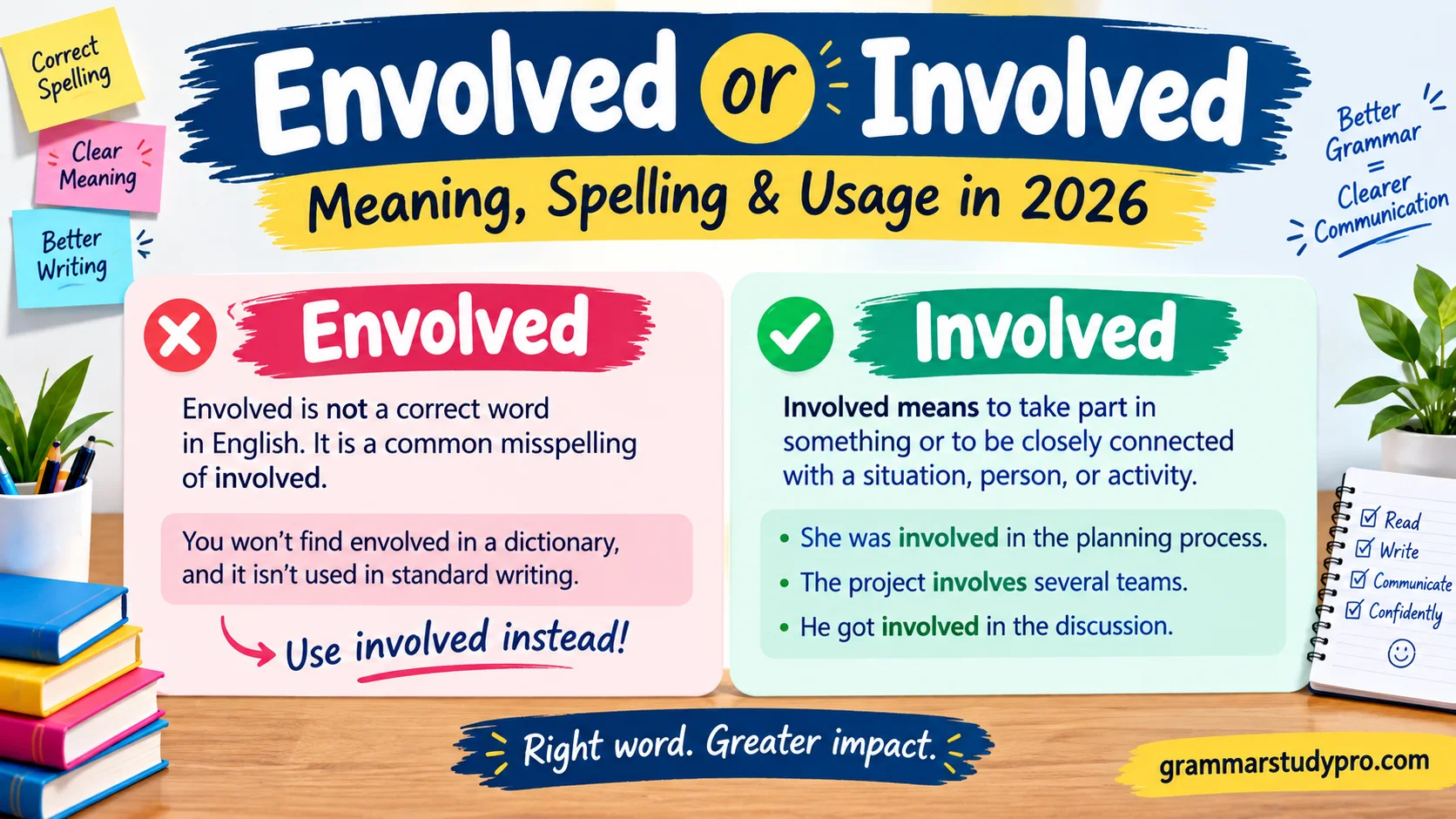
Envolved or Involved is a common spelling question because the two forms look similar and can sound alike when spoken quickly.
The word “envolved” is not the correct spelling in standard English, so the simple fix is to replace it with “involved” every time. The confusion comes from English words that begin with “en-”, including enclose, ensure, and envelop, but “Involved” follows a different pattern and begins with “in-”. Its spelling does not change with context, tense, or usage. English learners and native speakers may make this common mistake, but spell-checkers can flag “envolved” as an error, while a dictionary recognises “involved” as the standard version.
“Involved” means being part of something or participating in an activity. It describes someone who is connected to a situation, event, or relationship. The word comes from the Latin “involvere,” meaning to wrap or entangle. Today, it can describe participation, engagement, or complexity in different contexts. When talking or writing, use the correct form in the sentence, whether you are preparing an email, blog post, or assignment. A useful guide is to remember the difference between the correct and incorrect forms. In correct examples, use “involved” for taking part, being connected, or dealing with complexity. If you have questioned which form is right, remember to use “involved” every time.
Quick Answer
Involved is the standard spelling in modern English when you’re talking about participating in something, being connected to something, or describing something complicated.
Envolved is generally a misspelling of involved in modern English. However, there is a small historical wrinkle: envolve appears in some historical or obsolete usage as an old spelling of involve. That doesn’t make envolved an appropriate modern alternative.
Here’s the easiest way to remember it:
involve → involved → involving → involvement
So if your sentence comes from the verb involve, the past tense and past participle are involved, not envolved. Cambridge lists involve as a verb meaning to include, affect, or make someone take part in something.
Correct examples
- “I was involved in the discussion.”
- “Several employees were involved in the project.”
- “The investigation involved three companies.”
- “The instructions are quite involved.”
- “She became deeply involved with the organization.”
Incorrect examples
- “I was envolved in the discussion.”
- “Several employees were envolved in the project.”
- “The investigation envolved three companies.”
In modern standard English, replace envolved with involved.
Comparison Overview
The difference becomes much clearer when the two spellings sit side by side.
| Feature | Involved | Envolved |
| Standard modern English spelling | Yes | No, when intended as the modern form of involve |
| Base verb | Involve | Envolve |
| Common modern usage | Very common | Generally a misspelling |
| Can mean participating? | Yes | No, not as the standard form |
| Can mean connected? | Yes | No, not as the standard form |
| Can mean complicated? | Yes | No |
| Past tense of involve | Involved | Not envolved |
| Related noun | Involvement | — |
| Related participle | Involving | — |
There is one historical detail worth knowing. Wiktionary records envolve as an obsolete spelling of involve, with envolved as its historical past form. That usage doesn’t represent standard contemporary English.
For everyday writing, schoolwork, professional communication, websites, applications, and formal documents, involved is the form to use.
Main Differences Between Envolved and Involved
The biggest difference isn’t meaning. It’s standardness.
Involved Is the Standard Modern Form
Involved comes from the verb involve. The word can describe someone who participates in an activity, someone connected to an event, or something that contains many complicated details.
For example:
“Several engineers were involved in designing the bridge.”
Here, involved means that the engineers participated in the work.
Another example shows a different meaning:
“The legal procedure was extremely involved.”
Here, involved means complicated or difficult to understand.
Oxford lists these meanings separately. It defines involved as taking part in or being connected with something, giving significant time or attention to something, having a close personal relationship, and being complicated or difficult to understand.
Envolved Is Usually a Spelling Error
When someone writes envolved today, they usually intend involved.
The mistake may happen because the word sounds unfamiliar when spoken quickly. English spelling doesn’t always follow pronunciation neatly. Once you hear involved, it’s easy to imagine an en- beginning.
However, standard dictionaries use involved, not envolved, for the modern meanings discussed here. Cambridge’s current entry gives involved as the adjective and provides pronunciations for both US and UK English.
Why the Confusion Happens
English contains many legitimate words beginning with en-:
- enable
- encourage
- enlarge
- enrich
- enforce
- enroll
- ensure
It also contains many words beginning with in-:
- include
- inform
- inspect
- invite
- involve
- introduce
That makes envolved look believable at first glance.
But English spelling isn’t a puzzle where every word follows the same prefix pattern. Sometimes the correct spelling simply has to be learned as part of the word.
What Does Involved Mean?
Involved has several meanings. Context determines which one applies.
At its core, the word expresses some form of connection. A person can connect to an activity by participating. A person can connect to an event by being affected by it. A process can contain so many connected parts that we call it involved.
Cambridge identifies several major uses, including being part of an activity, being interested in something, and being difficult or complicated.
Involved Meaning: Taking Part in Something
The most familiar meaning is participating in an activity, event, project, or situation.
Consider:
“Maya is involved in the school science project.”
Maya isn’t merely aware that the project exists. She’s participating in it.
You can use involved for almost any kind of participation:
- involved in a business
- involved in a project
- involved in research
- involved in sports
- involved in community work
- involved in education
- involved in an investigation
For example:
“The volunteers were heavily involved in organizing the event.”
Here, heavily involved emphasizes a high level of participation.
Involved Meaning: Connected to Something
Someone doesn’t always have to actively participate to be described as involved.
For example:
“Five vehicles were involved in the accident.”
The sentence doesn’t necessarily say that the drivers deliberately participated in anything. It says they were connected to the event.
Similarly:
“Several departments were involved in the decision.”
The departments had a connection to the decision-making process.
Oxford specifically gives examples of people and vehicles being involved in events or situations.
Involved Meaning: Giving Time and Attention
The word can also describe someone who gives substantial attention or effort to something.
For example:
“She became deeply involved in the charity’s work.”
This suggests more than simple membership. She invests time, energy, or attention.
You might also say:
- “He is deeply involved in his children’s education.”
- “They are actively involved in the community.”
- “She became heavily involved with the organization.”
Collins similarly describes involved as giving considerable time, effort, or attention to something.
Involved Meaning: Complicated
Here’s where the word can surprise learners.
Involved can mean complicated, detailed, or difficult to understand.
For example:
“The application process is quite involved.”
That doesn’t mean the application is participating in something. It means the process contains many steps or details.
Another example:
“The explanation became too involved.”
The explanation became complicated enough to make it difficult to follow.
Cambridge defines this sense as something that isn’t simple and is therefore difficult to understand.
Involved Meaning: Emotionally or Romantically Connected
Involved can also describe a close personal or romantic relationship.
For example:
“They became romantically involved.”
Or:
“She was emotionally involved in the situation.”
The meaning depends heavily on the surrounding words. Romantically involved has a relationship meaning while emotionally involved describes a strong emotional connection.
Oxford includes both close personal relationships and emotional involvement among the established meanings of the adjective.
What Does Envolved Mean?
In contemporary standard English, envolved generally doesn’t function as the modern equivalent of involved.
If you write:
“He was envolved in the project.”
A reader will normally understand that you meant:
“He was involved in the project.”
The confusion isn’t difficult to fix. Simply use involved.
There is, however, a historical footnote. The word envolve has been recorded as an obsolete spelling of involve, and envolved appears as its historical past form.
That distinction matters because an old or obsolete form isn’t automatically a modern spelling choice.
Think of it this way: historical English can contain spellings that aren’t appropriate for present-day everyday writing. If you’re writing an email, article, essay, resume, report, or social media post in 2026, involved is the practical standard.
Involved as Different Parts of Speech
Understanding the grammar behind involved makes the spelling easier to remember.
Involved as an Adjective
Involved frequently works as an adjective.
Examples include:
- “She is deeply involved in the project.”
- “The instructions are complicated and involved.”
- “Everyone involved received an email.”
- “He became emotionally involved.”
In these sentences, the word describes a person, group, situation, or process.
Involved as the Past Form of Involve
Involved is also the simple past and past participle of involve.
Compare these sentences:
“The project involves three departments.”
“The project involved three departments.”
“Three departments were involved in the project.”
The spelling stays connected to the base verb:
involve → involved
Not:
involve → envolved
Cambridge identifies involve as a verb used for including something, affecting someone or something, or making someone take part.
Involve, Involved, Involving, and Involvement
One of the easiest ways to avoid the envolved or involved mistake is to learn the entire word family.
| Word | Part of Speech | Example |
| Involve | Verb | “The job will involve travel.” |
| Involves | Verb | “The task involves careful planning.” |
| Involved | Past tense/past participle/adjective | “She was involved in the project.” |
| Involving | Present participle | “The study is involving several departments.” |
| Involvement | Noun | “Her involvement was important.” |
The family provides a useful visual clue:
INvolve → INvolved → INvolving → INvolvement
The in- stays intact.
Involve
Use involve when describing an action in the present or in general.
“The job involves working with customers.”
Involved
Use involved as the past form or adjective.
“She was involved in the project.”
Involving
Use involving when describing something that includes or affects someone or something.
“The investigation involved several departments.”
More naturally, in some contexts:
“The investigation involved several departments and lasted six months.”
Involvement
Use involvement when you need a noun.
“His involvement in the project lasted two years.”
How to Use Involved Correctly
The preposition following involved matters because it can change the emphasis.
Involved In
Involved in is extremely common when someone participates in an activity or situation.
Examples:
- “She is involved in research.”
- “He became involved in the project.”
- “They were involved in the discussion.”
- “Several workers were involved in the construction.”
Cambridge specifically gives involve someone in something and be involved with something as established constructions.
Involved With
Involved with often emphasizes a connection with a person, organization, group, or activity.
Examples:
- “She is involved with the local charity.”
- “He’s been involved with the organization for years.”
- “They became involved with the community center.”
It can also describe a romantic relationship:
“She became romantically involved with him.”
Oxford lists involved with alongside involved in as standard collocations.
Involved In vs. Involved With
The distinction isn’t always absolute. Native speakers sometimes use the two constructions in overlapping situations.
Still, this guideline works well:
| Expression | Typical emphasis | Example |
| Involved in | Participation in an activity or process | “He is involved in the research.” |
| Involved with | Connection or association | “He is involved with the organization.” |
| Romantically involved with | Personal relationship | “She is romantically involved with him.” |
Don’t treat this as a rigid rule. Context determines the most natural choice.
Common Sentences Using Involved
Seeing the word in different contexts makes its range easier to understand.
At Work
“Several managers were involved in the planning process.”
Here, involved means participating.
At School
“Students who are involved in extracurricular activities often develop practical skills.”
Here, it describes participation.
In Sports
“Three players were involved in the final play.”
The word means connected to or participating in the action.
In an Investigation
“Police questioned everyone involved in the incident.”
Here, involved identifies people connected to the event.
In Business
“The company is involved in international trade.”
The company operates or participates in that area.
In Relationships
“They became romantically involved.”
Here, involved describes a romantic relationship.
For Complicated Processes
“The repair is more involved than it initially appeared.”
Here, involved means complicated or requiring more work.
Envolved or Involved: Common Mistakes
Spelling mistakes often become easier to eliminate once you understand what causes them.
Writing Envolved Instead of Involved
This is the main mistake.
Wrong:
“She was envolved in the project.”
Correct:
“She was involved in the project.”
Confusing Involved With Evolved
This is another important distinction.
Involved means connected, participating, or complicated.
Evolved means developed or changed gradually.
Compare:
“The team was involved in the project.”
“The project evolved over several years.”
The two words look and sound somewhat similar. Their meanings are completely different.
| Word | Meaning | Example |
| Involved | Participating, connected, or complicated | “She was involved in the project.” |
| Evolved | Developed or changed gradually | “The project evolved over time.” |
Confusing Involved With Involvement
These words belong to the same family but have different grammatical jobs.
Involved:
“She was involved in the research.”
Involvement:
“Her involvement in the research was significant.”
The first describes a person. The second names the person’s participation.
Using Involving When Involved Is Needed
Consider:
“The scientists were involved in the study.”
Changing this to:
“The scientists were involving in the study.”
doesn’t work.
Involving generally describes an action or something that includes another element:
“The study involved several scientists.”
“The project is involving several research teams.”
The second sentence can be grammatically possible in a specific context, but involved remains the normal choice when describing an established connection.
Involved vs. Evolved: Why the Difference Matters
The words involved and evolved deserve special attention because their visual similarity can cause genuine confusion.
Involve relates to bringing something or someone into a situation, including something as a part, or making someone participate.
Evolve relates to gradual development or change.
Imagine a business launching a new product.
“The marketing team was involved in the launch.”
The team participated.
Meanwhile:
“The marketing strategy evolved after customer feedback.”
The strategy changed gradually.
One describes participation. The other describes development.
That’s the key distinction.
How to Remember the Correct Spelling
Here’s a simple trick: remember the base word first.
If the verb is:
involve
then its past form is:
involved
The same pattern appears in familiar words such as:
- solve → solved
- revolve → revolved
- involve → involved
That makes the spelling easier to recognize.
You can also remember the word family:
involve → involved → involving → involvement
The in- stays at the beginning.
If you see envolved, pause and ask:
“Is the base verb supposed to be involve?”
If the answer is yes, write involved.
Pronunciation of Involved
In US English, involved is commonly pronounced approximately /ɪnˈvɑlvd/. Cambridge gives US pronunciations including /ɪnˈvɑlvd/ and /ɪnˈvɔlvd/.
The pronunciation can contribute to spelling confusion because the unstressed first syllable may not feel strongly separated in ordinary speech.
That’s one reason learners sometimes write a form such as envolved. Spoken English doesn’t always provide enough information to reconstruct spelling perfectly.
The solution isn’t to spell the word exactly as it sounds. Instead, connect it to its base form:
involve → involved
Is Envolved Ever Correct?
For normal modern English writing, envolved should not replace involved.
There is a historical exception worth understanding. Envolve has been recorded as an obsolete spelling of involve, and the historical past form envolved is documented in that context.
That information is useful for historical linguistics or when reading older material. It isn’t a reason to use envolved in modern communication.
If you’re writing a contemporary article, school assignment, business document, email, or application, use:
involved
not:
envolved
Involved in Formal and Informal English
One useful feature of involved is its flexibility.
You can use it in everyday conversation:
“I don’t want to get involved.”
You can also use it in professional writing:
“Several departments were involved in the implementation process.”
And it fits academic writing:
“The study examined the factors involved in language acquisition.”
The surrounding vocabulary changes with the situation. The word itself remains perfectly natural across different registers.
Oxford’s examples also show involved appearing in contexts ranging from personal relationships to organizations, business, and complex systems.
Practical Case Study: Choosing the Right Word
Imagine you’re proofreading this sentence:
“Five employees were envolved in the development of the new software.”
At first glance, the sentence seems fine. The problem sits inside one word.
Step One: Identify the intended meaning
The employees participated in the software development.
Step Two: Identify the base verb
The relevant verb is involve.
Step Three: Form the past participle
Involve → involved
Step Four: Correct the sentence
“Five employees were involved in the development of the new software.”
The correction isn’t merely a spelling preference. It follows the established form of the verb involve.
Quick Facts About Involved
- Correct modern spelling: involved
- Base verb: involve
- Noun: involvement
- Present participle: involving
- Common preposition: in
- Another common preposition: with
- US pronunciation: approximately /ɪnˈvɑlvd/
- Main meanings: participating, connected, emotionally engaged, or complicated
- Common confusion: envolved and evolved
- Historical note: envolve has been recorded as an obsolete spelling of involve.
FAQs
Is “envolved” a correct English word?
No. “Envolved” is not a standard English word. The correct spelling is “involved.”
What does “involved” mean?
“Involved” can mean being part of something, participating in an activity, or being connected to a situation, event, or relationship.
Why do people write “envolved” instead of “involved”?
The mistake usually comes from English words that begin with “en-”, such as enclose, ensure, and envelop. However, involved begins with “in-.”
How can I remember the correct spelling?
Remember that the correct form is always “involved” with “in-”, not “envolved” with “en-.” Spell-checkers and dictionaries can also help identify the incorrect form.
Is “involved” used in different contexts?
Yes. “Involved” can describe participation, engagement, being connected to something, or dealing with complexity. Its meaning depends on the sentence and context.
Conclusion
Involved is the only correct standard English spelling. Envolved is an incorrect form that should be replaced with involved whenever it appears. Remembering the “in-” beginning makes this spelling easier to use correctly in everyday writing.