He Is Risen or He Has Risen is a useful comparison because modern English normally uses “He has risen” as the grammatically correct, standard form for everyday use. It follows the present perfect tense, with “have” working as an auxiliary verb in the correct pattern, just as in “he has left” and “he has returned.” In contrast, “He is risen” comes from an archaic construction linked with Early Modern English and an older English construction that used “to be” as the auxiliary verb. Although this older form was largely replaced in contemporary English, it survives in fixed religious phrases, formal quotations, religious language, and other specific contexts. When studying verb forms and historical usage, this difference becomes easier to understand without treating the older wording as meaningless or incorrect in every setting.
The older unaccusative intransitive form helps explain how “He is risen” can describe a state of being connected with an action. Similar examples include “the sun is set” and “autumn is come.” Modern English usually prefers “He has risen” because the present perfect tense presents a completed action with present results, making the wording more natural and easier to understand for most speakers. The Greek aorist tense found in the original New Testament texts also gives translators some flexibility. The verb form does not always establish one specific time frame, so a translation may communicate past action, present state, or a timeless truth, depending on biblical language and linguistic usage. This also shows why the auxiliary construction, grammatical form, and tense matter when examining the phrase.
A quiet moment of reflection can return each year during Easter mornings, when bells have rang across a church and I have sat quietly, listening to a familiar line that still resounds today. The wording can shape how people understand faith, tradition, language, meaning, and how a single phrase can guide an expression of belief. Its strength, sacred history, past participles, and older English forms connect linguistic history with spiritual memory, worship, and cultural expression. I have followed and explored these etymological roots as a young Christian, and it is interesting to see how the wording survived centuries of traditions, debate, and sacred writing. A 145 reference to manuscript variations can illustrate the evolution of nuances surrounding the resurrection. These details intersect with the message, context, and grammatical debates about completed action and continuing state. In churches, liturgical patterns, Christ’s ongoing nature, theology, older texts, modern usage, and religious history can affect how the wording is understood. The difference may leave speakers confused, but it can also provide clarity as they discover, learn, and use the phrase correctly within their own traditions.
Quick Answer
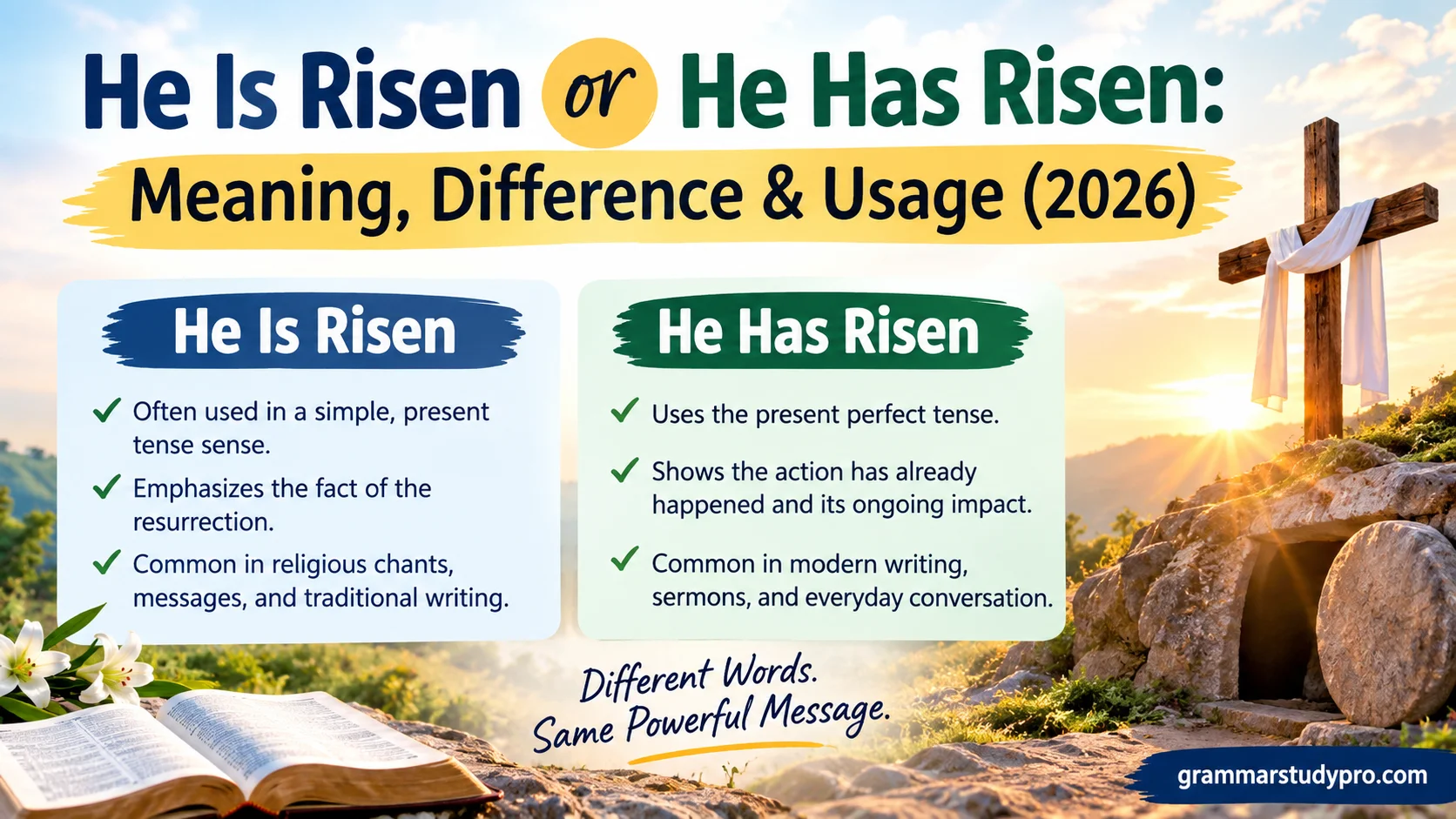
“He has risen” is the standard modern-English construction. It uses the present perfect: has + risen, where risen is the past participle of rise.
“He is risen” is a traditional English construction associated particularly with Christian language, Scripture, Easter worship, hymns, and liturgical greetings. It comes from an older pattern in which be could function as an auxiliary with certain verbs of movement or change of state.
So, if you’re writing ordinary modern English, “He has risen” will usually sound more natural.
If you’re writing an Easter greeting, quoting traditional Christian language, or deliberately using a biblical or liturgical style, “He is risen” remains an established expression.
The difference isn’t simply correct versus incorrect. Context matters.
Comparison Overview
| Phrase | Grammatical form | Typical use | Modern feel |
| He is risen | Traditional be + past participle construction | Easter, worship, traditional Christian language | Formal, biblical, traditional |
| He has risen | Present perfect | Modern English, explanations, contemporary writing | Natural and contemporary |
| He rose | Simple past | Narrating a past event | Direct and modern |
| He was raised | Passive construction | Emphasizing that someone raised him | Modern and precise |
| He has been raised | Present-perfect passive | Formal or explanatory writing | Modern and explicit |
The easiest way to remember the distinction is this:
“He has risen” describes the rising as an accomplished event with present relevance. “He is risen” preserves a traditional way of expressing the risen condition.
There’s also an important biblical detail. English Bible translations don’t all use the same wording for Matthew 28:6. The King James Version says, “he is risen,” while the New International Version says, “he has risen.” The English Standard Version also uses “he has risen.”
That difference alone shows why treating one expression as universally “correct” misses the bigger picture.
Main Differences Between “He Is Risen” and “He Has Risen”
The two expressions point to the same central Christian claim, but they package that idea differently.
“He Has Risen” Uses Modern Present Perfect Grammar
The phrase “he has risen” follows one of the most familiar patterns in contemporary English:
has + past participle
Examples include:
- She has arrived.
- He has left.
- The sun has risen.
- Prices have increased.
- The water level has fallen.
The verb rise has three important forms:
| Verb form | Example |
| rise | He rises early. |
| rose | He rose early. |
| risen | He has risen early. |
Cambridge Dictionary identifies the forms of rise as rise, rose, risen. It also distinguishes rise from raise, explaining that rise is intransitive while raise normally takes an object.
Therefore:
He has risen.
is completely natural modern English.
The phrase presents the resurrection as an accomplished event that has continuing relevance.
“He Is Risen” Preserves an Older English Pattern
Now consider:
He is risen.
To a modern English speaker, this structure may look strange. That’s because contemporary English normally uses have rather than be to form the perfect with rise.
Older English worked differently.
Certain verbs associated with movement, arrival, departure, or changes of state could take be as their auxiliary. Historical examples included constructions comparable to:
- He is come.
- She is gone.
- The sun is set.
- He is risen.
Modern English generally uses has with these verbs when forming the perfect:
- He has come.
- She has gone.
- The sun has set.
- He has risen.
The older pattern survived particularly well in religious, literary, and ceremonial language.
That’s why “He is risen” can sound perfectly familiar during an Easter service while sounding unusual in an everyday conversation.
What Does “He Is Risen” Mean?
In Christian usage, “He is risen” refers to the resurrection of Jesus Christ.
At a basic level, it means that Jesus has risen from the dead and now stands in the risen state.
The phrase also carries something that a plain grammatical translation doesn’t fully capture: tradition.
When someone says:
“He is risen!”
during Easter worship, they’re usually not trying to demonstrate an unusual English tense. They’re making a traditional proclamation.
That’s why the phrase has survived for centuries.
It functions almost like a linguistic heirloom. Its wording comes from an older stage of English, yet generations of Christians have continued to use it.
Why Does “He Is Risen” Sound So Formal?
The phrase has accumulated a strong religious register through repeated use in:
- Bible translations
- Easter services
- Church liturgy
- Sermons
- Hymns
- Religious artwork
- Devotional writing
- Easter cards
- Christian greetings
Language changes quickly in ordinary conversation. Religious language often changes much more slowly.
A phrase can therefore sound old-fashioned while remaining completely recognizable.
Think of expressions such as “thy will be done” or “peace be with you.” People don’t usually speak that way at the grocery store. In worship, however, those forms can feel entirely natural because the setting gives them meaning.
What Does “He Has Risen” Mean?
“He has risen” expresses the same central resurrection event using contemporary English grammar.
The construction is the present perfect:
has + risen
The present perfect connects a completed event with the present.
Consider:
The sun has risen.
The rising happened, but the result matters now because the sun is above the horizon.
Likewise:
He has risen.
presents the rising as an accomplished event with significance in the present.
This makes the phrase especially natural in modern explanatory writing.
For example:
Christian teaching holds that Jesus has risen from the dead.
That sentence doesn’t try to imitate biblical or liturgical language. It simply communicates the idea using contemporary English.
Why Is “He Is Risen” Grammatically Possible?
The history of English explains the apparent contradiction.
Modern English strongly prefers have when forming perfect constructions:
- He has gone.
- She has arrived.
- They have departed.
- He has risen.
Earlier English allowed be with certain verbs, particularly verbs connected with movement and change.
That produced forms such as:
- He is gone.
- He is come.
- They are departed.
- He is risen.
This wasn’t originally a mistake. It reflected a genuine grammatical pattern.
Over time, English shifted toward have for these perfect constructions. The older pattern gradually became less common in everyday speech.
Religious language helped preserve it.
That is why “He is risen” survives today even though a modern speaker would normally say “He has risen.”
Some linguistic discussions describe this as an archaic perfect construction. The important point is that “archaic” doesn’t mean “meaningless” or “badly formed.” It means the construction belongs primarily to an older stage or specialized register of English.
Is “He Is Risen” Passive Voice?
This is one of the most common points of confusion.
At first glance, “is + risen” resembles a passive construction.
Compare:
He was raised by God.
That sentence uses the passive voice. The subject receives the action of raise.
But:
He is risen.
doesn’t automatically mean the same thing.
The historical construction uses be as an auxiliary with risen. It isn’t simply the modern passive equivalent of “someone raised him.”
The distinction becomes much easier when you compare these forms:
| Sentence | Construction | Focus |
| He has risen. | Present perfect active | His rising |
| He is risen. | Traditional/historical construction | His risen state or traditional proclamation |
| He was raised. | Passive | Someone raised him |
| He has been raised. | Present-perfect passive | The completed act of raising him |
So don’t automatically interpret every be + past participle structure as passive.
Context and grammatical history matter.
Rise vs. Raise: The Difference That Causes Even More Confusion
The words rise and raise are closely related, but they don’t work the same way.
Rise Is Intransitive
An intransitive verb doesn’t take a direct object.
Rise means to move upward, get up, or increase.
Examples:
- The sun rises.
- The temperature rose.
- Prices have risen.
- He rose from his seat.
You don’t normally say:
He raised from his seat.
That’s incorrect.
Raise Is Transitive
Raise normally takes an object.
Examples:
- She raised her hand.
- They raised the flag.
- The company raised prices.
- God raised him from the dead.
Cambridge Dictionary specifically explains that raise must have an object, while rise does not take an object.
This distinction becomes crucial when talking about the resurrection.
Compare:
He has risen from the dead.
with:
He was raised from the dead.
The first uses rise. The second uses raise.
The grammatical focus changes.
Rise, Rose, and Risen: The Three Forms You Need to Know
The verb rise is irregular.
Rise — Present or Base Form
Examples:
- Birds rise into the air.
- The sun rises in the east.
- He rises early.
Rose — Simple Past
Use rose for a completed event in the past.
Examples:
- He rose from his chair.
- The sun rose at dawn.
- Prices rose last year.
Don’t put rose after has or have.
Incorrect:
He has rose.
Correct:
He has risen.
Risen — Past Participle
Risen normally appears with an auxiliary such as has, have, or had.
Examples:
- He has risen.
- Prices have risen.
- The water had risen.
- The sun has risen.
The easiest memory trick is:
He rises → He rose → He has risen.
That three-step pattern will eliminate most mistakes.
“He Is Risen” or “He Has Risen” in the Bible
The Bible provides one of the clearest reasons for the confusion.
Matthew 28:6 appears with different wording across English translations.
The King James Version reads:
“He is not here: for he is risen, as he said.”
The New International Version renders the key phrase as:
“He is not here; he has risen, just as he said.”
The English Standard Version also uses “he has risen.” Other translations use constructions such as “he has been raised” or similar modern wording.
This variation matters.
It means there isn’t one universal English wording that every Bible translation must use.
Instead, translators make choices about how to express the underlying biblical text in the English style of their translation.
A Translation Comparison
| Translation | Matthew 28:6 wording |
| King James Version | “he is risen” |
| New International Version | “he has risen” |
| English Standard Version | “he has risen” |
| New Living Translation | “He is risen from the dead” |
| Christian Standard Bible | “he has risen” |
The differences can be seen directly in comparative Bible text resources.
So when someone asks, “Does the Bible say he is risen or he has risen?”, the most accurate answer is:
It depends on the English Bible translation.
That’s much more precise than claiming that every Bible uses one phrase.
Why Christians Still Say “He Is Risen”
If modern English favors “He has risen,” why hasn’t the traditional expression disappeared?
Tradition is the biggest reason.
Religious communities repeat certain phrases across generations. Repetition gives those phrases a special status.
The Easter proclamation is a perfect example:
“He is risen!”
A congregation may respond:
“He is risen indeed!”
The exchange has a ceremonial rhythm. It isn’t merely information. It’s a traditional declaration.
Changing the wording to “He has risen” would preserve the basic meaning while changing the established sound and rhythm.
That’s why both forms continue to exist.
One belongs naturally to modern explanatory English. The other belongs strongly to traditional Christian English.
“He Is Risen Indeed” Meaning
The phrase “He is risen indeed” deserves special attention because it appears frequently in Easter contexts.
Here, indeed adds emphasis.
It can communicate ideas such as:
- Truly
- Certainly
- In truth
- Without doubt
So the traditional response:
“He is risen indeed!”
can be understood in modern language as an emphatic affirmation of the resurrection proclamation.
The expression has become a set phrase in many Christian traditions.
Its power comes partly from its brevity.
Four words carry an enormous amount of religious and cultural meaning.
When Should You Use “He Is Risen”?
Choose “He is risen” when the traditional register is intentional.
Good contexts include:
- Easter cards
- Church bulletins
- Worship services
- Sermons
- Religious artwork
- Traditional hymns
- Devotional writing
- Liturgical greetings
- Historical quotations
- Traditional Christian publications
For example:
He is risen! May your Easter be filled with hope and joy.
That sentence sounds natural because the context supports the traditional expression.
Another example:
The congregation responded, “He is risen indeed!”
Here, changing the wording would make the quotation less faithful to the traditional formula.
When Should You Use “He Has Risen”?
Choose “He has risen” when you’re writing ordinary contemporary English.
It works particularly well in:
- Grammar explanations
- News-style writing
- Academic prose
- General educational content
- Modern religious explanations
- Contemporary essays
- Everyday discussion
For example:
Christianity teaches that Jesus has risen from the dead.
That sounds natural to a modern English reader.
You could also write:
The Gospel accounts describe Jesus as having risen from the dead.
This version fits formal explanatory prose without trying to reproduce a traditional liturgical register.
He Rose vs. He Has Risen
There’s another important distinction.
“He rose” uses the simple past.
“He has risen” uses the present perfect.
Compare:
He rose from the dead.
This simply presents the event as a past occurrence.
Now consider:
He has risen from the dead.
The present perfect connects the completed event with the present.
Neither construction is inherently superior. They simply serve different grammatical purposes.
Example
Imagine writing a historical account:
The disciples discovered that Jesus had risen.
Here, the past perfect works because the rising happened before the disciples’ discovery.
Now imagine a present-day Christian statement:
Christ has risen from the dead.
The present perfect fits the connection between the past event and its continuing significance.
He Has Risen vs. He Had Risen
English learners sometimes overlook had risen, but it follows the same verb pattern.
Has risen
Has + risen
He has risen.
This is present perfect.
Had risen
Had + risen
He had risen.
This is past perfect.
The past perfect places one past event before another past reference point.
For example:
When the women arrived at the tomb, Jesus had risen.
The arrival happened in the past. The rising had already happened before that moment.
The important lesson is that risen remains the past participle in both constructions.
Common Mistakes With “He Is Risen” and “He Has Risen”
Mistake: “He Has Rose”
This is one of the most common errors.
❌ He has rose.
✅ He has risen.
Why?
Because rose is the simple past while risen is the past participle.
Mistake: “He Risen”
❌ He risen from the dead.
✅ He rose from the dead.
or
✅ He has risen from the dead.
The form risen normally needs an auxiliary.
Mistake: “He Is Rose”
❌ He is rose.
✅ He is risen.
or
✅ He has risen.
The phrase “he is rose” doesn’t use the correct form of rise.
Mistake: “He Has Raised”
This mistake comes from confusing rise and raise.
❌ He has raised from the dead.
If the subject itself performs the rising, use:
✅ He has risen from the dead.
If someone raises the subject, use the passive:
✅ He has been raised from the dead.
Cambridge’s grammar guidance makes the core distinction straightforward: rise does not take a direct object while raise does.
Is “He Is Risen” Archaic or Traditional?
The most useful description is traditional or archaic English usage, depending on context.
Calling it simply “wrong” doesn’t explain why the phrase appears in established Christian language.
Calling it ordinary modern English would also be misleading.
The better explanation recognizes both facts:
Modern English:
“He has risen” is the normal present-perfect construction.
Traditional Christian English:
“He is risen” is an established expression with historical roots.
That’s why the phrase can sound old-fashioned without being meaningless.
Language is full of survivors. Words and structures sometimes remain alive inside particular communities long after everyday speech changes.
Case Study: Three Ways to Describe the Same Resurrection
Consider three writers discussing the same event.
A modern English teacher
“He has risen” uses the present perfect because risen is the past participle of rise.
The goal here is grammar. Modern wording makes sense.
A historian
The traditional English expression is “He is risen.”
The historian is discussing language and tradition.
A church congregation
“He is risen!”
Here, the phrase functions as a religious proclamation.
The underlying subject is the same. The register changes.
That is the real key to understanding the difference.
A Practical Guide to Choosing the Right Phrase
Use this simple decision process.
Are you writing ordinary modern English?
Use:
He has risen.
Are you writing an Easter greeting?
Use:
He is risen!
if you want the traditional Christian expression.
Are you describing a past historical event?
Use:
He rose.
Are you emphasizing that someone raised him?
Use:
He was raised.
Are you writing about something that happened before another past event?
Use:
He had risen.
This approach keeps grammar and context working together rather than treating one expression as universally correct.
Quick Examples of “He Is Risen” vs. “He Has Risen”
| Context | Example |
| Easter greeting | He is risen! |
| Traditional worship | He is risen indeed! |
| Modern article | He has risen from the dead. |
| Grammar lesson | “He has risen” uses the present perfect. |
| Historical narration | He rose from the dead. |
| Passive construction | He was raised from the dead. |
| Past-perfect context | He had risen before they arrived. |
| Traditional quotation | Preserve the original wording |
The surrounding sentence matters just as much as the verb itself.
Why “He Is Risen” Sounds More Powerful at Easter
Grammar isn’t the only reason the traditional phrase feels distinctive.
Sound and rhythm matter.
“He is risen” has a compact, memorable cadence. The three words move quickly from subject to present state.
It also carries centuries of repetition.
A phrase repeated through sermons, hymns, Bible readings, artwork, and Easter celebrations gains cultural weight. Eventually, people recognize it instantly.
That doesn’t make it more grammatically modern.
It makes it more culturally established.
This distinction matters because language isn’t just a set of mechanical rules. Register, history, rhythm, and community usage all shape how a phrase works.
Is “He Has Risen” More Correct Than “He Is Risen”?
For ordinary modern English grammar, “He has risen” is the expected construction.
But saying that “He is risen” is simply incorrect would leave out its historical and religious function.
A more accurate distinction is:
- He has risen → standard contemporary construction
- He is risen → traditional construction preserved especially in Christian language
Both expressions remain understandable.
The appropriate choice depends on what you’re trying to accomplish.
If you’re writing a grammar textbook, modern prose, or general explanation, “He has risen” fits naturally.
If you’re writing a traditional Easter greeting, “He is risen” carries the established form that readers expect.
FAQs
Is “He Is Risen” grammatically correct?
Yes, “He Is Risen” is grammatically meaningful, but it is an older English construction. In modern everyday English, “He has risen” is the usual form.
Is “He Has Risen” the correct modern form?
Yes. “He has risen” follows the modern present perfect tense, using has as the auxiliary verb. It is the natural choice in contemporary English.
Why do people say “He Is Risen”?
The phrase “He is risen” survives mainly because of its religious, historical, and traditional use. It is strongly associated with Easter, Christian worship, and older biblical language.
What is the difference between “He Is Risen” and “He Has Risen”?
“He has risen” emphasizes the completed action and its present result. “He is risen” uses an older construction that can emphasize the resulting state. Both forms have a long connection with religious language.
Should I use “He Is Risen” or “He Has Risen”?
For modern English writing, use “He has risen.” If you are quoting a traditional religious expression or discussing historical language, “He is risen” can be appropriate.
Conclusion
The difference between “He Is Risen” and “He Has Risen” comes from changes in English grammar and usage. “He has risen” is the standard modern form because it follows the present perfect construction used in contemporary English. “He is risen,” meanwhile, preserves an older grammatical pattern that remains familiar through Christian tradition, Easter, worship, and historical texts. Understanding this distinction helps you choose the form that fits your context while appreciating why both expressions continue to appear.