Company-Wide or Companywide can seem confusing when you are writing an email and need the correct form for business writing.
If you’ve ever stopped while writing an email to wonder about company wide, companywide, or company-wide, you are not alone. This tiny difference often creates confusion in official communication and professional writing because spelling, word choice, and consistency influence clarity and professionalism. From my experience, it helps to understand that companywide is the one-word form, company-wide is the hyphenated form, and company wide is the open form. All three can appear in current English, although your chosen style standard, style guide, editorial style, or company preference should guide your choice. Cambridge’s Business English Dictionary describes the term as relating to or affecting the whole company, which helps clarify its meaning.
When deciding between the forms, modern English usage and usage rules provide useful guidance. The trend is to drop the hyphen and choose companywide, which remains popular in general American business writing in 2026. However, a style guide, publication, or editorial style guide may deliberately choose company-wide. The key is to follow your chosen standard consistently instead of searching for a universal spelling. Hyphens can clarify meaning by linking words closely together. As a general rule, a compound adjective or compound modifier placed before a noun can join two words that describe another word, especially when there is potential confusion. For example, a company-wide policy may appear clearer because the terms are visibly linked.
The grammar becomes easier when you consider how adjectives work with a noun. An attributive adjective usually comes before a noun, while a postpositive adjective can come after a noun. When these forms appear after nouns or stand alone, writers may skip the hyphen and use the closed form. That makes companywide useful as both an adjective and adverb in business communication. Its proper usage, grammar rules, writing rules, and punctuation should still match the selected style guide and company preference. A simple example is “a company-wide policy,” while another sentence might say, “the policy applies companywide.” These practical examples show how word formation, compound words, compound, term, spelling question, and English usage connect to a single writing decision. The right form depends on the context, personal preference, and writing standard you follow rather than simply choosing the spelling that looks most familiar.
Quick Answer
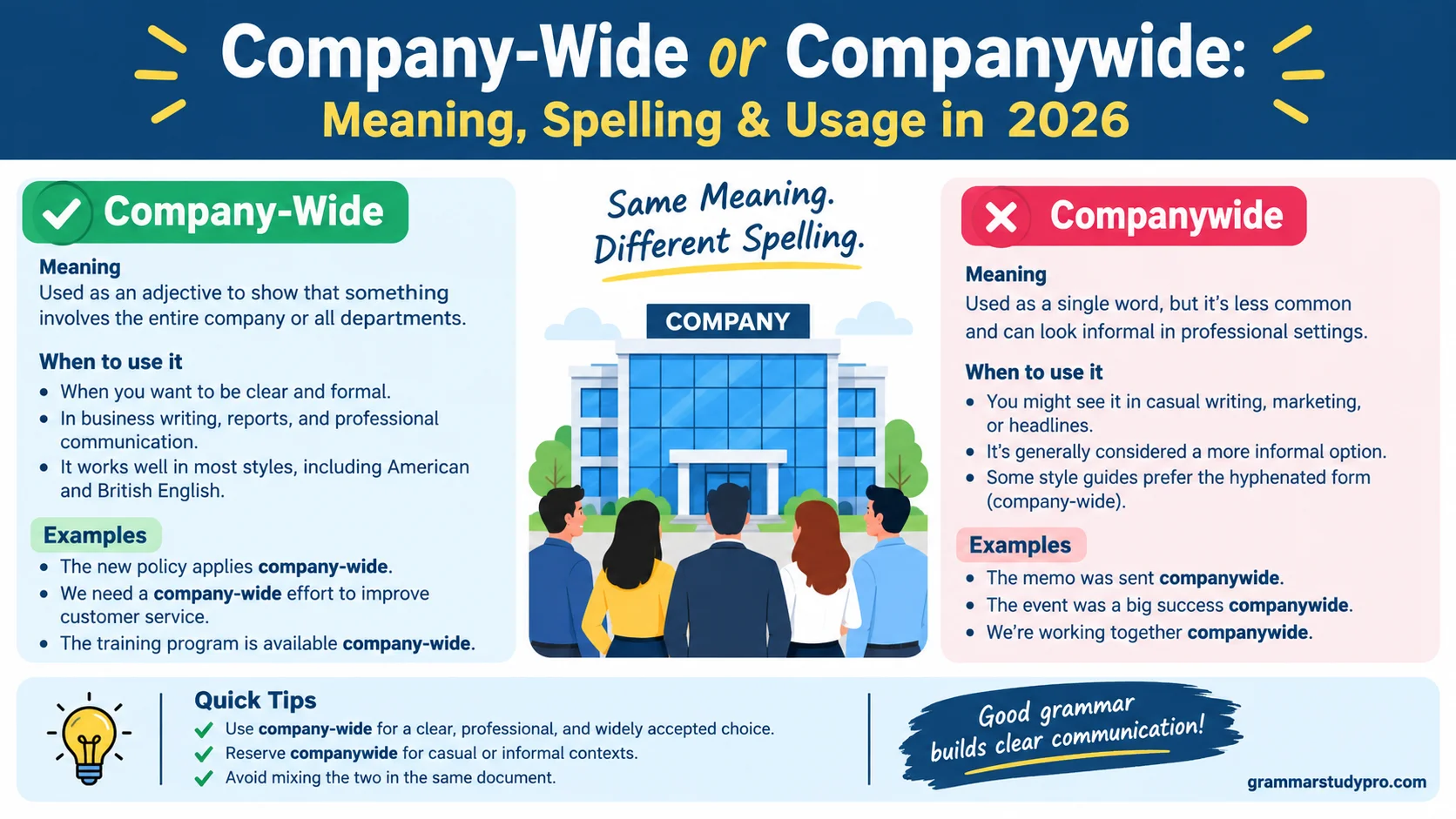
Companywide and company-wide can both mean throughout an entire company or affecting the company as a whole.
The important distinction is spelling and style rather than meaning.
- Companywide = closed compound, written as one word.
- Company-wide = hyphenated compound.
- Company wide = open form, which Cambridge also records but which is less useful when you’re deliberately treating the phrase as a single compound term.
If you need one practical choice for ordinary professional writing, companywide is a straightforward modern option.
For example:
The companywide policy takes effect Monday.
You could also write:
The company-wide policy takes effect Monday.
The meaning remains the same.
The best choice depends on the style rules governing your document. If your employer’s style guide says company-wide, use it. If your publication follows a style that uses companywide, use that consistently.
The Associated Press currently publishes the 58th edition of the AP Stylebook for 2026–2028, showing how actively professional style guidance continues to evolve.
Comparison Overview
| Form | Meaning | Structure | Typical consideration |
| companywide | Throughout the entire company | One word | Clean closed compound |
| company-wide | Throughout the entire company | Hyphenated | Makes the compound structure explicit |
| company wide | Can express the same idea | Two words | Less useful when intended as a fixed compound |
| across the company | Throughout the company | Phrase | Natural conversational alternative |
| throughout the company | Throughout the company | Phrase | Very clear and formal |
Cambridge explicitly lists company-wide as its dictionary headword while noting companywide and company wide as alternatives. That is useful evidence because it shows that current dictionary treatment doesn’t support the idea that only one spelling exists.
The bigger lesson is simple: English compound words don’t always behave like neatly engineered machines. Usage develops over time, dictionaries record that usage, and style guides sometimes impose additional consistency rules.
Main Differences Between Company-Wide and Companywide
The two main forms generally communicate the same idea. Their differences come from format, editorial preference, and grammatical treatment.
Companywide
Companywide is a closed compound.
The two elements, company and wide, combine into one word.
Examples include:
- companywide policy
- companywide meeting
- companywide training
- companywide announcement
- companywide survey
- companywide initiative
- companywide rollout
- companywide standards
You can also use it after a verb:
The new software will be available companywide.
That construction is compact and natural.
Company-wide
Company-wide joins the same elements with a hyphen.
Examples include:
- company-wide policy
- company-wide meeting
- company-wide training
- company-wide announcement
- company-wide initiative
The hyphen tells the reader that company and wide work together as a compound modifier.
Consider:
The company-wide training begins Monday.
Here, company-wide describes training. The hyphen makes that relationship visually obvious.
Company wide
The open form contains a space:
company wide
Cambridge recognizes this form as an alternative.
However, if you’re writing a compound expression that means “throughout the company,” choosing either companywide or company-wide usually gives you a cleaner result.
What Does Companywide Mean?
Companywide means extending throughout an entire company or affecting the company as a whole.
It describes something that reaches beyond a single department, office, team, or business unit.
For example:
The companywide training program applies to all employees.
The word tells readers that the training isn’t limited to the sales department or headquarters. Its scope covers the company.
Cambridge gives the core meaning as something “relating to or affecting the whole of a company.”
That definition captures the word’s most important feature: scope.
Imagine a company with five departments:
- Human resources
- Finance
- Sales
- Marketing
- Information technology
A new training course for the finance department isn’t companywide.
A training course required by employees in all five departments is companywide.
The distinction sounds obvious when explained this way. In business documents, however, scope can matter considerably.
A sentence such as:
The companywide security policy applies to all employees.
makes a much broader claim than:
The IT department’s security policy applies to technical staff.
The first describes an organization-level rule. The second describes a department-level rule.
How to Spell Companywide Correctly
When you choose the closed form, write it as:
companywide
Not:
company wide
And not:
company-wide
if your chosen style specifically requires the closed form.
The word follows a familiar English pattern involving -wide.
Consider:
- worldwide
- nationwide
- statewide
- citywide
- industrywide
- companywide
These compounds describe something extending across a particular area, group, or scope.
That doesn’t mean every -wide construction must be written as one word. English spelling doesn’t operate through one universal formula. Dictionary entries and established usage still matter.
That’s why checking an authoritative reference remains useful when a compound looks unfamiliar.
Is Companywide One Word?
Yes. Companywide is one word.
It is a closed compound formed from company and wide.
For example:
The companywide initiative launches next month.
Management introduced companywide safety standards.
The software update will roll out companywide.
Cambridge’s entry specifically identifies companywide as an alternative to its hyphenated headword.
The closed spelling also appears in established professional and journalistic usage. For example, Wiktionary records companywide as an English adjective and cites a 2009 New York Times example using the closed form.
So if a spell checker accepts companywide, it isn’t necessarily overlooking an error. The word has established usage.
Is Company-Wide Correct?
Yes. Company-wide is also an established form.
This matters because it would be misleading to tell writers that the hyphenated version is simply wrong.
Cambridge uses company-wide as its main entry and explicitly lists companywide as another form.
For example:
The company-wide recruitment freeze affects every department.
We announced a company-wide training program.
The company-wide initiative begins in January.
The hyphen connects company and wide into a single modifier.
That can be particularly useful when you’re writing for an organization with a formal editorial style.
Why the Hyphen Still Appears
Hyphens often survive because they make compound relationships easier to recognize.
A reader sees:
company-wide policy
and immediately understands that company-wide functions as one description of policy.
That visual cue can help in dense business writing, where readers often scan rather than read every sentence slowly.
Still, a hyphen isn’t automatically required simply because two words work together.
Established compounds can become closed over time. That’s one reason English contains familiar forms such as worldwide and nationwide.
Companywide as an Adjective
The most common use of companywide is as an adjective.
An adjective modifies a noun. Here, companywide tells you that something covers the whole company.
Common companywide phrases
You might see:
- companywide policy
- companywide meeting
- companywide survey
- companywide announcement
- companywide initiative
- companywide training
- companywide standard
- companywide restructuring
- companywide system
- companywide campaign
- companywide change
- companywide rollout
Consider the difference between these sentences:
The marketing department introduced a new reporting process.
and:
The company introduced a new companywide reporting process.
The first sentence limits the action to marketing. The second expands its reach to the entire organization.
That single compound word can therefore carry important information about organizational scope.
Companywide as an Adverb
Companywide can also work adverbially.
In that role, it describes an action that happens throughout the company.
For example:
The new system will be implemented companywide.
The policy takes effect companywide next month.
The update has already been deployed companywide.
Here, companywide doesn’t directly modify a noun. Instead, it explains where or across what scope the action occurs.
You can often replace it with a longer phrase:
The new system will be implemented throughout the company.
Both versions communicate the same basic idea.
The first is more compact. The second may sound more natural in conversational prose.
Company-Wide vs. Companywide in Sentences
Here’s where the issue becomes practical.
| Sentence | Form |
| The companywide policy begins Monday. | Closed |
| The company-wide policy begins Monday. | Hyphenated |
| The policy applies companywide. | Closed |
| The policy applies company-wide. | Hyphenated |
| The policy applies throughout the company. | Phrase |
The first two sentences have essentially the same meaning.
The same applies to the third and fourth sentences.
What changes is the orthographic presentation, not the basic concept.
This is why style consistency matters. Imagine a 50-page employee handbook that uses companywide on one page, company-wide on another, and company wide on a third.
Readers probably won’t misunderstand the document. But inconsistent terminology can make the publication look poorly edited.
A consistent house style solves that problem.
When Should You Use Companywide?
Choose companywide when your writing context accepts the closed compound and you want a concise modern form.
It works particularly well in:
- Business websites
- Internal communications
- HR materials
- Employee handbooks
- Corporate reports
- Product announcements
- Business blogs
- Workplace emails
- Newsletters
- Training documents
For example:
The companywide benefits update takes effect July 1.
That’s compact and clear.
You could write throughout the company instead, but you’d need three words instead of one.
A useful rule
If your organization has a house style, follow the house style first.
If it doesn’t, choose a reputable reference and apply its approach consistently.
The Associated Press maintains an actively updated style system for journalists and professional communicators. Its current 58th edition covers 2026–2028.
When Is Company-Wide Appropriate?
Use company-wide when your editorial rules call for the hyphenated form or when you deliberately want the compound structure to remain visible.
This can make sense in:
- Formal corporate documents
- Editorial publications
- Legal or compliance materials
- Brand style guides
- Documents governed by a specific publishing standard
- Organizations that have standardized the hyphenated spelling
Some companies explicitly establish their own terminology rules.
For example, Gainsight’s published content style guide specifies company-wide rather than companywide or company wide.
That example demonstrates an important point: a company’s own style guide can override a writer’s personal preference.
If the organization’s official documentation says company-wide, changing every instance to companywide isn’t necessarily an improvement.
Consistency wins.
Companywide vs. Company Wide: What’s the Difference?
The open form company wide deserves special attention.
Cambridge records company wide as an alternative.
However, writers should distinguish between a naturally open phrase and a compound word that they intend to treat as one established unit.
Compare:
The announcement was distributed companywide.
with:
The announcement was distributed throughout the company.
The second sentence avoids the spelling question entirely.
If the intended construction is the established compound adjective, however, these are the natural choices:
a companywide announcement
or:
a company-wide announcement
The important point is not to assume that the presence of a space automatically makes the phrase clearer.
Sometimes it does the opposite.
Why Does English Use Both Companywide and Company-Wide?
English compounds have a habit of changing shape.
Words that begin as separate elements can eventually become hyphenated. Some then become closed compounds after readers become familiar with them.
Think about familiar words such as:
- website
- online
- worldwide
- nationwide
The process isn’t perfectly predictable. Language isn’t a spreadsheet.
Dictionary editors observe established usage while style guides create conventions for specific audiences. As a result, two authoritative resources can sometimes present different preferences without one necessarily declaring the other form meaningless.
Cambridge provides a useful real-world example. Its entry is headed company-wide, yet it explicitly recognizes companywide and company wide.
That is exactly why simplistic grammar advice can cause problems.
Companywide vs. Enterprise-Wide
These terms overlap, but they’re not always interchangeable.
Companywide
Companywide normally refers to the entire company.
The companywide training program is mandatory.
Enterprise-wide
Enterprise-wide often describes something spanning an entire enterprise, particularly in large organizations or technology environments.
The enterprise-wide identity system connects multiple business units.
The distinction becomes useful when a corporation operates through several divisions, subsidiaries, or major organizational units.
A technology project might be described as enterprise-wide because it covers a broad organizational ecosystem. A policy affecting every employee within one company can simply be companywide.
Don’t choose the longer term merely because it sounds more sophisticated. Precision beats corporate jargon.
Companywide vs. Organization-Wide
Companywide refers specifically to a company.
Organization-wide has a broader scope.
An organization could be:
- A company
- A nonprofit
- A university
- A government agency
- A professional association
- A foundation
- Another structured institution
For example:
The companywide policy affects every employee.
But:
The organization-wide policy applies to employees, volunteers, and contractors.
The second sentence may describe a broader institutional structure.
This distinction becomes especially useful when writing for mixed audiences.
Companywide vs. Nationwide vs. Worldwide
The -wide ending generally signals the scope of something.
| Term | Scope | Example |
| companywide | Entire company | companywide policy |
| organization-wide | Entire organization | organization-wide reform |
| nationwide | Entire nation | nationwide program |
| statewide | Entire state | statewide initiative |
| worldwide | Entire world | worldwide demand |
| industrywide | Entire industry | industrywide standard |
These words aren’t interchangeable.
A companywide policy doesn’t necessarily apply to an entire industry.
A nationwide campaign doesn’t necessarily reach every company.
A worldwide product launch has a much broader geographic scope than a companywide employee initiative.
The suffix may look similar, but the noun attached to -wide determines what the word covers.
Capitalization: Should Companywide Be Capitalized?
In ordinary writing, companywide is lowercase.
For example:
The companywide policy begins tomorrow.
Not:
The Companywide policy begins tomorrow.
You might capitalize it when it appears in a title or heading under a title-case system:
Companywide Policy Changes for 2026
That’s a capitalization rule for the heading, not a special property of the word.
The same principle applies to company-wide:
Company-Wide Policy Changes
Follow the capitalization system used by the rest of the document.
Common Companywide Spelling Mistakes
Small errors become easier to avoid once you know what causes them.
Writing company wide automatically
Some writers see company and wide as two ordinary words and leave a space between them.
If you’re deliberately using the established compound, choose:
companywide
or:
company-wide
Assuming company-wide is wrong
It isn’t.
Cambridge explicitly recognizes the hyphenated form and lists companywide as an alternative.
Assuming companywide is a typo
It isn’t, either.
Current dictionary treatment and real-world usage support the closed form.
Switching between forms randomly
This creates an editing problem rather than a grammar disaster.
A document that consistently uses one form looks more deliberate.
Using companywide for something that affects only one department
This is a meaning problem.
If only the sales team receives the new training, calling it a companywide training program exaggerates its scope.
Use department-wide, department-specific, or simply name the department.
Case Study: A Companywide Policy Announcement
Consider a fictional company with 2,000 employees across six departments.
Management introduces a new cybersecurity policy. Every employee must complete training, regardless of role.
A clear announcement could say:
The companywide cybersecurity training program begins Monday.
Why does companywide work?
Because the program covers the organization as a whole.
Now imagine that only engineers must complete an advanced security module.
This would be more precise:
The engineering department will complete an additional security module.
Calling that additional module companywide would blur the scope.
The lesson is bigger than spelling: compound words often carry operational information.
In workplace writing, precision matters because employees act on what those words imply.
Case Study: Choosing a Style for a Corporate Website
Imagine a company publishing hundreds of articles every year.
Its editorial team has two choices:
- Use companywide everywhere.
- Use company-wide everywhere.
Either approach can produce readable content.
The real problem would arise if different writers made different choices without an editorial rule.
One article might say:
The companywide initiative starts today.
Another might say:
The company-wide initiative starts today.
Neither sentence creates a major comprehension problem. Yet the inconsistency can make the site feel fragmented.
A simple editorial rule solves it:
Use companywide throughout all general web copy unless a quoted source or official name requires another form.
The exact rule can differ. Consistency is the important part.
How to Choose Between Companywide and Company-Wide
Use this quick decision process.
First, identify the meaning.
Does the word mean throughout the entire company?
If yes, continue.
Next, check your style guide.
Does your organization specify companywide?
Use it.
Does it specify company-wide?
Use that.
No style guide?
Choose a reputable dictionary or editorial standard and stay consistent.
Simple decision guide
| Situation | Practical choice |
| General modern business writing | companywide |
| Organization requires hyphenation | company-wide |
| Publication has a house style | Follow that style |
| Need maximum conversational clarity | throughout the company |
| Referring to an entire organization rather than a company | organization-wide |
| Referring to a large enterprise ecosystem | enterprise-wide, when accurate |
The important thing is to avoid turning a small spelling question into a giant grammar headache.
Alternatives to Companywide
Sometimes the best solution isn’t choosing between two spellings.
You can simply rewrite the sentence.
Useful alternatives include:
- throughout the company
- across the company
- across the entire company
- for all employees
- throughout the organization
- organization-wide
- enterprise-wide
- firm-wide
- business-wide
Consider these examples:
The policy will be implemented companywide.
The policy will be implemented throughout the company.
The policy will be implemented across the company.
All three work.
The choice depends on tone, repetition, and precision.
Companywide is compact. Throughout the company is explicit. Across the company sounds conversational.
Good writers don’t treat synonyms as interchangeable Lego pieces. They choose the one that fits the sentence.
Companywide in Different Types of Business Writing
Human Resources
The companywide benefits update takes effect January 1.
This tells employees that the change applies across the organization.
Technology
The security patch will be deployed companywide.
Here, the adverb describes the scope of the deployment.
Management
Leadership approved a companywide restructuring plan.
The adjective tells readers that the restructuring isn’t confined to one division.
Marketing
The company launched a companywide customer-service campaign.
The campaign covers the organization rather than one team.
Internal Communication
A companywide announcement will be sent Friday.
This signals that the message is intended for the entire workforce.
Training
The new compliance course is required companywide.
Again, the word communicates organizational scope in a single compact term.
Why Consistency Matters More Than the Hyphen
Grammar discussions sometimes make spelling choices sound like matters of life and death.
This one isn’t.
The difference between companywide and company-wide rarely changes the meaning of a sentence. What matters more is whether your document uses the same convention throughout.
For example, avoid this:
The companywide policy affects everyone.
followed two pages later by:
The company-wide training begins Monday.
Unless there’s a deliberate reason for the change, pick one form.
A style sheet can settle the matter in seconds.
A basic entry might look like this:
| Term | House style |
| companywide | Preferred |
| company-wide | Avoid unless quoted |
| company wide | Avoid as a compound |
| worldwide | Closed |
| nationwide | Closed |
| organization-wide | Hyphenated |
That’s enough to keep a large team aligned.
What Dictionaries and Style Guides Tell Us
One of the most useful lessons from this debate is that dictionaries and style guides serve different purposes.
A dictionary records words, meanings, spellings, and usage.
A style guide establishes conventions for a particular type of writing.
Those aren’t the same job.
Cambridge’s Business English Dictionary provides a particularly clear example. It lists company-wide as the entry while recognizing companywide and company wide as alternatives.
Meanwhile, the Associated Press maintains a continuously updated style system designed for professional journalism and related communication. Its current print edition is the 58th edition, covering 2026–2028.
That difference explains why online grammar articles sometimes give conflicting answers.
One source may describe dictionary usage.
Another may describe a specific editorial house style.
Another may simply recommend what its author prefers.
The strongest approach is to identify which authority applies to your writing.
Formal vs. Informal Use of Companywide
You don’t need to reserve companywide for highly formal writing.
It works comfortably in everyday professional communication.
Formal
The companywide implementation of the revised compliance framework will begin in October.
Standard professional
The companywide policy starts October 1.
Conversational
The change affects everyone across the company.
The third version may be preferable when the goal is warmth and accessibility.
That’s an important writing principle: correct doesn’t always mean optimal.
A sentence can be grammatically sound yet unnecessarily stiff.
FAQs
Is “companywide” or “company-wide” correct?
Both companywide and company-wide are accepted forms. Companywide is the closed form, while company-wide uses a hyphen. Your style guide or organization’s preferred standard can determine which form you should use.
Is “company wide” also correct?
Company wide appears as an open form, but it is less common in modern business writing. In most cases, writers choose either companywide or company-wide for clearer and more consistent usage.
Should I use a hyphen in “company-wide policy”?
Yes, company-wide policy is a clear example of the hyphenated form. The hyphen connects the words when they work together as a compound modifier before the noun policy.
Is “companywide” one word?
Yes. Companywide is written as one word without a hyphen. It is commonly used in modern American business writing and can function as an adjective or adverb depending on the sentence.
Which form should I use in professional writing?
Choose the form required by your style guide, company policy, or publication standard. If there is no specific rule, choose one accepted form and use it consistently throughout your document.
Conclusion
Companywide and company-wide are both established forms, while company wide is also found in English usage. The main difference is how the words are formed and used in a sentence. For professional writing, consistency matters more than switching between forms. Check your preferred style guide, consider the sentence structure, and use the selected spelling consistently across your emails, reports, policies, and other business documents.