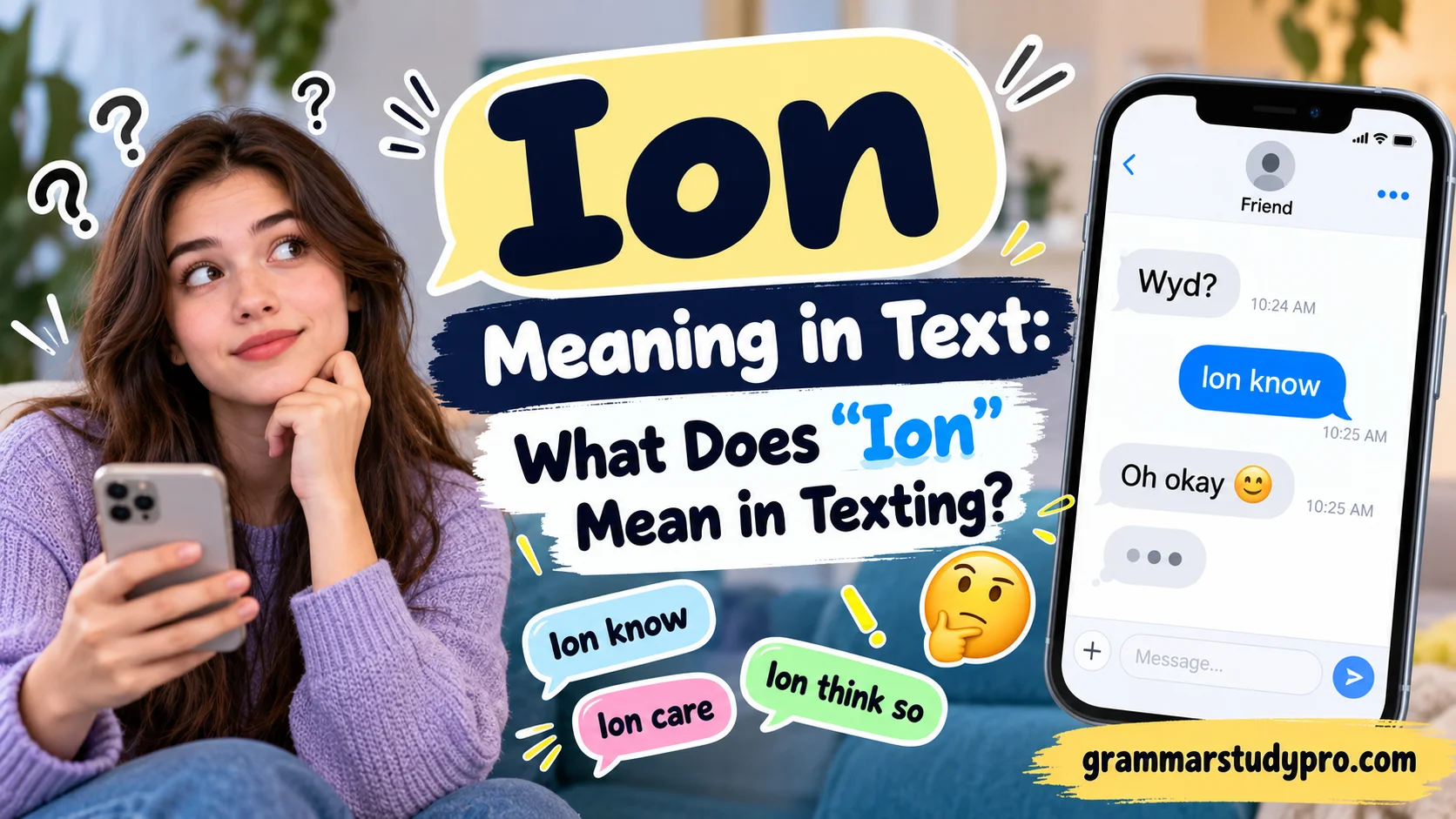
The Ion Meaning in Text is “I don’t,” a shortcut used in casual texting, online chats, and everyday conversations. This Gen Z slang appears in social media, group chats, and informal digital communication. People use shortened words, abbreviations, and quick expressions to save time and make messaging easier. Unlike acronyms such as LOL or initialisms such as BRB, ion reflects how a phrase sounds when spoken aloud. Although its spelling might seem confusing, the surrounding conversation usually reveals its intended meaning.
For example, someone might ask, “Hey, did you catch the new episode of Love Is Blind on Netflix?” A friend could reply, “Nah, ion watch reality TV.” In this example, ion expresses a negative response and means “I don’t watch reality TV.” Similar shortcuts help people communicate quickly without typing full sentences. Other popular expressions include TBH and ICYMI, each with a different meaning. When interpreting texting slang, pay attention to the conversational context instead of relying on spelling alone. Social media chats, group messaging, and everyday texting often use these expressions naturally.
However, ion has another meaning in science. A scientific ion is an electrically charged atom or molecule, which differs from the slang expression used in digital communication. Context helps distinguish these meanings. In informal settings, pronunciation, phonetics, and letter combinations can influence how people shorten phrases. Character limits and abbreviation rules on certain platforms have also encouraged digital shorthand, including typed shorthand and other shortened expressions. Understanding the difference between internet slang, scientific terminology, and ordinary written language makes online communication easier to follow.
Quick Answer: What Does “Ion” Mean in Text?
In casual texting, “ion” most commonly means “I don’t.”
It works as an informal, phonetic spelling of the phrase. For example:
- “ion know” = “I don’t know”
- “ion care” = “I don’t care”
- “ion want that” = “I don’t want that”
- “ion think so” = “I don’t think so”
- “ion remember” = “I don’t remember”
Dictionary.com describes this slang use as a spelling based on the colloquial pronunciation of “I don’t” and connects it with Black English.
However, context matters. Uppercase “ION” can also mean “In Other News,” especially when someone uses it to change the subject. And in science, an ion is an electrically charged atomic or molecular particle.
What Does “Ion” Mean in Texting?
The most common ion meaning in text is simply “I don’t.”
Unlike abbreviations such as “idk” or “idc,” this form isn’t built from the first letters of several words. Instead, it represents how “I don’t” can sound in fast, casual speech.
That distinction matters.
When people write “ion know,” they’re not necessarily trying to save a few keystrokes. The spelling can also reproduce the rhythm and sound of informal speech. Digital language often works this way. People write expressions that resemble how they actually talk.
For example:
“Ion know what happened.”
The standard-English version is:
“I don’t know what happened.”
The meaning hasn’t changed. The register has.
“ I don’t know” sounds neutral and standard. “Ion know” sounds much more casual and conversational.
Common Examples of “Ion” Meaning “I Don’t”
| Texting phrase | Standard English meaning |
| ion know | I don’t know |
| ion care | I don’t care |
| ion want it | I don’t want it |
| ion need it | I don’t need it |
| ion think so | I don’t think so |
| ion remember | I don’t remember |
| ion understand | I don’t understand |
| ion like it | I don’t like it |
| ion wanna go | I don’t want to go |
| ion see it | I don’t see it |
The exact interpretation comes from whatever follows “ion.” That’s why reading the entire message matters more than translating the word in isolation.
Why Does “Ion” Mean “I Don’t”?
The spelling comes from informal pronunciation rather than standard spelling rules.
Say “I don’t” quickly in casual conversation. Depending on the speaker and speech variety, the phrase can become compressed enough that a listener hears something resembling “ion.” Writing the sound as “ion” turns that spoken shortcut into text.
This kind of spelling isn’t unusual online.
Consider expressions such as:
- gonna → going to
- wanna → want to
- gotta → got to
- lemme → let me
These forms aren’t identical to “ion,” but they demonstrate a broader phenomenon: informal writing often captures speech instead of following formal orthography.
Dictionary.com notes that examples of ion meaning “I don’t” appear in internet writing from the 2000s, including an example dated August 2007. That means the slang predates TikTok by many years.
Some modern explanations incorrectly describe the term as something that appeared only after TikTok became popular. TikTok and other social platforms certainly helped slang reach larger audiences, but they didn’t create this particular spelling. Historical examples show earlier internet usage.
The Connection Between “Ion” and Black English
The slang use of “ion” has an important linguistic context.
Dictionary.com identifies it as a Black slang rendering of “I don’t” and connects the spelling with colloquial pronunciation in Black English.
That context is worth mentioning because internet slang doesn’t appear out of nowhere. Many expressions that become widespread online develop within particular speech communities before moving into broader digital culture.
Social media can accelerate that process dramatically. A phrase that once circulated primarily within particular communities can become recognizable to millions of people within a few years.
That doesn’t mean every person using “ion” belongs to the speech community where the form developed. Language spreads. Once a term becomes familiar online, people from many backgrounds may adopt it.
The important point is to avoid treating the spelling as meaningless internet gibberish. It has a recognizable linguistic pattern and a documented history.
How to Understand “Ion” in a Text Message
The easiest way to decode ion meaning in text is to examine the words immediately around it.
Look at What Comes After “Ion”
If “ion” comes before a verb or verb phrase, “I don’t” is often the natural interpretation.
For example:
“ion know what you’re saying.”
That translates naturally to:
“I don’t know what you’re saying.”
Another example:
“ion wanna argue.”
This means:
“I don’t want to argue.”
The grammar gives you the clue.
Look at the Conversation
Context can change the emotional meaning of the same phrase.
Imagine someone asks:
“Are you coming to the party?”
The response:
“ion know.”
usually means:
“I don’t know.”
Now imagine someone says:
“You should apologize.”
The response:
“ion care.”
means:
“I don’t care.”
The words themselves are simple. The surrounding conversation tells you whether the speaker sounds uncertain, dismissive, frustrated, playful, or simply casual.
Check Capitalization and Punctuation
Digital communication doesn’t follow punctuation rules as rigidly as formal writing.
You might see:
- ion know
- ION KNOW
- ion know 😭
- ion know lol
- ion know…
The basic meaning stays similar. The tone changes.
For instance, all-caps can add emphasis. An emoji can soften or exaggerate the statement. “Lol” can make a blunt response feel more playful.
That’s one reason translating slang word-for-word doesn’t always capture the full message.
“Ion” Examples in Realistic Text Conversations
Seeing the term inside a conversation makes its meaning much easier to recognize.
Example: Uncertainty
Person A: “Do you know where Marcus went?”
Person B: “ion know.”
Meaning:
“I don’t know.”
Here, the phrase is straightforward. There’s no hidden meaning.
Example: Refusal
Person A: “Come with us tonight.”
Person B: “ion wanna go.”
Meaning:
“I don’t want to go.”
The slang makes the reply feel informal and conversational.
Example: Disagreement
Person A: “That movie was amazing.”
Person B: “ion think it was that good.”
Meaning:
“I don’t think it was that good.”
The phrase expresses an opinion while maintaining a casual tone.
Example: Humor
Person A: “You really spent all your money on sneakers?”
Person B: “ion regret it 😭”
Meaning:
“I don’t regret it.”
Here, the slang and emoji work together. The message feels playful rather than formal.
How “Ion” Can Change the Tone of a Message
One subtle part of ion meaning in text is tone.
Compare these messages:
“I don’t know.”
“ion know.”
“ION KNOW 😭”
They communicate roughly the same basic idea. Yet they don’t feel identical.
The first sounds neutral and standard.
The second feels relaxed and conversational.
The third can sound exaggerated, humorous, frustrated, or overwhelmed depending on the conversation.
This is one reason slang matters. Words carry social information in addition to dictionary meaning.
The spelling can signal familiarity, informality, humor, or a particular online communication style.
What Does “ION” Mean Besides “I Don’t”?
Here’s where things get interesting.
ION can also mean “In Other News.”
This is a different abbreviation with a different function. Rather than expressing “I don’t,” it usually helps someone shift the conversation to another subject.
Dictionary.com documents this use as an internet abbreviation meaning “in other news.” It notes that the expression can work as a transition between topics.
For example:
“ION, did you finish that project?”
Here, “ION” isn’t “I don’t.”
It means:
“In other news, did you finish that project?”
How to Tell the Two Meanings Apart
The sentence structure usually gives the answer away.
| Usage | Example | Meaning |
| ion + verb phrase | “ion know” | I don’t know |
| ion + verb phrase | “ion care” | I don’t care |
| ION + topic shift | “ION, did you see that movie?” | In Other News |
| Science context | “Na⁺ ion” | Electrically charged particle |
So don’t automatically translate every occurrence of “ion” as “I don’t.”
Grammar and context are your decoder ring.
What Does “Ion” Mean in Chemistry?
Outside slang, ion has a precise scientific meaning.
The International Union of Pure and Applied Chemistry defines an ion as:
“An atomic or molecular particle having a net electric charge.”
An atom normally has equal numbers of positively charged protons and negatively charged electrons. When an atom gains or loses electrons, that balance changes. The resulting particle has a net electrical charge.
Cations
A cation carries a positive charge.
It forms when an atom loses one or more electrons.
For example:
Na → Na⁺
A sodium atom loses an electron and becomes a positively charged sodium ion.
Anions
An anion carries a negative charge.
It forms when an atom gains electrons.
For example:
Cl → Cl⁻
A chlorine atom gains an electron and becomes a negatively charged chloride ion.
Why This Matters for the Word “Ion”
The scientific word has nothing to do with the texting slang.
If someone writes:
“The sodium ion has a +1 charge.”
They’re talking about chemistry.
If someone writes:
“ion know what you’re talking about.”
They’re using informal slang for “I don’t.”
Same spelling. Completely different meaning.
“Ion” vs. “I Don’t”
The simplest way to understand the slang is to compare the informal and standard versions directly.
| Informal texting | Standard English |
| ion know | I don’t know |
| ion care | I don’t care |
| ion want that | I don’t want that |
| ion need it | I don’t need it |
| ion think so | I don’t think so |
| ion remember | I don’t remember |
| ion understand | I don’t understand |
| ion like this | I don’t like this |
Notice something important: “ion” doesn’t replace the entire sentence.
It generally functions as the informal equivalent of “I don’t.” The rest of the phrase supplies the specific meaning.
For example, “ion know” isn’t a unique idiom meaning “confused.” It literally corresponds to the casual spelling of “I don’t know.”
Is “Ion” Proper English?
“Ion” is not the standard written spelling of “I don’t.”
That doesn’t make it meaningless or illegitimate as slang. Informal language has its own conventions. People routinely bend standard spelling to reproduce pronunciation, personality, humor, or group identity.
The important distinction is register.
Use standard English when the situation calls for it.
Use slang when you’re communicating casually with people who understand that style.
Where “Ion” Usually Fits
- Text messages with friends
- Casual group chats
- Social media comments
- Informal direct messages
- Memes
- Casual online communities
Where “I Don’t” Is Better
- Academic essays
- Job applications
- Professional emails
- Business reports
- Formal letters
- Official documents
- Research papers
A slang term can work perfectly in a group chat while looking out of place in a résumé.
Audience matters.
Is “Ion” Rude?
Not inherently.
The word itself doesn’t automatically make a message rude. The phrase surrounding it and the speaker’s tone matter much more.
Consider:
“ion know 😂”
That can sound playful or uncertain.
Now consider:
“ion care.”
That can sound dismissive.
The difference isn’t caused solely by the word ion. The verb care, the context, and the relationship between the speakers all contribute to the tone.
Digital slang is often a social signal rather than merely a shortcut.
“Ion” Compared With Other Texting Slang
“Ion” belongs to a much larger family of informal digital expressions.
| Slang | Meaning |
| ion | I don’t |
| idk | I don’t know |
| idc | I don’t care |
| ngl | Not gonna lie |
| fr | For real |
| rn | Right now |
| imo | In my opinion |
| tbh | To be honest |
There is an important difference, though.
“idk” is an initialism. Its letters come from the words I don’t know.
“ion” is closer to a phonetic spelling. It represents how the phrase can sound in informal speech.
That makes ion particularly interesting from a language perspective.
Common Phrases Using “Ion”
If you’re learning modern texting slang, these expressions are worth recognizing.
“Ion know”
Meaning: I don’t know.
Example:
“ion know where she went.”
“Ion care”
Meaning: I don’t care.
Example:
“ion care what they say.”
“Ion want”
Meaning: I don’t want.
Example:
“ion want anything right now.”
“Ion think”
Meaning: I don’t think.
Example:
“ion think that’s gonna work.”
“Ion remember”
Meaning: I don’t remember.
Example:
“ion remember telling him that.”
“Ion understand”
Meaning: I don’t understand.
Example:
“ion understand what happened.”
The pattern is easy to spot once you’ve seen several examples.
A Simple Case Study: Decoding “Ion” From Context
Suppose you receive this message:
“ion even know why you mad 😭”
At first glance, someone unfamiliar with the slang might wonder whether ion refers to chemistry.
The surrounding grammar makes the answer obvious.
Break it apart:
- ion → I don’t
- even know → even know
- why you mad → why you’re mad
The standard-English interpretation is:
“I don’t even know why you’re mad.”
The emoji adds another layer. It can suggest frustration, disbelief, humor, or emotional exaggeration.
Now consider a completely different message:
“The solution contains sodium ions.”
Here, ion is clearly the scientific noun.
The surrounding vocabulary acts like a signpost. Words such as solution, sodium, charge, electron, molecule, and chemistry point toward the scientific meaning.
That’s why context beats isolated definitions.
Common Misunderstandings About “Ion”
“Ion” always means “I don’t.”
Not necessarily.
In casual texting, that’s usually the intended meaning when it appears as part of a phrase such as “ion know.” But ION can also mean “In Other News,” while the lowercase scientific noun refers to a charged particle.
“Ion” is just a typo.
Not necessarily.
When someone intentionally writes “ion know,” they’re using an established informal spelling rather than accidentally deleting letters.
“Ion” was invented by TikTok.
There’s no good reason to treat TikTok as its point of origin.
Documented internet examples of ion meaning “I don’t” date to the 2000s. Social media platforms later helped spread and normalize many slang forms to wider audiences.
“Ion” means “I’m not.”
This interpretation is sometimes claimed online, but “I don’t” is the clearer documented slang meaning. Don’t force “I’m not” onto a message unless the surrounding context genuinely supports it.
“Ion” is formal English.
It isn’t.
It’s best treated as informal digital slang. Standard writing should use “I don’t.”
Should You Use “Ion” in a Formal Message?
Generally, no.
The issue isn’t that the word is incomprehensible. Most readers can understand it once they’ve encountered the slang. The problem is that formal writing follows different conventions.
Consider a job application:
“ion have much experience, but I learn quickly.”
That looks informal and out of place.
A professional version would be:
“I don’t have extensive experience, but I learn quickly.”
The second version communicates the same idea without forcing the reader to interpret slang.
Quick Usage Guide
| Situation | Is “ion” appropriate? |
| Texting a close friend | Usually yes |
| Casual group chat | Usually yes |
| Social media comment | Often yes |
| Meme or casual post | Often yes |
| School assignment | No |
| Academic paper | No |
| Job application | No |
| Professional email | No |
| Business report | No |
| Formal document | No |
The rule is simple: match your language to your audience.
How to Respond When Someone Uses “Ion”
If someone texts:
“ion know what happened.”
You can simply respond normally:
“Same. I’m still trying to figure it out.”
There’s usually no need to ask what ion means once the context makes it obvious.
If you’re unsure, look at the words around it.
For example:
“ION, did you finish your homework?”
The topic shift suggests “In Other News.”
Meanwhile:
“ion finish my homework.”
clearly points toward “I don’t.”
A few seconds of context usually solves the puzzle.
Key Facts About the “Ion” Meaning in Text
Here are the most useful facts to remember:
- “Ion” commonly means “I don’t” in informal texting.
- The spelling reflects casual spoken pronunciation.
- The slang form has documented internet usage dating back to the 2000s.
- Dictionary.com connects this slang usage with Black English.
- “ION” can also mean “In Other News.”
- In chemistry, an ion is an atomic or molecular particle with a net electric charge.
- Context determines which meaning makes sense.
- “Ion” is informal slang, not the standard spelling of “I don’t.”
- Formal writing should generally use “I don’t.”
FAQs
What does ion mean in text messages?
Ion usually means “I don’t” in text messages and online conversations. People use it as informal slang to make typing quicker. For example, “Ion know” means “I don’t know.”
Is ion a Gen Z slang term?
Yes, ion is commonly associated with Gen Z slang and informal online communication. However, people outside Gen Z may also use it in texts, social media comments, and group chats.
How do you use ion in a sentence?
You can use ion when you want to express a negative statement casually. For example, “Ion feel like going out today” means “I don’t feel like going out today.” Its meaning depends on the surrounding conversation.
Does ion have a scientific meaning?
Yes. In science, an ion is an atom or molecule with an electrical charge because it has gained or lost electrons. In texting slang, however, ion usually means “I don’t.” The context tells you which meaning applies.
Is ion appropriate for formal conversations?
Generally, no. Ion is best suited to casual text messages, social media posts, and conversations with friends. In professional emails, academic writing, or formal communication, use the standard phrase “I don’t” instead.
Conclusion
Understanding Ion Meaning in Text helps you follow modern slang and communicate naturally online. In most casual conversations, ion means “I don’t” and serves as a quick alternative to the full phrase. Although it also has a scientific definition, the surrounding words usually make the intended meaning clear. Use it with friends when the tone is informal, but stick with standard English in professional or academic settings.