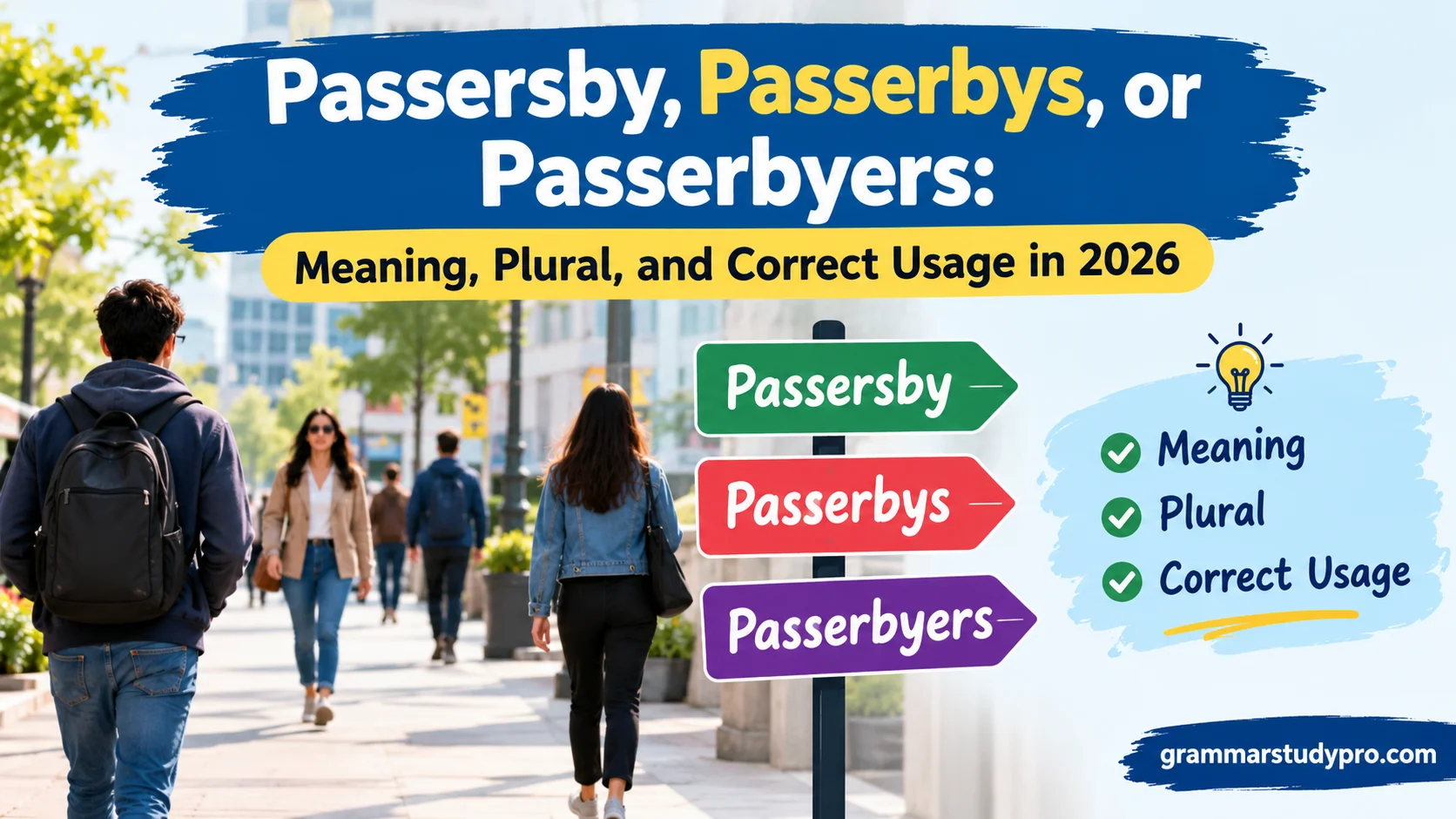
Passersby, Passerbys, or Passerbyers can confuse English learners because the correct plural form does not follow the most familiar pattern. A passerby is a convenient expression for a random person who passes by a place or someone without additional details. That person may go somewhere and minds their own business, yet at some point become part of an event. Passerby describes one person who is passing, while passersby refers to a group of people. Passerbyers is incorrect in standard English, so understanding the rules, logic, and usage improves writing, speaking, and clarity.
In real-world situations, choosing the correct form shows careful grammar, attention, and respect for small details, important details, and the language. The word can also describe a witness to an accident or an acter in an event who is mentioned in news articles. Headlines such as Right place right time, passerby saved, Gananda teen, die, RochesterFirst, Passerby helps, Fresno family, evacuate, house fire, and YourCentralValley.com show how the term works in real reporting. Studying compound nouns, singular, plural forms, irregular forms, and related patterns gives beginners and advanced learners a useful guide instead of relying on memorizing isolated rules.
For beginners, it is normal to pause, feel hesitation, or become confused when facing multiple examples and unusual plural patterns. A detailed reference containing clear definitions, history, and context can make learning easier while reducing common mistakes and awkward situations during communicating, whether formally or informally. Practicing with examples, quizzes, and signs found in real-life text strengthens understanding and confidence. Over time, observing people, reading articles, and applying rules through practice become more useful than simple memorization.
Looking at guides and texts also reveals the quirks of English, especially when comparing passerby, passersby, and passerbyers. Personally, I find that remembering the distinction through clarity and meaning is easier than memorizing every form. Paying attention to mid-sentence pauses, minor details, and whether a sentence sounds natural supports stronger English learning. With repeated exposure and careful practice, beginners and advanced learners can handle these tricky words more practically, engagingly, and confidently in everyday communication.
Quick Answer
The correct standard forms are:
- One person: passerby
- Two or more people: passersby
- Hyphenated singular: passer-by
- Hyphenated plural: passers-by
- Standard plural: passersby
- Nonstandard form: passerbys
- Nonstandard form: passerbyers
- Singular possessive: passerby’s
- Plural possessive: passersby’s
The easiest rule to remember
One passerby. Two passersby.
The plural changes passer to passers while by stays unchanged.
For example:
- A passerby called the police.
- Several passersby stopped to help.
- The passerby’s phone was found nearby.
- The passersby’s statements differed.
Cambridge gives passersby as the US plural of passerby, while Oxford’s American dictionary lists both passersby and passers-by.
Comparison Overview
The spelling becomes much easier when you compare the forms side by side.
| Form | Correct? | Meaning or use |
| passerby | Yes | Singular |
| passersby | Yes | Plural |
| passer-by | Yes | Hyphenated singular variant |
| passers-by | Yes | Hyphenated plural variant |
| passerbys | No in standard usage | Incorrect plural formation |
| passerbyers | No in standard usage | Incorrect plural formation |
| passerby’s | Yes | Singular possessive |
| passersby’s | Yes | Plural possessive |
Both passerby and passer-by appear in major dictionaries. The same applies to their plural forms.
For contemporary US English, passerby and passersby provide a clean, simple choice. If you’re following a particular style guide or publication’s house style, follow that guide consistently.
Main Differences Between Passersby, Passerbys, and Passerbyers
The three forms look similar, but they don’t have the same status in standard English.
Passersby
Passersby is the standard plural of passerby.
Use it when you’re talking about two or more people who happen to be passing a particular place or situation.
Examples:
- Several passersby stopped to watch the street performer.
- Police questioned passersby after the accident.
- Curious passersby gathered outside the store.
- Two passersby helped the injured cyclist.
- The unusual display attracted dozens of passersby.
This form isn’t an arbitrary exception. It reflects the way the compound noun is formed.
Passerbys
Passerbys isn’t the standard plural form.
It can look tempting because English commonly forms plurals by adding -s to the end of a noun:
- book → books
- car → cars
- visitor → visitors
- teacher → teachers
However, passerby belongs to a different compound pattern. The plural marker goes with passer, giving us passersby.
So write:
Several passersby noticed the commotion.
Not:
Several passerbys noticed the commotion.
Passerbyers
Passerbyers is also not the standard plural of passerby.
The extra -ers doesn’t belong in the plural formation. The noun already contains the agentive element -er in passer.
Think of the structure this way:
pass + -er + by → passerby
Then:
passer + s + by → passersby
Adding another -er creates a form that English doesn’t use as the standard plural.
What Does Passerby Mean?
A passerby is a person who is going past a particular person, place, or situation, usually without originally being involved in it.
Cambridge defines the word as someone going past a particular place. Oxford adds the idea that the person is passing by by chance, especially when something unexpected happens.
Consider this sentence:
A passerby noticed smoke coming from the building.
The person wasn’t necessarily visiting the building. They happened to be moving through the area and noticed something unusual.
That’s the heart of the word.
A passerby might:
- walk along a sidewalk
- drive past a location
- cycle through a street
- pass a shop
- notice an accident
- hear an unusual sound
- stop to help someone
- continue without becoming involved
The person’s defining feature is their passing presence.
Why Is the Plural Passersby Instead of Passerbys?
This is the question that causes most of the confusion.
The answer becomes clearer when you look at the compound’s structure.
Breaking Down Passerby
The word comes from pass by, with the agentive -er added to create passer. Collins traces the word to pass by + -er and dates its origin to the 1560s–1570s.
You can visualize the structure like this:
pass → passer → passer by → passerby
When the noun becomes plural, English marks the person doing the passing:
passerby → passersby
The word doesn’t become:
passerby → passerbys
The final by isn’t the part that becomes plural.
A Simple Visual Pattern
| Stage | Form |
| Verb | pass |
| Person who passes | passer |
| Compound noun | passerby |
| Plural compound noun | passersby |
That pattern is easier to remember than trying to memorize the spelling in isolation.
Is “Passersby” Grammatically Correct?
Yes. Passersby is grammatically correct and appears in major English dictionaries.
Oxford’s American dictionary gives:
passerby — plural passersby, passers-by
Cambridge similarly lists passersby for the US form. Collins also gives passersby as the plural.
That means you can confidently use passersby in:
- essays
- articles
- reports
- business writing
- news stories
- fiction
- academic prose
- everyday messages
For example:
Several passersby called emergency services after the crash.
The noun is plural, so the sentence naturally takes a plural verb.
Passerby vs. Passersby
The distinction is simple: passerby is singular, while passersby is plural.
| Singular | Plural |
| a passerby | several passersby |
| one passerby | two passersby |
| this passerby | these passersby |
| that passerby | those passersby |
| the passerby | the passersby |
Singular Examples
- A passerby noticed the broken window.
- One passerby stopped to help.
- The passerby called the fire department.
- That passerby had seen the accident.
Plural Examples
- Several passersby watched the performance.
- Two passersby helped carry the injured person.
- The passersby moved away from the road.
- Those passersby saw what happened.
The verb should agree with the number of people.
A passerby was walking past the building.
Several passersby were walking past the building.
That small distinction prevents a surprisingly common grammar mistake.
Passerby vs. Passer-by: One Word or Hyphenated?
Both spellings are established.
You may see:
- passerby
- passer-by
Likewise, the plural can appear as:
- passersby
- passers-by
Cambridge explicitly lists passerby as a form of passer-by, while Oxford’s American dictionary lists passerby and passer-by together.
Which Form Should You Use?
For US English, passerby and passersby are clear modern choices.
Still, don’t treat the hyphenated versions as errors. They’re established dictionary forms.
The most important rule is consistency.
If a publication consistently uses passer-by, don’t randomly switch to passerby within the same article unless there is a reason.
How to Use Passersby in a Sentence
The word works naturally in many everyday contexts.
Everyday Situations
A passerby asked whether I needed directions.
Here, the person happens to be nearby and moving through the area.
Another example:
Several passersby stopped when they heard the music.
The people weren’t necessarily part of the performance. Their attention was drawn to it while passing.
Accidents and Emergencies
This is one of the most common contexts for passerby.
A passerby saw the accident and called emergency services.
Or:
Several passersby helped clear the sidewalk.
Cambridge provides similar dictionary examples involving people passing a location and noticing an accident or unusual event.
Public Places
The colorful mural caught the attention of passersby.
Here, passersby emphasizes people moving through a public space.
You might also write:
- The shop window attracted passersby.
- The musician entertained passersby.
- Signs encouraged passersby to enter the exhibition.
- The sculpture became a talking point among passersby.
News Writing
News reports frequently use passerby because unexpected events often attract people who happen to be nearby.
A passerby recorded the incident on a cellphone.
Or:
Police asked passersby whether they had seen anything unusual.
Oxford uses a similar construction when explaining the word’s meaning and relationship to witnesses.
Common Passerby Grammar Mistakes
A few errors appear again and again.
| Incorrect | Correct |
| One passersby stopped. | One passerby stopped. |
| Several passerby stopped. | Several passersby stopped. |
| Several passerbys stopped. | Several passersby stopped. |
| Several passerbyers stopped. | Several passersby stopped. |
| A passerby were watching. | A passerby was watching. |
| The passersby was watching. | The passersby were watching. |
| One passer-byers helped. | One passer-by helped. |
| Two passer-by helped. | Two passers-by helped. |
The easiest way to avoid these mistakes is to identify the number first.
One person? Use passerby.
More than one? Use passersby.
Once that habit becomes automatic, the spelling problem mostly disappears.
Passerby Possessive: Passerby’s or Passersby’s?
Possessive forms introduce another wrinkle.
Singular Possessive: Passerby’s
When one passerby owns or is associated with something, use passerby’s.
Examples:
- The passerby’s phone was found near the bench.
- We recorded the passerby’s statement.
- The passerby’s bicycle remained outside.
- Police identified the passerby’s vehicle.
The apostrophe-s shows that the possession belongs to one person.
Plural Possessive: Passersby’s
When several passersby collectively possess or are associated with something, use passersby’s.
Examples:
- The passersby’s reactions varied.
- The reporter asked about the passersby’s observations.
- The passersby’s accounts helped establish the timeline.
Notice something important: the plural form is already passersby. You don’t add another plural s before the apostrophe.
So:
passersby + ‘s = passersby’s
Not:
passerbys’
Passerby vs. Pedestrian vs. Bystander
These words overlap, but they aren’t interchangeable in every situation.
Oxford groups passerby, bystander, onlooker, observer, and witness in the same semantic neighborhood. It also distinguishes their specific meanings.
| Word | Main idea | Example |
| passerby | Someone passing a place or situation | A passerby noticed the fire |
| pedestrian | Someone traveling on foot | Pedestrians crossed the road |
| bystander | Someone nearby who observes an event | A bystander called for help |
| onlooker | Someone watching an event | Onlookers gathered outside |
| witness | Someone who sees an event and can describe it | A witness gave a statement |
| eyewitness | Someone who directly saw an event | An eyewitness described the crash |
Why the Difference Matters
Imagine a traffic accident.
A person walking past the scene is a passerby.
That same person could also become a witness if they saw the accident happen.
Someone already standing nearby could be a bystander.
A person specifically watching the scene could be an onlooker.
The labels can overlap because they describe different aspects of the person’s relationship to the event.
That’s why word choice depends on context rather than a simple synonym swap.
Passerby Pronunciation
In US English, passerby is pronounced roughly as:
PASS-er-BYE
Cambridge gives the US pronunciation as /ˈpæs·ərˈbɑɪ/ and lists the plural pronunciation separately.
The plural adds a noticeable z sound in passersby.
The spelling can look complicated, but the spoken form is fairly natural once you hear the two parts together.
A useful way to think about it is:
passer + by
Then make the first part plural:
passers + by
Don’t pronounce it as though by were becoming plural. It isn’t.
Passersby in Formal and Informal Writing
Passerby works across a wide range of writing styles.
Formal Example
Investigators appealed to passersby who may have witnessed the incident.
Neutral Example
A passerby saw the dog wandering near the highway.
Conversational Example
Some passerby helped me find the right bus stop.
The word itself isn’t especially formal or informal. Context determines the tone.
In more technical or official writing, however, a more specific term may be preferable when precision matters.
For example, pedestrian is better when the fact that someone was walking is important.
Witness is better when the person’s observation matters.
Passerby is better when the fact that the person happened to be passing is relevant.
Usage Case Study: Choosing the Right Word
Consider this scenario:
A woman walks past a restaurant and sees a car crash outside.
What should you call her?
At first, passerby is appropriate because she was simply passing the restaurant.
If she saw the crash occur, she may also be a witness.
If she stops to watch the aftermath, she could become an onlooker.
If she remains nearby during the event without being directly involved, bystander could also describe her.
The words aren’t competing labels where only one can ever apply. Each emphasizes a different relationship to the event.
That’s an important distinction for writers.
Why “Passerbys” Looks Correct
English trains readers to expect a simple plural ending.
You see:
- passer → passers
- teacher → teachers
- driver → drivers
- visitor → visitors
So the brain may naturally produce passerbys.
There’s just one problem: the compound noun doesn’t pluralize at the final letter.
Think about another familiar compound:
runner-up → runners-up
Not:
runner-ups
The same general idea appears in other compounds where the central noun carries the plural marker.
Examples include:
- mother-in-law → mothers-in-law
- attorney general → attorneys general
- runner-up → runners-up
- passerby → passersby
These compounds don’t all follow an identical grammatical rule in every respect. Still, they demonstrate why English compounds can place the plural marker somewhere other than the final element.
Why “Passerbyers” Is Not the Plural
The form passerbyers introduces an unnecessary extra agentive ending.
The noun already contains passer, which means a person who passes.
The word developed historically from pass by with the agentive -er. Collins identifies that structure in its etymological note.
Adding another -er doesn’t create a recognized plural.
In practical terms:
passerby → passersby
is the established pattern.
You don’t need to create:
passerby → passerbyers
It’s simply not the standard form.
Facts About Passerby and Passersby
Here are the key facts worth remembering:
- Passerby is a countable noun.
- Passerby refers to one person.
- Passersby refers to multiple people.
- Passer-by is an established hyphenated variant.
- Passers-by is an established hyphenated plural.
- Major dictionaries recognize both closed and hyphenated forms.
- The word comes historically from pass by + -er.
- Passerbys isn’t the standard plural.
- Passerbyers isn’t the standard plural.
- The plural possessive is passersby’s.
- Passerby often describes someone who becomes involved in an event by chance.
Quick Reference: Passerby Forms
| Meaning | Correct form | Example |
| One person | passerby | A passerby called 911. |
| Multiple people | passersby | Several passersby stopped. |
| Hyphenated singular | passer-by | A passer-by saw the accident. |
| Hyphenated plural | passers-by | Several passers-by watched. |
| Singular possessive | passerby’s | The passerby’s phone rang. |
| Plural possessive | passersby’s | The passersby’s comments differed. |
| Incorrect plural | passerbys | Avoid this form. |
| Incorrect plural | passerbyers | Avoid this form. |
A Simple Memory Trick for Passersby
If you keep forgetting the plural, use this sentence:
One passerby passes by. Several passersby pass by.
The trick is to focus on passer.
passer → passers
The word by stays exactly where it is.
Another quick memory pattern is:
passerby = one
passersby = many
That tiny distinction is enough for most everyday writing.
FAQs
Is “passerby” singular or plural?
Passerby is the singular form. It refers to one person who happens to pass by a place, person, or event. For example, “A passerby helped the injured cyclist.”
What is the correct plural of “passerby”?
The correct plural is passersby. The plural -s is added to passer, while by remains unchanged. For example, “Several passersby stopped to help.”
Is “passerbys” correct?
No. Passerbys is generally considered incorrect in standard English. The accepted plural form is passersby.
Is “passerbyers” a correct word?
No. Passerbyers is not the standard plural form of passerby. Although someone may create this form by applying a familiar plural pattern, standard English uses passersby.
How can I remember the difference between passerby and passersby?
Think of passerby as one person and passersby as several people. The s belongs with passers, not at the end of the entire compound. Remembering this pattern makes the correct form easier to use in both writing and speaking.
Conclusion
Passerby is the correct singular form, while passersby is the correct plural. Passerbys and passerbyers should be avoided in standard English. Once you understand how this compound noun changes from singular to plural, the distinction becomes much easier to remember and use confidently.