When I Can or When Can I becomes easier when learners understand word order, question form, and how each phrase works in a sentence. Learning the correct usage also means noticing how native English speakers use these phrases in real use. The same three words, when, I, and can, can create a subtle difference in meaning because the phrasing and sentence structure can change meaning. A direct question normally uses When can I, while When I can often appears in a larger sentence, including indirect questions, time clauses, or conditional clauses. This English question structure involves subject-auxiliary inversion, which is an important word-order rule for avoiding an awkward statement. In my experience, a student may know the words but still become confused when the phrase changes position.
The difference becomes clearer when you connect the phrases with timing, permission, future action, and future plans. You can ask “When can I apply?” when seeking information directly, but “Do you know when I can apply?” places the question inside another structure. This distinction helps learners clarify expressions, sound natural, and avoid common mistakes in spoken communication and written communication. It also matters in formal or polite requests, email writing, or chatting with a friend, where the tone can shift depending on the situation. A tiny grammar problem can lead to everyday mistakes, especially when someone is asking about when they can apply or start. Understanding which form is typically used makes the choice easier and prevents confusion.
Formal writing, email messages, and everyday communication can all benefit from this simple guide. If someone writes “Do you know when can I apply?” the structure sounds unnatural because an indirect question normally keeps the subject before the auxiliary verb. By contrast, “When can I apply?” is a natural direct question. These real-world examples show why understanding the question form matters. The right phrase depends on what you mean, while punctuation can also help show whether you are asking a direct question or using the phrase within a statement. With practice, learners can recognize the pattern more quickly and use both forms naturally.
Quick Answer
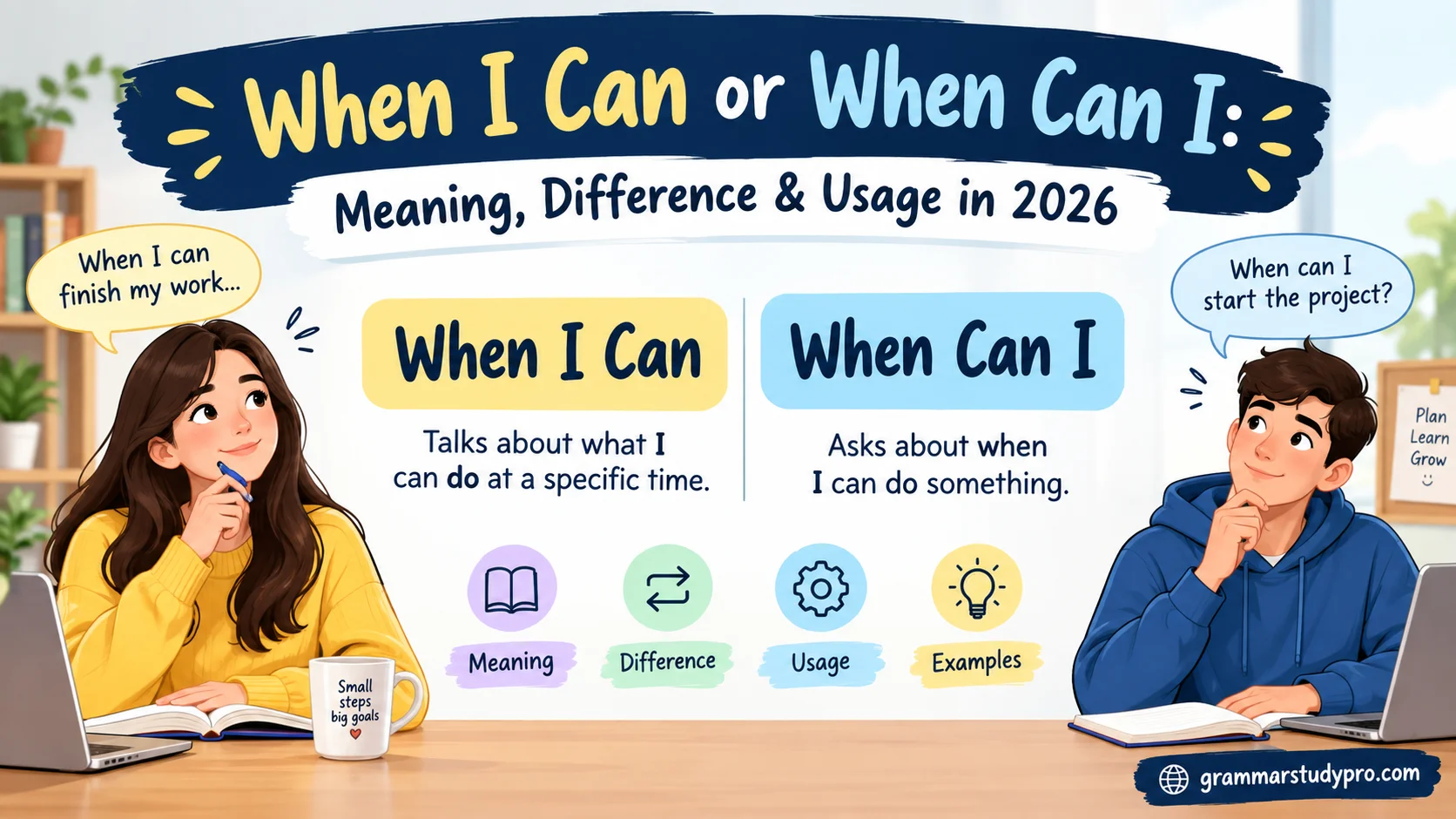
Both “when I can” and “when can I” can be grammatically correct. The correct choice depends on the sentence structure.
- “When can I…?” → Use this for a direct question.
- “when I can…” → Use this inside a statement, indirect question, or dependent clause.
Compare these examples:
When can I leave?
This is a direct question.
I don’t know when I can leave.
This is an indirect question.
I’ll leave when I can.
This is a time clause.
The word order changes because English normally uses subject-auxiliary inversion in direct questions. In a regular statement, the subject comes before the modal verb. In a direct question, the modal can move before the subject.
So the easiest rule to remember is:
Direct question: When can I…?
Statement or indirect question: …when I can…
That one distinction solves most “when I can or when can I” questions.
Comparison Overview
Here’s the difference at a glance.
| Phrase | Main use | Word order | Example |
| When can I…? | Direct question | when + can + subject | “When can I start?” |
| when I can… | Indirect question | when + subject + can | “Tell me when I can start.” |
| when I can… | Time clause | when + subject + can | “I’ll start when I can.” |
| When can I…? | Asking about permission | when + can + subject | “When can I enter?” |
| When can I…? | Asking about timing | when + can + subject | “When can I call?” |
Notice something important: “when I can” isn’t an incorrect version of “when can I.”
Both have legitimate grammatical jobs. The mistake happens when you use one structure where the other belongs.
Main Differences Between “When I Can” and “When Can I”
The biggest difference between when I can and when can I is grammatical function.
“When Can I” Is a Direct Question
Use “when can I” when you’re directly asking someone about the time, possibility, opportunity, or permission to do something.
For example:
- When can I start?
- When can I leave?
- When can I call you?
- When can I apply?
- When can I pick up my order?
- When can I schedule an appointment?
Each sentence directly asks for information.
You don’t need another clause before the question. The sentence can stand on its own.
“When I Can” Appears Inside a Larger Structure
Use “when I can” when the phrase forms part of a larger sentence.
For example:
Please tell me when I can start.
The direct question behind this sentence is:
When can I start?
But once that question becomes part of another sentence, the word order changes.
You can see the same pattern here:
When can I call you?
becomes:
Let me know when I can call you.
This is one of the most important rules behind the when can I vs. when I can distinction.
The Word Order Tells You What the Phrase Is Doing
Compare:
When can I leave?
with:
I don’t know when I can leave.
The first sentence asks a direct question.
The second sentence contains an indirect question.
The meaning remains closely related, but the grammatical structure changes.
What Does “When Can I” Mean?
“When can I” asks about the time at which something is possible, permitted, available, or practical.
The exact meaning depends on context.
Asking About Timing
When can I submit the application?
The speaker wants to know the available time or deadline.
Asking About Permission
When can I enter the building?
Here, the speaker may be asking when entry is allowed.
Asking About Availability
When can I meet with you?
The question asks about a suitable or available time.
Asking About Opportunity
When can I apply for the program?
The speaker wants to know when applications become possible.
Asking About Ability
When can I walk normally again?
Here, can relates to ability rather than permission.
So don’t assume that “when can I” always means “when am I allowed to?” The surrounding words establish the meaning.
The modal verb can commonly expresses ability and permission and can also relate to possibility or opportunity depending on context.
Why Is “When Can I” the Correct Direct Question?
To understand the grammar, start with an ordinary statement:
I can leave.
The normal word order is:
I + can + leave
Now turn that statement into a direct yes-or-no question:
Can I leave?
The order changes:
Can + I + leave?
This change is called subject-auxiliary inversion. English uses this pattern in many direct questions.
Now add when:
When can I leave?
The resulting structure becomes:
When + can + I + leave?
That’s why this is correct:
✅ When can I leave?
And this is normally incorrect as a standard standalone question:
❌ When I can leave?
The second version follows statement-style word order rather than the normal direct-question pattern.
A Simple Transformation
Think of the process like this:
Statement
I can start.
↓
Yes/no question
Can I start?
↓
Wh-question
When can I start?
The pattern becomes much easier once you stop treating “when can I” as a phrase that needs memorizing. Instead, recognize it as the natural result of English question formation.
What Does “When I Can” Mean?
“When I can” commonly appears in statements, indirect questions, and time clauses.
Its meaning changes slightly according to context.
“When I Can” in a Statement
Consider:
I’ll call you when I can.
Here, when I can means something like “when I’m able to” or “when circumstances allow me to.”
Other examples include:
- “I’ll help when I can.”
- “I’ll visit when I can.”
- “I’ll finish it when I can.”
- “I’ll respond when I can.”
- “She works on the project when she can.”
The phrase doesn’t ask a question.
Instead, it describes a time or circumstance connected to an action.
“When I Can” in an Indirect Question
Now consider:
I don’t know when I can leave.
The speaker is wondering about the answer to:
When can I leave?
But the question now sits inside a larger sentence.
That’s why the structure becomes:
when I can leave
rather than:
when can I leave
This same pattern appears in everyday speech and writing:
- “Do you know when I can apply?”
- “Tell me when I can call.”
- “I’m wondering when I can start.”
- “Could you tell me when I can pick it up?”
- “Please let me know when I can visit.”
These are all examples of embedded or indirect questions.
Direct Questions vs. Indirect Questions
This is where many learners stumble.
A direct question stands alone:
When can I submit the form?
An indirect question becomes part of another sentence:
Could you tell me when I can submit the form?
The underlying question hasn’t disappeared. Its structure has simply changed.
Direct Question
When can I speak with the manager?
Indirect Question
Could you tell me when I can speak with the manager?
Another Example
Direct:
When can I pick up my order?
Indirect:
Do you know when I can pick up my order?
One More
Direct:
When can I schedule the appointment?
Indirect:
I’d like to know when I can schedule the appointment.
The key is simple:
Direct questions use inversion. Embedded questions normally don’t.
This is why the following sentence is incorrect in standard English:
❌ Do you know when can I leave?
Use:
✅ Do you know when I can leave?
The same rule applies to many other question words, including where, why, how, what, and who, when they introduce embedded questions.
“When I Can” in Time Clauses
There’s another important use that has nothing to do with indirect questions.
Consider:
I’ll call you when I can.
Here, when I can is a dependent time clause.
The phrase tells you when the main action will happen.
You can expand the sentence:
I’ll call you when I can call you.
But English usually omits the repeated verb because the meaning is already clear:
I’ll call you when I can.
This shortened construction sounds natural and is extremely common.
More Examples
I’ll visit when I can.
I’ll help when I can.
I’ll respond when I can.
We’ll meet when I can arrange it.
She’ll join us when she can get away from work.
In these examples, when I can doesn’t ask a question. It describes a condition or time related to the main action.
When Can I vs. When I Can in Everyday English
The difference becomes much easier when you see both forms in realistic situations.
At Work
Direct question:
“When can I submit the report?”
Indirect question:
“Could you tell me when I can submit the report?”
Time clause:
“I’ll submit it when I can.”
Three sentences. Three structures. One basic idea.
At School
Direct question:
“When can I register for classes?”
Indirect question:
“Do you know when I can register for classes?”
Time clause:
“I’ll register when I can.”
With Customer Service
Direct question:
“When can I expect my package?”
Indirect question:
“Could you tell me when I can expect my package?”
In Casual Conversation
Direct question:
“When can I see you?”
Indirect question:
“Let me know when I can see you.”
Time clause:
“I’ll come over when I can.”
This is why learning the function of the phrase works better than memorizing a single “correct” version.
Common Mistakes With “When I Can” and “When Can I”
Small word-order errors can make otherwise clear English sound unnatural.
Mistake: “When I Can?” as a Direct Question
❌ When I can start?
✅ When can I start?
The direct question needs the modal can before the subject I.
Mistake: Inverting an Indirect Question
❌ I don’t know when can I start.
✅ I don’t know when I can start.
The phrase is embedded inside I don’t know, so normal subject-first order returns.
Mistake: “Tell Me When Can I…”
❌ Tell me when can I apply.
✅ Tell me when I can apply.
The word tell doesn’t change the rule. The question is embedded within the larger sentence.
Mistake: Thinking “When I Can” Is Always Wrong
This assumption causes just as many problems.
Consider:
I’ll help when I can.
That’s completely natural.
Or:
Please tell me when I can help.
That’s also correct.
So “when I can” isn’t a bad phrase. It simply doesn’t normally work as a standalone direct question.
“When Can I” vs. “Can I”
These two questions aren’t interchangeable.
Can I leave?
asks whether leaving is possible or permitted.
When can I leave?
asks about the time when leaving is possible or permitted.
The word when adds a timing element.
Compare:
| Question | What it asks |
| Can I leave? | Is leaving possible or permitted? |
| When can I leave? | At what time can I leave? |
| Where can I leave it? | At what place can I leave it? |
| Why can I leave early? | What explains the possibility? |
| How can I leave? | By what method can I leave? |
This broader pattern shows that can stays before the subject in direct questions.
When Can I vs. When May I
English also gives you “when may I”, especially in formal contexts.
Compare:
When can I begin?
and:
When may I begin?
Both can be grammatically correct.
Can is extremely common in everyday American English. May often sounds more formal or traditional when used to ask permission.
For example:
“When can I enter the room?”
sounds natural in everyday conversation.
“When may I enter the room?”
has a more formal tone.
The choice depends on context and tone. It doesn’t change the fundamental word-order rule.
When Can I vs. When Could I
You’ll also encounter “when could I”.
For example:
When could I schedule a meeting?
This can sound more tentative or polite than:
When can I schedule a meeting?
The exact effect depends on context.
Compare:
| Form | Example | Typical effect |
| When can I…? | “When can I call?” | Direct, neutral |
| When could I…? | “When could I call?” | More tentative or polite |
| When may I…? | “When may I call?” | More formal |
Don’t treat these as rigid rules of politeness. Real conversations depend on context, relationship, tone, and the rest of the sentence.
Does “When I Can” Need a Question Mark?
Not necessarily.
Punctuation depends on the complete sentence, not simply on the words when I can.
Direct Question
When can I leave?
Use a question mark because the entire sentence asks a direct question.
Indirect Question
I don’t know when I can leave.
Use a period because the entire sentence is a statement.
Request Containing an Embedded Question
Please tell me when I can leave.
Again, a period is normal because the complete sentence is a request or statement.
Time Clause
I’ll leave when I can.
A period works because the sentence makes a statement.
The presence of when doesn’t automatically make a sentence a question.
Formal and Professional Usage
The distinction matters in workplace emails, applications, customer-service messages, and other formal communication.
Consider this email sentence:
When can I expect a response?
That’s a straightforward direct question.
You could also write:
Could you please let me know when I can expect a response?
The second version contains an indirect question.
Both structures are grammatical. The second simply frames the request more indirectly.
Professional Examples
Instead of:
❌ “Please let me know when can I submit the documents.”
Write:
✅ “Please let me know when I can submit the documents.”
Instead of:
❌ “I would like to know when can I schedule an interview.”
Write:
✅ “I would like to know when I can schedule an interview.”
These aren’t cosmetic changes. They follow the grammatical structure of embedded questions.
A Practical Case Study: Turning One Question Into Three Structures
Imagine an employee wants to know when they can submit a project.
The direct version is:
When can I submit the project?
Now imagine the employee doesn’t want to ask the question directly. They write:
Could you tell me when I can submit the project?
Finally, they explain their plan:
I’ll submit the project when I can.
The core idea remains similar, but the grammatical role changes each time.
| Situation | Correct sentence | Structure |
| Asking directly | “When can I submit the project?” | Direct question |
| Asking indirectly | “Could you tell me when I can submit the project?” | Embedded question |
| Describing an action | “I’ll submit it when I can.” | Time clause |
This is the heart of when I can vs. when can I.
How “When Can I” Works With Other Modal Verbs
The same basic inversion pattern extends beyond can.
| Direct question | Embedded question or statement |
| When can I leave? | “I know when I can leave.” |
| When could I leave? | “She asked when I could leave.” |
| When should I leave? | “He knows when I should leave.” |
| When would I leave? | “I wondered when I would leave.” |
| When may I leave? | “Please advise when I may leave.” |
| When might I leave? | “We aren’t sure when I might leave.” |
| When must I leave? | “I know when I must leave.” |
The larger grammar pattern is useful because it gives you a reusable rule rather than a one-off answer.
Direct questions commonly use auxiliary-subject inversion. Embedded questions generally retain normal subject-auxiliary order.
A Simple Test for Choosing the Correct Form
When you’re unsure about when I can or when can I, don’t overthink it.
Ask yourself one question:
Am I asking directly?
If yes, use:
When can I…?
Example:
When can I apply?
Is the question inside another sentence?
If yes, use:
when I can…
Example:
Do you know when I can apply?
Am I describing when I’m able to do something?
Use:
when I can…
Example:
I’ll apply when I can.
This quick test handles most everyday cases.
Direct and Indirect Question Transformations
Here’s another useful way to see the pattern.
| Direct question | Indirect question |
| “When can I call you?” | “Do you know when I can call you?” |
| “When can I start?” | “Tell me when I can start.” |
| “When can I apply?” | “I don’t know when I can apply.” |
| “When can I visit?” | “Could you tell me when I can visit?” |
| “When can I pick it up?” | “Please let me know when I can pick it up.” |
The transformation is consistent:
Direct: when + can + I
Embedded: when + I + can
Once you spot that switch, the grammar becomes much less mysterious.
Practice: Choose “When Can I” or “When I Can”
Try completing each sentence before checking the answers.
Practice Questions
1. ______ start the course?
2. Do you know when ______ start the course?
3. I’ll start when ______.
4. Could you tell me when ______ call you?
5. ______ submit the application?
6. I’ll contact you when ______.
7. I don’t know when ______ leave.
8. ______ pick up my order?
Answers
- When can I start the course?
- Do you know when I can start the course?
- I’ll start when I can.
- Could you tell me when I can call you?
- When can I submit the application?
- I’ll contact you when I can.
- I don’t know when I can leave.
- When can I pick up my order?
The first, fifth, and eighth examples are direct questions. The others place the phrase inside a larger structure.
Quick Facts About “When I Can” vs. “When Can I”
- Both phrases can be grammatically correct.
- “When can I” normally introduces a direct question.
- “When I can” commonly appears in indirect questions.
- “When I can” can also introduce a time clause.
- Direct questions commonly use subject-auxiliary inversion.
- Embedded questions generally keep normal subject-before-auxiliary order.
- A question mark doesn’t turn incorrect word order into correct grammar.
- “When can I leave?” and “Tell me when I can leave.” are both correct.
- “Do you know when can I leave?” is not standard English.
- The same structural principle applies to other modal verbs such as could, should, would, may, might, and must.
FAQs
1. Is “When can I” correct for a direct question?
Yes. “When can I” is the normal structure for a direct question about time, permission, or a possible action. For example: “When can I apply?”
2. When should I use “when I can”?
Use “when I can” when the phrase appears inside a larger sentence. For example: “Please tell me when I can apply.” It is also common in time and conditional clauses.
3. Why is “Do you know when can I apply?” incorrect?
In an indirect question, English normally uses regular statement word order. The natural version is: “Do you know when I can apply?” The subject I comes before can.
4. Can “when can I” and “when I can” have the same meaning?
They can relate to the same idea, but their sentence structure is different. “When can I” normally introduces a direct question, while “when I can” usually appears inside a larger sentence.
5. Which one should I use in formal writing?
Both can be correct. The choice depends on the sentence. Use “When can I” for a direct question and “when I can” when the phrase forms part of an indirect question or another larger structure.
Conclusion
Understanding When I Can or When Can I mainly comes down to recognizing word order. Use “When can I” when asking a direct question, such as “When can I start?” Use “when I can” inside a larger sentence, such as “I want to know when I can start.” Once you recognize this simple pattern, it becomes easier to avoid common mistakes and make your English sound clear and natural.