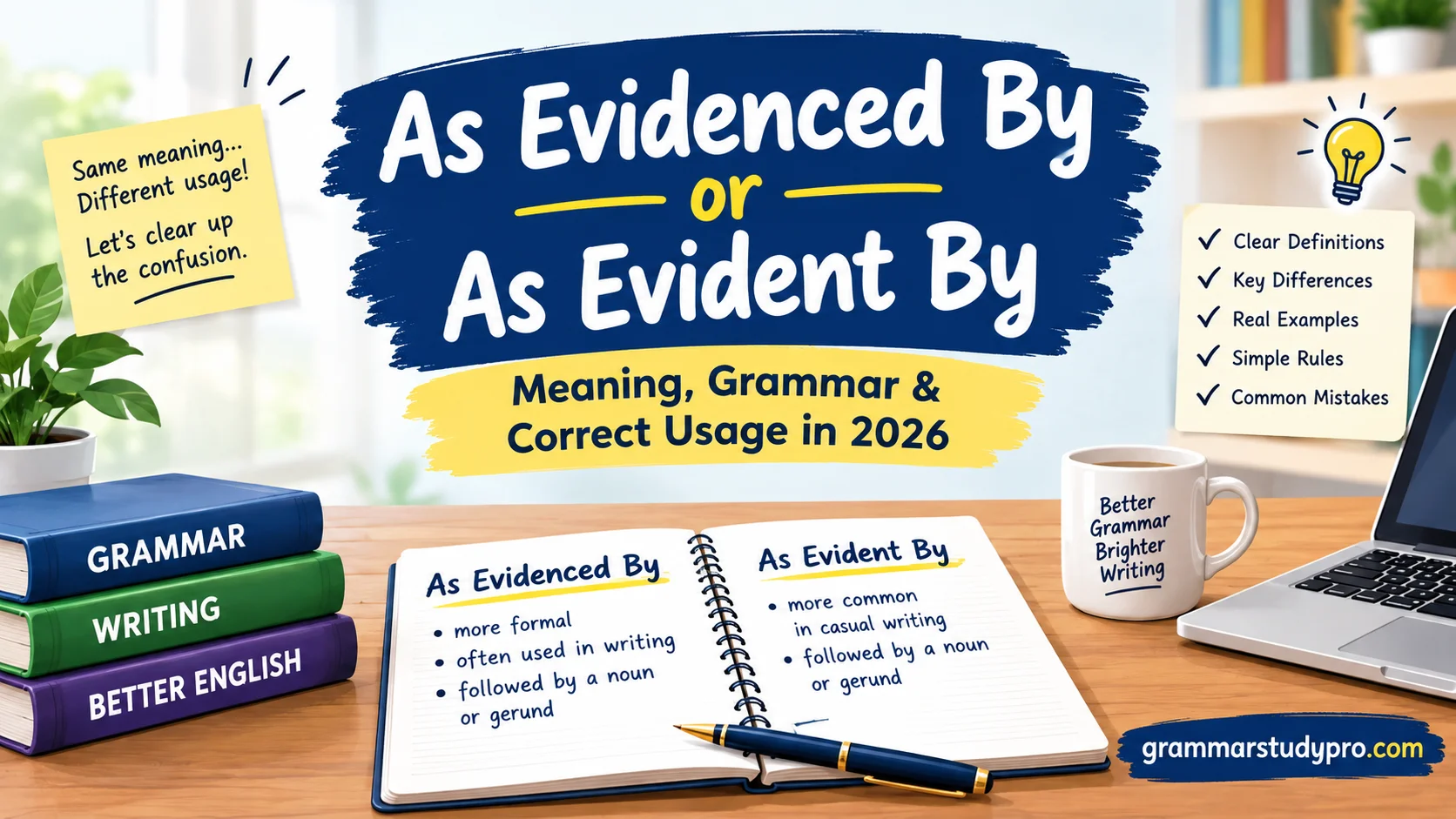
As Evidenced By or As Evident By can seem confusing because the two phrases look almost identical, yet they follow different grammar rules. Language can be tricky, and many writers pause when deciding which form is the correct phrase. The standard choice is as evidenced by, while as evident by is grammatically incorrect in standard English. The key distinction is the word form: evidenced is a past participle used in a passive structure, whereas evident is an adjective. Although both are legitimate words, they work differently in a sentence, affecting its structure, grammar, and meaning.
The phrase as evidenced by is used when evidence, facts, observations, or results give supporting proof for a statement. For example, “The improvement is clear, as evidenced by the results.” This phrase correctly introduces information that supports the statement and shows what has been shown or demonstrated. In academic writing, business writing, and professional writing, it usually sounds natural and improves clarity. The phrase structure also follows proper grammar rules and grammatical rules, making it a natural choice for formal English contexts.
The as evident by version may seem logical, but its structure is incomplete. This common mistake can cause confusion in an article, academic essay, professional report, application, or business document. To understand the usage more clearly, remember that as evidenced by is the grammatically established and safer choice for introducing supporting evidence or factual support. Proper wording matters because grammatical errors can affect clarity and credibility. This guide helps writers avoid such mistakes when they write in formal English. The standard usage is generally not considered awkward, while the alternative may be viewed as an error in this context.
Quick Answer
“As evidenced by” is the standard phrase when you want to introduce evidence supporting a claim.
For example:
The company has grown rapidly, as evidenced by its increasing sales figures.
Here, “as evidenced by” means roughly “as shown by” or “as demonstrated by.”
By contrast, “as evident by” is generally avoided in careful standard writing. The problem comes from the grammatical role of evident. It is an adjective meaning clear, obvious, or apparent. The construction “as evidenced by” instead uses evidenced, the past participle of the verb evidence.
If you want to use evident, write:
The company’s growth is evident from its increasing sales figures.
Or:
The company has grown rapidly, as is evident from its increasing sales figures.
The easiest rule to remember
Evidence is shown by something. Something is evident from something.
So:
- as evidenced by the data ✅
- as is evident from the data ✅
- as shown by the data ✅
- as evident by the data ⚠️ generally avoid
The distinction isn’t just about sounding formal. It comes from the different grammatical roles of evidenced and evident.
Comparison Overview
The quickest way to see the difference is to place the expressions side by side.
| Phrase | Word form | Main function | Recommended? | Example |
| as evidenced by | Past participle | Introduces supporting evidence | Yes | The results improved, as evidenced by the latest figures. |
| as evident by | Adjective | Attempts to introduce supporting evidence | Generally avoid | The results improved, as evident by the latest figures. |
| as is evident from | Adjective + linking verb | States that something is clear from evidence | Yes | The improvement is clear, as is evident from the latest figures. |
| as shown by | Past participle | Introduces evidence | Yes | The improvement is clear, as shown by the figures. |
| as demonstrated by | Past participle | Highlights demonstration or proof | Yes | The method works, as demonstrated by repeated tests. |
| as indicated by | Past participle | Points to an indication | Yes | Demand increased, as indicated by sales data. |
The central distinction is simple:
“As evidenced by” points to evidence. “As is evident from” describes something as clear from evidence.
Those meanings overlap. Their grammar does not.
Main Differences Between “As Evidenced By” and “As Evident By”
The biggest difference between “as evidenced by” and “as evident by” comes down to one letter ending and one major grammatical distinction.
“Evidenced” Is a Past Participle
Evidenced comes from the verb evidence.
The verb evidence means to show, demonstrate, or provide evidence of something.
For example:
The findings evidenced a significant change in consumer behavior.
When used in “as evidenced by,” the word functions as a past participle in a passive construction.
Consider:
The theory is supported, as evidenced by the experimental results.
The underlying idea is similar to:
The theory is supported, as it is evidenced by the experimental results.
More naturally, English often shortens the structure:
as evidenced by the experimental results
This shortened construction is standard and widely used.
“Evident” Is an Adjective
Evident, on the other hand, is an adjective.
It means clear, obvious, or easy to recognize.
For example:
Her excitement was evident.
The difference became evident after testing.
It was evident from the report that sales had increased.
Notice something important in that last example.
The natural construction is:
evident from the report
not:
evident by the report
That is why writers who want to use evident should normally choose “evident from” or “as is evident from.”
What Does “As Evidenced By” Mean?
“As evidenced by” means “as shown by,” “as demonstrated by,” or “as supported by.”
The phrase connects a statement with information that supports it.
For example:
The training program was successful, as evidenced by the employees’ improved test scores.
The first part makes a claim:
The training program was successful.
The second part supplies evidence:
the employees’ improved test scores.
The phrase “as evidenced by” acts as the bridge between those two ideas.
You can think of it as a signpost telling the reader:
Here is the evidence supporting that statement.
More examples
The company is expanding, as evidenced by its recent hiring activity.
The student’s preparation was obvious, as evidenced by her detailed answers.
The machine requires maintenance, as evidenced by its repeated errors.
Consumer interest appears to be increasing, as evidenced by higher search activity.
In each example, the phrase introduces something that helps support the preceding claim.
Why “As Evidenced By” Is Grammatically Correct
The grammar becomes clearer when you look at the word evidence itself.
Most readers know evidence as a noun:
The researchers collected evidence.
But English also uses evidence as a verb.
As a verb, to evidence means to show or demonstrate.
Its forms include:
- evidence
- evidenced
- evidencing
So when you write:
as evidenced by the data
the word evidenced belongs to the verb family.
The structure resembles other familiar expressions:
- as shown by
- as demonstrated by
- as indicated by
- as confirmed by
- as supported by
These constructions use participial forms to connect a claim with something that shows or supports it.
Compare the structures
The trend is clear, as shown by the figures.
The trend is clear, as demonstrated by the figures.
The trend is clear, as evidenced by the figures.
All three work because the phrase introduces information that supports the claim.
What Does “Evident” Mean?
Evident means clear, obvious, or readily understood.
It describes a condition rather than directly naming the evidence that proves it.
For example:
Her disappointment was evident.
This sentence tells you that her disappointment was obvious.
You can then explain where that conclusion comes from:
Her disappointment was evident from her expression.
Here, evident describes the disappointment.
From her expression identifies the source from which the reader can recognize that disappointment.
The same pattern appears in many ordinary constructions:
The difference was evident from the results.
His experience was evident in his work.
It became evident that the original estimate was wrong.
These examples show why evident and evidenced shouldn’t be treated as interchangeable forms.
Why “As Evident By” Is Usually Avoided
The phrase “as evident by” sounds plausible because English speakers regularly encounter the words evident and evidence together.
There is also a strong visual similarity:
evident
evidenced
That similarity can make the wrong construction feel perfectly natural.
However, when evident is used as an adjective, the more natural preposition is often from, not by, when you identify the source of the evidence.
Compare:
Her frustration was evident from her tone.
with:
Her frustration was evidenced by her tone.
Both sentences communicate a related idea. They simply use different grammatical structures.
The first says her frustration was clear from her tone.
The second says her tone provided evidence of her frustration.
Compare these examples
Generally avoid:
The improvement was clear, as evident by the results.
Standard alternative:
The improvement was clear, as evidenced by the results.
Another correct alternative:
The improvement was clear, as is evident from the results.
Simpler alternative:
The improvement was clear, as shown by the results.
That gives you several ways to express the same basic relationship without forcing evident into an awkward structure.
“As Evidenced By” vs. “As Is Evident From”
This is one of the most useful comparisons to understand.
Both expressions can introduce information connected to a claim. However, they approach the idea differently.
As evidenced by
The project succeeded, as evidenced by its strong financial results.
This emphasizes the evidence supporting the conclusion.
As is evident from
The project’s success is clear, as is evident from its strong financial results.
This emphasizes the fact that the success is clear or apparent.
The difference is subtle but useful.
| Expression | Main emphasis |
| as evidenced by | Evidence supporting a claim |
| as is evident from | The fact that something is clear from a source |
| as shown by | Direct demonstration |
| as demonstrated by | Demonstration through evidence, testing, or examples |
You don’t need to obsess over the distinction in ordinary writing. In many situations, “as evidenced by” and “as is evident from” can communicate nearly the same overall idea.
The grammatical structure is what changes.
How to Use “As Evidenced By” in a Sentence
The phrase is flexible and can appear in several positions.
At the end of a sentence
This is probably the easiest pattern to use.
The business has grown significantly, as evidenced by its expanding workforce.
The main claim comes first. The supporting evidence follows.
At the beginning of a sentence
You can also lead with the evidence.
As evidenced by the latest survey results, customer satisfaction has increased.
This construction puts more attention on the evidence before presenting the conclusion.
Between two related ideas
You can use the phrase to connect a broad statement with a specific observation.
The region experienced strong economic activity, as evidenced by rising employment and increased investment.
The phrase works particularly well when the evidence is concrete.
Can You Start a Sentence With “As Evidenced By”?
Yes.
There is nothing inherently wrong with beginning a sentence with “as evidenced by.”
For example:
As evidenced by the latest test results, the revised method performs better than the original.
The phrase works as an introductory element.
Another example:
As evidenced by the survey responses, customers value convenience highly.
This structure is especially useful in analytical writing because it lets the writer foreground the evidence.
However, don’t force the construction into every paragraph. If the evidence is secondary to your main point, putting the claim first may create a smoother sentence.
Punctuation With “As Evidenced By”
When “as evidenced by” introduces a sentence, a comma normally separates the introductory phrase from the main clause.
As evidenced by the survey results, customer satisfaction increased.
When the phrase comes after the main statement as a supplementary comment, a comma commonly introduces it.
Customer satisfaction increased, as evidenced by the survey results.
The comma helps readers recognize the phrase as supporting information rather than as part of the core grammatical structure.
Still, punctuation depends on the exact sentence. Don’t treat every occurrence as an automatic comma rule.
Common Mistakes With “As Evidenced By” and “As Evident By”
These errors are easy to fix once you recognize the underlying pattern.
| Avoid | Better | Reason |
| As evident by the results, sales increased. | As evidenced by the results, sales increased. | Evidenced introduces the supporting evidence. |
| The improvement was as evident by the data. | The improvement was as evidenced by the data. | Evidenced by fits the intended construction. |
| Her confidence was evident by her presentation. | Her confidence was evident from her presentation. | Evident from is the natural adjective construction. |
| As evident by his actions, he was prepared. | As evidenced by his actions, he was prepared. | The actions provide evidence. |
| The pattern was evident by the report. | The pattern was evident from the report. | The report is the source from which the pattern becomes clear. |
A particularly common mistake
Writers sometimes produce sentences like:
The results were as evident by the data.
The writer usually means one of two things.
If the intention is “the data demonstrates the results,” write:
The results were as evidenced by the data.
If the intention is “the results were clear from the data,” write:
The results were evident from the data.
That small distinction can clean up the entire sentence.
When Should You Use “As Evidenced By”?
Use “as evidenced by” when the following information genuinely supports or demonstrates the statement you just made.
Academic writing
The findings support the proposed theory, as evidenced by the experimental results.
Business writing
Customer demand has increased, as evidenced by the rise in monthly orders.
Research writing
The two groups responded differently, as evidenced by the statistical results.
Reports
The equipment requires further inspection, as evidenced by repeated performance failures.
Professional communication
The project remains on schedule, as evidenced by the completion of the latest milestones.
The phrase works especially well when you have something concrete behind the claim.
That last point matters.
“As evidenced by” should introduce actual evidence, not decoration.
If there is no evidence following the phrase, the construction can sound inflated.
When “As Evidenced By” Sounds Too Formal
A phrase can be grammatically correct without being the clearest choice.
Consider:
The restaurant was busy, as evidenced by the number of people waiting outside.
That’s perfectly understandable.
But in casual conversation, you might simply say:
The restaurant was busy. There were people waiting outside.
Or:
The restaurant was packed, judging by the line outside.
The simpler version may sound more natural.
Formality comparison
| Phrase | General tone |
| as evidenced by | Formal, analytical |
| as demonstrated by | Formal, explanatory |
| as indicated by | Neutral to formal |
| as shown by | Clear and broadly usable |
| because | Direct and conversational |
| according to | Source-focused |
Strong writing isn’t about making every sentence sound academic.
Sometimes “as shown by” is better because readers understand it instantly.
Better Alternatives to “As Evidenced By”
If you’ve used “as evidenced by” several times in the same article, vary your wording.
As shown by
The trend is clear, as shown by the latest figures.
This is probably the simplest alternative.
As demonstrated by
The method proved effective, as demonstrated by repeated trials.
Use this when an experiment, test, or example demonstrates something.
As indicated by
Consumer interest appears to have increased, as indicated by search activity.
This works well when the evidence suggests something rather than conclusively proving it.
As confirmed by
The diagnosis was later confirmed, as confirmed by additional testing.
This emphasizes confirmation.
As supported by
The argument is supported by recent research.
This is useful when evidence strengthens a position rather than directly demonstrating it.
As illustrated by
The problem is illustrated by several recent examples.
This emphasizes an example that makes an idea easier to understand.
As reflected in
The change is reflected in the latest financial figures.
This works especially well with statistics, trends, and measurable outcomes.
“As Evidenced By” vs. “As Shown By”
These phrases are close in meaning.
The strategy succeeded, as evidenced by the higher conversion rate.
The strategy succeeded, as shown by the higher conversion rate.
The first sounds more formal and analytical.
The second is simpler.
Neither needs to be forced into a sentence merely to make the writing sound sophisticated.
If you’re writing for a broad audience, “as shown by” can often improve readability.
“As Evidenced By” vs. “As Demonstrated By”
“As demonstrated by” can carry a slightly different emphasis.
Consider:
The method is reliable, as demonstrated by repeated experiments.
The word demonstrated suggests that something was actively shown through testing, performance, examples, or observation.
By contrast:
The method is reliable, as evidenced by repeated experiments.
This focuses more directly on the experiments as evidence supporting the conclusion.
The difference isn’t enormous. Context determines which phrase sounds most precise.
“As Evidenced By” vs. “According To”
These expressions aren’t interchangeable.
According to identifies a source or authority.
According to the report, sales increased.
The sentence attributes the information to the report.
As evidenced by does something different:
Sales increased, as evidenced by the report’s figures.
Here, the figures are being presented as evidence supporting the claim.
Simple distinction
According to = source
As evidenced by = supporting evidence
That distinction becomes important in academic and professional writing.
Is “As Evident By” Ever Acceptable?
You’ll encounter “as evident by” in real-world writing. The phrase is understandable, and readers can usually infer the intended meaning without difficulty.
However, frequency doesn’t automatically make a construction the best choice for edited writing.
When the intended meaning is “as shown by,” use:
as evidenced by
When the intended meaning is “as is clear from,” use:
as is evident from
For example:
❌ As evident by the results, the experiment succeeded.
✅ As evidenced by the results, the experiment succeeded.
Or:
✅ As is evident from the results, the experiment succeeded.
This approach gives you a clean grammatical construction without relying on a disputed or awkward form.
Why Does “As Evident By” Sound So Natural?
There’s a good reason many people make this mistake.
English contains countless expressions where similar-looking words behave differently.
Consider:
- dependent vs. depended
- apparent vs. appeared
- certain vs. confirmed
- visible vs. seen
The brain often focuses on meaning before grammatical structure.
When you see:
evident + evidence + by
the connection feels obvious.
But grammar operates beneath that surface similarity.
Evident describes.
Evidenced indicates something has been shown or demonstrated.
Once that distinction becomes familiar, the choice becomes much easier.
A Practical Editing Test
There’s a simple way to check yourself when you’re unsure.
Replace “as evidenced by” with:
as shown by
If the sentence still makes sense, “as evidenced by” is probably the structure you’re looking for.
For example:
The plan worked, as shown by the final results.
Now compare:
The plan worked, as evidenced by the final results.
The substitution works naturally.
Another useful test
If you want to use evident, try replacing the phrase with:
clear from
For example:
Her concern was clear from her expression.
That points you toward:
Her concern was evident from her expression.
So the two mental shortcuts are:
- shown by → evidenced by
- clear from → evident from
They’re not perfect grammar tests for every possible sentence, but they work well for this particular confusion.
Case Study: Fixing a Formal Sentence
Imagine a business report contains this sentence:
The company’s improved performance is as evident by its higher quarterly revenue.
At first glance, the sentence looks polished. It uses formal vocabulary and communicates a clear idea.
But the construction “as evident by” creates the problem.
There are two clean ways to rewrite it.
Option one: Focus on evidence
The company’s improved performance is as evidenced by its higher quarterly revenue.
Option two: Focus on clarity
The company’s improved performance is evident from its higher quarterly revenue.
The second version is especially natural because evident functions as an adjective followed by from.
Even simpler
The company’s improved performance is shown by its higher quarterly revenue.
The best choice depends on the tone and emphasis of the document.
The important point is that the original sentence doesn’t need a complicated rewrite. One small grammatical adjustment fixes it.
Examples of “As Evidenced By” in Different Contexts
Academic example
The findings support the hypothesis, as evidenced by the consistent results across multiple trials.
The phrase works because the trial results provide evidence for the claim.
Workplace example
The team has made significant progress, as evidenced by the completion of several major milestones.
The completed milestones provide concrete support.
Financial example
The company appears to be recovering, as evidenced by stronger quarterly revenue.
The word appears is useful here because the evidence supports the conclusion without necessarily proving every aspect of the company’s recovery.
Research example
The intervention produced measurable changes, as evidenced by the post-test results.
The post-test results provide the evidence.
Everyday example
He was nervous, as evidenced by the way he kept checking the door.
The phrase isn’t limited to academic writing.
“As Evidenced By” Does Not Automatically Mean “Proven”
One subtle point deserves attention.
Evidence and proof aren’t always identical.
Evidence can support a conclusion without making that conclusion absolutely certain.
For example:
The market may be changing, as evidenced by declining demand.
Declining demand provides evidence of change. It doesn’t necessarily prove every possible explanation for that decline.
This distinction matters in research, journalism, business analysis, and technical writing.
Use the strength of your wording carefully.
Compare
The theory is supported by the evidence.
The theory is strongly supported by the evidence.
The theory is confirmed by the evidence.
The theory is proven by the evidence.
These statements carry different levels of certainty.
“As evidenced by” itself simply points the reader toward evidence. The writer still needs to judge what that evidence actually establishes.
Common Questions About “As Evidenced By” and “As Evident By”
Is “as evidenced by” correct?
Yes. “As evidenced by” is a standard construction used to introduce evidence supporting a preceding statement.
Is “as evident by” correct?
It is widely understandable and appears in actual usage, but it is generally best avoided in careful standard writing. Use “as evidenced by” or “as is evident from” instead.
What does “as evidenced by” mean?
It means “as shown by,” “as demonstrated by,” or “as supported by.”
What is the difference between evident and evidenced?
Evident is an adjective meaning clear or obvious. Evidenced is the past participle of the verb evidence, meaning shown or demonstrated.
Can “as evidenced by” begin a sentence?
Yes.
As evidenced by the latest figures, demand has increased.
What should I use instead of “as evident by”?
Usually choose “as evidenced by” when you mean as shown by.
Choose “as is evident from” when you mean as is clear from.
Is “as evidenced by” too formal?
Not necessarily. It is somewhat formal and analytical, but it works in academic, professional, business, research, and general nonfiction writing.
What is the simplest alternative?
“As shown by” is usually the easiest substitute.
Should I use “evident by” or “evident from”?
When identifying the source from which something becomes clear, “evident from” is the safer and more natural construction.
The difference is evident from the data.
FAQs
1. Which is correct: “as evidenced by” or “as evident by”?
As evidenced by is the correct standard phrase. It introduces evidence, facts, results, or observations that support a statement.
2. Why is “as evident by” incorrect?
Evident is an adjective, while evidenced is a past participle. The phrase as evidenced by uses the correct grammatical structure for introducing supporting evidence.
3. What does “as evidenced by” mean?
As evidenced by means “as shown by” or “as demonstrated by.” It points to information that provides proof or support for a statement.
4. Can I use “as evidenced by” in academic writing?
Yes. As evidenced by is suitable for academic writing, research, professional reports, and other formal contexts where you need to connect a claim with supporting evidence.
5. Is “as evidenced by” formal English?
Yes. As evidenced by is a standard and formal expression. It works well in academic, business, and professional writing.
Conclusion
As evidenced by is the correct phrase when you want to introduce facts, results, observations, or other evidence that supports a statement. As evident by may sound natural at first, but it does not follow the standard grammatical structure. Remembering the difference between evidenced and evident can help you avoid this common mistake and make your writing clearer, more precise, and grammatically sound.