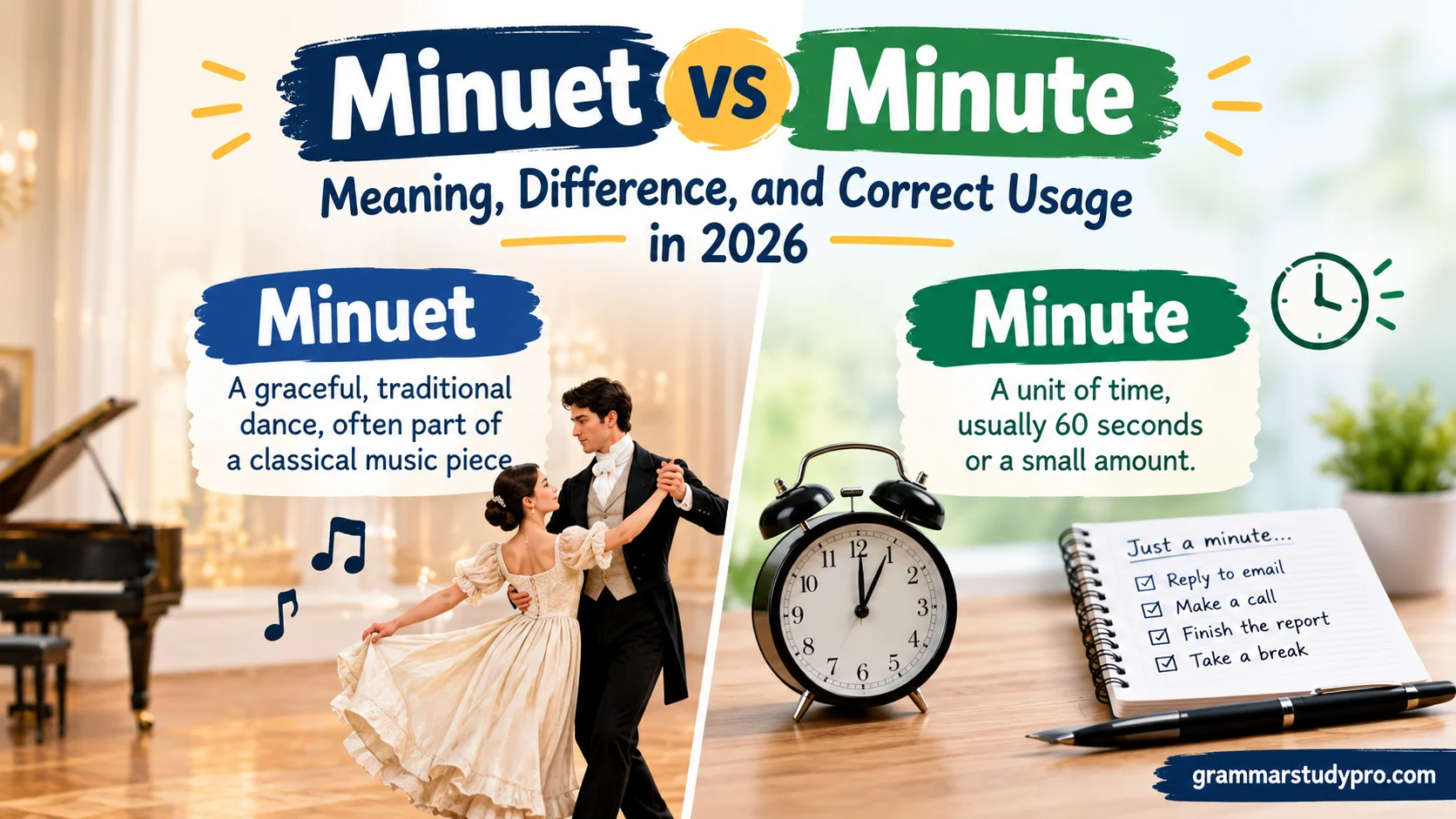
The Minuet vs Minute difference becomes easier to understand when you compare their spelling, pronunciation, and meanings in everyday English.
A minuet is a graceful dance and a musical composition associated with classical music, traditional dance, and 18th-century music. It is a slow dance with a distinct style, and the word can describe music composed for that dance. In contrast, minute has two main pronunciations and meanings. Pronounced MIN-it, it means a time period of sixty seconds, a unit of time, or a time measurement. Pronounced my-NOOT, it describes something extremely small, such as tiny details, small details, or a tiny crack in a glass. Although these commonly confused words look similar, their meanings and uses are quite different.
The two pronunciations of minute can cause confusion when you’re writing a sentence, preparing an email, or improving your English vocabulary. A minuet refers to dance, music, or a musical form, while a minute can refer to time, size, or a written record of a meeting. For example, you might spend one minute examining a tiny crack in a glass or read the minutes of a meeting to review its decisions. Checking the context helps you choose the correct word and avoid spelling mistakes. Understanding their definitions, spelling, grammar, usage, and pronunciation can improve your word choice, language skills, and written communication. With practice, you can use these words clearly and confidently in everyday communication.
Quick Answer:
Minuet is a noun that refers to a traditional, graceful dance or a piece of music written for that dance. Minute can mean a period of 60 seconds, something extremely small, or a written record of a meeting.
Here is the easiest way to remember the difference:
- Minuet: A traditional dance or its music. Example: The orchestra played a minuet.
- Minute: A unit of time. Example: The meeting lasted one minute.
- Minute: Extremely small. Example: The scientist discovered a minute particle.
Both spellings are correct English words. However, you cannot use them interchangeably because they communicate different meanings.
Comparison Overview: Minuet vs Minute
The following table highlights the main differences between minuet and minute, including their meanings, pronunciations, grammatical roles, and common uses.
| Feature | Minuet | Minute |
| Part of speech | Noun | Noun, adjective, and verb |
| Primary meaning | A traditional dance or its music | A period of 60 seconds |
| Other meaning | No common everyday alternative meaning | Extremely small; a record of a meeting |
| Pronunciation | min-yoo-ET | MIN-it (time); my-NOOT (tiny) |
| Common context | Classical music, dance, and history | Everyday conversation, schedules, science, and business |
| Example | The dancers performed a minuet. | I’ll return in a minute. |
| Spelling tip | Ends in -uet | Ends in -ute |
The most important distinction is context. If you’re discussing a dance or classical composition, minuet is usually the right choice. If you’re referring to time, a small detail, or meeting records, minute fits the sentence.
What Does Minuet Mean?
Definition of Minuet
A minuet is a slow, formal dance traditionally performed by two people. It became popular in European court society during the 17th and 18th centuries. The word also refers to music composed for this dance or written in its characteristic style.
Unlike many modern social dances, the minuet emphasizes controlled movements, graceful steps, and formal posture. Its elegant style suited royal courts and other formal gatherings of its time.
The word often appears in discussions of classical music, dance history, and historical celebrations. For example, a music teacher might introduce a minuet by a classical composer, while a historian might describe a court performance.
How to Pronounce Minuet
The standard pronunciation of minuet is /ˌmɪn.juˈet/. You can think of it as three syllables, with the strongest stress on the final syllable.
Here are a few examples:
- The orchestra performed a minuet.
- She learned the steps of a traditional minuet.
- The final minuet gave the concert an elegant finish.
Notice that the word ends with a clear “et” sound. This distinguishes it from minute, especially when minute refers to time.
Examples of Minuet in Sentences
The following sentences show how to use minuet naturally in different contexts.
- Dance: The performers practiced a minuet for the historical festival.
- Classical music: The pianist played a beautiful minuet during the recital.
- History: The museum’s exhibition explained how the minuet became popular among European court society.
- Performance: The dancers maintained perfect posture throughout the minuet.
- Composition: The composer included a minuet in the musical suite.
In each example, the word relates to a dance or its music. It doesn’t describe a period of time or something extremely small.
When Should You Use Minuet?
Use minuet when your sentence discusses a traditional dance, a musical composition, or the history of formal dancing.
For example, consider this sentence:
The musicians performed a minuet at the palace.
The word works because the sentence describes a musical performance associated with the historical dance.
However, this sentence uses the wrong word:
I’ll finish the assignment in a minuet.
If you mean that the assignment will take 60 seconds, write minute instead. A minuet is a dance, not a unit of time.
What Does Minute Mean?
The word minute has several meanings, which makes it more versatile than minuet. It can function as a noun, adjective, or verb. Its pronunciation changes depending on its meaning.
Minute as a Noun: A Unit of Time
The most familiar meaning of minute is a unit of time equal to 60 seconds. There are 60 minutes in an hour and 1,440 minutes in a standard 24-hour day.
People use the word when discussing appointments, travel times, waiting periods, deadlines, and daily routines. It also appears in expressions that describe a short or unspecified period.
Examples include:
- I’ll be ready in one minute.
- The presentation lasted 30 minutes.
- We arrived five minutes before the movie started.
- Give me a minute to check the schedule.
- The repair took less than 10 minutes.
In everyday conversation, a minute doesn’t always mean exactly 60 seconds. Someone who says, “Wait a minute,” may simply mean “wait briefly.”
Context determines whether the speaker means a precise duration or a general short delay.
Minute as an Adjective: Extremely Small
The adjective minute means extremely small, slight, or tiny. It can describe physical objects, small differences, subtle changes, or details that require close attention.
When used this way, the word has a different pronunciation: /maɪˈnuːt/ in American English. The stress falls on the second syllable.
Consider these examples:
- The inspector discovered a minute crack in the window.
- Researchers measured minute changes in the temperature.
- The artist added minute details to the portrait.
- The laboratory detected a minute quantity of the chemical.
- Even a minute difference in the measurements affected the results.
In these sentences, minute doesn’t describe time. It emphasizes how small something is or how fine its details are.
This meaning often appears in scientific writing, technical reports, art criticism, and careful descriptions. For instance, a scientist might study minute variations in a sample that ordinary observation would miss.
Minute as a Verb: Recording Meeting Proceedings
Minute can also function as a verb meaning to record the proceedings or decisions of a meeting in writing. This usage is common in business and formal organizational settings.
For example:
- The assistant will minute the committee’s decisions.
- The secretary carefully minuted the discussion.
- The organization requires someone to minute every formal meeting.
The verb is less common in everyday conversation than the noun minutes, which refers to the written record of a meeting.
For example, “Please send me the meeting minutes” asks for the document summarizing what happened. It doesn’t ask someone to send a duration of time.
How to Pronounce Minute Correctly
The spelling stays the same, but the pronunciation changes with the meaning. Learning this distinction can help you understand spoken English and pronounce the word confidently.
| Meaning | Pronunciation | Example |
| A unit of time | MIN-it | I’ll call you in a minute. |
| A short period | MIN-it | Wait a minute, please. |
| Extremely small | my-NOOT | The device detected a minute particle. |
| A meeting record or the act of recording it | MIN-it | Please review the meeting minutes. |
The pronunciation difference is important because the adjective sounds quite different from the noun and verb. Cambridge Dictionary confirms both pronunciations in its American English entries.
A useful practice technique is to say each word in a complete sentence. That helps you connect the sound with its meaning rather than memorizing pronunciation in isolation.
Main Differences Between Minuet and Minute
Although minuet and minute share several letters, their meanings, pronunciations, and grammatical functions differ. Understanding these distinctions makes it easier to select the right word when writing.
Difference in Meaning: Minuet vs Minute
The clearest difference is what each word describes.
Minuet relates to a traditional dance or the music associated with it. Minute most often refers to time, tiny things, or detailed information.
Compare these sentences:
- The orchestra performed a minuet. This describes a musical performance.
- The orchestra rehearsed for one minute. This describes the duration of the rehearsal.
- The conductor noticed a minute error in the score. This describes a very small error.
The last two sentences use the same spelling but different meanings. The surrounding words help readers identify the intended meaning.
Difference in Pronunciation
The words also differ when spoken aloud.
- Minuet has three syllables and ends with a stressed “et” sound.
- Minute meaning time has two syllables and stresses the first.
- Minute meaning extremely small has two syllables and stresses the second.
This distinction matters in conversation because the adjective minute can sound unfamiliar to people who know only its time-related meaning.
For example, a scientist describing a “minute particle” means the particle is extremely small. The speaker isn’t referring to a particle that lasts 60 seconds.
Difference in Spelling
The spellings differ by a small but important change near the end:
- Minuet: M-I-N-U-E-T
- Minute: M-I-N-U-T-E
The final letters can help you remember which word belongs in your sentence. Minuet ends in -uet, while minute ends in -ute.
However, don’t rely on spelling alone. Both are valid English words, so a spell-checker may accept the wrong choice if the word is grammatically possible but doesn’t fit your meaning.
Difference in Grammar and Usage
Minuet functions primarily as a noun. It names a dance or a piece of music.
Minute has more grammatical uses:
- Noun: We waited for a minute.
- Adjective: She noticed a minute scratch.
- Verb: The secretary will minute the meeting.
This flexibility explains why minute appears in a wider range of everyday and professional writing.
Difference in Context
Context often provides the quickest clue.
If the sentence mentions dancers, orchestras, classical compositions, or historical court celebrations, minuet may be the correct choice.
If it mentions clocks, schedules, tiny objects, measurements, or meeting records, minute is more likely.
For example, “The team discussed the minute changes” uses minute as an adjective. By contrast, “The team performed a minuet” describes a dance-related activity.
Minuet vs Minute: Correct Usage Examples
Examples make the difference easier to remember. The following sentences show how each word works in real situations.
Examples Using Minuet
Use minuet when referring to a dance or music associated with it.
- The orchestra opened the evening with a graceful minuet.
- The students studied the minuet as part of their music history course.
- The dancers practiced their minuet before the formal performance.
- The composer wrote a minuet that suited the elegant atmosphere of the event.
- The museum displayed an illustration of a couple performing a minuet.
Each example connects the word to dance, music, or cultural history.
Examples Using Minute for Time
Use minute when discussing a period of 60 seconds or a brief interval.
- I’ll be back in a minute.
- The elevator took less than a minute to reach the lobby.
- She spent 15 minutes reviewing the report.
- We have one minute left before the presentation begins.
- The coach asked the players to rest for a few minutes.
In these sentences, minute measures time or describes a short wait.
Examples Using Minute to Mean Small
Use the adjective minute when you want to emphasize something’s tiny size or a subtle detail.
- The technician found a minute crack in the machine.
- The microscope revealed minute organisms in the sample.
- She noticed a minute difference between the two paintings.
- The researcher recorded minute variations in pressure.
- The jeweler examined the minute details of the design.
These examples show why pronunciation matters. The word describes smallness rather than duration.
Incorrect vs. Correct Sentences
The following table highlights common mistakes and explains how to correct them.
| Incorrect sentence | Correct sentence | Explanation |
| Please wait five minuets. | Please wait five minutes. | The sentence refers to time. |
| The orchestra played a minute. | The orchestra played a minuet. | The intended meaning is a dance or its music. |
| The inspector found a minuet crack. | The inspector found a minute crack. | The adjective means extremely small. |
| We practiced the minute for the performance. | We practiced the minuet for the performance. | The sentence refers to a traditional dance. |
| The meeting lasted three minuets. | The meeting lasted three minutes. | A meeting’s duration is measured in minutes. |
The main lesson is simple: choose the word that matches your intended meaning, not merely the spelling that looks familiar.
Common Mistakes When Using Minuet and Minute
Even confident writers can mix up these words because their spellings are so similar. A few practical checks can prevent most errors.
Confusing a Dance With a Unit of Time
The most obvious mistake is writing minuet when you mean a period of time.
For example:
Incorrect: The bus will arrive in ten minuets.
Correct: The bus will arrive in ten minutes.
The number provides a useful clue. When you describe a duration, use minute or its plural form minutes. When you describe a historical dance or its music, use minuet.
Mispronouncing Minute
Another common mistake involves pronouncing both meanings of minute the same way.
Remember these two forms:
- MIN-it: A unit of time or a meeting record.
- my-NOOT: Something extremely small.
For example, “I’ll finish in a minute” refers to time. However, “The report contains minute details” refers to small or precise details.
Practicing the words in context will help you remember the difference.
Trusting Spell-Check Too Much
Spell-checking software catches many typing errors, but it doesn’t always catch incorrect word choices. Both minuet and minute are legitimate English words.
Suppose you write, “The dancers performed a minute.” A spelling checker might not flag the sentence because every word is spelled correctly. The problem lies in the meaning.
To catch such mistakes, reread the sentence and ask whether the word communicates your intended idea.
Confusing Minute With Meeting Minutes
The word minutes also appears in workplaces, schools, and organizations to describe written meeting records.
Compare these examples:
- Time: The discussion lasted 20 minutes.
- Meeting record: The secretary distributed the meeting minutes.
The first sentence measures duration. The second refers to a document recording the meeting’s main points, decisions, or actions.
Both uses are correct. The surrounding context makes the intended meaning clear.
Easy Ways to Remember Minuet vs Minute
You don’t need to memorize complicated grammar rules to distinguish these words. A few simple associations can help you choose correctly.
Associate Minuet With Music
Think of a ballroom, an orchestra, or a historical dance when you see minuet. Its connection with classical music gives the word a clear place in your vocabulary.
For example, if your sentence discusses a composer, dancers, or a formal performance, minuet may be the word you need.
Memory tip: Minuet has an extra e before the final t. Associate that spelling with the elegant movements of the dance.
Associate Minute With Time or Tiny Details
The word minute connects to two common ideas: time and smallness.
When it means time, think of a clock counting 60 seconds. When it means extremely small, imagine a tiny mark that requires close inspection.
For example:
- The appointment starts in one minute.
- The scientist noticed a minute change in the sample.
Although the spelling stays the same, the sentence tells you which meaning applies.
Use Context to Choose the Correct Word
Before writing either word, ask yourself one quick question: Am I describing a dance, time, or something extremely small?
- A dance or its music? Choose minuet.
- Sixty seconds or a short wait? Choose minute.
- A tiny object or subtle difference? Choose minute.
- A written record of a meeting? Choose minutes.
This simple check can prevent errors even when spell-checking tools miss them.
Are Minuet and Minute Related?
Interestingly, minuet and minute have a historical linguistic connection. Their similar spellings aren’t entirely coincidental.
The word minuet entered English through French menuet, a word associated with something small, fine, or delicate. The dance’s name has traditionally been linked to its small, graceful steps. Oxford Learner’s Dictionaries records this French origin.
The adjective minute, meaning extremely small, also has roots connected to the Latin word minutus, meaning small or reduced. This historical relationship helps explain why the words share similar forms.
However, their modern meanings have developed in different directions. Today, minuet refers to a specific dance or musical form, while minute covers time, smallness, and meeting records.
You can explore the historical details.
Minuet vs Minute in American and British English
American and British English use the same spellings for minuet and minute. Their central meanings also remain consistent across both varieties.
The most noticeable pronunciation difference concerns the adjective minute, meaning extremely small. British English commonly includes a slight “y” sound in the second syllable, while standard American pronunciation generally omits that sound. The noun meaning time has the familiar two-syllable pronunciation in both varieties.
Here’s what you should remember:
- Minuet: Refers to the traditional dance or its music in both varieties.
- Minute: Refers to 60 seconds in both varieties.
- Minute: Can mean extremely small in both varieties.
- Minutes: Commonly refers to written records of meetings in both varieties.
You don’t need a separate American or British spelling rule for this comparison. Focus on meaning, pronunciation, and context instead.
FAQs
1. What is the difference between minuet and minute?
A minuet is a traditional dance or a piece of music composed for it. A minute refers to sixty seconds or something extremely small, depending on its pronunciation and context.
2. How do you pronounce minuet and minute?
Minuet is pronounced “min-yoo-ET.” Minute has two common pronunciations: “MIN-it” for a unit of time and “my-NOOT” for something very small.
3. Does minute have more than one meaning?
Yes, minute has two main meanings. It can describe a period of sixty seconds or something extremely small, detailed, or precise.
4. What is a minuet in classical music?
A minuet is a traditional, graceful dance that became popular in European courts during the 17th and 18th centuries. The word also refers to music composed for this dance.
5. How can I remember the difference between minuet and minute?
Remember that minuet relates to music and dancing, while minute relates to time or small details. Checking the sentence’s context will help you choose the correct word.
Conclusion
Understanding Minuet vs Minute becomes simple once you learn their meanings and pronunciations. A minuet belongs to the world of traditional dance and classical music, while a minute describes sixty seconds or something very small.
Although the words look similar, they serve different purposes in English. Remember their meanings, check the context, and use the correct spelling to make your writing clearer and more accurate.