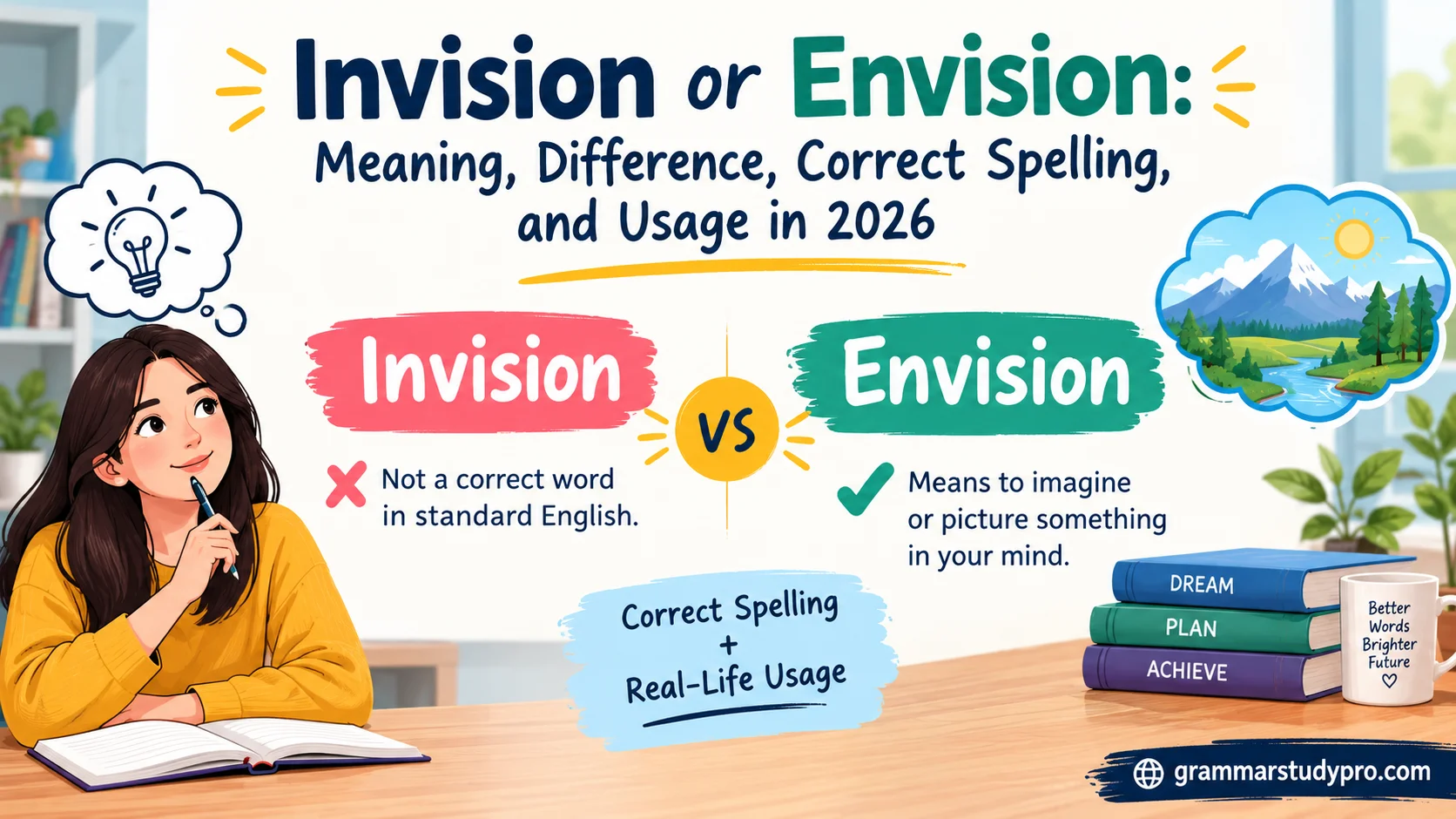
Invision or Envision can confuse writers because both forms look similar, but only one is standard for clear, professional English writing today. When I review professional writing, I often notice writers hesitate between invision and envision because the two words sound similar. The correct spelling is envision when the intended verb means to imagine, picture, or expect a future possibility. It is the standard, widely accepted form in American English and general writing. By contrast, lowercase invision is usually incorrect, and Dictionary.com identifies it as a frequent misspelling of envision. Cambridge Dictionary lists envision as a US English verb, while envisage is the common UK counterpart. In ordinary speech, these forms may seem close, but their meanings and usage are not the same.
The distinction becomes clearer when you consider how each word functions in sentences. Envision works as a verb, as in a sentence about a cleaner design for the future. Its use can change with verb tense, while careful writers should also check subject–verb agreement, articles, prepositions, and modifiers to keep the meaning precise. In general writing, envision is the natural choice. However, InVision with a capitalized letter can be a proper noun, brand name, or reference to design software. This proper name is different from the lowercase spelling and can represent something completely different. In my experience, remembering this distinction helps prevent a simple spelling error from changing the intended meaning.
Working with editors, I find that contextual examples and practical checking are useful tips for avoiding common mistakes. Parts of speech, including nouns, verbs, adjectives, adverbs, prepositions, conjunctions, and pronouns, show how words fit into sentences, while grammar patterns, pronunciation, idiomatic expressions, and correct usage help people understand the difference. If you have typed invision and stopped because it looked wrong, check whether you actually mean envision. Experienced writers can use this simple check to reduce ambiguity, improve precision, and write with confidence. It also helps you modify sentences correctly instead of using invision as a substitute for envision.
Quick Answer
If you’re asking whether to write invision or envision when you mean imagine something, use envision.
Envision means to imagine or expect something to happen, appear, or develop in a particular way. Cambridge Dictionary gives examples involving future plans, transformations, buildings, and other imagined situations.
For example:
Correct: I can envision a better future.
Usually incorrect: I can invision a better future.
The lowercase spelling invision is generally treated as a misspelling when someone intends to write envision. Dictionary.com explicitly labels it a frequent misspelling of envision.
There is one important exception to remember: InVision can be a proper name. For example, the name appears in software and product contexts. Atlassian’s marketplace currently identifies InVision as a design-related product and integration name.
So the easiest rule is:
If you’re talking about imagining something, write “envision.” If you’re referring to a specific name such as InVision, preserve its official capitalization and spelling.
Comparison Overview
The fastest way to understand the difference is to put the forms side by side.
| Word or form | Standard use | Meaning |
| envision | Standard English verb | Imagine or expect something in a particular way |
| envisioned | Past tense/past participle | Imagined or expected |
| envisioning | Present participle/gerund | Imagining or considering a possibility |
| invision | Generally a misspelling when intended as the verb envision | Usually intended to mean envision |
| InVision | Proper name | A name used for a specific product or organization |
| envisage | Standard English, especially UK usage | Imagine or expect something in the future |
Cambridge defines envision as imagining or expecting something to happen or appear in a particular way. Its dictionary also identifies envisage as the UK form.
The distinction between envision and invision therefore isn’t like the distinction between color and colour. Those are recognized regional spellings. Envision and invision aren’t standard regional variants of one another.
A simple memory trick
Think of the word this way:
Envision = imagine it.
If you’re mentally creating a picture of a future result, situation, place, or possibility, envision is the spelling you want.
Main Differences Between Invision or Envision
The biggest difference comes down to standard English usage versus a misspelling or proper name.
Envision is the standard verb
When envision functions as a verb, it describes the act of imagining or expecting something in a particular form.
For example:
- I envision a quiet life near the coast.
- She envisions opening her own restaurant.
- They envisioned a completely different approach.
- We are envisioning a larger community center.
Cambridge lists envision as a transitive verb and gives examples using nouns, -ing forms, and that-clauses.
Invision usually isn’t the spelling you want
If you’re writing a sentence such as:
I invision myself running a successful company.
The standard correction is:
I envision myself running a successful company.
Dictionary.com specifically identifies lowercase invision as a frequent misspelling of envision.
That makes the correction straightforward in normal writing.
InVision can be a proper name
Context changes things when the word appears as InVision.
A proper name doesn’t have to follow ordinary vocabulary patterns. Companies, software products, organizations, and other entities can choose distinctive spellings and capitalization.
For example, Atlassian has pages describing integrations involving InVision, while its marketplace identifies an InVision product.
So these sentences don’t mean the same thing:
The architect envisions a larger building.
The designer uses InVision.
The first sentence uses an ordinary English verb. The second uses a proper name.
What Does Envision Mean?
Envision means to imagine or expect something in a particular way.
The word often points toward something that isn’t fully present yet. You might envision a future career, a redesigned room, a new business, a different lifestyle, or an entirely new system.
Cambridge gives examples such as envisioning a park with trails and a boating lake and envisioning a museum displaying particular types of art.
That gives the word a useful flavor. You’re not merely having a random thought. You’re forming a mental picture of what something could look like or become.
Envision can describe a future possibility
Consider this sentence:
The company envisions opening five new stores next year.
The company isn’t saying those stores already exist. Instead, it has a particular future scenario in mind.
That’s why envision appears frequently in discussions about:
- Business strategy
- Long-term goals
- Urban planning
- Product development
- Personal ambitions
- Education
- Technology
- Creative projects
Envision can also describe a mental picture
The word doesn’t have to involve a detailed business plan.
For example:
I envisioned someone much taller.
Here, envisioned describes the mental picture someone had before meeting another person.
Cambridge includes this broader sense in its related entry for envisage, defining it partly as forming a mental picture of someone or something that hasn’t been seen before.
In other words, envision isn’t limited to formal planning.
How to Use Envision in a Sentence
One reason people search for invision or envision is that knowing the spelling doesn’t always answer the grammar question.
Fortunately, envision follows several useful patterns.
Envision + noun
You can place a noun directly after envision.
Examples:
- She envisions a peaceful retirement.
- They envision a modern campus.
- The designer envisions a cleaner interface.
- We envision a stronger community.
Here, the noun identifies the thing being imagined.
Envision + -ing verb
This pattern is extremely useful.
Examples:
- I envision working from home.
- She envisions opening a bakery.
- They envision building a larger facility.
- We envision creating a simpler system.
Cambridge explicitly provides examples of envision followed by an -ing form.
This leads to an important grammar point.
Don’t normally write:
I envision to open a bakery.
A more natural construction is:
I envision opening a bakery.
Envision + that-clause
You can also use that to introduce a clause.
For example:
I envisioned that I would return home.
Cambridge includes this construction among its documented examples.
In everyday writing, however, a shorter construction can often sound more natural:
I envisioned returning home.
Neither idea requires unnecessary grammatical gymnastics.
Envision + question word
The word can also appear with how, what, or similar question words.
For example:
It’s difficult to envision how the project will work.
Or:
Can you envision what the finished building will look like?
These constructions work especially well when you’re discussing possibilities rather than making a definite prediction.
Envision vs. Imagine
Imagine is probably the closest everyday alternative to envision.
Both words involve forming an idea or mental picture. However, envision often carries a stronger sense of deliberately considering a possible future.
Compare these sentences:
Imagine winning the lottery.
The entrepreneur envisions opening ten stores.
The first sounds casual and hypothetical. The second sounds more deliberate and goal-oriented.
That doesn’t mean envision always describes a realistic plan. Someone can envision an impossible scenario. The distinction lies more in how the mental picture is framed.
When imagine sounds more natural
Use imagine when you’re:
- Making a casual suggestion
- Describing a hypothetical situation
- Telling a story
- Expressing surprise
- Asking someone to picture an unusual situation
For example:
Imagine waking up tomorrow and finding snow outside.
When envision sounds natural
Use envision when you’re:
- Describing a future goal
- Discussing a proposed design
- Talking about long-term plans
- Explaining a desired outcome
- Describing a mental picture of something specific
For example:
The architect envisions a public square surrounded by trees.
Both words work. Their tone and emphasis differ.
Envision vs. Visualize
Visualize is another close relative, but the emphasis can shift.
Visualize usually puts more weight on creating a mental image. Envision can include that mental picture while also suggesting a broader possibility or future situation.
Consider:
She visualized the finished painting.
This focuses on the image in her mind.
Now consider:
She envisioned transforming the empty room into an art studio.
This suggests more than an image. It describes a possible future use and outcome.
The distinction isn’t absolute. English words frequently overlap. Still, this difference helps explain why envision often appears in planning and strategic contexts.
Cambridge’s definition of envision specifically includes imagining or expecting something to happen or appear in a particular way.
Envision vs. Foresee
Don’t treat foresee and envision as perfect synonyms.
Foresee generally emphasizes anticipating something that may happen. It can imply that someone recognizes a future development before it occurs.
For example:
We foresee delays during construction.
That sentence suggests an expectation based on circumstances.
Now compare:
We envision a new transportation system.
That sentence focuses on a future concept or possibility.
Here’s a useful distinction:
| Word | Main emphasis |
| Envision | Imagine or picture a possibility |
| Imagine | Form an idea or mental picture |
| Visualize | Create a mental image |
| Foresee | Anticipate something before it happens |
| Expect | Believe something is likely to happen |
The words overlap. Their emphasis doesn’t.
Envision vs. Envisage
This is another common point of confusion.
Envision and envisage have essentially the same core meaning. The main difference involves regional usage and style.
Cambridge lists envision as the US form and envisage as the UK form.
For example:
US English:
We envision expanding the program next year.
UK English:
We envisage expanding the program next year.
The meanings are closely aligned.
Cambridge also describes envisage as a formal verb and gives constructions with that, -ing, and question words.
Is envisage more formal?
It can sound more formal, particularly to American readers. That’s partly because American English generally uses envision while envisage appears more often in British English.
This doesn’t make envisage incorrect in American English. It simply gives the word a different regional flavor.
Is “Invision” a Word?
Here’s where the answer needs a little historical and contextual nuance.
In modern standard English, invision is generally not the form to use when you mean “envision.” Dictionary.com specifically labels it a frequent misspelling of envision.
However, the spelling has appeared historically. An 1828 edition of Noah Webster’s American Dictionary of the English Language recorded invision as a noun meaning a lack of vision or the power of seeing, while marking the word as little used.
That historical fact is worth knowing because it prevents an overly simplistic claim that the letter sequence has never existed in English.
But historical dictionary entries don’t change modern usage.
If you’re writing an email, article, essay, resume, report, or website today and mean “to imagine,” use:
envision
Not:
invision
Why Do People Write “Invision”?
The mistake makes sense when you look at pronunciation.
Cambridge gives the pronunciation of envision as:
/ɪnˈvɪʒ.ən/
The first syllable sounds like “in.” That’s probably one reason the spelling invision feels intuitive.
There’s another clue: the word contains vision, which strongly attracts the eye. A writer may remember the sound more clearly than the spelling and simply insert in- before vision.
English contains plenty of words beginning with in-, after all. The brain naturally looks for familiar patterns.
That’s why this error can survive even among experienced writers.
Common Mistakes With Envision
A few mistakes appear repeatedly.
“I invision a better future”
Incorrect for the intended meaning:
I invision a better future.
Correct:
I envision a better future.
“I envision to become successful”
This construction sounds unnatural.
Better:
I envision becoming successful.
Or:
I envision myself becoming successful.
“We envision about expanding”
The word about isn’t normally needed.
Better:
We envision expanding the business.
“She envisioned of a new design”
Again, of doesn’t belong in this construction.
Better:
She envisioned a new design.
“They invisioned the result”
Use:
They envisioned the result.
The past form simply adds -ed to envision.
Correct Forms of Envision
Once you know the base form, the other forms are straightforward.
| Form | Example |
| envision | I envision a different future. |
| envisions | She envisions a larger home. |
| envisioned | They envisioned a new system. |
| envisioning | We are envisioning several possibilities. |
These forms all preserve the en- spelling.
Envisioned
Use envisioned for the past tense or past participle.
The founders envisioned a much smaller company.
Envisioning
Use envisioning when the action is ongoing or when the word functions as a gerund.
They are envisioning a completely different approach.
Envisions
Use envisions with a third-person singular subject in the present tense.
The architect envisions a building with natural light.
Envision in Different Tenses
Here’s a practical reference you can bookmark.
| Tense or form | Example |
| Present | I envision a better system. |
| Present, third person | She envisions a different future. |
| Past | They envisioned a larger project. |
| Present continuous | We are envisioning several options. |
| Present perfect | The team has envisioned multiple solutions. |
| Past perfect | They had envisioned a different outcome. |
The spelling remains predictable. The main thing to watch is the en- beginning.
Envision Examples in Everyday Writing
The word fits many situations.
Personal goals
I envision living somewhere quieter in the future.
Here, envision describes a desired lifestyle.
Career planning
She envisions building a career in environmental research.
The sentence describes a future possibility.
Business
The company envisions expanding into three new markets.
This sounds natural in strategic writing.
Architecture
The architect envisions a public library surrounded by gardens.
The word works because the design exists first as a concept.
Education
The teacher envisions a classroom where students work together.
This describes a desired future environment.
Technology
Developers envision a system that can process the information automatically.
The word introduces a future possibility.
Creative work
The novelist envisioned the city as a character in its own right.
Here, envisioned describes a creative mental concept rather than a concrete business plan.
A Practical Case Study: Choosing the Right Word
Imagine you’re writing a company announcement.
Your first draft says:
Our team invisions a future where customers can access everything from one platform.
The spelling problem is easy to fix:
Our team envisions a future where customers can access everything from one platform.
Now imagine you want a more conversational tone:
Our team imagines a future where customers can access everything from one platform.
Both are grammatical. The choice depends on tone.
Envisions sounds more deliberate and strategic.
Imagines sounds more conversational and accessible.
That small difference demonstrates why good word choice isn’t only about correctness. It’s also about meaning, emphasis, and audience.
Envision in Professional and Business Writing
You’ll frequently encounter envision in strategic documents because businesses often need to describe something that doesn’t exist yet.
For example:
The organization envisions creating a more accessible customer experience.
The sentence communicates a future direction without claiming that the goal has already been achieved.
The word works particularly well with concepts such as:
- vision
- strategy
- growth
- expansion
- innovation
- development
- transformation
- long-term goals
However, don’t use envision simply because it sounds sophisticated.
If you mean plan, say plan.
If you mean expect, say expect.
If you mean predict, say predict.
If you mean imagine, say imagine.
Precision beats decoration.
Is Envision Formal or Informal?
Envision works in both everyday and professional English.
You can use it in a casual sentence:
I can envision us spending the summer there.
You can also use it in a formal context:
The proposal envisions substantial improvements to public transportation.
The surrounding vocabulary determines much of the tone.
Compared with imagine, envision can sound slightly more deliberate or purposeful. Compared with envisage, it often feels more natural to American readers.
Envision Synonyms
No synonym works perfectly in every sentence. Context matters.
When you mean “imagine”
- Imagine
- Picture
- Conceive
- Visualize
When you mean “anticipate”
- Foresee
- Expect
- Anticipate
When you mean “consider as a possibility”
- Contemplate
- Conceive
- Imagine
- Project
For example:
We envision expanding the company.
Possible alternatives include:
We plan to expand the company.
We expect to expand the company.
We imagine expanding the company.
But each changes the meaning slightly.
Plan suggests intention.
Expect suggests anticipation.
Imagine emphasizes mental possibility.
Envision sits comfortably between imagining and describing a future possibility.
How to Pronounce Envision
Cambridge gives the US pronunciation as:
/ɪnˈvɪʒ.ən/
A simple approximation is:
en-VIZH-un
The stress falls on the middle syllable.
The “zh” sound is the sound you hear in words such as vision and decision.
This pronunciation also helps explain the spelling confusion. When spoken quickly, the opening sound can easily be interpreted as “in.”
That doesn’t change the spelling.
Say it like “in-VIZH-un.” Spell it “envision.”
Is “InVision” Different From “Envision”?
Yes, when InVision functions as a proper name.
Capitalization is important here.
Compare:
The designer envisions a new interface.
with:
The team works with InVision.
The first is an ordinary English verb. The second is a proper name.
InVision has appeared in software and design contexts, including integrations documented by Atlassian and products listed through Microsoft’s marketplace.
Therefore, seeing InVision online doesn’t mean invision has become an alternative spelling of envision.
Brand names often have their own capitalization and spelling conventions.
Invision or Envision: A Quick Grammar Guide
Use this simple reference when writing.
Use these patterns
- envision + noun
- We envision a better solution.
- envision + -ing
- We envision creating a better solution.
- envision + that-clause
- We envision that the project will expand.
- envision + question word
- It’s difficult to envision how the plan will work.
Cambridge documents these patterns for envision and its closely related envisage.
Avoid these common patterns
- envision to do something
- envision about doing something
- envision of something
Instead, choose the construction that matches your meaning.
Invision or Envision: Common Questions
Is “invision” the correct spelling?
Not when you mean the standard verb envision, meaning to imagine or expect something in a particular way. Dictionary.com identifies invision as a frequent misspelling of envision.
What does envision mean?
Envision means to imagine or expect something to happen, appear, or develop in a particular way.
Is envision a real word?
Yes. Envision is an established English verb listed by major dictionaries, including Cambridge Dictionary.
Is “invision” ever used?
Yes, but context matters. Lowercase invision can appear as a misspelling. Historically, the form also appeared in dictionaries with a different meaning related to lack of vision. In addition, InVision appears as a proper name.
Is envisage the same as envision?
They have essentially the same core meaning. Cambridge identifies envisage as the UK form and envision as the US form.
What is the past tense of envision?
The past tense is envisioned.
She envisioned a different future.
What is the -ing form of envision?
The -ing form is envisioning.
They are envisioning a new approach.
What is another word for envision?
Depending on context, possible alternatives include imagine, picture, visualize, foresee, anticipate, and conceive.
They’re not always interchangeable, though.
How do you use envision in a sentence?
A common pattern is:
Subject + envision + noun
For example:
The architect envisions a modern community center.
Another common structure is:
Subject + envision + verb-ing
For example:
She envisions opening her own business.
Invision or Envision: Final Cheat Sheet
When you’re stuck between the two spellings, use this table.
| What you mean | Correct choice | Example |
| Imagine a future | envision | I envision a better future. |
| Picture a possibility | envision | She envisions living abroad. |
| Describe a future plan or concept | envision | They envision expanding the project. |
| Past form | envisioned | He envisioned a different outcome. |
| Ongoing form | envisioning | We are envisioning several possibilities. |
| British English equivalent | envisage | They envisage major changes. |
| Specific proper name | InVision | The designer used InVision. |
| Ordinary verb spelled “invision” | Avoid | Use envision instead. |
FAQs
Is it Invision or Envision?
Envision is the correct spelling when you mean “to imagine,” “to picture,” or “to expect something.” Invision is generally a misspelling in ordinary English writing.
What does Envision mean?
Envision is a verb that means to imagine or picture something, especially a future possibility. For example, “We envision a cleaner and more efficient design.”
Is InVision a correct word?
InVision can be correct when it refers to a proper name or brand associated with design software. However, lowercase invision should not normally be used as a substitute for envision.
Is Envisage the same as Envision?
Yes, envisage and envision have essentially the same meaning. Envision is commonly used in American English, while envisage is more common in British English.
How can I remember the difference between Invision and Envision?
Remember that envision starts with en- and means to imagine or picture something. If you are using the word as a normal English verb, envision is usually the form you need.
Conclusion
Understanding Invision or Envision becomes easy once you separate the ordinary English verb from the proper name. Use envision when you mean to imagine, picture, or expect something in the future. Use InVision only when you are referring to the specific proper name or brand. Remembering this small spelling difference can help you avoid common errors and make your writing clearer, more precise, and more professional.