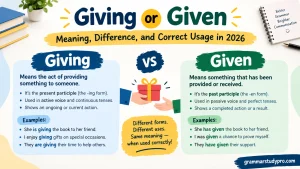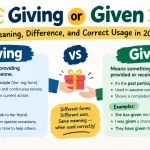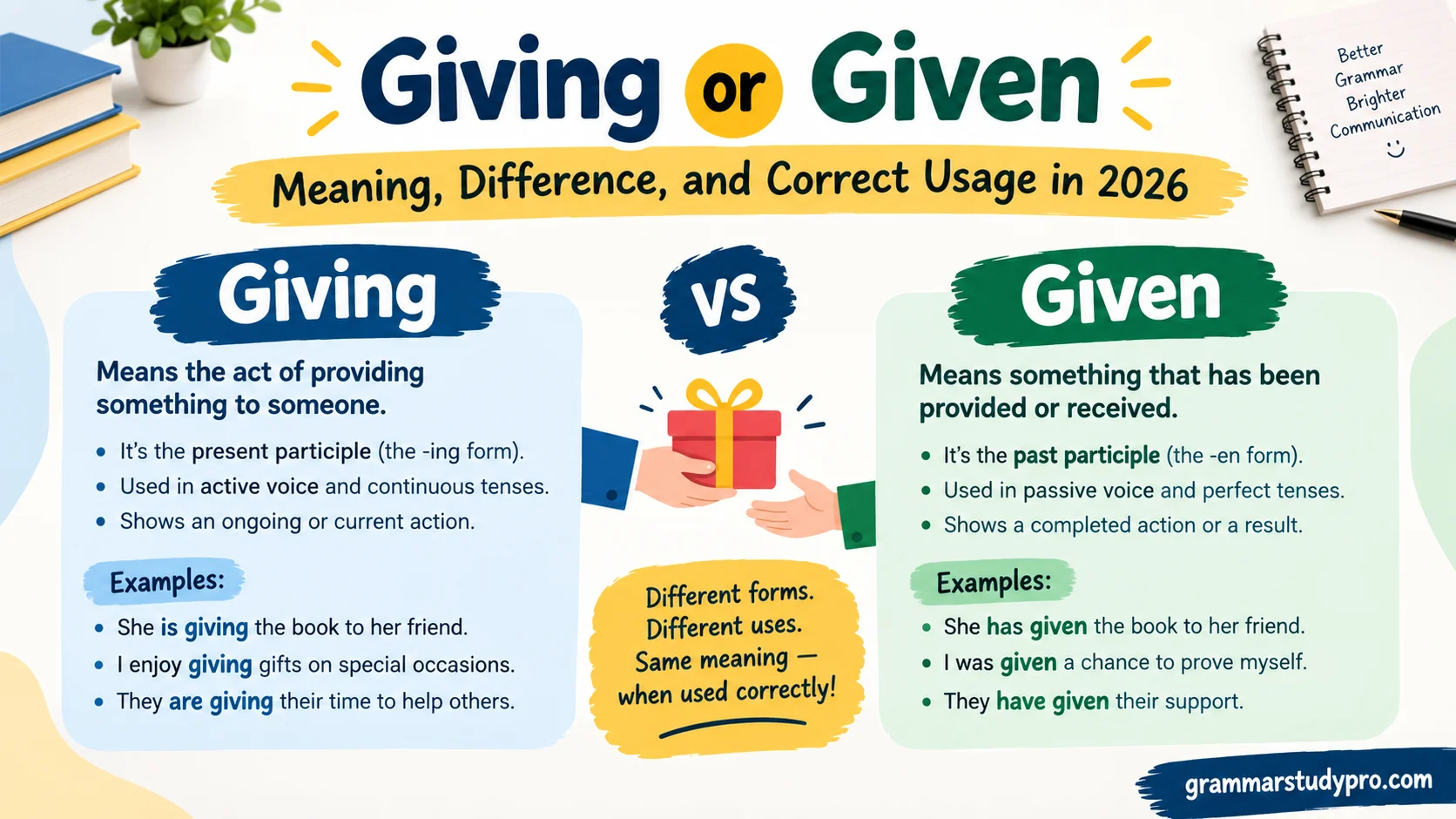
Giving or Given can seem confusing, but understanding their timing, function, and distinct roles makes their use much clearer. For English learners, Giving shows an action happening now, right now, or continuously. It is a present participle used with continuous tenses, as in I am giving. It can also work as a gerund, or noun form, such as giving gifts. This form describes an ongoing activity that is still in progress, rather than something that already happened. For example, he is giving him advice during a presentation, so the action continues at that moment. Many students struggle to use these forms correctly, but learning their basic patterns helps them write and speak more naturally and confidently.
Given, by contrast, is a past participle that often refers to something completed or connected with an earlier action. It appears in perfect tenses, such as I have given, and in passive voice constructions, such as The award was given. These passive constructions can indicate something that was provided or assumed. Given can also act as an adjective when something is specified, or as a preposition when considering a particular situation. For Examples, she has given her a book, while The award was given to the student. These subtle differences help prevent confusion and make the overall meaning clearer. In my own writing, I’ve found that this simple habit improves both writing and speaking because it helps sharpen my writing skills.
Depending on when you use each, using the right form can help you act cautiously while choosing either one or the other. This approach can create better sentences in every kind of writing and make your meaning easier to understand than before, whether the example appears in any book or in everyday communication. The key is to notice the states that exist in the sentence and decide whether the action is happening now or already happened. When to Use Each becomes easier to understand through practical Examples, and this method reminds him, her, and other writers that Giving and Given have different roles and functions. With regular practice, learners can use the right form more accurately and confidently.
Quick Answer
Giving is the -ing form of give. You usually use it for an action that is happening, continuing, or functioning as a noun.
- She is giving me advice.
- They were giving away free samples.
- Giving can be rewarding.
Given is the past participle of give. You use it with perfect tenses and in passive constructions. It also appears in expressions where it means “considering” or “taking something into account.”
- She has given me advice.
- They were given extra time.
- Given the circumstances, we left early.
A simple rule can help:
Use “giving” for the -ing form. Use “given” after have, has, or had, in passive structures, and when it means “considering.”
The form you choose depends on the grammar around it, not simply on whether the action happened in the past.
Comparison Overview
| Feature | Giving | Given |
| Base verb | Give | Give |
| Verb form | Present participle / -ing form | Past participle |
| Common structure | am/is/are/was/were + giving | has/have/had + given |
| Passive structure | Usually appears as being given | Commonly appears as given |
| Gerund use | Yes | No |
| Can act as an adjective | Yes, in some contexts | Yes |
| Can act as a preposition | No | Yes |
| Example | She is giving advice. | She has given advice. |
| Another use | Giving advice takes experience. | Given the circumstances, we left. |
Cambridge identifies given as the past participle of give and also records its use as a preposition meaning “knowing about or considering” something.
Meanwhile, giving can function as a noun in expressions such as charitable giving and gift giving.
Main Differences Between Giving and Given
The biggest difference between giving and given comes down to their grammatical forms.
Giving Is the -ing Form of Give
Giving is the present participle of give. It commonly follows forms of be when you want to describe an ongoing action.
For example:
- I am giving him the documents.
- She is giving a presentation.
- They were giving away food.
- We are giving customers more options.
The action has a sense of movement or continuation. Imagine a video camera pointed at the action. You can see the giving happening.
That’s the basic idea behind the continuous form.
Given Is the Past Participle of Give
Given is the past participle of give. It commonly appears after have, has, or had.
For example:
- I have given him the documents.
- She has given a presentation.
- They had given away the food.
- We have given customers several options.
Notice the difference:
She is giving a presentation.
She has given a presentation.
The first sentence presents the action as ongoing. The second presents it as completed in relation to another point in time.
Cambridge lists the principal forms of give as give, gave, given, while identifying giving as its present participle.
Given Also Appears in Passive Sentences
Here’s another important distinction.
You often see given when someone receives something rather than performs the action.
Compare:
- The teacher is giving the students extra time.
- The students are being given extra time.
- The students were given extra time.
In the first sentence, the students’ teacher performs the action.
In the second and third sentences, the students receive the action.
That’s why given appears frequently in passive constructions.
What Does Giving Mean?
Giving has several uses because give itself has many meanings.
At its most basic level, giving means providing, handing, offering, allowing, producing, or performing something, depending on the context.
Cambridge lists meanings of give that include providing something, telling someone something, producing an effect, allowing someone an opportunity, paying money, and performing an action.
Giving as an Ongoing Action
The most common grammatical use appears in continuous tenses.
Consider:
Maria is giving her brother a birthday present.
The action is taking place now or around the current time.
Change the sentence to the past:
Maria was giving her brother a birthday present.
Now the action was in progress at a particular time in the past.
You can also use it with the future:
Maria will be giving her brother a birthday present tomorrow.
The pattern remains recognizable:
be + giving
Giving as a Gerund
Giving can also behave like a noun.
For example:
Giving is better than receiving.
Here, giving doesn’t describe an action happening at this exact moment. Instead, it names the activity itself.
Other examples include:
- Giving advice requires judgment.
- Giving someone a second chance can change everything.
- He enjoys giving gifts.
- Giving to charity can support community projects.
Cambridge also recognizes giving as a noun meaning the act of giving money or other things to help someone or as a present.
Giving in Participial Phrases
You can also use giving to introduce a phrase that adds information about an action.
For example:
He walked into the room, giving everyone a quick smile.
Or:
She closed the laptop, giving herself a much-needed break.
The -ing phrase connects an additional action to the main sentence.
What Does Given Mean?
Given has more than one grammatical role.
First, it’s the past participle of give. That’s the role you see in:
She has given me the information.
But given can also work as a preposition, an adjective, or a noun.
That flexibility makes the word especially interesting.
Given in Perfect Tenses
Use given after have, has, or had when forming perfect constructions.
Present Perfect
I have given him the answer.
She has given us enough information.
Past Perfect
They had given us the wrong address.
He had given the matter considerable thought.
Future Perfect
By Friday, she will have given her presentation.
The structure is easy to remember:
have/has/had + given
Don’t write:
- She has giving me advice.
- He had gave me the answer.
Use:
- She has given me advice.
- He had given me the answer.
Given in Passive Voice
Passive sentences provide another major use of given.
Consider this active sentence:
The manager gave Sarah a promotion.
Now turn it into the passive:
Sarah was given a promotion.
The person receiving the action becomes the grammatical subject.
Here are more examples:
- The students were given extra time.
- He was given another opportunity.
- The patient was given medication.
- The employees were given new instructions.
- She will be given a chance to explain.
This distinction becomes particularly useful when you’re writing formal or academic English.
Being Given vs. Being Giving
This is a common point of confusion.
When the passive action is continuous, use:
being + given
For example:
The students are being given extra time.
Not:
The students are being giving extra time.
The second version is incorrect because giving is the active -ing form. The passive structure requires the past participle given.
Given as a Preposition
One of the most useful meanings of given has nothing to do with physically handing something to someone.
In phrases such as given the circumstances, given means considering or taking into account.
For example:
Given the weather, we decided to stay home.
This means:
Considering the weather, we decided to stay home.
Another example:
Given his experience, he should understand the problem.
In other words:
Considering his experience, he should understand the problem.
Cambridge specifically records this use of given as a preposition meaning “knowing about or considering” a particular thing.
Common Examples of Given as “Considering”
- Given the circumstances, we changed our plans.
- Given the evidence, the conclusion seems reasonable.
- Given her experience, she handled the situation well.
- Given the amount of time available, the project progressed quickly.
- Given that it was raining, we stayed indoors.
This construction appears frequently in academic, professional, journalistic, and everyday English.
Given That: Meaning and Correct Usage
Given that introduces a fact or condition that should be considered.
For example:
Given that the store was closed, we went somewhere else.
The phrase means approximately:
Considering that the store was closed…
You can use it to connect one known fact with a resulting decision, conclusion, or observation.
Examples include:
- Given that he already knew the answer, the test was easy for him.
- Given that traffic was heavy, we left early.
- Given that prices have increased, many customers are changing their habits.
Don’t confuse this construction with giving that.
In standard English, given that is the normal expression for this meaning.
Given as an Adjective
Given can also function as an adjective.
It can describe something that has already been specified, arranged, decided, or established.
For example:
Follow the instructions for the given exercise.
Here, given means something like “specified” or “provided.”
Consider these examples:
- At any given time, hundreds of people may be online.
- Use the formula with the given values.
- The experiment must be completed under the given conditions.
- The team worked within the given deadline.
Cambridge records this adjective use with meanings such as already decided, arranged, or agreed.
Given as a Noun
There’s another useful expression:
a given
A given is something regarded as certain, established, or accepted as a fact.
For example:
Reliable internet access is a given for many modern businesses.
Or:
It’s a given that customers expect quick responses.
Cambridge also records given as a noun meaning something considered certain to happen or be true.
The phrase take something as a given is also common:
Don’t take customer loyalty as a given.
Here, the speaker means you shouldn’t automatically assume that customer loyalty will continue.
Giving vs. Given in Different Tenses
The easiest way to understand the distinction is to place the forms into actual tense patterns.
| Tense or structure | Correct form | Example |
| Present continuous | am/is/are giving | She is giving a speech. |
| Past continuous | was/were giving | She was giving a speech. |
| Future continuous | will be giving | She will be giving a speech. |
| Present perfect | has/have given | She has given a speech. |
| Past perfect | had given | She had given a speech. |
| Future perfect | will have given | She will have given a speech. |
| Passive | be + given | She was given an award. |
| Continuous passive | be + being + given | She is being given an award. |
This table reveals a useful pattern.
Giving normally appears when give takes the -ing form.
Given appears when the grammar requires the past participle.
Giving vs. Given: Direct Sentence Comparisons
Sometimes the fastest way to understand grammar is to put similar sentences side by side.
| Sentence | What it means |
| She is giving me advice. | She is currently providing advice. |
| She has given me advice. | She has already provided advice. |
| She was giving me advice. | She was providing advice at a past time. |
| She was given advice. | Someone provided advice to her. |
| She is being given advice. | Someone is currently providing advice to her. |
| Given her experience, she handled it well. | Considering her experience, she handled it well. |
Notice something important: the surrounding grammar tells you which form to use.
You don’t have to memorize hundreds of isolated sentences. Learn the structures instead.
Common Meanings of Give
The verb give itself is extremely flexible.
Cambridge lists meanings involving providing something, putting something into someone’s hands, telling someone something, causing an effect, allowing an opportunity, paying money, and performing actions.
That means giving and given can appear in many different contexts.
Providing Something
- She is giving him a gift.
- She has given him a gift.
Providing Information
- The teacher is giving us useful information.
- The teacher has given us useful information.
Allowing an Opportunity
- They are giving him another chance.
- They have given him another chance.
Producing an Effect
- The fresh air is giving me energy.
- The fresh air has given me more energy.
Performing an Action
English frequently uses give with nouns to describe actions:
- give a speech
- give a smile
- give a warning
- give a call
- give an answer
- give a presentation
Cambridge also gives examples such as give someone a call and give a speech among established uses of the verb.
Common Expressions With Giving
Giving appears in many everyday expressions.
Giving Advice
She’s always giving good advice.
Giving Permission
The manager is giving permission to proceed.
Giving Someone a Chance
We’re giving him another chance.
Giving a Speech
The president is giving a speech.
Giving Information
The witness is giving information to the investigators.
Giving Up
Don’t give up just because the first attempt failed.
Giving Away
They’re giving away free samples.
Giving Back
Many businesses focus on giving back to their communities.
These examples also show why you shouldn’t judge the meaning of giving from the word alone. Phrasal verbs can change the meaning considerably.
Common Expressions With Given
Given has several fixed or semi-fixed constructions that you’ll encounter often.
Given the Circumstances
Given the circumstances, the delay was understandable.
Meaning: Considering the circumstances.
Given the Situation
Given the situation, we decided to wait.
Given the Opportunity
Given the opportunity, she would travel more.
Given Enough Time
Given enough time, the team could finish the project.
Given That
Given that the store was closed, we went home.
A Given
Reliable transportation isn’t a given everywhere.
These expressions have become standard parts of English usage. Cambridge specifically documents given the fact that, given that, and related uses.
Giving vs. Given vs. Gave
One mistake deserves special attention because it involves all three forms.
The verb give has an irregular past-tense pattern:
give → gave → given
Here’s how the forms work:
| Form | Grammatical role | Example |
| give | Base form | I give him advice. |
| gave | Simple past | I gave him advice yesterday. |
| given | Past participle | I have given him advice. |
| giving | Present participle / gerund | I am giving him advice. |
The important point is that gave and given aren’t interchangeable.
Correct:
She gave me the book yesterday.
Correct:
She has given me the book.
Incorrect:
She has gave me the book.
Also incorrect:
She has giving me the book.
The auxiliary has requires the past participle given.
Common Mistakes With Giving and Given
Mistake: “She Is Given Me Advice”
This sentence is incorrect if you mean that she is currently providing advice.
Use:
She is giving me advice.
The structure is:
is + giving
Mistake: “She Has Giving Me Advice”
This is also incorrect.
Use:
She has given me advice.
The structure is:
has + given
Mistake: “She Has Gave Me Advice”
This mistake occurs because gave is the simple past form.
Use:
She has given me advice.
Remember:
has/have/had + past participle
Since given is the past participle, it follows these auxiliaries.
Mistake: “The Students Are Giving Extra Time”
This sentence means the students are providing extra time to someone.
If the intended meaning is that someone is providing extra time to the students, write:
The students are being given extra time.
The word being matters because the sentence uses the continuous passive.
Giving vs. Given in Questions
Questions make the grammatical contrast especially clear.
Questions With Giving
Are you giving him the money?
Is she giving a presentation?
Were they giving you enough information?
The auxiliary be combines with the -ing form.
Questions With Given
Have you given him the money?
Has she given the presentation yet?
Had they given you enough information?
The auxiliary have combines with the past participle.
This gives you a useful shortcut:
be + giving
have + given
Giving vs. Given in Negative Sentences
The same pattern works in negative sentences.
With Giving
- She isn’t giving him the answer.
- They weren’t giving us enough information.
- He isn’t giving the project enough attention.
With Given
- She hasn’t given him the answer.
- They hadn’t given us enough information.
- He hasn’t given the project enough attention.
The negative word not doesn’t change the underlying verb form.
The auxiliary still determines what comes next.
Case Study: Giving and Given at Work
Imagine a manager training a new employee.
At 10 a.m., the manager says:
“I’m giving you some extra time to finish this report.”
The action is happening now.
Later, the employee tells a colleague:
“The manager has given me extra time.”
Now the employee describes a completed action with a present result.
The colleague might say:
“You were given an extra hour. Use it wisely.”
That sentence uses the passive voice.
Finally, someone reviewing the situation might write:
Given the tight deadline, the manager made a reasonable adjustment.
Here, given means considering.
Four sentences. Four related ideas. Different grammatical structures.
Case Study: Giving and Given in Academic Writing
Academic writing often combines these forms within the same paragraph.
For example:
The researchers are giving participants additional instructions before the experiment. They have given each participant a consent form. The participants were given enough time to review the document. Given the sensitive nature of the study, the researchers also answered questions before testing began.
Each form has a specific purpose.
- giving describes an ongoing action.
- given follows have.
- given appears in the passive voice.
- given introduces a consideration.
This is why learning grammar through sentence patterns works better than memorizing definitions alone.
A Simple Way to Choose Between Giving and Given
When you’re unsure, don’t guess. Walk through these questions.
Check the Auxiliary Verb
If you see:
- am
- is
- are
- was
- were
and you’re describing an ongoing action, giving will often follow.
She is giving a lecture.
If you see:
- has
- have
- had
you’ll normally need given.
She has given a lecture.
Check for Passive Voice
If the subject receives the action, check whether given is required.
The students were given instructions.
For a continuous passive:
The students were being given instructions.
Check the Meaning of “Given”
If given means considering, use given.
Given the circumstances, we changed our plans.
Check Whether “Giving” Acts Like a Noun
If the word names the activity itself, giving may be functioning as a gerund.
Giving can make a difference.
This simple checklist solves most everyday cases.
Giving and Given in Formal and Informal English
Neither word belongs exclusively to formal or informal English.
You’ll hear and read giving everywhere:
I’m giving you five minutes.
You’ll also see given in everyday speech:
Given the traffic, we’d better leave now.
However, certain given constructions can sound more formal or analytical, especially in academic and professional writing.
For example:
Given the available evidence, further research is necessary.
That’s perfectly natural in a report or research paper.
In casual conversation, someone might instead say:
Considering what we know, we probably need more research.
The grammar differs slightly, but the underlying idea remains similar.
Giving and Given With Different Meanings of Give
The distinction doesn’t disappear when give changes meaning.
Consider give meaning “cause”:
The noise is giving me a headache.
Now use the perfect form:
The noise has given me a headache.
Or consider give meaning “provide”:
The company is giving employees more flexibility.
Then:
The company has given employees more flexibility.
The grammatical pattern stays consistent even when the meaning of give changes.
A Useful Grammar Formula
You can reduce most cases to a few formulas:
Continuous active:
be + giving
Perfect active:
have + given
Simple past:
gave
Passive:
be + given
Continuous passive:
be + being + given
Considering meaning:
given + noun/noun phrase
Once these patterns become familiar, the choice becomes almost automatic.
FAQs
1. What is the main difference between Giving and Given?
Giving usually describes an ongoing action, while given is a past participle used for completed actions, passive constructions, and other grammatical functions.
2. When should I use Giving?
Use giving when an action is happening now or continuing. For example, “She is giving a presentation” shows an action in progress.
3. When should I use Given?
Use given as a past participle in sentences such as “She has given me a book.” It can also function as an adjective or preposition, depending on the sentence.
4. Is Giving a present participle?
Yes. Giving is the present participle of “give.” It can appear in continuous tenses, such as “I am giving advice,” and can also work as a gerund.
5. Is Given always used for the past?
Not always. Although given is the past participle of “give,” it can also mean “considering” when used as a preposition, as in “Given the circumstances.”
Conclusion
Understanding Giving or Given becomes easier when you focus on the role each word plays in a sentence. Giving generally shows an ongoing action, while given commonly appears as a past participle in perfect tenses and passive constructions. With regular practice and attention to context, you can choose the correct form naturally and make your writing and speaking clearer.