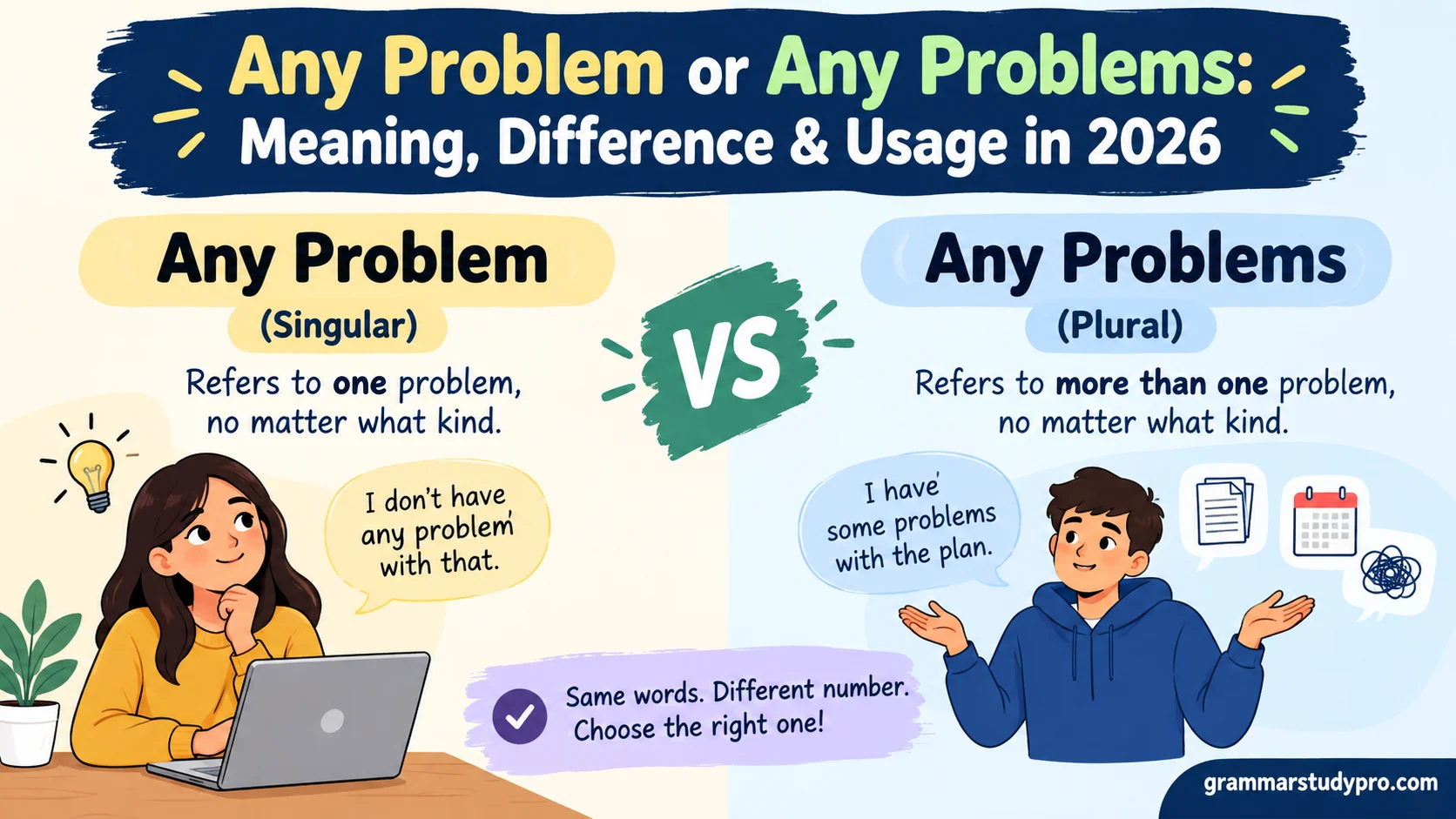
Any Problem or Any Problems: any problem can describe one possible issue, while any problems can cover several issues in everyday speech. In the singular form, one specific concern, single difficulty, or one particular obstacle may arise. If you ask someone, “Is there any problem?” the phrase asks whether a problem exists. This use fits formal settings, business emails, and professional conversations, where a manager might say, “Let me know if you have any problem with the new system.” The focus remains on one, single, specific, or particular concern, even when the speaker expects no issues.
The plural form any problems changes the meaning, choice, agreement, emphasis, and tone by allowing an open-ended set of issues. It gives more breadth and can suggest a repeated possibility. The distinction depends on countability, plurality, and intent, especially in questions, negatives, offers, and conditional clauses. Real sentences and examples can show how parts of speech, number agreement, and modifier placement work. Short edits also reveal meaning shifts when the singular changes to plural. In context, the correct choice depends on the form or forms, while usage notes from American English and British English show how both can sound natural and precise in the right setting. The problems, number, sentence, sentences, modifier, placement, usage, idiomatic, and patterns help explain how each expression works.
Both forms are grammatically correct and sometimes interchangeable, but they do not always communicate the same idea. Any problem may describe a general issue, including the no matter which one sense of any, while any problems can mean more than one possible issue. The latter is a common choice in everyday questions and negative statements. The difference depends on how problem is functioning in the sentence, not a fixed rule that makes one form universally right-or-wrong. This is a matter of grammar and grammatical meaning. Possible, statements, everyday, general, and more than one help show why speakers select one form over another.
Quick Answer
“Any problem” uses the singular countable noun problem. It can refer to one possible issue, one unspecified problem, or a problem considered as a possibility.
“Any problems” uses the plural noun problems. It normally asks about one or more possible difficulties without specifying how many.
Here is the simplest comparison:
| Expression | Form | Typical meaning | Example |
| any problem | Singular | One possible issue or a singular focus | “Is there any problem with the report?” |
| any problems | Plural | One or more possible issues generally | “Are there any problems with the report?” |
For everyday questions about difficulties, “any problems” is often the more natural choice:
“Did you have any problems with the software?”
However, “any problem” is also correct in suitable contexts:
“If there is any problem, please contact us.”
The important point is this: don’t choose the form simply because you think one is formal and the other is informal. Look at the meaning and structure of the entire sentence.
Comparison Overview
The difference becomes much easier when you compare the two forms directly.
| Feature | Any Problem | Any Problems |
| Noun number | Singular | Plural |
| Noun type | Countable | Countable |
| Common focus | One possible issue | Problems generally |
| Typical question | “Is there any problem?” | “Are there any problems?” |
| Verb with “there” | Is / was | Are / were |
| Common conditional | “If there is any problem…” | “If there are any problems…” |
| Everyday general question | Possible but less common | Very common |
| Meaning “whichever one” | Yes | Can also occur with plural nouns |
| Example | “Choose any problem.” | “Report any problems.” |
One subtle point matters here.
Any does not automatically make a noun plural. English uses any in more than one way. In questions and negative sentences, it commonly introduces an indefinite quantity with plural countable nouns or uncountable nouns. But any can also mean “it doesn’t matter which”, and that use can appear with singular countable nouns.
For example:
“You can choose any problem from the list.”
Here, any problem means whichever single problem you want.
Compare that with:
“Did you encounter any problems?”
Here, any problems asks whether one or more difficulties occurred.
That distinction explains much of the confusion.
Main Differences Between Any Problem and Any Problems
Any Problem Refers to a Singular Possibility
In any problem, the noun problem remains singular.
The phrase can describe one possible issue without identifying exactly which issue it might be.
For example:
“If there is any problem with the payment, let us know.”
The sentence treats a problem as one possible condition that could occur.
Another example is:
“Is there any problem with this arrangement?”
The speaker is asking whether a problem exists with the arrangement. The singular form gives the question a narrower focus.
You can also use any problem when selecting one item from a group:
“Choose any problem from the exercise.”
This doesn’t mean “choose several problems.” It means choose whichever one problem you prefer.
That is an important use of any because it shows why the word cannot simply be labeled a “plural word.”
Any Problems Refers to Possible Difficulties Generally
Any problems uses the plural form.
It commonly appears when the speaker doesn’t know whether there are zero, one, or several difficulties.
For example:
“Did you have any problems during the trip?”
The question doesn’t assume a particular number. Maybe the person had one problem. Maybe they had five. Maybe everything went perfectly.
Another example:
“Are there any problems with the new website?”
Again, the speaker wants to know whether any difficulties exist at all.
This makes the plural form particularly useful for general troubleshooting, customer support, workplace communication, and everyday conversation.
The Difference Is More Than Just Adding “S”
It can be tempting to think the distinction is simply:
problem = one
problems = more than one
That is true at the noun level, but it doesn’t fully explain how any works.
The word any can leave the quantity open.
Consider:
“Do you have any problems?”
The speaker doesn’t know whether the answer is zero, one, or several.
That is why the plural form works so naturally when discussing difficulties generally.
Now consider:
“Choose any problem.”
Here, any means whichever one you choose.
The sentence is not asking how many problems exist. It asks you to select one unrestricted member from a group.
What Does “Any Problem” Mean?
“Any Problem” in Questions
You can use any problem in questions when the singular framing fits the context.
For example:
“Is there any problem with the installation?”
The speaker is checking whether there is a problem with a particular installation.
However, everyday English often uses the plural version when the question is broader:
“Are there any problems with the installation?”
The second sentence sounds like an open invitation to identify any difficulties.
Neither sentence should be judged solely by whether it is “formal” or “informal.” The intended focus matters.
“Any Problem” in Conditional Sentences
The singular form works naturally in conditional constructions:
“If there is any problem, call me.”
The structure is straightforward:
if + there is + any + singular noun
You can also say:
“If any problem arises, contact the support team.”
This version sounds concise and somewhat structured.
The meaning is that if a problem of any kind arises, the reader should take the specified action.
“Any Problem” Meaning “Whichever One”
This is another important use.
“You can choose any problem from the list.”
Here, any has a different meaning from the one found in:
“Did you have any problems?”
In the first sentence, any means something close to “whichever one”.
English grammar references distinguish this unrestricted-choice use from the use of any for indefinite quantities.
That is why singular countable nouns can appear naturally after any in sentences such as:
“Any student can answer this question.”
“You can select any option.”
“Choose any problem.”
The meaning isn’t “an unknown number of students.” It means any individual member of the group.
What Does “Any Problems” Mean?
“Any Problems” in Questions
The plural form is extremely common when asking whether difficulties exist.
For example:
“Did you have any problems finding the hotel?”
“Are there any problems with your account?”
“Do you have any problems using the application?”
These questions leave the number open.
The answer could be:
“No, I didn’t have any problems.”
Or:
“Yes, I had one problem.”
Or:
“Yes, I had several problems.”
That flexibility makes the plural construction particularly useful.
“Any Problems” in Negative Sentences
Plural problems frequently appears after any in negative sentences:
“We didn’t have any problems.”
“She hasn’t reported any problems.”
“The technician didn’t find any problems.”
Here, any problems means no problems of the relevant kind.
Compare:
“We didn’t encounter any problems.”
with:
“We encountered no problems.”
The meanings are essentially equivalent, although the second version places slightly stronger emphasis on the complete absence of problems.
“Any Problems” in Everyday Speech
If someone asks:
“Any problems?”
they usually mean:
“Are there any problems?”
It’s a shortened conversational question.
For example, after helping someone install software, a colleague might ask:
“Any problems?”
The expected answer could be:
“No, everything worked fine.”
This short form is natural in conversation because the surrounding context supplies the missing words.
Is “Is There Any Problem?” or “Are There Any Problems?” Correct?
Both can be correct.
The crucial issue is subject-verb agreement.
With singular problem:
Is there any problem?
With plural problems:
Are there any problems?
The common mistake is mixing the two:
❌ “Is there any problems?”
The problem here isn’t any. The problem is the mismatch between is and plural problems.
Use:
✅ “Are there any problems?”
Likewise, don’t write:
❌ “Are there any problem?”
Use:
✅ “Is there any problem?”
A useful way to remember this is to look at the noun:
problem → is
problems → are
“Is There Any Problem?” in Context
Imagine a manager reviewing one particular decision:
“Is there any problem with the deadline?”
The singular form can focus attention on whether there is an objection or issue with that specific matter.
Now imagine a software tester reviewing an entire application:
“Are there any problems with the new version?”
The plural form naturally invites the tester to identify any difficulties found during testing.
The difference is subtle. That’s exactly why context matters.
“Do You Have Any Problem?” vs. “Do You Have Any Problems?”
This pair creates another common grammar question.
Do You Have Any Problems?
This is the natural general-purpose question in many situations.
“Do you have any problems with the new system?”
It asks about difficulties generally.
It can also be used in everyday conversation:
“Do you have any problems understanding the instructions?”
“Do you have any problems with your order?”
The listener can mention one problem, several problems, or none.
Do You Have Any Problem?
This sentence is possible in particular contexts, but it is generally less natural as a broad everyday question.
For example:
“Do you have any problem with my decision?”
Here, the singular can give the sentence a more specific focus. It may mean something like:
“Do you have any objection to this particular decision?”
That is different from asking someone about all the difficulties they might be experiencing.
For general troubleshooting, “Do you have any problems?” is usually the safer and more natural choice.
“If There Is Any Problem” vs. “If There Are Any Problems”
Both structures are useful.
If There Is Any Problem
Use the singular form when problem is singular:
“If there is any problem, please call me.”
The structure is:
if + there is + any + singular noun
You can also say:
“If there is any problem with your order, contact customer service.”
If There Are Any Problems
Use the plural form with problems:
“If there are any problems, please call me.”
The structure is:
if + there are + any + plural noun
This version is particularly natural when you mean any difficulties that might occur.
For example:
“If there are any problems during installation, restart the device and contact support.”
What You Should Never Mix
Avoid:
❌ “If there is any problems…”
The noun is plural, so the verb needs to be plural too.
Correct:
✅ “If there are any problems…”
Or change the noun to singular:
✅ “If there is any problem…”
The same principle applies throughout English.
Any Problem vs. Any Problems in Negative Sentences
Negative sentences often favor plural countable nouns with any.
Compare:
“I don’t have any problems.”
“We didn’t experience any problems.”
“She hasn’t reported any problems.”
These sentences describe the absence of difficulties generally.
You can sometimes encounter singular any problem in negative constructions, particularly when the sentence focuses on one possible issue:
“The change shouldn’t cause any problem.”
But in ordinary modern usage, “The change shouldn’t cause any problems” is often the more natural choice when the writer means difficulties generally.
This is one reason the plural form appears so frequently in practical English.
Any Problem vs. Any Problems in Workplace English
Workplace communication provides a perfect test because both forms appear naturally.
Customer Support
“Please let us know if you experience any problems with your order.”
The plural form works well because the company is inviting customers to report any difficulties.
Technical Instructions
“If there is any problem during installation, restart the device.”
The singular form frames a problem as one possible event.
Another natural option is:
“If there are any problems during installation, restart the device.”
The plural version casts a wider net.
Project Management
“Are there any problems we need to address before launch?”
This is a broad question.
It doesn’t assume how many problems might exist.
Meetings
A manager might ask:
“Any problems with the proposal?”
This is a conversational shortened form of:
“Are there any problems with the proposal?”
The plural version works well because the manager wants to hear about possible concerns generally.
Any Problem vs. Any Problems in Everyday Conversation
Natural conversation tends to favor expressions that leave room for an open answer.
For example:
“Any problems so far?”
“Did you have any problems?”
“Are there any problems?”
These forms don’t force the listener to think about a specific single problem.
Still, singular any problem isn’t automatically unnatural.
Consider:
“Is there any problem with that?”
This can sound perfectly natural when the speaker is asking about one particular situation or decision.
Tone also matters.
Compare:
“Is there any problem with my suggestion?”
with:
“Are there any problems with my suggestion?”
The first can sound like a focused check for an objection. The second invites a broader list of concerns.
Neither sentence carries exactly the same conversational implication.
Any Problem vs. Any Problems in Formal Writing
One common mistake is to claim that any problem is formal while any problems is informal.
That’s too simplistic.
Both forms can appear in professional writing.
For example:
“Please report any problems immediately.”
That’s completely appropriate in a formal notice.
Likewise:
“Should any problem arise, contact the administrator.”
That is also appropriate in formal writing.
The difference comes primarily from meaning and construction, not from a fixed formal/informal rule.
In fact, the plural phrase can be especially useful in professional documents because it clearly covers an unspecified number of possible difficulties.
Common Mistakes With Any Problem and Any Problems
| Incorrect or awkward sentence | Better sentence | Why |
| “Is there any problems?” | “Are there any problems?” | Plural noun needs plural verb |
| “Are there any problem?” | “Is there any problem?” | Singular noun needs singular verb |
| “If there are any problem…” | “If there are any problems…” | Are requires the plural noun |
| “Do you have any problems?” | Correct | Natural general question |
| “Did you have any problem?” | “Did you have any problems?” | Plural is usually more natural for general difficulties |
| “Choose any problems.” | “Choose any problem.” | Singular fits choosing one item |
| “If any problem, call me.” | “If there is any problem, call me.” | The full conditional needs a grammatical clause |
The last example deserves special attention.
You may see phrases such as:
“If any problem, contact us.”
They sometimes appear in informal workplace messages or non-native English. However, “If there is any problem, contact us” or “If there are any problems, contact us” is clearer standard English.
Any Problem vs. Any Problems: Real-World Examples
Software
Singular:
“If there is any problem with the installation, restart the computer.”
Plural:
“If you experience any problems during installation, contact support.”
The first presents a possible problem as a condition. The second invites the user to report any difficulties.
Travel
Singular:
“If there is any problem with your reservation, contact the hotel.”
Plural:
“Did you have any problems during your trip?”
The second question naturally covers the whole travel experience.
Education
Singular:
“Choose any problem from the worksheet.”
One problem must be selected.
Plural:
“Did you have any problems with the assignment?”
The teacher is asking about difficulties generally.
Customer Service
Singular:
“Is there any problem with the replacement item?”
The focus is a specific item or situation.
Plural:
“Are there any problems with your order?”
The question invites the customer to identify any concerns.
Any Problem vs. Any Problems vs. No Problem vs. No Problems
These expressions are closely related but shouldn’t be treated as identical.
| Expression | Example | Main idea |
| any problem | “Is there any problem?” | One possible issue |
| any problems | “Are there any problems?” | Possible difficulties generally |
| no problem | “There is no problem.” | No single problem exists |
| no problems | “There are no problems.” | No problems exist generally |
There’s also the familiar expression:
“No problem.”
In everyday English, this often means “You’re welcome” or “That’s fine.”
For example:
“Could you send me the file?”
“No problem.”
Here, no problem functions as a conversational expression rather than simply describing the number of problems.
Any Problem vs. Any Issue
The word issue often overlaps with problem, especially in workplace English.
Compare:
“Are there any problems with the report?”
and:
“Are there any issues with the report?”
Both can ask whether something needs attention.
However, issue can sound somewhat more neutral or diplomatic in professional settings.
For example:
“Please let me know if you encounter any issues.”
This wording doesn’t necessarily suggest that something has gone seriously wrong.
Still, the grammatical pattern remains similar:
- any problem
- any problems
- any issue
- any issues
The noun’s number still determines whether the sentence uses singular or plural agreement.
A Simple Way to Choose the Correct Form
When you’re unsure, ask yourself one question:
Am I talking about one possible problem or possible problems generally?
If the focus is one possible issue:
“any problem”
If you’re asking broadly about difficulties:
“any problems”
For example:
“Is there any problem with the payment?”
versus:
“Are there any problems with the payment?”
Both can work. The second simply gives the listener more room to report multiple issues.
There is one more useful test.
If you’re choosing one unrestricted item, singular any often works naturally:
“Choose any problem.”
“Pick any question.”
“Select any option.”
Here, any means whichever one you want.
Quick Decision Guide
Think of the choice this way:
- One possible issue: any problem
- One unrestricted item from a group: any problem
- Possible difficulties generally: any problems
- General question about difficulties: any problems
- Singular noun: use is or was where appropriate
- Plural noun: use are or were where appropriate
The most important lesson is simple:
Don’t let the word “any” make you forget the noun’s number.
Practice Quiz: Any Problem or Any Problems?
Choose the form that best fits each sentence.
Question One
“Are there ___ with the new system?”
- A. any problem
- B. any problems
Answer: B — any problems
The question asks generally about possible difficulties.
Question Two
“If there is ___ with your payment, contact us.”
- A. any problem
- B. any problems
Answer: A — any problem
The structure uses singular there is with singular problem.
Question Three
“Choose ___ from the list.”
- A. any problem
- B. any problems
Answer: A — any problem
The sentence asks the reader to select one unrestricted item.
Question Four
“Did you have ___ during the installation?”
- A. any problem
- B. any problems
Answer: B — any problems
This is a broad question about possible difficulties.
Question Five
“Please let us know if there are ___.”
- A. any problem
- B. any problems
Answer: B — any problems
The plural verb are pairs with plural problems.
Question Six
“Is there ___ with the proposal?”
- A. any problem
- B. any problems
Answer: A — any problem
The sentence uses singular is and singular problem.
FAQs
Is “any problem” grammatically correct?
Yes, “any problem” is grammatically correct. It usually refers to one possible or general issue. For example, “Is there any problem with the new system?” asks whether a problem exists.
Is “any problems” grammatically correct?
Yes, “any problems” is also correct. It usually refers to multiple possible issues. For example, “Are there any problems with the new system?” asks about several possible difficulties.
What is the difference between “any problem” and “any problems”?
“Any problem” uses the singular form and focuses on one possible issue. “Any problems” uses the plural form and allows for more than one issue. The choice depends on the meaning and context.
Which is more common: “any problem” or “any problems”?
Both are used in English, but “any problems” is often natural in everyday questions when someone wants to know whether several issues exist. “Any problem” can work when the focus is on one general or specific concern.
Can “any problem” and “any problems” be interchangeable?
Sometimes, yes, but not always. The singular and plural forms can create a slightly different meaning. Consider whether you are referring to one possible issue or more than one possible issue before choosing the form.
Conclusion
“Any problem” and “any problems” are both grammatically correct. The main difference is number and meaning: the singular form focuses on one possible issue, while the plural form refers to multiple possible issues. Understanding the context, intent, and number of problems being discussed makes the correct choice much easier.